

Fluoropolymers Films Market Market Size and Trends
Fluoropolymers Films Market is estimated to be valued at USD 2.44 Bn in 2026 and is expected to reach USD 3.79 Bn in 2033, exhibiting a compound annual growth rate (CAGR) of 6.5% from 2026 to 2033.
Key Takeaways
- Based on Product Type, the Polytetrafluoroethylene (PTFE) segment leads the market with highest share in 2026, due to its superior chemical resistance property.
- Based on End Use, the Packaging segment, holding an estimated share of 29.7% in 2026, leads the market, due to its broad utility in various industries.
- Based on Region, Asia Pacific leads the market holding 38. 00% share in 2026. While, Europe is anticipated to be the fastest-growing region during forecast period.
Market Overview
Fluoropolymer films consist of fluorine and carbon molecules and are high-performance polymer films. These films are widely used across high-temperature applications and extremely harsh chemical conditions. They are highly resistant to chemicals, and moisture, offer non-stick performance, and have optical transparency. These films are used for cable insulation, composite mold release, roll covers, pharmaceutical liners, anti-corrosive linings, adhesives, photovoltaic cells, microphone membranes, surface coverings, airbags, anti-graffiti coverings, and fuel hoses. Moreover, they are also used across the pharmaceutical industry as blister packaging materials.
Current Events and their Impact on the Fluoropolymers Films Market
Current Events | Description and its Impact |
EU Regulatory Restrictions on PFAS Including Fluoropolymers |
|
Energy Market Volatility Affecting Production |
|
End User Feedback and Unmet Needs
Cost Efficiency
One of the most frequently cited concerns among end users is the high cost of fluoropolymer films, particularly PTFE and FEP variants. While their performance is undisputed, budget constraints in certain applications—especially in price-sensitive markets like packaging and consumer electronics—limit broader adoption. Users consistently express a desire for cost-effective alternatives or composite solutions that can deliver similar performance at a lower price point.
Processing Challenges
End users report that the complex processing requirements of fluoropolymer films—such as high-temperature extrusion and specialized surface treatments—can increase production costs and limit manufacturing flexibility. There is a growing demand for improved processability, including films that are easier to thermoform, laminate, or bond with other materials without compromising performance.
Limited Film Thickness and Customization Options
Several users in niche segments such as advanced electronics and membrane technology highlight limitations in the availability of ultra-thin or highly customized film variants. These users require tighter tolerances, specific surface modifications, or multi-layer structures that are not always commercially available or economically viable at low volumes.
- Current Industry Events of 2026
- Market Size Estimation
- Regional Breakdown
- Competitive Landscape
- Customer Intelligence
- Segmental Analysis
- Pricing Analysis
- Key Market Drivers, Challenges & Future Trends
- Customized Insights Section
Segmental Insights
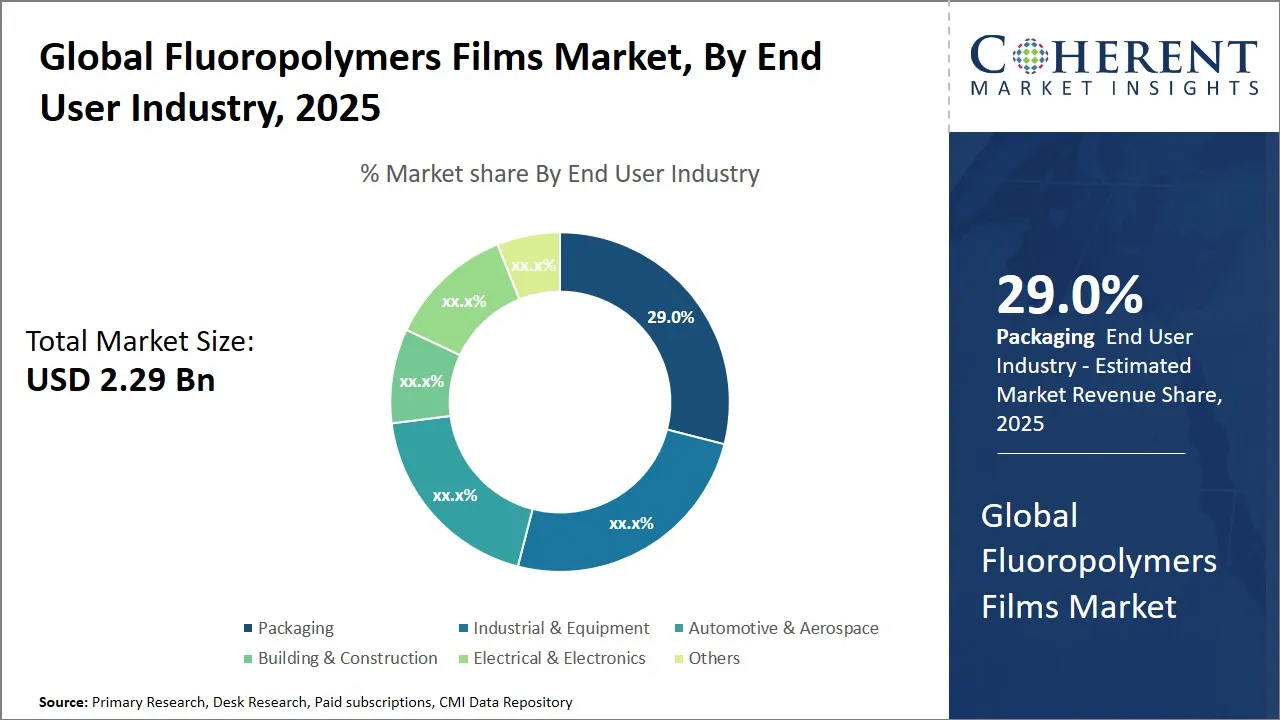
Fluoropolymers Films Market Insights, End User Industry
Packaging Holds the dominant market share
In terms of end use, the packaging segment is accounted for the largest market share of 29.7% in terms of revenue in 2026 owing to rising the need for packaging in various applications such as food, pharmaceuticals, and industrial packaging. In addition, they are appropriate for a variety of packaging applications due to their superior barrier, chemical resistance, and non-stick qualities. Fluoropolymer films offer an exceptional barrier properties, chemical resistance, and ability to withstand extreme temperatures, which are crucial for protecting sensitive products. They offer advantages like moisture and oxygen barrier, crucial for food preservation, and also find use in medical and pharmaceutical packaging where chemical inertness is paramount.
In March 2024, Arkema Group introduced a new line of partially fluorinated, recyclable fluoropolymer films specifically designed for food and consumer packaging in India. These innovative films offer superior barrier properties, chemical resistance, and mechanical durability—crucial for protecting food products, extending shelf life, and meeting stringent hygiene standards. Such product advancements are propelling the fluoropolymers market revenue.
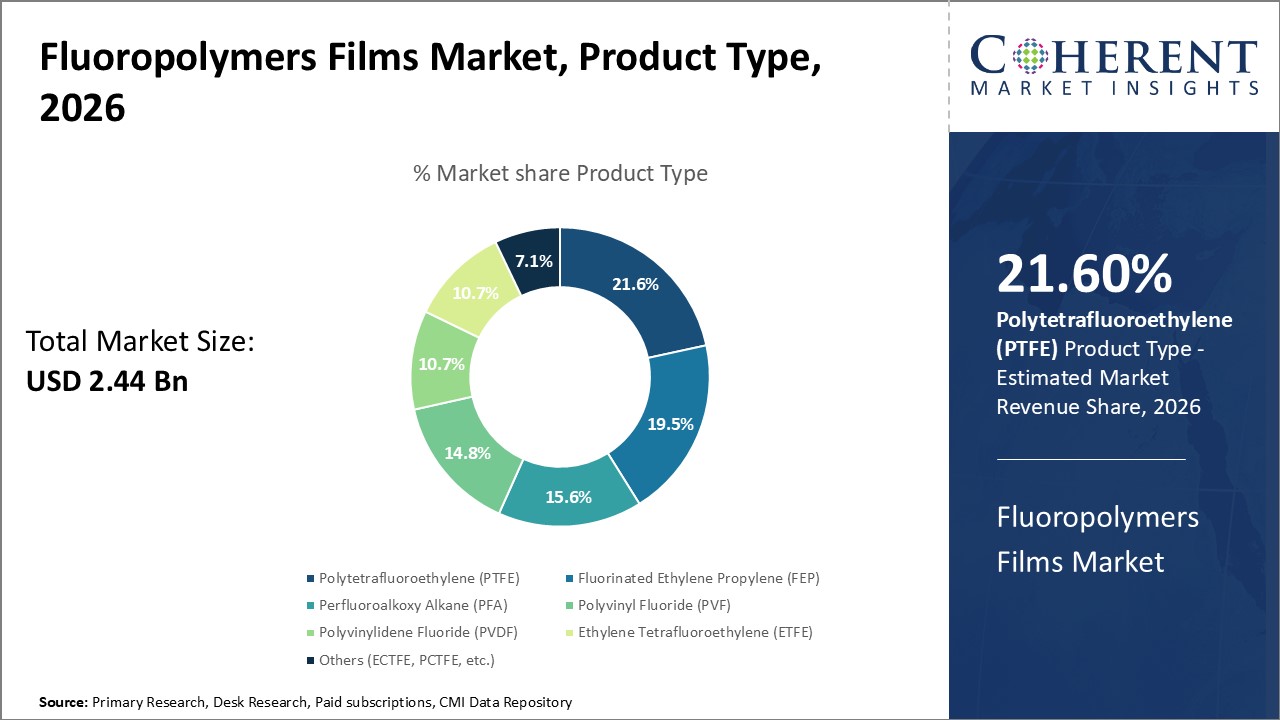
Fluoropolymers Films Market Insights, Product Type
Polytetrafluoroethylene (PTFE) Acquires the Largest Share owing to Superior Chemical Resistance
In terms of product type, the polytetrafluoroethylene (PTFE) segment is expected to contribute the highest share of the market in 2026, due to their superior chemical resistance, exceptional dielectric properties, non-stick surface, and stability across extreme temperatures, making them indispensable in electrical insulation, industrial equipment, and chemical processing. PTFE material is ideal for use in medical applications and for the production of internal and external life-saving equipment such as catheters, bio-containment vessels, syringes and sutures. This unique fluoropolymer is also perfect for electrical insulation and the protection of electronic components.
For instance, recent advancements in PTFE coatings are revolutionizing industrial applications by offering enhanced low-friction, non-stick properties while significantly reducing environmental impact. These next-generation formulations are increasingly used across sectors such as aerospace and water treatment, providing durable protection for filtration media and mechanical components. The new coatings’ chemical resistance and friction reduction extend the lifespan of elements like filters, valves, and pumps, decreasing replacement frequency and operational waste
Regional Insights
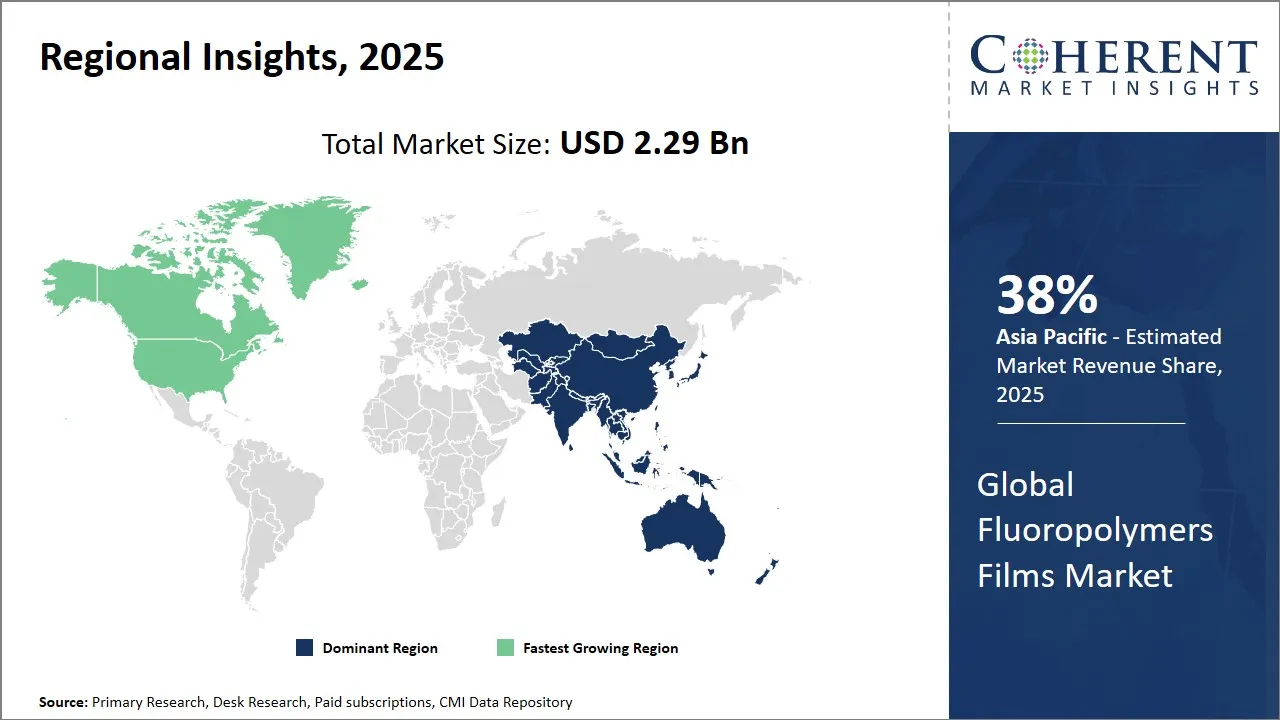
Asia Pacific Fluoropolymers Films Market Analysis & Trends
Asia Pacific dominated the global fluoropolymer films market in 2026 reporting 38% market share in terms of revenue, and is expected to maintain its dominance over the forecast period. The leading position of Asia Pacific is observed due to increased middle-class disposable income and an expanding market for electronic goods; it is projected that both demand and output for electronics in China would rise. As the market for electronics grows, it is anticipated that demand for fluorescent polymer sheets in the upcoming forecast period.
The residential and commercial growth in China during the last two years has contributed to the industry's overall rise in terms of volume and value. The Indian government has taken many steps to promote the growth of the domestic electronics manufacturing industry and exports from the country. The Modified Special Incentive Package Scheme (M-SIPS) allows for a 20–25% subsidy on the construction of an electronics manufacturing facility. There have been 212 projects funded, with projected investments worth US$ 6,74,81,73,670 Bn. The Indian Electronics and Semiconductor Association (IESA) and the Singaporean Semiconductor Industry Association (SSIA) have also signed an MoU to promote trade and technological collaboration between the two countries' electronics and semiconductor industries. This is projected to result in the development of several innovative semiconductor manufacturing technologies, which are anticipated to increase the fluoropolymers market size investigated in the prospective application sector for India.
Europe Fluoropolymers Films Market Analysis & Trends
Europe is expected to experience the fastest growth during the forecast period. The expansion is witnessed due to their exceptional properties, including chemical and thermal resistance, excellent dielectric properties, and low friction coefficients, making them suitable for a wide range of applications. Specifically, their use in the automotive and electronics industries, construction, and sustainable packaging are key drivers of the fluoropolymers market demand. The proliferation of data centers, semiconductor fabs, and consumer electronics production is driving substantial demand for these films. Europe’s fluoropolymer sector plays a pivotal role across major industries by delivering materials with exceptional chemical resistance, thermal stability, mechanical durability, and longevity. These specialized polymers underpin critical applications: they enable ultra-pure semiconductor processing, protect high-voltage electrical systems, enhance durability in transportation and aerospace, and support chemical plant operations.
In January 2026, Europe launched a coordinated lobbying campaign to safeguard its products amid mounting pressure on PFAS chemicals often dubbed “forever chemicals”. These materials, essential for non-stick coatings, semiconductors, medical devices, and more, are targeted under the European Chemicals Agency’s proposal to regulate the entire PFAS class. Industry groups, including Plastics Europe’s Fluoropolymers Product Group, are urging exemptions, citing critical applications and potential harm to innovation and green-transition goals.
Fluoropolymers Films Market Outlook Country-Wise
The United States Fluoropolymers Films Market Trends
The U.S. market for fluoropolymers films is driven by the stabilization of shale gas prices which has a significant cost advantage over their European counterparts, who continue to grapple with elevated energy prices driven by geopolitical tensions and reliance on imported gas. Fluoropolymer film production—especially PTFE and FEP, requires high energy inputs for polymerization and processing. Thanks to affordable shale-derived natural gas, U.S.-based producers can maintain lower operational costs and price competitiveness in global markets.
In July 2024, Alfa Chemistry broadened its product offerings by introducing high-performance fluoropolymer materials, including PTFE, PCTFE, and ETFE, as well as a range of fluoropolymer coatings. These cutting-edge materials deliver outstanding durability, chemical resistance, and superior performance, making them ideal for use in industries such as automotive, aerospace, electronics, and chemical processing, further proliferating the fluoropolymers films market share.
China Fluoropolymers Films Market Trends
The China market of fluoropolymers films is expanding due to PVDF's rising demand in EV batteries, semiconductors, and renewable energy components intensifies the pressure. As a result, PVDF manufacturers may either pass on higher costs to end-users or accelerate investment in recycling and rare-earth-free alternatives.
For instance, Chinese firm Fangya Weitou secured a patent for a novel polyimide/fluoropolymer composite insulation film tailored for aerospace applications.
Germany Fluoropolymers Films Market Trends
The fluoropolymers films market is growing in Germany as it is home to several manufacturers, including those from the equipment, material, component, engine, and full system integration industries. Germany is one of the top places for the production of airplane sectors. Additionally, Germany’s fluoropolymer film industry is pushing boundaries with nano-enhanced PTFE and PVDF films tailored for electric vehicle (EV) and lithium-ion battery applications. Spearheading this trend, major German automotive OEMs are integrating ultra-thin PVDF insulation films into battery modules, benefitting from increased dielectric strength, thermal stability, and chemical resistance, echoing broader Europe-wide adoption trends.
Market Report Scope
Fluoropolymers Films Market Report Coverage
| Report Coverage | Details | ||
|---|---|---|---|
| Base Year: | 2025 | Market Size in 2026: | USD 2.44 Bn |
| Historical Data for: | 2020 To 2024 | Forecast Period: | 2026 To 2033 |
| Forecast Period 2026 to 2033 CAGR: | 6.5% | 2033 Value Projection: | USD 3.79 Bn |
| Geographies covered: |
| ||
| Segments covered: |
| ||
| Companies covered: | The Chemours Company, Arkema Group, Solvay, Daikin Industries, Ltd., Asahi Glass Co., Ltd., 3M, Saint-Gobain, Polyflon Technology Limited, Dongyue Group Ltd., and Honeywell International Inc. | ||
| Growth Drivers: |
| ||
| Restraints & Challenges: |
| ||
Fluoropolymers Films Market Trends
- Increasing penetration of smartphones, tablets, and watches is expected to accelerate the fluoropolymer films market growth. The Polytetrafluoroethylene and polyvinylidene fluoride films are used in the production of smart devices such as phones, wearable devices, tablets, and other smart devices. Therefore, the growth of the market can also be attributed to the booming electrical &electronic industry around the globe.
Fluoropolymers Films Market Growth Drivers
The rising demand for blister packaging from the pharmaceutical industry
The rising demand for blister packaging from the pharmaceutical industry is projected to propel the growth of the global fluoropolymer film market. It is a cavity or pocket which is made up of thermoformed plastic. Blister packaging usually consists of the lidding seal of aluminum foil or plastic. Blister packaging is beneficial for protecting products from external factors such as moisture and preventing contamination. Hence, the rising demand for blister packaging from the pharmaceutical industry is propelling the growth of the fluoropolymer film market.
- Growing demand for fluoropolymer films across end user industries
Growing demand for fluoropolymer films across end user industries such as machines, electronics, automobiles, and semiconductors due to their excellent chemical and physical properties is accelerating market growth. Fluoropolymers have high strength over a wide range of temperature and excellent thermal stability which makes them high-performance polymer which has a wide range of application across various end user industries. Hence, the rising demand for product from the aforementioned industries is accelerating market growth.
Fluoropolymers Films Market Opportunities
- The rising demand for fluoropolymer films from the construction industry
The rising demand for fluoropolymer films market forecast from the construction industry is expected to propel the market growth over the forecast period. Fluoropolymer films are widely used to laminate various infrastructures in order to protect against extreme weather conditions, fading, and cracking. Therefore, the rising demand for fluoropolymer films from the construction industry is augmenting the market growth of fluoropolymer films over the forecast period.
- Growing demand for fluoropolymer films from the defense industry
Growing demand for fluoropolymer films from the defense industry is expected to augment the market growth in the near future. In the defense industry, it is used to package products due to its excellent technical properties such as non-yellowing chemistry, clarity UV stability, moisture barrier, and chemical inertness. All these properties are projected to boost the market growth of fluoropolymer films.
Recent Developments
- In February 2025, Cosmo Specialty Chemicals, a subsidiary of Cosmo First, launched a new line of water-based Oil and Grease Resistant (OGR) barrier coatings OGR 145B and OGR 145S for sustainable packaging applications. The non-heat sealable OGR 145B provides strong oil, grease, and water resistance ideal for food packaging, while the heat-sealable OGR 145S is tailored for paper cup production. Both coatings deliver zero VOC emissions, FDA-approved food-safe performance, and compatibility with gravure, flexo, and air-knife coating methods.
- In January 2025, At MD&M West, Zeus unveiled its StreamLiner™ NG, the latest innovation in film-cast PTFE catheter liners. With walls as thin as 0.001″ (0.025 mm), the StreamLiner NG delivers exceptional flexibility and mechanical strength, making it ideal for navigating complex vasculature such as below-the-knee and above-the-neck pathways. The proprietary film-cast process enhances consistency, significantly reducing defects and pinholes common in previous PTFE liners.
- In July 2024, Junkosha introduced its latest High‑Barrier PFA Tubing at SEMICON West, targeting semiconductor manufacturers seeking superior chemical resistance and gas barrier protection. The dual‑layer tubing—comprising high-purity PFA inside and barrier fluoropolymer outside—is optimized for wet-processing environments in advanced fabrication facilities. It resists strong acids, alkalis, and solvents while minimizing gas permeation and fluid contamination.
- In April 2024, Rostec's Russian Research Center Applied Chemistry (GIPH) launched Russia's first production of wide (up to 1.6 meters) fluoropolymer films. The material, called NEVAFLON, is described as environmentally friendly and multifunctional. It is intended for use in various applications, including construction, solar cell protection, electronics, and medicine. The film is highly durable, with a lifespan of over 30 years, and is 100% recyclable.
Analyst Opinion (Expert Opinion)
The fluoropolymer films market value stands at a pivotal juncture, transitioning from traditional durability-driven applications to high-value, innovation-centric sectors.
A clear inflection point is the emergence of high-frequency 5G and 6G devices. PTFE (Polytetrafluoroethylene) and FEP (Fluorinated Ethylene Propylene) films, with their ultra-low dielectric constants (<2.1) and negligible signal loss, are increasingly used in base station radomes, antenna substrates, and semiconductor processing. Consider this: in high-speed data applications, even a 0.2 variation in dielectric loss can critically impair system performance. Fluoropolymer films eliminate that risk—no other film class matches this consistency under thermal and RF stress.
Another strategic axis is EV battery insulation and safety. With thermal runaway events under intense regulatory scrutiny (see recent recalls by Hyundai and GM), demand for PFA and ETFE films due to their 200°C+ thermal stability and high voltage resistance (>100 kV/mm) is accelerating. Tesla’s transition to dry electrode coatings has further highlighted the need for chemically inert release liners again, a space dominated by fluoropolymers.
Critically, ESG-driven materials substitution efforts have failed to dislodge fluoropolymers from high-end markets. Bio-based alternatives simply cannot replicate the gas impermeability, weatherability, or UV resistance necessary for applications like aerospace insulation, photovoltaic front sheets, and critical lab environments. The 25+ year field reliability of PVDF-based backsheets in solar modules remains unmatched, especially in desert or coastal climates.
Yet, the market faces a regulatory paradox. On one hand, EU’s PFAS regulations threaten to classify certain long-chain fluoropolymers under restriction. On the other, exemptions for "essential uses"—like medical devices, semiconductors, and aerospace—highlight the systemic dependency. It is telling that even REACH regulatory drafts exclude high-purity, high-molecular-weight fluoropolymers used in Class III devices.
Daikin’s investment in closed-loop FEP recovery and Chemours' advances in low-global warming potential (GWP) processing solvents demonstrate that cost alone is not the battleground—control over purity and compliance is. OEMs in electronics and energy storage are already demanding cradle-to-grave traceability for film materials, a capability that few players outside the top five possess.
Speak to the analyst
Want personalized insights?
Take the findings above to one of our principal consultants, or have the report rebuilt around the segments, geographies and competitors you actually track.
Market Segmentation
- Global Fluoropolymer Films Market, By Product Type (Revenue, USD Bn, 2021 - 2033)
- Polytetrafluoroethylene (PTFE)
- Fluorinated Ethylene Propylene (FEP)
- Perfluoroalkoxy Alkane (PFA)
- Polyvinyl Fluoride (PVF)
- Polyvinylidene Fluoride (PVDF)
- Ethylene Tetrafluoroethylene (ETFE)
- Others (ECTFE, PCTFE, etc.)
- Global Fluoropolymer Films Market, By End Use (Revenue, USD Bn, 2021 - 2033)
- Automotive and Aerospace
- Electrical and Electronics
- Industrial and Equipment
- Packaging
- Building and Construction
- Others
- Global Fluoropolymer Films Market, By Region (Revenue, USD Bn, 2021 - 2033)
- North America
- U.S.
- Canada
- Latin America
- Brazil
- Argentina
- Mexico
- Rest of Latin America
- Europe
- Germany
- U.K.
- Spain
- France
- Italy
- Russia
- Rest of Europe
- Asia Pacific
- China
- India
- Japan
- Australia
- South Korea
- ASEAN
- Rest of Asia Pacific
- Middle East
- GCC Countries
- Israel
- Rest of Middle East
- Africa
- South Africa
- North Africa
- Central Africa
- North America
- Key Players
- The Chemours Company
- Arkema Group
- Solvay
- Daikin Industries, Ltd.
- Asahi Glass Co., Ltd.
- 3M
- Saint-Gobain
- Polyflon Technology Limited
- Dongyue Group Ltd.
- Honeywell International Inc.
Sources
Primary Research Interviews from the following stakeholders
Stakeholders
Interviews with fluoropolymer film manufacturers, specialty chemical processors, flexible packaging converters, electronics material engineers, cleanroom infrastructure consultants, procurement and R&D heads across global markets.
Specific stakeholders
- Product development leads at electronics companies
- Procurement and process heads at semiconductor fabs and cleanroom OEMs
- R&D specialists at pharmaceutical packaging firms
- Operations managers at solar PV panel manufacturers
- Quality assurance managers at food packaging units
- Materials engineers at aerospace and defense contractors
Databases
- World Trade Organization (WTO) Trade Statistics
- UN Comtrade Database
- Ministry of Chemicals and Fertilizers (India)
- U.S. International Trade Commission (USITC)
- Eurostat – Chemicals & Plastics Division
- China Customs Statistics
- Korea Trade Investment Promotion Agency (KOTRA)
- Japan External Trade Organization (JETRO)
- Directorate General of Commercial Intelligence and Statistics (DGCIS), India
Magazines
- Chemical Week
- Plastics News
- Modern Plastics India
- Semiconductor Digest
- Packaging World
- Cleanroom Technology
- Renewable Energy World
- Coatings World
- Advanced Materials & Processes
Journals
- Journal of Fluorine Chemistry (Elsevier)
- Polymer Degradation and Stability
- Journal of Applied Polymer Science
- Journal of Materials Chemistry A
- Progress in Organic Coatings
- IEEE Transactions on Components, Packaging and Manufacturing Technology
- Thin Solid Films
- Solar Energy Materials and Solar Cells
Newspapers
- The Wall Street Journal – Chemicals & Materials Section
- The Economic Times – Chemicals, Plastics & Materials
- The Hindu Business Line – Industrial and Manufacturing Reports
- Financial Times – Energy & Materials Markets
- Nikkei Asia – Electronics and Advanced Materials
- South China Morning Post – Industrial Technology & Trade
Associations
- American Chemical Society (ACS) – Division of Polymer Chemistry
- Society of Plastics Engineers (SPE)
- Fluoropolymer Division of PlasticsEurope
- International Solar Energy Society (ISES)
- Semiconductor Equipment and Materials International (SEMI)
- Indian Plastics Institute (IPI)
- Cleanroom Testing and Certification Board – India
- International Pharmaceutical Excipients Council (IPEC)
Public Domain Sources
- Ministry of Chemicals and Petrochemicals (India)
- Ministry of Economy, Trade and Industry (METI), Japan
- U.S. Environmental Protection Agency (EPA) – Fluorochemical Guidelines
- National Renewable Energy Laboratory (NREL), U.S.
- Central Pollution Control Board (India) – Fluorinated Chemicals Reports
- India Investment Grid – Chemicals & Materials Sector
- EU REACH Chemicals Database
- Reserve Bank of India (RBI) – Industry and Materials Sector Reports
Proprietary Elements
- CMI Data Analytics Tool, and Proprietary CMI Existing Repository of information for last 8 years
Get access to 250+ pages report
Every segment, forecast, competitor profile and data table behind the analysis above — available for instant download.
- ESOMAR Member
- ISO 9001:2015 Certified
- D-U-N-S Registered
- GDPR & CCPA Compliant
Missing comfort of reading report in your local language? Find your preferred language:
Transform your Strategy with Exclusive Trending Reports
Frequently Asked Questions
The Fluoropolymers Films Market is estimated to be valued at USD 2.44 Bn in 2026, and is expected to reach USD 3.79 Bn by 2033.
Global Fluoropolymers Films market is estimated to reach USD 3.1 Bn by 2033.
Major players operating in the global Fluoropolymers Films market include The Chemours Company, Arkema Group, Solvay, Daikin Industries, Ltd., Asahi Glass Co., Ltd., 3M, Saint-Gobain, Polyflon Technology Limited, Dongyue Group Ltd., and Honeywell International Inc.
The complex manufacturing process of fluoropolymer films and fluctuating prices of raw materials used to produce fluoropolymer film are the major factors that are expected to hamper the growth of the market over the forecast period.
The rising demand for blister packaging from the pharmaceutical industry and the growing demand for fluoropolymer films across end user industries are some of the major factors that are expected to propel the growth of the market over the forecast period.
The CAGR of the Fluoropolymers Films Market is projected to be 6.5% from 2026 to 2033.
Among region, Asia Pacific is expected to hold dominant position in the market over the forecast period.