

Global HDI PCB Market Size and Forecast – 2026-2033
The Global HDI PCB Market is estimated to be valued at USD 21.26 Bn in 2026 and is expected to reach USD 37.62 Bn by 2033, exhibiting a compound annual growth rate (CAGR) of 8.5% from 2026 to 2033.
Key Takeaways of the HDI PCB Market
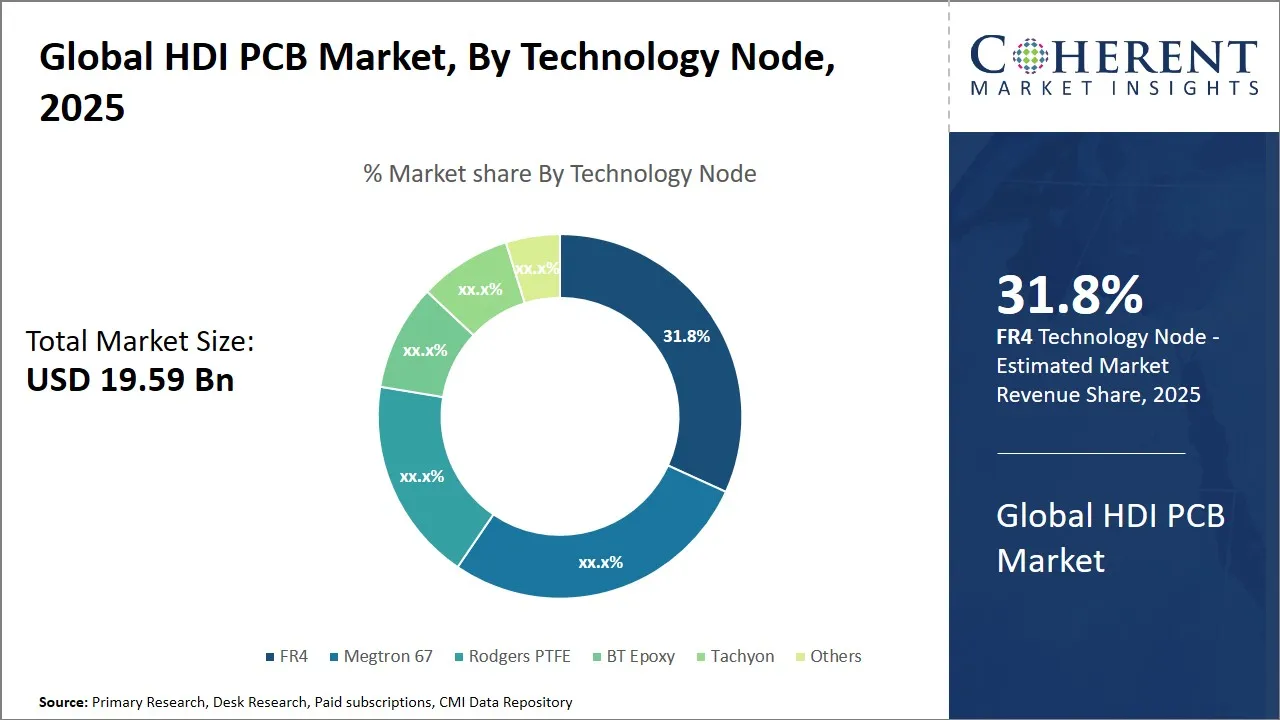
- The FR4 segment leads the market holding an estimated share of 32.8 % in 2026.
- The Smartphones and Mobile Devices segment leads the market holding an estimated share of 30.3 % in 2026.
- Asia Pacific is estimated to lead the market with a share of 76.9 % in 2026.
- Europe, holding a share of 6.4 % in 2026, is projected to be the fastest growing region.
Market Overview
The market trend for high-density interconnect printed circuit board (HDI PCBs) is characterized by a rapid shift towards more compact, lightweight, and high-performance electronic devices. Innovations, such as the integration of embedded components and advanced materials, are improving circuit density and reliability. Also, this growth is fueled by applications in automotive electronics, telecommunications, and consumer electronics.
Current Events and Its Impact
Current Events | Description and Impact |
Geopolitical and Trade Developments |
|
Economic and Infrastructure Trends |
|
Technological Shifts |
|
Environmental & Regulatory Changes |
|
Segmental Insights
- Current Industry Events of 2026
- Market Size Estimation
- Regional Breakdown
- Competitive Landscape
- Customer Intelligence
- Segmental Analysis
- Pricing Analysis
- Key Market Drivers, Challenges & Future Trends
- Customized Insights Section
Global HDI PCB Market Insights, by Technology Node - FR4 Leads Due to its Cost-Effectiveness and Versatile Performance
The FR4 segment, holding an estimated share of 32.8% in 2026, dominates the global HDI PCB market. FR4, a composite material made of woven fiberglass cloth with an epoxy resin binder, offers a balance of electrical, mechanical, and thermal properties, making it a suitable choice for manufacturers for many applications. FR4 provides a more economical solution without compromising on essential performance parameters. Also, FR4 is versatile, and it delivers reliable electrical insulation and mechanical stability in different operating environments.
Its widespread industry familiarity and availability also adds greatly to the FR4 segment’s market share. Most PCB manufacturers have optimized their processes around FR4, using mature fabrication techniques and existing supply chains that ensure consistent quality and lead times. While alternatives like Megtron 6/7 or Rodgers PTFE can offer superior high-frequency or high-speed performance, many applications do not require such specialized features.
Unimicron, one of the world’s largest PCB manufacturers, uses advanced FR4 materials across its HDI product lines. In its 2024 investor report, the company emphasized FR4’s role in delivering cost-effective and reliable performance in many consumer electronics, including wearables, smartphones, and IoT devices.
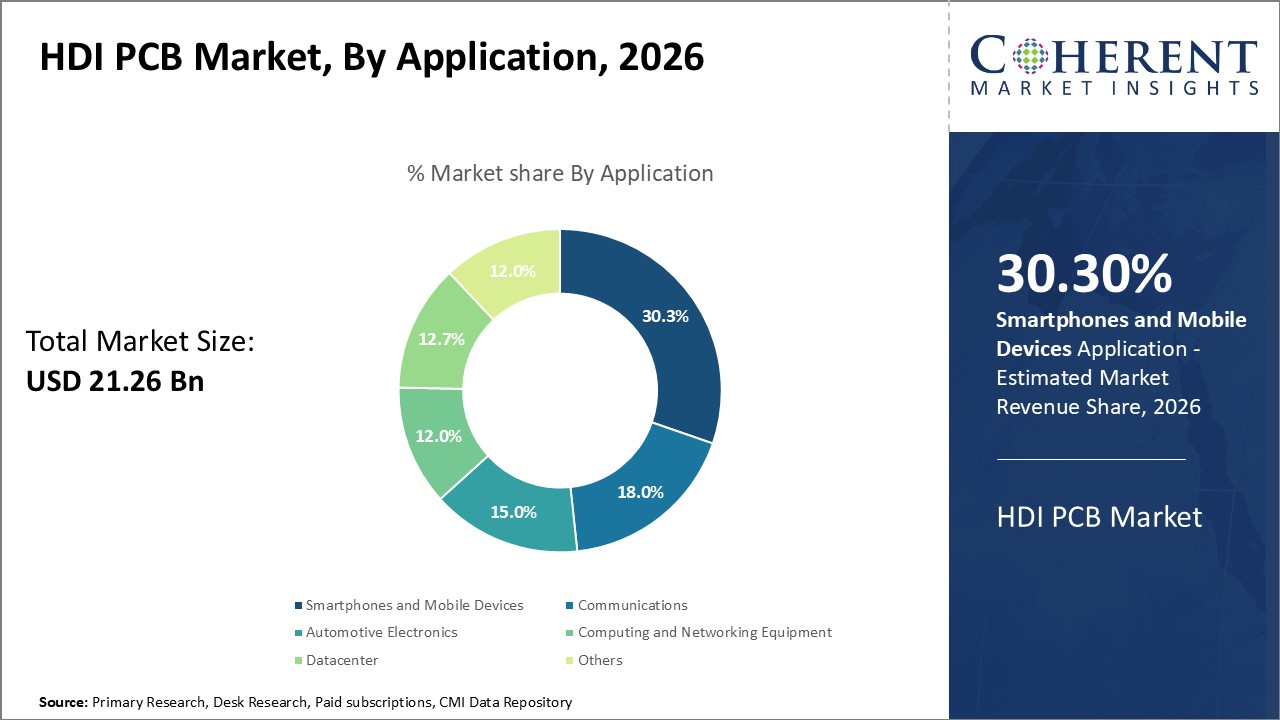
Global HDI PCB Market Insights, by Application - Smartphones and Mobile Devices Lead Driven by Miniaturization and Increasing Functionality
Smartphones and mobile devices, holding a projected share of 30.3%, constitute the largest application segment in the global HDI PCB market. As smartphone designs evolve, manufacturers are required to cram more components into increasingly smaller form factors, pushing the limitations of conventional PCB technology. HDI PCBs enable this by incorporating microvias, blind and buried vias, and fine lines, dramatically increasing the interconnect density while reducing the overall footprint.
Apple’s iPhone 14 and 15 models utilize HDI PCBs with stacked microvia technology to support their ultra-compact designs and high-performance functionality. Suppliers like Zhen Ding Tech and Compeq Manufacturing (Taiwan) have provided high-layer-count HDI boards using FR4 for non-RF modules, while premium materials were reserved for RF-specific layers.
Moreover, the proliferation of 5G technology and advanced communication protocols in smartphones demands PCBs capable of supporting higher signal integrity and faster data transmission. HDI technology meets these stringent electrical performance requirements, ensuring stable and efficient operation of high-frequency, high-speed circuits essential for enhanced mobile experiences.
Additionally, the rising integration of multiple functionalities—such as high-resolution cameras, biometric sensors, augmented reality components, and power management modules—in a single device leads to complex multilayer PCB designs. HDI PCBs facilitate multi-layer stacking and complex routing, enabling the seamless integration of these features without significantly increasing device size or weight.
Impact of AI on the HDI PCB Market
The impact of Artificial Intelligence (AI) on the HDI PCB market is becoming increasingly profound, particularly in the areas of design automation, defect detection, and production optimization. AI algorithms are enabling faster and more accurate PCB layout and routing processes by predicting optimal paths, minimizing signal interference, and reducing layer count—leading to smaller, more efficient boards.
For instance, tools like Cadence Cerebrus AI are already being used in PCB design to automate and optimize electronic layouts for complex boards, including HDI PCBs used in smartphones and high-performance computing systems. These intelligent design systems not only reduce time-to-market but also minimize material usage and improve signal integrity, which are critical factors for HDI applications.
Regional Insights
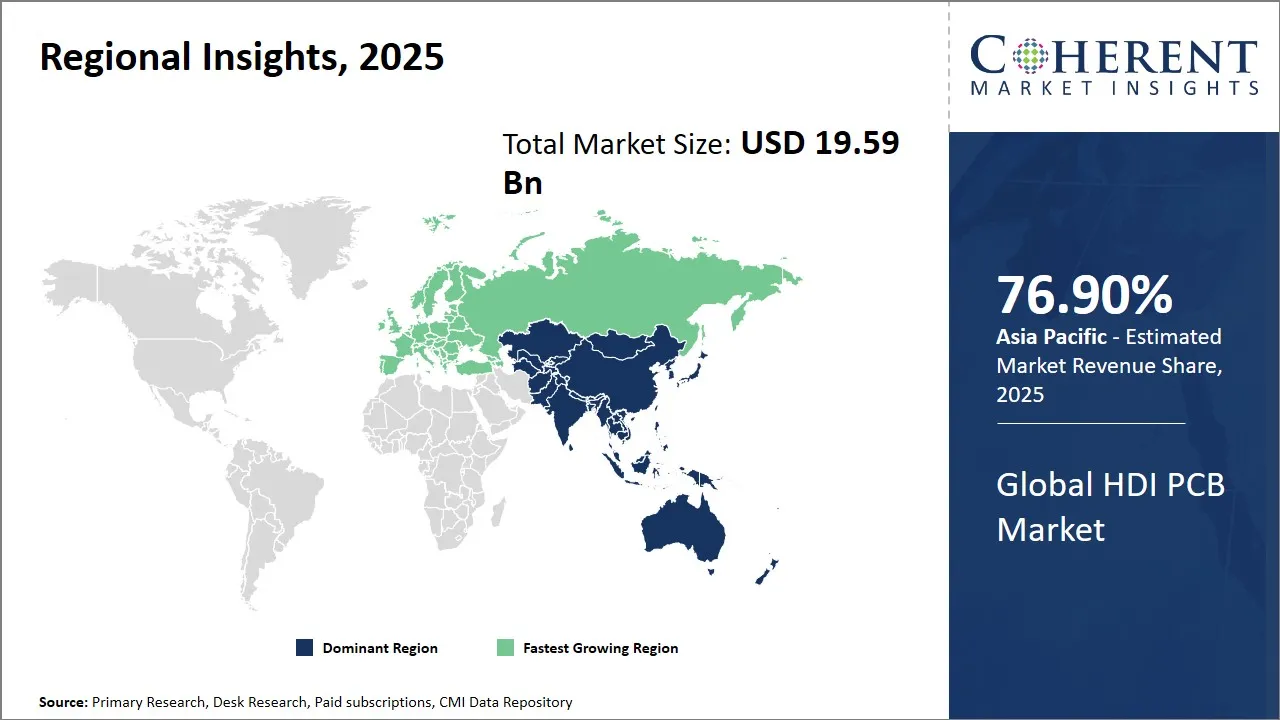
Asia Pacific HDI PCB Market Analysis and Trends
Asia Pacific region, holding an estimated share of 76.9% in 2026, dominates the global HDI PCB market is primarily driven by a robust manufacturing ecosystem, advanced technological adoption, and strong government support. Countries like China, Japan, South Korea, and Taiwan host a large concentration of PCB manufacturers and electronic device producers, making the region the hub for HDI PCB production.
The availability of skilled labor, well-established supply chains, and proximity to key end-use industries such as consumer electronics, automotive, telecommunications, and industrial electronics enhance the region’s leadership position. Government policies promoting digitalization, “Make in” initiatives, and investment in R&D further bolster the market. Major players like Unimicron (Taiwan), Zhen Ding Technology (China), Ibiden (Japan), and Samsung Electro-Mechanics (South Korea) actively contribute to innovation and production capacity, enabling Asia Pacific to maintain its dominance. Unimicron has pioneered Any-Layer Interconnect (ELIC) HDI PCBs that enable ultra-dense interconnection with improved signal performance and reduced board size.
Europe HDI PCB Market Analysis and Trends
Europe, holding an estimated share of 6.4% in 2026, exhibits the fastest growth in the HDI PCB market, driven by increasing demand across automotive, industrial automation, medical devices, and aerospace sectors. The region’s leadership in automotive innovation, particularly in electric vehicles (EVs) and advanced driver assistance systems (ADAS), is fueling the adoption of high-reliability, compact PCBs. Additionally, Europe's stringent environmental and quality regulations are pushing manufacturers to adopt sustainable materials and precision manufacturing processes.
The region benefits from a robust base of OEMs, research institutions, and advanced electronics manufacturers, particularly in countries like Germany, Austria, France, and the Nordic nations. Government-backed programs supporting digitization, green mobility, and localized semiconductor ecosystems further enhance HDI PCB demand. Companies like AT&S (Austria) and Schweizer Electronic AG (Germany) are leading the innovation curve with technologies such as embedded systems, any-layer HDI, and thermal management solutions tailored for high-stress environments. The growing integration of AI, IoT, and 5G across European industries ensures long-term demand for advanced HDI PCB capabilities. AT&S developed embedded component packaging technology within HDI PCBs, allowing passive and active components to be integrated directly into inner layers of the board.
Global HDI PCB Market Outlook for Key Countries
China HDI PCB Market Analysis and Trends
China is characterized by a vast manufacturing base and a significant supply chain network that feeds global demand for HDI PCBs. The country benefits from government policies aimed at strengthening domestic production capabilities and reducing reliance on imports. Companies such as Zhen Ding Technology and Shenzhen Fastprint Circuit Technology dominate with high automation levels and product diversification, catering to consumer electronics, 5G infrastructure, and automotive sectors. China's extensive export activities and focus on quality improvements are propelling it as a global supplier of HDI PCBs.
Japan HDI PCB Market Analysis and Trends
Japan HDI PCB market is supported by a mature electronics industry and well-established R&D facilities. Prominent firms like Ibiden and Meiko Electronics invest heavily in next-generation PCB technologies, including ultra-fine lines and embedded components. The government’s focus on fostering high-tech manufacturing and collaborations between academia and industry further strengthens Japan’s competitive edge, particularly in automotive electronics and precision instruments.
South Korea HDI PCB Market Analysis and Trends
South Korea’s HDI PCB market thrives on the back of its semiconductor and consumer electronics giants like Samsung Electro-Mechanics and LG Innotek, which are pivotal in driving technological advancements and scale production. Strategic investments in smart electronics, 5G, and electric vehicles create steady demand. Government programs targeting innovation and digital transformation accelerate product development and adoption, positioning South Korea as a critical hub for HDI PCB growth.
U.S. HDI PCB Market Analysis and Trends
The U.S. benefits from a diverse and innovation-centric electronics industry with significant demand from defense, aerospace, automotive, and medical sectors. Companies such as TTM Technologies and Sanmina Corporation emphasize high-reliability HDI PCBs and custom solutions for critical applications. The U.S. government’s focus on incentivizing domestic manufacturing and advanced technology development attracts investments that bolster capacity and technical expertise. The presence of numerous technology startups and R&D centers also stimulates the market expansion.
Germany HDI PCB Market Analysis and Trends
Germany HDI PCB market is deeply integrated with its advanced automotive, industrial automation, and machinery sectors, placing strong emphasis on quality, precision, and durability. Firms like AT&S and NCAB Group leverage sophisticated manufacturing technologies and stringent quality control to serve premium end-users. Germany’s government policies encouraging Industry 4.0 and digital industries drive innovation and demand for compact, high-performance interconnect solutions, reinforcing its stature in the European market.
Market Players, Key Development, and Competitive Intelligence
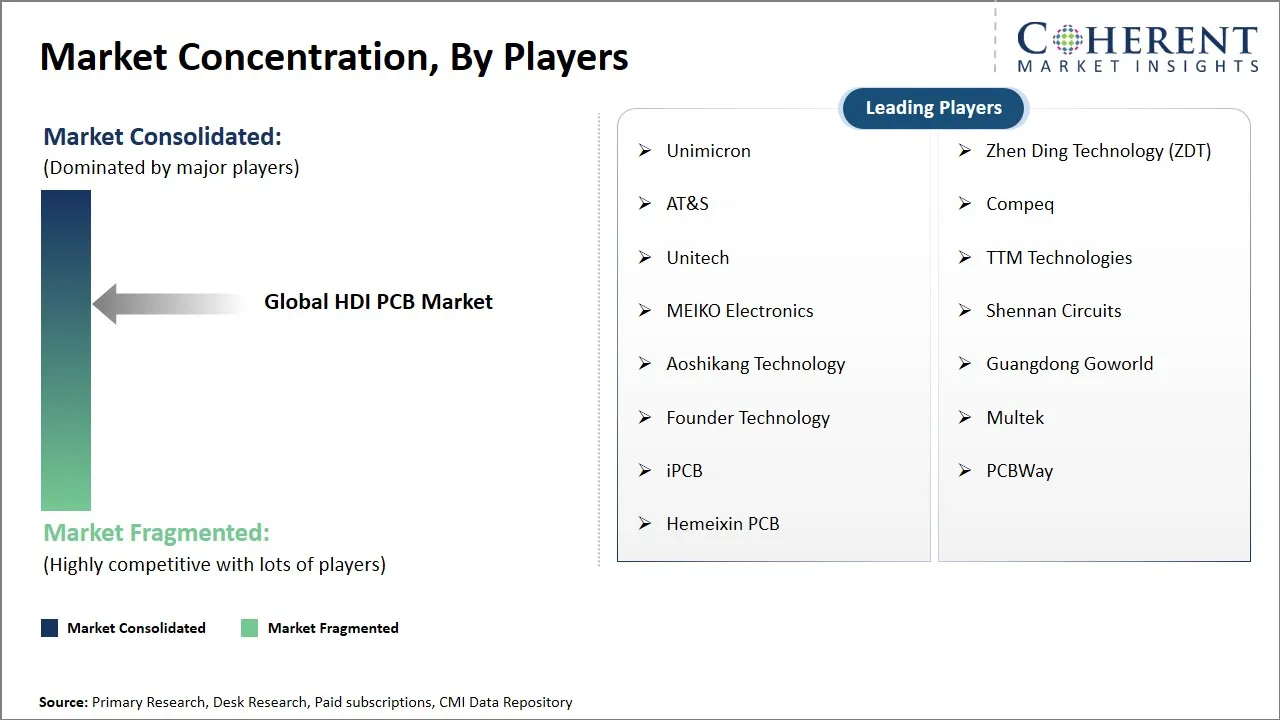
Key Developments
- In January 2024, The Amber group, a diversified B2B company having three business verticals; Consumer Durables, Electronics (EMS) and Railway Subsystems & Mobility, entered an MoU with South Korea-based Korea Circuit, a YoungPoong group co., through its recent venture Ascent Circuits. This enhanced the capability of Ascent Circuits (Amber) for providing solutions to Mobile & Semiconductor industry.
- In November 2023, TTM Technologies, Inc. selected New York State, U.S. as the location for a proposed new greenfield high-tech manufacturing facility.
- In April 2023, Firan Technology Group Corporation acquired 100% of U.S.-based Holaday Circuits and IMI Inc. The IMI acquisition bolstered FTG presence in RF circuit boards for the Aerospace and Defense market. The Holaday Circuits acquisition gave FTG a large, U.S.-based facility that can address the market for high technology circuit boards, particularly for defense applications.
Top Strategies Followed by HDI PCB Market Players
- Established players, often multinational corporations with significant capital and resources, focus heavily on research and development to push the boundaries of HDI technology. Their investment in R&D aims to develop high-performance, reliable, and customized PCB solutions that meet the increasingly complex demands of sectors such as aerospace, telecommunications, and consumer electronics.
- AT&S (Austria) announced an USD 1.98 million (€1.7 billion) investment in a new R&D and production site in Malaysia (2022–2026) focused on advanced HDI and IC substrate technologies.
- Mid-level companies in the HDI PCB market adopt a strategy focused on balancing quality with affordability to attract price-sensitive consumers, especially in growing but cost-conscious markets. By offering cost-effective solutions that do not compromise significantly on performance, these players cater to segments such as consumer electronics, automotive, and medical devices, where both price and reliability are critical selection criteria.
- Compeq Manufacturing (Taiwan) has optimized production for standard HDI PCBs used in budget smartphones and mid-tier consumer electronics. By focusing on volume production and localized supply chains, Compeq remains competitive in Southeast Asia and India, where price sensitivity is high.
- Small-scale players in the global HDI PCB market differentiate themselves by concentrating on niche segments and highly specialized or innovative product features that might be overlooked by larger competitors.
- Hemeixin PCB (China) specializes in rigid-flex HDI PCBs for low-volume, high-complexity applications in aerospace and medical devices.
Market Report Scope
HDI PCB Market Report Coverage
| Report Coverage | Details | ||
|---|---|---|---|
| Base Year: | 2025 | Market Size in 2026: | USD 21.26 Bn |
| Historical Data for: | 2020 To 2024 | Forecast Period: | 2026 To 2033 |
| Forecast Period 2026 to 2033 CAGR: | 8.5% | 2033 Value Projection: | USD 37.62 Bn |
| Geographies covered: |
| ||
| Segments covered: |
| ||
| Companies covered: | Unimicron, Zhen Ding Technology (ZDT), AT&S, Compeq, Unitech, TTM Technologies, MEIKO Electronics, Shennan Circuits, Aoshikang Technology, Guangdong Goworld, Founder Technology, Multek, iPCB, PCBWay, and Hemeixin PCB | ||
| Growth Drivers: |
| ||
| Restraints & Challenges: |
| ||
Market Dynamics
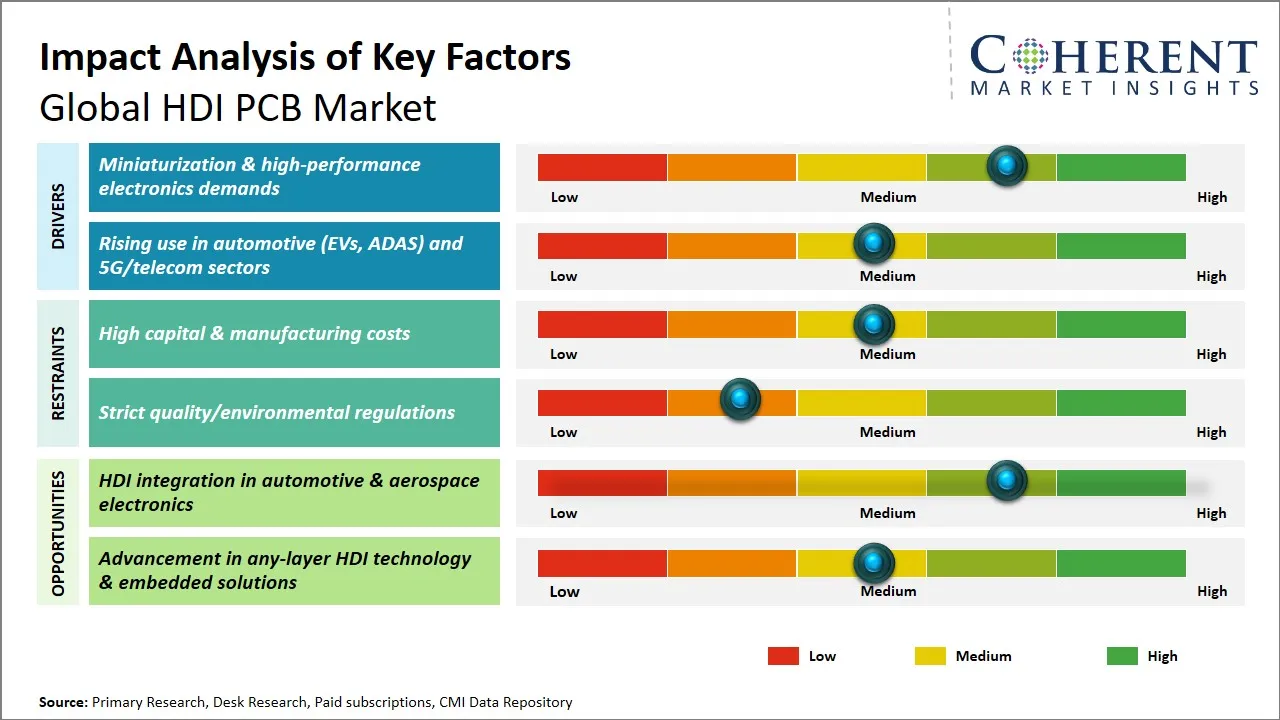
Global HDI PCB Market Driver – Miniaturization & High-performance Electronics Demands
As consumer electronics, telecommunications equipment, and automotive applications increasingly require compact yet powerful components, HDI PCBs provide the necessary solution by enabling finer lines, smaller vias, and higher connection density. This capability supports the integration of more advanced functionalities while maintaining or reducing device size.
Additionally, the rising reliance on high-performance electronics that demand improved signal integrity, faster transmission speeds, and better thermal management further emphasizes the importance of HDI technology. Complex applications such as smartphones, wearable devices, and 5G infrastructure benefit from these advancements, necessitating PCBs that accommodate high input/output counts and multi-layering. Apple Inc., in collaboration with suppliers like Unimicron and Zhen Ding Technology, has adopted Any-Layer HDI PCBs in devices like the iPhone 15 Pro and Apple Watch Series 9. These PCBs support ultra-compact form factors while enabling high-speed processing and efficient power distribution.
Global HDI PCB Market Opportunity – HDI Integration in Automotive & Aerospace Electronics
As vehicles and aircraft increasingly incorporate advanced electronic systems to enhance safety, connectivity, and autonomous functionalities, the demand for compact, reliable, and high-performance circuit boards intensifies. HDI PCBs, with their superior miniaturization capabilities, higher wiring density, and improved electrical performance, are particularly well-suited to meet these stringent requirements. In automotive applications, the surge in electric vehicles (EVs), advanced driver-assistance systems (ADAS), and in-vehicle infotainment systems drives the need for HDI PCBs that can support complex electronic architectures while maintaining lightweight and space-efficient designs. AT&S has partnered with European automotive OEMs to supply HDI PCBs with embedded components for Advanced Driver Assistance Systems (ADAS) and electric vehicle (EV) battery management systems.
Similarly, in aerospace, HDI technology enables the development of smaller, lighter avionics systems that contribute to fuel efficiency and improved system reliability under extreme environmental conditions. The trend toward the increased integration of sensors, communication modules, and power management units further propels the adoption of HDI PCBs in these industries.
Analyst Opinion (Expert Opinion)
- The rise of Any-Layer HDI and embedded passive/active components is enabling ultra-compact, high-speed PCB designs crucial for 5G smartphones, wearables, and advanced automotive systems. These innovations are closing the gap between PCB and semiconductor performance.
- Advanced players are integrating AI in layout optimization, defect detection, and predictive maintenance, dramatically reducing design cycles and improving yield. These technologies are becoming essential as complexity and precision requirements grow in HDI manufacturing.
- The shift toward high-frequency laminates, halogen-free substrates, and ultra-thin copper foils is addressing both environmental compliance and performance demands, especially in aerospace and medical sectors. Material science will increasingly define next-gen HDI capabilities.
Speak to the analyst
Want personalized insights?
Take the findings above to one of our principal consultants, or have the report rebuilt around the segments, geographies and competitors you actually track.
Market Segmentation
- Technology Node Insights (Revenue, USD Bn, 2021 - 2033)
- FR4
- Megtron 67
- Rodgers PTFE
- BT Epoxy
- Tachyon
- Others
- Application Insights (Revenue, USD Bn, 2021 - 2033)
- Smartphones and Mobile Devices
- Communications
- Automotive Electronics
- Computing and Networking Equipment
- Datacenter
- Others
- Regional Insights (Revenue, USD Bn, 2021 - 2033)
- North America
- U.S.
- Canada
- Latin America
- Brazil
- Argentina
- Mexico
- Rest of Latin America
- Europe
- Germany
- U.K.
- Spain
- France
- Italy
- Russia
- Rest of Europe
- Asia Pacific
- China
- India
- Japan
- Australia
- South Korea
- ASEAN
- Rest of Asia Pacific
- Middle East
- GCC Countries
- Israel
- Rest of Middle East
- Africa
- South Africa
- North Africa
- Central Africa
- North America
- Key Players Insights
- Unimicron
- Zhen Ding Technology (ZDT)
- AT&S
- Compeq
- Unitech
- TTM Technologies
- MEIKO Electronics
- Shennan Circuits
- Aoshikang Technology
- Guangdong Goworld
- Founder Technology
- Multek
- iPCB
- PCBWay
- Hemeixin PCB
Sources
Primary Research Interviews
Stakeholders
- HDI PCB Manufacturers
- Raw Material Suppliers (e.g., copper foil, FR4 laminate producers)
- Electronics OEMs & ODMs
- Supply Chain Managers from Automotive & Consumer Electronics Firms
- PCB Equipment & Software Providers
- Technology Consultants in PCB Miniaturization and Embedded Systems
Databases
- Asia Pacific Electronics Industry Tracker
- International Electronics Manufacturing Consortium (IEMC)
- Automotive Electronics Council (AEC)
- European Electronic Components Database (EECD)
Magazines
- PCB World Today
- Advanced Electronics Manufacturing Digest
- Automotive Tech & Boards Magazine
- High-Density Interconnect Monthly
Journals
- Journal of Advanced Printed Circuit Engineering
- Microelectronics Reliability Journal
- HDI Systems and Integration Review
- Journal of Embedded Electronics and PCB Technologies
Newspapers
- Electronics Manufacturing Times (EMT)
- Asia Circuit Daily
- The Semiconductor Herald
- Global PCB News Online
Associations
- International Association for Advanced PCB Technologies (IAAPT)
- Asia-Pacific Printed Circuit Board Alliance (APPCBA)
- European HDI & Substrate Association (EHSA)
- Automotive Electronics Manufacturers Council (AEMC)
- Global Alliance for PCB Innovation (GAPI)
Public Domain Sources
- U.S. Census Bureau
- EUROSTAT
- United Nations Economic Commission for Europe (UNECE)
- World Bank
- ResearchGate
Proprietary Elements
- CMI Data Analytics Tool, Proprietary CMI Existing Repository of Information for Last 8 Years
Get access to 250+ pages report
Every segment, forecast, competitor profile and data table behind the analysis above — available for instant download.
- ESOMAR Member
- ISO 9001:2015 Certified
- D-U-N-S Registered
- GDPR & CCPA Compliant
Missing comfort of reading report in your local language? Find your preferred language:
Transform your Strategy with Exclusive Trending Reports
Frequently Asked Questions
The global HDI PCB market is estimated to be valued at USD 21.26 billion in 2026 and is expected to reach USD 37.62 billion by 2033.
The CAGR of global HDI PCB market is projected to be 8.5% from 2026 to 2033.
Miniaturization & high-performance electronics demands and rising use in automotive (EVs, ADAS) and 5G/telecom sectors are the major factors driving the growth of the global HDI PCB market.
High capital & manufacturing costs and strict quality/environmental regulations are the major factors hampering the growth of the global HDI PCB market.
In terms of Technology Node, FR4 segment is estimated to dominate the market revenue share in 2026.
HDI PCBs feature finer lines, microvias, and multiple layers, allowing denser component placement and improved signal integrity compared to conventional PCBs.
HDI PCBs are crucial in EVs for battery management systems (BMS), advanced driver assistance systems (ADAS), and infotainment units, offering high reliability, space efficiency, and enhanced thermal performance in compact electronic assemblies.