

Global Homomorphic Encryption Market
What is the Homomorphic Encryption Market? |
The homomorphic encryption market comprises technologies, software, and services that enable computations to be performed directly on encrypted data without decrypting it, ensuring data privacy throughout processing. The market is expanding rapidly due to increasing demand for secure cloud computing, privacy-preserving artificial intelligence, regulatory compliance, and confidential data analytics across the healthcare, finance, government, and telecommunications industries. |
Global Homomorphic Encryption Market - Key Statistics
Metric | Value |
Global Market Size (2026) | USD 1.20 Bn |
Forecast Market Size (2033) | USD 4.25 Bn |
Growth Rate (CAGR 2026–2033) | 9% |
Leading Type | Partial Homomorphic Encryption (51% share in 2026) |
Leading End User | BFSI (34% share in 2026) |
Dominant Region | North America (43% share in 2026) |
Fastest Growing Region | Asia Pacific (27% share in 2026) |
Base Year | 2025 |
Forecast Period | 2026–2033 |
Key Players | IBM, Microsoft, Google, Intel Corporation and Duality Technologies |
Source | Coherent Market Insights Analysis, July 2026 |
Global Homomorphic Encryption Market Size and Forecast – 2026 To 2033
The global homomorphic encryption market is expected to grow from USD 1.20 Bn in 2026 to USD 4.25 Bn by 2033, registering a compound annual growth rate (CAGR) of 9% from 2026 to 2033. The global homomorphic encryption market is driven by growing regulatory requirements for secure data processing. On January 30, 2025, EY introduced expanded advisory and implementation services to help enterprises comply with India's newly notified Digital Personal Data Protection Rules, 2025.
Key Takeaways of the Global Homomorphic Encryption Market
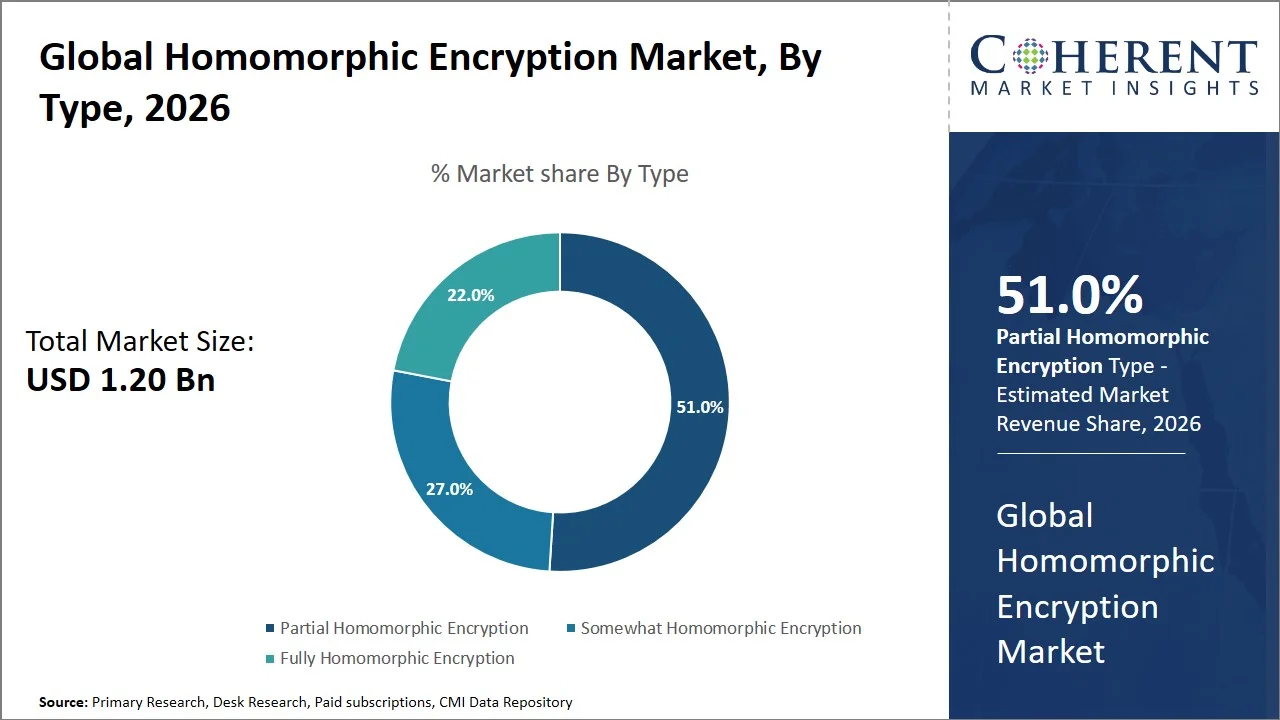
- The partial homomorphic encryption segment is expected to account for 51.0 % of the global homomorphic encryption market share in 2026. Expansion of AI and machine learning on encrypted datasets is driving the growth of the segment. On August 29, 2025, Intel and Duality Technologies enhanced the OpenFHE library, which now includes new features and optimizations that make homomorphic encryption more practical and accessible for a new wave of applications, from secure cloud computing to privacy-preserving machine learning.
- The BFSI segment is estimated to capture 34.0 % of the market share in 2026. Increasing cybersecurity threats targeting sensitive financial data is majorly driving the growth of the segment. On February 9, 2026, BridgePay confirmed a ransomware attack that disrupted payment processing systems used by government agencies and enterprise customers.
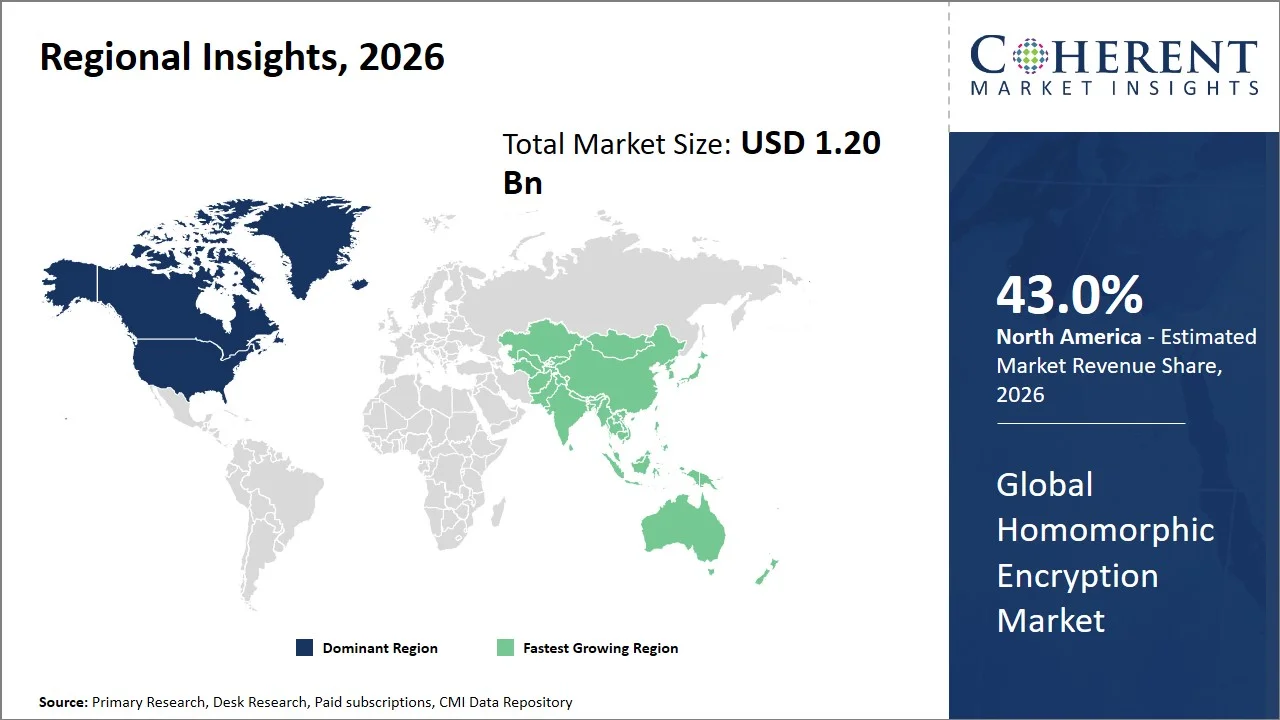
- North America is expected to dominate the homomorphic encryption market in 2026 with a market share of 43.0 %. Expansion of government and defense cybersecurity programs in North America is driving the growth of the regional market. On April 15, 2024 Google Cloud enhanced its Assured Workloads and Confidential Computing capabilities for U.S. government agencies, enabling higher levels of protection for regulated and defense-related cloud environments.
- Asia Pacific is expected to account for 27.0 % share in 2026 and is projected to record the fastest growth over the forecast period. Rising use of encryption in cross border data integration and collaboration in Asia Pacific is driving the growth of the regional market. On March 3, 2025, Huawei enhanced its cloud security and data encryption portfolio to support regulated industries requiring secure cross-border collaboration and compliance with evolving regional data governance policies.
- Current Industry Events of 2026
- Market Size Estimation
- Regional Breakdown
- Competitive Landscape
- Customer Intelligence
- Segmental Analysis
- Pricing Analysis
- Key Market Drivers, Challenges & Future Trends
- Customized Insights Section
Segmental Insights
Why Does Partial Homomorphic Encryption Dominate the Global Homomorphic Encryption Market?
The partial homomorphic encryption segment is expected to account for 51.0% of the global homomorphic encryption market share in 2026. Partial homomorphic encryption is extensively employed as it provides an efficient trade-off between security, computing performance and implementation cost for practical enterprise applications. This enables certain mathematical operations on encrypted data with significantly less processing overhead than full homomorphic encryption. Hence, it is applicable for financial transactions, digital signatures, authentication systems, and secure cloud services where a small number of encrypted computations are required. On March 11, 2026, Intel announced the Heracles accelerator for homomorphic encryption, claiming dramatic speed improvements for encrypted compute, and reduced latency for real-world commercial installations.
Why is BFSI the Most Crucial End User?
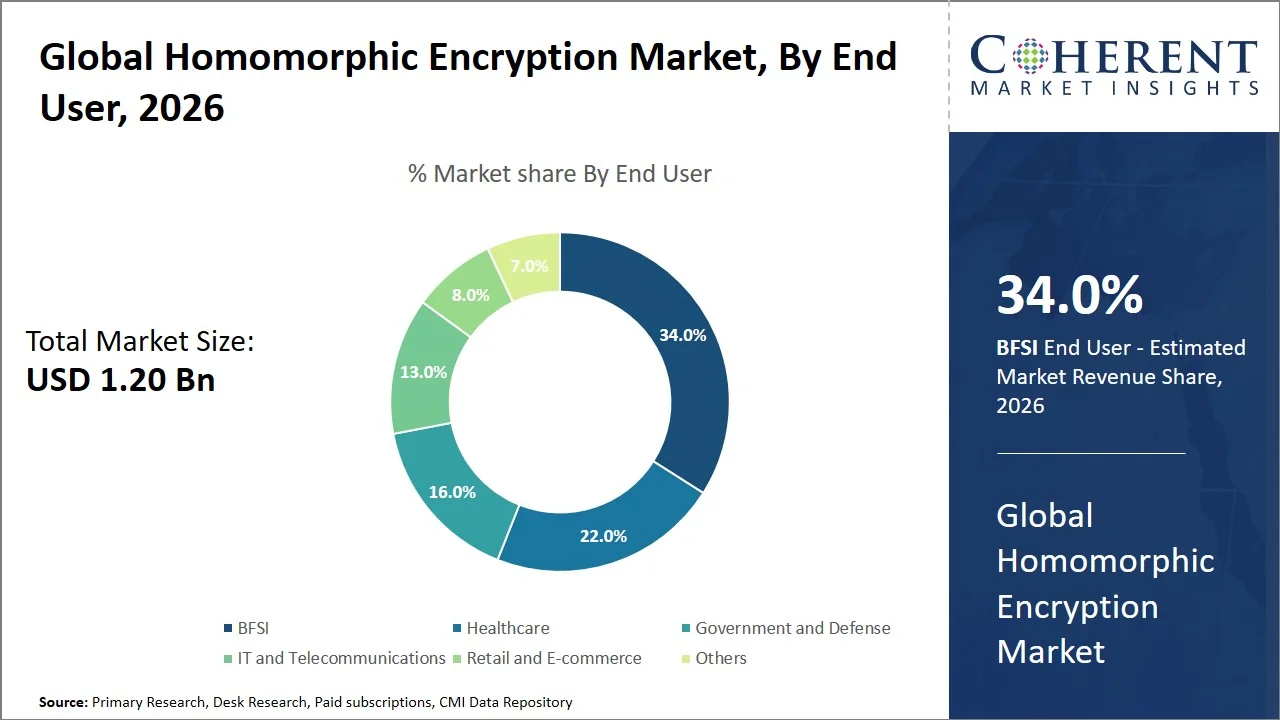
The BFSI segment is expected to account for 34.0% of the global homomorphic encryption market share in 2026. The BFSI sector is the largest user of homomorphic encryption, as it needs to safeguard extremely sensitive financial data, while also allowing for secure data processing, fraud detection, and regulatory compliance. Financial institutions are increasingly adopting encrypted analytics to analyze client transactions, risk models and cross-border data without disclosing sensitive information, helping them bolster cybersecurity while complying with tight privacy and data security mandates. Inpher is constantly increasing the adoption of its ZeroReveal technology for safe collaborative risk modeling and fraud detection on encrypted client data by banking and insurance entities.
Currents Events and their Impact
Current Events | Description and its Impact |
European Health Data Space Regulation (EU, 2025) |
|
India - Digital Personal Data Protection Act, 2023 |
|
Homomorphic Encryption Market Dynamics
Market Drivers
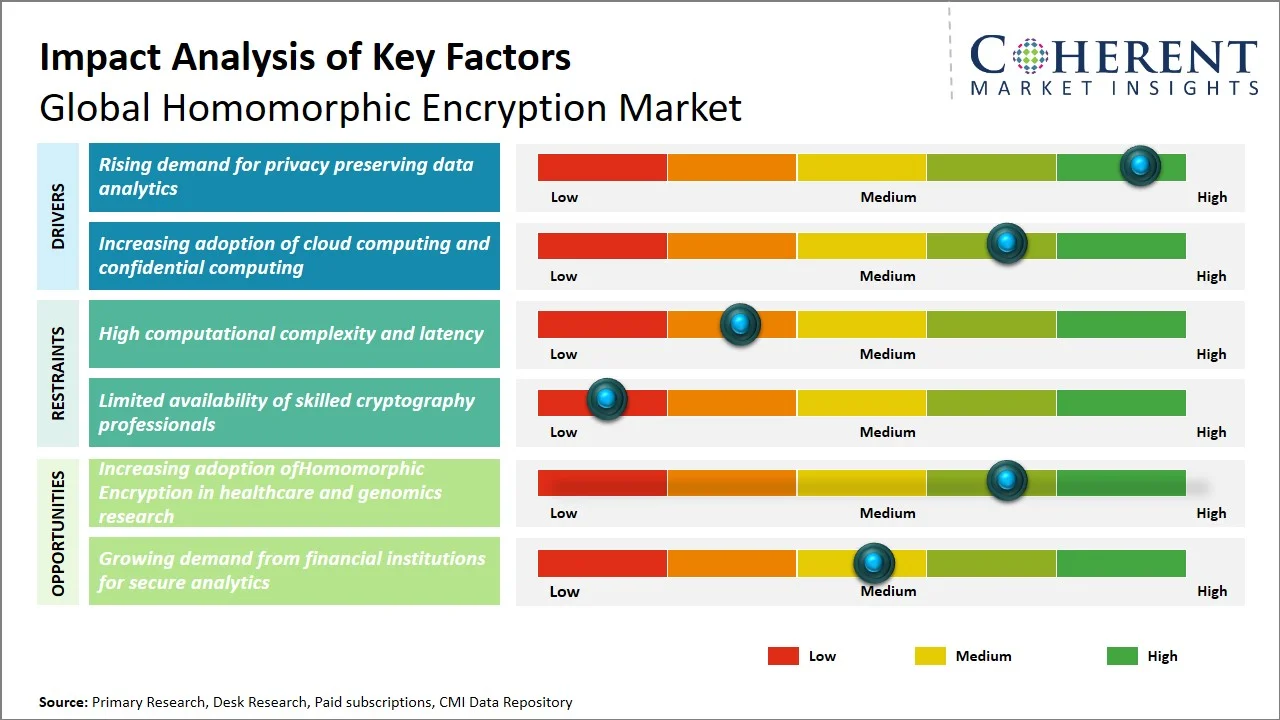
- Rising demand for privacy preserving data analytics: Growing need for privacy preserving data analytics is one of the key driving factors for the homomorphic encryption market with enterprises seeking to get meaningful insights from sensitive data while without exposing its contents. Stringent privacy regulations and the need for cloud-based analytics, artificial intelligence and collaborative research are making secure data processing an increasingly important demand for industries such as healthcare, banking, government and telecommunications. Homomorphic encryption is an effective solution to protect confidential information throughout the computation process. On July 1, 2025, Pimloc announced automated screen anonymization and expanded its Secure Redact technology to allow enterprises to analyze video and visual datasets while automatically preserving personally identifiable information.
- Increasing adoption of cloud computing and confidential computing: Increasing adoption of cloud computing and confidential computing is boosting the demand for homomorphic encryption, as it allows enterprises to safely process sensitive data in remote and shared computing environments. As organizations move critical workloads to the cloud, they need advanced encryption technologies that provide data protection throughout the data lifecycle, including confidential analytics, artificial intelligence, and business operations on encrypted data, all with a low risk of unauthorized access or data breaches. On August 14, 2025, NVIDIA announced Confidential Computing compatibility across entire Blackwell platform, allowing secure AI processing on encrypted datasets within hardware-protected GPU.
- Integration of homomorphic encryption with artificial intelligence and machine learning: The integration of homomorphic encryption with artificial intelligence and machine learning is emerging as a major trend, as organizations look to train and deploy AI models while maintaining data confidentiality. Traditional AI systems use raw datasets, which could lead to privacy and security issues, especially when dealing with sensitive data like financial records, healthcare data, and customer behavior patterns. Homomorphic encryption allows AI algorithms to execute calculations on encrypted datasets so firms can build privacy preserving AI solutions without disclosing sensitive information. This trend is accelerating with the rise of generative AI, cloud-based AI platforms and regulated businesses with a need for safe data processing settings.
- Growing adoption of privacy enhancing technologies in regulated industries: The growing importance of data protection regulations and cybersecurity requirements is fueling the adoption of homomorphic encryption across highly regulated industries such as BFSI, healthcare, government, and telecommunications. This creates a demand for encryption techniques that safeguard information when it is being processed, not only when it is stored or transmitted. Homomorphic encryption is becoming a significant privacy enhancing technology that facilitates safe collaboration, secret analytics and cross organization data flow while helping organizations comply with developing worldwide data protection regulations. On April 8, 2025, the Centre for Information Policy Leadership at Hunton released a white paper on Privacy-Enhancing and Privacy-Preserving Technologies in AI, Enabling Data Use and Operationalizing Privacy by Design and Default. The paper provides an in-depth exploration of how privacy-enhancing technologies are being deployed to address privacy within artificial intelligence systems.
Market Restraints & Challenges
- High computational complexity and latency: Homomorphic encryption needs calculation on the encrypted data itself, which demands far more computing power than traditional encryption algorithms, where data is first decrypted before analysis. Maintaining encryption security requires complex mathematical operations that can increase computational time, memory requirements and system latency. This can make it challenging to implement in applications requiring real-time processing, such as financial transactions, large-scale analytics and artificial intelligence workloads. Better algorithms and hardware acceleration are boosting speed, but computational overhead remains one of the biggest obstacles to wider industry use.
- Limited availability of skilled cryptography professionals: Deploying solutions based on homomorphic encryption demands significant expertise in sophisticated cryptography, mathematical modeling, secure computing infrastructures, and system integration. Many firms are challenged by the lack of experts with the technical abilities to develop, deploy and manage encrypted computing environments, leaving a large knowledge gap in the market. The shortfall leads to increased dependence on outside experts, protracted implementation times and more operational difficulties for companies attempting to embed privacy-preserving solutions into their existing infrastructure.
- High implementation and infrastructure costs: The deployment of homomorphic encryption demands a significant investment in high performance computing equipment, specialized encryption software, security frameworks, and employee training programs. Processing encrypted data is computationally intensive and demands upgrading of existing IT environments, leading to higher costs of implementation and maintenance. These financial challenges are particularly relevant for small and medium sized firms that may struggle to justify the expenditure, despite long term benefits from improved data security and compliance with regulations.
Emerging Trends
- Advancement of hardware acceleration for encrypted computing: Advancements in dedicated processors, GPUs and cryptographic hardware are helping to speed up the performance of homomorphic encryption by minimizing computational delays and enabling more realistic enterprise implementation.
- Expansion of cloud based homomorphic encryption services: More and more cloud providers and cybsersecurity companies are offering homomorphic encryption features through managed platforms and thus allowing businesses to securely process encrypted data without the need to grow in house cryptography expertise.
Regional Insights
Why is North America a Strong Market for Homomorphic Encryption?
North America is expected to account for a market share of 43.0% in 2026. The North American homomorphic encryption market is driven by high adoption of homomorphic encryption among technology providers, financial institutions, healthcare organizations, and government agencies that stress on safe data processing. The region boasts a lively ecosystem of companies working on privacy preserving computation solutions. For example, IBM has integrated fully homomorphic encryption capabilities into its cybersecurity and cloud research programs, and Microsoft supports research on encrypted computing through its confidential computing and security platforms. Healthcare organizations are exploring encrypted analytics for genomic research and sharing of medical data while financial institutions are exploring homomorphic encryption for fraud detection, risk analysis and secure processing of customer data without revealing sensitive information.
Why Does the Asia Pacific Homomorphic Encryption Market Exhibit High Growth?
Asia Pacific is projected to account for 27.0% of the global homomorphic encryption market and is expected to register the fastest growth. The Asia Pacific homomorphic encryption market is expected to grow due to rising digital transformation, fast cloud adoption and rising concerns for data sovereignty and cybersecurity in large economies. Countries like China, Japan, South Korea and India are investing in privacy enhancing technologies to provide safe artificial intelligence, financial technology and healthcare data applications. South Korea’s CryptoLab Inc and other companies are creating homomorphic encryption solutions for secure data analytics. Japanese technology firms are studying encrypted computation for financial services and industrial data interchange. Governments and businesses are also increasingly looking at the area for secure ways to share data between organizations, while yet complying with ever-shifting data protection requirements.
Global Homomorphic Encryption Market Outlook for Key Countries
Why is the U.S. Emerging as a Major Hub in the Homomorphic Encryption Market?
The U.S. is expected to hold 33.2% of the global homomorphic encryption market in 2026. The U.S. has one of the most advanced markets for homomorphic encryption, due to the presence of large cloud providers, cyber security vendors and research organizations working on encrypted computing technologies. Google, Microsoft and Intel Corporation have invested in private computing, secure hardware acceleration and privacy preservation technologies that complement homomorphic encryption applications. The finance industry is aggressively studying encrypted analytics for sensitive customer data and healthcare institutions are applying privacy protecting techniques for joint research with patient records and biomedical data. Government agencies and defense organizations are also researching advanced encryption techniques to secure sensitive and mission important information.
Is China the Next Growth Engine for the Homomorphic Encryption Market?
China is expected to hold 8.4% of the global homomorphic encryption market in 2026. Artificial intelligence, fintech platforms, cloud computing, and government cybersecurity measures are driving growth in China’s homomorphic encryption sector. The country has a great interest in privacy preserving computation demonstrated by the number of organizations working on secure multi-party computation and encrypted data processing technologies, in particular for banking, healthcare and smart city applications. Chinese IT businesses are developing privacy-enhancing solutions that enable corporations to study encrypted data sets while meeting data security regulations. The requirement to safely manage huge volumes of digital data created by financial platforms, industrial systems and government services is accelerating the deployment of homomorphic encryption solutions.
Germany Homomorphic Encryption Market Analysis and Trends
Germany is expected to hold 7.1% of the global homomorphic encryption market in 2026. The market for homomorphic encryption in Germany is driven by the stringent data protection standards of European privacy laws and the demand for secure industrial data sharing. German car manufacturers, industrial automation businesses and research institutes are researching encrypted computation to work together on critical data without revealing confidential information. Organizations are considering Industry 4.0 applications for connected manufacturing, supply chain optimization and industrial analytics for privacy preserving technology. German research projects and cybersecurity institutions are also working on improved cryptographic technologies to enable secure artificial intelligence and confidential cloud computing applications.
U.K. Homomorphic Encryption Market Analysis and Trends
The U.K. is expected to hold 6.6% of the global homomorphic encryption market in 2026. In the U.K. homomorphic encryption market, demand is driven by increased demand for secure data collaboration across financial services, healthcare and public sector applications. London’s biggest financial institutions are studying homomorphic encryption for risk analysis, fraud detection and consumer analytics, keeping confidential financial data secure. Healthcare institutions and research agencies are also exploring encrypted computation as a means to share medical datasets and allow collaborative study while safeguarding patient privacy. The emergence of artificial intelligence governance and data protection initiatives is compelling organizations to implement privacy enhancing technologies that enable the secure use of data.
Japan Homomorphic Encryption Market Analysis and Trends
Japan is expected to hold 5.7% of the global homomorphic encryption market in 2026. Growing demand from the financial services, healthcare research, telecommunications and advanced technology industries is fueling the expansion of the homomorphic encryption market in Japan. Japanese companies and academic organizations are targeting secure computation techniques for applications such as financial data analysis, medical research collaboration and industrial data exchange. The country is also focusing on cybersecurity and digital trust, prompting firms to consider technology that enable for processing encrypted data without ever revealing sensitive data. Technology vendors are also combining homomorphic encryption with artificial intelligence and cloud platforms to enable secure digital transformation across enterprises.
Global Homomorphic Encryption Market - Average Encryption Processing Latency by Technology
Technology | Primary Computation Type | Typical Average Processing Latency per Operation |
Partial Homomorphic Encryption (PHE – Paillier, ElGamal) | Single operation (Addition or Multiplication) | 0.05–0.50 ms |
BFV (Brakerski/Fan-Vercauteren) | Exact integer arithmetic | 0.8–2.5 ms |
BGV (Brakerski/Gentry/Vaikuntanathan) | Exact modular arithmetic | 0.9–2.8 ms |
CKKS (Cheon-Kim-Kim-Song) | Approximate real-number arithmetic | 3–8 ms |
TFHE (Fast Fully Homomorphic Encryption over the Torus) | Boolean gate operations | 1–10 ms per gate |
FHEW | Boolean circuits | 20–80 ms per gate |
Fully Homomorphic Encryption with Bootstrapping | Arbitrary encrypted computation | 200–2,000 ms (depending on workload and hardware) |
How is Increasing Adoption of Homomorphic Encryption in Healthcare and Genomics Research Creating New Growth Opportunities in the Homomorphic Encryption Market?
The homomorphic encryption market is witnessing considerable development prospects driven by the increasing application in healthcare and genomics research which allows for secure analysis of extremely sensitive medical and biological data without disclosing patient information. Healthcare organizations, pharmaceutical corporations and academic institutes are increasingly working on genetic studies, drug discovery and precision medicine programs that require sharing huge datasets across various stakeholders, but with stringent privacy measures. Homomorphic encryption enables researchers to do calculations on encrypted genetic sequences, electronic health records, and clinical trial data, lowering privacy risks associated with data sharing and helping to ensure compliance with rules such as healthcare data protection guidelines. For example, pharmaceutical corporations can use encrypted patient datasets to build AI based drug development models without having access to identifying health information, while hospitals and research institutions can work together on illness research without sending raw patient records.
On September 11, 2025, DNAnexus, Inc announced its intention to bring precision medicine capabilities by selecting Oracle Health clinical applications. Executed as part of a non-binding agreement, the integration of DNA Nexus with Oracle Health is expected to power continuous examination of clinical interpretations of genomics results to help doctors better understand adaptations that may impact a patient’s health or require adjustments to their treatment plan.
Market Players, Key Development, and Competitive Landscape
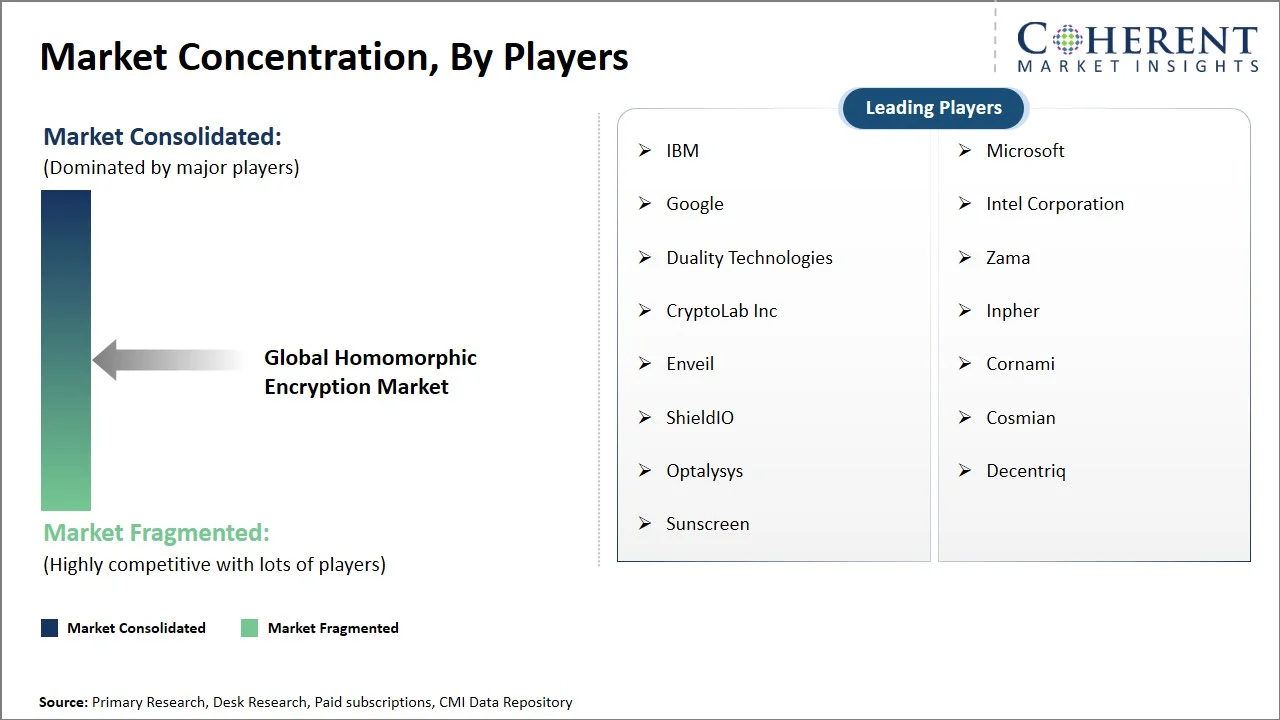
Key Developments
- On July 16, 2025, Zama released a new version of TFHE-rs (v1.3), along with Concrete (v2.11), a new Hugging Face demo for Concrete ML, and the FHEVM (v0.7) for the Zama Confidential Blockchain Protocol Testnet.
- On May 15, 2025, IBM introduced the new IBM LinuxONE 5 cybersecurity capabilities featuring enhanced confidential computing and quantum-safe security features that support privacy-enhancing technologies, including homomorphic encryption use cases.
Competitive Landscape
The homomorphic encryption market competition includes a mix of established technology companies, specialized cryptography companies and research-focused startups, all working to improve performance, scalability and usability in the enterprise. IBM and Microsoft are cementing their positions by integrating encrypted computing capabilities into wider cloud security and confidential computing ecosystems, while niche players such as Zama and Duality Technologies are targeting real-world fully homomorphic encryption use cases for AI, data collaboration and secure analytics.
Competitive Landscape Table
Company | Headquarters | Key Homomorphic Encryption Solutions/Platforms | Primary Market Segment |
IBM | Armonk, New York, United States | IBM HElib, IBM Research | BFSI, Healthcare, Government, Enterprise data security, Cloud computing |
Microsoft | Redmond, Washington, United States | Microsoft SEAL | Cloud services, Enterprise software, AI security, Healthcare, Financial services |
Mountain View, California, United States | Fully homomorphic encryption research frameworks, privacy preserving AI and secure computation technologies | Artificial intelligence, Cloud computing, Data analytics, Enterprise security | |
Intel Corporation | Santa Clara, California, United States | Intel HEXL | Semiconductor, Cloud infrastructure, AI computing, Enterprise security |
Duality Technologies | New York, United States | Duality SecurePlus | Healthcare, Financial services, Government, Data collaboration |
Zama | Paris, France | Concrete framework, TFHE based fully homomorphic encryption technology, encrypted AI computation platforms | Artificial intelligence, Blockchain, Cloud security, Developer platforms |
CryptoLab Inc | Seoul, South Korea | CKKS and BFV | Finance, Healthcare, Cloud security, Secure data analytics |
Inpher | New York, United States | ZeroReveal | Financial services, Healthcare, Enterprise analytics |
Enveil | Fulton, Maryland, United States | Zero Trust Privacy Enhancing Technology platform | Government, Defense, Intelligence, Financial services |
Cornami | Palo Alto, California, United States | Software and hardware acceleration platforms designed to improve encrypted computing performance including FHE acceleration | AI computing, High performance computing, Data security |
ShieldIO | San Jose, California, United States | Secure AI and privacy preserving computation platform using encrypted processing technologies | Artificial intelligence, Enterprise security, Data analytics |
Cosmian | Paris, France | Cosmian KMS | Cloud security, Healthcare, Financial services, Enterprise data protection |
Optalysys | Leeds, United Kingdom | Optical computing based fully homomorphic encryption acceleration technology | Defense, Government, Cloud computing, Secure analytics |
Decentriq | Zurich, Switzerland | Data clean room platform using confidential computing and privacy enhancing technologies for secure data collaboration | Healthcare, Advertising, Financial services, Enterprise data sharing |
Sunscreen | San Francisco, California, United States | Fully homomorphic encryption compiler and developer tools enabling encrypted application development | Software developers, AI applications, Blockchain, Enterprise security |
Source: CMI Analysis, July 2026 | |||
Market Report Scope
Homomorphic Encryption Market Report Coverage
| Report Coverage | Details | ||
|---|---|---|---|
| Base Year: | 2025 | Market Size in 2026: | USD 1.20 Bn |
| Historical Data for: | 2020 To 2024 | Forecast Period: | 2026 To 2033 |
| Forecast Period 2026 to 2033 CAGR: | 9% | 2033 Value Projection: | USD 4.25 Bn |
| Geographies covered: |
| ||
| Segments covered: |
| ||
| Companies covered: | IBM, Microsoft, Google, Intel Corporation, Duality Technologies, Zama, CryptoLab Inc, Inpher, Enveil, Cornami, ShieldIO, Cosmian, Optalysys, Decentriq, and Sunscreen | ||
| Growth Drivers: |
| ||
| Restraints & Challenges: |
| ||
Analyst Opinion (Expert Opinion)
- The homomorphic encryption market will be affected by the transition of homomorphic encryption from research-oriented applications to commercial-ready solutions, particularly as algorithm improvements and hardware acceleration overcome performance limitations. The emphasis is more on usability, interoperability with existing cloud environments and integration with artificial intelligence workflows. Enterprises are unlikely to embrace complex cryptographic systems unless they can be integrated with existing data pipelines. Vendors that are able to simplify deployment through software development kits, managed encryption services, and application-specific solutions are projected to gain stronger adoption among organizations.
- The competitive standing of companies is expected to be influenced by their capacity to address the current trade-off between security and operational efficiency. Fully homomorphic encryption suppliers are projected to continue investing in decreasing processing time and enhancing scalability, while partial and hybrid encryption systems may remain significant for near-term enterprise installations where performance needs are critical. Strategic cooperation between cryptography companies, cloud providers, semiconductor firms, and regulated industries are expected to play a vital role in expediting commercialization and extending real-world use cases.
- The future outlook of the homomorphic encryption market is expected to be influenced by increasing integration with artificial intelligence, confidential computing, and secure data ecosystems where organizations require advanced methods to utilize sensitive information without exposing raw datasets. Growth is projected to be supported by applications such as privacy preserving AI model training, encrypted healthcare analytics, secure financial risk assessment, and cross-organizational data cooperation. As hardware acceleration, efficient encryption libraries, and cloud-based deployment models continue developing, homomorphic encryption is projected to progress toward broader business usage, particularly in industries where data privacy and regulatory compliance are essential criteria.
Speak to the analyst
Want personalized insights?
Take the findings above to one of our principal consultants, or have the report rebuilt around the segments, geographies and competitors you actually track.
Market Segmentation
- Type Insights (Revenue, USD Billion, 2021 - 2033)
- Partial Homomorphic Encryption
- Somewhat Homomorphic Encryption
- Fully Homomorphic Encryption
- End User Insights (Revenue, USD Billion, 2021 - 2033)
- BFSI
- Healthcare
- Government and Defense
- IT and Telecommunications
- Retail and E-commerce
- Others
- Regional Insights (Revenue, USD Billion, 2021 - 2033)
- North America
- U.S.
- Canada
- Latin America
- Brazil
- Argentina
- Mexico
- Rest of Latin America
- Europe
- Germany
- U.K.
- Spain
- France
- Italy
- Russia
- Rest of Europe
- Asia Pacific
- China
- India
- Japan
- Australia
- South Korea
- ASEAN
- Rest of Asia Pacific
- Middle East
- GCC Countries
- Israel
- Rest of Middle East
- Africa
- South Africa
- North Africa
- Central Africa
- North America
- Key Players Insights
- IBM
- Microsoft
- Intel Corporation
- Duality Technologies
- Zama
- CryptoLab Inc
- Inpher
- Enveil
- Cornami
- ShieldIO
- Cosmian
- Optalysys
- Decentriq
- Sunscreen
Sources
Primary Research Interviews
- Cryptography Solution Providers & Vendors
- Cloud Service Providers & IT Infrastructure Companies
- Cybersecurity Consultants & Data Privacy Experts
- Banking, Financial Services & Healthcare End-Users
Magazines
- MIT Technology Review
- IEEE Spectrum
- Cybersecurity Ventures Magazine
- Dark Reading
Journals
- Journal of Cryptology
- IEEE Transactions on Information Forensics and Security
- International Journal of Information Security
Associations
- International Association for Cryptologic Research (IACR)
- Cloud Security Alliance (CSA)
- org Consortium
Public Domain Sources
- European Union Agency for Cybersecurity (ENISA) Publications
- U.S. Department of Homeland Security (DHS)
- World Economic Forum (WEF)
Proprietary Elements
- CMI Data Analytics Tool
- Proprietary CMI Existing Repository of Information for the last 10 years
Get access to 250+ pages report
Every segment, forecast, competitor profile and data table behind the analysis above — available for instant download.
- ESOMAR Member
- ISO 9001:2015 Certified
- D-U-N-S Registered
- GDPR & CCPA Compliant
Missing comfort of reading report in your local language? Find your preferred language:
Transform your Strategy with Exclusive Trending Reports
Frequently Asked Questions
Homomorphic encryption is a cryptographic technology that allows computations to be performed on encrypted data without decrypting it, enabling secure data processing while preserving privacy.
Homomorphic encryption solves the challenge of processing sensitive data securely without exposing the original information.
The global homomorphic encryption market is expected to stand at USD 1.20 Bn in 2026 and is expected to reach USD 4.25 Bn by 2033.
The CAGR of the global homomorphic encryption market is projected to be 9% from 2026 to 2033.
It protects confidential data by allowing computations to be performed directly on encrypted information while keeping the data unreadable.
In terms of type, the partial homomorphic encryption segment is estimated to dominate the market revenue share in 2026.
Unlike traditional encryption, homomorphic encryption enables data analysis and computation while the information remains encrypted.