

Global House Wraps Market Size and Forecast – 2026 To 2033
The global house wraps market is expected to grow from USD 6.78 Bn in 2026 to USD 11.37 Bn by 2033, registering a compound annual growth rate (CAGR) of 7.67%. Increasing number of new construction and retrofit projects worldwide are contributing to high demand for house wraps that protect a home against air and water intrusions. According to recent data from the U.S. Census Bureau, total construction spending in January 2026 in the U.S. was estimated at a seasonally adjusted annual rate of USD 2,190.4 billion. On a year-over-year basis, spending registered a modest increase of 1.0% from USD 2,169.6 billion in January 2025.
The residential sector has been a strong area of financial success for house wrap manufacturers as spending on home renovation increases. Residential building activity across the globe is set to rebound to US$ 3.8 trillion by 2026.
(Source: Census.gov)
Key Takeaways of the Global House Wraps Market
- Polyethylene house wraps are projected to hold 39.6% of the global house wrap market share in 2026, making it the dominant product segment. These wraps are predominantly the product of choice in North America within the global house wraps market as consumers look for durability and affordability.
- North America market maintains dominance with an expected share of 34.2% in 2026. The region is characterized by a well-established construction ecosystem with escalating renovation activities, making it a dominant market. The U.S. Census Bureau's New Residential Construction report reveals that housing starts surged to a seasonally adjusted annual rate of 1,487,000 in January 2026, marking a 9.5% increase year-over-year, signaling renewed construction momentum heading into 2026. (Source: census.gov)
- Asia Pacific is expected to contribute 19.3% of the global market share in 2026 owing to the high rate of urbanization and infrastructural development. The market growth in Asia Pacific is expected to remain the fastest. UN’s projections of more than half (55%) of the population residing in urban areas by 2030 indicates fast-paced urbanization in the region. As per Asian Development Bank, Asia requires an annual infrastructure investment of approximately US$ 1.7 trillion to maintain its growth momentum, thus supporting the market growth. (Source: ADB, FAO)
- Net Zero Construction Alignment: Eco-friendly and technologically advanced house wraps are increasingly addressing the challenges of achieving net-zero building standards.
- Market Expansion Catalysts: Innovations in breathable, durable materials combined with regulatory support for industrial energy efficiency conservation in buildings are propelling the market expansion.
- Profitability Outlook: Profitability seems to be higher for companies focusing on house wraps that enhance thermal insulation and moisture control of buildings.
Segmental Insights
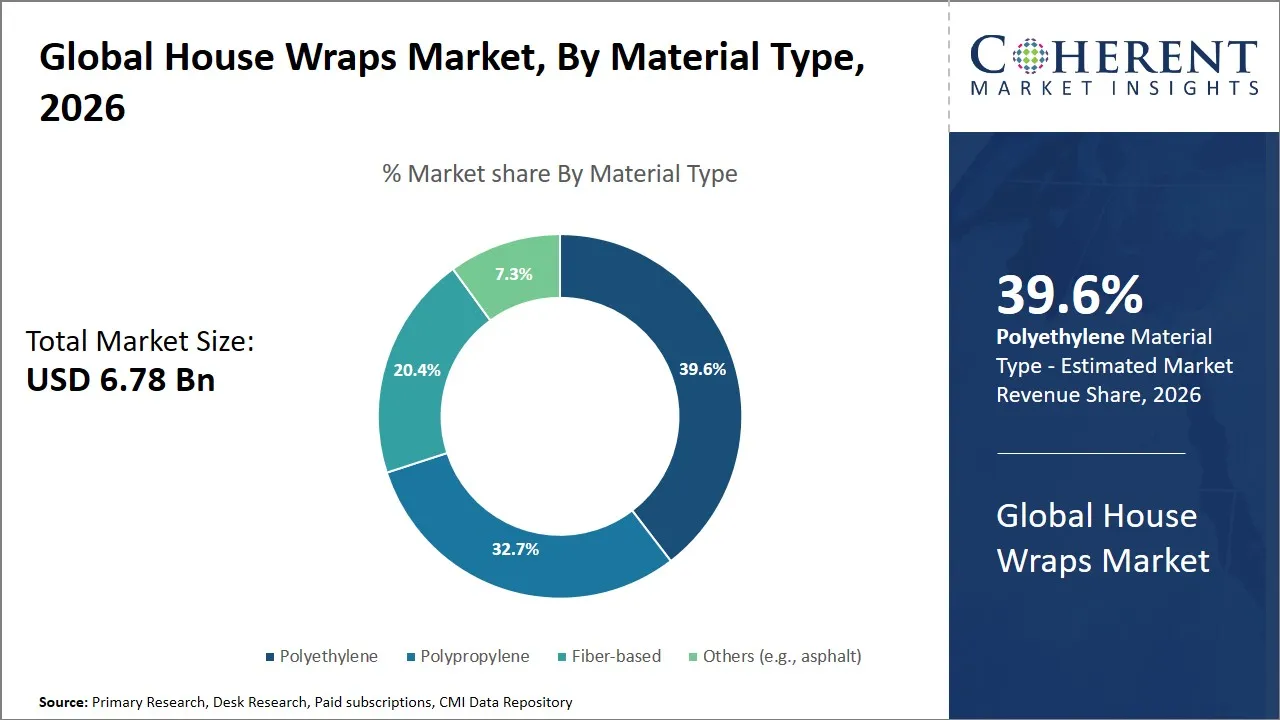
Why Do Polyethylene House Wraps Dominate the Global Market?
Polyethylene house wraps dominate the market because of their outstanding balance in terms of durability, waterproofing and affordability. This material type is expected to hold 39.6% of the house wraps market share in 2026.
Being a thermoplastic material, polyethylene is highly resistant to water infiltration and is permeable to vapor. This special combination is necessary to ensure that building structures are not affected by external weather, moisture-related damages like mold, and rot will not occur without the trapping of condensation in walls.
The U.S. and Canada in North America as well as Germany, the U.K., France, and Nordic countries in Europe are becoming the key markets for polyethylene-based wraps, with high adoption of Tyvek HomeWrap in residential construction. Cold and high-moisture microclimates such as the U.S. Northeast and Pacific Northwest, Canada’s Ontario and British Columbia, and Northern Europe are witnessing the highest adoption. The need for effective air and moisture barrier solutions in these regions due to the climatic conditions along with growing stringency of building standards (e.g. Energy Performance of Buildings Directive (EPBD) and Zero-Emission Buildings (ZEBs) Mandate in Europe, International Energy Conservation Code (IECC) 2024, ASHRAE Standard 100-2024, LEED v5 (2025) in North America) is favoring polyethylene’s leadership in the market.
- Current Industry Events of 2026
- Market Size Estimation
- Regional Breakdown
- Competitive Landscape
- Customer Intelligence
- Segmental Analysis
- Pricing Analysis
- Key Market Drivers, Challenges & Future Trends
- Customized Insights Section
Why are Non-perforated House Wraps the Most Preferred Product?
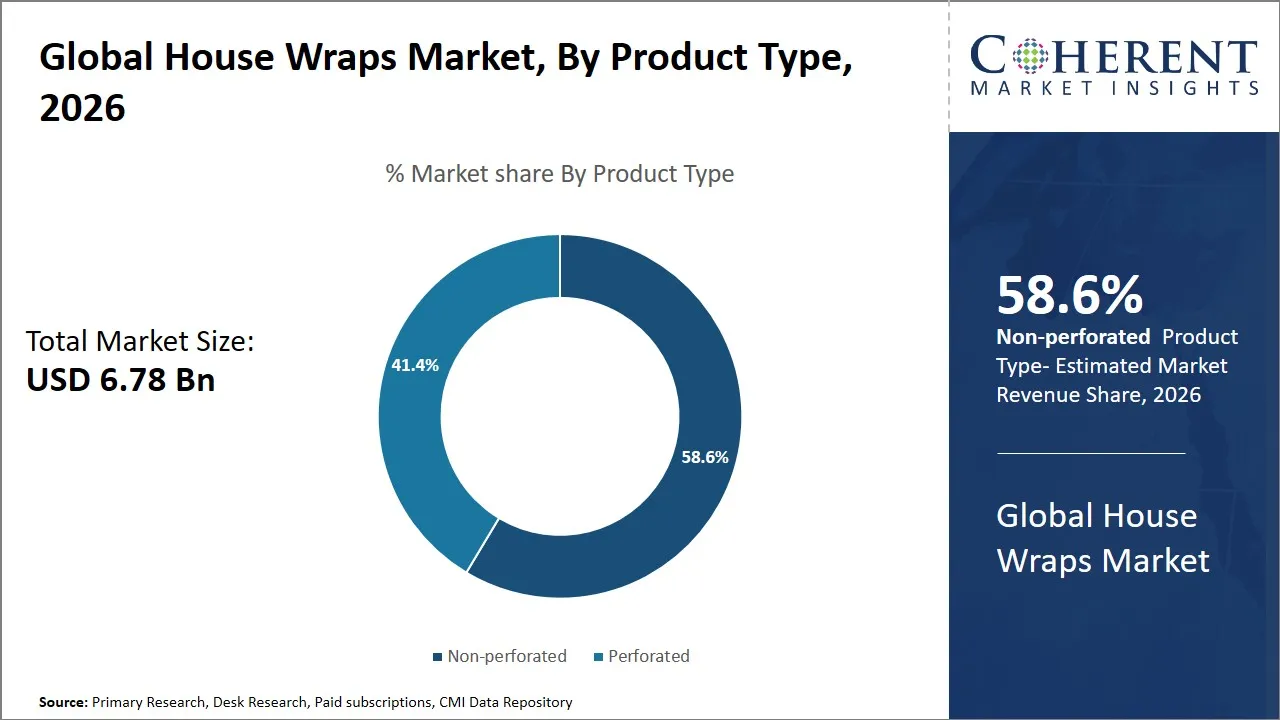
Non-perforated house wraps are highly preferred because of their higher waterproof quality than perforated products. Non-perforated wraps are an effective barrier to elements like rain, snow, and moisture caused by the wind, which serves as one of the leading causes of exterior wall deterioration. This great performance in moisture barriers helps protect deterioration of building structures and minimize the chances of molds, rotting of wood, and corrosion in structures.
Non-perforated house wraps are projected to hold 58.6% of the house wraps market share in 2026. In countries like the U.S., Canada, Germany, the U.K., France, Sweden, Norway, there has been an increased need for improved air barrier performance, as energy efficiency standards become stricter. As a result, the use of non-perforated house wraps has increased in residential construction such as single- and multi-family homes as well as in light commercial construction and retrofit applications in these countries.
Residential Segment Dominates the Global House Wraps Market
The residential segment is expected to lead and hold 59.6% of the global house wraps market share in 2026, as consumers in the U.S., Germany, China, Japan, and India continue to look for effective building envelop solutions that offer energy efficiency and moisture resistance. Additionally, due to the growth of urban population and disposable income, the construction of new residential buildings and renovation of the existing ones are in high demand. For instance, in the second quarter of 2025, the U.S. had 949,600 construction establishments as per the U.S. Bureau of Labor Statistics.
The U.S. witnesses a high usage of polyethylene-based non-perforated wraps for exterior wall air barrier applications, especially in single-family homes. A large number of multi-family and urban residential construction in China and India use polyethylene and polypropylene wraps which are breathable and help moisture management in humid conditions.
Japan mostly has wooden residential structures and thus emphasizes high-performance, non-perforated wraps for weather resistance and durability. The use of vapor-open, fiber-based and polypropylene wraps is concentrated in Germany in energy-efficient and passive housing applications. Owing to superior airtightness and moisture control, non-perforated house wraps remain the dominant product type in these countries.
Perforated variants, on the other hand, find selective applications in structures requiring higher vapor permeability. Southeast Asian countries like Thailand, Malaysia, Singapore, Indonesia, Philippines, and Vietnam owing to high humidity levels are primary preference market for perforated house wraps.
Currents Events and their Impact
Current Events | Description and its Impact |
EU Mandatory Life‑Cycle Carbon Disclosure Rules (Dec 2025) |
|
Macro Regulatory Push on Embodied Carbon & Building Compliance (2025–2028) |
|
House Wraps Market Dynamics
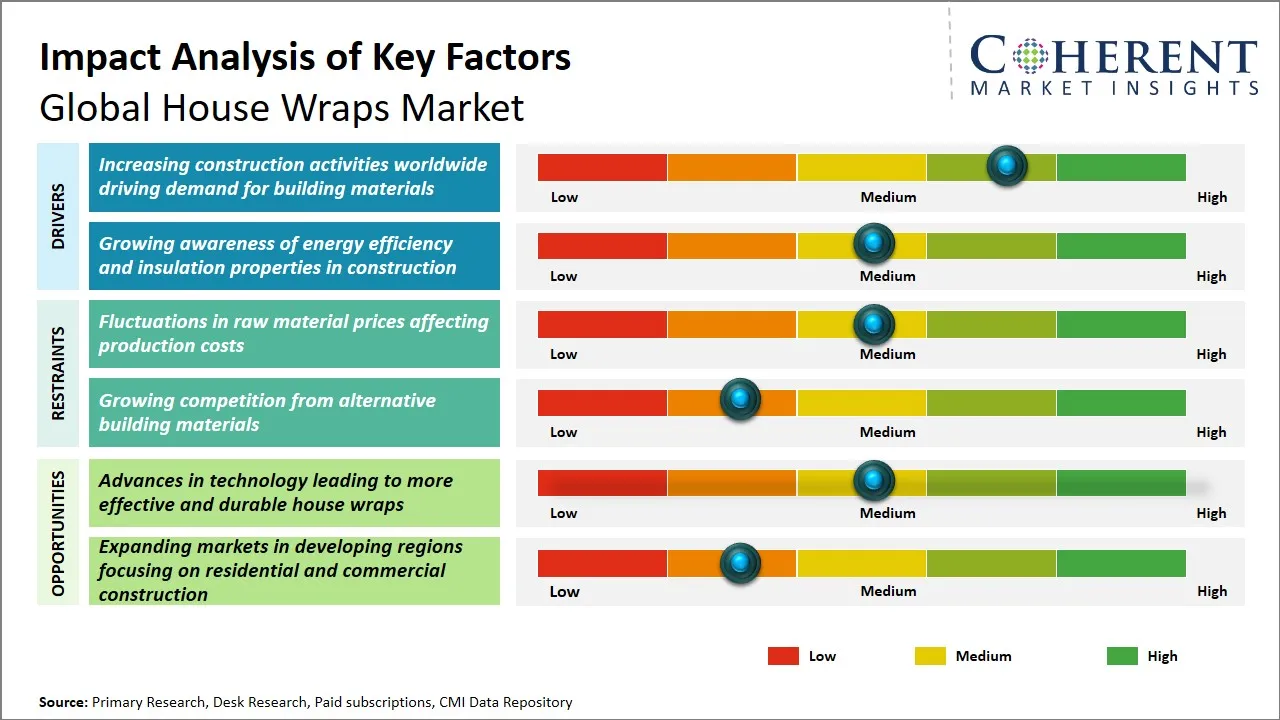
Market Drivers
- Growing Importance of Green Construction and Energy Efficiency: Strict regulatory frameworks, net-zero targets, and increasing ESG-driven investments are pushing the need for sustainable buildings in developed markets like the U.S. and Europe. On the other hand, green building mandates and energy-efficiency codes are boosting adoption in China, India, and other emerging economies.
- In the EU, with regulations such as the Energy Performance of Buildings Directive (EPBD) and the ‘Fit for 55’ climate package, advanced building envelope solutions are witnessing a high demand. These policies govern improved energy efficiency and airtightness in buildings which drive the demand for weather-resistant barriers. House wraps are becoming highly preferred weather-resistant barriers to reduce heat loss while improving insulation performance and meeting decarbonization targets.
- In residential structures, air leakage is one of the major concerns and causes about 25–40% of energy loss. Emerging as a solution, the proper installation of house wraps can result in nearly 10–20% reduction in heating and cooling energy consumption and improve a building’s energy efficiency. (Source: Directorate-General for Energy)
- Increasing Home Renovation Practices: There has been a subsequent rise in retrofits and renovation activities as new building technologies and sustainable construction materials improve energy efficiency and ease the installations. High-efficiency HVAC systems, smart building automation, and energy-efficient lighting are the key technologies transforming both old and new buildings. There has also been a higher adoption of advanced insulation materials, energy-efficient windows, and weather-resistant barriers like house wraps. House wraps, moreover, are emerging as key solution for air leakage reduction and moisture management and help improve the overall envelope performance of a building.
Rising Rainfall Intensity to Accelerate Demand for House Wrap Solutions
Rank | Country | Avg. Annual Rainfall (mm) | Market Implication for House Wraps |
1 | Colombia | 3,240 | High demand for advanced moisture barriers |
2 | São Tomé and Príncipe | 3,200 | Need for breathable, water-resistant envelopes |
3 | Papua New Guinea | 3,142 | Increased adoption in tropical construction |
4 | Solomon Islands | 3,028 | Strong requirement for weatherproofing systems |
5 | Panama | 2,928 | Growth in residential protection solutions |
6 | Costa Rica | 2,926 | Demand for mold- and moisture-resistant wraps |
7 | Samoa | 2,880 | Increased need for durable building envelopes |
8 | Malaysia | 2,875 | Rising use in monsoon-prone regions |
9 | Brunei | 2,772 | Demand for long-lasting protective membranes |
10 | Indonesia | 2,702 | Growth in cost-effective, high-performance wraps |
(Source: Worldatlas.com)
Emerging Trends
- Rising Popularity of Sustainable Materials: Sustainable house wrap materials like Tyvek are lighter, better for the environment, and more effective for long-term protection of homes which help meet sustainability goals for both new construction and retrofit projects.
- Technological Advancement in House Wrap Installation: Innovations such as self-adhering wraps, drainable house wraps, and liquid applied membranes are representing a significant shift from traditional lapped and tapped house wraps, making them suitable for complex building designs.
Regional Insights
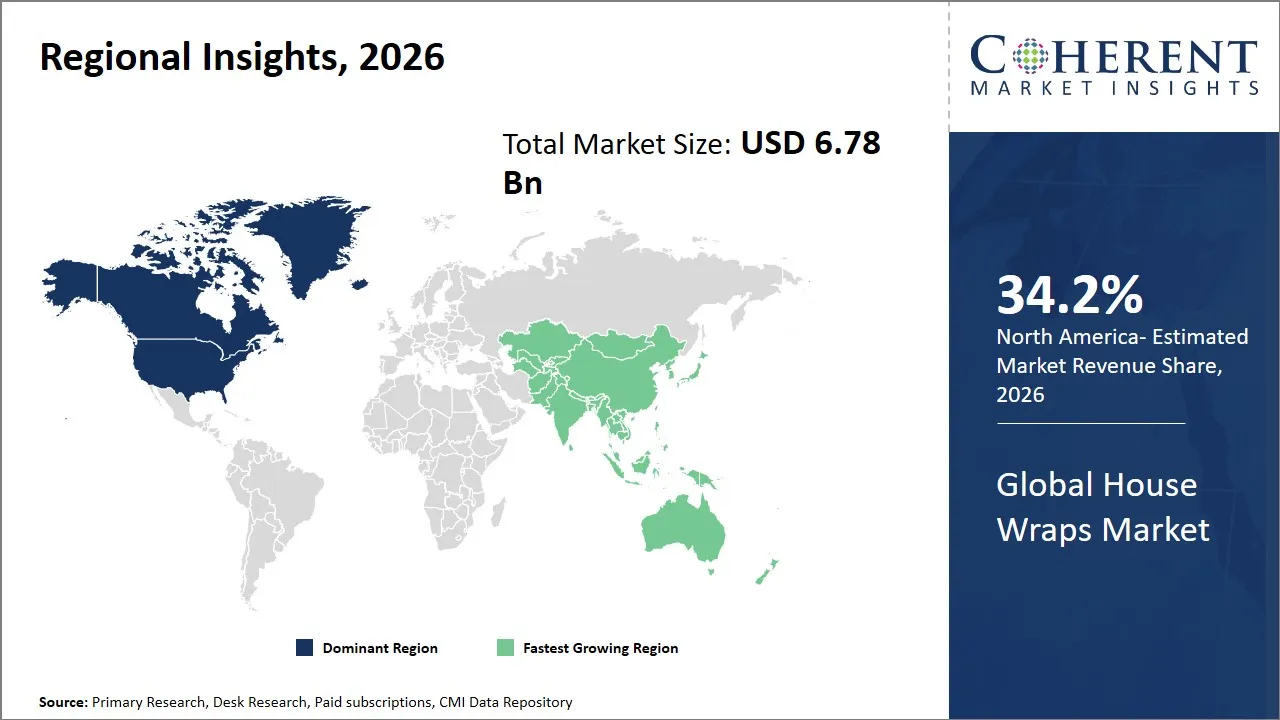
Why is North America a Strong Market for House Wraps?
North America leads the global house wraps market, accounting for an estimated 34.2% share in 2026 due to the established construction ecosystem, strict building codes aimed at energy efficiency, and the high usage of sophisticated building materials. For instance, California has introduced strict updates under its 2025 Title 24 Building Standards Code, focusing on enhanced fire safety, energy systems regulation, rooftop occupancy rules, and stricter requirements for wildfire-prone areas and temporary structures. These codes aim to improve building safety, sustainability, and compliance across residential and commercial construction projects.
Companies like DuPont, Owens Corning, and 3M are focusing on alignment with green building standards such as LEED. In addition to developing low-carbon and sustainability-certified products, these companies are taking initiatives to integrate building envelope systems. These strategies help them stand out and strengthen their presence in the U.S. house wraps market.
One of the clear instances is the introduction of Environmental Product Declarations (EPDs) on July 11, 2025 by DuPont for its Tyvek products in North America. It targets reduced embodied carbon with the adoption of renewable energy. (Source: DuPont.com)
Additionally, for large-scale residential demand, these companies are making significant investments in production capacity and advanced material innovation. Growing emphasis of the U.S. on energy-efficient and sustainable construction (for e.g. DuPont’s production facility in Richmond, Virginia received ISCC PLUS certification in July 2024) are also likely to favor these companies. (Source: DuPont)
Why Does Asia Pacific House Wraps Market Exhibit High Growth?
The Asia Pacific house wraps market is expected to exhibit the fastest growth with an estimated contribution of 19.3% share to the global market in 2026. China, India, Indonesia, Vietnam, and the Philippines are key countries currently witnessing high rate of urbanization and infrastructure development.
Moreover, urbanization in China is set to hit 70% by 2030, while the rate of urban population growth in India and Vietnam is exceeding 2% annually. Similarly, urbanization in Indonesia and the Philippines is witnessing annual growth of approximately 1.5–2.0%; initiatives taken for large-scale infrastructure are supporting such growth. This has resulted in the expansion of urban housing and construction activities, thus driving demand for house wraps, particularly for applications in moisture management and energy-efficient building envelope.
(Source: WHO, Tradingeconomics.com)
The increasing number of middle-class population (expected to be 3.2 billion by 2035) and increased investments in modern housing construction will make the demand rise. To capitalize on the emerging opportunities and strengthen their presence, BASF, Saint-Gobain, and other multinational companies are expanding their local production and capacities. To illustrate, BASF has made large-scale investment in China while Saint-Gobain is expanding its manufacturing capacity in India. Similarly, Owens Corning and DuPont are the companies that are solidifying manufacturing facilities and distribution partnerships for a strong regional footprint. Also, local Chinese and Indian players are parallelly coming up with cost-effective offerings and strong distribution networks and intensifying the competition to accelerate their penetration in the market.
(Source: Mastercard.com)
The supply chain in Asia Pacific is strengthened by trade dynamics and policy frameworks such as the Regional Comprehensive Economic Partnership (RCEP). These factors reduce tariffs and streamline the cross-border movement of raw materials. Local manufacturing is also increasing with the support of national initiatives such as India’s ‘Make in India’ policy. Additionally, foreign investment and technology transfer are growing strong in line with China’s Foreign Investment Law and agreements such as the EU–Vietnam Free Trade Agreement while doing business is becoming easy in Indonesia with Omnibus Law. Collectively, these policies are making raw materials easily available, reducing the cost of production and logistics, and enabling faster expansion of the construction materials market compared to other regions.
Global House Wraps Market Outlook for Key Countries
Why is the U.S. Leading Innovation and Adoption in the House Wraps Market?
The U.S. is a mature and deeply penetrated market for house wraps. The country has witnessed decades of widespread adoption of weather-resistant barriers in wood-frame residential construction. House wraps have been a standard component of exterior wall assemblies since the last 20th century. As building codes evolve and the culture of energy-efficient construction becomes strong, product penetration remains high. Large-scale residential construction and increasing renovation activities in the country are further boosting the adoption.
Continuous large-scale investment in both new construction and renovation, strong focus on energy efficiency, and an aging housing stock are directing the interest in high-performance building envelope solutions such as house wraps. Consequently, the U.S. maintain its market leadership in the adoption, innovation, and standardization of house wraps.
Is Canada a Favorable Market for House Wraps Market?
Canada is a favorable market for house wraps due to cold weather conditions which require sophisticated moisture and thermal management systems in building wraps. DuPont (Tyvek) and 3M are market leaders in the country who have new weather-resistant house wraps that are innovative in saving energy to minimize energy loss and preventing mold. Restricted regional building codes along with environmental sustainability objectives support the implementation of high-quality house wrap materials in residential and commercial building projects.
The large supply chains of forestry industry also makes it easy to access raw materials that are used in the manufacture of house wraps. According to government of Canada, the forestry sector in Canada spans approximately 369 million hectares (roughly 9% of world’s forest cover). The industry generates over US$ 87 billion in revenues, produces more than 14 million tons of wood pulp annually, and contributes over US$ 30 billion to GDP annually. This ensures a stable and scalable raw material supply chain, enhancing the stability of the market.
(Source: Canada.ca)
Is China Emerging as a Key Growth Hub for the House Wraps Market?
China is emerging as a key growth hub for the house wraps market with massive urban housing construction and government policies such as 14th Five-Year Plan, Three-Star Green Building Rating System promoting the use of green buildings and energy-efficient construction practices. The sustained demand for new residential infrastructure can be attributed to unprecedented growth of urban population accounting for approximately ~64% in 2023 and projected to reach ~70% by 2030.
Companies such as Saint-Gobain and BASF are adopting local manufacturing and product localization strategies to strengthen their presence in the country. To intensify the competition, domestic players such as Beijing New Building Material (BNBM), China National Building Material Group, and Oriental Yuhong are also offering cost-effective and climate-adapted membrane and barrier solutions. Large-scale urban housing expansion and supportive green building policies along with a competitive mix of multinational and local manufacturers are fueling demand for advanced building envelope materials like house wraps in China.
The modernization of infrastructure and housing programs has intensified the need to use high-quality house wraps, with special attention to those that enhance house wrap insulation and weather resistance. The government intends to build over 8.7 million subsidized housing units under the 14th Five-Year Plan, and by 2026, affordable housing is set to hold nearly 20% of housing supply in large cities.
Furthermore, supported by major players such as China National Building Material Group (annual cement capacity: ~410 million tons), Beijing New Building Material (wallboard capacity: 3.4 billion m² per year), and Oriental Yuhong (500 million m² waterproofing membrane capacity across 80+ production lines), alongside multinational firms like BASF and Saint-Gobain, the country has an extensive manufacturing base. This allows large-scale production as well as efficient distribution of construction materials, thus making China a strategic growth hub in the Asia Pacific market for house wraps.
(Source: U.S. Census Bureau, Reuters, IEA)
Why Does Germany Top the European House Wraps Market?
Germany remains on the top of the European market due to stringent energy efficiency regulations under the Building Energy Act (GEG) and alignment with the EU Energy Performance of Buildings Directive (EPBD), which mandate high-performance building envelopes. The market is further supported by major industry players such as Knauf and Sto SE & Co. KGaA, which are integrating house wraps into advanced, energy-efficient building envelope systems.
Moreover, government-backed incentives from KfW and BAFA including grants of 15–40% and loans up to USD 172, 995 (€150,000) per unit are accelerating energy-efficient retrofits. This regulatory and financial support ensures sustained demand for advanced house wrap solutions across both new construction and renovation activities.
(Source: Energy.ec.europa.eu)
Is House Wraps Market Developing in India?
The house wraps market is in the process of vast development in India backed by growing urban housing and commercial infrastructure developments and government initiatives like the Energy Conservation Building Code (ECBC). Under the Pradhan Mantri Awas Yojana (PMAY-Urban), more than 11 million houses have been sanctioned, as per the Ministry of Housing and Urban Affairs. Additionally, the construction sector in India is set to exhibit a CAGR of ~6–7%. High infrastructure investments in smart cities along with industrial corridors and urban development projects are supporting the growth.
Local companies such as Pidilite Industries, Dr. Fixit are actively promoting waterproofing and barrier solutions specific to diverse climatic conditions such as high humidity, monsoon exposure, and extreme heat in India. These players are further focusing on distribution expansion and contractor engagement to improve product awareness and localized adoption.
Additionally, the middle-income population is increasing rapidly, with projections of around 715 million by 2030–31 from 432 million in 2020–21. This reflects a significant rise in disposable incomes, consumption capacity, and subsequently, greater investment in durable and energy-efficient construction materials. These factors are expected to support the long-term growth of India house wraps market.
Regulatory Incentives for Insulation Efficiency
Country
| Key Regulation / Incentive Program | Insulation Efficiency Requirement |
U.S. | IECC updates, Inflation Reduction Act home efficiency credits | Higher building envelope insulation standards for new and renovated buildings |
Canada | National Energy Code for Buildings (NECB) & provincial efficiency programs | Stricter thermal and air barrier performance standards |
European Union | Energy Performance of Buildings Directive (EPBD) | Near-zero energy building (NZEB) compliance mandates |
How is the need of more efficient and lasting house wraps creating new growth opportunities in the House Wraps Market?
The global house wraps market will be able to take advantage of the current technological advancements that are paving the way to create more efficient and lasting house wraps. The breathability of house wraps, as well as their UV impermeability, are improving with technological advances in the field of material science, including the incorporation of improved polymers and nanotechnology, which is making them more dependable and long-lived.
Water vapor permeability levels in modern house wraps are between 50 and 70 perms, which is up to ten times better than the minimum baseline levels of about 5 perms in earlier products. Moreover, in advanced commercial-grade wraps, UV resistance has grown from roughly 60–120 days to as much as 270 days. Innovations in high-density polyethylene fiber structures and microporous membranes are contributing to these developments, which consequently improve the durability, reliability, and long-term performance of house wraps.
For example, DuPont introduced Tyvek Fluid Applied and Tyvek Self-Adhered Weather Barrier Systems, which combine adhesive-backed or fluid-applied technology to create a continuous air and water barrier without mechanical fastening. These systems are widely adopted in North American residential and commercial projects to improve airtightness, speed up installation, and enhance long-term wall assembly durability.
(Source: Dupont.com)
Market Players, Key Development, and Competitive Intelligence
Key Developments
- In November 2024, architecture studio, Rahul Pudale Design completed Porous Adobe, a compact family home in India featuring a perforated earthen façade. Built on a narrow plot measuring 6 meters wide and 15 meters deep, the design incorporates multiple internal courtyards to improve natural light, airflow, and integration of greenery, effectively overcoming space constraints.
- In March 2024, Grip-Rite launched its ProWrap product line at the International Builders’ Show. The range provides contractors with a complete solution for building tight, energy-efficient, and breathable wall systems. This self-adhering house wrap is designed for both residential and commercial use, offering high breathability, easy installation, and cost efficiency.
Competitive Landscape
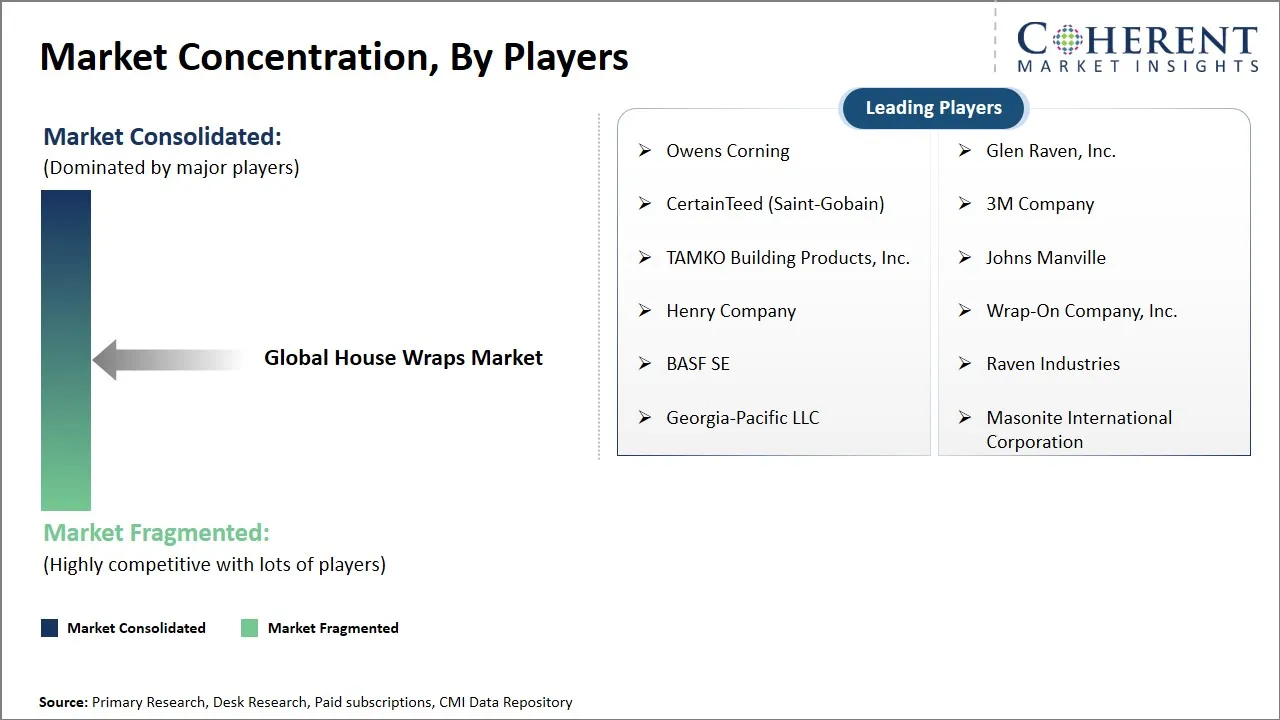
The house wraps market is characterized as highly competitive. With strong foothold and greater understanding of the landscape, established companies are able to adapt to stricter building codes and bring in advanced materials to the market faster. Key focus areas include:
- High-performance and easy-to-install products
- Sustainable products
- Product diversification and strategic partnerships
Market Report Scope
House Wraps Market Report Coverage
| Report Coverage | Details | ||
|---|---|---|---|
| Base Year: | 2025 | Market Size in 2026: | USD 6.78 Bn |
| Historical Data for: | 2020 To 2024 | Forecast Period: | 2026 To 2033 |
| Forecast Period 2026 to 2033 CAGR: | 7.67% | 2033 Value Projection: | USD 11.37 Bn |
| Geographies covered: |
| ||
| Segments covered: |
| ||
| Companies covered: | Owens Corning, Glen Raven, Inc., CertainTeed (Saint-Gobain), 3M Company, TAMKO Building Products, Inc., Johns Manville, Henry Company, Wrap-On Company, Inc., BASF SE, Raven Industries, Georgia-Pacific LLC, and Masonite International Corporation | ||
| Growth Drivers: |
| ||
| Restraints & Challenges: |
| ||
Analyst Opinion (Expert Opinion)
- India is the most underpenetrated large construction market relative to its growth rate. Formal developer-led residential projects in metro and tier-2 cities are scaling rapidly. Government housing schemes are pushing affordable multi-family construction at a volume that creates a meaningful base load. Current house wrap penetration is low, meaning incumbents have not yet entrenched. The opportunity is specification-led. Architects and structural consultants in Bangalore and Mumbai who work on premium residential towers are the gateway. Once specified into a project by a Tier 1 developer, a product becomes the default for that developer's pipeline nationally. The window to be the first mover who builds these specification relationships is still genuinely open, but it is narrowing as global players begin to give direct attention to India.
- Manufacturing FDI reshoring from China is building industrial capacity in Vietnam and Indonesia at pace. Alongside this, modular and prefabricated construction is entering the residential segment in urban areas of both countries as a response to labor cost inflation in traditional construction. Factory-applied house wraps (pre-laminated to panel systems) are a higher-value product format that travels with this trend.
- The modular construction firms entering these markets are often Japanese, Korean, or Singaporean operators already familiar with building envelope performance products. Reaching them through their home-market supply chain relationships is more effective than attempting direct distribution entry. Building wrap into a modular panel system as a pre-applied component converts it from a purchased consumable into a design-specified material with much lower price sensitivity.
Speak to the analyst
Want personalized insights?
Take the findings above to one of our principal consultants, or have the report rebuilt around the segments, geographies and competitors you actually track.
Market Segmentation
- Material Type Insights (Revenue, USD Bn, 2021 - 2033)
- Polyethylene
- Polypropylene
- Fiber-based
- Others (e.g., asphalt)
- Product Type Insights (Revenue, USD Bn, 2021 - 2033)
- Non-perforated
- Perforated
- Application Insights (Revenue, USD Bn, 2021 - 2033)
- Residential
- Commercial
- Regional Insights (Revenue, USD Bn, 2021 - 2033)
- North America
- U.S.
- Canada
- Latin America
- Brazil
- Argentina
- Mexico
- Rest of Latin America
- Europe
- Germany
- U.K.
- Spain
- France
- Italy
- Russia
- Rest of Europe
- Asia Pacific
- China
- India
- Japan
- Australia
- South Korea
- ASEAN
- Rest of Asia Pacific
- Middle East
- GCC Countries
- Israel
- Rest of Middle East
- Africa
- South Africa
- North Africa
- Central Africa
- North America
- Key Players Insights
- Owens Corning
- Glen Raven, Inc.
- CertainTeed (Saint-Gobain)
- 3M Company
- TAMKO Building Products, Inc.
- Johns Manville
- Henry Company
- Wrap-On Company, Inc.
- BASF SE
- Raven Industries
- Georgia-Pacific LLC
- Masonite International Corporation
Sources
Primary Research Interviews
- House wrap manufacturers
- Supply Chain Director of building materials producer
- Stego Industries (weather-resistive barrier specialist)
- Sustainability Officer of building envelope certification authority
Stakeholders
- Manufacturers of house wraps and weather-resistive barriers (e.g., DuPont, CertainTeed, Benjamin Obdyke, Cosella-Dorken)
- End-use Sectors
- Residential Construction Builders (e.g., Lennar, D.R. Horton)
- Commercial Building Developers (e.g., Prologis, Brookfield)
- Roofing and Siding Contractors (e.g., NRCA members)
- Regulatory & Certification Bodies: ICC (building codes), ENERGY STAR (efficiency), ASTM International (performance standards).
- E-commerce Platforms and Retailers: Home Depot, ABC Supply, Industrial Suppliers like Grainger.
- Technology Integration Players: Innovators in advanced insulation/smart envelopes (e.g., Owens Corning, BASF)
Databases
- UN Comtrade Database (HS Code 3921 for plastics in sheets, relevant to house wraps)
- India Import Export (EXIM) Database
- USGS Construction Materials Reports (broader aggregates, adapted for synthetics)
- Eurostat Trade Statistics for Building Materials
- USITC DataWeb for construction product imports
Magazines
- Professional Roofing Magazine – Trends in building envelopes and barriers
- Walls & Ceilings – House wrap innovations in cladding
- Building Enclosure – Weather barriers in construction
- Roofing Contractor – Moisture management products
- Professional Builder – Residential wrap applications
Journals
- Journal of Building Engineering – Durability of weather-resistive barriers
- Building and Environment – Energy efficiency of house wraps
- Construction and Building Materials – Permeability and performance testing
- Energy and Buildings – Thermal impacts of barriers
- Journal of Architectural Engineering – Envelope technology advancements
Newspapers
- The Wall Street Journal – Construction demand for building materials
- Business Standard (India) – Growth in housing and wraps imports
- Construction Dive – Supply chain for envelopes
Associations
- National Roofing Contractors Association (NRCA)
- Building Enclosure Technology and Environment Council (BETEC)
- Sealant, Waterproofing & Restoration Institute (SWRI)
- Vinyl Siding Institute (VSI)
- International Institute of Building Enclosure Consultants (IIBEC)
- American Institute of Architects (AIA) Building Enclosure Councils
Public Domain Sources
- EPA – Guidelines for building product VOCs and synthetics
- International Code Council (ICC) – Standards for weather barriers
- US Department of Energy – Energy-efficient envelope guidelines
- OECD – Sustainable construction materials trade reports
Proprietary Elements
- CMI Data Analytics Tool, Proprietary CMI Existing Repository of information for last 10 years.
Get access to 250+ pages report
Every segment, forecast, competitor profile and data table behind the analysis above — available for instant download.
- ESOMAR Member
- ISO 9001:2015 Certified
- D-U-N-S Registered
- GDPR & CCPA Compliant
Missing comfort of reading report in your local language? Find your preferred language:
Transform your Strategy with Exclusive Trending Reports
Frequently Asked Questions
The global house wraps market is estimated to be valued at USD 6.78 Bn in 2026 and is expected to reach USD 11.37 Bn by 2033.
Polyethylene-based wraps dominate due to their durability, moisture resistance, and cost efficiency.
House wraps are protective membranes installed under exterior cladding to block air and moisture while allowing vapor escape.
The CAGR of global house wraps market is projected to be 7.67% from 2026 to 2033.
Increasing construction activities worldwide driving demand for building materials and growing awareness of energy efficiency and insulation properties in construction are the major factors driving the growth of the global house wraps market.
Fluctuations in raw material prices affecting production costs and growing competition from alternative building materials are the major factors hampering the growth of the global house wraps market.
In terms of material type, polyethylene is estimated to dominate the market revenue share in 2026.