

Teak Furniture Market Size & Forecast 2026- 2033
Teak Furniture Market is estimated to be valued at USD 36,886.8 Mn in 2026 and is expected to reach USD 53,658.5 Mn in 2033, exhibiting a compound annual growth rate (CAGR) of 5.5% from 2026 to 2033.
Key Takeaways
- Based on Furniture Type, the Indoor Segment is projected to capture 73.4% of the global teak furniture market in 2026, driven by strong demand for durable and elegant interior furnishings.
- Based on Product, the Table and Chair segment is expected to account for the largest share of the market in 2026, driven by their versatility and high demand across residential and commercial spaces.
- Based on Distribution Channel, the online Store segment expected to dominate the market with the highest share in 2026, driven by digital convenience, wider reach, and evolving consumer preferences.
- Based on End User, the Residential segment is set to hold the greatest share of the market in 2026, driven by rising demand for durable and stylish home furnishings.
- Based on Region, Asia Pacific is expected to lead the global teak furniture market in 2026 with a 51. 8% share. While, North America, with a share of 21.2% will be the fastest growing region.
Market Overview
The teak furniture market demand is driven by rising demand for durable, premium-quality wood furnishings. Known for its natural resistance to moisture, pests, and decay, teak is favored for both indoor and outdoor applications. Sustainability concerns are boosting interest in certified and reclaimed teak, while growing disposable incomes and design trends fuel global expansion.
Current Events and Its Impact
Current Event | Description and its Impact |
EU Deforestation Regulation (EUDR) Compliance Requirements |
|
Certified Plantation Teak Expansion and Sustainable Material Transition |
|
Top Exporting Countries
- Myanmar (Burma)
- Historically the largest exporter of natural forest teak, especially Grade A teak.
- However, due to environmental concerns and illegal logging, Myanmar imposed a log export ban in 2014, and international sanctions have further restricted trade.
- Despite restrictions, Myanmar teak remains in demand for high-end marine and architectural use.
- Indonesia
- A major exporter of plantation-grown teak, primarily from Perum Perhutani, a state-owned forestry company.
- Known for FSC-certified sustainable teak, Indonesia supplies large volumes to the U.S., Europe, and Australia.
- Exports include both raw timber and finished furniture products.
- India
- Both an importer and exporter: India imports raw teak logs (especially from Africa and Latin America) and exports finished teak furniture.
- Indian manufacturers are known for skilled craftsmanship and competitive pricing, making them key players in global furniture exports.
- Thailand and Laos
- Export smaller volumes of plantation teak.
- Thailand has strict controls on natural teak logging, focusing more on domestic use and value-added exports.
- African Nations (Ghana, Nigeria, Ivory Coast, Togo, Benin)
- Emerging exporters of plantation teak, especially to India and China.
- African teak is generally younger and less oily than Southeast Asian varieties but is gaining popularity due to availability and cost.
- Current Industry Events of 2026
- Market Size Estimation
- Regional Breakdown
- Competitive Landscape
- Customer Intelligence
- Segmental Analysis
- Pricing Analysis
- Key Market Drivers, Challenges & Future Trends
- Customized Insights Section
Top Importing Countries
- India
- The largest importer of raw teak logs, especially from Africa and Latin America.
- Imports support its vast furniture manufacturing sector, which re-exports finished goods globally.
- China
- A major importer of both raw and semi-processed teak.
- Uses teak in luxury interiors, flooring, and high-end furniture.
- Increasing domestic demand has made China a key player in global teak procurement.
- United States
- Imports finished teak furniture and decking materials, primarily from Indonesia, India, and Vietnam.
- Demand is driven by outdoor living trends and sustainable sourcing preferences.
- European Union (Germany, France, Netherlands)
- Focus on FSC-certified and legally sourced teak.
- Imports are mostly in the form of furniture and decking, with strict compliance to EUTR (EU Timber Regulation).
Segmental Insights
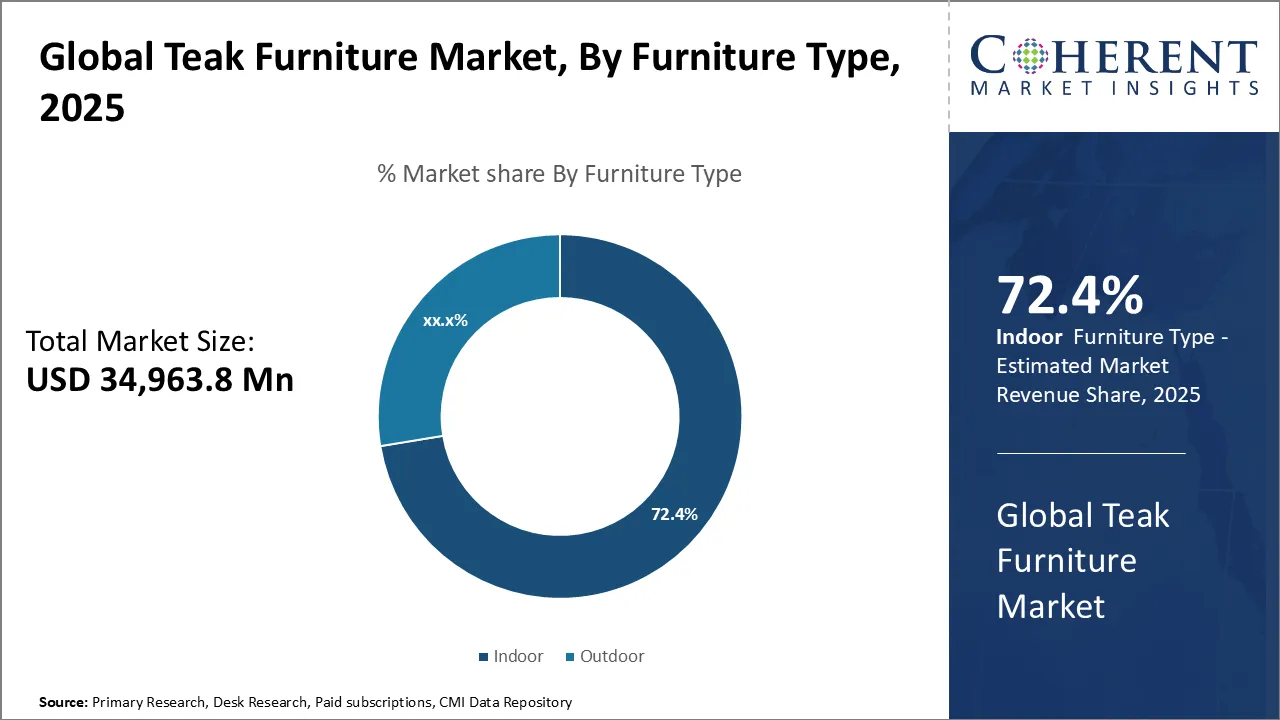
Teak Furniture Market Insights, By Furniture Type - Indoor Teak Furniture Leads Is Driven by Strong Demand for Durable and Elegant Interior Furnishings
In terms of furniture type, the indoor segment is expected to lead the market with a 73.4% share in 2026, due to its widespread use in homes, offices, and hospitality spaces. Its popularity stems from teak’s durability, elegant appearance, and resistance to pests, making it ideal for beds, dining tables, and cabinets. Rising urbanization and disposable incomes, especially in Asia-Pacific and North America, fuel demand for premium indoor furnishings. While outdoor teak furniture like patio sets and garden benches, remains popular in seasonal and regional markets, its overall share is smaller. The indoor segment benefits from consistent year-round demand and broader applications, securing its position as the leading category in the teak furniture market.
For instance, in March 2025, Luxus Home and Garden, renowned for luxury teak outdoor pieces, has unveiled its new indoor furniture collection. Featuring dining sets, sideboards, bedroom furniture, and more, each item is crafted from premium natural materials like teak, ash, and leather. The collection blends timeless elegance with everyday functionality, emphasizing sustainability and craftsmanship.
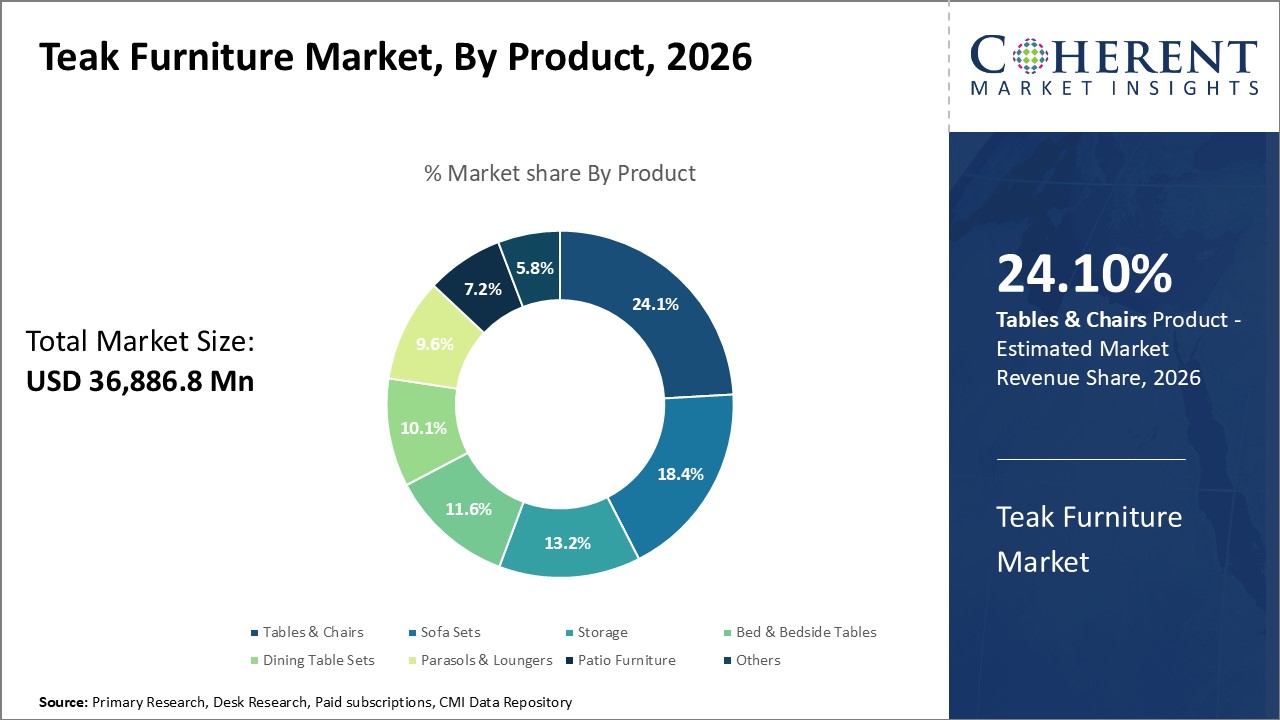
Teak Furniture Market Insights, By Product - Tables & Chairs Lead Is Driven by Their Versatility and High Demand Across Residential and Commercial Spaces
In terms of product, the tables and chairs segment is projected to lead with largest share in 2026, due to their versatility, functionality, and widespread use across residential and commercial spaces. These pieces are essential in dining rooms, kitchens, offices, and hospitality venues, making them high-demand products. Teak’s natural durability, resistance to moisture and pests, and elegant grain enhance their appeal for everyday use. The rise in urban living and preference for sustainable, long-lasting furniture further boosts their popularity. While other segments like beds, sofas, and patio furniture show growth, Tables & Chairs maintain the lead by offering practical value and timeless design, making them the top choice for consumers globally.
For instance, in April 2025, Eterna Home launched its Summer 2025 Teak Collection, bringing sustainable luxury to British gardens. The collection showcases responsibly sourced teak furniture, including beautifully crafted outdoor tables designed for timeless style and durability. With a focus on eco-conscious living and refined craftsmanship, Eterna’s new range caters to the growing demand for elegant, sustainable garden furnishings.
Teak Furniture Market Insights, By Distribution Channel - Online Stores dominance is Driven by Digital Convenience, Wider Reach, And Evolving Consumer Preferences
In terms of distribution channel, the online store segment is expected to capture the highest share of the market in 2026, driven by the convenience of digital shopping and broader product accessibility. Consumers increasingly prefer browsing and purchasing furniture online due to features like virtual showrooms, customer reviews, and home delivery. The rise in smartphone usage and internet penetration, especially in emerging markets, further boosts online sales. While independent furniture retailers and factory outlets still cater to niche and premium buyers, their reach is limited compared to e-commerce platforms. Departmental stores continue to decline in relevance, making online channels the most influential and fastest-growing segment in teak furniture distribution.
Teak Furniture Market Insights, By End-user - Residential Dominance Is Driven by Rising Demand for Durable and Stylish Home Furnishings
In terms of end-user, the residential segment is expected to account for the greatest share of the market in 2026, driven by rising demand for durable and stylish home furnishings. Teak’s natural resistance to moisture, pests, and wear makes it ideal for long-term use in bedrooms, dining areas, and living rooms. Increasing urbanization, higher disposable incomes, and a growing preference for sustainable materials contribute to this trend, especially in Asia-Pacific and North America. Homeowners are investing more in premium furniture to enhance comfort and aesthetics. While commercial use in hotels and offices is growing, it remains secondary to the consistent and widespread demand from residential consumers.
For instance, in March 2025, Ethimo’s latest Patio collection blends ancient weaving traditions with premium teak wood to create elegant outdoor furniture. Showcased in March 2025, the designs highlight artisanal craftsmanship and Mediterranean aesthetics, offering durable, stylish solutions for luxury outdoor living. The collection reinforces teak’s role in timeless, sustainable design.
Regional Insights
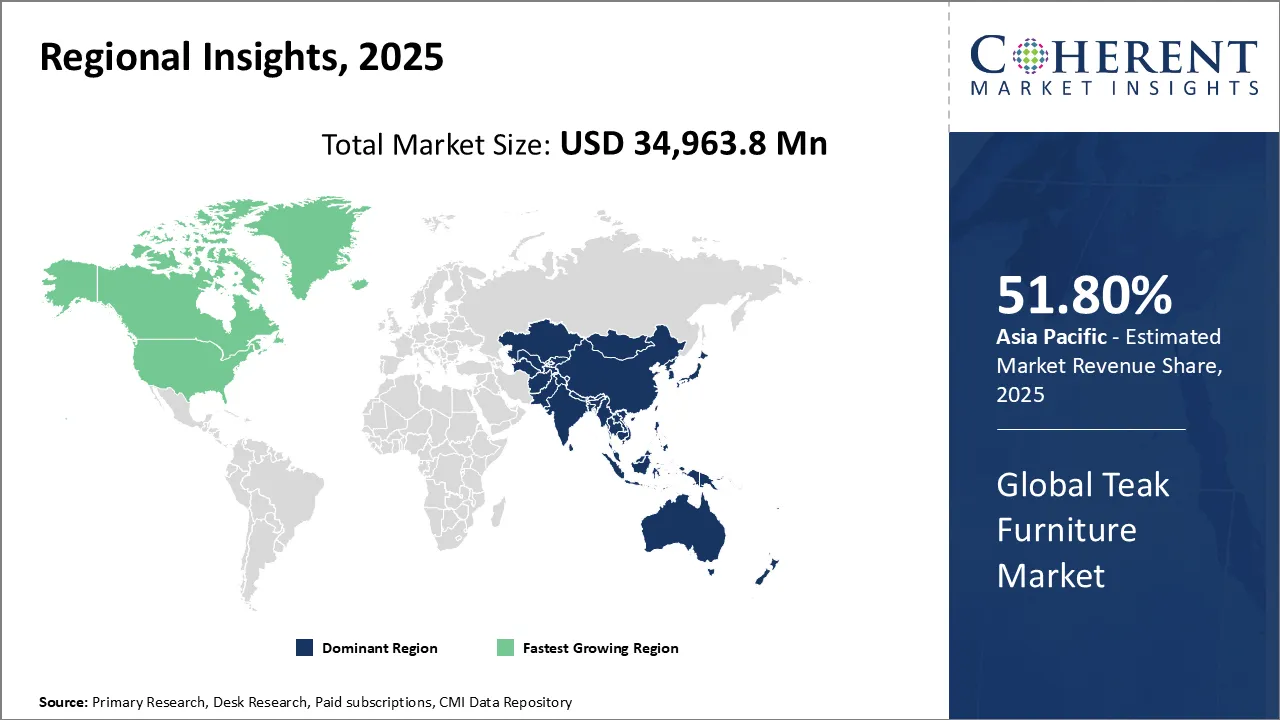
Asia Pacific Teak Furniture Market Analysis & Trends
The Asia Pacific region is projected to lead the market with a 51.8% share in 2026, due to abundant teak resources, rising disposable incomes, and a robust manufacturing base. Countries like Indonesia, India, and Vietnam benefit from local teak plantations, reducing production costs and ensuring supply stability. Rapid urbanization and a growing middle class are driving consumer interest in premium, durable furniture. Teak’s natural resistance to humidity and pests makes it ideal for tropical climates, further boosting its appeal. Additionally, cultural preferences for wooden furniture and expanding export opportunities position Asia-Pacific as a dominant force in the global teak furniture market, with increasing market share.
For instance, in October 2026, Indonesian manufacturer MPP Furniture will present its latest indoor and outdoor teak collections at IFEX 2026, held March 5–8 at ICE BSD City. Known for sustainable sourcing and elegant craftsmanship, MPP aims to attract global buyers with premium teak designs that highlight durability, style, and eco-conscious production for modern living spaces.
North America Teak Furniture Market Analysis & Trends
North America region is expected to exhibit the fastest growth in the market contributing 21.2% share in 2026, due to growing demand for sustainable luxury and durable outdoor furnishings. Consumers increasingly favor teak for its natural resistance to moisture, pests, and weather, making it ideal for patios, gardens, and upscale interiors. The region’s high disposable income supports investment in premium, long-lasting furniture, while eco-conscious buyers seek FSC-certified teak products. E-commerce platforms further boost accessibility, offering customization and direct delivery. Additionally, commercial sectors like hospitality and offices are adopting teak for its elegant appeal and resilience, contributing to North America’s expanding teak furniture market share.
For instance, in August 2026, Harbour underscores teak’s enduring appeal as the gold standard for luxury outdoor furniture. Celebrated for its natural oils, weather resistance, and evolving patina, Grade A Indonesian teak offers unmatched durability and elegance. The brand emphasizes sustainability, minimal maintenance, and timeless design, positioning teak as a cornerstone of premium outdoor living.
Teak Furniture Market Outlook Country-Wise
The U.S. Teak Furniture Market Trends
In 2026, the United States holds a significant 18.2% share of the teak furniture market, driven by high disposable income and a strong preference for sustainable luxury. Teak’s durability and resistance to weather make it ideal for outdoor living spaces, which are increasingly popular in American homes. Consumers are also drawn to FSC-certified teak for its eco-friendly appeal. The rise of e-commerce platforms offering customization and direct delivery has further boosted accessibility. Additionally, commercial sectors such as hospitality and corporate offices favor teak for its upscale aesthetic and long-term value, reinforcing its market strength across the country.
For instance, in January 2026, HiTeak Furniture announces its participation in Casual Market Atlanta 2026, unveiling new outdoor living collections that blend style, durability, and sustainability. The event offers attendees an exclusive look at innovative teak designs tailored for modern outdoor spaces, reinforcing HiTeak’s commitment to craftsmanship and eco-conscious luxury.
China Teak Furniture Market Trends
China leads the teak furniture market with a 19.8% share, fueled by rapid urbanization, rising middle-class wealth, and a growing appetite for premium home furnishings. Teak is viewed as a symbol of status and sophistication, making it highly desirable in luxury residential and hospitality projects. Domestic production capabilities and strategic imports support a robust supply chain. Chinese consumers increasingly seek customized, designer teak furniture that blends traditional craftsmanship with modern aesthetics. The country’s booming real estate and interior design sectors further amplify demand, positioning China as a dominant force in the global teak furniture landscape.
Germany Teak Furniture Market Trends
Germany accounts for 3.3% of the teak furniture market in 2026, driven by its strong commitment to sustainability and high-quality craftsmanship. German consumers value minimalist, durable furniture, and teak’s natural resilience and elegant grain make it a preferred choice. The country’s emphasis on eco-friendly materials aligns with the popularity of FSC-certified teak. Teak furniture is widely used in both indoor and outdoor settings, supported by a mature retail infrastructure and growing online sales. Germany’s design-conscious market and environmental awareness continue to support steady growth in teak furniture demand, especially among affluent and eco-minded buyers.
Brazil Teak Furniture Market Trends
Brazil holds a 1.7% share of the teak furniture market, supported by its local teak plantations and favorable tropical climate. The availability of domestic teak reduces production costs and encourages local manufacturing. As Brazil’s middle class expands, consumers are increasingly investing in stylish, long-lasting furniture for both indoor and outdoor use. Teak’s resistance to humidity and pests makes it particularly suitable for Brazilian homes and resorts. The country’s growing interest in sustainable living and natural materials also contributes to teak’s appeal. With rising awareness and export potential, Brazil is emerging as a promising player in the global teak furniture market.
GCC Countries Teak Furniture Market Trends
The GCC region commands a 1.0% share of the teak furniture market in 2026, driven by demand from luxury hospitality, real estate, and high-end residential sectors. Teak’s durability and resistance to extreme heat and moisture make it ideal for outdoor furniture in Gulf climates. Affluent consumers and commercial buyers favor teak for its elegant appearance and long-term performance. The region’s booming tourism industry and upscale developments, especially in the UAE and Saudi Arabia, fuel demand for premium furnishings. As sustainability gains traction, interest in responsibly sourced teak is also rising, positioning GCC countries as niche but influential markets.
Market Report Scope
Teak Furniture Market Report Coverage
| Report Coverage | Details | ||
|---|---|---|---|
| Base Year: | 2025 | Market Size in 2026: | USD 36,886.8 Mn |
| Historical Data for: | 2020 To 2024 | Forecast Period: | 2026 To 2033 |
| Forecast Period 2026 to 2033 CAGR: | 5.5% | 2033 Value Projection: | USD 53,658.5 Mn |
| Geographies covered: |
| ||
| Segments covered: |
| ||
| Companies covered: | Westminster Teak, Inc., GLOSTER FURNITURE GMBH, Nusantara Teak, Wihardja, Wisanka Indonesia, Posteak Furniture, Teak & Mahogany, Danish Teak Classics, Kingsley Bate, Ltd., ARTINDO JAYA FURNITURE (1teakfurniture), MoreThanTeak.com, Pearl Handicraft, Vetra, Segoro Mas Furniture, Country Casual Teak, and Meigu Metal Products Co., Ltd. | ||
| Growth Drivers: |
| ||
| Restraints & Challenges: |
| ||
Teak Furniture Market Driver
Sustainability and Eco-Conscious Living
Sustainability and eco-conscious living are key drivers influencing the teak furniture market share in 2025. Consumers increasingly prioritize environmentally responsible choices, favoring teak for its natural durability, low maintenance, and long lifespan. FSC-certified teak, sourced from responsibly managed forests, appeals to buyers seeking ethical and sustainable products. This shift aligns with global trends in green living and climate-conscious design. As awareness grows, manufacturers emphasize eco-friendly production methods and recyclable materials, boosting teak furniture’s appeal. The market share of teak furniture continues to expand, especially in regions where sustainability is a purchasing priority, reinforcing its position as a premium, planet-friendly option.
Teak Furniture Market Opportunity
Luxury And Customization Demand
The teak furniture market forecast for 2025 indicates strong growth driven by sustainability, luxury demand, and expanding global reach. Consumers increasingly favor teak for its durability, natural beauty, and eco-friendly sourcing, especially FSC-certified wood. The residential segment leads market share, with rising interest in premium, customizable furniture for indoor and outdoor spaces. E-commerce platforms enhance accessibility, while emerging markets like India and Southeast Asia contribute to rising demand. Commercial sectors such as hospitality and offices also adopt teak for its upscale appeal. Overall, the teak furniture market is poised for continued expansion, with innovation and green living shaping future opportunities.
For instance, At MYS 2025, Siebensee unveiled its latest outdoor furniture collections crafted from premium teak, designed for superyachts and exclusive terraces. The brand emphasized teak’s durability, marine-grade quality, and timeless elegance, reinforcing its reputation as a leader in luxury outdoor furnishings tailored for elite maritime and residential environments.
Analyst Opinion (Expert Opinion)
The teak furniture market value is shifting from volume expansion to supply governance and value differentiation. Limited availability of high-grade teak, primarily concentrated in Myanmar, India, and Indonesia, continues to define the market’s price structure. Despite Myanmar’s historic dominance, ongoing regulatory restrictions and traceability failures have rendered its exports highly risky, creating a premium tier for certified, verifiable supply chains. Recent Myanmar auctions yielded only a few hundred cubic meters of export-grade teak, underscoring persistent scarcity.
Demand remains resilient in luxury outdoor, marine, and bespoke interior applications where teak’s durability and dimensional stability are unmatched. Manufacturers are now strategically segmenting offerings, premium certified teak for high-end buyers, plantation-grade for mid-range, and reclaimed or engineered substitutes for cost-sensitive markets. The rise of traceability technologies and FSC-certified plantations in Indonesia and India is enabling compliant suppliers to command stronger margins and preferred buyer status.
In this evolving environment, firms that integrate provenance verification, sustainability credentials, and diversified sourcing will lead market consolidation. The teak furniture industry’s growth will no longer hinge on volume but on credibility, governance, and material innovation, transforming teak from a commodity hardwood into a symbol of ethical luxury and engineered excellence.
Speak to the analyst
Want personalized insights?
Take the findings above to one of our principal consultants, or have the report rebuilt around the segments, geographies and competitors you actually track.
Recent Developments
- In August 2025, Yardbird launched its latest teak furniture collection, blending sustainability with timeless outdoor style. Designed for durability and elegance, the collection features FSC-certified teak pieces perfect for patios and gardens. With a focus on eco-conscious materials and modern comfort, Yardbird continues to redefine outdoor living for the summer season.
- In July 2025, Hongkai Outdoor launched multiple premium outdoor furniture collections for 2025, including the Valeria, Swing, Urban, and Pandia series. Each line blends modern aesthetics with durable materials like FSC-certified teak and PE rattan, offering modular, weather-resistant solutions for residential and commercial spaces. The collections emphasize comfort, sustainability, and adaptive design.
Market Segmentation
- Furniture Type Insights (Revenue, USD, 2021 - 2033)
- Indoor Teak Furniture
- Outdoor Teak Furniture
- Product Insights (Revenue, USD, 2021 - 2033)
- Bed & Bedside Tables
- Sofa Sets
- Storage
- Tables & Chairs
- Dining Table Sets
- Parasols & Loungers
- Patio Furniture
- Others (Benches & Barstools, etc.)
- Distribution Channel Insights (Revenue, USD, 2021 - 2033)
- Online Stores
- Departmental Stores
- Independent Furniture Retailers
- Factory Outlets
- End User Insights (Revenue, USD, 2021 - 2033)
- Residential
- Commercial
- Regional Insights (Revenue, USD Mn, 2021 - 2033)
- North America
- U.S.
- Canada
- Latin America
- Brazil
- Mexico
- Argentina
- Rest of Latin America
- Europe
- Germany
- U.K.
- Spain
- France
- Italy
- Russia
- Rest of Europe
- Asia Pacific
- China
- India
- Japan
- Australia
- South Korea
- ASEAN
- Rest of Asia Pacific
- Middle East
- GCC
- Israel
- Rest of Middle East
- Africa
- North Africa
- Central Africa
- South Africa
- North America
- Key Players Insights
- Westminster Teak, Inc
- GLOSTER FURNITURE GMBH
- Nusantara Teak
- Wihardja
- Wisanka Indonesia
- Posteak Furniture
- Teak & Mahogany
- Danish Teak Classics
- Kingsley Bate, Ltd.
- ARTINDO JAYA FURNITURE (1teakfurniture)
- MoreThanTeak.com
- Pearl Handicraft
- Vetra
- Segoro Mas Furniture
- Country Casual Teak
- Meigu Metal Products Co., Ltd.
Sources
Primary Research Interviews from the following stakeholders
Stakeholders
- Interviews with furniture manufacturers, timber suppliers, furniture retailers, interior designers, export managers, procurement officers, and sustainability certification bodies across key teak-producing and consuming markets.
Specific stakeholders
- Procurement heads and sourcing managers at premium furniture brands (e.g., IKEA, Godrej Interio, Ethan Allen, Ashley Furniture)
- Plantation owners and forest management officials in Southeast Asia and Africa (e.g., Indonesia, Myanmar, Tanzania)
- Exporters and trading agents specializing in teak wood and semi-finished products (e.g., boards, slabs, veneers)
- Operations heads at furniture manufacturing clusters (e.g., Jodhpur, Jepara, Chiang Mai)
- Interior architects and designers catering to residential and hospitality projects
- Quality assurance and compliance officers overseeing FSC and PEFC certifications
- Procurement teams at luxury hotel chains and resorts (e.g., Oberoi Group, Hyatt, Four Seasons)
- Supply chain and logistics coordinators in timber and furniture export corridors
Databases
- UN Comtrade Database
- World Trade Organization (WTO) Trade Statistics
- FAO Forestry Database (Food and Agriculture Organization)
- International Tropical Timber Organization (ITTO) Statistics
- Eurostat
- Directorate General of Commercial Intelligence and Statistics (DGCIS), India
- Indonesia Ministry of Trade Export Data Portal
- Myanmar Timber Enterprise (MTE) Trade Reports
- Kenya Forestry Research Institute (KEFRI) Data Portal
- U.S. International Trade Commission (USITC) Timber Import Reports
Magazines
- Woodworking Network
- Furniture Today
- Wood & Panel Europe
- Interiors & Sources
- Architectural Digest (Design & Furnishings Section)
- Habitat Magazine
- Timber Industry News
- Woodworking News
- Surface & Panel
- Design Middle East
Journals
- Journal of Wood Science
- Forest Policy and Economics (Elsevier)
- Journal of Forestry Research
- Bioresources (North Carolina State University)
- Wood Material Science & Engineering
- Journal of Interior Design
- Journal of Cleaner Production (Sustainable Furniture Section)
- Construction and Building Materials
Newspapers
- The Economic Times – Manufacturing & Timber Trade
- The Hindu Business Line – Furniture and Consumer Goods
- Financial Times – Forestry & Trade Section
- The Guardian – Environment and Forestry Reports
- Nikkei Asia – Wood Products & Exports
- Bangkok Post – Timber and Furniture Trade Updates
- Jakarta Post – Forestry and Plantation News
- The East African – Trade and Forestry Segment
Associations
- Forest Stewardship Council (FSC)
- Programme for the Endorsement of Forest Certification (PEFC)
- International Tropical Timber Organization (ITTO)
- European Federation of Furniture Manufacturers (UEA)
- All India Furniture Manufacturers & Traders Association (AIFMTA)
- Indonesian Furniture and Craft Industry Association (ASMINDO)
- Wood Products Manufacturers Association (WPMA)
- Confederation of Indian Industry (CII) – Wood and Furniture Panel
- Asia Furniture Industry Council (AFIC)
Public Domain Sources
- Ministry of Environment, Forest and Climate Change (Government of India)
- Forest Research Institute (FRI), Dehradun
- Ministry of Trade, Indonesia
- Myanmar Forest Department
- National Bureau of Statistics (Nigeria, Tanzania) – Forestry Reports
- FAO Forestry and Timber Market Outlook Reports
- NITI Aayog – Forestry and Sustainable Development Publications
- Reserve Bank of India (RBI) – Export and Manufacturing Sector Data
- United Nations Environment Programme (UNEP) – Forest and Trade Reports
- European Commission – Timber Regulation Database
Proprietary Elements
- CMI Data Analytics Tool and proprietary repository of teak furniture market data accumulated over 8+ years, covering plantation economics, production capacity, value-chain pricing, trade routes, and design trends across Asia, Europe, and North America.
Get access to 250+ pages report
Every segment, forecast, competitor profile and data table behind the analysis above — available for instant download.
- ESOMAR Member
- ISO 9001:2015 Certified
- D-U-N-S Registered
- GDPR & CCPA Compliant
Missing comfort of reading report in your local language? Find your preferred language:
Transform your Strategy with Exclusive Trending Reports
Frequently Asked Questions
Teak Furniture Market is estimated to be valued at USD 36,886.8 Mn in 2026 and is expected to reach USD 53,658.5 Mn in 2033, exhibiting a compound annual growth rate (CAGR) of 5.5% from 2026 to 2033.
The teak furniture market is expected to grow at a compound annual growth rate (CAGR) of around 5.5%.
Key challenges include sustainability concerns, deforestation, high cost of teak wood, and competition from synthetic and alternative materials.
Westminster Teak, Inc., GLOSTER FURNITURE GMBH, Nusantara Teak, Wihardja, Wisanka Indonesia, Posteak Furniture, Teak & Mahogany, Danish Teak Classics, Kingsley Bate, Ltd., ARTINDO JAYA FURNITURE (1teakfurniture), MoreThanTeak.com, Pearl Handicraft, Vetra, Segoro Mas Furniture, Country Casual Teak, and Meigu Metal Products Co., Ltd.
Top services include online retail platforms, custom furniture design, and direct-to-consumer delivery models for teak furniture.
The primary raw material is Tectona grandis (teak wood), valued for durability, resistance to moisture, and aesthetic appeal.
Asia Pacific will dominate the teak furniture market due to abundant teak resources and strong manufacturing capabilities.