

Global Hydrogen Fluoride Market Size and Forecast – 2026 To 2033
The global hydrogen fluoride market is estimated to be valued at USD 4.35 Bn in 2026 and is expected to reach USD 6.72 Bn by 2033, exhibiting a compound annual growth rate (CAGR) of 6.4% from 2026 to 2033. This growth is supported by the increasing use of hydrogen fluoride in fluorochemicals, refrigerants, fluoropolymers, aluminum fluoride, semiconductor etching, battery materials, petroleum alkylation, and specialty chemical synthesis. Demand is also shifting toward high-purity and application-specific Hydrogen Fluoride (HF) as semiconductor fabs, EV battery supply chains, and advanced fluoropolymer applications require stricter purity, safety, and supply reliability.
Growth is further supported by capacity expansion and backward integration by fluorochemical producers. For instance, in February 2026, Navin Fluorine International Limited commissioned a new 40,000 TPA hydrofluoric acid/anhydrous hydrofluoric acid plant at Dahej, Gujarat, with around US$ 4.70 Mn capital investment, strengthening India’s fluorine chemistry and downstream HF supply base. (Source: Navin Fluorine International Limited)
Key Takeaways of the Global Hydrogen Fluoride Market
- Fluorspar sulfuric acid route is expected to dominate the global hydrogen fluoride market with 84.6% share in 2026, as acid-grade fluorspar remains the primary feedstock for anhydrous HF and downstream fluorochemicals. In September 2025, the U.S. Geological Survey (USGS) reported that a new fluorspar mine in Xinjiang, China began operations with projected annual output of 300,000 tons of acid-grade fluorspar, reinforcing feedstock-led production strength. (Source: U.S. Geological Survey)
- Industrial grade is expected to account for 61.5% share in 2026, supported by broad use in chemical processing, metal treatment, glass etching, petroleum alkylation, and fluorochemical intermediates. Honeywell’s hydrogen fluoride product stewardship summary notes HF use in stainless steel pickling, glass etching, metal coatings, exotic metal extraction, quartz purification, petroleum alkylation, and uranium chemicals production. (Source: Honeywell)
- Anhydrous hydrogen fluoride is expected to dominate by product form with 46.2% share in 2026, owing to its critical role as a concentrated fluorine intermediate for fluorocarbons, fluoropolymers, aluminum fluoride, and electronic-grade derivatives. Stella Chemifa’s May 2025 business results specifically flagged rising domestic purchase prices of anhydrous hydrofluoric acid, highlighting the material’s strategic cost relevance. (Source: Stella Chemifa Corporation)
- Asia Pacific is expected to lead the global hydrogen fluoride market with 48.2% share in 2026, supported by China’s fluorochemical base, semiconductor manufacturing in China, Taiwan, South Korea, and Japan, and aluminum and battery-material activity.
- North America is expected to account for 20.8% share in 2026 in the global hydrogen fluoride market, supported by established fluorochemical production, semiconductor supply-chain investments, aluminum processing, petroleum alkylation, and regulated refrigerant transition activity. The region’s demand is also supported by high-purity chemical requirements from semiconductor manufacturing and specialty chemical applications. The U.S. CHIPS program continues to strengthen domestic semiconductor manufacturing and equipment capacity, creating long-term demand potential for electronic-grade process chemicals, including high-purity hydrogen fluoride.
- Low-GWP transition reshapes fluorocarbon demand for global hydrogen fluoride market: The low-GWP refrigerant transition is changing hydrogen fluoride consumption patterns across fluorochemical production, as HF remains a key upstream feedstock for several fluorinated intermediates used in refrigerants, fluoropolymers, and specialty chemicals. The U.S. EPA states that the AIM Act authorizes an 85% phasedown of HFC production and consumption by 2036, pushing fluorochemical producers toward compliant next-generation products. (Source: Environmental Protection Agency)
- Battery materials create new fluoride demand in global hydrogen fluoride market: Battery-grade HF and downstream fluorinated materials are emerging as strategic opportunities as lithium-ion supply chains expand into electrolytes, PVDF/PTFE binders, and specialty fluorochemicals. Gujarat Fluorochemicals’ Q3FY26 investor presentation noted IFC approval of US$ 4.52 Mn investment in GFCL EV to support India’s first integrated battery materials manufacturing facility, including fluoropolymer and battery chemical capabilities. (Source: Gujarat Fluorochemicals Limited)
Segmental Insights
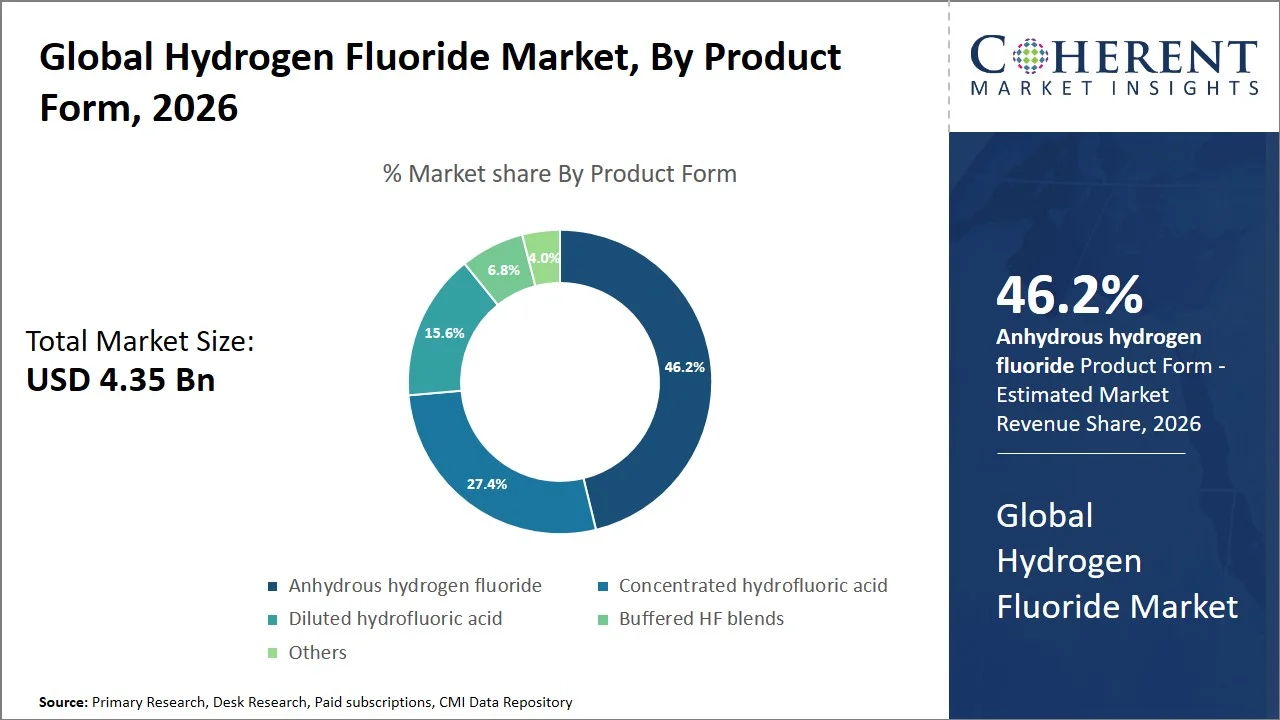
Why Does Anhydrous Hydrogen Fluoride Dominate the Global Hydrogen Fluoride Market by Product Form?
Anhydrous hydrogen fluoride is expected to account for 46.2% of the market share in 2026 and it dominates the product form segment due to its critical role as a concentrated fluorine intermediate for downstream applications such as fluorocarbons, fluoropolymers, aluminum fluoride, and semiconductor etching. Demand-side growth is fueled by chemical manufacturing, aluminum smelting, and specialty fluorochemical industries requiring high-purity, stable HF. On the supply side, advanced handling, storage, and transport technologies enable safer distribution of anhydrous HF, reinforcing adoption. End-use relevance spans chemical plants, smelters, and semiconductor fabs. A recent instance is Honeywell’s expansion of HF production capacity in Louisiana (2025) to supply fluorochemical and aluminum customers efficiently.
- Current Industry Events of 2026
- Market Size Estimation
- Regional Breakdown
- Competitive Landscape
- Customer Intelligence
- Segmental Analysis
- Pricing Analysis
- Key Market Drivers, Challenges & Future Trends
- Customized Insights Section
Why Does Industrial Grade Represent the Largest Grade Segment in the Hydrogen Fluoride Market?
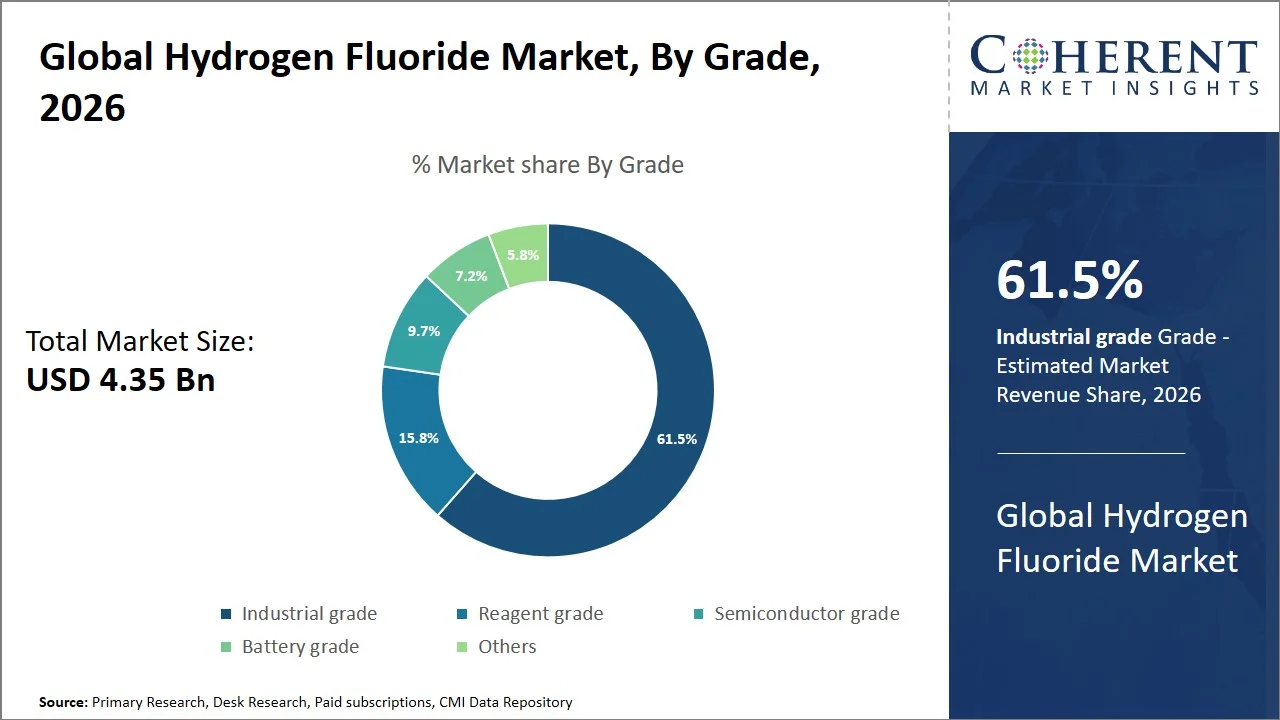
The industrial grade segment is expected to account for 61.5% of the market share in 2026. This segment leads the market owing to its broad usage across chemical manufacturing, aluminum fluoride production, and fluorocarbon intermediates. Demand-side factors include high-volume industrial applications where purity tolerances allow industrial-grade materials. Supply-side relevance stems from cost-effective production and well-established logistics for large-scale industrial-grade HF distribution. End-use relevance includes large chemical plants, aluminum smelters, and bulk fluorochemical production units. For instance, Solvay increased industrial-grade HF output in its Tavaux, France facility in 2025 to meet rising European chemical industry demand. (Source: Solvay)
Why Does the Fluorspar Sulfuric Acid Route Dominate the Global Hydrogen Fluoride Market by Production Route?
The fluorspar sulfuric acid route dominates production, contributing over 84.6% of the global hydrogen fluoride market in 2026 due to the abundance of acid-grade fluorspar reserves and well-established industrial process know-how. Demand-side relevance comes from large-scale HF consumers relying on predictable, high-volume supply. Technology adoption includes optimized sulfuric acid digestion and continuous reactor designs for enhanced yield and efficiency. End-use spans chemical, aluminum, and semiconductor sectors requiring reliable HF feedstock. A recent example is China’s Xinjiang fluorspar mine commencing commercial production in 2025, with projected annual output of 300,000 tons of acid-grade fluorspar.
Currents Events and their Impact
Current Events | Description and its Impact |
European Union Strengthens Critical Raw Material Security for Fluorspar (May 2024 onward) |
|
China Issues 2025–2030 Montreal Protocol Implementation Plan (April 2025) |
|
U.S. EPA Updates Hydrofluoric Acid Mixture Reporting Guidance under EPCRA (March 2026) |
|
U.S. EPA Extends TSCA PFAS Reporting Timeline (May 2025 onward) |
|
(Source: European Commission, Ministry of Ecology and Environment, China, U.S. Environmental Protection Agency)
Global Hydrogen Fluoride Market Dynamics
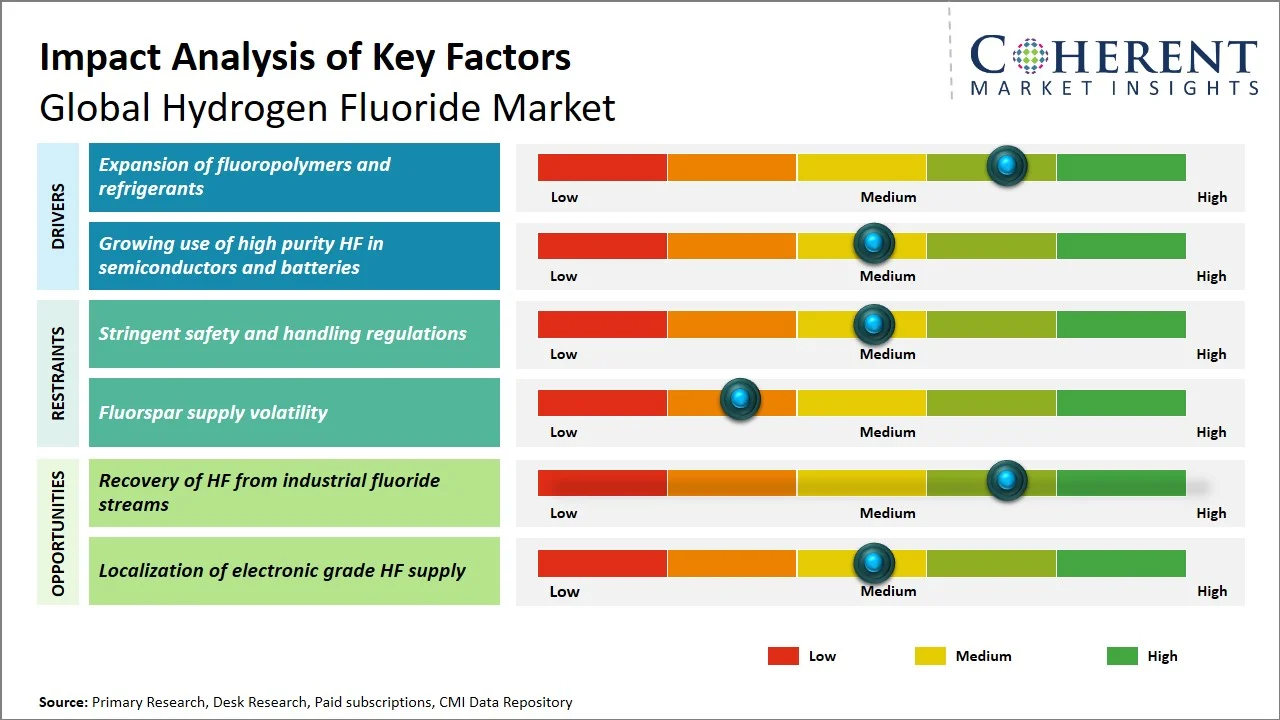
Market Drivers
- Fluoropolymer capacity expansion and refrigerant transition preserve core HF demand: Fluoropolymers and refrigerant intermediates remain major demand anchors for the global hydrogen fluoride market because HF is a primary fluorine source used in producing fluorinated monomers, PVDF, PTFE, and downstream fluorocarbon chemistries. Demand is being supported by lithium-ion batteries, wire and cable insulation, chemical processing equipment, coatings, and regulated next-generation refrigerant applications. This creates stable pull for anhydrous HF and industrial-grade HF, especially among integrated fluorochemical producers that consume HF captively. In March 2026, Arkema announced a 20% expansion of Kynar PVDF production capacity at its Changshu site in China, scheduled to start up in 2028, to support strong demand across Asia Pacific and beyond. (Source: Arkema)
- High-purity HF demand rises with semiconductor and battery supply-chain localization: Growing investment in semiconductor fabs, advanced packaging, and battery materials is increasing demand for high-purity HF used in wafer cleaning, oxide etching, surface preparation, and fluorinated battery intermediates. Unlike bulk industrial HF, semiconductor-grade HF requires very low metal impurities, strict packaging control, and reliable local supply near fab clusters. This improves pricing power for qualified suppliers and raises entry barriers for producers without purification, quality assurance, and hazardous chemical logistics capabilities. In May 2026, the Semiconductor Industry Association reported more than USD 640 billion in U.S. semiconductor supply-chain investments, reflecting large-scale fab and ecosystem expansion that will require reliable process chemical supply, including high-purity wet chemicals such as HF. (Source: Semiconductor Industry Association)
Emerging Trends
- Feedstock security is becoming a strategic procurement priority: Fluorspar availability is becoming a critical trend for the global hydrogen fluoride market because the fluorspar-sulfuric acid route remains the dominant production pathway. HF producers are increasingly exposed to acid-grade fluorspar pricing, mine restarts, regional supply risk, import dependence, and logistics bottlenecks. This is pushing buyers toward diversified sourcing, long-term offtake contracts, regional fluorspar development, and closer integration between mining, HF conversion, and downstream fluorochemical production. In 2025, Canada Fluorspar restarted activity at the St. Lawrence operation and announced its first shipment of acid-grade fluorspar, with plans to ramp production toward 200 kilotons per year. This supports the trend toward regional feedstock resilience for North American fluorochemical and HF users.
- Circular fluorine recovery is emerging as a long-term sustainability pathway: Circular fluorine recovery is gaining attention as regulators and chemical users focus on reducing fluorinated waste, improving resource efficiency, and lowering dependency on virgin fluorspar. For HF producers, this trend may gradually support recovered fluoride routes, recycling-linked feedstocks, and alternative fluorine recovery technologies. Although still at an early stage, the trend is commercially relevant because fluorine is difficult to substitute in semiconductors, batteries, aluminum fluoride, and high-performance materials. In March 2025, University of Oxford researchers reported a mechanochemical process that can destroy long-lived PFAS and recover fluoride for reuse, pointing toward a future circular fluorine economy. Such technologies may influence long-term investment in recovered fluoride and lower-waste HF value chains. (Source: University of Oxford)
Regional Insights
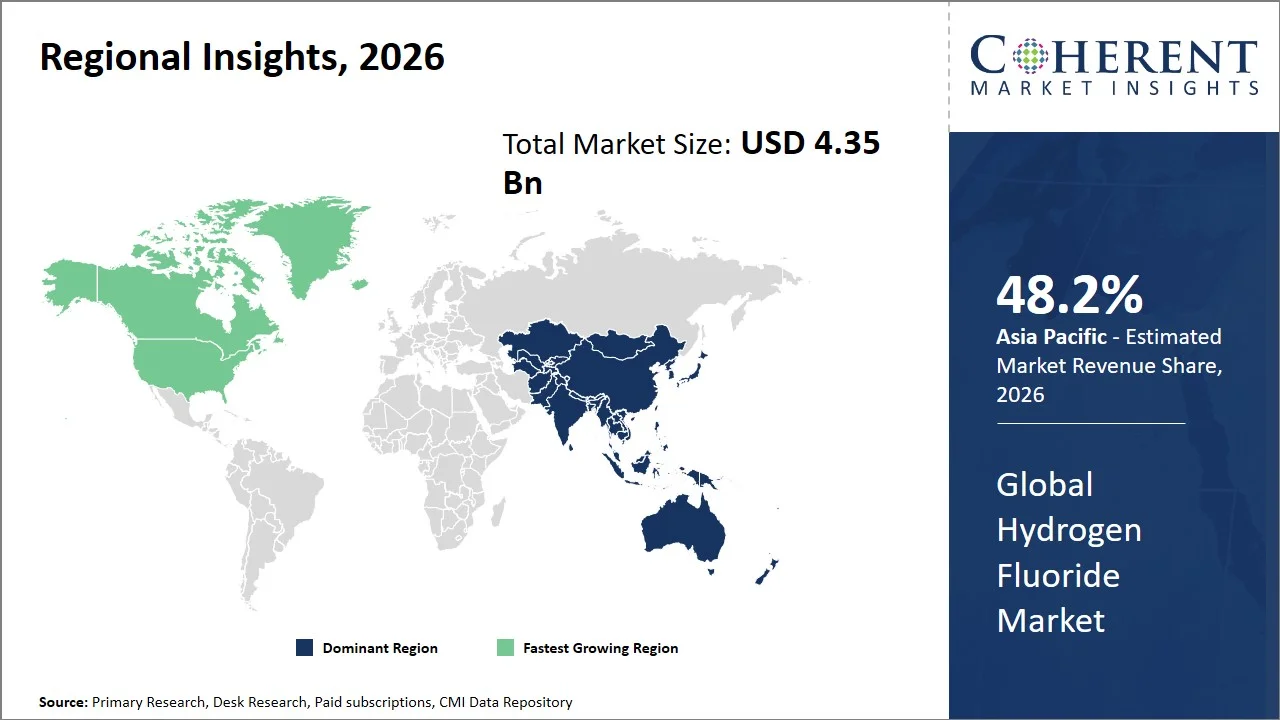
Why is Asia Pacific a Strong Market for Hydrogen Fluoride?
Asia Pacific is expected to dominate the global hydrogen fluoride market with 48.2% share in 2026, supported by its integrated fluorspar-to-fluorochemical value chain, large semiconductor manufacturing base, aluminum processing activity, and expanding battery-material ecosystem. China remains the key production and consumption center, while Japan, South Korea, and Taiwan strengthen demand for high-purity HF used in wafer cleaning and etching. The region also benefits from proximity to electronics, refrigerant, fluoropolymer, and lithium-ion battery customers, allowing integrated producers to manage feedstock, conversion, and downstream consumption more efficiently. A recent example highlighting regional strength is TSMC’s 2025 annual report, which cited robust AI-related semiconductor demand and 35.9% year-on-year revenue growth in U.S. dollar terms, reinforcing Asia Pacific’s process chemical demand base. (Source: TSMC Annual Report)
Why Does the North America Hydrogen Fluoride Market Exhibit High Growth?
North America is expected to be the fastest-growing region in the global hydrogen fluoride market, with 20.8% share in 2026, supported by semiconductor reshoring, battery supply-chain localization, fluoropolymer demand, petroleum alkylation, and regulated transition toward advanced fluorochemicals. The region’s growth is being accelerated by large-scale investment in semiconductor fabs, advanced packaging, and high-purity materials supply chains, which increases demand for electronic-grade HF and related wet chemicals. North America also has a strong installed base of refining and chemical manufacturing where industrial-grade HF remains relevant. A recent market development is TSMC’s expanded U.S. investment program, including a USD 165 billion commitment covering additional Arizona fabs, advanced packaging facilities, and R&D infrastructure.
Global Hydrogen Fluoride Market Outlook for Key Countries
Why is China Leading Production and Consumption in the Hydrogen Fluoride Market?
China is the most important country in the global hydrogen fluoride market due to its large fluorspar reserves, extensive anhydrous HF capacity, strong fluorochemical manufacturing base, and leading role in downstream refrigerants, fluoropolymers, aluminum fluoride, and electronics chemicals. The country’s demand is supported by integrated chemical clusters in provinces such as Fujian, Inner Mongolia, Jiangxi, Shandong, and Zhejiang, where fluorspar processing and HF production are closely linked to downstream fluorine chemistry. China is also important for semiconductor-grade and battery-linked HF demand as domestic electronics and EV supply chains continue expanding. A recent industry indicator shows China’s domestic anhydrous hydrofluoric acid capacity is projected to reach 4.1–4.2 million tons per year in 2026, reflecting continued production strength. (Source: SunSirs)
Why is the U.S. Driving High-Purity Hydrogen Fluoride Adoption?
The U.S. is a critical country in the global hydrogen fluoride market because of its strong demand from semiconductor fabs, petroleum alkylation units, fluoropolymer applications, refrigerant transition chemistry, and advanced manufacturing. High-purity HF demand is expected to expand as the U.S. builds domestic semiconductor capacity and reduces dependence on imported process chemicals. Industrial-grade HF also remains relevant for refining, metal treatment, and chemical synthesis. The country’s competitive position is supported by policy-backed semiconductor manufacturing investments and the presence of major chemical and electronics supply-chain participants. For instance, Intel finalized USD 7.86 billion CHIPS Act award, supporting its broader USD 100 billion U.S. semiconductor manufacturing investment plans across Arizona, New Mexico, Ohio, and Oregon.
Is Japan a Favorable Market for Semiconductor-Grade Hydrogen Fluoride?
Japan is important in the global hydrogen fluoride market because it has a strong specialty chemicals base, high-purity material expertise, and a renewed national focus on semiconductor manufacturing. The country is especially relevant for electronic-grade HF used in wafer cleaning, oxide etching, precision surface preparation, and advanced process control. Japan’s chemical suppliers are positioned around strict purity standards, reliable packaging, and long-standing relationships with semiconductor device manufacturers. Demand is also supported by government-backed chip investments aimed at strengthening domestic technology sovereignty. A recent example is Rapidus securing USD 1.67 billion in funding from the Japanese government and private-sector companies in February 2026 to move from R&D toward 2nm logic semiconductor mass production by 2027, supporting future demand for ultra-clean process chemicals. (Source: Rapidus Corporation)
Why is Germany Important for Specialty Fluorochemicals in the Hydrogen Fluoride Market?
Germany is a key European country in the global hydrogen fluoride market due to its advanced chemical manufacturing base, automotive electronics ecosystem, semiconductor investments, and demand for fluorinated materials used in mobility, industrial equipment, and specialty applications. The country’s importance is reinforced by its role in Europe’s chip localization strategy and its strong presence in automotive, power electronics, and industrial automation, all of which require reliable semiconductor process chemicals. Germany also has established chemical clusters that support downstream fluorochemical applications. For Instance, German government’s final funding approval for Infineon’s new Dresden fab, where Infineon plans to invest over USD 5.79 billion in high-technology semiconductors and create up to 1,000 jobs, strengthening local demand for high-purity chemical supply chains. (Source: Infineon Technologies AG)
Is Saudi Arabia Emerging as a Growth Hub for Industrial Hydrogen Fluoride Applications?
Saudi Arabia is an important emerging country in the global hydrogen fluoride market because of its aluminum value chain, petrochemical base, and broader industrial diversification strategy. HF demand relevance is linked to aluminum fluoride used in aluminum smelting, petroleum and chemical processing, fluorinated intermediates, and specialty industrial applications. The country’s large-scale mining and chemical ecosystem provides a platform for future fluorochemical and mineral-processing opportunities, especially as regional industrial projects aim to localize more value-added materials. A recent indicator of demand relevance is Maaden reported revenue of USD 10.3 Bn during FY2025, an increase of 19% year-on-year (YoY), leading to an EBITDA of $4.3B (+30% YoY) and net profit attributable to shareholders of $2.0B (+156% YoY), and performance led by record phosphate production and near-record aluminum production. This supports Saudi Arabia’s role in aluminum-linked fluoride demand. (Source: Maaden)
Regulatory Landscape - Global Hydrogen Fluoride Market
Regulatory Area | Key Regulatory Focus | Impact on the Hydrogen Fluoride Market |
Chemical hazard classification and labelling | Hydrogen fluoride and hydrofluoric acid are regulated as highly hazardous chemicals due to acute toxicity, corrosivity, inhalation risk, and severe skin and eye damage. Classification and labelling are governed globally through GHS-based frameworks and regionally through systems such as EU CLP, U.S. OSHA HazCom, Japan GHS, and China hazardous chemical rules. | This increases compliance requirements for labelling, safety data sheets, packaging, storage, employee training, and emergency communication. Producers and distributors must maintain strict documentation and hazard communication systems, especially for industrial-grade and high-purity HF supplied to chemical, semiconductor, and aluminum applications. |
Occupational exposure and worker safety regulations | Hydrogen fluoride handling is subject to strict workplace exposure limits, engineering controls, personal protective equipment requirements, emergency response protocols, and medical preparedness due to its high toxicity and deep tissue penetration risk. | Compliance increases operating costs for HF producers, chemical plants, semiconductor fabs, and petroleum facilities. However, it also favors established suppliers with advanced safety systems, trained workforce, closed-transfer technologies, scrubbers, monitoring systems, and strong product stewardship capabilities. |
Process safety and major accident prevention | Facilities producing, storing, or using anhydrous HF and concentrated hydrofluoric acid are commonly subject to process safety management, accident prevention, threshold quantity rules, emergency planning, and risk management obligations. | These rules raise entry barriers in the global hydrogen fluoride market because producers need robust containment, leak detection, emergency shutdown, neutralization, and safety audit systems. Large integrated fluorochemical companies are better positioned than smaller producers due to stronger safety infrastructure and regulatory compliance resources. |
Hazardous transportation and logistics controls | Anhydrous hydrogen fluoride and hydrofluoric acid are regulated as dangerous goods during road, rail, marine, and air transport. Transport rules cover UN classification, corrosive and toxic labels, packing group requirements, cylinder/tank specifications, documentation, placarding, and emergency response information. | Transport regulation directly affects pricing, supplier reach, and customer selection. Semiconductor and specialty chemical users prefer reliable local or regional suppliers because long-distance transport of HF requires specialized containers, trained carriers, route controls, and higher insurance and compliance costs. |
Environmental air emission controls | Hydrogen fluoride is regulated as a hazardous air pollutant in several jurisdictions. HF-producing and HF-using facilities may require air permits, scrubbers, emission monitoring, fugitive emission controls, and reporting under chemical plant and hazardous air pollutant regulations. | Environmental compliance increases capital spending on abatement systems but supports cleaner production and reduces community risk. Producers with advanced emission control and waste neutralization systems are likely to gain preference from multinational customers and regulators, especially in semiconductor, battery, and high-value fluorochemical supply chains. |
Critical raw material and fluorspar supply regulation | Fluorspar is a critical feedstock for HF production and is recognized as a strategically important raw material in regions such as Europe. Policy attention is increasing around critical mineral security, domestic processing, recycling, and supply-chain diversification. | This is expected to influence HF feedstock sourcing strategies, long-term offtake agreements, mining investment, and regional production planning. Supply security regulation may support producers with integrated fluorspar access or diversified procurement networks, reducing exposure to raw material volatility. |
Country-level hazardous chemical registration | China, Japan, the U.S., EU member states, and other major markets require registration, inventory listing, licensing, safety documentation, and handling controls for hazardous chemicals such as hydrogen fluoride and hydrofluoric acid. | Regulatory registration affects import, export, domestic manufacturing, and distribution of HF. Companies must comply with local chemical inventories and hazardous substance controls before supplying high-purity HF, industrial HF, and hydrofluoric acid solutions to end-use sectors. |
Downstream fluorochemical regulation | Regulations affecting refrigerants, fluoropolymers, PFAS-related substances, and other fluorinated chemicals indirectly influence HF demand because HF is a core upstream raw material for many fluorochemical value chains. | The global hydrogen fluoride market may see demand shift from legacy fluorocarbon applications toward high-value and compliance-driven applications such as semiconductors, battery materials, aluminum fluoride, low-GWP fluorochemicals, and specialty fluoropolymers. |
How are high-purity and sustainable HF production technologies creating new growth opportunities in the hydrogen fluoride market?
Technological advancement in hydrogen fluoride production, purification, and recycling is creating new growth opportunities in the global hydrogen fluoride market. Demand is increasingly shifting from bulk industrial HF toward high-purity and application-specific HF used in semiconductors, batteries, fluoropolymers, aluminum fluoride, and specialty fluorochemicals. Advanced purification, impurity-control systems, safer closed-transfer handling, and recovered-fluoride production routes are helping suppliers meet stricter quality, safety, and sustainability requirements. This is particularly important for semiconductor fabrication, where HF is used for wafer cleaning and oxide etching, and even trace impurities can affect yield. For instance, TSMC collaborated with HF suppliers to produce hydrofluoric acid by replacing fluorspar with phosphate fertilizer waste, without affecting semiconductor process quality. This highlights how sustainable feedstock innovation can improve supply security, reduce dependence on virgin fluorspar, and open new value creation opportunities for HF producers. (Source: Taiwan Semiconductor Manufacturing Company Limited, TSMC)
Market Players, Key Development, and Competitive Intelligence
Key Developments
- In October 2024, TANFAC Industries Limited completed brownfield expansion of its hydrofluoric acid capacity. The company completed its HF capacity enhancement project in October 2024, supporting higher hydrofluoric acid sales volumes in subsequent quarters. The expansion doubled the company’s hydrofluoric acid capacity from 14,850 MTPA to 29,700 MTPA, making TANFAC one of India’s major fluorine-chemistry producers with stronger support for downstream specialty fluoride molecules.
- In May 2024, Arkema confirmed progress at its Nutrien HF site in the U.S. Arkema stated that production levels at the Nutrien HF site were progressing well and that the unit was expected to be fully operational by the end of Q2 2024. The facility supports Arkema’s access to anhydrous hydrogen fluoride for fluoropolymers, fluoro-derivatives, and low-GWP fluorogas applications, strengthening supply security for the company’s U.S. fluorochemical value chain.
Competitive Landscape
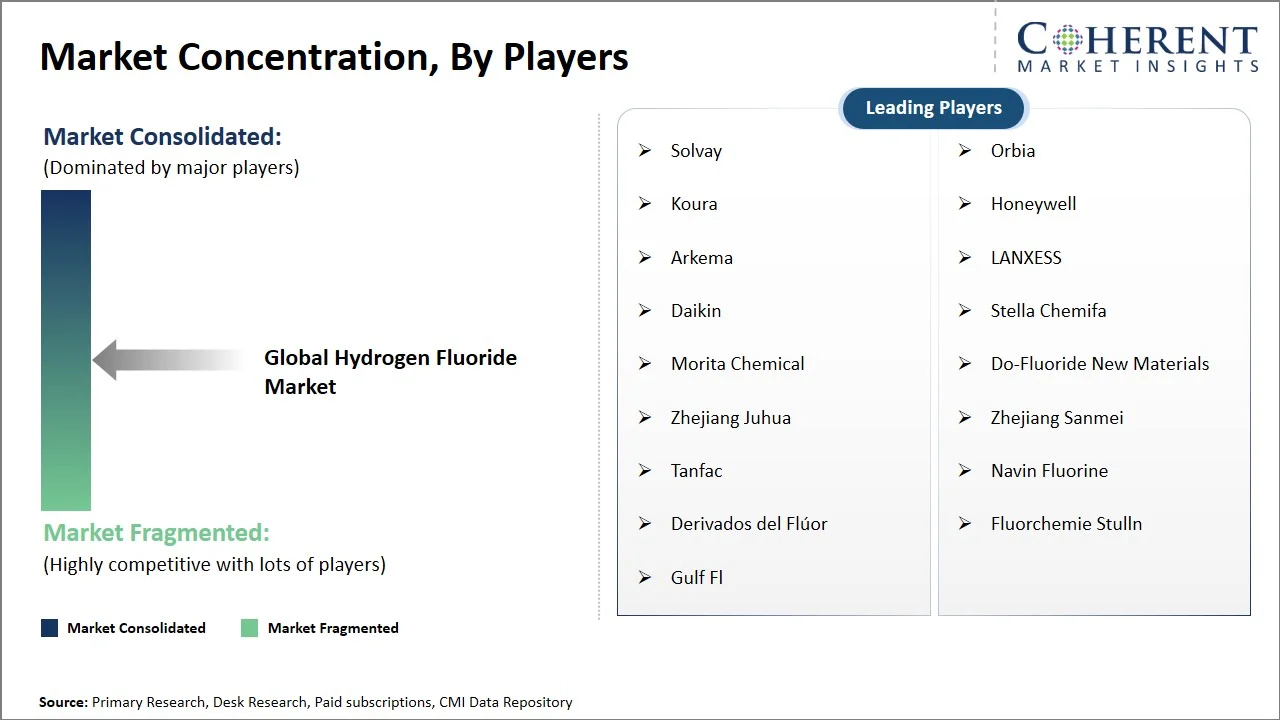
The global hydrogen fluoride market is moderately consolidated, with competition led by integrated fluorochemical manufacturers, specialty chemical companies, and regional hydrofluoric acid producers. Companies compete primarily on feedstock security, production capacity, purity levels, safety compliance, downstream integration, and long-term supply relationships with fluoropolymer, refrigerant, semiconductor, aluminum, and battery material customers. Large players with access to acid-grade fluorspar, anhydrous hydrogen fluoride capacity, advanced purification systems, and hazardous chemical handling infrastructure are better positioned than smaller producers. The competitive landscape is also being shaped by capacity expansions, backward integration, high-purity HF development, and growing demand for reliable local supply in semiconductor and battery value chains. Regulatory pressure around hazardous chemical handling, fluorinated emissions, and supply-chain traceability is expected to further strengthen the position of compliant and technologically advanced producers.
Key focus areas include
- Expansion of anhydrous hydrogen fluoride and hydrofluoric acid production capacity to support fluorochemicals, aluminum fluoride, semiconductor, and battery applications
- Development of high-purity and semiconductor-grade HF with tighter impurity control, advanced purification, and specialized packaging systems
- Backward integration into fluorspar sourcing and long-term feedstock agreements to reduce raw material volatility and supply disruption risks
- Strengthening of safety, storage, transport, and regulatory compliance systems for hazardous chemical production and distribution
- Investment in recovered fluoride and circular fluorine technologies to reduce dependence on virgin fluorspar and improve sustainability positioning
- Geographic expansion near semiconductor, battery, fluoropolymer, refrigerant, and aluminum manufacturing clusters to improve supply reliability and customer responsiveness
Market Report Scope
Hydrogen Fluoride Market Report Coverage
| Report Coverage | Details | ||
|---|---|---|---|
| Base Year: | 2025 | Market Size in 2026: | USD 4.35 Bn |
| Historical Data for: | 2020 To 2024 | Forecast Period: | 2026 To 2033 |
| Forecast Period 2026 to 2033 CAGR: | 6.4% | 2033 Value Projection: | USD 6.72 Bn |
| Geographies covered: |
| ||
| Segments covered: |
| ||
| Companies covered: | Solvay, Orbia, Koura, Honeywell, Arkema, LANXESS, Daikin, Stella Chemifa, Morita Chemical, Do-Fluoride New Materials, Zhejiang Juhua, Zhejiang Sanmei, Tanfac, Navin Fluorine, Derivados del Flúor, Fluorchemie Stulln, and Gulf Fl | ||
| Growth Drivers: |
| ||
| Restraints & Challenges: |
| ||
Analyst Opinion (Expert Opinion)
- The global hydrogen fluoride market is expected to witness steady long-term growth due to its critical role as a fluorine building block across fluorocarbons, fluoropolymers, aluminum fluoride, semiconductor etching, and battery-related applications. Demand is expected to remain resilient as industries continue to require anhydrous hydrogen fluoride, industrial-grade HF, and high-purity HF for chemical synthesis, metal processing, electronics manufacturing, and advanced materials production.
- The strongest opportunities are expected to remain in Asia Pacific, where China, Japan, South Korea, and Taiwan support large-scale consumption through fluorochemical manufacturing, semiconductor fabrication, aluminum processing, and battery material production. North America is expected to show strong growth momentum due to semiconductor reshoring, battery supply-chain localization, high-purity chemical demand, and continued use of HF in specialty chemicals and petroleum alkylation.
- To gain a competitive advantage, market participants should focus on feedstock security, backward integration into fluorspar supply, high-purity HF production, safer handling technologies, and recovered fluoride routes. Companies with strong hazardous chemical compliance, advanced purification capabilities, regional supply reliability, and long-term relationships with semiconductor, battery, refrigerant, fluoropolymer, and aluminum customers are expected to strengthen their market position.
Speak to the analyst
Want personalized insights?
Take the findings above to one of our principal consultants, or have the report rebuilt around the segments, geographies and competitors you actually track.
Market Segmentation
- Product Form Insights (Revenue, USD Bn, 2021 - 2033)
- Anhydrous hydrogen fluoride
- Concentrated hydrofluoric acid
- Diluted hydrofluoric acid
- Buffered HF blends
- Others
- Grade Insights (Revenue, USD Bn, 2021 - 2033)
- Industrial grade
- Reagent grade
- Semiconductor grade
- Battery grade
- Others
- Production Route Insights (Revenue, USD Bn, 2021 - 2033)
- Fluorspar sulfuric acid route
- Fluorosilicic acid conversion route
- Recovered fluoride route
- Integrated fluorochemical production
- Others
- Application Insights (Revenue, USD Bn, 2021 - 2033)
- Fluorocarbons
- Fluoropolymers
- Aluminum fluoride
- Semiconductor etching
- Others
- End-Use Industry Insights (Revenue, USD Bn, 2021 - 2033)
- Chemical manufacturing
- Semiconductor manufacturing
- Aluminum smelting
- Petrochemicals
- Others
- Regional Insights (Revenue, USD Bn, 2021 - 2033)
- North America
- U.S.
- Canada
- Latin America
- Brazil
- Argentina
- Mexico
- Rest of Latin America
- Europe
- Germany
- U.K.
- Spain
- France
- Italy
- Russia
- Rest of Europe
- Asia Pacific
- China
- India
- Japan
- Australia
- South Korea
- ASEAN
- Rest of Asia Pacific
- Middle East
- GCC Countries
- Israel
- Rest of Middle East
- Africa
- South Africa
- North Africa
- Central Africa
- North America
Sources
Primary Research Interviews
- Hydrogen fluoride and hydrofluoric acid manufacturers
- Fluorochemical producers and specialty chemical manufacturers
- Fluorspar mining companies and acid-grade fluorspar suppliers
- Semiconductor wet chemical suppliers and high-purity chemical manufacturers
- Aluminum fluoride and aluminum smelting industry participants
- Refrigerant and fluoropolymer manufacturers
- Battery material and electrolyte chemical suppliers
- Industrial safety, hazardous chemical handling, and logistics experts
- Regulatory, EHS, and quality assurance professionals from chemical manufacturing companies
Stakeholders
- Hydrogen fluoride manufacturers
- Hydrofluoric acid suppliers and distributors
- Anhydrous hydrogen fluoride producers
- Acid-grade fluorspar suppliers
- Fluorochemical and fluoropolymer manufacturers
- Refrigerant manufacturers
- Semiconductor-grade chemical suppliers
- Aluminum fluoride producers
- Petroleum refining and alkylation chemical users
- Battery material and electrolyte chemical manufacturers
- Hazardous chemical storage, packaging, and transport service providers
End-use Sectors
- Chemical manufacturing
- Semiconductor manufacturing
- Aluminum smelting
- Fluoropolymer production
- Refrigerant and fluorocarbon production
- Battery materials and electrolyte manufacturing
- Petroleum refining and alkylation
- Metal treatment and surface processing
- Glass etching and specialty industrial applications
Regulatory & Environmental Bodies
- U.S. Environmental Protection Agency (EPA)
- Occupational Safety and Health Administration (OSHA), U.S.
- National Institute for Occupational Safety and Health (NIOSH), U.S.
- European Chemicals Agency (ECHA)
- European Commission – REACH, CLP, F-Gas, and Critical Raw Materials regulations
- Ministry of Ecology and Environment, China
- National Development and Reform Commission (NDRC), China
- Ministry of Economy, Trade and Industry (METI), Japan
- Ministry of Environment, Japan
- Korea Ministry of Environment
- Central Pollution Control Board (CPCB), India
- Petroleum and Explosives Safety Organisation (PESO), India
- United Nations Economic Commission for Europe (UNECE) – Dangerous Goods Transport
- International Maritime Organization (IMO)
Databases
- UN Comtrade Database
- International Trade Centre (ITC) Trade Map
- U.S. Geological Survey (USGS) Mineral Commodity Summaries
- Eurostat Database
- U.S. International Trade Commission DataWeb
- World Bank DataBank
- OECD Chemical Safety and Environment Statistics
- ECHA Chemicals Database
- U.S. EPA Toxic Release Inventory (TRI)
- U.S. EPA Risk Management Program Database
- Semiconductor Industry Association data
- National customs and trade statistics databases
Magazines
- Chemical & Engineering News
- Chemical Week
- ICIS Chemical Business
- Specialty Chemicals Magazine
- Semiconductor Today
- Semiconductor Digest
- Aluminium International Today
- Battery Materials Review
- Chemical Industry Digest
- Process Worldwide
Journals
- Journal of Fluorine Chemistry
- Industrial & Engineering Chemistry Research
- Journal of Hazardous Materials
- Chemical Engineering Journal
- Journal of Environmental Chemical Engineering
- ACS Sustainable Chemistry & Engineering
- Separation and Purification Technology
- Materials Chemistry and Physics
- Journal of Cleaner Production
- Hydrometallurgy
Associations
- Semiconductor Industry Association (SIA)
- SEMI
- American Chemistry Council (ACC)
- European Chemical Industry Council (Cefic)
- Japan Chemical Industry Association (JCIA)
- China Petroleum and Chemical Industry Federation (CPCIF)
- International Aluminium Institute (IAI)
- The Aluminum Association
- Battery Council International
- Responsible Battery Coalition
Public Domain Sources
- U.S. Geological Survey (USGS) – Fluorspar production, reserves, and trade data
- U.S. EPA – Hydrogen fluoride reporting, emissions, RMP, and chemical safety data
- OSHA – Occupational exposure limits and chemical hazard data
- NIOSH – Hydrogen fluoride safety and exposure information
- ECHA – Hydrogen fluoride classification, registration, and regulatory data
- European Commission – Critical raw materials, fluorinated gases, and chemical regulations
- UN Comtrade – Hydrogen fluoride and fluoride trade data
- ITC Trade Map – Import and export analysis
- World Bank – Industrial production, trade, and macroeconomic indicators
- National customs databases – Country-level import and export data
Proprietary Elements
- CMI Data Analytics Tool
- Proprietary CMI Existing Repository of information for last 10 years.
Get access to 250+ pages report
Every segment, forecast, competitor profile and data table behind the analysis above — available for instant download.
- ESOMAR Member
- ISO 9001:2015 Certified
- D-U-N-S Registered
- GDPR & CCPA Compliant
Missing comfort of reading report in your local language? Find your preferred language:
Transform your Strategy with Exclusive Trending Reports
Frequently Asked Questions
The CAGR of global hydrogen fluoride market is projected to be 6.4% from 2026 to 2033.
The global hydrogen fluoride market is estimated at USD 4.35 Bn in 2026 and is expected to reach USD 6.72 Bn by 2033.
China is the largest producer of hydrogen fluoride, supported by its strong fluorspar reserves, large HF manufacturing capacity, and integrated fluorochemical production base.
Yes, the business can be profitable, especially for integrated producers with secure fluorspar supply, anhydrous HF capacity, high-purity HF technology, and customers in fluoropolymers, semiconductors, aluminum fluoride, refrigerants, and batteries. Profitability is affected by feedstock prices, safety compliance costs, and hazardous chemical logistics.
Expansion of fluoropolymers and refrigerants and growing use of high purity HF in semiconductors and batteries are the major factors driving the growth of the global hydrogen fluoride market.
Stringent safety and handling regulations and fluorspar supply volatility are the major factors hampering the growth of the global hydrogen fluoride market.
In terms of product form, anhydrous hydrogen fluoride is estimated to dominate the market revenue share in 2026.