

Acetone Market Size and Share Analysis- 2026 To 2033
The Acetone Market size is anticipated to grow at a CAGR of 8%, with USD 7.5 Bn in 2026, and is expected to reach USD 12.85 Bn by 2033. The primary drivers are largely defined by increasing demand for acetone as a key solvent and chemical intermediate, rising consumption of methyl methacrylate (MMA) and bisphenol A (BPA), expanding applications across paints and coatings, pharmaceuticals, cosmetics, and adhesives, and continued growth in construction and automotive-related end-use industries. INEOS Phenol reports annual acetone production capacity of about 1.35 million tonnes across the U.S. (335 kt), Europe (830 kt), and Singapore (185 kt).
Key Takeaways
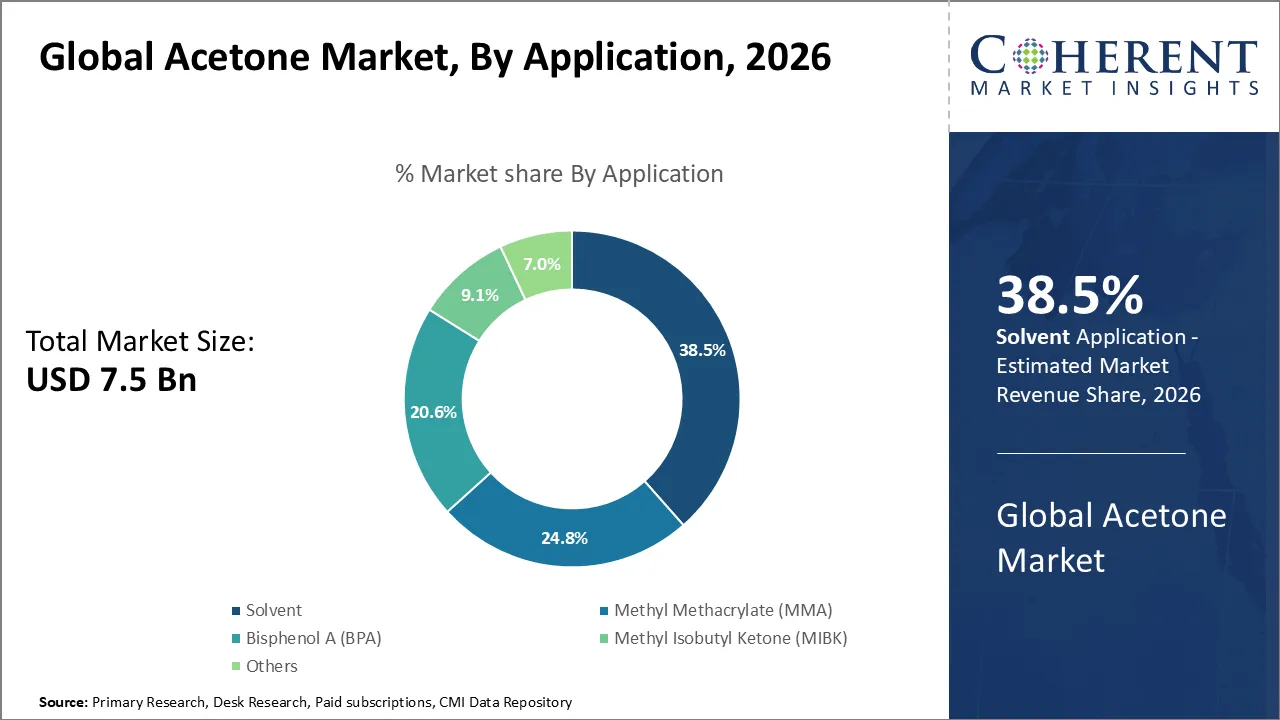
- The solvent segment is expected to dominate the market with 38.5% in 2026. The segment’s growth is owing to acetone’s high solvency, rapid evaporation, miscibility with water, and widespread use across paints & coatings, pharmaceuticals, cosmetics, adhesives, and industrial cleaning applications. According to the American Coatings Association, the U.S. paints and coatings industry produced around 1.33 Bn gallons valued at USD 34.1 Bn in 2025, and the market is projected to reach approximately USD 35.3 Bn in 2026, representing 3.5% growth in value.
- The chemicals segment is set to lead with 42.0% in 2026. The segment’s growth is owing to the extensive consumption of acetone as a chemical intermediate for methyl methacrylate (MMA), bisphenol A (BPA), isophorone, and other downstream derivatives used in acrylics, polycarbonates, epoxy resins, coatings, and specialty chemicals. SABIC’s 2025 Integrated Annual Report identifies acetone within its aromatics portfolio and states that the company sources acetone, benzene, cumene, phenol, and PTA to support downstream production of polycarbonates, styrene monomer, PET, and other chemical products.
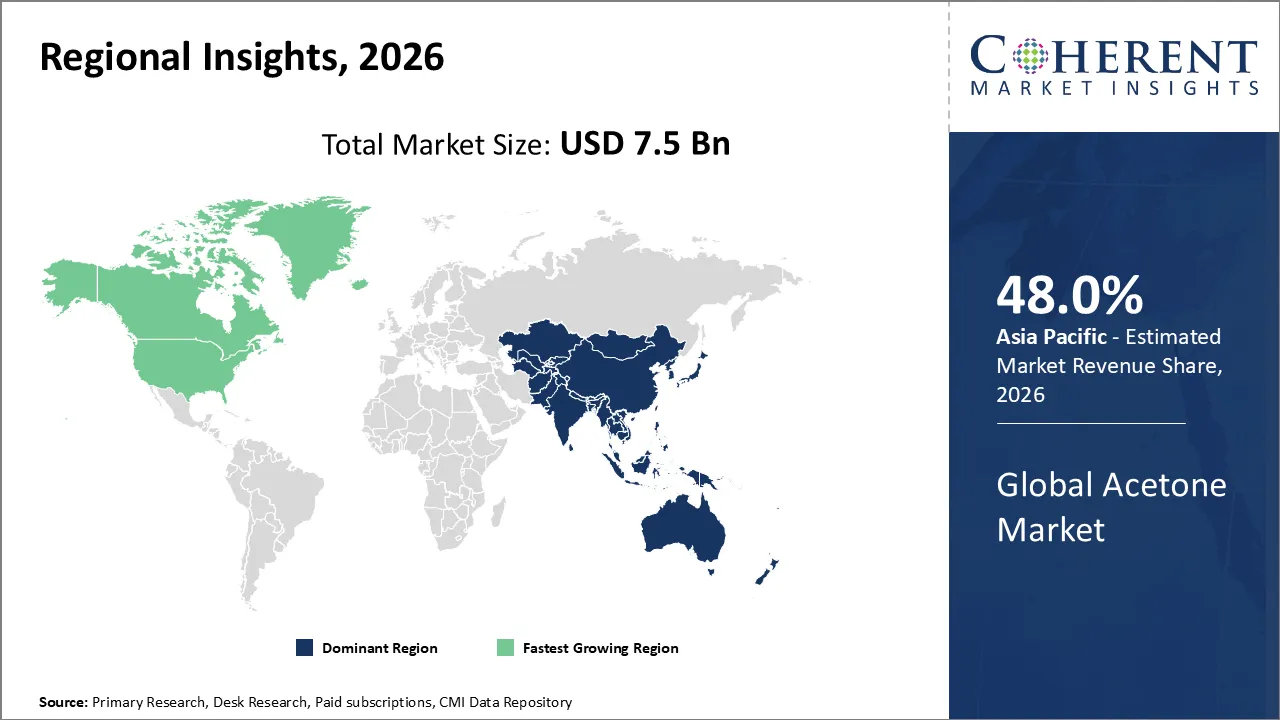
- Asia Pacific is expected to acquire the prominent share of 48.0% in 2026. The region’s growth is owing to large-scale petrochemical manufacturing, expanding paints & coatings and construction industries, growing production of acrylics and polycarbonates, and strong demand from China and other Asian manufacturing economies. INEOS’ Singapore production facility has a total annual production volume of 1,075 kt (1.075 million tonnes) across phenol, acetone, alpha-methylstyrene (AMS), bisphenol A (BPA), and associated production.
Market Drivers
Expansion of Paints & Coatings Industry is Strengthening Demand for Acetone-Based Solvents
The Acetone Market is being driven by continued expansion in paints, coatings, automotive refinishing, protective coatings, and industrial finishing applications. Acetone is widely used as a fast-evaporating solvent and processing aid in coating formulations, surface preparation, cleaning, and related chemical processes.
The U.S. industrial OEM coatings segment generated approximately USD 10.3 billion on 367 million gallons in 2025 and is projected to increase to USD 10.7 billion on 372 million gallons in 2026. Continued growth across automotive, machinery, metal finishing, construction products, and industrial maintenance is supporting demand for solvents and chemical processing materials, thereby positively influencing acetone consumption.
Growing Methacrylate and Polycarbonate Production is Expanding Acetone Downstream Demand
Increasing production of methyl methacrylate (MMA), polymethyl methacrylate (PMMA), polycarbonate materials, and other specialty chemicals is another major driver of the Acetone Market. Acetone serves as an important feedstock in conventional MMA production routes and is also closely linked with bisphenol A production, which supports the polycarbonate and epoxy resin value chains.
In June 2026, Röhm announced that its new Bay City, Texas MMA facility had reached full-scale industrial operation. The plant has an annual production capacity of 250,000 metric tons of MMA and is one of the largest new methacrylate production investments in North America. Röhm also stated that strong demand had resulted in long-term customer commitments for production from the facility.
Current Events and Their Impact on the Acetone Market
Current Event | Description and its Impact |
EU Revised Classification, Labelling and Packaging (CLP) Regulation Moves into Industry Implementation Phase (2026) |
|
EU Industrial Emissions Directive Tightens Environmental Requirements for Chemical Manufacturing (2024–2026) |
|
- Current Industry Events of 2026
- Market Size Estimation
- Regional Breakdown
- Competitive Landscape
- Customer Intelligence
- Segmental Analysis
- Pricing Analysis
- Key Market Drivers, Challenges & Future Trends
- Customized Insights Section
Segmental Insights
Why is the Solvent Segment Acquiring the Largest Share?
The solvent segment is projected to account for the largest Acetone Market share of 38.5% in 2026. The segment’s growth is owing to acetone’s strong solvency, rapid evaporation rate, water miscibility, and extensive use in adhesives, sealants, cosmetics, pharmaceuticals, coatings, cleaning formulations, and other industrial processes.
According to FEICA, Europe consumes around 5 million tonnes of adhesives and sealants annually, while the industry contributed more than EUR 20.7 billion to the European economy in 2025. The sector also offers more than 250,000 adhesive and sealant products across construction, healthcare, energy, packaging, and other industries.
In January 2025, Mitsui Chemicals announced that its Taiwan subsidiary had obtained ISCC PLUS certification and had already launched sales of biomass-based acetone produced under a mass-balance system.
Why is the Chemicals Segment Holding the Largest Market Share?
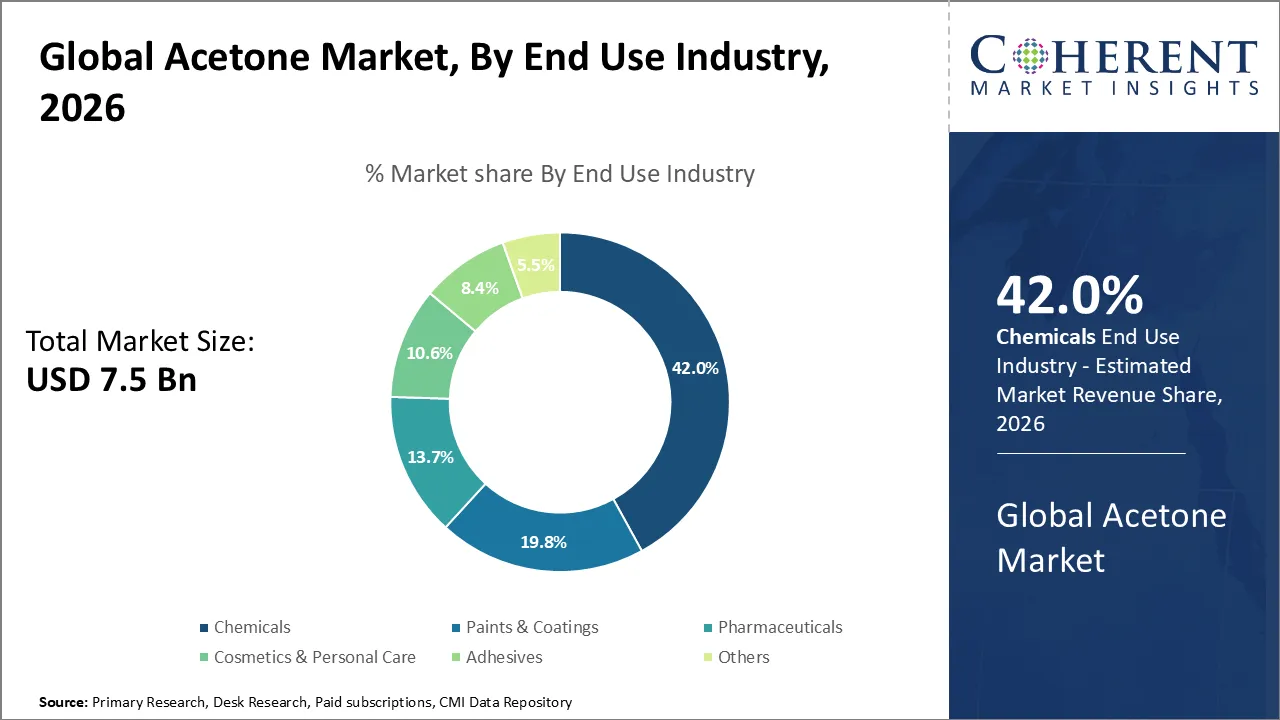
On the basis of end-use industry, the chemicals segment is expected to lead the Acetone Market with a 42.0% share in 2026. The segment’s dominance is owing to acetone’s role as a key feedstock and process chemical in petrochemicals, specialty chemicals, polymers, resins, methyl methacrylate, bisphenol A, and other downstream chemical value chains.
According to Cefic’s 2025 Facts & Figures, the European chemical industry generated approximately EUR 635 billion in turnover, employed around 1.2 million people, and comprised approximately 31,000 companies. Petrochemicals and specialty chemicals together account for more than half of EU27 chemical sales, demonstrating the large addressable downstream base for acetone and other organic intermediates.
More recently, Cefic’s Q2 2026 Chemical Trends Report, published in September 2026, noted that EU27 chemical-sector capacity utilization was around 75% during H1 2026, while the region sustained a chemical trade surplus of EUR 18.4 billion.
Acetone Market Trends
- Acetone is moving from petrochemicals to a more integrated role in bio-based downstream plastics value chains. In January 2025, Nan Ya Plastics and Taiwan Mitsui Chemicals declared a market-development initiative whereby Nan Ya Plastics would source biomass-based acetone from Mitsui Chemicals for the manufacture of biomass-derived bisphenol A (BPA) in Taiwan. This is indicative of growing demand for traceable, lower-carbon feedstocks in polycarbonate and specialty-plastics manufacturing.
- Acetone supply chains are changing with the expanding use of ISCC PLUS certified mass-balance production as producers seek to move away from traditional fossil feedstocks. Chang Chun Group expanded its ISCC PLUS certification scope to include acetone and phenol in November 2025, with 21 core products across its Taiwan and overseas operations passing the annual certification audit.
- Ongoing focus on integrated, globally diversified production networks is enhancing supply security for large acetone consumers. INEOS Phenol has a presence in Europe, North America and Asia, with a capacity of about 1.345 million tonnes/year of acetone, backed by integrated phenol, cumene and acetone production assets. This combination is helping large producers to manage feedstock availability, logistics and regional customer supply more efficiently.
Regional Insights
Asia Pacific Dominates Owing to Large Chemical Manufacturing Base and Expanding Downstream Consumption
The Asia Pacific region accounts for 48.0% of the Acetone Market share in 2026. The region’s dominance is owing to its extensive petrochemical manufacturing base, large production of phenol and acetone derivatives, and strong consumption across solvents, plastics, electronics, pharmaceuticals, paints & coatings, and other chemical-processing industries.
Asia’s production base is also continuing to expand. S&P Global Energy reported in its 2026 phenol-acetone outlook that approximately 680,000 tonnes per year of additional phenol capacity was expected in China during 2026, while PetroChina had recently added a 250,000-tonne-per-year phenol facility in Jilin.
In September 2026, Haldia Petrochemicals Ltd. announced that it was moving toward commissioning a new phenol–acetone plant in India, designed to produce approximately 345,000 metric tons per year of phenol and 215,000 metric tons per year of acetone.
North America Acetone Market Trends
North America is expected to witness strong growth in the Acetone Market over the forecast period, supported by demand from chemical intermediates, solvents, pharmaceuticals, plastics, coatings, adhesives, cosmetics, and export markets. The region also has an established phenol-acetone production infrastructure and a large downstream chemical-processing industry.
In June 2026, S&P Global Energy reported that U.S. Gulf Coast acetone prices had climbed to their highest level in two years during May 2026, driven by production outages, tightening inventories, higher feedstock costs, and increasing export demand from Europe and Latin America. U.S. acetone operating rates were expected to stay around 70%–80% through late summer or early fall 2026, indicating ongoing tight supply conditions.
Measures protecting domestic acetone production are also buoying the U.S. market. In January 2026, the U.S. International Trade Commission (USITC) announced that rescinding existing antidumping orders on imports of acetone from Belgium, Singapore, South Africa, South Korea, and Spain would likely lead to a continuation or recurrence of material injury to the U.S. industry.
Supply Tightness, Export Demand, and Domestic Production Base are Supporting the U.S. Acetone Market
The U.S. Acetone Market is witnessing strong market activity owing to its established domestic production base, demand from solvents and chemical intermediates, and changing international trade flows. In April 2026, S&P Global reported that U.S. acetone supply tightened significantly due to multiple production outages, stronger export demand from Europe and Latin America, and elevated feedstock costs. This led to large increases in spot prices and limited regional availability.
U.S. Gulf Coast acetone spot prices were at their highest level since early 2024 by May 2026 and operating rates were expected to remain at about 70%–80% through late summer or early fall 2026. Rising offshore demand was also pulling additional U.S. volumes toward Europe and Latin America, tightening domestic supply.
China Acetone Market Trends
China is expected to remain one of the most influential markets in the global acetone industry owing to its rapidly expanding phenol-acetone capacity, integrated petrochemical infrastructure, and large downstream manufacturing base across bisphenol A, polycarbonate, MMA, solvents, coatings, and specialty chemicals.
The broader expansion of China’s petrochemical manufacturing capacity is also important. China Petroleum and Chemical Industry Federation said in March 2026 at the World Petrochemical Conference that more than 60% of global ethylene capacity additions between 2020 and 2025 were in China. Despite this large capacity build-out, China still imported approximately 6 million metric tons of ethylene in 2025, illustrating the enormous scale of its downstream chemical demand.
Who are the Major Companies in Acetone Industry
Some of the major key players in Acetone Market are INEOS Phenol, Royal Dutch Shell PLC, The Dow Chemical Company, Mitsui Chemicals, Inc., Sasol, Hindustan Organic Chemicals Limited, Domo Chemicals, Honeywell International, Inc., Formosa Chemicals and Fiber Corporation, CEPSA Quimica, Prasol Chemicals Pvt. Ltd., EMCO Limited.
Key News
- In June 2026, INEOS announced that the planned 2027 restart of its phenol plant in Doel, Antwerp, would be postponed because market recovery remained insufficient. The company cited weak European phenol and acetone demand, high energy costs, carbon taxation, and pressure from Chinese imports.
- In September 2026, Mitsui Chemicals announced an organizational restructuring effective October 2026 under its VISION 2030 strategy. The company is strengthening its R&D foundation, technology strategy functions, and digital-development infrastructure to accelerate new product and business creation across its chemical portfolio, including its Basic & Green Materials business.
Market Report Scope
Acetone Market Report Coverage
Report Coverage | Details | ||
Base Year: | 2025 | Market Size in 2026: | USD 7.5 Bn |
Historical Data for: | 2020 to 2024 | Forecast Period: | 2026 to 2033 |
CAGR: | 8% | 2033 Value Projection: | USD 12.85 Bn |
Geographies covered: |
| ||
Segments covered: |
| ||
Companies covered: | INEOS Phenol, Royal Dutch Shell PLC, The Dow Chemical Company, Mitsui Chemicals, Inc., Sasol, Hindustan Organic Chemicals Limited, Domo Chemicals, Honeywell International, Inc., Formosa Chemicals and Fiber Corporation, CEPSA Quimica, Prasol Chemicals Pvt. Ltd., EMCO Limited. | ||
Growth Drivers: |
| ||
Restraints & Challenges: |
| ||
Analyst Opinion
- The Acetone Market is expected to remain closely linked to the operating economics of the global phenol–acetone chain, as acetone is typically produced as a co-product of phenol through the cumene process. This creates a structural dependence on phenol demand, refinery economics, and plant operating rates. S&P Global reported in 2026 that Asian phenol-acetone markets continue to face pressure from new capacity additions in China, with roughly 680,000 tons per year of additional phenol capacity expected during the year. This will probably keep regional acetone supply competitive and continue to put pressure on producer margins.
- The market is also heading toward a more differentiated product mix, where sustainability is an increasingly important purchase criterion. Producers are increasing their certified circular and lower-carbon acetone offerings to serve customer decarbonization needs in plastics, coatings, pharmaceuticals and specialty chemicals. In 2025, Mitsui Chemicals started producing ISCC PLUS-certified biomass-based acetone in Taiwan, demonstrating that sustainability is shifting from a long-term concept to product availability at commercial scale.
- Regional supply imbalances are likely to continue to be a defining feature of the market. Asia is still adding capacity but North America has had periods of tight supply and stronger export pull. In June 2026, S&P Global reported that U.S. Gulf Coast acetone prices had reached their highest level in two years, supported by production outages, lower inventories, and stronger export demand from Europe and Latin America.
Speak to the analyst
Want personalized insights?
Take the findings above to one of our principal consultants, or have the report rebuilt around the segments, geographies and competitors you actually track.
Market Segmentation
- By Application (Revenue, USD Bn, 2021-2033)
- Methyl Methacrylate (MMA)
- Bisphenol A (BPA)
- Solvent
- Methyl Isobutyl Ketone (MIBK)
- Others
- By End Use Industry (Revenue, USD Bn, 2021-2033)
- Chemicals
- Pharmaceuticals
- Paints & Coatings
- Cosmetics & Personal Care
- Adhesives
- Others
- By Region (Revenue, USD Bn, 2021-2033)
- North America
- U.S.
- Canada
- Latin America
- Brazil
- Mexico
- Argentina
- Rest of Latin America
- Europe
- Germany
- U.K.
- France
- Italy
- Spain
- Russia
- Rest of Europe
- Asia Pacific
- China
- India
- Japan
- Australia
- South Korea
- ASEAN
- Rest of Asia Pacific
- Middle East
- GCC
- Israel
- Rest of Middle East
- Africa
- South Africa
- Central Africa
- North Africa
- North America
Sources
Primary Research Interviews
- Acetone manufacturers and phenol-acetone producers
- Petrochemical and specialty chemical manufacturers
- Solvent formulators and industrial chemical distributors
- Methyl methacrylate (MMA) and bisphenol A (BPA) producers
- Paints, coatings, adhesives, and sealants manufacturers
- Pharmaceutical, cosmetics, and personal care manufacturers
- Procurement and sourcing managers from chemical processing companies
- Industry experts and key opinion leaders (KOLs) in solvents and petrochemicals
Databases
- World Bank
- UN Comtrade Database
- Eurostat
- U.S. International Trade Commission (USITC)
- U.S. Environmental Protection Agency (EPA)
- European Chemicals Agency (ECHA)
- Organisation for Economic Co-operation and Development (OECD)
Magazines
- ICIS Chemical Business
- Chemical Week
- Chemical & Engineering News
- Hydrocarbon Processing
- Paint & Coatings Industry
- Coatings World
Journals
- Industrial & Engineering Chemistry Research
- Journal of Chemical & Engineering Data
- Chemical Engineering Journal
- Journal of Cleaner Production
- ACS Sustainable Chemistry & Engineering
- Process Safety and Environmental Protection
Newspapers
- Financial Times
- The Wall Street Journal
- Reuters
- The Economic Times
- Nikkei Asia
Associations
- American Chemistry Council (ACC)
- European Chemical Industry Council (Cefic)
- American Coatings Association (ACA)
- European Council of the Paint, Printing Ink and Artists’ Colours Industry (CEPE)
- Association of the European Adhesive & Sealant Industry (FEICA)
- China Petroleum and Chemical Industry Federation (CPCIF)
- Indian Chemical Council (ICC)
Public Domain Sources
- Company Annual Reports and Investor Presentations
- Company Production Capacity and Product Portfolio Disclosures
- Government Trade, Import, and Export Statistics
- Environmental, Chemical Safety, and Regulatory Publications
- Antidumping and Trade Investigation Documents
- Company Press Releases on Plant Expansions, Closures, and Product Launches
- ISCC PLUS and Sustainability Certification Disclosures
- Publicly Available Phenol, Acetone, MMA, and BPA Industry Publications
Proprietary Elements
- CMI Data Analytics Tool
- Proprietary CMI Existing Repository of Information for the Last 10 Years
Get access to 250+ pages report
Every segment, forecast, competitor profile and data table behind the analysis above — available for instant download.
- ESOMAR Member
- ISO 9001:2015 Certified
- D-U-N-S Registered
- GDPR & CCPA Compliant
Missing comfort of reading report in your local language? Find your preferred language:
Transform your Strategy with Exclusive Trending Reports
Frequently Asked Questions
The Acetone Market is expected to reach USD 12.85 Bn in 2033, up from USD 7.5 Bn in 2026.
Major players operating in the global Acetone Market include INEOS Phenol, Royal Dutch Shell PLC, The Dow Chemical Company, Mitsui Chemicals, Inc., Sasol, Hindustan Organic Chemicals Limited, Domo Chemicals, Honeywell International, Inc., Formosa Chemicals and Fiber Corporation, CEPSA Quimica, Prasol Chemicals Pvt. Ltd., and EMCO Limited.
The key factors hampering growth of the market include volatility in raw material and feedstock prices and stringent environmental and VOC regulations.
The increasing demand for acetone as an industrial solvent and rising consumption of acetone in methyl methacrylate (MMA) and bisphenol A (BPA) production are the major factors driving market growth.
The Acetone Market is anticipated to grow at a CAGR of 8% between 2026 and 2033.
Among regions, Asia Pacific is expected to account for the largest share of the global Acetone Market, with approximately 48.0% share in 2026.
Acetone is a widely used organic solvent and chemical intermediate. It is used in industrial solvents and in the production of downstream chemicals such as methyl methacrylate, bisphenol A, and other derivatives.