

Global Hypersonic Weapons Market Size and Forecast – 2026 To 2033
The global hypersonic weapons market is expected to grow from USD 14 Bn in 2026 to USD 25 Bn by 2033, registering a compound annual growth rate (CAGR) of 9% from 2026 to 2033. The global hypersonic weapons market is driven by growing defense budgets across major nations. On June 5, 2025, BAE Systems announced that it has been awarded a USD 1.2 billion contract by the U.S. Space Systems Command to provide the U.S. Space Force with missile tracking satellite capabilities. (Source: BAE Systems)
Key Takeaways of the Global Hypersonic Weapons Market
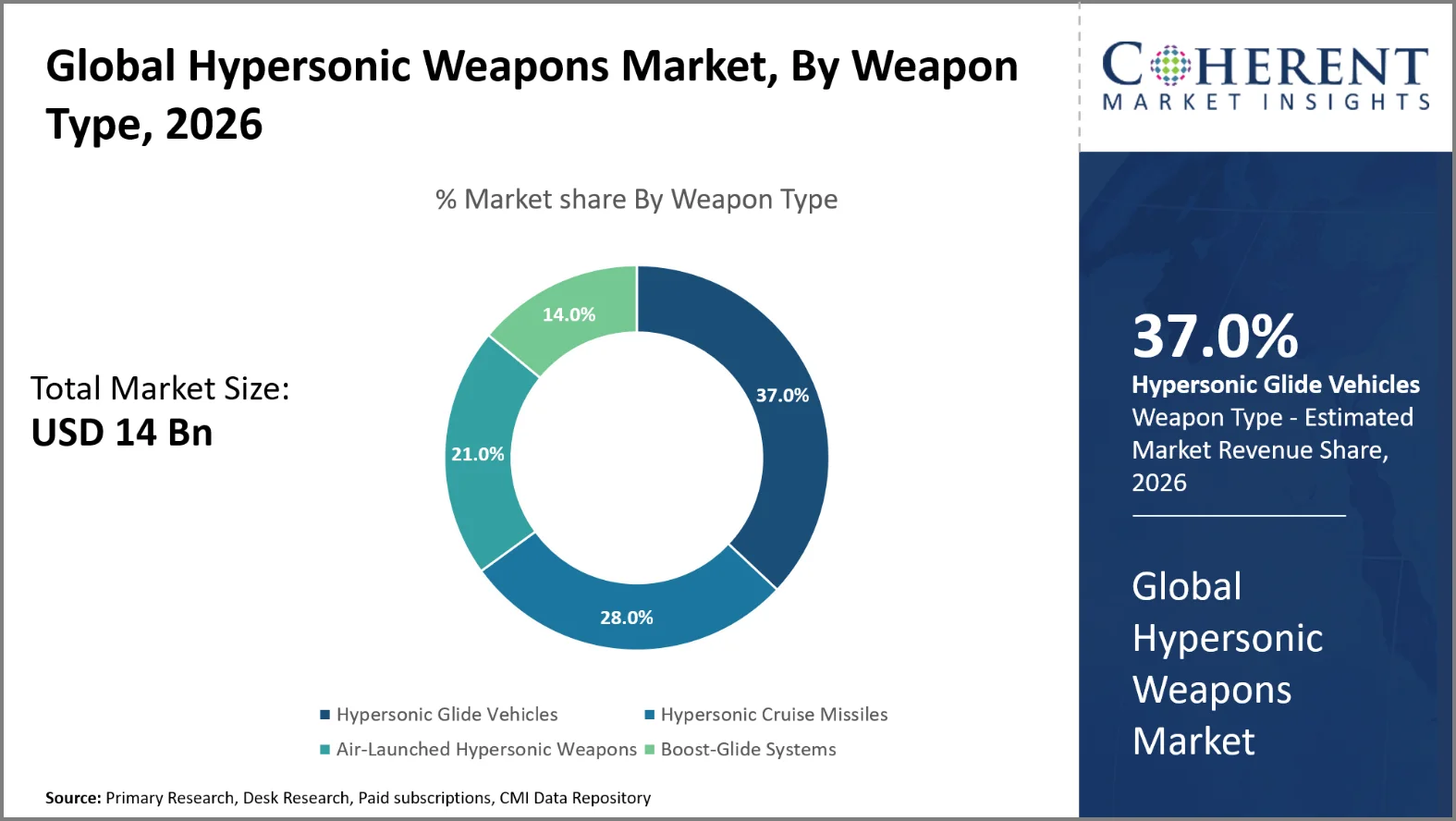
- The hypersonic glide vehicles segment is expected to account for 37.0 % of the global hypersonic weapons market share in 2026. Increasing development of maneuverable hypersonic glide vehicles is a major factor driving the growth of the segment. On June 2, 2026, MBDA received a development contract from France’s Directorate General of Armament for the ASN4G missile, France's next-generation strategic weapon incorporating hypersonic-speed capabilities. (Source: Defence Industry Europe)
- The land-launched segment is estimated to capture 48.0 % of the market share in 2026. Growing demand for weapons capable of penetrating advanced missile defense systems is driving the growth of the segment. On May 13, 2026, Castelion announced a production framework agreement with the Department of War to manufacture and field Blackbeard, its first low-cost hypersonic strike missile, at a guaranteed minimum of 500 missiles per year once testing and validation is complete, with a pathway to purchase thousands of additional missiles. (Source: Castelion)
- The propulsion systems segment is estimated to capture 32.0 % of the market share in 2026. Expansion of long-range precision strike capabilities is driving the growth of the segment. On March 25, 2026, Lockheed Martin announced the signing of a new framework agreement signed with the Department of War (DoW) to rapidly increase production of Precision Strike Missile (PrSM). Under this new agreement, PrSM production will quadruple, building on a previous USD 4.94 billion contract award from the U.S. Army last year. (Source: Lockheed Martin)
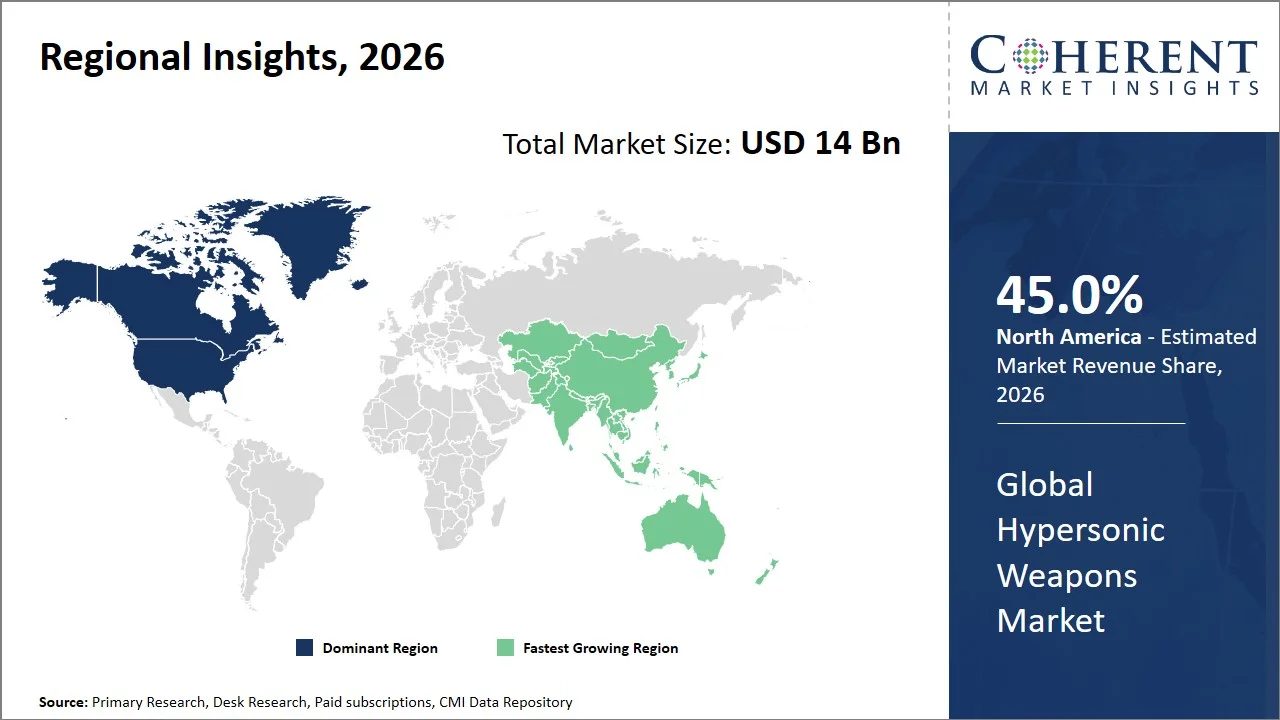
- North America is expected to dominate the hypersonic weapons market in 2026 with a market share of 45.0 %. Development of reusable hypersonic platforms in North America is driving the growth of the regional market. On March 6, 2026, Stratolaunch successfully executed MDA’s Flight Test Experiment Other-04 (FEX)-04 flight test mission from Mojave Air and Space Port, supporting ongoing hypersonic flight testing. (Source: Stratolaunch)
- Asia Pacific is expected to account for 39.0 % share in 2026 and is projected to record the fastest growth over the forecast period. Expansion of indigenous hypersonic weapon programs in Asia Pacific is driving the growth of the regional market. On February 27, 2026, Australian hypersonic flight pioneer, Hypersonix Launch Systems announced that it has successfully completed the first flight of its DART AE hypersonic aircraft, marking a major milestone in the development of advanced hypersonic systems. (Source: Hypersonix)
- Transition from R&D to Operational Deployment: Top defense countries are transitioning hypersonic systems from experimental to operational military deployment. The U.S., China, Russia and India are expanding their procurement of operational hypersonic missiles and glide vehicles, with their armed services and aerospace testing modifying doctrine, training and logistics to integrate these weapons into real world combat capabilities.
- Rapid Advancement in Propulsion and Materials: Scramjet engines, thermal protection systems, and high-temperature composite materials are making continuous hypersonic flight more reliable and closer to reality. They improve mobility, range and survivability, and they lower the technical obstacles that used to render deployment infeasible.
Segmental Insights
Why Do Hypersonic Glide Vehicles Dominate the Global Hypersonic Weapons Market?
The hypersonic glide vehicles segment is expected to account for 37.0% of the global hypersonic weapons market share in 2026. Hypersonic glide vehicles lead the global hypersonic weapons industry mainly because they can maneuver unexpectedly at hypersonic speeds after re-entering the atmosphere. Unlike typical ballistic missiles that fly a predetermined route, hypersonic glide vehicles can alter their direction and altitude during flight, making them much harder for current missile defense systems to detect, track and intercept. Such increased survivability and strategic strike potential has made projects of HGV development and deployment a priority for major military nations.
On April 24, 2026, Castelion announced that it was awarded a USD 105 Mn contract by the U.S. Navy to continue efforts to integrate its Blackbeard hypersonic strike weapon onto the F/A-18 and transition the system to an Early Operational Capability in 2027. Under this award, Castelion will conduct extensive system safety and certification testing, flight testing, and other integration activities related to carrier-based operations. (Source: Castelion)
- Current Industry Events of 2026
- Market Size Estimation
- Regional Breakdown
- Competitive Landscape
- Customer Intelligence
- Segmental Analysis
- Pricing Analysis
- Key Market Drivers, Challenges & Future Trends
- Customized Insights Section
Why is Land-Launched the Most Crucial Launch Platform?
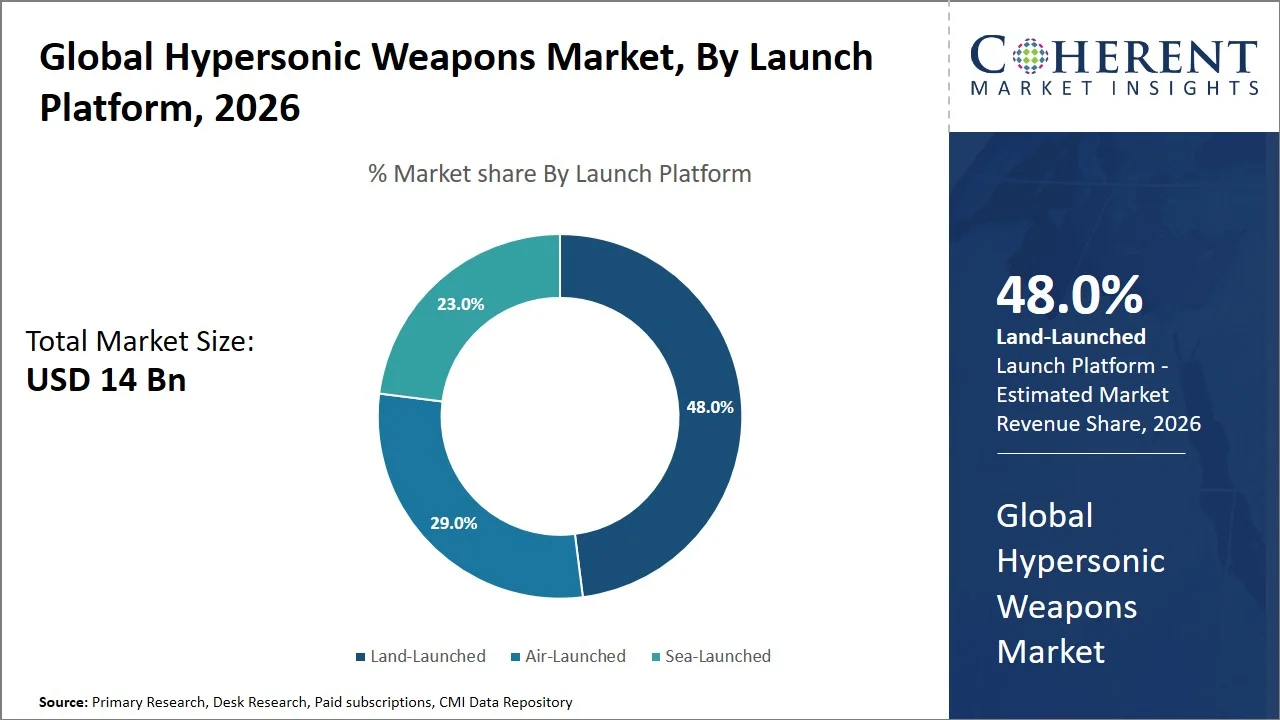
The land-launched segment is expected to account for 48.0% of the global hypersonic weapons market share in 2026. Land-launched systems are the most important launch platform in the global hypersonic weapons market since they give the highest level of strategic deployment flexibility and operational readiness. Ground based launchers can be stationary or movable, can be spread across large territory, moved rapidly and maintained at lesser cost than air or sea based launchers. This ability allows military forces to maintain continuous deterrence and quickly adapt to evolving threats, making land-launched hypersonic weapons a cornerstone of modern defensive systems.
On March 18, 2026, Rocket Lab Corporation announced the signing of its single largest launch agreement, a USD 190 million contract for a block buy of 20 hypersonic test flights with its HASTE launch vehicle for the Test Resource Management Center (TRMC) Multi-Service Advanced Capability Hypersonic Test Bed (MACH-TB) 2.0 program, a U.S. Department of War effort executed in partnership with Naval Surface Warfare Center Crane Division (NSWC Crane) to rapidly accelerate hypersonic flight tests and advanced aerospace technologies shaping the future of defense missions. (Source: Rocket Lab)
Propulsion Systems Dominates the Global Hypersonic Weapons Market
The propulsion systems segment is expected to account for 32.0% of the global hypersonic weapons market share in 2026. Propulsion systems are the driving force in the worldwide hypersonic weapons market since they represent the key technology that allows missiles to achieve and maintain speeds above Mach 5. Advanced propulsion technologies, especially scramjet and boost-glide propulsion systems, directly impact the range, mobility, survivability and mission effectiveness of a weapon. Propulsion systems are a large part of the research, development and procurement investment in hypersonic weapon programs, as countries spend a lot of money trying to improve speed, endurance and strike capabilities.
On February 24, 2026, Ursa Major unveiled the HAVOC Missile System, a complete hypersonic capability designed to deliver high-speed, affordable mass at scale to meet urgent warfighter requirements, with a core module that can also be used for hypersonic targets. HAVOC is engineered for rapid production and scalability, addressing the growing need for optionality in survivable, maneuverable hypersonic systems that can be fielded in operationally relevant quantities. (Source: Ursa Major)
Currents Events and their Impact
Current Events | Description and its Impact |
UK Export Control (Amendment) Regulations 2025 |
|
U.S. Export Administration Regulations (EAR) -Missile Technology Controls (Updated 2025–2026) |
|
(Source: UK Government, Bureau of Industry & Security)
Hypersonic Weapons Market Dynamics
Market Drivers
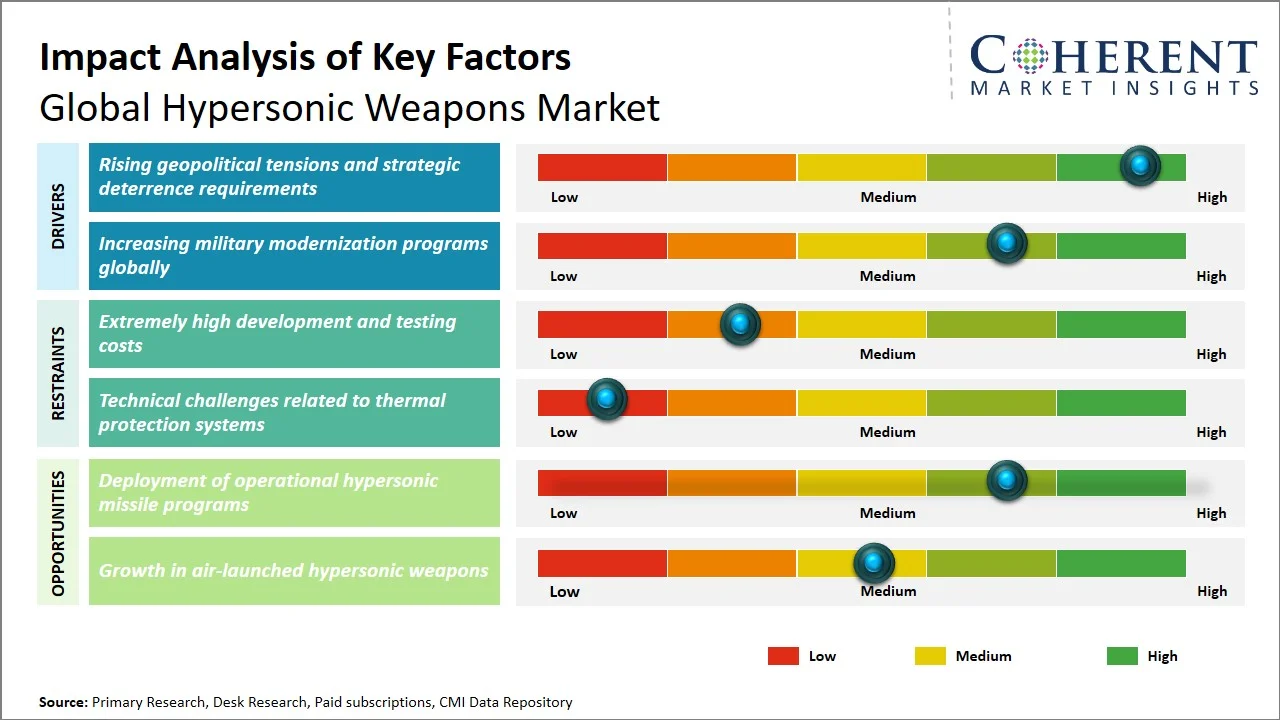
Rising geopolitical tensions and strategic deterrence requirements
Rising geopolitical tensions and expanding strategic deterrence requirements are key factors fueling the global hypersonic weapons market. Increasing competitiveness between major military powers, regional security issues and fears of enhanced missile threats have driven countries to invest extensively in next-generation attack capabilities. Hypersonic weapons can be used to quickly strike at large distances with high maneuverability, which is difficult for existing missile defense systems to intercept, and can be used to enhance national security and maintain strategic stability. This is why countries are speeding up the development and fielding of hypersonic weapons to boost deterrence and maintain military superiority in a changing security landscape.
On April 28, 2026, Raytheon delivered its second sensor to Lockheed Martin for the U.S. Space Force's Next-Generation Overhead Persistent Infrared (Next-Gen OPIR) Geosynchronous Earth Orbit (GEO) Block 0 satellite program. The satellites, commonly referred to as NGG, will provide enhanced missile warning and tracking to address evolving space-based threats. (Source: Raytheon)
Increasing military modernization programs globally
The growing military modernization programs throughout the globe are playing a vital role in the growth of the hypersonic weapons market as countries are upgrading their defense capabilities to meet rising security issues. Military forces globally are spending money on sophisticated weapons systems, future missile technologies, networked command and control systems, and accuracy-strike capabilities to enhance operational effectiveness. Hypersonic weapons have become a key element of these modernization efforts due to their exceptional speed, maneuverability and ability to penetrate sophisticated air and missile defense systems, prompting substantial government funding and long-term procurement programs across major defense markets.
On April 10, 2026, the U.S. government awarded Lockheed Martin a multibillion-dollar contract to continue critical accelerated production of PAC-3 Missile Segment Enhancement (MSE). The USD 4.7 billion undefinitized contract action (UCA) enables Lockheed Martin to advance production acceleration and deliver record numbers of combat-proven interceptors for American and allied forces this year. (Source: Lockheed Martin)
Emerging Trends
- Expansion Across Multiple Launch Platforms: Hypersonic weapons are being developed for land, air, and naval platforms, rather than single-use systems. Key priority are developing in the form of air-launched hypersonic missiles for fighter aircraft and bombers and ship-based hypersonic strike weapons, which offer greater flexibility and faster response times.
- Growth of Counter-Hypersonic and AI-Enabled Systems: As hypersonic threats proliferate, governments are pouring money on detection, tracking and interception technology. At the same time, artificial intelligence and improved guidance systems are being incorporated into hypersonic weapons to improve targeting precision, autonomous maneuvering and decision-making at extreme speeds.
Regional Insights
Why is North America a Strong Market for Hypersonic Weapons?
North America is expected to hold a market share of 45.0% in 2026. North America is still the hub for hypersonic weapons development, with the U.S. being at the forefront. The US Army has upgraded its Long-Range Hypersonic Weapon (Dark Eagle) development, and the US Navy is incorporating the Conventional Prompt Strike (CPS) technology in future surface ships and subs. The region remains the key hub for hypersonic weapons industrialization and significant contractors like as Lockheed Martin, Northrop Grumman and RTX Corporation continue to win large contracts to build missile integration, propulsion systems, and guidance technology. On May 13, 2026, the U.S. Department of War announced a framework agreement with Anduril Industries to rapidly scale production of a new, affordable and mass-producible cruise missile solution to the long-range precision fires and stand-off strike problem: surface-launched Barracuda-500M (SLB-500M). (Source: Anduril)
Why Does Asia Pacific Hypersonic Weapons Market Exhibit High Growth?
Asia Pacific is projected to account for 39.0% of the global hypersonic weapons market and is expected to register the fastest growth. Asia Pacific is home to multiple nations with ongoing major defense programs and activities. China continues to extend its deployment of the DF-17 hypersonic glide vehicle system, India has successfully tested the Hypersonic Technology Demonstrator Vehicle (HSTDV), and is developing designs for future indigenous hypersonic cruise missiles. Japan and Australia have expanded spending in hypersonic strike and counter-hypersonic defense efforts through cooperative programs with the U.S., underscoring the region’s growing reliance on enhanced long-range deterrence capabilities. On May 28, 2026, Hanwha Aerospace announced a joint development program with the Korea AeroSpace Administration (KASA) to produce a 4,500-pound-class turbofan engine for Collaborative Combat Aircraft (CCA) and other unmanned aerial platforms. (Source: Hanwha)
Global Hypersonic Weapons Market Outlook for Key Countries
Why is the U.S. Emerging as a Major Hub in the Hypersonic Weapons Market?
The U.S. hypersonic weapon market is driven by a number of parallel initiatives across the Army, Navy and Air Force. The Army’s Dark Eagle system is getting closer to being operational, the Navy’s Conventional Prompt Strike program is moving toward fleet integration, and defense agencies are continuing to fund next-generation hypersonic interceptors and monitoring systems. Several companies, notably as Leidos and L3Harris Technologies, are increasingly supporting this trend, providing sensor, guidance and testing capabilities. The overall trend in the space is toward a comprehensive hypersonic ecosystem – not just missile development.
Is China the Next Growth Engine for the Hypersonic Weapons Market?
China's hypersonic weapons industry is based on operational deployment and constant technological improvement. The DF-17 missile, which is armed with a hypersonic glide vehicle, has become a cornerstone of the country’s strategic deterrent architecture, while other research is aimed at longer-range boost-glide systems and sophisticated maneuvering reentry technology. Chinese defense entities continue to invest in high-temperature materials, scramjet propulsion and hypersonic test infrastructure, allowing them to move from research to fielding far more rapidly than many of their competitors.
Russia Hypersonic Weapons Market Analysis and Trends
Russia has one of the most advanced operational hypersonic weapons arsenals in the world, including systems such as the Avangard hypersonic glide vehicle and the Kinzhal air-launched hypersonic missile. While many nations are still in the testing phase, Russia has concentrated on the fielding and tactical integration of hypersonic systems into its military strategy. Continuous investments are targeting improvements in maneuverability, survivability and launch-platform compatibility, and operating experience has yielded significant data for future hypersonic weapon upgrades.
India Hypersonic Weapons Market Analysis and Trends
India’s hypersonic weapons business revolves around indigenous technological development and strategic self-reliance. The successful test of the Hypersonic Technology Demonstrator Vehicle (HSTDV) by the Defence Research and Development Organisation opens the door to future hypersonic cruise missile programmes and innovative propulsion technologies. India is also harnessing knowledge gathered from BrahMos Aerospace to develop next-gen hypersonic missile technology, with a greater emphasis on local production and reduced reliance on foreign vendors.
France Hypersonic Weapons Market Analysis and Trends
France leads a European effort in indigenous hypersonic weapons with the V-MaX (Véhicule Manoeuvrable Expérimental) program to develop maneuverable hypersonic glide vehicle technology. The French government has prioritized hypersonic research as part of its long-term strategic deterrence modernization plans, while defense businesses such as ArianeGroup and MBDA are actively engaged in propulsion, missile and flight-control development. France’s development is also supporting wider European efforts to develop sovereign hypersonic and counter-hypersonic capabilities.
Global Hypersonic Weapons Market - Hypersonic Glide Vehicle (HGV) Development Programs
Country | HGV Program / System | Development Status (2026) | Lead Organizations |
U.S. | Common Hypersonic Glide Body (C-HGB) / Dark Eagle | Advanced development & initial deployment phase | U.S. Army, U.S. Navy, Leidos, Lockheed Martin |
China | DF-17 with DF-ZF HGV | Operational deployment | PLA Rocket Force, CASIC, CASC |
Russia | Avangard | Operational deployment | NPO Mashinostroyenia, Roscosmos |
India | Hypersonic Glide Vehicle Program (HGV) | Technology development phase | DRDO |
France | V-MAX (Véhicule Manoeuvrant Expérimental) | Flight-tested prototype | ArianeGroup, DGA |
Global Hypersonic Weapons Market - Hypersonic Glide Vehicle (HGV) Development Programs
Region | Defense R&D Spending on Hypersonic Technologies (USD Billion) |
North America | 9.8 |
Asia-Pacific | 8.1 |
Europe | 3.7 |
Russia & CIS | 1.3 |
Middle East | 0.3 |
Latin America | 0.1 |
How is the Deployment of Operational Hypersonic Missile Programs Creating New Growth Opportunities in the Hypersonic Weapons Market?
With operational hypersonic missile projects being deployed, the hypersonic weapons market is witnessing substantial expansion, translating government investment from research and prototype development into large-scale manufacture, procurement, integration and lifecycle support. As countries switch to systems such as the U.S. Meanwhile, the Army’s Dark Eagle, as well as Russia’s Avangard and Kinzhal and China’s DF-17, have all entered active duty, driving demand for propulsion systems, thermal protection materials, guidance electronics, launch platforms, testing infrastructure, maintenance services and supply-chain components. The transition to operational deployment is also encouraging defense contractors to increase manufacturing capacity, invest in next-generation hypersonic technologies and develop complementary counter-hypersonic defense solutions, creating market opportunities across the entire defense ecosystem.
On February 13, 2026, Amentum UK, supported by Ebeni and Synthetik, received a USD 16.15 million UK Ministry of Defence contract to develop and flight-test a sovereign hypersonic missile capability. The project is intended to progress from design and testing toward prototype missiles that can eventually support operational deployment by British forces. (Source: Ministry of Defence)
Market Players, Key Development, and Competitive Intelligence
Key Developments
- On May 12, 2026, Leidos announced that it has been awarded a USD 2.7 billion U.S. Army contract to advance hypersonic weapons from prototyping to production. This contract unifies the Thermal Protection Shield (TPS) and Common Hypersonic Glide Body (CHGB) programs, with the goal of streamlining development and accelerating delivery of this critical capability in alignment with Army acquisition reform initiatives.
- On December 19, 2025, the U.S. Space Development Agency (SDA) awarded Lockheed Martin a contract for 18 space vehicles for its Tranche 3 Tracking Layer (TRKT3) constellation, with a potential value of more than USD 1 billion.
Competitive Landscape
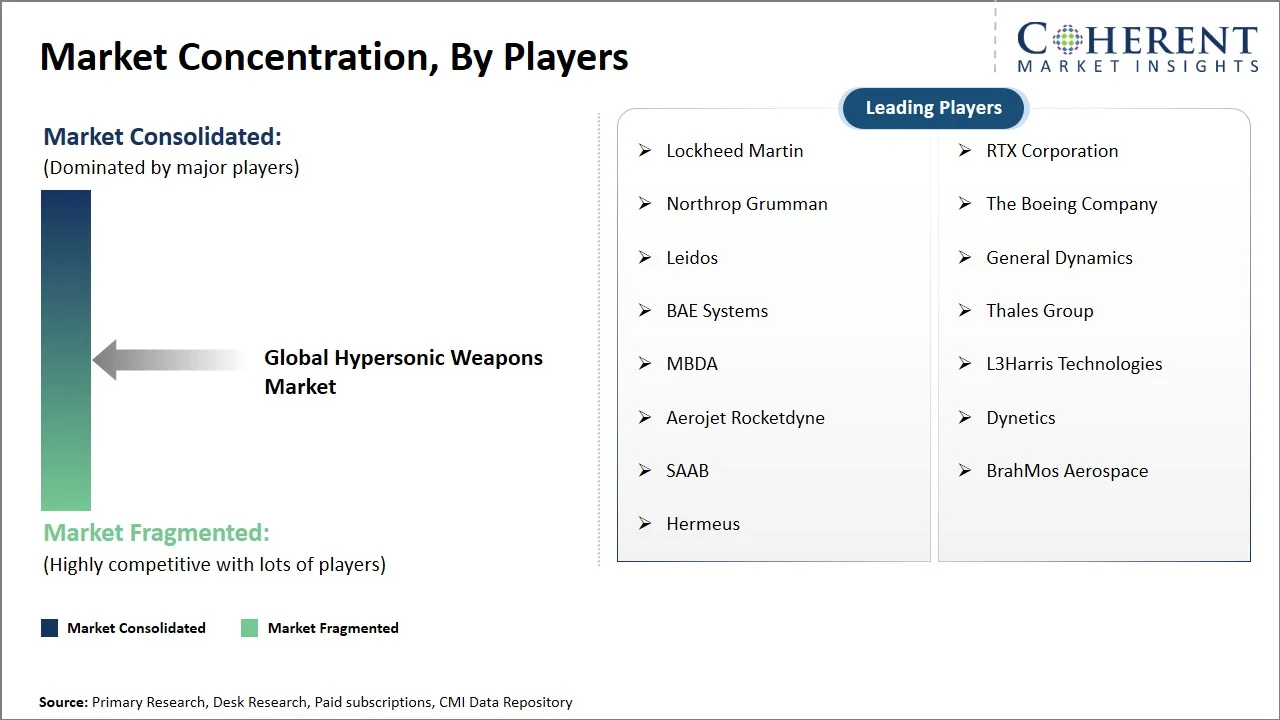
The global hypersonic weapons industry is highly competitive with the presence of a number of defense contractors, aerospace manufacturers and government funded research groups. Significant investment is being made on hypersonic glide vehicles, scramjet propulsion systems, enhanced thermal protection materials and precision guidance technologies. Industry players such as Lockheed Martin, RTX Corporation, Northrop Grumman, Boeing, BAE Systems, MBDA, and BrahMos Aerospace are actively developing and integrating next-generation hypersonic systems, with a growing emphasis on strategic partnerships between governments, defense agencies, and industry players to expedite technological advancements and deployment timelines.
Market Report Scope
Report Coverage
| Report Coverage | Details | ||
|---|---|---|---|
| Base Year: | 2025 | Market Size in 2026: | USD 14 Bn |
| Historical Data for: | 2020 To 2024 | Forecast Period: | 2026 To 2033 |
| Forecast Period 2026 to 2033 CAGR: | 9% | 2033 Value Projection: | USD 25 Bn |
| Geographies covered: |
| ||
| Segments covered: |
| ||
| Companies covered: | Lockheed Martin, RTX Corporation, Northrop Grumman, The Boeing Company, Leidos, General Dynamics, BAE Systems, Thales Group, MBDA, L3Harris Technologies, Aerojet Rocketdyne, Dynetics, SAAB, BrahMos Aerospace, and Herm | ||
| Growth Drivers: |
| ||
| Restraints & Challenges: |
| ||
Analyst Opinion (Expert Opinion)
- The hypersonic weapons market is likely to be driven by the ongoing geopolitical rivalry, increased defense modernization drives and growing demand for rapid response strategic strike capabilities. As operational hypersonic systems are fielded in several services and procurement projects ramp-up, significant expansion should be anticipated. Technical complications, high development costs and regulatory restrictions are projected to remain problems, but significant potential are believed to be provided by advancements in propulsion technology, thermal management systems and counter-hypersonic defense options.
- The hypersonic weapons industry is likely to be driven by the move from experimental programs to full-scale operational deployment and serial production in the future. More investment is expected in air-launched, sea-launched and long-range hypersonic systems, with artificial intelligence, autonomous guidance and improved materials anticipated to boost missile performance and survivability. Additionally, the development of counter-hypersonic defensive designs, space-based tracking networks and multinational defense partnerships are likely to offer new opportunities for technology providers, system integrators and defense contractors during the next decade.
Speak to the analyst
Want personalized insights?
Take the findings above to one of our principal consultants, or have the report rebuilt around the segments, geographies and competitors you actually track.
Market Segmentation
- Weapon Type Insights (Revenue, USD Billion, 2021 - 2033)
- Hypersonic Glide Vehicles
- Hypersonic Cruise Missiles
- Air-Launched Hypersonic Weapons
- Boost-Glide Systems
- Launch Platform Insights (Revenue, USD Billion, 2021 - 2033)
- Land-Launched
- Air-Launched
- Sea-Launched
- Component Insights (Revenue, USD Billion, 2021 - 2033)
- Propulsion Systems
- Guidance, Navigation and Control
- Airframe Structures
- Thermal Protection Systems
- Payloads and Seekers
- End User Insights (Revenue, USD Billion, 2021 - 2033)
- Army
- Navy
- Air Force
- Strategic Defense Agencies
- Regional Insights (Revenue, USD Billion, 2021 - 2033)
- North America
- U.S.
- Canada
- Latin America
- Brazil
- Argentina
- Mexico
- Rest of Latin America
- Europe
- Germany
- U.K.
- Spain
- France
- Italy
- Russia
- Rest of Europe
- Asia Pacific
- China
- India
- Japan
- Australia
- South Korea
- ASEAN
- Rest of Asia Pacific
- Middle East
- GCC Countries
- Israel
- Rest of Middle East
- Africa
- South Africa
- North Africa
- Central Africa
- North America
- Key Players Insights
- Lockheed Martin
- RTX Corporation
- Northrop Grumman
- The Boeing Company
- Leidos
- General Dynamics
- BAE Systems
- Thales Group
- MBDA
- L3Harris Technologies
- Aerojet Rocketdyne
- Dynetics
- SAAB
- BrahMos Aerospace
- Hermeus
Sources
Primary Research Interviews
- Defense contractors and hypersonic weapon manufacturers
- Military officials and defense procurement specialists
- Aerospace engineers and R&D professionals
- Government defense policy makers
Magazines
- Defense News
- Aviation Week & Space Technology
- Military & Aerospace Electronics
- Aerospace America
Journals
- Journal of Strategic Studies
- Defense & Security Analysis
- Aerospace Science and Technology
Associations
- American Institute of Aeronautics and Astronautics (AIAA)
- International Association for the Advancement of Space Safety (IAASS)
- Aerospace Industries Association (AIA)
- Defense Manufacturing Association
Public Domain Sources
- U.S. Department of Defense official publications
- Congressional Research Service reports
- Government Accountability Office (GAO) reports
- International Institute for Strategic Studies (IISS) publications
Proprietary Elements
- CMI Data Analytics Tool
- Proprietary CMI Existing Repository of information for last 10 years
Get access to 250+ pages report
Every segment, forecast, competitor profile and data table behind the analysis above — available for instant download.
- ESOMAR Member
- ISO 9001:2015 Certified
- D-U-N-S Registered
- GDPR & CCPA Compliant
Missing comfort of reading report in your local language? Find your preferred language:
Transform your Strategy with Exclusive Trending Reports
Frequently Asked Questions
The global hypersonic weapons market is expected to stand at USD 14 Bn in 2026 and is expected to reach USD 25 Bn by 2033.
The CAGR of the global hypersonic weapons market is projected to be 9% from 2026 to 2033.
In terms of weapon type, the hypersonic glide vehicles segment is estimated to dominate the market revenue share in 2026.
Thermal protection systems shield the weapon from extreme temperatures generated during high-speed flight.
Artificial intelligence can improve navigation, targeting accuracy, and autonomous flight decision-making.
Rising geopolitical tensions and strategic deterrence requirements and increasing military modernization programs globally are the major factors driving the growth of the global hypersonic weapons market.
Extremely high development and testing costs and technical challenges related to thermal protection systems are the major factors hampering the growth of the global hypersonic weapons market.