

Global Aerospace Testing Market Size and Forecast – 2026-2033
Coherent Market Insights estimates that the global aerospace testing market is expected to reach USD 7 Bn in 2026 and will expand to USD 10 Bn by 2033, registering a CAGR of 5% between 2026 and 2033.
Key Takeaways of the Aerospace Testing Market
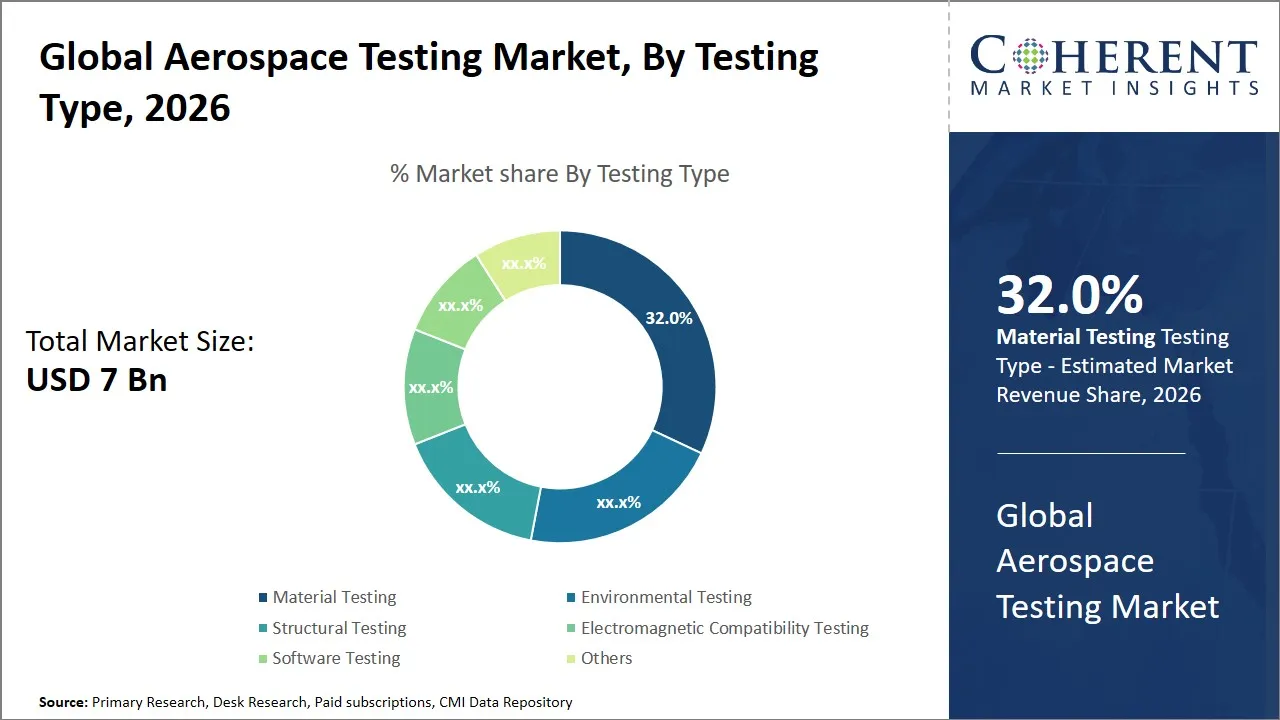
- The material testing segment is expected to account for 32% of the aerospace testing market share in 2026.
- The commercial aviation segment is estimated to hold 41% of the market share in 2026.
- The aircraft structures segment is projected to capture 36% share in 2026.
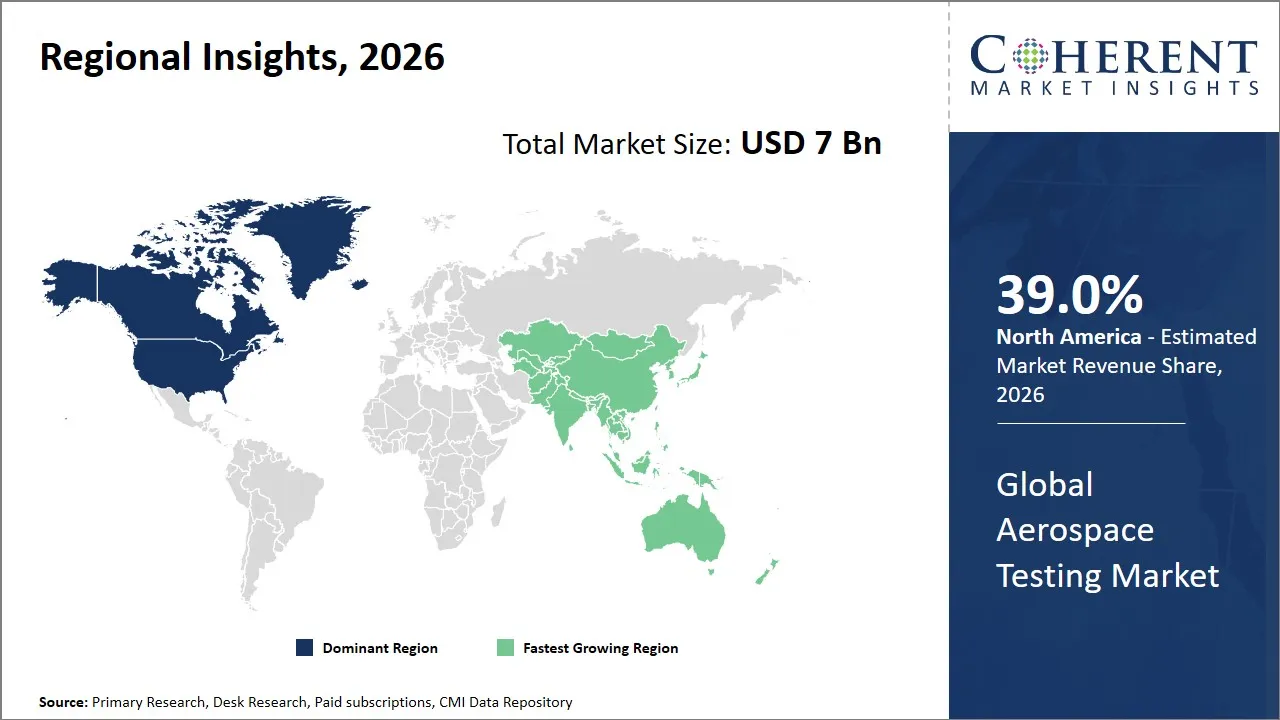
- North America will dominate the aerospace testing market in 2026 with an estimated 39% share.
- Asia Pacific will hold 23% share in 2026 and is expected to record the fastest growth over the forecast period.
Current Events and Its Impact
Current Events | Description and their Impact |
CFM International and Global Airlines Partnership Expansion |
|
Segmental Insights
- Current Industry Events of 2026
- Market Size Estimation
- Regional Breakdown
- Competitive Landscape
- Customer Intelligence
- Segmental Analysis
- Pricing Analysis
- Key Market Drivers, Challenges & Future Trends
- Customized Insights Section
Why Does the Material Testing Segment Dominate the Global Aerospace Testing Market in 2026?
The material testing segment is expected to account for 32.0% of the global aerospace testing market share in 2026. The growth is primarily due to the critical role material integrity plays in aerospace safety and performance. The aerospace industry demands materials that can withstand extreme environmental conditions such as high temperature variations, intense mechanical stresses, and corrosive atmospheres. With advanced composites and reduced-density alloys increasingly adopted to decrease fuel usage and emission levels, rigorous assessment techniques become more central to engineering workflows.
Commercial Aviation Segment Dominates the Global Aerospace Testing Market
The commercial aviation segment is expected to account for 41.0% of the global aerospace testing market share in 2026. Driven by rising numbers of air travelers, fleet sizes across the globe are expanding rapidly. As safety rules influence design choices, showing parts work well in actual environments matters greatly. Testing involves extreme conditions, temperature changes, electrical noise - with endurance a key measure. As urban areas expand and international links strengthen, orders for fresh aircraft rise without pause.
Why are Aircraft Structures the Most Widespread Application in the Aerospace Testing Market?
The aircraft structures segment is expected to account for 36.0% of the global aerospace testing market share in 2026. Even when planes must endure constant pressure, interest does not fade. Since performance links directly to framework reliability, auxiliary mechanisms need precise design. Components like wings, propulsion units, storage tanks, also cabin areas depend on stable foundations. Signs of strain emerge under testing conditions. Degradation becomes visible after repeated use. Surfaces lose strength following long-term exposure. Damage from air contact becomes visible later. After collisions, recovery ability matters most. When parts fail, outcomes may be severe. For this reason, companies test assemblies thoroughly prior to use and during operation.
For instance, on December 10, 2025, Saab announced the launch of world’s first software-defined aircraft fuselage in collaboration with Divergent Technologies. Saab partnered with Divergent 3D to produce an ultralight, large 3D‑printed fuselage structure for autonomous aircraft and then subjected it to extensive materials validation.
(Source: saab.com)
Shift from Physical to Hybrid & Digital Testing
Category | 2025 | Projected ~2030 |
Physical Testing Share | ~62.1% | ~≤55% |
Digital/Virtual Testing Share | ~37.9% | ~≥45% |
Adoption of Digital Twin Technologies | ~25% industry adoption reported | ~40–50% adoption |
Labs with High-Fidelity Simulation | ~40% upgraded | ~60–70% |
Regional Insights
North America Aerospace Testing Market Analysis and Trends
The North America region is projected to lead the market with a 39% share in 2026. Emerging from a long-standing foundation in aerospace and defense, expansion is supported by sustained public funding for exploration and technical advancement. Testing frameworks in the area follow patterns shaped by Boeing and Lockheed Martin. Operations rely on up-to-date installations, where effectiveness grows through disciplined procedures overseen by the FAA. High dependability is maintained since military branches demand repeatable validation results. When tests run, they check how drones fly, how engines work, what electronics do inside, also how tough the body stays - every part shaped by national rules. Because countries agree on standards, improvements move forward, linking trade routes with pooled engineering insight. As collaboration grows, so does reach, making delivery systems smoother from one continent to another.
For instance, on January 16, 2026, North Wind announced an investment of USD 1.1 billion to build a new, state-of-the-art aerospace and hypersonic research and testing complex in Rosemount, the nation’s most advanced aerospace research and development testing facility.
(Source: globenewswire.com)
Asia Pacific Aerospace Testing Market Analysis and Trends
The Asia Pacific region is expected to exhibit the fastest growth in the market contributing 23% share in 2026. Driven by swift growth in civilian air travel, rising military upgrades, and efforts toward homegrown aerospace development - especially within nations such as India and China - the increase takes shape. Progress in homegrown manufacturing emerges as countries focus on independence, illustrated by initiatives such as “Make in India” alongside parallel ambitions in China, driving demand for robust testing setups within regions. Across Japan, South Korea, and select areas of Southeast Asia, fresh industrial hubs take form, uniting international and domestic firms through cooperative frameworks. Growth accelerates with increased investment in exploration, while techniques including contactless inspection, environmental modeling, and unified operational assessments gain common use. Open trade policies together with alliances between Asian developers and established Western manufacturers allow knowledge exchange, adding depth to current progress.
Global Aerospace Testing Market Outlook for Key Countries
Why is the U.S. Emerging as a Major Hub in the Aerospace Testing Market?
Across the globe, prominence remains tied to American involvement in aerospace trials, rooted in robust civil and military flight sectors. Out of homegrown operations come Boeing and Lockheed Martin, advancing progress by rigorous testing of new aircraft models, engine systems, and integrated electronics. Financial support flows to laboratories and federal bodies such as NASA and DARPA, fostering original approaches in experimental planning. Precision marks the way U.S. entities handle structural assessments, code inspections, and compliance standards, strengthening enduring leadership in this field. Despite challenges arising, consistent investment and extensive technical expertise preserve its central role within global certification networks.
Is China the Next Growth Engine for the Aerospace Testing Market?
Expansion within China's aviation sector influences evolution in inspection methods. As state-backed programs such as COMAC progress, so does pressure to boost domestic production capabilities. Because regulations now support locally designed planes, additional scrutiny is required - spanning durability checks to performance monitoring. In response, enterprises including AVIC establish high-tech facilities dedicated to analyzing both commercial and defense-related systems. Fleets grow larger, rules shift more frequently, maintenance structures spread wider - each step sharpens the attention on testing norms. With fresh vehicle versions appearing and support frameworks expanding, validation methods stretch across wider territory, taking on layered demands.
India Aerospace Testing Market Analysis and Trends
A shift occurs in how India assesses aerospace technology, guided by steady public investment meant to strengthen local expertise. Backing comes through the Defense Research and Development Organization, collaborating with international flight technology firms, broadening availability of test facilities nationwide. Activity spreads across entities such as Hindustan Aeronautics Limited and emerging independent enterprises, concentrating on powerplant efficiency studies, verification of electronic systems, evaluations of frame resilience. Methods for inspection grow more advanced while oversight structures evolve via revised standards released by the national air transport regulator. Movement continues quietly, tied closely to extended production objectives.
France Aerospace Testing Market Analysis and Trends
France remains active in aerospace testing through a framework built around key players such as Airbus and Safran. Across its territory, centers specialize in assessing engines, validating electronics, alongside examining structural components. Support from bodies including the French Civil Aviation Authority, together with collaborative European efforts, helps maintain reliable standards during certification phases. Involvement in international projects requiring strict evaluation methods enhances visibility overseas. Owing to exacting practices and enduring facilities, influence spreads well past regional limits.
Japan Aerospace Testing Market Analysis and Trends
In Japan’s aerospace testing field, advancement moves without fanfare. Mitsubishi Heavy Industries works beside Kawasaki Aerospace, each shaping outcomes through exact methods. Propulsion systems face close analysis, while structures undergo strength checks, flight behaviors recorded carefully. Government backing supports both military projects and orbital initiatives, reinforcing rigorous assessment at every point. Partnerships abroad add depth - collaborations with manufacturers in Europe or North America widen reach. Progress unfolds slowly, out of view, but never aimless. Change comes quietly, shaped by timing - when creation meets rule-making and shared goals. Stability grows where planning joins long-term effort across fields, linked by common direction.
Market Players, Key Development, and Competitive Intelligence
Key Developments
- On December 11, 2024, DEKRA Sweden announced the acquisition of Force Aerospace Testing AB. Force Aerospace Testing is a leading inspection company in the aviation and aerospace sector. This strategic acquisition is a groundbreaking that further strengthens DEKRA’s position as a market leader in Sweden within Non-Destructive Testing (NDT).
- On February 15, 2024, SGS announced it has expanded its fire safety, resistance, and flammability testing services at its laboratory in Farmingdale, New York, U.S. The laboratory’s team of experts has been successful in enhancing the scope, within the framework of its ISO/IEC 17025:2017 accreditation, to incorporate testing for various applications.
Top Strategies Followed by Global Aerospace Testing Market Players
Player Type | Strategic Focus | Example |
Established Market Leaders | Business Acquisition | On January 16, 2026, TransDigm Group Incorporated announced it has entered into a definitive agreement to acquire Jet Parts Engineering and Victor Sierra Aviation Holdings for approximately USD 2.2 billion. |
Mid-Level Players | Product Development | On January 15, 2026, Salient Motion announced the development of motion control systems for commercial aircraft that can achieve certification in months rather than years, marking a significant departure from traditional aerospace development timelines. |
Small-Scale Players | Business Acquisition | On November 20, 2025, Laboratory Testing LLC announced that it has acquired Assured Testing Services, a trusted source for corrosion exposure, mechanical, and materials testing based in Ridgway, Penn. |
Market Report Scope
Aerospace Testing Market Report Coverage
| Report Coverage | Details | ||
|---|---|---|---|
| Base Year: | 2025 | Market Size in 2026: | USD 7 Bn |
| Historical Data for: | 2020 To 2024 | Forecast Period: | 2026 To 2033 |
| Forecast Period 2026 to 2033 CAGR: | 5% | 2033 Value Projection: | USD 10 Bn |
| Geographies covered: |
| ||
| Segments covered: |
| ||
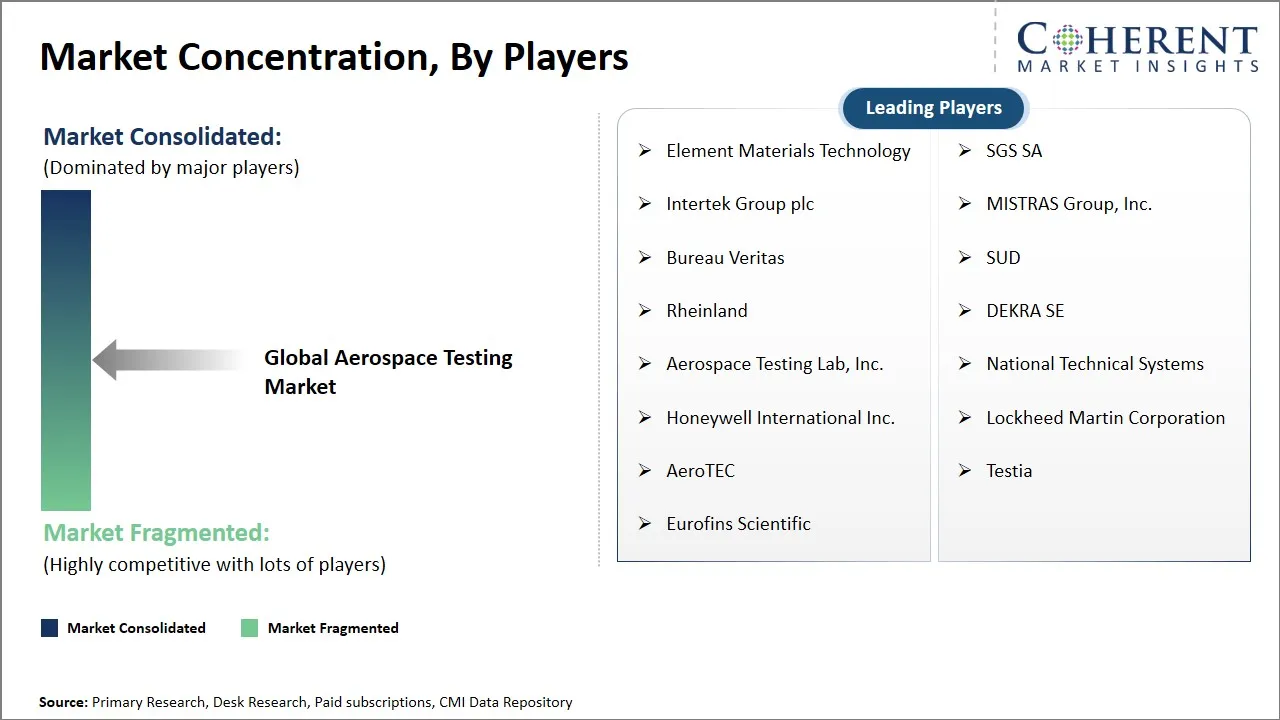
| Companies covered: | Element Materials Technology, SGS SA, Intertek Group plc, MISTRAS Group, Inc., Bureau Veritas, SUD, Rheinland, DEKRA SE, Aerospace Testing Lab, Inc., National Technical Systems, Honeywell International Inc., Lockheed Martin Corporation, AeroTEC, Testia, and Eurofins Scientific | ||
| Growth Drivers: |
| ||
| Restraints & Challenges: |
| ||
Global Aerospace Testing Market Dynamics
Global Aerospace Testing Market Driver - Increasing Production of Aircrafts
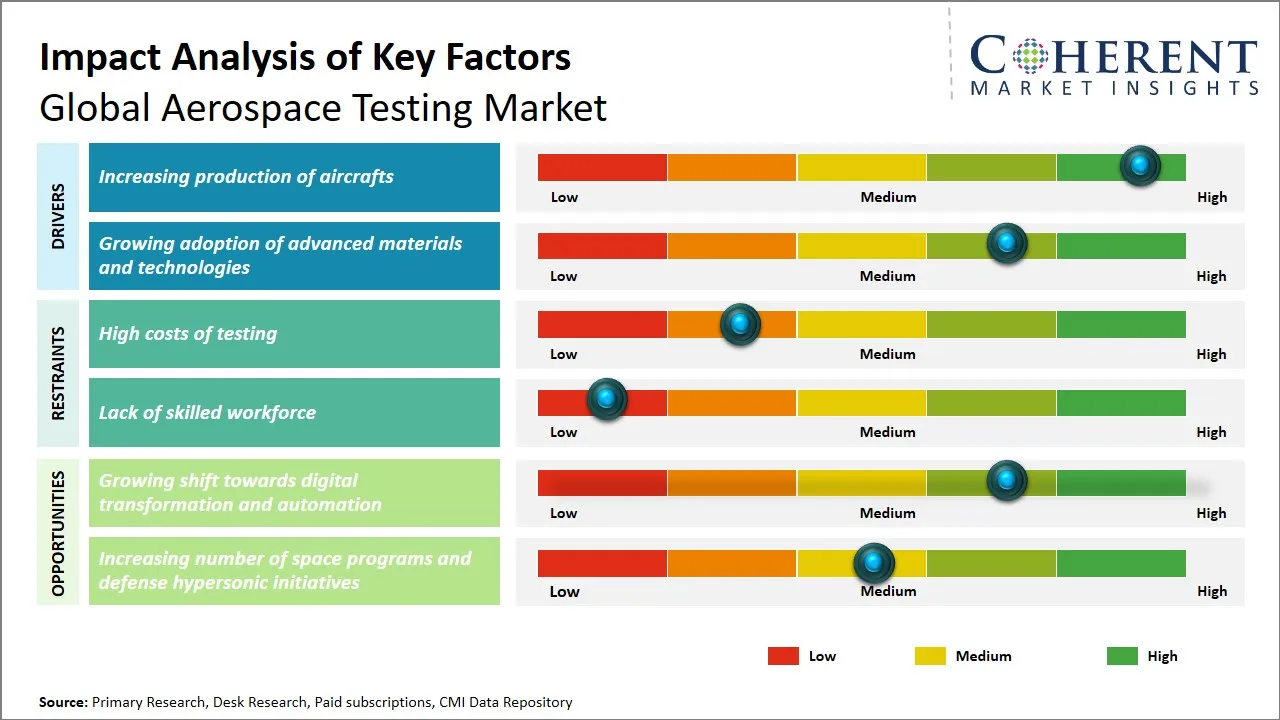
The rising production of commercial aircrafts and military aircrafts significantly drives the demand for aerospace testing services and solutions. With rising demand for air travel alongside evolving military demands, makers of airplanes now face heavier workloads in both building and certifying new models. Because these vehicles must perform under extreme conditions, every model undergoes deep examination before approval. Testing goes beyond simple inspections: it includes checking how well parts handle stress, how efficiently they move through air, and whether onboard mechanisms function correctly over time.
For instance, on November 18, 2025, Etihad Airways announced a significant expansion of its Airbus widebody fleet by placing a firm order for six A330-900s, becoming the latest A330neo customer. In addition, the airline has disclosed an order for seven additional A350-1000s (increasing its total for the type to 27) and three A350F (bringing the airline’s A350F commitment to 10 aircraft).
(Source: etihad.com)
Global Aerospace Testing Market Opportunity - Growing Shift Towards Digital Transformation and Automation
Pushing precision forward, digital tools shape how aerospace testing evolves worldwide. Not merely automation but smart integration defines current industry shifts. From early design phases onward, sensor networks feed information without pause. Instead of waiting until late stages, problems reveal themselves sooner through steady streams of evidence. Relying less on manual checks, firms adopt responsive technologies that adjust in real time. Because systems learn from patterns, decision-making gains consistency across tests. This change leads to steadier results, reducing holdups throughout distribution networks. Gains in performance come less from pace, instead emerging through refined choices built into testing routines.
For instance, on January 19, 2026, Airbus ordered UBTech’s Walker S2, a full-size humanoid that stands 176 cm tall (5’9"), weighs 70 kg (154 lbs), and walks at about two meters/second (4.5 mph). The Walker S2 can also hot-swap its own batteries, and UBTech reported it was the first humanoid robot to be able to do so.
(Source: forbes.com)
Analyst Opinion (Expert Opinion)
- Ahead of traditional timelines, assessments begin influencing engineering choices much sooner. Driven by tougher reliability demands plus increased production goals, the role of flight-related validation shifts within factory workflows. When composite substances enter prototypes, older inspection patterns struggle to keep pace. Advanced analysis tools emerge not as options, but requirements under these evolving conditions. Progress in flight electronics pushes test frameworks forward. Validation grows stricter as engines evolve through harsher tests. With oversight now more intense, manufacturers adapt by embedding evaluation further into processes. Though pace is essential, omitting stages often leads to breakdowns. Closer inspection follows every advancement made. As decisions align with evidence, assurance strengthens gradually. With rising intricacy, exactness in evaluation becomes more essential.
- Fueled by expanding space missions, interest rises steadily. Drones gain wider use across industries over time. Flight technologies evolve when intelligent systems integrate gradually. Progress unfolds as innovation meets practical needs. Digital validation methods take center stage - simulation tools, self-guided inspection processes evolve steadily. Firms combining predictive data models, virtual replicas of equipment, full-cycle assessment frameworks gain advantage. Original manufacturers, oversight bodies emphasize dependable performance across time, reduced ownership expenses. Positioning improves for those aligning with these efficiency demands.
Speak to the analyst
Want personalized insights?
Take the findings above to one of our principal consultants, or have the report rebuilt around the segments, geographies and competitors you actually track.
Market Segmentation
- Testing Type Insights (Revenue, USD Billion, 2021 - 2033)
- Material Testing
- Environmental Testing
- Structural Testing
- Electromagnetic Compatibility Testing
- Software Testing
- Others
- Aviation Type Insights (Revenue, USD Billion, 2021 - 2033)
- Commercial Aviation
- Military Aviation
- Space Exploration
- Others
- Application Insights (Revenue, USD Billion, 2021 - 2033)
- Aircraft Structures
- Propulsion Systems
- Interiors
- Space Systems
- Avionics and Electronics
- Regional Insights (Revenue, USD Billion, 2021 - 2033)
- North America
- U.S.
- Canada
- Latin America
- Brazil
- Argentina
- Mexico
- Rest of Latin America
- Europe
- Germany
- U.K.
- Spain
- France
- Italy
- Russia
- Rest of Europe
- Asia Pacific
- China
- India
- Japan
- Australia
- South Korea
- ASEAN
- Rest of Asia Pacific
- Middle East
- GCC Countries
- Israel
- Rest of Middle East
- Africa
- South Africa
- North Africa
- Central Africa
- North America
- Key Players Insights
- Element Materials Technology
- SGS SA
- Intertek Group plc
- MISTRAS Group, Inc.
- Bureau Veritas
- SUD
- Rheinland
- DEKRA SE
- Aerospace Testing Lab, Inc.
- National Technical Systems
- Honeywell International Inc.
- Lockheed Martin Corporation
- AeroTEC
- Testia
- Eurofins Scientific
Sources
Primary Research Interviews
- Aerospace Testing Equipment Manufacturers
- Aircraft OEMs and Tier-1 Suppliers
- Aerospace Testing Service Providers
- Aviation Regulatory Bodies Representatives
- Others
Databases
- Aviation Week Intelligence Network (AWIN)
- Aerospace & Defense Intelligence Database
- Federal Aviation Administration (FAA) Database
- European Aviation Safety Agency (EASA) Database
Magazines
- Aviation Week & Space Technology
- Aerospace Testing International
- Flight International
- Aerospace Manufacturing Magazine
Journals
- Journal of Aircraft
- Aerospace Science and Technology
- International Journal of Aerospace Engineering
Newspapers
- Aviation Daily
- The Wall Street Journal (Aerospace Section)
- Financial Times (Aerospace & Defense)
- Reuters (Aerospace News)
Associations
- Aerospace Industries Association (AIA)
- International Association for the Advancement of Space Safety (IAASS)
- Society of Flight Test Engineers (SFTE)
- American Institute of Aeronautics and Astronautics (AIAA)
Public Domain Sources
- NASA Technical Reports Server
- Federal Aviation Administration (FAA) Publications
- European Aviation Safety Agency (EASA) Publications
- International Civil Aviation Organization (ICAO) Reports
Proprietary Elements
- CMI Data Analytics Tool
- Proprietary CMI Existing Repository of information for last 8 years
Get access to 250+ pages report
Every segment, forecast, competitor profile and data table behind the analysis above — available for instant download.
- ESOMAR Member
- ISO 9001:2015 Certified
- D-U-N-S Registered
- GDPR & CCPA Compliant
Missing comfort of reading report in your local language? Find your preferred language:
Transform your Strategy with Exclusive Trending Reports
Frequently Asked Questions
The global aerospace testing market stood at USD 7 Bn in 2026 and is expected to reach USD 10 Bn by 2033.
The CAGR of global aerospace testing market is projected to be 5% from 2026 to 2033.
Increasing production of aircrafts and growing adoption of advanced materials and technologies are the major factors driving the growth of the global aerospace testing market.
High costs of testing and lack of skilled workforce are the major factors hampering the growth of the global aerospace testing market.
In terms of testing type, material testing is estimated to dominate the market revenue share in 2026.
Rising defense budgets increase demand for advanced testing of military aircraft and aerospace systems.
Yes, growing space missions and satellite launches are expanding the scope of aerospace testing requirements.