

India Aerial Work Platform Market Size and Forecast – 2026 to 2033
The India aerial work platform market is estimated to be valued at USD 798.3 Mn in 2026 and is expected to reach USD 2,283.5 Mn by 2033, exhibiting a compound annual growth rate (CAGR) of 16.2% from 2026 to 2033.
Key Takeaways from the India Aerial Work Platform Market Report
- Scissor lift remains the top-selling type of aerial work platform in India, accounting for 50.5% of market revenue in 2026.
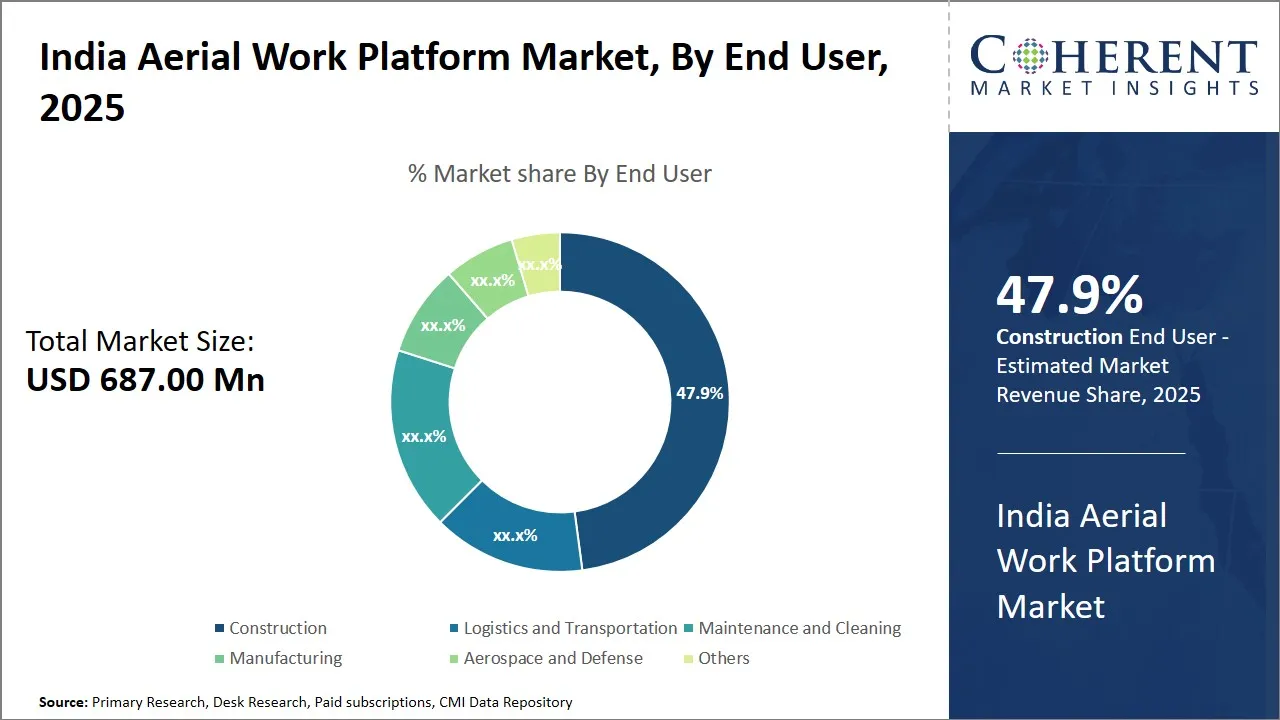
- Construction industry is expected to remain the leading end user of aerial work platforms in India, representing about 48.9% of the market in 2026.
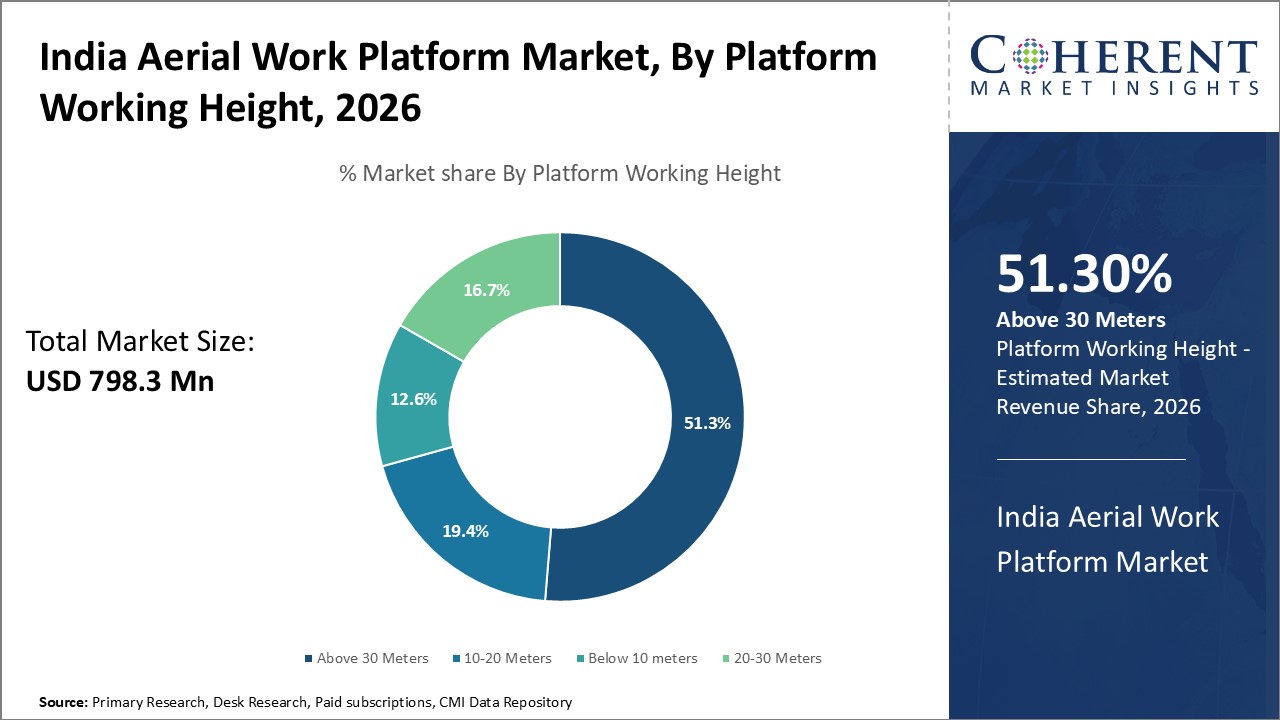
- Based on platform working height, above 30 meters segment is slated to account for 51.3% of the India aerial work platform market share in 2026.
India Aerial Work Platform Market Overview
The India aerial work platform market is poised to exhibit robust growth during the forecast period. This can be attributed to expanding construction industry, increasing investments in smart city projects, and growing safety concerns.
The market is seeing the rising adoption of technologically advanced and safer aerial work platforms with features like automation, remote control, and improved maneuverability. Industries like aviation, construction, and logistics are embracing cutting-edge AWPs.
For instance, in June 2026, Cochin International Airport (CIAL) improved its emergency response by adding advanced equipment like an Articulated Boom Lift and a Multipurpose Firefighting Robot. Combined with the powerful Rosenbauer PANTHER 6X6 fire truck, these upgrades make CIAL one of the few airports in India with such a modern and capable firefighting team.
Rising awareness of workplace safety and supportive government initiatives are driving the adoption of aerial work platforms in India. Additionally, ongoing large-scale infrastructure development projects are expected to fuel sales of aerial work platforms during the forthcoming period.
Top players are introducing novel aerial work solutions to capitalize on emerging opportunities. For instance, TIL Limited unveiled the Snorkel A62JRT, an articulating boom lift, at Bauma ConExpo India in December 2024
Current Events and Their Impact on the India Aerial Work Platform Market
Current Event | Description and its Impact |
Rise in Demand for Short-Term Labor in Festive Season |
|
Expansion of Warehousing Infrastructure by DHL Logistics |
|
Segmental Insights
- Current Industry Events of 2026
- Market Size Estimation
- Regional Breakdown
- Competitive Landscape
- Customer Intelligence
- Segmental Analysis
- Pricing Analysis
- Key Market Drivers, Challenges & Future Trends
- Customized Insights Section
India Aerial Work Platform Market Insights, By End User: Construction Tops Aerial Work Platform Users
As per Coherent Market Insights’ latest India aerial work platform analysis, construction segment is projected to hold around 48.9% share in 2026. This is attributable to the nation’s fast urbanization and expansive infrastructure development initiatives.
The construction industry relies on aerial work platforms (AWPs) for their ability to provide elevated access solutions that enhance both efficiency as well as safety at job sites. As Indian cities expand vertically with the rise of high-rise buildings, commercial complexes, and residential towers, demand for reliable and versatile equipment such as AWPs is expected to increase rapidly.
AWPs are preferred in construction because they allow safe and efficient work at heights for tasks such as structural assembly, electrical installation, painting, and facade maintenance. These platforms reduce the need for traditional scaffolding, which is time-consuming and often involves higher safety risks.
There is a rise in government infrastructure development programs, including metro rail expansion, smart city projects, and highway construction, in India. This is expected to further drive demand for aerial work platforms in India’s construction sector during the forthcoming period.
A recent example showing the rising demand for aerial work platforms (AWPs) in India’s construction sector is the opening of the country’s first urban public transport ropeway in Varanasi. Projects like this are expected to become growth engines for India’s aerial work platform market.
Another big driver is the focus on occupational safety norms in the construction industry. With stricter regulatory oversight and growing awareness about workplace safety, construction companies are using mechanically aided solutions like aerial work platforms. This trend brings the market toward higher investments in AWPs with better load capacities, improved manoeuvrability, and safety features made for complex construction environments.
India Aerial Work Platform Market Insights, By Platform Working Height: Above 30 Meters Segment Sees Rising Demand for High-Rise Access Solutions
The above 30 meters segment is expected to hold the largest share of 51.3% in 2026. This is due to a growing trend toward servicing ultra-high elevation tasks. The growth of this segment correlates strongly with India’s construction landscape, which is increasingly moving toward skyscrapers, multi-story industrial facilities, and tall infrastructure assets needing elevated maintenance and operational activities.
Platforms with working heights of over 30 meters make it possible to perform tasks that would otherwise be difficult or unsafe using traditional ladders or scaffolding. This capability is especially important in major cities like Mumbai, Delhi, Bangalore, and Hyderabad, where the demand for commercial real estate and industrial infrastructure is rapidly increasing.
Facilities like power plants, telecommunications towers, and large bridges create demand for equipment with high-reach capability for inspection, repair, and installation. Also, public and private sectors focus on maintaining existing infrastructure like airports and large manufacturing plants needs regular inspection and maintenance at high altitudes. The flexibility and precision offered by platforms above 30 meters make these operations possible to be performed efficiently, reducing downtime and operational disruptions.
The demand for platforms above 30 meters is also driven by advances in technology, including enhanced stability, hydraulic and electric lift systems, and integrated safety features. These improvements make long-reach aerial platforms more reliable and easier to operate in confined spaces and moderate weather conditions.
Growing adoption of green construction technologies and smart infrastructure also adds to the segment’s growth, where the need to manage complex installations at height is very much. The trend toward taller, more sophisticated structures and increasingly strict safety standards adds to segment growth.
India Aerial Work Platform Market Insights, By Type: Scissor Lifts Lead Because of Versatility and Cost-Effectiveness
Scissor lifts remain a highly sought-after aerial work platform type in India, thanks to their versatile design and cost-efficient operation. The target segment is expected to account for a market share of 50.5% in 2026.
Scissor lifts are chosen because of their strong vertical elevation mechanism, which gives a stable platform made for a range of applications in multiple industries. Their simplicity of use and relatively low operational costs make them an attractive choice, particularly for projects where vertical access is needed.
In sectors like manufacturing, logistics, maintenance, and construction, scissor lifts make possible efficient workflow by allowing personnel to safely work on elevated platforms for extended periods. Their compact footprint allows them to be deployed indoors and in confined spaces, making them very adaptable to warehouses, factories, and tight urban job sites.
Also, scissor lifts have higher load capacities than other platform types, allowing workers to carry tools and materials simultaneously, which improves operational productivity. The ease of training operators and the relatively lower maintenance expenses also incentivize businesses to adopt scissor lifts for frequent, repetitive tasks.
The rise of electric and hybrid scissor lifts aligns well with India’s growing environmental and sustainability objectives, making demand for cleaner and quieter equipment suitable for indoor use. Also, advancements in safety features like automatic braking systems, guardrails, and platform controls add to their appeal by ensuring compliance with safety regulations.
Pricing Analysis of the India Aerial Work Platform Market
AWP Type (typical use) | Typical price range (USD, new unless noted) |
Vertical mast/personnel lift (indoor single-person access) | $5,000 – $20,000 |
Indoor slab scissor (low height, electric) | $15,000 – $50,000 |
Rough-terrain scissor (diesel/4x4) | $25,000 – $80,000 |
Small articulating boom (compact outdoor) | $25,000 – $120,000 |
Medium telescopic boom (commonly 40'–80' working height) | $40,000 – $200,000 |
High-reach telescopic boom (very large, e.g., SX-150 class) | $150,000 – $400,000+ |
Telescopic handler/Telehandler | $35,000 – $150,000 |
Used small scissor — marketplace example | $4,000 – $25,000 (used) |
Rental day-rates (reference, India/global varies) | $90 – $350/day (typical for scissor/boom small-to-mid on daily rent) |
India Aerial Work Platform Industry News
- In August 2024, JCB launched its very first diesel Telescopic Boom Platform, the T65D, in Goa, India, during the Aerial Platform Association of India’s (APAOI) conference.
- In August 2024, TIL Limited announced a new partnership with Snorkel Europe Limited in a stock exchange filing. Under this agreement, Snorkel agreed to supply its wide range of products and offer expertise and support. The company became the official Sales and Service partner for Northern and Eastern India, the Andaman and Nicobar Islands, Nepal, and Bhutan.
In June 2024, Mtandt Group made a partnership with CO.ME.T. Officine, a renowned manufacturer of Aerial Work Platforms (AWPs) and industrial equipment.
Top Strategies Followed by India Aerial Work Platform Market Players
- Established companies dominate the market by investing a lot in research and development (R&D), adding to innovation to produce high-performance, reliable aerial work platforms made for the evolving needs of industrial customers.
- JLG Industries launched its DaVinci AE1932 electric scissor lift, with fully electric drive and no hydraulic oil, fulfilling India’s growing demand for clean, low-maintenance equipment.
- Mid-level players in the India aerial work platform market offer cost-effective solutions that give a balance between quality and affordability.
- ACE and Mtandt Group offer locally assembled scissor and boom lifts in partnership with global OEMs, giving competitive pricing and maintaining acceptable performance standards for Indian users.
- Small-scale players in the India aerial work platform market distinguish themselves by focusing on specialized features or niche applications that larger competitors may overlook.
- Shakti Equipments Pvt. Ltd. and Rapid Lift India focus on customized vertical mast and towable boom lifts, made for sectors like facility management, warehousing, and retail malls, helping them differentiate from big companies.
Market Report Scope
India Aerial Work Platform Market Report Coverage
| Report Coverage | Details | ||
|---|---|---|---|
| Base Year: | 2025 | Market Size in 2026: | USD 798.3 Mn |
| Historical Data for: | 2020 To 2024 | Forecast Period: | 2026 To 2033 |
| Forecast Period 2026 to 2033 CAGR: | 16.2% | 2033 Value Projection: | USD 2,283.5 Mn |
| Segments covered: |
| ||
| Companies covered: | Toyota Industries Corporation, Dinolift Oy, Jost's Engineering Company Limited, CTE, Haulotte Group, Manitou Group, Niftylift (UK) Limited, Tadano Ltd., and Versalift, JLG Industries | ||
| Growth Drivers: |
| ||
| Restraints & Challenges: |
| ||
Market Dynamics
India Aerial Work Platform Market Driver
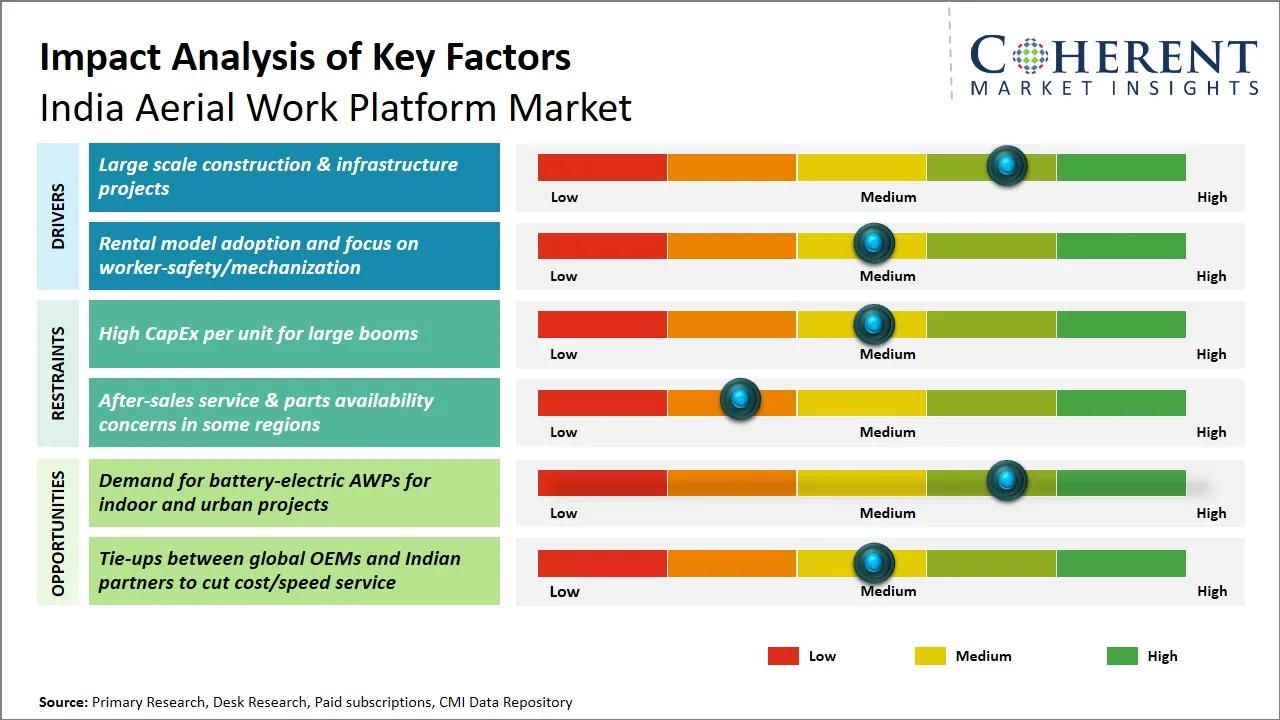
Large Scale Construction & Infrastructure Projects
Rise in large-scale construction and infrastructure development in India is a big driver for the aerial work platform market. With fast urbanization and government initiatives for improving connectivity in highways, metro rail systems, airports, and smart city projects, there is a growing need for efficient and safe access to elevated workspaces. Aerial work platforms give a practical solution by improving worker safety, operational efficiency, and accessibility in complex construction environments.
Also, the growth of industrial parks, commercial complexes, and residential high-rises creates need for advanced machinery to handle tasks like maintenance, installation, and repairs at big heights. Thus, the growth in infrastructure and construction activities adds to the adoption of these platforms.
India Aerial Work Platform Market Opportunity
Growing Demand for Battery-Electric Aerial Work Platforms in Indoor and Urban Projects
The India aerial work platform market is seeing a big opportunity because of the rising demand for battery-electric AWPs, particularly in indoor and urban construction and maintenance projects. As India’s urbanization grows and infrastructure development expands in metropolitan areas, the need for equipment that is quiet, emission-free, and maneuverable in confined spaces has grown a lot.
Battery-electric AWPs offer big advantages over traditional diesel-powered models, like zero emissions, reduced noise levels, and lower maintenance costs. This is making them very suited for indoor applications in shopping malls, airports, warehouses, and office buildings. The increasing emphasis on green building certifications and workplace safety enhances the appeal of battery-powered platforms, as they contribute to healthier working environments.
Analyst Opinion (Expert Opinion)
- Fast urbanization and government-led initiatives like Smart Cities Mission and Bharatmala Pariyojana are big drivers of AWP adoption. A lot of demand can be seen in high-rise construction, metro rail, and airport expansion projects where safety and efficiency in elevated work are very important.
- The growth of e-commerce players like Amazon, Flipkart, and Reliance Retail has pushed a lot of large-scale warehouse construction in Tier I and Tier II cities. This has added a lot to the use of scissor lifts and vertical mast lifts for maintenance, racking, and inventory operations in modern logistics centers.
- Industries like oil & gas, power generation, and manufacturing are increasingly adopting AWPs for plant maintenance and inspection tasks. The shift to mechanized access solutions in these sectors is added to by strict workplace safety regulations and the push for operational efficiency.
Speak to the analyst
Want personalized insights?
Take the findings above to one of our principal consultants, or have the report rebuilt around the segments, geographies and competitors you actually track.
Market Segmentation
- Platform Working Height Insights (Revenue, USD Mn, 2021 - 2033)
- Above 30 Meters
- 10-20 Meters
- Below 10 meters
- 20-30 Meters
- Type Insights (Revenue, USD Mn, 2021 - 2033)
- Scissor Lift
- Boom Lift
- Atrium Lift
- Propulsion Type Insights (Revenue, USD Mn, 2021 - 2033)
- Internal Combustion Engine (ICE)
- Others
- End User Insights (Revenue, USD Mn, 2021 - 2033)
- Construction
- Logistics and Transportation
- Maintenance and Cleaning
- Manufacturing
- Aerospace and Defense
- Others
- Key Players Insights
- Toyota Industries Corporation
- Dinolift Oy
- Jost's Engineering Company Limited
- CTE
- Haulotte Group
- Manitou Group
- Niftylift (UK) Limited
- Tadano Ltd.
- Versalift
- JLG Industries
Sources
Primary Research Interviews
- Conducted interviews with key industry stakeholders, including equipment manufacturers, rental companies, construction firms, and infrastructure developers, to gather firsthand insights into market trends and demands
Databases
- Utilized data from government publications such as the Ministry of Heavy Industries & Public Enterprises – India and international organizations like the United Nations Industrial Development Organization (UNIDO) to analyze industry reports and infrastructure projects.
Magazines
- Reviewed industry-specific publications like Equipment Times and Equipment India to stay updated on the latest developments, product launches, and market dynamics within the aerial work platform sector.
Journals
- Consulted academic and industry journals available on platforms like ResearchGate to understand the technical advancements, safety standards, and engineering innovations related to aerial work platforms.
Newspapers
- Analyzed national and regional newspapers for reports on infrastructure projects, government policies, and industry news impacting the aerial work platform market in India.
Associations
- Engaged with the Aerial Platform Association of India (APAOI), which provides access to industry standards, best practices, and safety guidelines pertinent to aerial platforms.
Public Domain Sources
- Examined publicly available reports and data from organizations such as the World Bank, Ministry of Heavy Industries & Public Enterprises – India, and UNIDO to analyze industrial equipment and infrastructure projects.
Proprietary Elements
- CMI Data Analytics Tool and Proprietary CMI Existing Repository of information for last 8 years
Get access to 250+ pages report
Every segment, forecast, competitor profile and data table behind the analysis above — available for instant download.
- ESOMAR Member
- ISO 9001:2015 Certified
- D-U-N-S Registered
- GDPR & CCPA Compliant
Missing comfort of reading report in your local language? Find your preferred language:
Transform your Strategy with Exclusive Trending Reports
Frequently Asked Questions
The India aerial work platform market value is set to reach around USD 798.3 million in 2026.
The CAGR of the India aerial work platform market is projected to be 16.2% from 2026 to 2033.
The target market is expected to reach USD 2,283.5 million by 2033.
Large scale construction & infrastructure projects, growing adoption of electric aerial work platforms, and focus on worker-safety/mechanization.
High CapEx per unit for large booms and after-sales service & parts availability concerns.
Construction industry is the leading end user of aerial work platforms in India
Toyota Industries Corporation, Dinolift Oy, Jost's Engineering Company Limited, CTE, Haulotte Group, Manitou Group, Niftylift (UK) Limited, Tadano Ltd., Versalift, and JLG Industries are the major players.