

India Bamboo Based Ethanol Plant Market Size and Forecast – 2026 To 2033
The India Bamboo Based Ethanol Plant Market is estimated to be valued at USD 512.4 Mn in 2026 and is expected to reach USD 1,661.5 Mn by 2033, exhibiting a compound annual growth rate (CAGR) of 18.3% from 2026 to 2033.
This growth is supported by India’s move toward commercial-scale second-generation ethanol assets, stronger use of non-food lignocellulosic biomass, and refinery-linked clean fuel production. In February 2024, the Centre for High Technology listed the ABRPL Golaghat project as a commercial 2G ethanol plant using bamboo feedstock, with 185 KLPD ethanol capacity and 900 MTPD biomass processing capacity, highlighting the scale at which bamboo-based ethanol is entering India’s renewable fuel infrastructure. (Source: Centre for High Technology)
Key Takeaways of the India Bamboo Based Ethanol Plant Market
- Bamboo biomass is expected to dominate with 72.6 % of the market share in 2026, driven by strong feedstock localization, high cellulose yield, and dedicated bamboo supply ecosystems in North-East India. In April 2025, Numaligarh Refinery Ltd. (NRL) commissioned India’s first bamboo-based ethanol biorefinery under ABEPL, designed to produce 48,900 MT of ethanol annually from bamboo feedstock. (Source: Assam Bio Ethanol Private Limited ABEPL)
- Biochemical conversion is projected to account for 64.8 % of the market share in 2026, supported by higher conversion efficiency of lignocellulosic bamboo and compatibility with commercial enzyme-based hydrolysis routes. In March 2025, Chempolis highlighted the deployment of its formico technology at the Assam biorefinery, enabling the processing of ~300,000 tons of bamboo annually into fuel-grade ethanol with ~99.6% purity. (Source: Chempolis Biorefining Park)
- Above 100 KLPD plants are expected to hold 46.3 % of the market share in 2026, as economies of scale, refinery integration, and continuous feedstock processing reduce per-unit production cost. In September 2024, Numaligarh Refinery Limited (NRL) announced the expansion of its bio-refinery ecosystem with integrated bamboo-based ethanol production facilities under its Assam refinery modernization program, strengthening India’s shift toward large-scale biofuel infrastructure.
- Policy-Backed Ethanol Blending Momentum: India's ethanol blending program is also boosting commercial ethanol consumption through the promotion of advanced bioethanol routes, which will help provide a conducive environment for the growth of ethanol plants based on bamboo. India reached 20% ethanol blending in petrol in August 2025, five years ahead of its original target, and is now more focused on the development of ethanol feed-stocks like bamboo which will help secure ethanol blending for the future.
- Integrated Bamboo Supply Ecosystem Expansion: Development of organized bamboo clusters is strengthening long-term feedstock security, reducing logistics fragmentation, and improving plant viability. The National Bamboo Mission has expanded structured cultivation and processing infrastructure across multiple states, supporting industrial-scale biomass availability for ethanol production and improving rural value-chain integration.
Segmental Insights
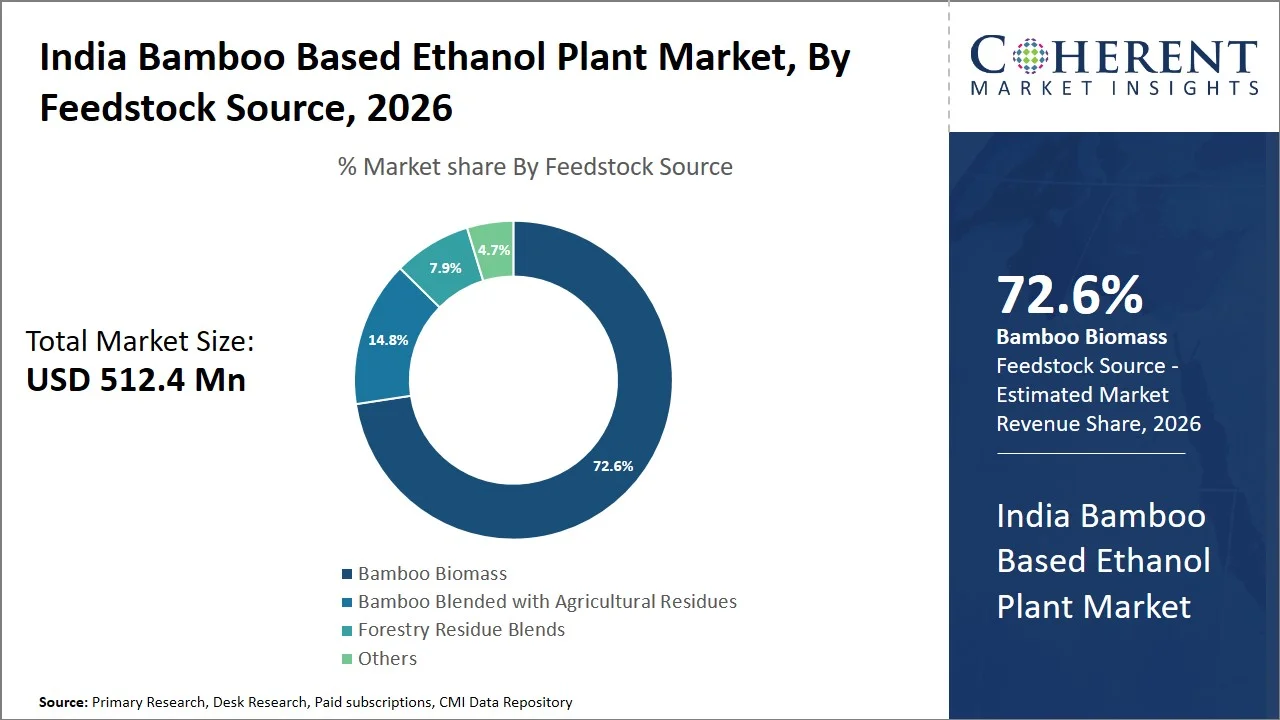
Why Does the Bamboo Biomass Segment Dominate the India Bamboo Based Ethanol Plant Market?
Bamboo biomass is expected to dominate the India bamboo based ethanol plant market with 72.6% share in 2026, as it provides a dedicated non-food lignocellulosic feedstock suitable for continuous ethanol production. On the demand side, refinery-led ethanol projects require scalable biomass that can support fuel-grade ethanol output without competing with sugar, grain, or food supply chains. On the demand side, ethanol projects based on refineries need biomass that is scalable to produce ethanol for fuel without competing with sugar, grain or food supply chain.
On the supply side, bamboo can be chipped by decentralized aggregation units, and the efficiency of handling and consistency of the feedstocks in the plants is improved. It is most applicable in fuel ethanol production applications, and furfural, acetic acid, CO₂ and green energy recovery downstream enhances project economics. In October 2025, Assam Bio Ethanol Private Limited (ABEPL) issued an EOI for transporting around 3,75,000 MT per annum bamboo chips from designated local-level entrepreneur units to the plant, showing the formalization of bamboo supply logistics. (Source: ABEPL)
- Current Industry Events of 2026
- Market Size Estimation
- Regional Breakdown
- Competitive Landscape
- Customer Intelligence
- Segmental Analysis
- Pricing Analysis
- Key Market Drivers, Challenges & Future Trends
- Customized Insights Section
Why Does Biochemical Conversion Represent the Largest Technology Segment in the India Bamboo Based Ethanol Plant Market?
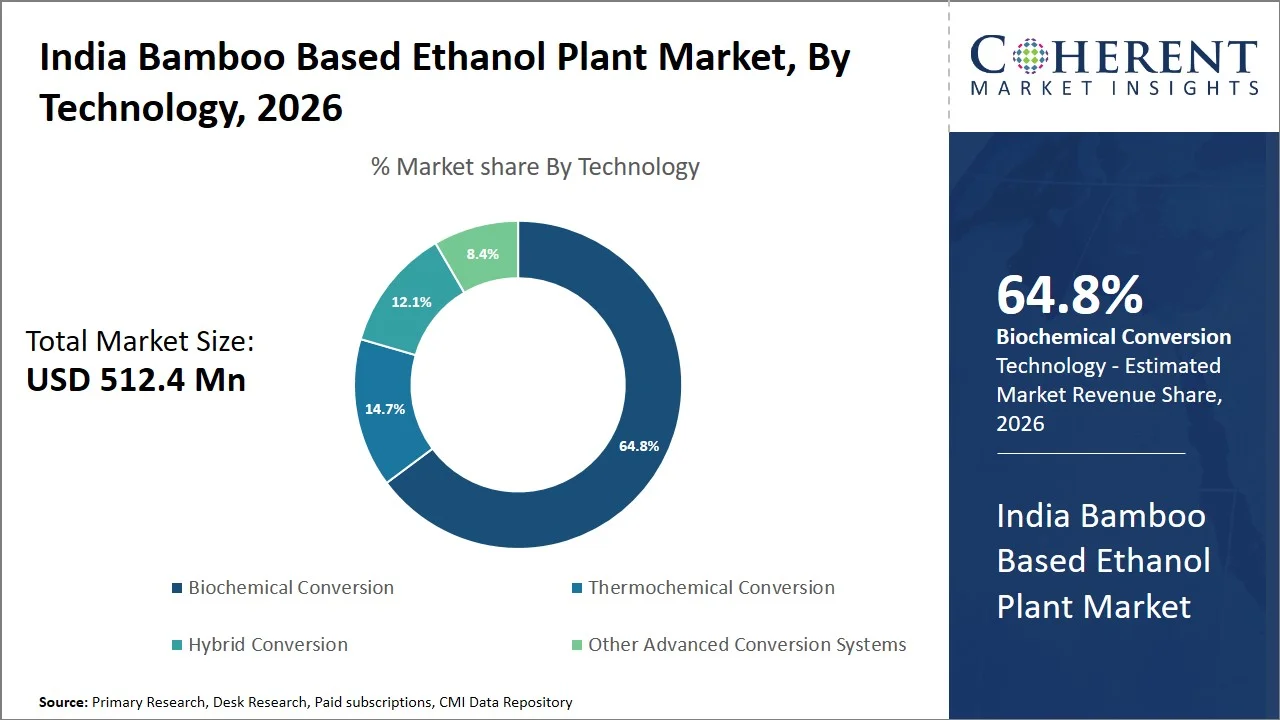
Biochemical conversion is expected to represent the largest technology segment with 64.8% share in 2026, as bamboo-based ethanol production depends on converting cellulose and hemicellulose into fermentable sugars before distillation into fuel-grade ethanol. Demand-side preference is linked to high-purity ethanol requirements for blending, where consistent alcohol quality and process reliability are critical. From the technology side, biochemical processing combines digestion, washing, enzymatic hydrolysis, and fermentation, making it more suitable for lignocellulosic bamboo than standalone thermal routes. The route also supports coproduct recovery, which strengthens commercial viability for integrated biorefineries. In March 2025, Numaligarh Refinery Limited (NRL)’s reply to Parliament stated that bamboo was successfully processed through the digestor, bamboo washing, enzymatic hydrolysis, and fermentation sections during the trial run, validating the core biochemical pathway for commercial bamboo ethanol production.
Why Does Above 100 KLPD Segment Dominate the India Bamboo Based Ethanol Plant Market?
Above 100 KLPD plants are expected to dominate with 46.3% share in 2026, as bamboo ethanol plants require high-capacity infrastructure to justify biomass procurement, preprocessing, enzyme handling, fermentation, distillation, utilities, and coproduct recovery investments. Demand-side viability is the strongest for large plants because oil marketing companies and refinery-linked buyers need dependable ethanol volumes for blending programs. Supply-side economics also favor larger plants, as fixed costs related to bamboo handling yards, chipping networks, storage, effluent systems, and captive utilities can be spread across higher output. End-use relevance is highest in bulk fuel-grade ethanol supply, where uninterrupted output is more important than small-batch flexibility. In February 2026, Lok Sabha documentation cited a 185 KLPD bamboo-based 2G ethanol plant at Numaligarh, inaugurated in September 2025, confirming India’s commercial preference for above-100 KLPD bamboo ethanol assets.
India Bamboo Based Ethanol Plant Market Dynamics
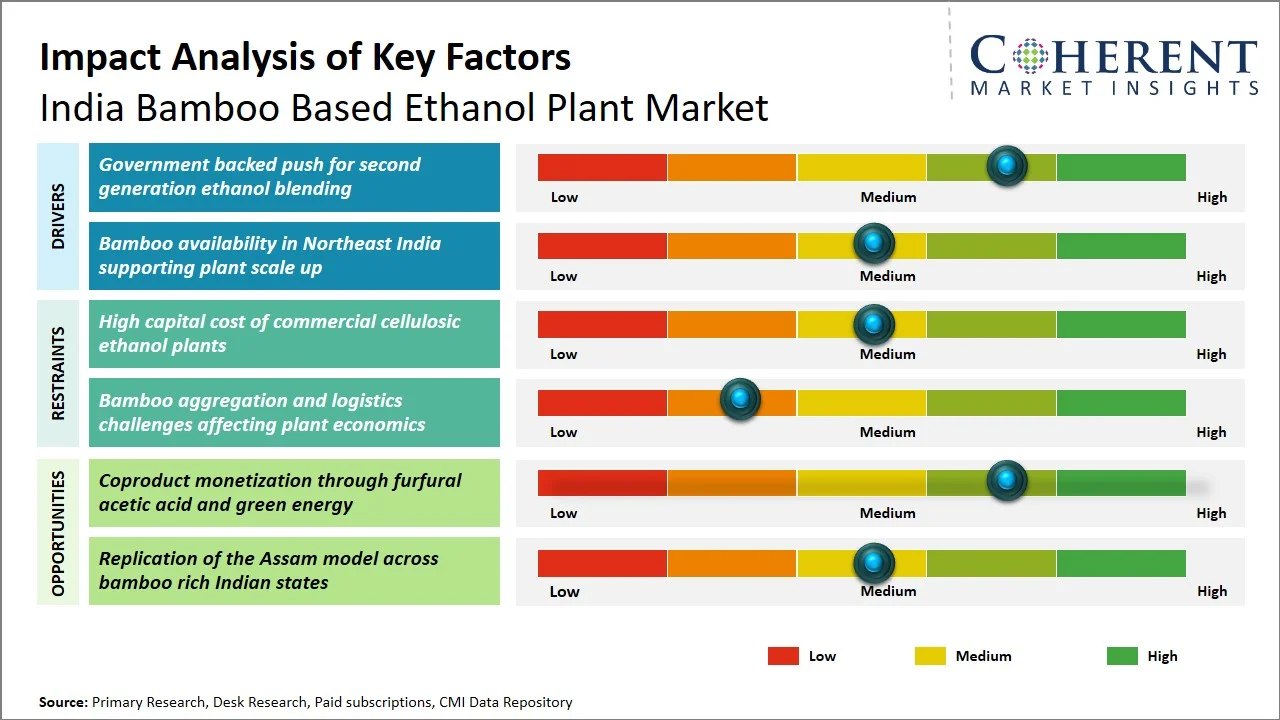
Key Market Drivers
- Government-Backed 2G Ethanol Blending Push: India’s policy support for second-generation ethanol is becoming a direct growth catalyst for bamboo-based ethanol plants, as the government is expanding feedstock flexibility beyond sugarcane and grain toward lignocellulosic biomass. This supports investment in bamboo-based conversion assets because refinery-linked buyers need stable, non-food ethanol sources to meet blending obligations without disrupting food-linked feedstock chains. In August 2024, the Union Cabinet approved the modified Pradhan Mantri JI-VAN Yojana, extending implementation to 2028–29 and expanding support for advanced biofuels from lignocellulosic feedstocks, agricultural and forestry residues, industrial waste, syngas, and algae. This improves project bankability for bamboo ethanol plants through policy visibility, offtake confidence, and advanced biofuel incentives.
- Bamboo Availability in Northeast India Supporting Plant Scale-Up: Bamboo availability in Northeast India is strengthening the supply-side foundation for large bamboo-based ethanol plants, particularly where feedstock aggregation, preprocessing, and logistics can be linked with industrial biorefineries. Bamboo’s high biomass density, perennial availability, and compatibility with rural sourcing networks make it suitable for continuous ethanol production at commercial capacity. This reduces procurement risk for investors and supports long-term plant utilization. In February 2026, the Ministry of Development of North Eastern Region stated that bamboo-based economic cluster projects were sanctioned in the region, including processing units, certified bamboo plantations, youth training, and export facilitation measures. Such organized bamboo ecosystems can improve feedstock reliability, lower logistics fragmentation, and support future bamboo ethanol scale-up.
Emerging Market Trends
- Shift Toward Integrated Biorefinery Models: Bamboo-based ethanol plants in India are increasingly being developed as integrated biorefineries where bamboo biomass is processed into ethanol along with recoverable coproduct streams. The model focuses on extracting value from cellulose, hemicellulose, and lignin fractions, enabling production of fuel-grade ethanol while using residues for captive power, steam generation, lignin-based energy, furfural, acetic acid, and recovered CO₂. This approach is especially relevant for bamboo feedstock because it improves residue utilization and supports higher plant-level value recovery. Going forward, bamboo ethanol plants with coproduct monetization and captive utility integration are expected to be more commercially attractive than standalone ethanol facilities.
- Rising Preference for Refinery-Linked Large-Capacity Plants: India’s bamboo-based ethanol market is shifting toward large-capacity plants connected with refinery ecosystems, as seen in projects aligned with established fuel distribution and ethanol blending networks. These plants are better suited for handling bulk bamboo feedstock, centralized preprocessing, continuous ethanol conversion, and large-volume offtake. Refinery linkage supports smoother integration with fuel-blending channels, while larger capacity improves plant utilization and reduces dependence on fragmented small-scale production. Going forward, projects with refinery-backed offtake, secured bamboo supply corridors, and integrated processing infrastructure are expected to gain stronger preference over standalone decentralized facilities.
Currents Events and their Impact
Current Events | Description and its Impact |
India Extends Advanced Biofuel Support under PM JI-VAN Yojana (August 2024 onward) |
|
E20 Fuel Supply Mandate Strengthens Ethanol Offtake Visibility (April 2026 onward) |
|
National Bamboo Mission Strengthens Bamboo Value-Chain Development (August 2025 onward) |
|
Technology Adoption Landscape in the India Bamboo Based Ethanol Plant Market
Technology | Key Features | Operational / Commercial Advantage | Market Relevance |
Bamboo Biomass Preprocessing and Chipping Systems | Converts raw bamboo into uniform chips through cutting, sizing, drying, and controlled handling systems before conversion. | Improves feedstock consistency, reduces reactor blockages, lowers logistics complexity, and supports continuous plant operation. | Highly relevant for large bamboo ethanol plants, as stable chip quality directly affects throughput, enzyme performance, and plant utilization. |
Biomass Fractionation / Pretreatment Technology | Breaks down bamboo’s lignocellulosic structure and separates cellulose, hemicellulose, and lignin for further processing. | Enhances sugar accessibility, improves ethanol yield, and enables recovery of high-value coproduct streams from bamboo. | Core technology for bamboo-based 2G ethanol plants, especially where commercial viability depends on both ethanol and biochemical recovery. |
Enzymatic Hydrolysis Technology | Uses cellulase and related enzymes to convert pretreated bamboo cellulose into fermentable sugars. | Reduces harsh chemical dependency, improves conversion selectivity, and supports higher-quality biochemical processing. | Critical for biochemical conversion, which dominates the market due to its suitability for lignocellulosic bamboo ethanol production. |
Advanced Fermentation Systems | Converts C5 and C6 sugars from bamboo hydrolysate into ethanol using optimized microbes and controlled fermentation conditions. | Improves ethanol productivity, reduces sugar loss, and supports consistent fuel-grade output. | Important for scaling commercial bamboo ethanol production, as fermentation efficiency directly affects yield, cost, and blending-grade ethanol availability. |
Distillation and Dehydration Systems | Purifies fermented ethanol through distillation, rectification, and dehydration to achieve fuel-grade ethanol quality. | Ensures compliance with blending specifications, improves product purity, and supports refinery-linked offtake. | Highly relevant for fuel-grade ethanol applications, which form the largest output category in the India bamboo ethanol plant market. |
Residue Valorization and Captive Utility Integration | Converts lignin, residues, and process by-products into bio-coal, steam, captive power, CO₂, or biochemical coproducts. | Improves project economics, reduces waste disposal burden, and lowers dependence on external energy inputs. | Emerging as a key differentiator for integrated bamboo biorefineries, where multiple revenue streams improve investment attractiveness. |
How are Technological Advancements Creating New Growth Opportunities in the India Bamboo Based Ethanol Plant Market?
Technological advancements in bamboo-based ethanol plants are creating new growth opportunities by improving conversion efficiency, expanding coproduct recovery, and making large-scale lignocellulosic ethanol commercially viable. Advanced fractionation, enzymatic hydrolysis, fermentation, and integrated residue-utilization systems are enabling bamboo to be converted into fuel-grade ethanol while also generating value-added outputs such as furfural, acetic acid, carbon dioxide, and green energy. This improves project economics and supports wider adoption by refinery-led and public-sector biofuel developers. For instance, in September 2025, India’s first bamboo-based biorefinery at Numaligarh adopted Chempolis’ formico fractionation technology, designed to process 300,000 tons of bamboo annually and produce around 49,000 tons of bioethanol, along with biochemicals and green energy. The development highlights how next-generation bamboo conversion technologies can strengthen ethanol blending, reduce fossil fuel dependence, and create new investment opportunities in integrated bio-refineries.
Market Players, Key Development, and Competitive Intelligence
Key Developments
- In February 2026, Assam Bio Ethanol Private Limited moved closer to full-capacity operations after trial production generated fuel-grade ethanol with 99.7% purity, and the first consignment was supplied to Numaligarh Refinery Limited. This validated the project’s readiness for commercial-scale bamboo-to-ethanol production in India.
- In September 2024, Fortum signed an agreement to sell its stake in Chempolis, its biobased solutions businesses, and its interest linked to Assam Bio Ethanol Private Limited to AM Green Technology & Solutions. This supported stronger domestic clean energy participation and strategic consolidation across India’s advanced biofuel value chain.
Competitive Landscape
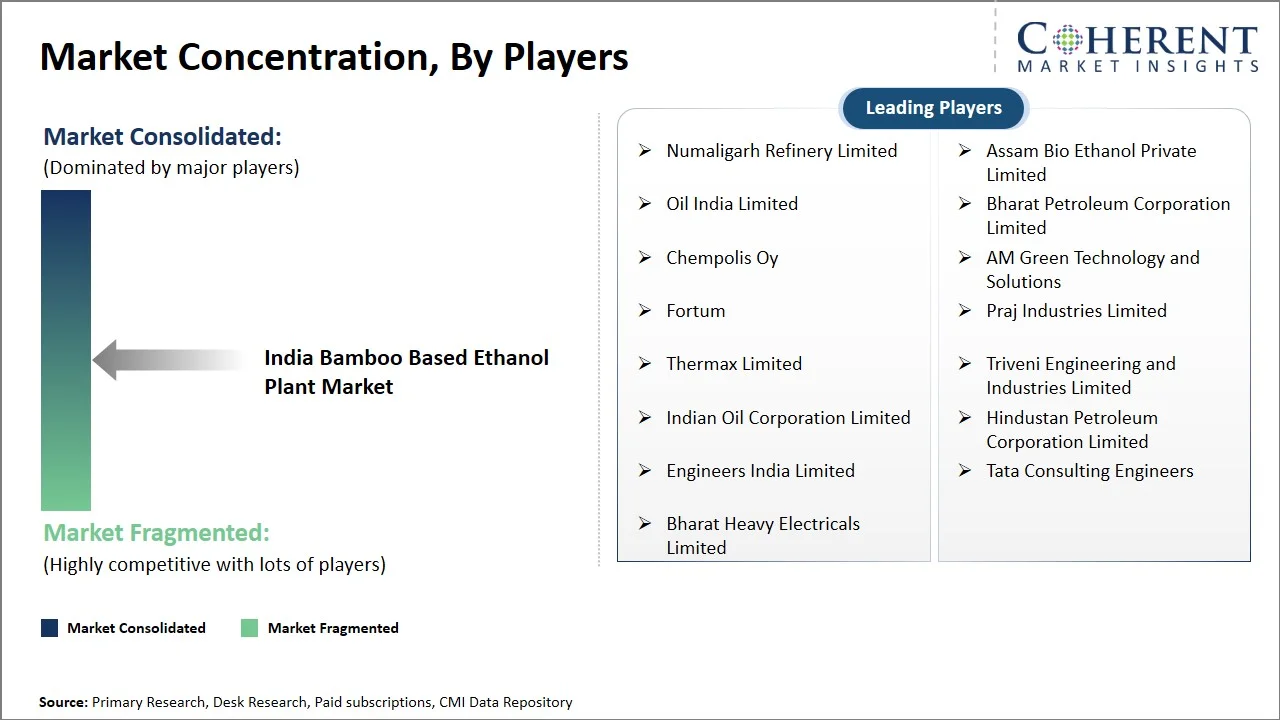
The India bamboo based ethanol plant market is at an early commercialization stage and is moderately concentrated, with competition led by public sector refinery-backed projects, technology partnerships, private biofuel developers, and state-supported bamboo value-chain participants. Companies are focusing on improving bamboo feedstock security, conversion efficiency, plant scalability, and coproduct recovery to make bamboo-based ethanol commercially viable. Strategic partnerships between refinery operators, technology providers, and bamboo supply-chain stakeholders are expected to shape the competitive environment.
Key focus areas include
- Development of large-scale bamboo-based 2G ethanol plants with stable fuel-grade ethanol output
- Adoption of advanced fractionation, enzymatic hydrolysis, and fermentation technologies to improve conversion yield
- Strengthening bamboo sourcing, preprocessing, chipping, and logistics networks to ensure continuous feedstock supply
- Integration of coproduct recovery such as furfural, acetic acid, CO₂, green energy, and captive utilities to improve margins
- Expansion of refinery-linked and government-supported biofuel projects to meet India’s ethanol blending targets
- Collaboration with technology providers and clean-energy investors to reduce project risk and accelerate commercialization
Market Report Scope
India Bamboo Based Ethanol Plant Market Report Coverage
| Report Coverage | Details | ||
|---|---|---|---|
| Base Year: | 2025 | Market Size in 2026: | USD 512.4 Mn |
| Historical Data for: | 2020 To 2024 | Forecast Period: | 2026 To 2033 |
| Forecast Period 2026 to 2033 CAGR: | 18.3% | 2033 Value Projection: | USD 1,661.5 Mn |
| Segments covered: |
| ||
| Companies covered: | Numaligarh Refinery Limited, Assam Bio Ethanol Private Limited, Oil India Limited, Bharat Petroleum Corporation Limited, Chempolis Oy, AM Green Technology and Solutions, Fortum, Praj Industries Limited, Thermax Limited, Triveni Engineering and Industries Limited, Indian Oil Corporation Limited, Hindustan Petroleum Corporation Limited, Engineers India Limited, Tata Consulting Engineers, and Bharat Heavy Electricals Limited | ||
| Growth Drivers: |
| ||
| Restraints & Challenges: |
| ||
Analyst Opinion (Expert Opinion)
- The India bamboo based ethanol plant market is expected to witness strong long-term growth due to government support for second-generation ethanol, rising ethanol blending requirements, and the need for non-food biomass-based fuel sources. Bamboo offers a commercially attractive feedstock because it is renewable, locally available, and suitable for large-scale lignocellulosic ethanol production.
- The strongest opportunities are likely to emerge in refinery-linked ethanol plants, especially where bamboo supply chains, preprocessing units, and technology partnerships are well integrated. Public sector refinery-led plants are expected to remain dominant, supported by policy backing, assured ethanol offtake, and stronger ability to manage high capital investment and long project development cycles.
- To gain a competitive advantage, India bamboo based ethanol plant market players should focus on advanced fractionation technology, efficient enzymatic hydrolysis, stable bamboo sourcing, and coproduct recovery. Companies that can improve ethanol yield, reduce feedstock logistics cost, and generate additional value from biochemicals, green energy, and captive utilities will be better positioned in this market.
Speak to the analyst
Want personalized insights?
Take the findings above to one of our principal consultants, or have the report rebuilt around the segments, geographies and competitors you actually track.
Market Segmentation
- Feedstock Source Insights (Revenue, USD Mn, 2021 - 2033)
- Bamboo Biomass
- Bamboo Blended with Agricultural Residues
- Forestry Residue Blends
- Others
- Technology Insights (Revenue, USD Mn, 2021 - 2033)
- Biochemical Conversion
- Thermochemical Conversion
- Hybrid Conversion
- Other Advanced Conversion Systems
- Plant Capacity Insights (Revenue, USD Mn, 2021 - 2033)
- Above 100 KLPD
- 50 to 100 KLPD
- 10 to 50 KLPD
- Below 10 KLPD
- Output Application Insights (Revenue, USD Mn, 2021 - 2033)
- Fuel Grade Ethanol for Blending
- Industrial Ethanol
- Biochemicals and Coproducts
- Captive Power and Utilities
- Ownership Model Insights (Revenue, USD Mn, 2021 - 2033)
- Public Sector Refinery Led Plants
- Joint Venture Technology Partnerships
- Private Biofuel Developers
- State Backed Bamboo Clusters
- Key Players Insights
- Numaligarh Refinery Limited
- Assam Bio Ethanol Private Limited
- Oil India Limited
- Bharat Petroleum Corporation Limited
- Chempolis Oy
- AM Green Technology and Solutions
- Fortum
- Praj Industries Limited
- Thermax Limited
- Triveni Engineering and Industries Limited
- Indian Oil Corporation Limited
- Hindustan Petroleum Corporation Limited
- Engineers India Limited
- Tata Consulting Engineers
- Bharat Heavy Electricals Limited
Sources
Primary Research Interviews
- Bioethanol plant operators and project heads managing bamboo-based 2G ethanol facilities
- Refinery executives involved in ethanol blending, biofuel procurement, and clean fuel strategy
- Biomass procurement managers handling bamboo sourcing, chipping, storage, and logistics
- Technology providers offering biomass fractionation, enzymatic hydrolysis, fermentation, and distillation systems
- EPC contractors and process engineering consultants working on lignocellulosic ethanol plants
- Bamboo growers, farmer producer organizations, bamboo cluster managers, and feedstock aggregators
- Policy experts and biofuel consultants involved in India’s ethanol blending and advanced biofuel programs
Stakeholders
- Bamboo-based ethanol plant developers
- Public sector refinery companies
- Private biofuel developers
- 2G ethanol technology providers
- Bamboo growers and feedstock aggregators
- EPC and process equipment suppliers
- Enzyme and fermentation technology suppliers
- Oil marketing companies
- Bamboo processing and chipping units
- Logistics and biomass storage service providers
End-use Sectors
- Fuel ethanol blending
- Refinery and oil marketing companies
- Industrial ethanol users
- Biochemical and coproduct manufacturers
- Captive power and utility generation
- Green fuel and low-carbon energy projects
- Rural bamboo value-chain enterprises
Regulatory & Government Bodies
- Ministry of Petroleum and Natural Gas (MoPNG), India
- Ministry of New and Renewable Energy (MNRE), India
- Department of Food and Public Distribution (DFPD), India
- National Bamboo Mission, Ministry of Agriculture & Farmers Welfare
- NITI Aayog
- Petroleum Planning & Analysis Cell (PPAC)
- Centre for High Technology (CHT)
- Bureau of Indian Standards (BIS)
- Central Pollution Control Board (CPCB)
- State Pollution Control Boards
- Ministry of Environment, Forest and Climate Change (MoEFCC), India
Databases
- Petroleum Planning & Analysis Cell (PPAC) Ethanol Blending Data
- Ministry of Petroleum and Natural Gas Annual Reports
- National Bamboo Mission Reports and Dashboards
- Centre for High Technology 2G Ethanol Project Database
- NITI Aayog Biofuel and Energy Transition Reports
- MNRE Annual Reports
- CPCB Environmental Compliance Data
- India Biofuel Policy Documents
- FAOSTAT Forestry and Biomass Data
- Indian State Forest Report
Magazines / Industry Publications
- Biofuels International
- Ethanol Producer Magazine
- Renewable Energy World
- Chemical Industry Digest
- BioEnergy International
- Hydrocarbon Processing
- Energy Industry Review
Journals
- Bioresource Technology
- Renewable Energy
- Biomass and Bioenergy
- Industrial Crops and Products
- Fuel
- Biotechnology for Biofuels and Bioproducts
- Renewable and Sustainable Energy Reviews
Associations
- Indian Federation of Green Energy (IFGE)
- Society of Indian Automobile Manufacturers (SIAM)
- Indian Sugar & Bio-energy Manufacturers Association
- Indian Biogas Association
- Federation of Indian Chambers of Commerce & Industry (FICCI)
- Confederation of Indian Industry (CII)
- Associated Chambers of Commerce and Industry of India (ASSOCHAM)
Public Domain Sources
- Government of India Biofuel Policy Documents
- National Policy on Biofuels
- Ethanol Blended Petrol Programme Publications
- National Bamboo Mission Publications
- NITI Aayog Energy Transition Reports
- Ministry of Petroleum and Natural Gas Press Releases
- Ministry of Agriculture & Farmers Welfare Publications
- CPCB Environmental Guidelines
- Bureau of Indian Standards Fuel Quality Standards
- Company Annual Reports and Investor Presentations
Proprietary Elements
- CMI Data Analytics Tool, Proprietary CMI Existing Repository of information for last 10 years
Get access to 250+ pages report
Every segment, forecast, competitor profile and data table behind the analysis above — available for instant download.
- ESOMAR Member
- ISO 9001:2015 Certified
- D-U-N-S Registered
- GDPR & CCPA Compliant
Missing comfort of reading report in your local language? Find your preferred language:
Transform your Strategy with Exclusive Trending Reports
Frequently Asked Questions
The CAGR of the India bamboo based ethanol plant market is projected to be 18.3% from 2026 to 2033.
The India bamboo based ethanol plant market is estimated to be valued at USD 512.4 Mn in 2026 and is expected to reach USD 1,661.5 Mn by 2033.
In terms of technology, biochemical conversion is estimated to dominate the market revenue share in 2026.
In terms of plant capacity, above 100 KLPD is estimated to dominate the market revenue share in 2026.
Government backed push for second generation ethanol blending and bamboo availability in Northeast India supporting plant scale up are the major factors driving the growth of the India bamboo based ethanol plant market.
High capital cost of commercial cellulosic ethanol plants and bamboo aggregation and logistics challenges affecting plant economics are the major factors hampering the growth of the India bamboo based ethanol plant market.
In terms of feedstock source, bamboo biomass is estimated to dominate the market revenue share in 2026.