

India Cleanroom Gloves Market Size and Forecast – 2026 To 2033
The India cleanroom gloves market is expected to grow from USD 370.8 Mn in 2026 to USD 717.4 Mn by 2033, registering a compound annual growth rate (CAGR) of 9.9% from 2026 to 2033. The India cleanroom gloves market is fueled by the growth of pharmaceutical manufacturing facilities, which necessitates contamination control procedures during production and packaging processes.
According to the Press Information Bureau, the Indian pharmaceutical industry ranks 3rd globally by volume and 11th by value, with more than 3,000 companies and 10,500 manufacturing units. The domestic pharmaceutical market, valued at USD 60 billion, is projected to reach USD 130 billion by 2030.
(Source: Press Information Bureau)
Key Takeaways of the India Cleanroom Gloves Market
- Latex gloves are projected to hold 43.9 % of the India cleanroom gloves market share in 2026, making it the dominant product type segment, due to their high dexterity and comfort in controlled manufacturing environments. For instance, in December 2023, the Ministry of Health and Family Welfare released the revised Schedule M regulations which urged pharmaceutical manufacturers to reinforce their processes on control of contamination and personal hygiene to facilitate the employment of clean room gloves. (Source: Ministry of Health and Family Welfare) The new rules are anticipated to bolster the demand for cleanroom gloves, as pharmaceutical companies upgrade their contamination control procedures and manufacturing standards in order to conform to the latest rules.
- Sterile is projected to hold 65.9 % of the India cleanroom gloves market share in 2026, making it the dominant category segment, due to stringent aseptic processing requirements in pharmaceutical and biotechnology manufacturing. For instance, according to Indian Pharmacopoeia Commission (IPC) requirements, sterile products must comply with sterile testing and microbiological quality specifications and manufacturers have to provide controlled manufacturing environments. Such requirements encourage the use of cleanroom sterile gloves for aseptic manufacturing and quality control processes.
- Pharmaceutical and biotechnology companies are projected to hold 48.4 % of the India cleanroom gloves market share in 2026, making it the dominant end user segment, driven by the proliferation of regulated pharmaceutical manufacturing facilities. For instance, under the Department of Pharmaceuticals, Promotion of Bulk Drugs Parks Scheme helps create massive drug manufacturing sites in India and further boost internal drug manufacturing capabilities. (Source: Department of Pharmaceuticals) These manufacturing centers will consequently create the demand for contamination-control consumables such as cleanroom gloves to be utilized in manufacturing and quality control functions.
- Rising Semiconductor Manufacturing Investments in India: Increased production and packaging of semiconductors in India is expected to be driven by robust demand from cleanroom gloves industry. Semiconductor fabrication involves processes which need precisely controlled environments and a minute contamination would compromise on the yield and quality of the products. Governments favorable schemes towards domestic semiconductor production are expected to drive the growth in cleanroom consumables which will include cleanroom gloves in fabrication and assembly lines.
- Growing Adoption of Cleanrooms in Cell & Gene Therapy Manufacturing: The advent of cell therapy, gene therapy, and biopharmaceutical development in the future represents a major area of growth for cleanroom gloves The cell and gene therapy processes require extreme contamination control during all stages of research and development through to full production. Given the growing interest in developing state-of-the-art biopharmaceutical manufacturing facilities in India, there will be substantial demand for specialized, sterile, and low-particulate cleanroom gloves.
Segmental Insights
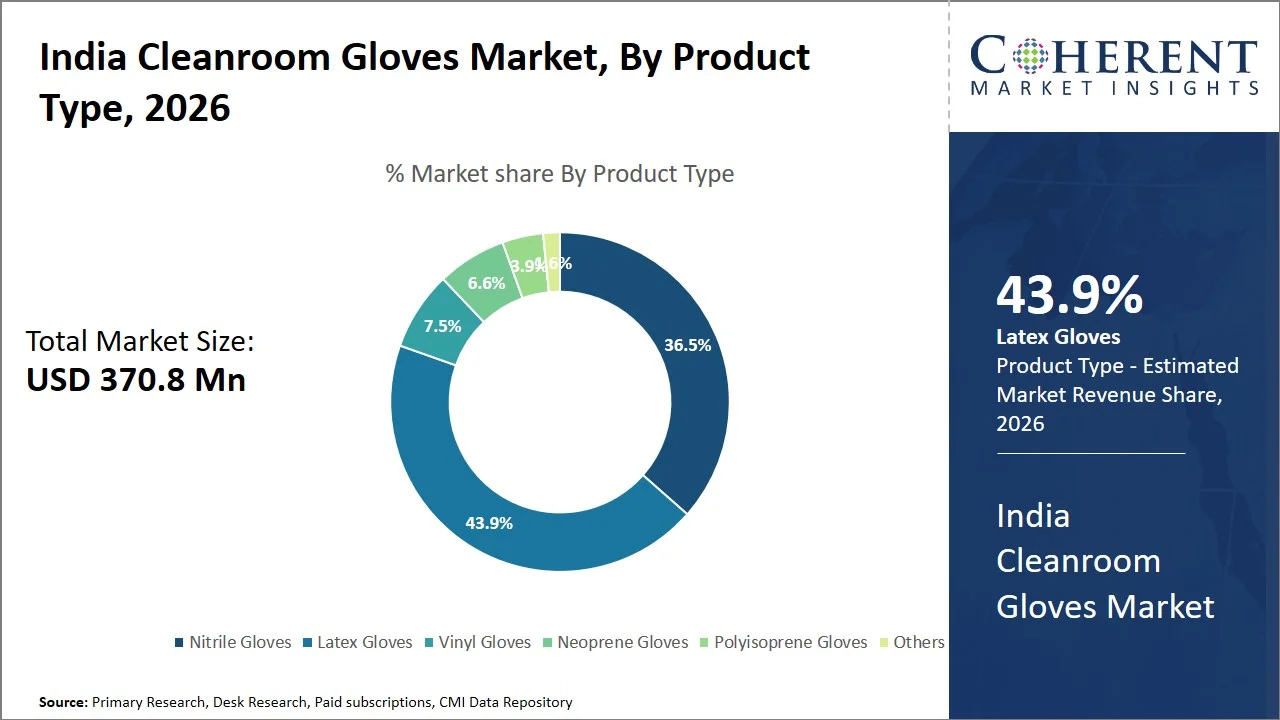
Why Do Latex Gloves Dominate the India Cleanroom Gloves Market?
Latex gloves are projected to hold a market share of 43.9% in 2026, as they offer high degree of elasticity and best tactile sensitivity along with a comfortable fit making it ideal for complex cleanroom jobs. High adhesion quality and dexterity facilitate sensitive procedures to be carried out efficiently in pharmaceutical manufacturing, lab testing and research works in biotechnology. Latex gloves offer good barrier protection while allowing manipulation with increased control and sensitivity. For instance, in January 2026, Ansell Ltd. launched TouchNTuff 93-800, the only disposable glove incorporating MICROCHEM Chemical Barrier Technology and is manufactured from a multi-layered composite of neoprene, nitrile and natural rubber latex. (Source: Ansell Ltd.) These innovations illustrate the industry's commitment to the advancement of high-performance glove technologies, particularly those which provide protection without sacrificing hand flexibility and tactile sensitivity-continuing to reinforce the popularity of latex in controlled manufacturing settings.
- Current Industry Events of 2026
- Market Size Estimation
- Regional Breakdown
- Competitive Landscape
- Customer Intelligence
- Segmental Analysis
- Pricing Analysis
- Key Market Drivers, Challenges & Future Trends
- Customized Insights Section
Why is Sterile the Most Preferred Category in India Cleanroom Gloves Market?
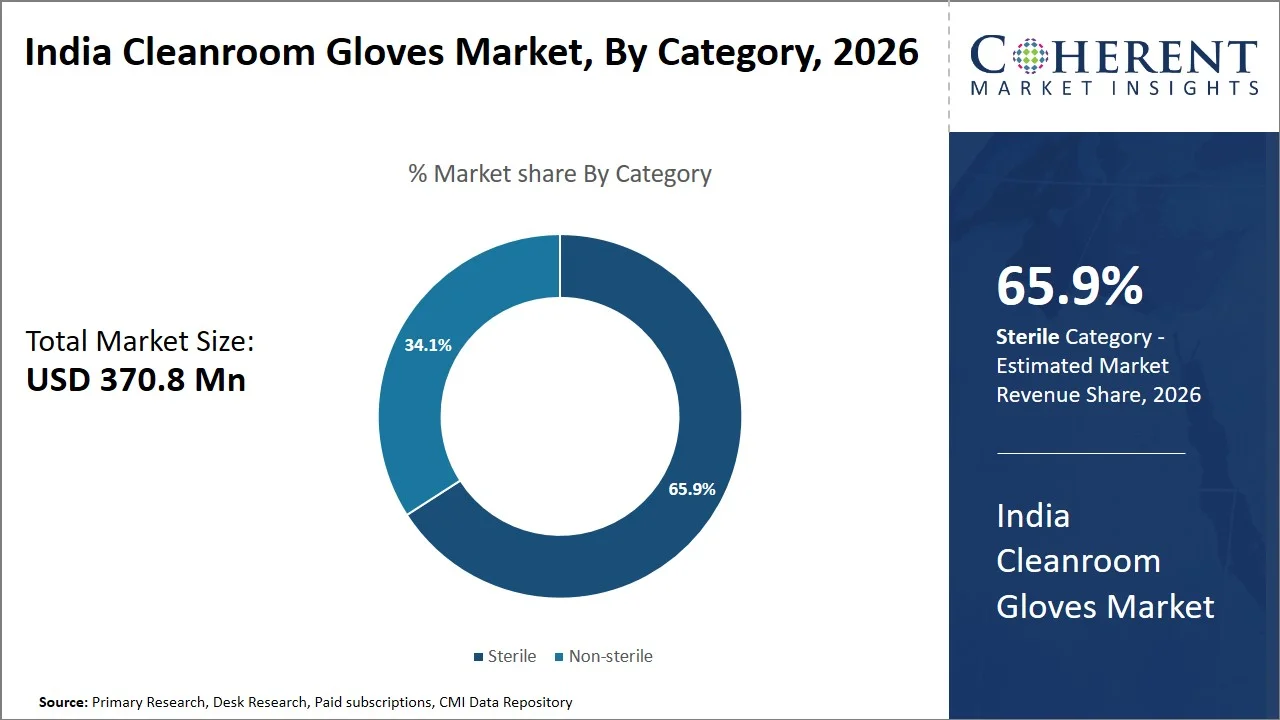
Sterile is projected to hold 65.9% of the market share in 2026, as they play a vital role in the control of microbial contamination of the product during aseptic manufacturing and sterile product handling. The sterile cleanroom gloves are widely used in pharmaceutical, biotech and medical device manufacturing facilities as they are needed to ensure the product safety. For instance, according to the Medical Device Rules, 2017, the manufacturers of sterile medical devices must perform process validation on sterilization process and controlled environments for maintaining the sterile quality of the device. Thus, the demand for sterile cleanroom consumables, such as sterile gloves used during manufacturing, assembling, packaging, quality check activities are anticipated to increase significantly.
Pharmaceutical and Biotechnology Companies Segment Dominates the India Cleanroom Gloves Market
The pharmaceutical and biotechnology companies segment is expected to hold 48.4% of the India cleanroom gloves market share in 2026, as they make widespread use of cleanrooms for the manufacturing of sterile drugs, biologics, vaccines, cell culture products and other contamination sensitive therapeutics. Cleanroom gloves play a crucial role in maintaining sterility and ensuring product quality. This sector is anticipated to drive the demand for cleanroom consumables further with increased focus on high value pharmaceutical and biologics. For instance, in August 2024, the Union Cabinet approved the BioE3 (Biotechnology for Economy, Environment & Employment) Policy to promote fast and widespread use of biotechnology innovations by developing biomanufacturing facilities, Bio-AI hubs, and biofoundries. (Source: Ministry of Science & Technology) The policy has been launched to augment India's biomanufacturing capabilities which is presumed to boost the demand of cleanroom gloves to be utilized at biotechnology research, development and manufacturing facilities.
Currents Events and their Impact
Current Events | Description and its Impact |
India's Pharmaceutical Industry Expected to Double in Size (June 08, 2026) |
|
Launch of BioPharma SHAKTI Initiative under Union Budget 2026-27 |
|
(Source: Ministry of Commerce & Industry, Government of India)
India Cleanroom Gloves Market Dynamics
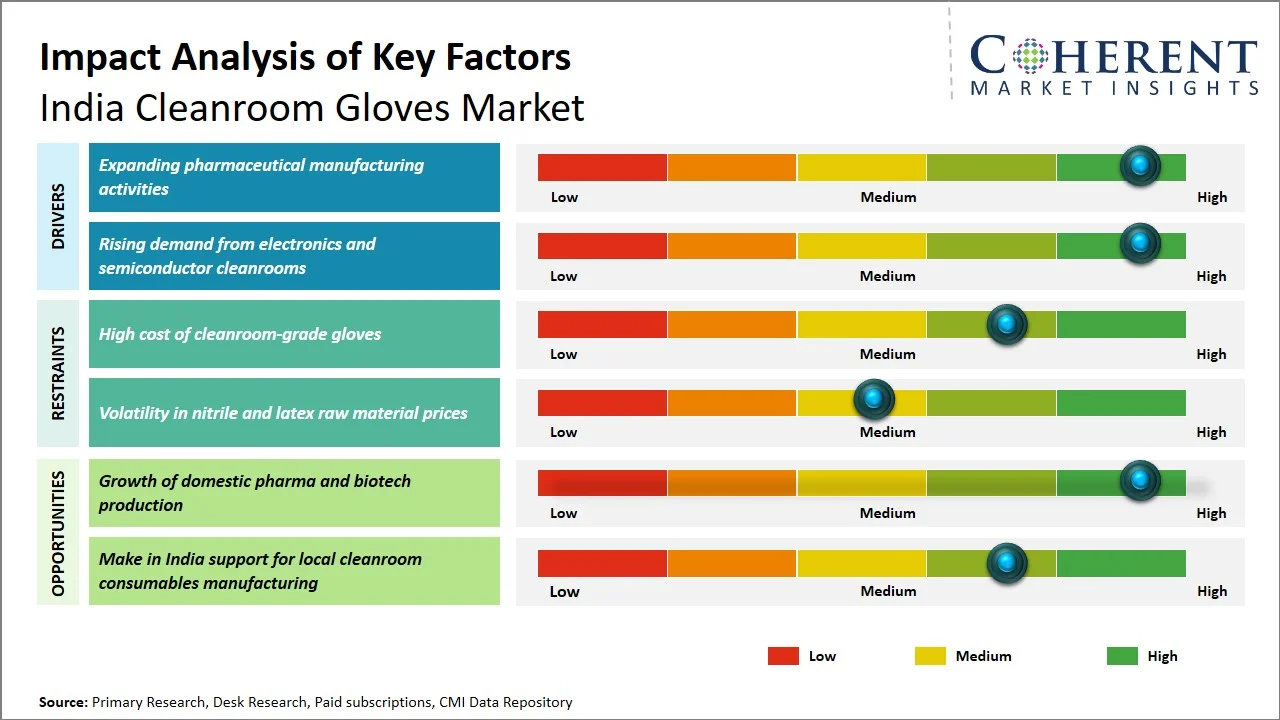
Market Drivers
- Expanding pharmaceutical manufacturing activities: Due to increased manufacturing activities of pharmaceuticals in India the cleanroom gloves demand is expanding as controlled manufacturing area necessitates stringent controls against contamination. Increased investment on sterile injectables, biologics, vaccines, specialty pharmaceuticals are creating further demand for cleanroom consumables in manufacturing as well as quality control. Also, pharmaceutical manufacturing capabilities are getting expanded for supplying both domestic and international markets. For instance, under the Promotion of Bulk Drug Parks scheme, Gujarat, Himachal Pradesh, and Andhra Pradesh were approved for the development of bulk drug parks by the Department of Pharmaceuticals. They will provide large-scale pharmaceutical production facilities and shared infrastructure enabling the development of regulated production areas and require cleanroom gloves and other contamination control items. (Source: Ministry of Chemicals and Fertilizers)
- Rising demand from electronics and semiconductor cleanrooms: A rise in demand for cleanroom gloves is expected in India's rapidly expanding electronics and semiconductor manufacturing sector, where a highly controlled environment is essential to ensure no particle contamination occurs during fabrication and assembly processes. Thus, cleanroom gloves play a critical role in enhancing product quality and increasing manufacturing yields of these highly contaminant sensitive applications. Growing investment in fabrication of semiconductors, packaging, electronics production facility will surely boost the market. For instance, in March 2026, Kaynes Semicon started operations of its USD 390 million (INR 3,300 crore) outsourced semiconductor assembly and test facility in Sanand, Gujarat. The facility will bolster India's semiconductor packaging and testing capabilities and is expected to drive demand for contamination control products such as cleanroom gloves in cleanroom manufacturing areas. (Source: Industries & Mines Department Directorate Of Information)
Emerging Trends
- Rising Preference for Sterile and Accelerator-Free Cleanroom Gloves: Sterile and accelerator-free cleanroom gloves have been finding wider acceptance by end users due to their role in preventing contamination and reducing the chances of skin sensitivity in workers. The trend is widely visible in pharmaceutical, biotechnology, medical device manufacturers where strict quality guidelines are followed.
- Growing Demand from Semiconductor and Electronics Manufacturing: Growing domestic fabrication of semiconductors and manufacturing of high-end electronics in India is spurring the demand for low-particulate cleanroom gloves. High-level cleanliness, SD (Electrostatic Discharge) protection and particulate control for contamination-sensitive manufacturing have been increasingly specified by manufacturers
Regulatory and Industry Initiatives Impacting the India Cleanroom Gloves Market
End-use Industry | Key Regulation / Initiative | Impact on Cleanroom Operations | Effect on Cleanroom Gloves Market |
Pharmaceuticals | Revised Schedule M (2023) | Strengthens GMP compliance, contamination control, and personnel hygiene requirements | Increases adoption of cleanroom gloves across manufacturing and packaging operations |
Pharmaceuticals | Production Linked Incentive (PLI) Scheme for Pharmaceuticals | Encourages expansion of domestic pharmaceutical manufacturing facilities | Creates additional demand for cleanroom gloves in newly established and expanded production sites |
Pharmaceuticals | Promotion of Bulk Drug Parks Scheme | Supports development of large-scale pharmaceutical manufacturing clusters | Expands consumption of cleanroom consumables, including gloves, across production facilities |
Biotechnology | Indian Pharmacopoeia (IP) Standards | Emphasizes sterility and microbiological quality in pharmaceutical products | Drives demand for sterile cleanroom gloves in aseptic processing and laboratory environments |
Medical Devices | Medical Device Rules, 2017 | Requires quality-controlled manufacturing environments and compliance standards | Supports increased procurement of cleanroom gloves in device production facilities |
Semiconductors | India Semiconductor Mission (ISM) | Promotes establishment of semiconductor fabrication and packaging facilities | Boosts demand for low-particulate cleanroom gloves used in contamination-sensitive processes |
Electronics | Electronics Manufacturing Promotion Initiatives | Encourages expansion of electronics production and assembly operations | Increases adoption of cleanroom gloves in precision manufacturing environments |
How is the growth of domestic pharma and biotech production creating new growth opportunities in the India cleanroom gloves market?
The growth of India's domestic pharma and biotech manufacturing is significantly contributing to the growth of the India cleanroom gloves market due to increasing requirement for contamination-controlled manufacturing processes. As domestic manufacturers focus on building new facilities for production of APIs, biologics, vaccines and specialty drugs, the demand for sterile as well as low-particle cleanroom gloves is gradually increasing. Higher standards for quality and regulations are also expected to push the market towards higher end cleanroom consumables, which are to be used for production and quality control purposes. For instance, the Government of India PLI Scheme for Pharmaceuticals approved 55 projects which pledged investment of more than USD 5.0 billion (INR 41,943 crores) as of December 2025 to enhance India's pharma manufacturing. The creation and upgradation of these facilities will generate demand for clean room gloves for the regulated manufacturing industries. (Source: Ministry of Chemicals and Fertilizers)
Market Players, Key Development, and Competitive Intelligence
Key Developments
- In May 2025, Enliva launched accelerator-free nitrile gloves that reduce instances of skin allergy in health professionals. Using the latest in glove technology to omit the chemical accelerators that can contribute to skin allergies, the release marks a move toward performance skin-friendly nitrile gloves in healthcare and controlled environments.
- In March 2023, Ansell announced the commencement of packing and irradiation activities for the initial phase of its new USD 80 million manufacturing facility in Kovai, Tamil Nadu, India. The facility enhances the company’s local manufacturing and sterilization capabilities for protective gloves and ancillary products. The new facility is an example of increased industry emphasis on building local manufacturing capacity and resilient supply chains within India.
Competitive Landscape
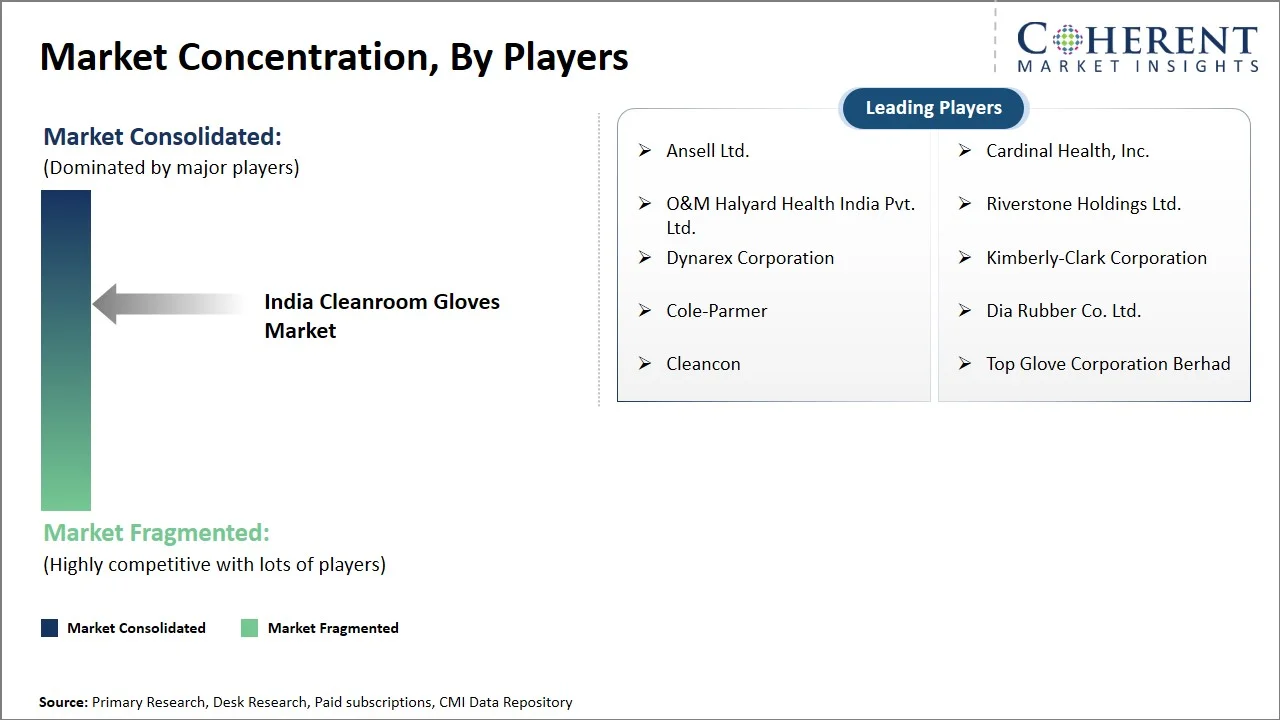
The India cleanroom gloves market is moderately consolidated. Market players include global glove producers, cleanroom consumables vendors and Indian manufacturers supplying the pharmaceutical, biotechnology, electronics and semiconductor markets. Market participants emphasize on the product quality, regulatory standards, performance on contamination control and local manufacturing capabilities. Key focus areas include:
- Sterile and Low-Particulate Glove Innovation
- Expansion of Domestic Manufacturing & Supply Capabilities
- Regulatory Compliance with GMP and Cleanroom Standards
- Strategic Partnerships with Pharmaceutical and Biotechnology Manufacturers
Market Report Scope
India Cleanroom Gloves Market Report Coverage
| Report Coverage | Details | ||
|---|---|---|---|
| Base Year: | 2025 | Market Size in 2026: | USD 370.8 Mn |
| Historical Data for: | 2020 To 2024 | Forecast Period: | 2026 To 2033 |
| Forecast Period 2026 to 2033 CAGR: | 9.9% | 2033 Value Projection: | USD 717.4 Mn |
| Segments covered: |
| ||
| Companies covered: | Ansell Ltd., Cardinal Health, Inc., O&M Halyard Health India Pvt. Ltd., Riverstone Holdings Ltd., Dynarex Corporation, Kimberly-Clark Corporation, Cole-Parmer, Dia Rubber Co. Ltd., Cleancon, and Top Glove Corporation Berhad | ||
| Growth Drivers: |
| ||
| Restraints & Challenges: |
| ||
Analyst Opinion (Expert Opinion)
- The market for cleanroom gloves in India is projected to expand significantly during the forecast period, due to growth in pharmaceutical manufacturing, increasing use of biologics, and increase in investment in manufacturing facilities of semiconductors and electronics. Stringent regulatory measures for cleanroom and contamination control are expected to drive the adoption of sterile performance cleanroom gloves.
- In terms of opportunities, the most promising area of growth can be seen in sterile nitrile clean room gloves within the pharmaceutical and biotech sectors, specifically for injectable drug and vaccine manufacturers, biologics manufacturers and CMO facilities. Emerging and expanding semiconductor manufacturing within the Indian economy, in particular, provides an opportunity to sellers of low particulate clean room gloves to highly clean production facilities.
- In order to gain a competitive advantage market players should emphasize the introduction of sterile and accelerator-free variants, build robust domestic manufacturing capacity and secure globally recognized cleanroom certifications to achieve a competitive advantage. A close alliance with pharmaceutical companies, biotech’s and semiconductor facilities, investment in R&D and supply chain robustness will be crucial for long-term growth.
Speak to the analyst
Want personalized insights?
Take the findings above to one of our principal consultants, or have the report rebuilt around the segments, geographies and competitors you actually track.
Market Segmentation
- Product Type Insights (Revenue, USD Mn, 2021 - 2033)
- Nitrile Gloves
- Latex Gloves
- Vinyl Gloves
- Neoprene Gloves
- Polyisoprene Gloves
- Others
- Category Insights (Revenue, USD Mn, 2021 - 2033)
- Sterile
- Non-sterile
- End User Insights (Revenue, USD Mn, 2021 - 2033)
- Pharmaceutical and Biotechnology Companies
- Medical Device Companies
- Hospitals and Clinics
- Diagnostic Laboratories
- Key Players Insights
- Ansell Ltd.
- Cardinal Health, Inc.
- O&M Halyard Health India Pvt. Ltd.
- Riverstone Holdings Ltd.
- Dynarex Corporation
- Kimberly-Clark Corporation
- Cole-Parmer
- Dia Rubber Co. Ltd.
- Cleancon
- Top Glove Corporation Berhad
Sources
Primary Research Interviews
- Cleanroom managers – Pharmaceutical manufacturing facilities
- Quality Assurance (QA) & GMP compliance heads
- Production managers – Biotechnology companies
- Procurement managers – Medical device manufacturers
- Cleanroom consumables distributors and suppliers
- EHS (Environment, Health & Safety) managers – Electronics and semiconductor facilities
Stakeholders
- Cleanroom glove manufacturers and suppliers
- Pharmaceutical and biotechnology companies
- Medical device manufacturers
- Semiconductor and electronics manufacturers
- Contract Manufacturing Organizations (CMOs) and Contract Development & Manufacturing Organizations (CDMOs)
- Cleanroom consumables distributors and procurement service providers
- End-use Sectors
- Pharmaceutical manufacturing facilities
- Biotechnology research and production facilities
- Medical device production plants
- Semiconductor fabrication and assembly facilities
- Electronics manufacturing facilities
- Regulatory & Health Bodies
- Central Drugs Standard Control Organization (CDSCO)
- Ministry of Health and Family Welfare (MoHFW)
- Department of Pharmaceuticals (DoP)
- Indian Pharmacopoeia Commission (IPC)
- International Society for Pharmaceutical Engineering (ISPE) India Affiliates
Databases
- Central Drugs Standard Control Organization (CDSCO)
- Department of Pharmaceuticals (DoP)
- Ministry of Health and Family Welfare (MoHFW)
- Press Information Bureau (PIB)
- Invest India
- Open Government Data (OGD) Platform India
- Indian Pharmacopoeia Commission (IPC)
Magazines
- Cleanroom Technology
- Cleanroom Technology Asia
- BioSpectrum India
- Express Healthcare
- Pharmabiz
- ET HealthWorld
- Pharmaceutical Technology
- Manufacturing Today India
- Electronics For You (EFY)
- Medical Buyer
Journals
- PDA Journal of Pharmaceutical Science and Technology
- Journal of Validation Technology
- Pharmaceutical Engineering Journal (ISPE)
- International Journal of Pharmaceutical Sciences and Research
- Journal of Pharmaceutical Innovation
Newspapers
- The Economic Times
- Business Standard
- Mint
- The Hindu BusinessLine
- Financial Express
Associations
- Indian Pharmaceutical Alliance (IPA)
- Indian Drug Manufacturers' Association (IDMA)
- International Society for Pharmaceutical Engineering (ISPE)
- Parenteral Drug Association (PDA)
- SEMI (Semiconductor Equipment and Materials International)
Public Domain Sources
- Department of Pharmaceuticals (DoP)
- Ministry of Chemicals and Fertilizers
- Central Drugs Standard Control Organization (CDSCO)
- Indian Pharmacopoeia Commission (IPC)
- Press Information Bureau (PIB)
- Invest India
- Open Government Data Platform India
Proprietary Elements
- CMI Data Analytics Tool, Proprietary CMI Existing Repository of information for last 10 years.
Get access to 250+ pages report
Every segment, forecast, competitor profile and data table behind the analysis above — available for instant download.
- ESOMAR Member
- ISO 9001:2015 Certified
- D-U-N-S Registered
- GDPR & CCPA Compliant
Missing comfort of reading report in your local language? Find your preferred language:
Transform your Strategy with Exclusive Trending Reports
Frequently Asked Questions
The India cleanroom gloves market is estimated to be valued at USD 370.8 Mn in 2026 and is expected to reach USD 717.4 Mn by 2033.
Latex gloves dominate due to their superior elasticity, tactile sensitivity, and comfortable fit, making them well-suited for precision tasks performed in pharmaceutical, biotechnology, and laboratory cleanroom.
Cleanroom gloves are specialized gloves designed to minimize particulate contamination and maintain cleanliness standards in controlled environments.
The CAGR of the India cleanroom gloves market is projected to be 9.9% from 2026 to 2033.
Sterile cleanroom gloves undergo sterilization to eliminate microorganisms, whereas non-sterile gloves are primarily designed to control particulate contamination.
Low-particulate cleanroom gloves reduce the release of particles and contaminants, helping maintain product quality and compliance with cleanroom standards.
High cost of cleanroom-grade gloves, and volatility in nitrile and latex raw material prices are the major factors hampering the growth of the India cleanroom gloves market.