

Biological Safety Cabinets Market Size and Forecast — 2026 - 2033
The Global Biological Safety Cabinets Market size is estimated to be valued at USD 1.45 billion in 2026 and is expected to reach USD 2.50 billion by 2033, exhibiting a compound annual growth rate (CAGR) of 8.5% from 2026 to 2033.
Overview
A Biological Safety Cabinet (BSC) is an enclosed, ventilated laboratory workspace designed to protect laboratory personnel, the environment, and biological samples when handling potentially infectious materials. It uses HEPA-filtered airflow to prevent the release of harmful microorganisms and contaminants. BSCs are commonly used in microbiology, biomedical research, pharmaceutical production, and clinical laboratories while working with pathogens, cell cultures, or biohazardous materials. There are three main types—Class I, Class II, and Class III—each providing different levels of protection. By maintaining controlled airflow and containment, biological safety cabinets help ensure safe handling of biological agents and maintain sterile conditions during sensitive laboratory procedures.
Key Takeaways
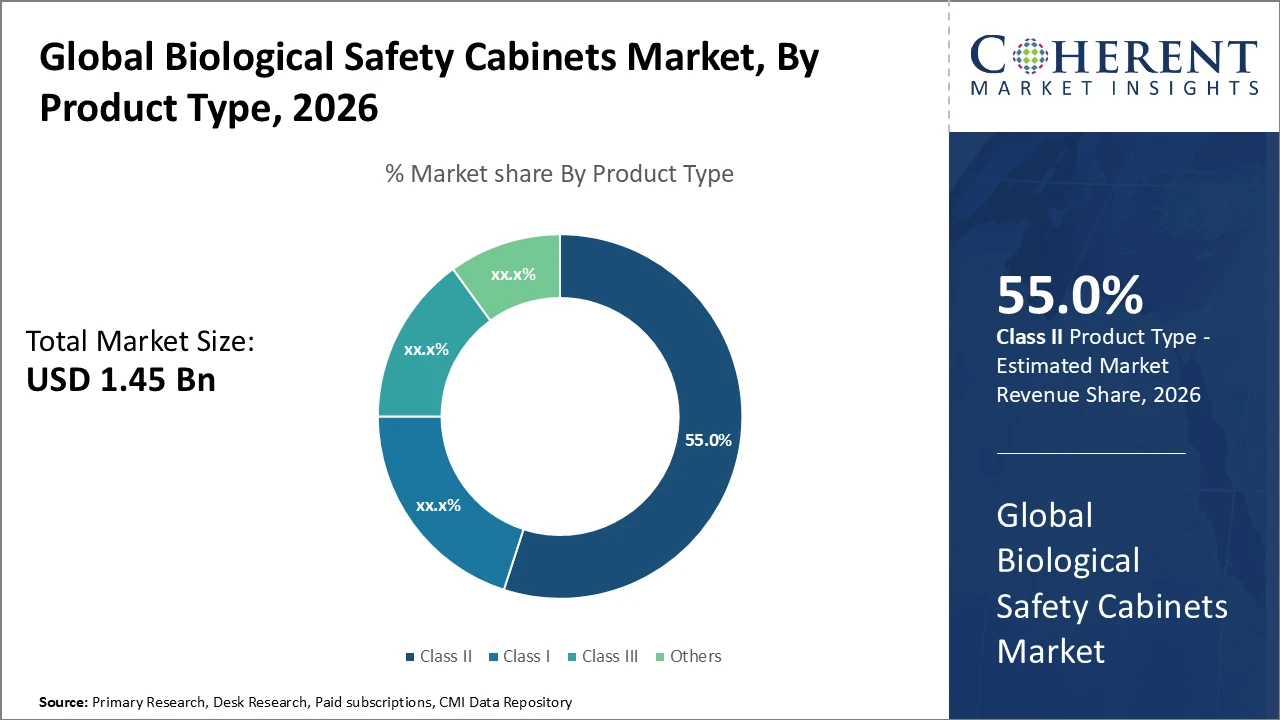
The Class II biological safety cabinets segment dominates with over 55% market share due to wide applicability and regulatory preference, while ducted airflow technology is the fastest-growing adoption segment.
Pharmaceutical and biotechnology laboratories lead end-user segments, capturing the majority share driven by increasing global R&D expenditure.
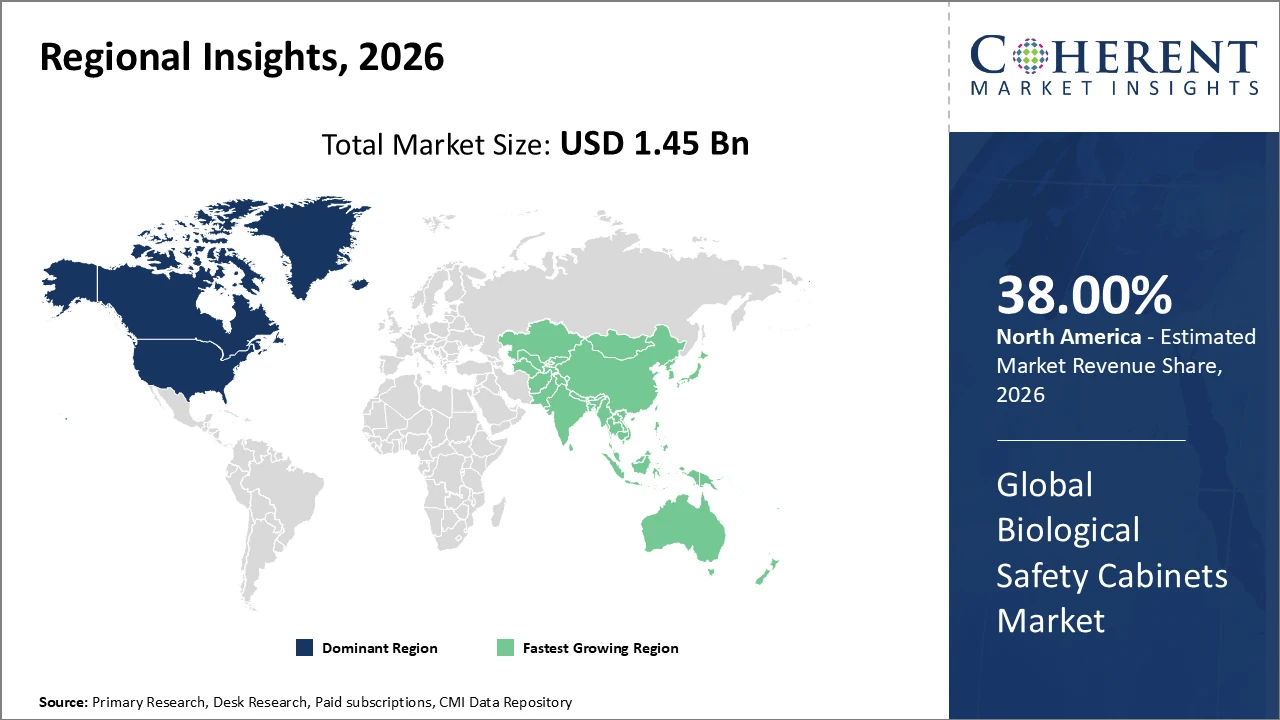
North America holds the largest regional market share at around 38%, supported by strong regulatory frameworks and substantial investments in healthcare infrastructure.
Asia Pacific is the fastest-growing region with a CAGR exceeding 10%, fueled by government initiatives promoting laboratory modernization and rising research activity in infectious diseases.
Biological Safety Cabinets Market Segmentation Analysis
Biological Safety Cabinets Market Insights, By Product Type
Class II biological safety cabinets dominate the market due to their balanced protection of personnel, product, and environment, making them essential in pharmaceutical, biotechnology, and clinical laboratory operations. Their versatility in handling moderate-risk biological agents supports broad application, while ongoing technological improvements, including enhanced airflow efficiency and UV sterilization, further drive adoption. The fastest-growing subsegment is Class III cabinets, driven by rising demand for maximum containment in high biosafety level laboratories managing highly infectious agents. Class I cabinets remain relevant for basic protection needs, and other specialty units serve niche applications such as veterinary research, environmental testing, and specialized laboratory workflows.
Biological Safety Cabinets Market Insights, By Technology
Recirculating airflow cabinets hold a dominant market share due to their ease of installation and energy efficiency, making them popular in biotechnology and pharmaceutical laboratories focused on reducing operational costs. The ducted airflow segment is the fastest-growing subcategory, driven by stricter filtration standards and regional regulatory mandates requiring external venting to prevent contaminant re-entry. Hybrid airflow technologies are also gaining traction, offering flexibility by combining the advantages of both recirculating and ducted systems. Each airflow type addresses specific biosafety needs, allowing laboratories to optimize cabinet selection based on pathogen risk, operational requirements, and existing infrastructure capabilities.
Biological Safety Cabinets Market Insights, By End-User
Pharmaceutical and biotechnology laboratories dominate the biological safety cabinets market, driven by intensive R&D activities and strict quality control protocols that require advanced containment solutions. Their leadership is further supported by continuous regulatory updates enforcing biosafety standards for sample handling and drug development. Clinical laboratories are the fastest-growing subsegment, fueled by expanding diagnostic testing and government-backed screening programs worldwide. Food and beverage testing, while niche, has shown steady growth due to rising food safety concerns. The 'Others' category, including research institutions and academic laboratories, contributes incrementally to overall market expansion, reflecting the broadening applications of biological safety cabinets across diverse sectors.
Biological Safety Cabinets Market Trends
The biological safety cabinets market is undergoing a technological transformation with IoT integration and remote monitoring, enabling real-time tracking of airflow integrity and filter status, reducing downtime, and enhancing user safety.
In early 2025, several North American laboratories adopted smart cabinets, reporting up to 25% savings in maintenance costs.
Sustainability trends are driving higher energy efficiency, with 2026 models consuming around 30% less electricity compared to 2023 versions.
North America dominates the market with a 38% share, supported by stringent biosafety regulations (CDC, OSHA) and extensive laboratory infrastructure, with the U.S. contributing the majority of regional revenue.
Asia Pacific is the fastest-growing region with a CAGR exceeding 10%, fueled by infectious disease research, healthcare reforms, and government initiatives upgrading lab facilities in China and India.
Companies such as Esco Lifesciences and Thermo Fisher Scientific have expanded production in Asia Pacific to capture emerging demand.
Biological Safety Cabinets Market Insights, By Geography
North America Biological Safety Cabinets Market Analysis and Trends
In North America, the Biological Safety Cabinets market is dominated by stringent biosafety regulations and the expanding pharmaceutical and biotechnology sectors. The U.S. serves as the largest contributor, supported by advanced research facilities, well-established laboratory infrastructure, and regulatory frameworks that mandate the use of certified safety cabinets for handling biological materials. Key market players, including Esco Lifesciences and Thermo Fisher Scientific, ensure widespread availability of products and rapid deployment of technological innovations, such as IoT-enabled monitoring and energy-efficient designs. These factors collectively drive business growth, reinforce the region’s leading market position, and support sustained adoption across laboratories and clinical settings.
Asia Pacific Biological Safety Cabinets Market Analysis and Trends
Asia Pacific is the fastest-growing region in the Biological Safety Cabinets market, registering a CAGR of over 10%, driven by rising pharmaceutical and biotechnology R&D investments in countries such as China, India, and Southeast Asia. Government-led initiatives aimed at laboratory modernization, coupled with increasing healthcare expenditure, are boosting demand for advanced, next-generation safety cabinets. Additionally, prominent market players have expanded manufacturing facilities within the region, enabling cost-effective production and localized distribution, which supports quicker adoption. These factors, combined with growing research infrastructure and rising awareness of biosafety standards, are fueling rapid market expansion across the Asia Pacific region.
Biological Safety Cabinets Market Outlook for Key Countries
USA Biological Safety Cabinets Market Analysis and Trends
The U.S. market remains the largest for Biological Safety Cabinets, supported by a robust healthcare infrastructure and stringent biosafety regulations. Annual investments exceeding USD 1 billion between 2024 and 2026 in laboratory upgrades have driven strong demand for advanced safety cabinets. Leading companies such as Thermo Fisher Scientific and Esco Lifesciences dominate the market with cutting-edge product portfolios that emphasize personnel and product protection, energy efficiency, and smart technologies. Their focus on innovation aligns with the high expectations of research and clinical laboratories, sustaining industry revenue growth and reinforcing the U.S. as a key market hub for biosafety solutions.
Germany Biological Safety Cabinets Market Analysis and Trends
Germany’s Biological Safety Cabinets market is marked by steady growth driven by strong laboratory infrastructure and rigorous biosafety regulations. The country’s extensive network of research institutions, pharmaceutical manufacturers, and clinical laboratories fuels consistent demand for advanced containment solutions. Adoption of Class II cabinets remains high, particularly in biotech and pharmaceutical R&D settings, while demand for ducted airflow and hybrid systems is rising in high‑containment facilities. Technological trends such as IoT‑enabled monitoring and energy‑efficient designs are gaining traction among end users focused on operational efficiency. Government initiatives supporting laboratory modernization and increased infectious disease research further contribute to market expansion, positioning Germany as a significant contributor within the European biosafety cabinets landscape.
Analyst Opinion
Enhanced Production Capacities: In 2026, leading manufacturing hubs increased biological safety cabinets’ production capacity by approximately 12% compared to 2024, meeting rising institutional demand. Asia Pacific’s increased output notably strengthened supply-side dynamics, contributing to an overall industry capacity utilization rate of around 85%.
Pricing Dynamics & Revenue Growth: Despite raw material cost inflation, strategic pricing adjustments enabled manufacturers to raise average selling prices by 6% in 2025, boosting market revenue. Demand elasticity in pharmaceutical and biotech sectors supported premium pricing for advanced Class III cabinets.
Multi-Industry Demand Expansion: Clinical diagnostics and biotech sectors drove imports of biological safety cabinets by nearly 15% year-over-year in 2026, with hospitals accounting for over 40% of total consumption.
Regional Import-Export Flows: Exports from North America to emerging Asian markets rose over 20% in 2025, while Europe maintained steady import growth with a compound annual market share increase of 3%.
- Current Industry Events of 2026
- Market Size Estimation
- Regional Breakdown
- Competitive Landscape
- Customer Intelligence
- Segmental Analysis
- Pricing Analysis
- Key Market Drivers, Challenges & Future Trends
- Customized Insights Section
Market Scope
| Report Coverage | Details | ||
|---|---|---|---|
| Base Year: | 2025 | Market Size in 2026: | USD 1.45 billion |
| Historical Data for: | 2020 To 2024 | Forecast Period: | 2026 To 2033 |
| Forecast Period 2026 to 2033 CAGR: | 8.5% | 2033 Value Projection: | USD 2.50 billion |
| Geographies covered: |
| ||
| Segments covered: |
| ||
| Companies covered: | Esco Lifesciences, NuAire Inc., Labconco Corporation, The Baker Company, BMC Group, Jeio Tech, Holytop International, Bioquell PLC, Air Science Technologies, Germfree Laboratories | ||
| Growth Drivers: |
| ||
Biological Safety Cabinets Market Growth Factors
Increasing regulatory compliance in healthcare and research sectors is a major driver of the Biological Safety Cabinets market, with FDA and OSHA guidelines contributing to a 14% rise in Class II cabinet procurement across U.S. laboratories in 2026. Rapid advancements in biotechnology and pharmaceutical research further boost demand for advanced containment solutions, reflected in a 20% year-over-year increase in laboratory infrastructure investments in Asia Pacific. Rising infectious disease prevalence and heightened biosafety awareness have led to over a 25% increase in biosafety cabinet installations in Indian hospitals between 2024 and 2026. Sustainability initiatives promoting energy-efficient, eco-friendly designs have also shaped market dynamics, with newer models achieving up to 30% energy savings compared to 2023 versions.
Biological Safety Cabinets Market Development
In May 2025, Thermo Fisher Scientific expanded its biological safety cabinets portfolio by launching a smart Class II model equipped with IoT connectivity and real‑time airflow monitoring. This product allowed laboratories in North America and Europe to track filter life, airflow integrity, and maintenance alerts through cloud-based dashboards.
Key Players
Leading Companies of the Market
Esco Lifesciences
NuAire Inc.
Labconco Corporation
The Baker Company
Air Science Technologies
Germfree Laboratories
BMC Group
Holytop International
Bioquell PLC
Jeio Tech
Competitive strategies in the Biological Safety Cabinets market are marked by increased R&D investments and global expansion initiatives. Thermo Fisher Scientific has focused on developing energy-efficient, low-noise cabinets, improving user ergonomics while reducing operational costs. Esco Lifesciences expanded its global manufacturing capabilities, achieving a 10% increase in production volume in 2025 to meet rising demand across Asia Pacific and other emerging markets. Meanwhile, NuAire pursued strategic collaborations with leading research institutions to introduce IoT-enabled biological safety cabinets, enhancing real-time monitoring, maintenance efficiency, and overall customer satisfaction, thereby strengthening its competitive positioning in the global market.
Biological Safety Cabinets Market Future Outlook
The Biological Safety Cabinets market is poised for strong growth driven by rising demand for advanced containment solutions across pharmaceutical, biotechnology, and clinical research sectors. Future trends include wider adoption of IoT-enabled and AI-integrated cabinets, allowing real-time monitoring of airflow, filter status, and maintenance needs. Energy-efficient and sustainable designs will gain prominence amid regulatory and environmental pressures. Expanding laboratory infrastructure in emerging markets, particularly in Asia Pacific, coupled with increasing biosafety regulations globally, will further propel market expansion. Innovations targeting higher containment levels and user ergonomics are expected to shape the market, enhancing safety, operational efficiency, and adoption across diverse laboratory settings.
Biological Safety Cabinets Market Historical Analysis
The Biological Safety Cabinets market has experienced steady growth over the past decade, driven by increasing global awareness of laboratory biosafety and stringent regulatory requirements. Historically, Class II cabinets dominated due to their balanced protection for personnel, product, and environment, while Class III and specialty units remained niche. Expansion in pharmaceutical, biotechnology, and clinical diagnostic sectors fueled demand, particularly in North America and Europe, where regulatory frameworks like OSHA and CDC guidelines mandated certified containment solutions. Technological advancements, including improved airflow systems, HEPA filtration, and early automation, gradually enhanced cabinet efficiency and reliability. This foundation set the stage for current innovations in smart, energy-efficient, and IoT-enabled safety cabinets.
Sources
Primary Research Interviews:
Hospitals, clinics, and surgical centers
Academic and university research institutions
Pharmaceutical and medical device manufacturing facilities
Government and private biosafety laboratories
Magazines:
Laboratory Equipment Magazine – Biosafety & Containment
MD+DI (Medical Device & Diagnostic Industry) – Lab Safety Solutions
HealthTech Magazine – Laboratory Technologies
Lab Manager Magazine – Safety & Containment Equipment
Journals:
Applied Biosafety: Journal of the American Biological Safety Association
Journal of Laboratory Automation
Journal of Biosafety and Biosecurity
Clinical Laboratory Science
Newspapers:
The Wall Street Journal – Healthcare & Laboratory Equipment
Financial Times – Medical Technology & Lab Safety
Reuters – Laboratory Equipment & Biosafety
Bloomberg – Research & Medical Laboratory Devices
Nikkei Asia – Healthcare Equipment Manufacturing
Associations:
American Biological Safety Association (ABSA)
European Biosafety Association (EBSA)
International Federation of Biosafety Associations (IFBA)
Association for the Advancement of Medical Instrumentation (AAMI) – Biosafety Standards
Get access to 250+ pages report
Every segment, forecast, competitor profile and data table behind the analysis above — available for instant download.
- ESOMAR Member
- ISO 9001:2015 Certified
- D-U-N-S Registered
- GDPR & CCPA Compliant
Missing comfort of reading report in your local language? Find your preferred language:
Transform your Strategy with Exclusive Trending Reports
Frequently Asked Questions
The market is primarily led by companies such as Esco Lifesciences, Jeio Tech, and NuAire Inc., who maintain significant market share through innovative product designs, advanced containment technologies, and expansive global distribution networks.
The market is projected to grow from USD 1.45 billion in 2026 to approximately USD 2.50 billion by 2033, reflecting a CAGR of 8.5%, driven by increasing biosafety awareness, regulatory compliance, and expanding laboratory infrastructure worldwide.
Pharmaceutical and biotechnology laboratories offer the largest growth opportunity due to sustained investments in drug development, biosafety compliance, and advanced biotechnological research.
Trends will focus on smart, IoT-integrated, and eco-efficient safety cabinets, while adoption expands into emerging sectors like food safety, environmental testing, and advanced research facilities.
The market is highly competitive with established players emphasizing innovation, scalability, and global reach, while navigating challenges such as high production costs, rigorous regulatory requirements, and evolving biosafety standards.
Companies rely on strategic collaborations with research institutions, expanding manufacturing capacities, and launching energy-efficient, technologically advanced cabinets to strengthen market positioning and customer adoption.