

North America Respiratory Trainer Market Size and Share Analysis - 2026 to 2033
The North America respiratory trainer market is estimated to be valued at USD 271.5 Mn in 2026 and expected to reach USD 444.5 Mn by 2033, witnessing a CAGR of 7.3% over the forecast period (2026-2033).
Key Takeaways
- Based on Product Type, the resistance training devices segment is expected to hold 59% share of the market in 2026
- Based on Technique, the inspiratory muscle training segment is expected to lead the market with 66.5% share in 2026.
- Based on Disease Indication, the COPD segment is projected to account for 51% share of the market in 2026.
- Based End User, the Adults segment is projected to capture 71% share of the market in 2026.
Market Overview
Respiratory trainer devices are handheld devices that are designed to strengthen the muscles of expiration and inspiration. These devices are easy to handle and useful for anyone intending to improve the endurance of their breathing muscles. For individuals with inspiratory muscle weakness, the addition of inspiration muscle training to an exercise training program leads to improved performance.
Current Events and their Impacts on the North America Respiratory Trainer Market
Current Event | Description and its Impact |
Digital Health Technology Integration Trends |
|
Regulatory Environment Changes and Standards Evolution |
|
Are Respiratory Trainers Becoming Essential Across North American Sports?
Sport Category | Data on Respiratory Trainer Use | Measured Outcomes |
Endurance Sports (Cycling, Swimming, Running) | Clinical trials show 60–70% of elite swimmers and cyclists in North America have participated in respiratory muscle training programs. | Improvements include 15–25% increase in maximal inspiratory pressure (MIP) and 5–10% gains in VO₂ max. |
Team Sports (Soccer, Basketball, Hockey) | Adoption is moderate, with 30–40% of collegiate and professional athletes using respiratory trainers in conditioning programs. | Data shows enhanced repeated sprint ability and VO₂ max improvements of 5–8%. |
Strength & Power Sports (Weightlifting, Football, Wrestling) | Limited use, estimated at 10–15% of athletes in these categories. | Gains are smaller, with marginal increases in inspiratory strength but less direct impact on performance outcomes. |
Clinical/Adaptive Athletes (Asthma, EIB cases) | Among athletes with exercise-induced bronchoconstriction (EIB), 20% report using respiratory trainers as supportive tools. | Documented improvements include better peak expiratory flow and reduced airway reactivity during exertion. |
- Current Industry Events of 2026
- Market Size Estimation
- Regional Breakdown
- Competitive Landscape
- Customer Intelligence
- Segmental Analysis
- Pricing Analysis
- Key Market Drivers, Challenges & Future Trends
- Customized Insights Section
Segmental Insights
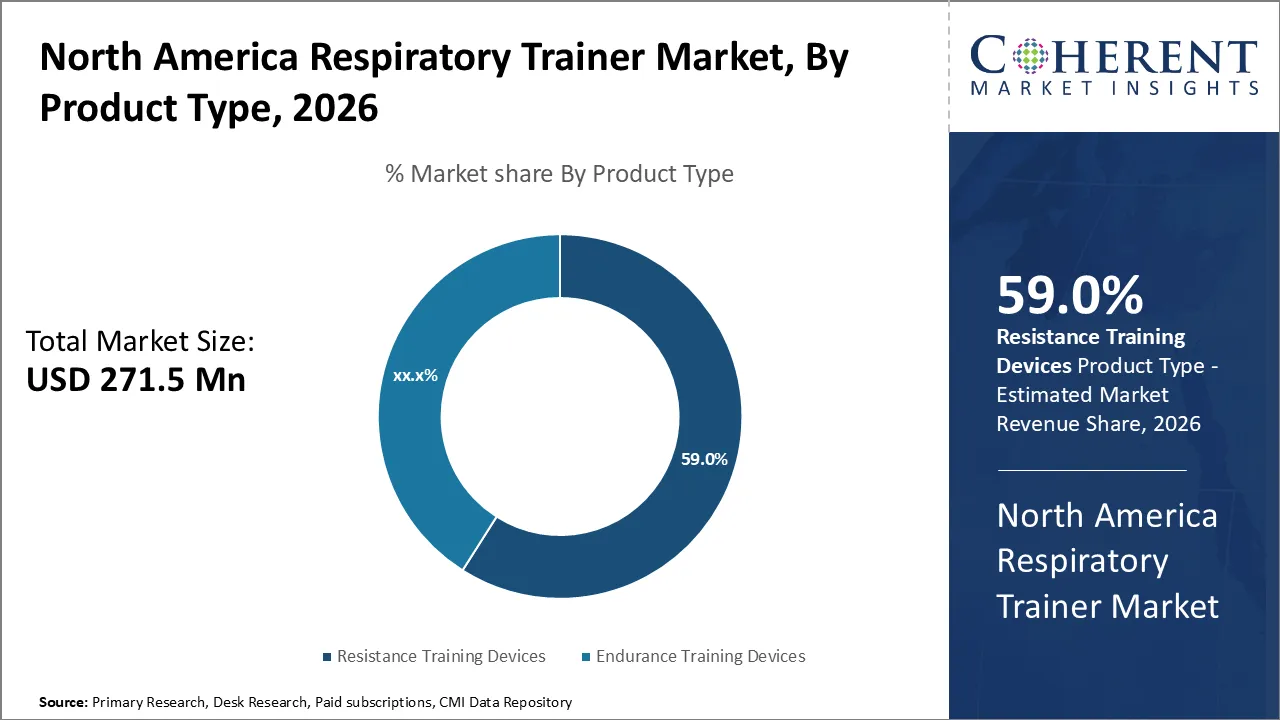
North America Respiratory Trainer Market Insights, By Product Type: Resistance training devices dominate for affordability, portability, and effectiveness in strengthening respiratory muscles
In terms of product type, the resistance training devices segment is expected to hold 59% share of the market in 2026, because they are easy to use, inexpensive, and work well to strengthen the muscles that help you breathe. Since they are used widely in rehab programs for people with asthma and COPD, they have consistent demand. Clinicians prefer them as they are easy to prescribe, and patients value their portability and straightforward design, driving adoption.
North America Respiratory Trainer Market Insights, By Technique: Inspiratory muscle training leads due to strong clinical validation and widespread rehabilitation adoption
In terms of technique, the inspiratory muscle training segment is expected to lead the market with 66.5% share in 2026, especially pressure threshold loading, is the most clinically proven technique in this area. It makes breathing easier, reduce dyspnea, and makes it easier for people with COPD and asthma to exercise. Increasingly, hospitals and rehabilitation centers are using IMT as a standard treatment, making it the most trusted and widely used method.
North America Respiratory Trainer Market Insights, By Disease indication: COPD drives demand as the most prevalent chronic respiratory condition requiring consistent pulmonary rehabilitation support.
In terms of disease indication, the COPD segment is projected to account for 51% share of the market in 2026. COPD is the most common disease in North America, especially among older people and smokers. Respiratory trainers are an important part of pulmonary rehabilitation programs as they help patients deal with their symptoms and live better lives. COPD is a long-term condition, so there will always be a need for it. This makes it the biggest market driver.
North America Respiratory Trainer Market Insights, By End User: Adults dominate usage because chronic respiratory diseases are more common in older populations
In terms of end user, the Adults segment is projected to capture 71% share of the market in 2026. Adults are the largest group of end users, and they use respiratory trainers the most. Older people are more likely to have chronic respiratory conditions like COPD and asthma, so adults are the main group targeted. Adults are in charge of rehabilitation programs, clinical prescriptions, and self-management practices, while children only play a small role.
For instance, in July 2025, the LibAirty Airway Clearance System got its approval from the FDA in the United States, which means it can be used by adults with COPD, bronchiectasis, and cystic fibrosis. This device is mainly for clearing the airways. It helps loosen and move mucus to make breathing easier, reduce exacerbations, and help with adult respiratory therapy.
Market Report Scope
North America Respiratory Trainer Market Report Coverage
| Report Coverage | Details | ||
|---|---|---|---|
| Base Year: | 2025 | Market Size in 2026: | USD 271.5 Mn |
| Historical Data for: | 2020 To 2024 | Forecast Period: | 2026 To 2033 |
| Forecast Period 2026 to 2033 CAGR: | 7.3% | 2033 Value Projection: | USD 444.5 Mn |
| Geographies covered: |
| ||
| Segments covered: |
| ||
| Companies covered: | Teleflex Incorporated, Koninklijke Philips N.V., Smiths Medical, Inc., Vyaire Medical, Inc., IngMar Medical, POWERbreathe International Limited, PN Medical, Aleas Europe LLC, Aspire Products, LLC, and Airofit | ||
| Growth Drivers: |
| ||
| Restraints & Challenges: |
| ||
North America Respiratory Trainer Market Driver
Growing Awareness of Respiratory Health
One of the main reasons the North America Respiratory Trainer Market growth that more people are becoming aware of the importance of respiratory health. Preventive health care trends are encouraging people to use tools that help them breathe better and make their lungs stronger. Numerous individuals who care about their health, including athletes and people recovering from respiratory illnesses, are using respiratory trainers as part of their wellness routines. This change shows that people are emphasizing on taking care of their health before problems arise, making respiratory trainer’s important tools in both medical and everyday life.
Technological Innovation in Devices
The North American Respiratory Trainer Market demand is on big rise because of new technologies. Digital monitoring, mobile app integration, and personalized training programs are now standard features of modern respiratory trainers. These features make them more appealing to both healthcare providers and consumers. These new features let users keep track of their progress, get personalized feedback, and take part in interactive fitness or rehabilitation routines. Smart respiratory trainers are becoming more popular in hospitals, clinics, and fitness communities because they combine medical usefulness with easy-to-use digital experiences. This is driving long-term market growth in the area.
North America Respiratory Trainer Market Opportunity
Expansion into Fitness & Sports Segments
The North America Respiratory Trainer Market forecast shows that there is a strong potential in fitness and sports applications. A growing number of athletes and fitness fans are using respiratory trainers to improve their lung capacity, stamina, and overall performance. This crossover from medical rehabilitation to wellness and athletic training opens up new ways for manufacturers to make funding. Companies can take advantage of the growing demand for sports technology and health solutions by marketing respiratory trainers as tools that improve performance. This will make them more popular in gyms, training centers, and with individual consumers.
Analyst Opinion (Expert Opinion)
- Increasingly clinical and rehabilitation settings are using respiratory trainers, and research shows that they help people get stronger and last longer when they breathe in. Research shows that inspiratory muscle training can increase maximal inspiratory pressure by 20–30% in 6–8 weeks, which can help people with chronic obstructive pulmonary disease (COPD) and asthma exercise more and feel less short of breath.
- The use of respiratory trainers is encouraged because they can help with both preventing and treating illnesses. Studies show that using these devices in a structured way can reduce on hospital readmissions for COPD patients by as much as 25%. They can also help with peak expiratory flow and overall lung function in children with asthma. These results show the benefit they are as inexpensive, non-invasive treatments that work well with drug treatments and pulmonary rehabilitation programs.
Speak to the analyst
Want personalized insights?
Take the findings above to one of our principal consultants, or have the report rebuilt around the segments, geographies and competitors you actually track.
Recent Developments
- In May 2025, The MyAcapella launch connects ICU Medical in the United States with VisionHealth in Germany. This collaboration introduces a digital coaching app that supports patients using OPEP respiratory trainers, improving adherence and effectiveness. The news is tied to both North America and Europe, reflecting a joint regional effort.
Market Segmentation
- By Product Type
- Resistance Training Devices
- Endurance Training Devices
- By Technique
- Inspiratory Muscle Training
- Inspiratory Flow Resistive Loading
- Inspiratory Pressure Threshold Loading
- Expiratory Muscle Training
- Combination of Both
- Inspiratory Muscle Training
- By Disease Indication
- Asthma
- Chronic Obstructive Pulmonary Disease
- Others
- By End User
- Children
- Adults
- By Region
- North America
- U.S.
- Canada
- North America
- Key Players
- Teleflex Incorporated
- Koninklijke Philips N.V.
- Smiths Medical, Inc.
- Vyaire Medical, Inc.
- IngMar Medical
- POWERbreathe International Limited
- PN Medical
- Aleas Europe LLC
- Aspire Products, LLC
- Airofit
Sources
Primary Research Interviews
- Respiratory Trainer / IMT & PEP Device Manufacturers (North America)
- Respiratory Therapy & Pulmonary Rehabilitation Clinics (RT managers, clinical leads)
- Pulmonologists, Sleep Medicine Specialists, and Primary Care Physicians
- Physiotherapists / Physical Therapists and Sports Performance Trainers
- Hospital Procurement Teams, GPO Representatives, and DME Distributors
- Homecare Providers and Remote Patient Monitoring (RPM) Program Managers
- Others
Databases
- IQVIA
- Factiva / LexisNexis (company & news tracking)
- PitchBook / Crunchbase (funding, M&A, startups)
- Others
Magazines / Trade Publications
- Respiratory Therapy
- Respiratory Care (news/features section where applicable)
- Medical Device and Diagnostic Industry (MDDI)
- MedTech Dive
- Fierce Medtech
- Others
Journals
- CHEST
- American Journal of Respiratory and Critical Care Medicine (AJRCCM)
- European Respiratory Journal (ERJ)
- Respiratory Care
- Journal of Cardiopulmonary Rehabilitation and Prevention
- Others
Newspapers / Newswires
- The Wall Street Journal
- Reuters
- Bloomberg News
- Financial Times
- The New York Times
- Others
Associations
- American Thoracic Society (ATS)
- American Association for Respiratory Care (AARC)
- American College of Chest Physicians (CHEST)
- Canadian Thoracic Society (CTS)
- American Physical Therapy Association (APTA)
- Others
Public Domain Sources
- U.S. Food & Drug Administration (FDA) – 510(k) database, device classification, recalls, MAUDE adverse event reports
- Health Canada – Medical Devices Active Licence Listing (MDALL), recalls & safety alerts
- Centers for Disease Control and Prevention (CDC) – respiratory disease burden statistics
- National Institutes of Health (NIH) / PubMed – clinical evidence tracking
- Centers for Medicare & Medicaid Services (CMS) – reimbursement coding context (where relevant)
- Statistics Canada / Government of Canada Open Data
- Others
Proprietary Elements
- CMI Data Analytics Tool
- Proprietary CMI Existing Repository of Information for the Last 8 Years
Get access to 250+ pages report
Every segment, forecast, competitor profile and data table behind the analysis above — available for instant download.
- ESOMAR Member
- ISO 9001:2015 Certified
- D-U-N-S Registered
- GDPR & CCPA Compliant
Missing comfort of reading report in your local language? Find your preferred language:
Transform your Strategy with Exclusive Trending Reports
Frequently Asked Questions
The global North America Respiratory Trainer Market size was valued at USD 271.5 Mn in 2026 and is expected to reach USD 444.5 Mn in 2033.
Factors such as the growing awareness of respiratory health and technological innovation in Devices are expected to drive the North America respiratory trainer market growth during the forecast period.
Resistance training devices is the leading product type segment in the market.
The major factors hampering the market growth include product recalls and critical regulatory compliance procedures.
Major players operating in the market include Teleflex Incorporated, Koninklijke Philips N.V., Smiths Medical, Inc., Vyaire Medical, Inc., IngMar Medical, POWERbreathe International Limited, PN Medical, Aleas Europe LLC, Aspire Products, LLC, and Airofit.