

Single Use Products In Biopharmaceuticals Market Size and Forecast: 2026-2033
The Single Use Products in Biopharmaceuticals Market is estimated to be valued at USD 21.7 Bn in 2026 and is expected to reach USD 34.4 Bn by 2033, exhibiting a compound annual growth rate (CAGR) of 11.7% from 2026 to 2033.
Key Takeaways
- By Product Type, Work Equipment hold the largest market share of 52.3% in 2026 owing to its rapid growth in biologics & advanced therapies.
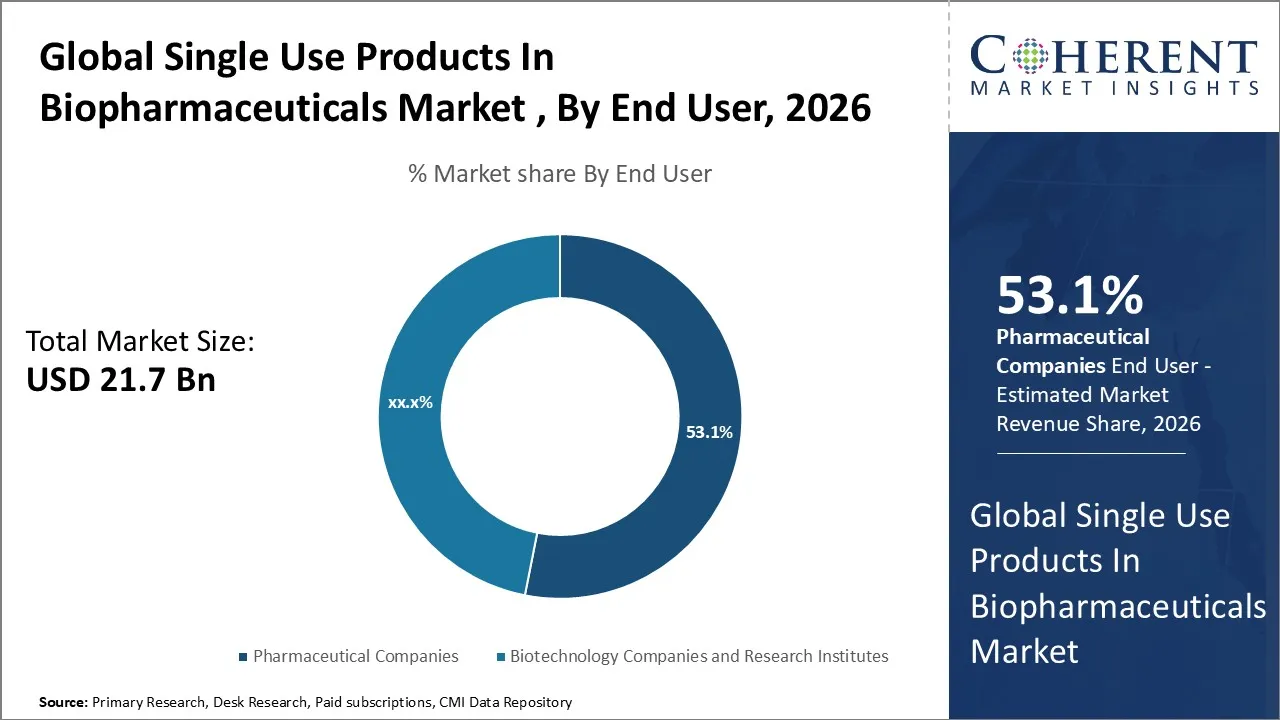
- By End User, Pharmaceutical Companies acquired the largest market share of 53.1% in 2026 owing to the rapid growth of biologic drugs.
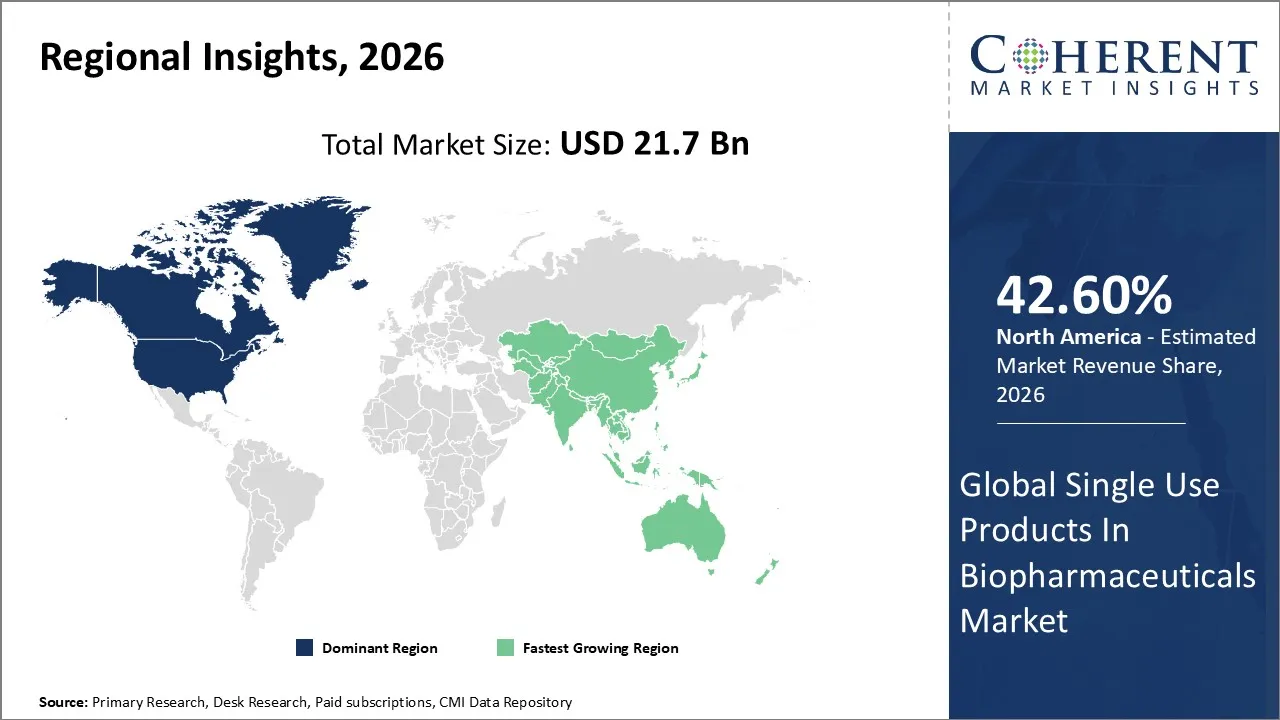
- By Region, North America dominates the overall market with an estimated share of 42.6% in 2026 owing to the dominant biopharmaceutical industry & manufacturing base.
Market Overview
The Single Use Products in Biopharmaceuticals Market is evolving rapidly as biopharmaceutical companies increasingly demand flexible, efficient, and contamination‑free manufacturing solutions. Companies are adopting single‑use technologies such as disposable bioreactors, tubing, filters, and sensors for biologics, vaccines, cell and gene therapies, and personalized medicines. These technologies reduce cleaning, sterilization, and setup time, boosting operational efficiency and enabling small‑batch, multiproduct workflows. Ongoing R&D, supportive regulations, and the push for faster time‑to‑market continue to drive market expansion.
Current Events and their Impact on the Single Use Products In Biopharmaceuticals Market
Current Events | Description and its impact |
Geopolitical and Regulatory Developments |
|
Technological Advancements and Innovation |
|
Regional Industry Growth Trends |
|
Segmental Insights
- Current Industry Events of 2026
- Market Size Estimation
- Regional Breakdown
- Competitive Landscape
- Customer Intelligence
- Segmental Analysis
- Pricing Analysis
- Key Market Drivers, Challenges & Future Trends
- Customized Insights Section
Single Use Products In Biopharmaceuticals Market Insights, By End User - Pharmaceutical Companies contribute the highest share of the market owing to its operational efficiency & time savings
Pharmaceutical Companies acquired the largest market share of 53.1% in 2026. Pharmaceutical companies are driving the adoption of single-use products in biopharmaceuticals to boost production efficiency and maintain high-quality, contamination-free operations. They implement disposable systems such as bioreactors, filters, tubing, and sensors to speed up setup, minimize cleaning and validation, and enable flexible small-batch or multiproduct manufacturing. Companies use single-use technologies to accelerate drug development, adapt to emerging biologics and personalized therapies, and meet regulatory standards. Ongoing innovations and the integration of advanced monitoring tools continue to encourage their use in agile, modern biomanufacturing. For instance, in April 2025, Parker Bioscience Filtration has launched the SciLog NFF+ PF, an automated Normal Flow Filtration system that streamlines Pre-Use Post-Sterilisation Integrity Testing in biopharmaceutical production
Single Use Products In Biopharmaceuticals Market Insights, By Product Type - Work Equipment contribute the highest share of the market owing to its personalized medicine & small‑batch production
Work Equipment hold the largest market share of 52.3% in 2026. Manufacturers are driving the adoption of work equipment in the Single Use Products in Biopharmaceuticals Market to achieve streamlined, contamination-free production. They deploy single-use bioreactors, mixers, filtration units, and disposable sensors to increase operational flexibility and minimize downtime by removing the need for extensive cleaning and sterilization. Companies rely on these systems for small-batch and multi-product production, enhanced sterility, and easy integration into modular facilities. Ongoing advances in materials and monitoring technologies further boost efficiency and reliability, positioning single-use work equipment as a key choice in modern biomanufacturing. For instance, ABEC has introduced a single-use bioreactor system with a 6,000 L working volume, tripling the industry’s typical maximum. While single-use bioreactors are now common, most vendors cap at 2,000 L, forcing manufacturers to operate multiple units simultaneously or switch to stainless-steel tanks for larger production needs.
Regional Insights
North America Single Use Products In Biopharmaceuticals Market Trends
North America dominates the overall market with an estimated share of 42.6% in 2026. North America drives strong growth in the Single Use Products in Biopharmaceuticals Market through several emerging trends. Companies across the region actively adopt disposable bioprocessing systems, supported by advanced biopharmaceutical infrastructure and substantial R&D investments. Manufacturers integrate single-use technologies into both upstream and downstream operations for biologics and vaccine production. Regulatory bodies encourage innovation, while firms expand automation and flexible manufacturing platforms. Growing contract manufacturing activities and increasing demand for efficient, contamination-free workflows further strengthen the market across the U.S., Canada, and Mexico. For instance, in July 2025, Fresenius Kabi is expanding its U.S. biosimilars portfolio by introducing Conexxence (denosumab-bnht) and Bomyntra® (denosumab-bnht). Bomyntra, available as a 120 mg/1.7 mL vial and single-use prefilled syringe, is FDA approved for all indications of the reference product Xgeva® (denosumab).
Asia Pacific Single Use Products In Biopharmaceuticals Market Trends
Asia Pacific is advancing the Single Use Products in Biopharmaceuticals Market through dynamic regional trends. Biopharmaceutical manufacturers in China, India, Japan, and Southeast Asia are accelerating the adoption of disposable bioprocessing systems to produce biologics, vaccines, and advanced therapies. Companies are expanding local manufacturing capacity to meet growing healthcare demand while prioritizing modular and scalable solutions. They are also integrating automation and digital technologies to enhance productivity. Increasing outsourcing activities and stronger focus on sustainability further drive the adoption of single-use technologies across the region. For instance, in December 2025, the Government of Telangana inaugurated Telangana 1 Bio, India’s first single-use bioprocess design and scale-up facility in Genome Valley, to strengthen the country’s biologics and next-generation therapeutics capabilities.
United States Single Use Products In Biopharmaceuticals Market Trends
Manufacturers in the United States Single Use Products in Biopharmaceuticals Market are actively prioritizing disposable bioprocessing systems to produce biologics, vaccines, and advanced therapies, moving away from traditional equipment toward more flexible and efficient solutions. U.S. companies are advancing their single-use portfolios by developing innovative bioreactors, mixers, fluid assemblies, and other disposable components to address evolving manufacturing requirements. Strong biopharmaceutical demand, greater adoption of single-use consumables in upstream processes, and expanded use of modular and automated systems continue to drive market progress. For instance, in August 2025, Accord BioPharma, the specialty division of Intas Pharmaceuticals, launched IMULDOSA (ustekinumab-srlf), a biosimilar to STELARA.
India Single Use Products In Biopharmaceuticals Market Trends
Manufacturers are driving growth in India’s Single Use Products in Biopharmaceuticals Market by integrating disposable bioprocessing systems to enhance production efficiency and address rising demand for biologics and vaccines. Companies in key hubs such as Delhi, Mumbai, Bengaluru, and Hyderabad are adopting modular, flexible solutions to support small-batch and advanced therapy manufacturing while minimizing contamination risks and costs. Firms are also increasing the use of single-use sensors and probes for real-time monitoring, and expanding partnerships with CMOs and CROs to accelerate technology adoption nationwide. For instance, Aligning with the ‘Make in India’ initiative, the government-backed Mumbai-based company launched its first integrated manufacturing unit at PharmNXT Biotech LLP in Chakan, Pune, to provide single-use bioprocess solutions and tackle challenges in biologics production.
End-user Feedback and Unmet Needs in the Single Use Products In Biopharmaceuticals Market
- Demand for Improved Material Durability: End users report concerns regarding the mechanical strength and chemical compatibility of single-use components. Bags, tubing, and connectors sometimes face issues such as leakage, breakage, or extractables and leachables. Manufacturers seek more robust materials that maintain integrity under high-pressure and long-duration processing conditions without compromising sterility or performance.
- Need for Standardization Across Suppliers: Biopharmaceutical companies highlight inconsistencies in design specifications and compatibility between suppliers. Variations in connectors, assemblies, and system configurations create integration challenges. End users require standardized components and clearer validation documentation to simplify procurement, reduce validation time, and enable smoother multi-vendor operations.
- Enhanced Sustainability Solutions: Environmental impact remains a key concern among users. While single-use systems reduce water and energy consumption, disposal of plastic waste presents challenges. Companies are seeking recyclable materials, take-back programs, and eco-friendly manufacturing practices to align single-use adoption with corporate sustainability goals.
Single Use Products In Biopharmaceuticals Market Trend
Expansion of Flexible Manufacturing Platforms
The market is shifting toward flexible, modular manufacturing platforms that integrate single-use systems across multiple bioprocessing stages. Manufacturers are designing facilities that accommodate rapid changeovers, support multi-product workflows, and reduce dependency on fixed stainless-steel infrastructure. This flexibility helps companies adapt quickly to fluctuating demand and streamline facility utilization while maintaining high quality and sterility standards in biologics and advanced therapy production.
Integration of Digital and Automation Tools
Biopharmaceutical companies are increasingly embedding digital technologies and automation into single-use workflows to enhance process control and data integrity. Real-time monitoring, advanced sensors, and automated control systems improve consistency, reduce manual intervention, and enable predictive maintenance. These trends support higher productivity, facilitate regulatory compliance, and drive broader acceptance of single-use solutions in both upstream and downstream processes.
Single Use Products In Biopharmaceuticals Market Opportunity
Growth in Contract Manufacturing Services
Contract development and manufacturing organizations (CDMOs) and contract manufacturing organizations (CMOs) present a major opportunity for single‑use product suppliers. Outsourcing continues to increase as pharmaceutical firms seek capacity without heavy capital investment. By providing ready‑to‑install single‑use systems and comprehensive integration support, suppliers can attract partners needing rapid deployment, flexible production lines, and efficient multiproduct manufacturing, strengthening their foothold across global biomanufacturing networks.
Market Report Scope
Single Use Products In Biopharmaceuticals Market Report Coverage
| Report Coverage | Details | ||
|---|---|---|---|
| Base Year: | 2025 | Market Size in 2026: | USD 21.7 Bn |
| Historical Data for: | 2020 To 2024 | Forecast Period: | 2026 To 2033 |
| Forecast Period 2026 to 2033 CAGR: | 11.7% | 2033 Value Projection: | USD 34.4 Bn |
| Geographies covered: |
| ||
| Segments covered: |
| ||
| Companies covered: | Aber instruments, Adolf Kühner AG, Thermo Fisher Scientific, Bio-equip, Pall corp., C-Cit Sensors AG, Corning Life Sciences, Eppendorf, GE Healthcare, Gemu GmbH, Merck, Avantor, Meissner, New Horizon Biotech, PBS-Biotech, Xcellerex, and Single Use Support GmbH. | ||
| Growth Drivers: |
| ||
| Restraints & Challenges: |
| ||
Single Use Products In Biopharmaceuticals Market News
- In July 2024, Thermo Fisher Scientific expanded its Aegis and CX film lineup by launching biobased films for single-use bioprocessing containers, earning ISCC Plus certification. Biopharma manufacturers can prepurchase these films for upstream or downstream systems in early 2025, with Thermo Fisher supporting carbon tracking and sustainability goals.
Analyst Opinion (Expert Opinion)
- The Single Use Products in Biopharmaceuticals market is transitioning from technology novelty to operational backbone for leading manufacturers, with adoption data reflecting this shift. Industry surveys show that approximately 87% of biopharma facilities now use single‑use systems in their workflows, indicating near‑ubiquitous penetration, particularly in upstream processes. Disposable bioreactors and fluid systems have replaced legacy stainless steel for flexibility and reduced contamination risk, while newer products like membrane adsorbers exhibit nearly 10% faster adoption growth compared to older formats.
- Market research further highlights that over 80% of biopharmaceutical companies integrate single‑use technologies in at least one production stage, with filtration assemblies, tubing and connectors becoming standard to streamline operations and cut validation requirements. Filtration applications alone account for the majority of single‑use implementations, demonstrating the industry’s confidence in disposable components for critical quality control.
- Supply chain challenges are significant — more than half of manufacturers report delays in procuring essential single‑use parts, which directly impacts production continuity and planning. Additional pressure arises from quality assurance processes; extended validation efforts have escalated QA expenditure substantially, with some firms reporting increases nearing 50%, underscoring the hidden costs associated with disposable systems integration.
Speak to the analyst
Want personalized insights?
Take the findings above to one of our principal consultants, or have the report rebuilt around the segments, geographies and competitors you actually track.
Market Segmentation
- By Product Type
- Work Equipment
- Flask
- Containers
- Syringes
- Pipettes tips
- Centrifuge tubes
- Hand Gloves
- Face Mask
- Filters
- Tubes
- Others
- Apparatus
- Single Use Bioreactor
- Isolators
- Membrane Valves
- Canister
- Chromatography Systems
- Filtration Systems
- Mixing Systems
- Others
- Work Equipment
- By End User
- Pharmaceutical Companies
- Biotechnology Companies and Research Institutes
- By Regional Insights
- North America
- U.S.
- Canada
- Latin America
- Brazil
- Argentina
- Mexico
- Rest of Latin America
- Europe
- Germany
- U.K.
- Spain
- France
- Italy
- Russia
- Rest of Europe
- Asia Pacific
- China
- India
- Japan
- Australia
- South Korea
- ASEAN
- Rest of Asia Pacific
- Middle East
- GCC Countries
- Israel
- Rest of Middle East
- Africa
- South Africa
- North Africa
- Central Africa
- North America
- Key Players Insights
- Aber instruments
- Adolf Kühner AG
- Thermo Fisher Scientific
- Bio-equip
- Pall corp.
- C-Cit Sensors AG
- Corning Life Sciences
- Eppendorf
- GE Healthcare
- Gemu GmbH
- Merck
- Avantor
- Meissner
- New Horizon Biotech
- PBS-Biotech
- Xcellerex
- Single Use Support GmbH.
Sources
Primary Research interviews
- Senior executives and process engineers at biopharmaceutical manufacturing facilities
- Heads of production and quality assurance departments in biologics and vaccine companies
- R&D scientists working on cell and gene therapy manufacturing
- Facility managers overseeing single-use system operations
Databases
- PubMed Central (PMC) for bioprocessing publications
- ScienceDirect for life sciences and biotechnology datasets
- FDA Drug and Biologics database for regulatory filings and approvals
- ClinicalTrials.gov for insights into biologics and advanced therapy manufacturing
Magazines
- BioProcess International
- Genetic Engineering & Biotechnology News (GEN)
- Pharmaceutical Technology
Journals
- Journal of Biotechnology
- Biotechnology and Bioengineering
- Cytotechnology
Newspapers
- The Wall Street Journal – Health & Biopharma section
- The New York Times – Science and Health section
- Financial Times – Healthcare & Life Sciences coverage
Associations
- International Society for Pharmaceutical Engineering (ISPE)
- Parenteral Drug Association (PDA)
- Biotechnology Innovation Organization (BIO)
Public Domain sources
- U.S. Food and Drug Administration (FDA) public guidance documents
- World Health Organization (WHO) reports on biologics and vaccines
- U.S. National Institutes of Health (NIH) publications
- Government press releases on biopharmaceutical facilities and policies
Proprietary Elements
- CMI Data Analytics Tool
- Proprietary CMI Existing Repository of information for last 8 years
Get access to 250+ pages report
Every segment, forecast, competitor profile and data table behind the analysis above — available for instant download.
- ESOMAR Member
- ISO 9001:2015 Certified
- D-U-N-S Registered
- GDPR & CCPA Compliant
Missing comfort of reading report in your local language? Find your preferred language:
Transform your Strategy with Exclusive Trending Reports
Frequently Asked Questions
The Single Use Products in Biopharmaceuticals Market is estimated to be valued at USD 21.7 Bn in 2026 and is expected to reach USD 34.4 Bn by 2033.
The global single use products in biopharmaceuticals market is expected to exhibit a CAGR of 11.7% during the forecast period.
The market is estimated to be valued at USD 21.7 Bn in 2026.
Aber instruments, Adolf Kühner AG, Thermo Fisher Scientific, Bio-equip, Pall corp., C-Cit Sensors AG, Corning Life Sciences, Eppendrof, GE Healthcare, Gemu GmbH, Merck, Avantor, Meissner, New Horizon Biotech, PBS-Biotech, Xcellerex, and Single Use Support GmbH are some of the prominent players operating in the market over the forecast period.
The market is expected to be valued at USD 34.4 Bn in 2033.
North America is the prominent region in the market.