

India Cotton (Linter) Pulp Market Size and Forecast – 2026-2033
The India cotton (linter) pulp market is estimated to be valued at USD 3,456.2 Mn in 2026 and is expected to reach USD 5,586.4 Mn by 2033, exhibiting a compound annual growth rate (CAGR) of 7.1% from 2026 to 2033.
Key Takeaways of the India Cotton (Linter) Pulp Market
- The bleached cotton pulp segment is expected to hold 67.3 % share of the India cotton (linter) pulp market in 2026.
- The textiles manufacturing segment is projected to account for 35.8 % of the market share in 2026.
- The direct segment is expected to hold 58.9 % of the market share in 2026.
Market Overview
A key market trend in the India cotton (linter) pulp market is the rising adoption of eco-friendly products, which has accelerated the demand for cotton linter pulp as a renewable alternative to synthetic fibers. Technological advancements in processing and extraction methods have improved the quality and application range of cotton linter pulp, bolstering its utilization. Additionally, government initiatives supporting sustainable agriculture and environmentally conscious manufacturing practices are fueling the market expansion, making cotton linter pulp an integral component of India's green industrial transformation.
Current Events and Its Impact
Current Events | Description and its Impact |
Cotton Production Decline in India (2025/2026) |
|
Extension of Cotton Import Duty Exemption |
|
Segmental Insights
- Current Industry Events of 2026
- Market Size Estimation
- Regional Breakdown
- Competitive Landscape
- Customer Intelligence
- Segmental Analysis
- Pricing Analysis
- Key Market Drivers, Challenges & Future Trends
- Customized Insights Section
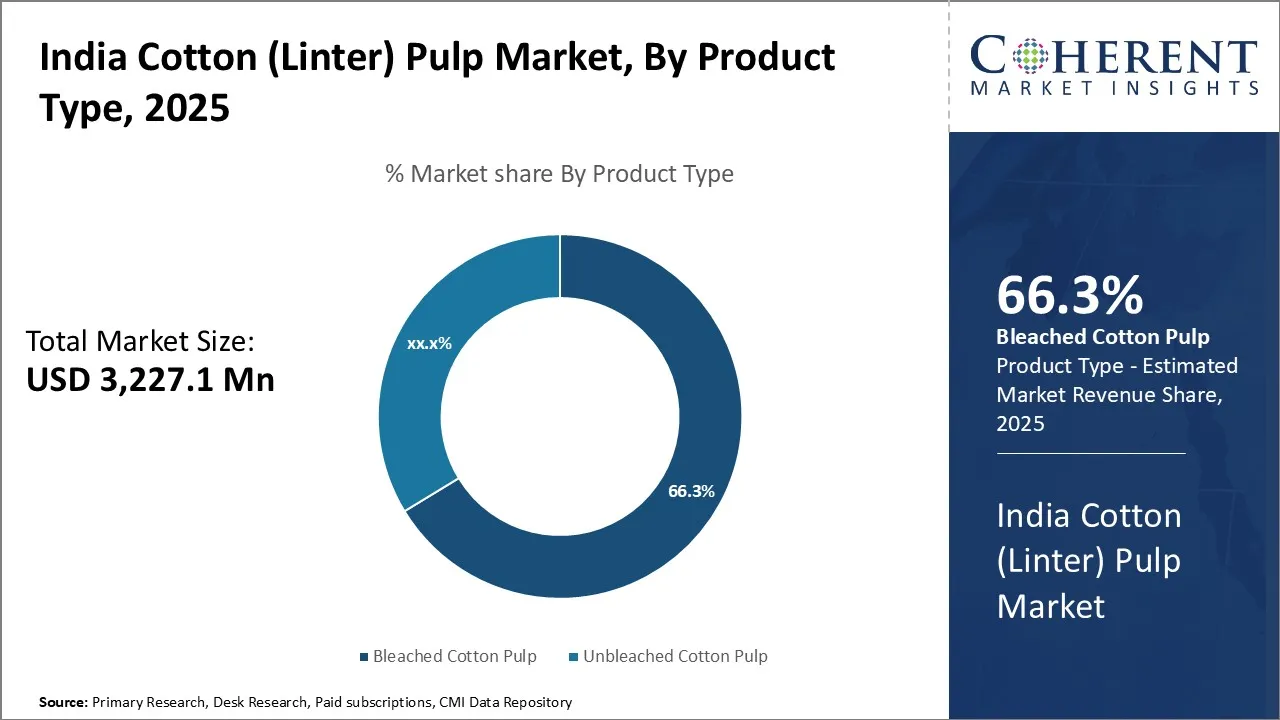
India Cotton (Linter) Pulp Market Insights, by Product Type - Bleached Cotton Pulp Segment Dominates the Market due to its Superior Quality and Versatile Applications
The bleached cotton pulp segment is expected to capture 67.3% of the India cotton (linter) pulp market share in 2026, due to its ability to achieve high purity level and brightness rates required by various end-use sectors. Bleaching is done to remove natural impurities, lignin and colorants of the raw cotton linters, in order to produce a much whiter and finer pulp. This improved quality renders bleached cotton pulp particularly suitable in those manufacturing where color reliability and purity is an essential consideration like in production of high quality materials, specialty paper, and personal care products.
For example, the producers of tissue products such as ITC Limited use bleached cotton pulp to make tissue products which are bright and have good texture, which matches the high standards of their luxury brand customers. The capability to achieve high levels of purity is also very important in this type of pulp, and this is because of its use in medical grade cotton products where cleanliness and non-reactivity are the key attributes.
-pulp-market-by-end-use-application.webp "India Cotton (Linter) Pulp Market, By End-Use Application")
India Cotton (Linter) Pulp Market Insights, by End-use Application - Textiles Manufacturing Segment Dominates the Market Driven by Rapid Industrialization and Innovation in Textile Products
The textiles manufacturing segment is projected to account for 35.8% of the market share in 2026. Cotton pulp is a vital raw material in making viscose rayon, cellulose fibers, non-woven fabrics among other textile products. Government programs and increased exports have helped the growth of the Indias textile industry, which has in turn been a major factor in promoting the usage of cotton pulp. As companies around the world are becoming more environmentally conscious and focused on the use of sustainable and natural fibers, cotton linter pulp is increasingly being used to make environmental friendly and biodegradable textiles to satisfy consumer demands.
The use of cotton linter pulp has also been driven by technological advancements in the manufacturing of textile materials. High cellulose content of the pulps enables production of superior quality regenerated fibers which are soft, breathable and versatile and can be used in apparel, industrial, and home furnishing. This flexibility is one of the reasons of why the textile segment is in the lead in end-use applications. In addition, the product innovations include blended fabrics consisting of cotton linter fiber with synthetic one since this type of fabrics can be applied to a broad range of uses and the general demand is increased.
India Cotton (Linter) Pulp Market Insights, by Distribution Channel - Direct Segment Dominates the Market Driven by Enhanced Supply Chain Control and Client Relationships
The direct segment is projected to hold 59.9% of the market share in 2026. Direct distribution helps the producers to have more direct interactions with their major customers like textile mills, paper manufacturers and personal care products companies where specific solutions and just-in-time deliveries can be made which indirectly influence the quality of products and production timelines.
This channel helps to maintain more effective communication and transparency between the suppliers and the end-users and allows promptly customization of pulp grades and shipment volumes depending on the needs of the clients. The technical complexity of cotton linter pulp, including bleaching amounts, fiber length, and purity, makes direct interactions the only way to engage suppliers in giving professional advice, to customize the product characteristics, and to solve problems quickly. This benefit plays a major role in ensuring stable supply chains especially in industries where there is a high degree of uniformity in the quality of raw materials.
Macro and Micro Economic Factors Impacting the India Cotton (Linter) Pulp Market Growth
Macroeconomic Factors
- Global Cotton Prices: Indian cotton linter pulp prices are extremely sensitive to international cotton trends, especially those in China and the U.S., as these drive both export opportunities and import competition for finished pulp.
- Weather and Climate: Irregular monsoons and climate-related events can significantly impact raw cotton yield, thereby affecting the input supply for the linter pulp segment.
- Government Policy: The Minimum Support Price (MSP) initiative, crop insurance schemes, and subsidies for inputs like fertilizers or seeds influence farmer incentives and stability in cotton production, indirectly supporting steady pulp supply and price realization.
Microeconomic Factors
- Input Cost Volatility: Variability in input prices, such as labor, fertilizer, water, and processing chemicals, directly affects profitability for growers and processors, potentially leading to price fluctuations for linter pulp consumers.
- Production Efficiency: Productivity improvements, supply chain logistics, and technological upgrades in processing and conversion of cotton linters into pulp are increasing industry competitiveness and yield.
Market Players, Company Insights, and Competitive Intelligence
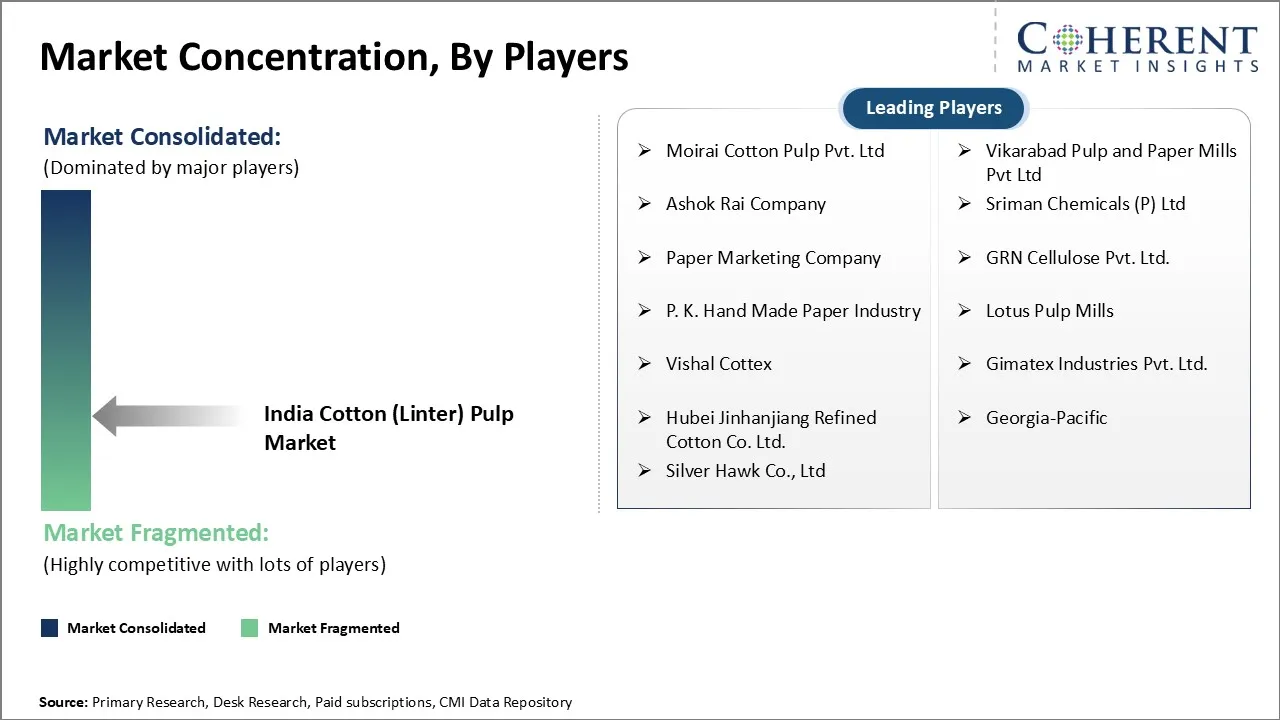
Company Insights
- Sriman Chemicals (P) Ltd, stands as the country's largest manufacturer of cotton linters pulp. The company specializes in producing high-quality chemical pulp derived from cotton linters, catering to diverse industrial applications. Sriman Chemicals offers cotton linters pulp in various grades, including bleached and unbleached forms. These products are meticulously processed to meet stringent quality standards, ensuring high alpha cellulose content, low ash levels, and consistent brightness.
Top Strategies Followed by India Cotton (Linter) Pulp Market Players
- Established players dominate the market by leveraging significant investments in research and development (R&D) aimed at innovating high-performance products that meet evolving customer demands. These companies are also proactive in seeking strategic alliances with leading players and Original Equipment Manufacturers (OEMs) in the industry to enhance their presence as well as become better integrated in the global supply chains. These partnerships do not only help them increase the products they produce but also simplify the production cycle and guarantee the maintenance of constant demand.
- For example, Grasim Industries is a large player in the India cotton (linter) pulp market, and it has put a lot of emphasis on innovation and research. They have also entered into agreements with multinational firms in the textile and paper sector to incorporate high technology and automation of the production processes.
- Mid-scale players are primarily interested in providing affordable solutions that would provide a balance between quality and price. By appealing to the price-sensitive consumers, these companies create a large niche in the market, which is especially popular among Small and Medium-Sized Enterprises (SMEs) and manufacturers seeking a good and inexpensive supply of the raw materials. Mid-level players usually enter into partnerships with technology providers and manufacturing partners to develop their production capacity and efficiency of operations.
- For example, GRN Cellulose Pvt. Ltd, a mid-level player in the India cotton linter pulp sector, offers cotton linter pulp at competitive prices while maintaining a focus on quality. By leveraging collaborations with local technology providers and manufacturing partners, they enhance operational efficiency and reduce costs.
- Small-scale players adopt a more specialized approach to compete in the fragmented the cotton (linter) pulp market in India. They are generally interested in niche markets where they create products that have special functions or use new formulations that fit special customer needs. The key to these players being successful is innovation and implementation of the latest technologies to increase product differentiation and efficiency in their operations.
- An example is the case of Arya Industries, which is a small firm in the market, which has developed a niche by specializing in cotton linter pulp with superior characteristics like high brightness and better quality of this fiber that serves high end markets in the textile and paper industry.
Market Report Scope
India Cotton (Linter) Pulp Market Report Coverage
| Report Coverage | Details | ||
|---|---|---|---|
| Base Year: | 2025 | Market Size in 2026: | USD 3,456.2 Mn |
| Historical Data for: | 2020 To 2024 | Forecast Period: | 2026 To 2033 |
| Forecast Period 2026 to 2033 CAGR: | 7.1% | 2033 Value Projection: | USD 5,586.4 Mn |
| Segments covered: |
| ||
| Companies covered: | Moirai Cotton Pulp Pvt. Ltd, Vikarabad Pulp and Paper Mills Pvt Ltd, Ashok Rai Company, Sriman Chemicals (P) Ltd, Paper Marketing Company, GRN Cellulose Pvt. Ltd., P. K. Hand Made Paper Industry, Lotus Pulp Mills, Vishal Cottex, Gimatex Industries Pvt. Ltd., Hubei Jinhanjiang Refined Cotton Co. Ltd., Georgia-Pacific, and Silver Hawk Co., Ltd | ||
| Growth Drivers: |
| ||
| Restraints & Challenges: |
| ||
India Cotton (Linter) Pulp Market Dynamics
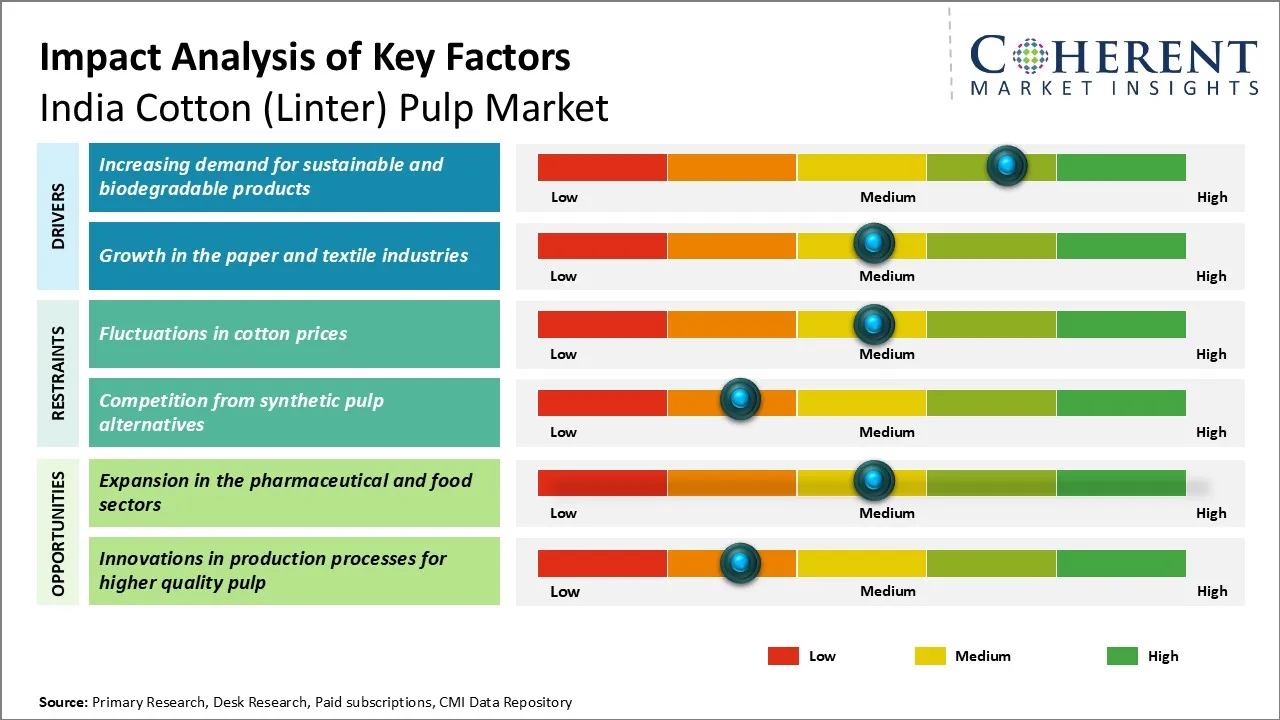
India Cotton (Linter) Pulp Market Driver - Increasing Demand for Sustainable and Biodegradable Products
The increasing sensitivity of consumers and industries to the issue of environmental sustainability has been a major cause of increasing cotton (linter) pulp demand in India. With the growing concerns in the global and domestic markets about the use of eco-friendly and biodegradable products, the packaging, textile, and hygiene product industry are considering cotton linter pulp as a solution to the usage of synthetic fibers and wood-based pulps. Cotton linter pulps natural origin and biodegradability are in line with the trend of minimizing carbon footprints and reducing plastic wastes, which will make it appealing to manufacturers who are determined to keep their sustainability objectives.
To illustrate, in the packaging industry, firms are seeking plastic substitutes that are sustainable. The eco-friendly packaging materials are being made using cotton linter pulp because of its biodegradability and high fiber content. Uflex and Amcor are the leading producers of major packaging and they are adding cotton linter pulp based items to their products in order to fulfill the increasing demand of environmentally friendly packaging.
India Cotton (Linter) Pulp Market Opportunity - Expansion in the Pharmaceutical and Food Sectors
The India cotton (linter) pulp market presents a significant opportunity driven by the expanding pharmaceutical and food sectors. Cotton linter pulp, known for its high purity and superior fiber quality, is increasingly utilized as a raw material in the production of cellulose derivatives such as cellulose acetate, Microcrystalline Cellulose (MCC), and other specialty cellulose fibers products. These derivatives are critical ingredients in pharmaceutical formulations, serving as binders, fillers, and stabilizers in tablets and capsules, which has fueled demand with the growth of India’s pharmaceutical manufacturing capabilities.
For example, MCC is used as a stabilizer and emulsifier in processed foods, dairy products, and beverages. As the food sector evolves with increasing consumer demand for clean-label and natural ingredients, the adoption of cotton linter pulp-derived products has expanded.
Analyst Opinion (Expert Opinion)
- The India cotton (linter) pulp market is poised to reach tremendous growth as a result of the rising demand in the application of the product in textiles, pharmaceuticals, and food packaging. The perspectives of the India Pulp and Paper Industry Conference (2023) and the Textile Sustainability Summit (2022) revealed some of the most important trends, with organizations such as Ruchira Papers and Shree Renuka Sugars doing well in providing sustainable approaches to production.
- The recent Proactive move of Ruchiras to invest in eco-friendly processing technologies is a demonstration of a proactive attitude to satisfy the increased raw material demand on the sustainable nature. During these events, it was pointed out that regulatory compliance and quality assurance are very important especially since international buyers are demanding certified sources of cotton pulp.
- The issues like unstable cotton prices and inefficient chain of supply were often mentioned as possible impediments. Firms that are capable of maximizing their sourcing process and improving the quality of their products through the use of innovation have a high chance of attaining a competitive advantage. In addition, quality branding which conveys environmental advantages of cotton linter pulp will be necessary to expand the market. Finally, India cotton (linter) pulp market will develop depending on its innovativeness and responsiveness to economic demands and sustainability issues.
Speak to the analyst
Want personalized insights?
Take the findings above to one of our principal consultants, or have the report rebuilt around the segments, geographies and competitors you actually track.
Market Segmentation
- Product Type Insights (Revenue, USD Mn, 2021 - 2033)
- Bleached Cotton Pulp
- Unbleached Cotton Pulp
- End-use Application Insights (Revenue, USD Mn, 2021 - 2033)
- Textiles Manufacturing
- Paper Manufacturing
- Personal Care and Hygiene Formulations
- Others (Pharmaceutical Formulations, etc.)
- Distribution Channel Insights (Revenue, USD Mn, 2021 - 2033)
- Direct
- Indirect (Via Distributors)
- Key Players Insights
- Moirai Cotton Pulp Pvt. Ltd
- Vikarabad Pulp and Paper Mills Pvt Ltd
- Ashok Rai Company
- Sriman Chemicals (P) Ltd
- Paper Marketing Company
- GRN Cellulose Pvt. Ltd.
- P.K. Hand Made Paper Industry
- Lotus Pulp Mills
- Vishal Cottex
- Gimatex Industries Pvt. Ltd.
- Hubei Jinhanjiang Refined Cotton Co. Ltd.
- Georgia-Pacific
- Silver Hawk Co., Ltd
Sources
Primary Research Interviews
- Plant Manager – Leading Cotton Linter Pulp Mill (India)
- Procurement Head – Major Indian Paper and Packaging Company
- Head of Sustainability – Textile Fiber Manufacturer
- Senior R&D Scientist – Pulp & Cellulose Application Lab
Stakeholders
- Manufacturers (Cotton Linter Pulp Producers)
- End Use Sectors:
- Paper and Packaging (Specialty paper, food-grade packaging)
- Viscose/Rayon Fiber Producers (Textiles, Nonwovens)
- Pharmaceuticals and Medical Supplies (Cellulose derivatives)
- Regulatory & Certification Bodies (BIS, State Environment Departments)
- Exporters and Importers (Agri Commodities Traders, EXIM Organizations)
- E-commerce Platforms and Industrial Suppliers
- Technology Providers (Pulping Technology, Effluent Treatment Solutions)
Databases
- UN Comtrade Database (Cotton Linters, HS Codes for Cellulosic Pulp)
- India Export Import (EXIM) Database
- Directorate General of Foreign Trade (DGFT) – India
- Ministry of Commerce, Government of India Trade Data
Magazines
- Pulp and Paper International – Trends and market updates for pulp sector
- Indian Textile Journal – Developments in cotton and pulp for textiles
- Packaging South Asia – Specialty fiber and packaging sector trends
- Fibre2Fashion Magazine – Innovations and use cases for cotton linters
Journals
- Cellulose – Research in cellulosic materials and applications
- Journal of Natural Fibers – Cotton linter applications and properties
- Indian Journal of Fibre & Textile Research – Technical advances in linter pulp
- Carbohydrate Polymers – Functional applications of cellulosic pulp
Newspapers
- The Economic Times – India pulp industry investment and trade news
- The Hindu Business Line – Domestic and export market updates
- Business Standard – Policy, regulation, and price trends in raw materials
- The Times of India – Regional news and industry expansion
- Financial Express – Technology adoption in agri and pulp sectors
Associations
- Indian Pulp & Paper Technical Association (IPPTA)
- Indian Cotton Federation (ICF)
- Confederation of Indian Textile Industry (CITI)
- The South India Cotton Association (SICA)
- Federation of Indian Export Organizations (FIEO)
Public Domain Sources
- Ministry of Textiles, Government of India – Linter and cotton production reports
- Central Institute for Research on Cotton Technology (CIRCOT)
- Ministry of Commerce & Industry, Government of India – Trade Policy and Exports
- Directorate of Economics and Statistics – Cotton and pulp crop data
- Food and Agriculture Organization (FAO) – Cotton linter pulp global data
Proprietary Elements
- CMI Data Analytics Tool, Proprietary CMI Existing Repository of information for last 8 years.
Get access to 250+ pages report
Every segment, forecast, competitor profile and data table behind the analysis above — available for instant download.
- ESOMAR Member
- ISO 9001:2015 Certified
- D-U-N-S Registered
- GDPR & CCPA Compliant
Missing comfort of reading report in your local language? Find your preferred language:
Transform your Strategy with Exclusive Trending Reports
Frequently Asked Questions
The India cotton (linter) pulp market is estimated to be valued at USD 3,456.2 Mn in 2026 and is expected to reach USD 5,586.4 Mn by 2033.
The CAGR of the India cotton (linter) pulp market is projected to be 7.1% from 2026 to 2033.
Increasing demand for sustainable and biodegradable products and growth in the paper and textile industries are the major factors driving the growth of the India cotton (linter) pulp market.
Fluctuations in cotton prices and competition from synthetic pulp alternatives are the major factors hampering the growth of the India cotton (linter) pulp market.
In terms of product type, the bleached cotton pulp segment is estimated to dominate the market revenue share in 2026.
Moirai Cotton Pulp Pvt. Ltd, Vikarabad Pulp and Paper Mills Pvt Ltd, Ashok Rai Company, Sriman Chemicals (P) Ltd, Paper Marketing Company, GRN Cellulose Pvt. Ltd., P. K. Hand Made Paper Industry, Lotus Pulp Mills, Vishal Cottex, Gimatex Industries Pvt. Ltd., Hubei Jinhanjiang Refined Cotton Co. Ltd., Georgia-Pacific, and Silver Hawk Co., Ltd are the major players.