

India Rare Earth Magnets Market Size and Forecast – 2026-2033
The India rare earth magnets market is estimated to be valued at USD 2.50 Bn in 2026 and is expected to reach USD 4.02 Bn by 2033, exhibiting a compound annual growth rate (CAGR) of 7.0% from 2026 to 2033.
Key Takeaways of the Rare Earth Magnets Market
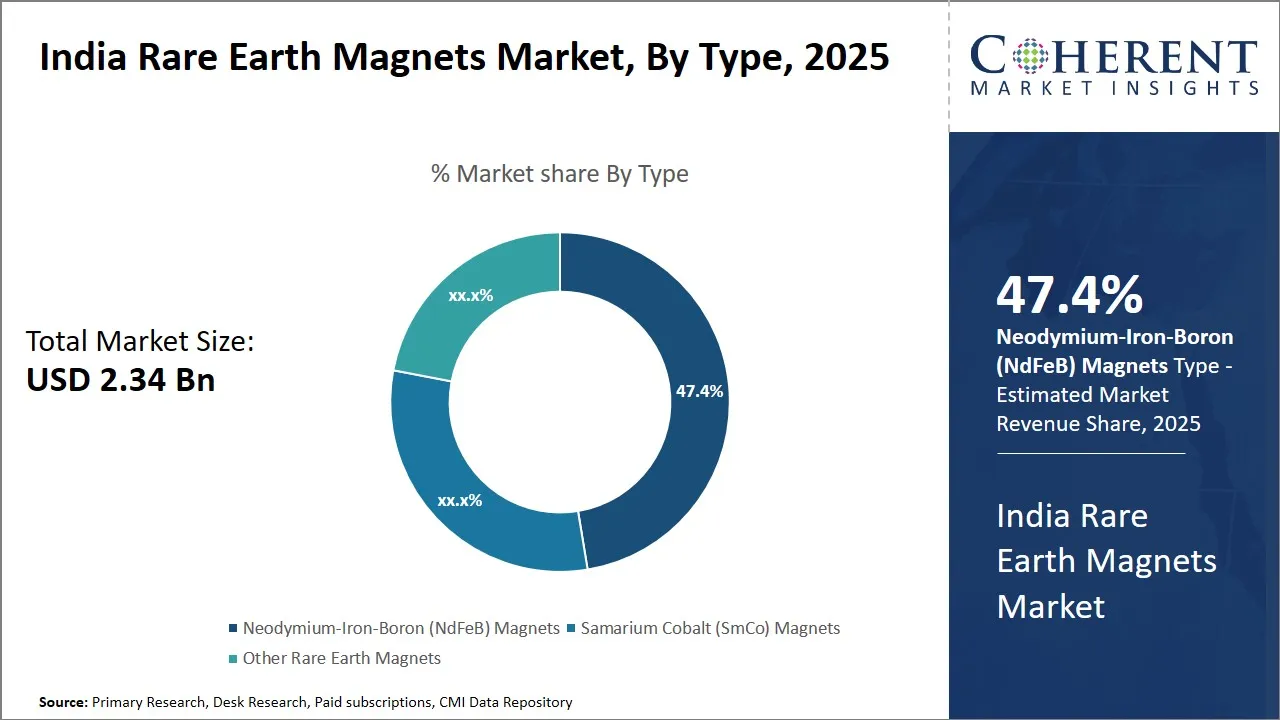
- The Neodymium-Iron-Boron (NdFeB) magnets segment is expected to account for 48.4 % of the India rare earth magnets market share in 2026.
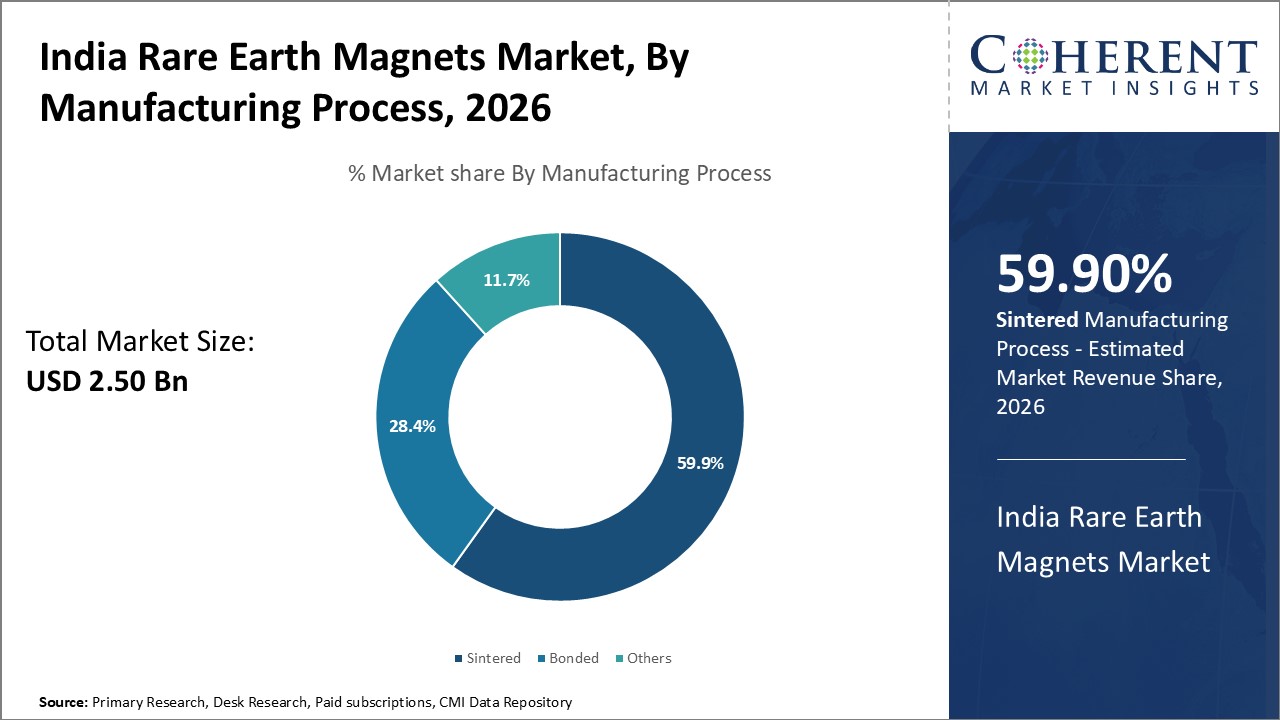
- The sintered segment is projected to hold 59.9 % of the market share in 2026.
- The automotive segment is expected to hold 26.5 % of the rare earth magnets market share in 2026.
Market Overview
Another significant market driver of the India rare earth magnets market is the increasing popularity of sustainable and eco-friendly technologies that drive the use of rare earth magnets in electric vehicle (EVs) and wind turbines. Also, the efforts of the governments to advance the domestic production of the rare earth materials and decrease the reliance on imports are enhancing the market environment. The increase in the magnetic properties has been contributed by innovation of the magnet materials including neodymium and samarium-cobalt which have been used in the development of the high-performance applications in many industries.
Current Events and Its Impact
Current Events | Description and its Impact |
China’s tightening of rare‑earth magnet export controls |
|
Indian government’s domestic manufacturing push (PLI + incentives) |
|
Segmental Insights
- Current Industry Events of 2026
- Market Size Estimation
- Regional Breakdown
- Competitive Landscape
- Customer Intelligence
- Segmental Analysis
- Pricing Analysis
- Key Market Drivers, Challenges & Future Trends
- Customized Insights Section
India Rare Earth Magnets Market Insights, By Type - Neodymium-Iron-Boron (NdFeB) Magnets Segment Dominates the Market Driven by Superior Magnetic Properties and Versatile Applications
Neodymium-Iron-Boron (NdFeB) magnets segment is expected to contribute 48.4% of the India rare earth magnets market share in 2026, owing to their exceptional magnetic strength and versatility across multiple industries. The NdFeB magnets are also characterized by the highest energy product of all the rare earth magnets, and thus they can produce strong magnetic fields even when they are in small sizes.
This unique characteristic has seen them be in great demand in applications that demand strong but light magnets like automobile and consumer electronics. The popularity of NdFeB magnets is greatly driven by the increased demand of electric vehicles (EVs) in India because the magnets are needed to achieve the efficiency and performance necessary to ensure that electric motors work well.
The other advantageous factor that is promoting growth of the sector is continuous improvement of technology in material processing of NdFeB magnets which enhance corrosion resistance, as well as high-temperature characteristics.
These enhancements also increase the possible application scope, and NdFeB magnets are now good to work in more adverse conditions found in the aerospace, defense, and industrial machinery. Also, the cost-effectiveness of NdFeB magnets as compared to other rare-earth based magnets can assist manufacturers in choosing them as their choice of magnets to use when designing magnetic parts.
India Rare Earth Magnets Market Insights, By Manufacturing Process – Sintered Segment Dominates the Market due to Enhanced Performance and Reliability Requirements
The sintered segment is projected to hold 59.9% of the rare earth magnets market share in 2026, mainly due to the ability to produce higher magnetic performance and structural integrity of the sintered segment in high-end applications. Sintering process is a compacting and heating process of the rare earth powders to produce a dense and highly uniform magnet. It produces improved coercivity and remanence magnets needed in high-demand settings requiring a steady performance level and long-lasting performance.
Sintered magnets have a higher demagnetization and temperature sensitivity resistance, which makes them the materials of choice particularly in automotive and aerospace industries where safety and reliability are paramount. Moreover, sintered NdFeB magnets have a good mechanical strength and can therefore resist severe operational forces like vibrations and high rotational frequencies. This renders them essential in electric motors, generators and precision instruments that are being prolifically made in Indias that are becoming more advanced manufacturing ecosystem.
India Rare Earth Magnets Market Insights, By End-use Industry – Automotive Segment Dominates the Market Growth Fueled by Electrification and Technological Innovation
The automotive segment is projected to command 27.5% to the India rare earth magnets market share in 2026, driven primarily by the accelerating adoption of electric and hybrid vehicles and the integration of advanced electronic components. The switch to electric to replace the traditional internal combustion engines with electric drive reduces the use of rare earth magnets, particularly those of the NdFeB, variants, by a significant margin to provide improved power density and energy efficiency of the motors. The increased attention of Indias to the decrement of vehicle emissions and the governmental policies aimed at the creation of electric cars and their sale directly trigger the needs of rare earth magnets in the automotive industry. There is also the widespread use of rare earth magnets in ancillary car systems like sensors, actuators, infotainment devices and advanced driver-assistance systems (ADAS), where magnetic components must be accurate and reliable.
Government Policies & Domestic Production (India’s critical minerals strategy (2023)
India’s Critical Minerals Strategy (2023/2025)
- The NCMM, launched with a budget of USD 1.84 Bn, prioritizes the security of critical minerals, including rare earth elements (REEs) essential for domestic industry and green technologies. Objectives include tripling magnet production capacity by 2030, reducing dependency on imports (especially from China), and establishing an integrated domestic supply chain.
- Strategic mineral stockpiles are being created to buffer India against supply shocks caused by global concentration in countries like China. Policy reforms under the MMDR Act (1957) give the central government direct control over leases, facilitating coordinated development and exploration of rare earth resources.
- Significant resource mapping and domestic mining expansion are underway via agencies like IREL and the Geological Survey of India.
Market Players, Key Development, and Competitive Intelligence
Key Developments
- On November 10, 2025, Lohum Aims 20% of India's Rare Earth Magnet Demand With First Plant After China Hurdles. In a bid to strengthen India's push for self-reliance in critical minerals, Lohum, a startup claiming to be the country’s largest producer of sustainable critical minerals, has launched India’s first integrated rare earth magnet production facility in Uttar Pradesh.
- On November 3, 2025, India rare earth magnet incentive programme set to triple to USD 788 Mn. India is preparing to expand its rare earth magnet incentive programme, with plans to nearly triple its size to more than USD 786 Mn as the country seeks to boost domestic capacity in a sector currently dominated by China. The proposed increase in funding for India’s rare earth magnet incentive programme is currently awaiting cabinet approval, reported Bloomberg.
Top Strategies Followed by India Rare Earth Magnets Market Players
- The existing firms dominate this industry through intensive funding in research and development to come up with high-performance magnets products that comply with strict industrial standards. These players have focused on materials science and manufacturing methods and they are able to create magnets that are stronger in terms of magnetism, stronger in terms of durability and strength and also stronger in terms of energy consumption. This kind of partnership allows them to continue with the development of customized magnet solutions as well as assure consistent demand pipelines.
- For example, Jai-Mag Industries company produces neodymium iron boron (NdFeB) permanent magnets with proprietary patented technology for clients from various countries and application areas.
- The middle-level market players in the India rare earth magnets industry are pragmatic and do not pose a risk to the quality of the products by being cost-effective. The small and medium enterprises and local manufacturers are among the price-sensitive segments of these companies because they are being offered affordable magnet solutions that reflect the balance between performance and cost.
- For example, Everest Tools & Magnets and a local material science research company which joined forces in order to enhance the production efficiency and quality of their rare earth magnets to consumer electronics.
- Small-scale players are able to cut a special niche by focusing on new products and differentiated products designs that meet specific regional or industrial needs. These firms tend to specialize in types of magnets that are developed with unusual shapes, sizes or magnetic characteristics to meet particular purpose like medical equipment, precision tools or educational equipment. Adopting the latest technologies in manufacturing such as additive manufacturing and the newest methods of coating can enable these smaller firms to preserve product differentiation and compete based on innovation instead of size.
Production Linked Incentive (PLI) Schemes Promoting Local Magnet Production
- In 2025, a USD 82.91 Mn PLI scheme is being approved to incentivize domestic manufacturing of rare earth permanent magnets, especially sintered NdFeB magnets critical for electric vehicles, wind energy, electronics, and defense.
- The scheme allocates both capital (USD 73.3 Mn) and operational expenditure support (USD 9.02 Mn), aiming to reach a 6,000 tons annual production capacity by 2030—sufficient for domestic demand and reducing import reliance.
- The program includes supporting supply chain development (raw material processing and conversion), facilitating tariff relief on equipment, and encouraging recycling from electronic waste to promote sustainable, circular practices.
- Non-Ferrous Materials Technology Development Centre (NFTDC) and multiple Centres of Excellence (CoEs) have been set up for R&D, process optimization, and local technology development.
Market Report Scope
India Rare Earth Magnets Market Report Coverage
| Report Coverage | Details | ||
|---|---|---|---|
| Base Year: | 2025 | Market Size in 2026: | USD 2.50 Bn |
| Historical Data for: | 2020 To 2024 | Forecast Period: | 2026 To 2033 |
| Forecast Period 2026 to 2033 CAGR: | 7.0% | 2033 Value Projection: | USD 4.02 Bn |
| Segments covered: |
| ||
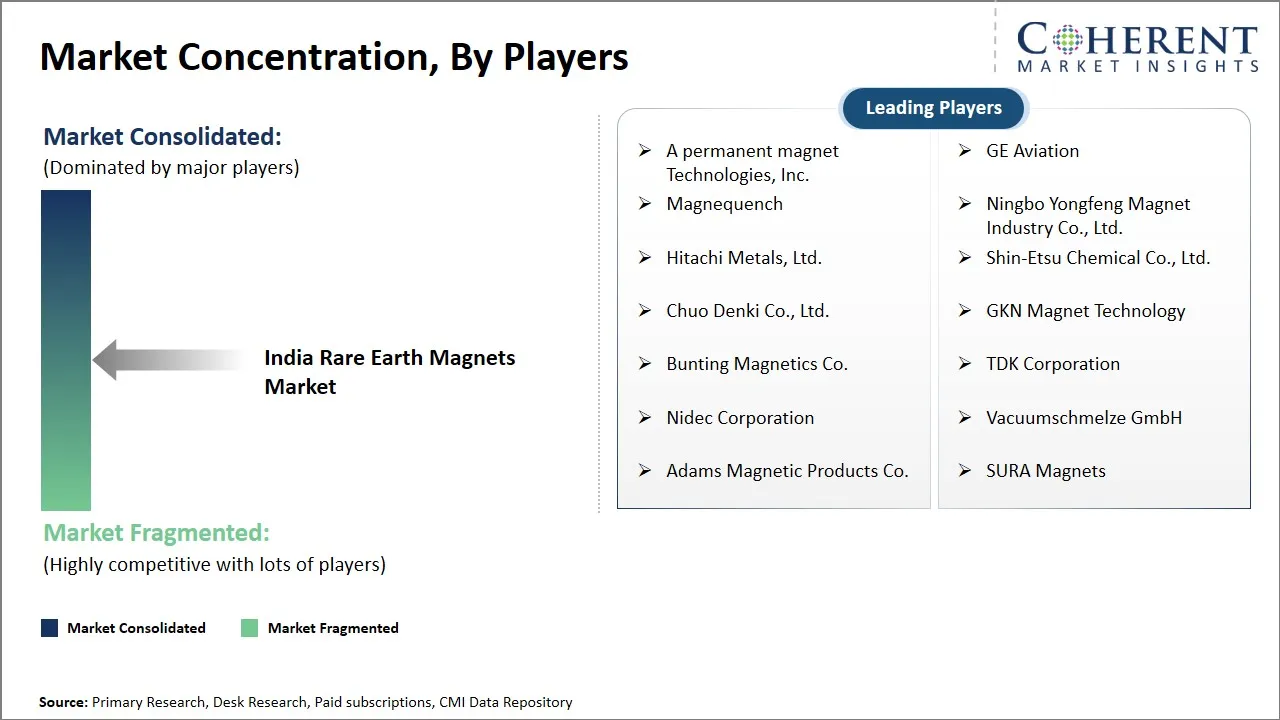
| Companies covered: | A permanent magnet Technologies, Inc., GE Aviation, Magnequench, Ningbo Yongfeng Magnet Industry Co., Ltd., Hitachi Metals, Ltd., Shin-Etsu Chemical Co., Ltd., Chuo Denki Co., Ltd., GKN Magnet Technology, Bunting Magnetics Co., TDK Corporation, Nidec Corporation, Vacuumschmelze GmbH, Adams Magnetic Products Co., and SURA Magnets | ||
| Growth Drivers: |
| ||
| Restraints & Challenges: |
| ||
India Rare Earth Magnets Market Dynamics
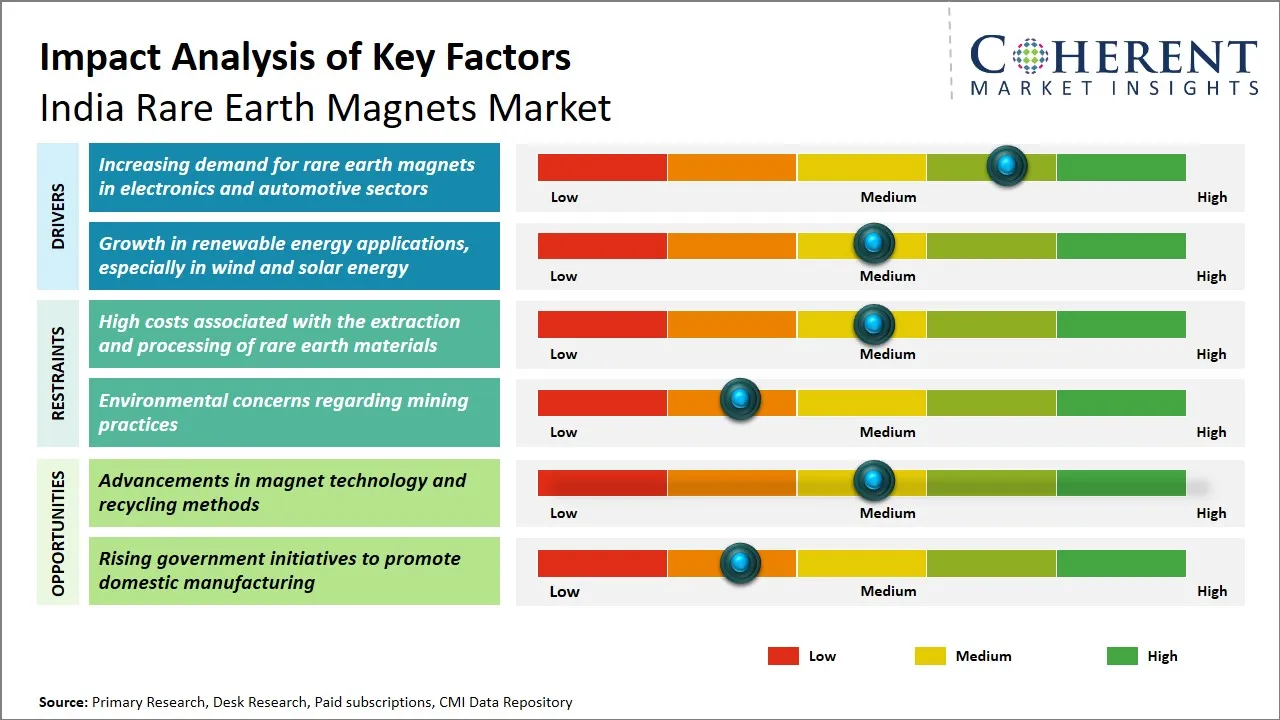
India Rare Earth Magnets Market Driver - Increasing Demand for Rare Earth Magnets in Electronics and Automotive Sectors
Demand of rare earth magnets in India is largely motivated by the fact that they have critical applications in the fast growing automotive and electronic industries. The increased use of consumer electronics like smartphones, speakers and wearable device in electronics critically depends on the high magnetic properties of the rare earth magnets to improve performance, miniaturize and increase energy efficiency. At the same time, the shift of the automotive sector towards electric vehicles (EVs) and hybrid models is a major stimulus of the demand in rare earth magnets, especially in the high-performance motors and generators.
As an example, the recent iPhone models of Apples use the rare earth magnet in their speakers, camera stabilization devices, and MagSafe charging. These elements are based on the high magnetic power of neodymium magnets to develop small designs with high energy efficiency and performance.
India Rare Earth Magnets Market Opportunity - Advancements in Magnet Technology and Recycling Methods
The India rare earth magnets market will experience a major advantage with current improvement in development of magnet technology and recycling techniques that have the potential of spurring growth and sustainability in the industry. The applications of innovations in the magnet materials, including the creation of high-performance neodymium-iron-boron (NdFeB) magnets with increased thermal stability and magnetic strength, are also being applied in areas where compact and efficient magnetic solutions are needed, such as electric vehicles (EVs), renewable energy systems, and consumer electronics.
Among the improvements made in magnet technology is the development of high performance NdFeB magnets which are more thermal stable by Hitachi Metals. These magnets are essential in utilizing in electric motors in electric vehicles, and wind turbines, where heat resistance and magnet strength are essential to the long-term operation.
Analyst Opinion (Expert Opinion)
- India rare earth magnets market will experience a significant growth due to the presence of the growing demand of electric vehicles (EVs) and renewable energy technologies. The lessons learned at the India Magnetics Conference (2023) and the Renewable Energy India Expo (2022) pointed to the remarkable progress, and such businesses as Lynas Corporation and REMG are at the forefront of national production and development.
- The recent investment in local processing facilities by Lynas highlights how the markets have been responding to the push by the government on self-reliance in the rare earth industry to reduce reliance on imports. The role of rare earth magnets in increasing the efficiency of EV motors and wind turbine generators was discussed in these conferences as critical.
Speak to the analyst
Want personalized insights?
Take the findings above to one of our principal consultants, or have the report rebuilt around the segments, geographies and competitors you actually track.
Market Segmentation
- Type Insights (Revenue, USD Bn, 2021 - 2033)
- Neodymium-Iron-Boron (NdFeB) Magnets
- Samarium Cobalt (SmCo) Magnets
- Other Rare Earth Magnets
- Manufacturing Process Insights (Revenue, USD Bn, 2021 - 2033)
- Sintered
- Bonded
- Others
- End-use Industry Insights (Revenue, USD Bn, 2021 - 2033)
- Automotive
- Consumer Electronics
- Aerospace & Defense
- Energy
- Industrial
- Others
- Key Players Insights
- A permanent magnet Technologies, Inc.
- GE Aviation
- Magnequench
- Ningbo Yongfeng Magnet Industry Co., Ltd.
- Hitachi Metals, Ltd.
- Shin-Etsu Chemical Co., Ltd.
- Chuo Denki Co., Ltd.
- GKN Magnet Technology
- Bunting Magnetics Co.
- TDK Corporation
- Nidec Corporation
- Vacuumschmelze GmbH
- Adams Magnetic Products Co.
- SURA Magnets
Sources
Primary Research Interviews
- R&D Director – Leading Rare Earth Magnet Manufacturer
- Procurement Manager – Major Industrial Magnet Distributor
- Product Development Head – Well-Known Magnet Technology Company
- Sustainability Manager – Rare Earth Minerals Certification Body
Stakeholders
- Manufacturers of Rare Earth Magnets
- End-use Sectors
- Automotive (Electric Vehicles, Hybrid Cars)
- Electronics and Consumer Appliances
- Renewable Energy (Wind Turbines, Solar Equipment)
- Industrial Machinery and Robotics
- Regulatory & Certification Bodies
- E-commerce Platforms and Industrial Retailers
- Technology Integration Players: AI-driven magnet material optimization firms
Databases
- UN Comtrade Database
- India Import Export (EXIM) Database
- Indian Bureau of Mines Database (Rare Earth Minerals Production Data)
Magazines
- Magnetics Industry Review – Trends in rare earth magnet production and technology
- Materials Today India – Innovations in magnetic materials
- Industrial Minerals Magazine – Market updates on rare earth elements
- TechMagnet Journal – Advances in magnet technology and applications
- The Rare Earth Report – Industry insights and market analysis
Journals
- Journal of Magnetism and Magnetic Materials – Research on rare earth magnet properties
- Materials Science and Engineering A – Developments in rare earth alloy formulations
- Minerals Engineering – Processing and supply chain studies of rare earth materials
- Journal of Sustainable Mining – Environmental impacts of rare earth mining
Newspapers
- The Economic Times – Market growth and investment in rare earth magnets
- Business Standard – Demand and supply dynamics in rare earth materials
- The Hindu Business Line – Industrial applications and government policies
- Times of India – Indian manufacturing capabilities in rare earth magnets
Associations
- Magnetics Society of India
- Indian Rare Earths Association
- Confederation of Indian Industry (CII) – Materials & Metallurgy Division
- Rare Earth Industry Consortium of India
- Bureau of Indian Standards (BIS) – Magnet Specification Committees
Public Domain Sources
- Ministry of Mines, India – Guidelines and reports on rare earth minerals
- Geological Survey of India – Research and data on rare earth mineral reserves
- Department of Commerce, India – Trade policies related to rare earth magnets
- World Trade Organization – International trade regulations on rare earths
Proprietary Elements
- CMI Data Analytics Tool, Proprietary CMI Existing Repository of information for last 8 years.
Get access to 250+ pages report
Every segment, forecast, competitor profile and data table behind the analysis above — available for instant download.
- ESOMAR Member
- ISO 9001:2015 Certified
- D-U-N-S Registered
- GDPR & CCPA Compliant
Missing comfort of reading report in your local language? Find your preferred language:
Transform your Strategy with Exclusive Trending Reports
Frequently Asked Questions
The India rare earth magnets market is estimated to be valued at USD 2.50 Bn in 2026 and is expected to reach USD 4.02 Bn by 2033.
The CAGR of the India rare earth magnets market is projected to be 7.0% from 2026 to 2033.
Increasing demand for rare earth magnets in electronics and automotive sectors and growth in renewable energy applications, especially in wind and solar energy are the major factors driving the growth of the India rare earth magnets market.
High costs associated with the extraction and processing of rare earth materials and environmental concerns regarding mining practices are the major factors hampering the growth of the India rare earth magnets market.
In terms of type, the Neodymium-Iron-Boron (NdFeB) Magnets segment is estimated to dominate the market revenue share in 2026.
A permanent magnet Technologies, Inc., GE Aviation, Magnequench, Ningbo Yongfeng Magnet Industry Co., Ltd., Hitachi Metals, Ltd., Shin-Etsu Chemical Co., Ltd., Chuo Denki Co., Ltd., GKN Magnet Technology, Bunting Magnetics Co., TDK Corporation, Nidec Corporation, Vacuumschmelze GmbH, Adams Magnetic Products Co., and SURA Magnets are the major players.