

Global Industrial Touch Screen Market Size and Forecast – 2026 To 2033
The global industrial touch screen market is expected to grow from USD 6.80 Bn in 2026 to USD 11.90 Bn by 2033, registering a compound annual growth rate (CAGR) of 8.2% from 2026 to 2033. The global industrial touch screen market is driven by rising demand for rugged touch displays in harsh industrial environments. On October 9, 2025, Kontron, a leading global provider of IoT/Embedded Computer Technology (ECT), announced a strategic partnership with EIZO Rugged Solutions Inc., an expert in ruggedized embedded graphics processing, AI compute, and video solutions.
Key Takeaways of the Global Industrial Touch Screen Market
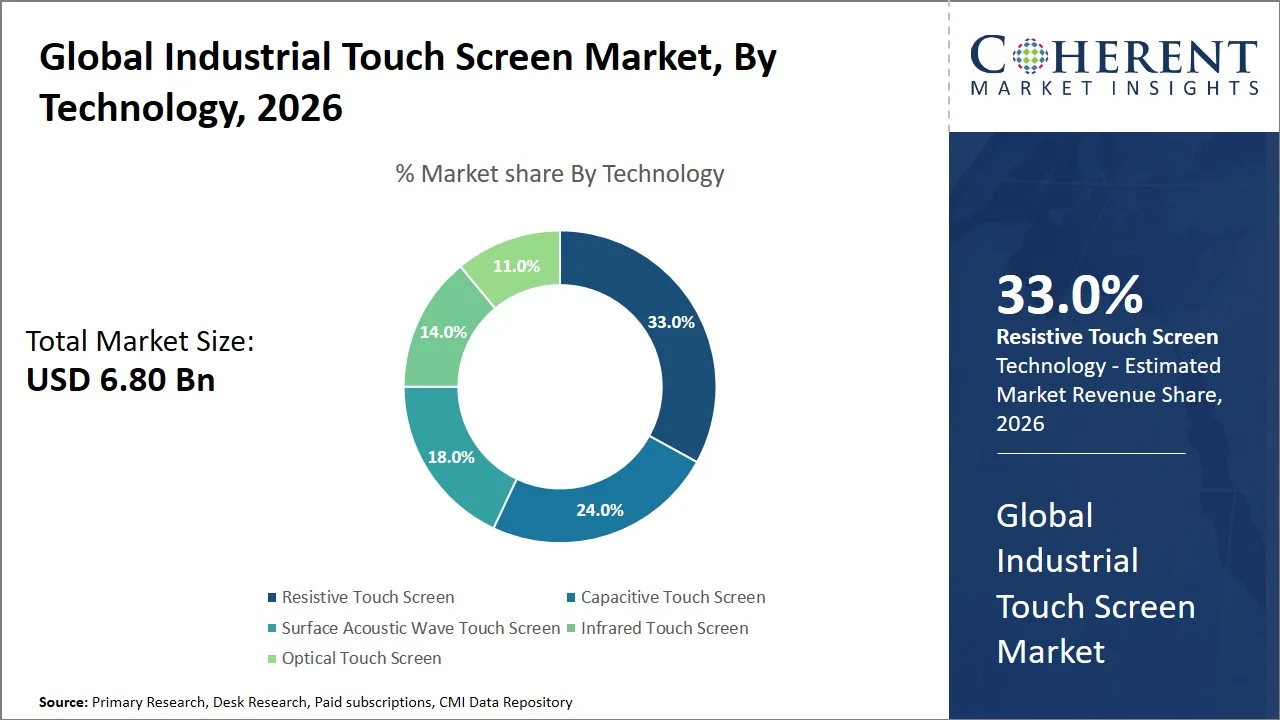
- The Resistive Touch Screen segment is expected to account for 33.0% of the global industrial touch screen market share in 2026. Increasing investments in digital manufacturing infrastructure is driving the growth of the segment. On March 26, 2025, Siemens announced that it has completed the acquisition of Altair Engineering Inc., a leading provider of software in the industrial simulation and analysis market, for an enterprise value of approximately USD 10 billion.
- The Up to 10 Inches segment is estimated to capture 44.0% of the market share in 2026. Expansion of warehouse automation and logistics facilities is majorly driving the growth of the segment. On July 28, 2026, Millennium Semiconductors, Mouser Electronics and RayQ TTI announced to expand storage and logistics operations across India to service the country’s fast increasing electronics manufacturing ecosystem.
- The Human Machine Interface segment is estimated to capture 36.0% of the market share in 2026. Expansion of industrial IoT enabled production facilities is driving the growth of the segment. On October 24, 2025, Siemens and rhobot.ai announced the next step in their collaboration with the commercial availability of their advanced AI solution for manufacturing.
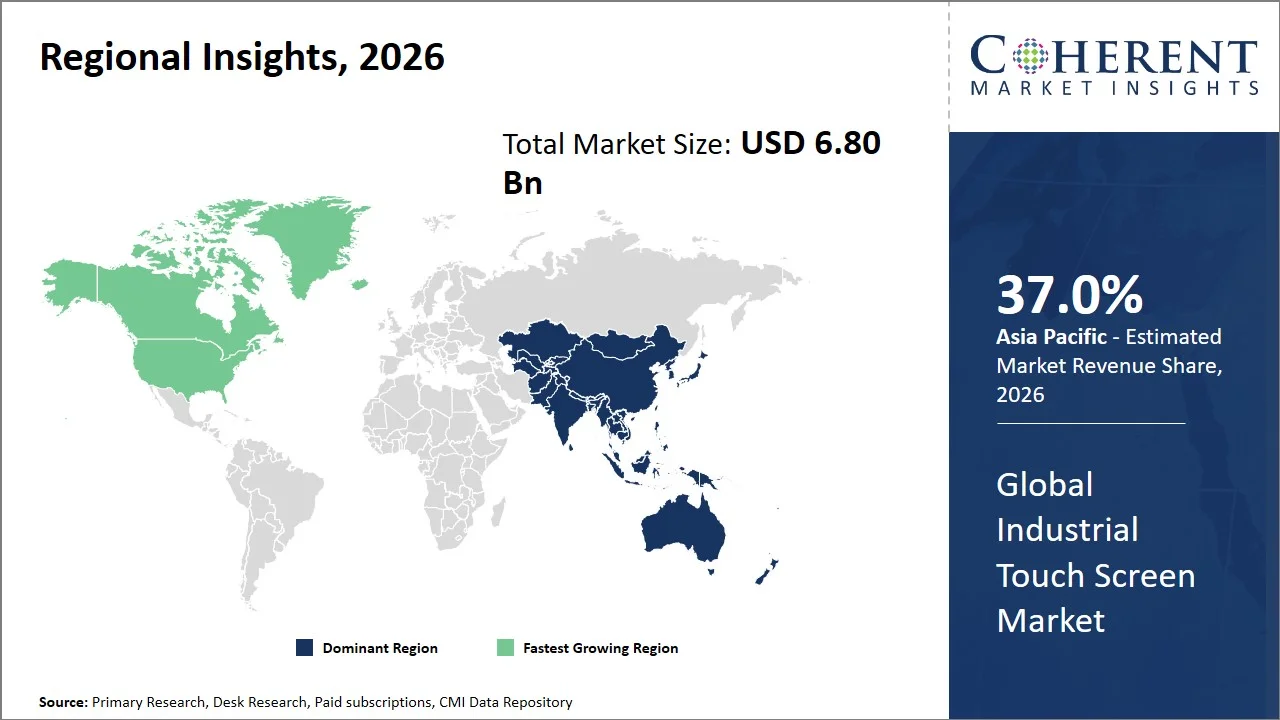
- Asia Pacific is expected to dominate the industrial touch screen market in 2026 with a market share of 37.0%. Rising investments in semiconductor and electronics manufacturing in Asia Pacific is driving the growth of the regional market. On July 18, 2025, Rapidus announced the launch of its first 300 mm wafer with its 2 nm prototype chips, a significant milestone in Japan’s next-generation semiconductor manufacturing strategy, and a boost to the country’s domestic chip production ecosystem.
- North America is expected to account for 33.0% of the market share in 2026 and is projected to record the fastest growth over the forecast period. Growing deployment of autonomous manufacturing and robotic systems in North America is driving the growth of the regional market. On July 17, 2026, Agility Robotics debuted a 60,000-square-foot engineering and testing hub in Fremont, California, to enhance development and deployment of its Digit humanoid robots for manufacturing and warehouse automation applications in North America.
- Integration of AI powered human machine interfaces: Industrial touch screen manufacturers are integrating artificial intelligence into HMI platforms for predictive maintenance, real time process optimization, intelligent alarms, and operator guidance to boost production efficiency while reducing downtime.
- Growing adoption of projected capacitive multi touch technology: The projected capacitive touch screens are being adopted rapidly due to their better touch accuracy, multi touch capability, glove compatibility and enhanced durability, making them the preferred choice for advanced industrial automation applications.
Segmental Insights
Why Does Resistive Touch Screen Dominate the Global Industrial Touch Screen Market?
The resistive touch screen segment is expected to account for 33.0% of the global industrial touch screen market share in 2026. Resistive touch screens are the most widely used mainly because they perform well under tough industrial conditions where the operator is often wearing protective gloves or styluses. Unlike capacitive technology, resistive touch screens accurately respond to pressure-based input regardless of moisture, dust, grease or contaminants on the screen surface. This makes them well-suited for factory automation, machine control panels, process monitoring systems and outdoor industrial equipment. Manufacturers looking for solid human-machine interface solutions for industrial applications favor them because of their longevity, constant performance in harsh working circumstances, and reduced implementation cost. On November 1, 2025, TDS TOUCH announced the TDS37 embedded industrial touchscreen monitor with integrated resistive touchscreen and flat-front industrial design. The solution was intended for machinery working in dusty, wet and vibration-prone situations where accurate stylus and glove-touch input is required.
- Current Industry Events of 2026
- Market Size Estimation
- Regional Breakdown
- Competitive Landscape
- Customer Intelligence
- Segmental Analysis
- Pricing Analysis
- Key Market Drivers, Challenges & Future Trends
- Customized Insights Section
Why is Up to 10 Inches the Most Preferred Screen Size?
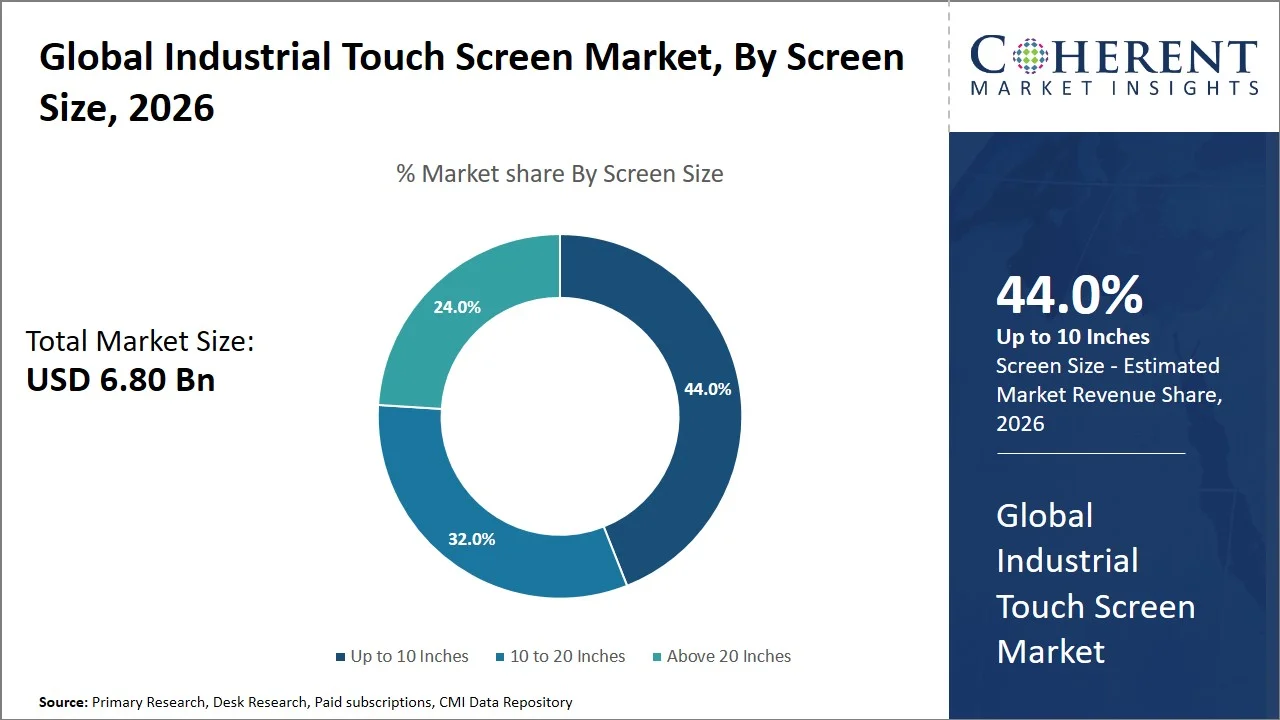
The up to 10 inches segment is expected to account for 44.0% of the global industrial touch screen market share in 2026. The main advantage of touch screens up to 10 inches is their successful application in tiny industrial human-machine interface where space economy and simple operation are of paramount importance. Many applications require small screens to enable quick access to controls without increasing the size of the equipment, including programmable logic controller panels, CNC machines, medical instruments, handheld diagnostic devices and process control systems. Touch screens up to 10 inches also provide lower power consumption, easier panel integration, better mechanical durability and lower total system cost, making them the favored choice for big volume industrial equipment producers. On July 8, 2025, Advantech, a global leader in industrial IoT and automation, announced that its Human-Machine Interface (HMI) product line, the TPC-100W Series, has officially received IEC 62443-4-2 Verification of Compliance (VoC) certification from Bureau Veritas.
Human Machine Interface Dominates the Global Industrial Touch Screen Market
The human machine interface segment is expected to account for 36.0% of the global industrial touch screen market share in 2026. The extensive use of industrial touch screens in human-machine interface applications is mostly due to the growing demand for real-time equipment monitoring and intuitive machine control in production contexts. Through a single interactive display, human-machine interface systems enable operators to efficiently monitor production data, alter machine settings, diagnose errors and control automated operations, enhancing operational efficiency and decreasing downtime. With the growth of factory automation, smart manufacturing and industrial IoT deployments, touch-enabled human machine interfaces have become a critical component of production lines, process control systems, packing equipment and industrial machinery. On November 20, 2025, Siemens unveiled its newest SIMATIC HMI and Industrial AI portfolio at SPS 2025, highlighting AI-assisted operator interfaces, digital engineering workflows, zero-trust OT security and enhanced HMI capabilities for connected manufacturing environments, in line with its One Tech Company strategy.
Current Events and their Impact
Current Events | Description and its Impact |
European Union Cyber Resilience Act (CRA) |
|
European Union Machinery Regulation (EU) 2023/1230 |
|
Global Industrial Touch Screen Market Dynamics
Market Drivers
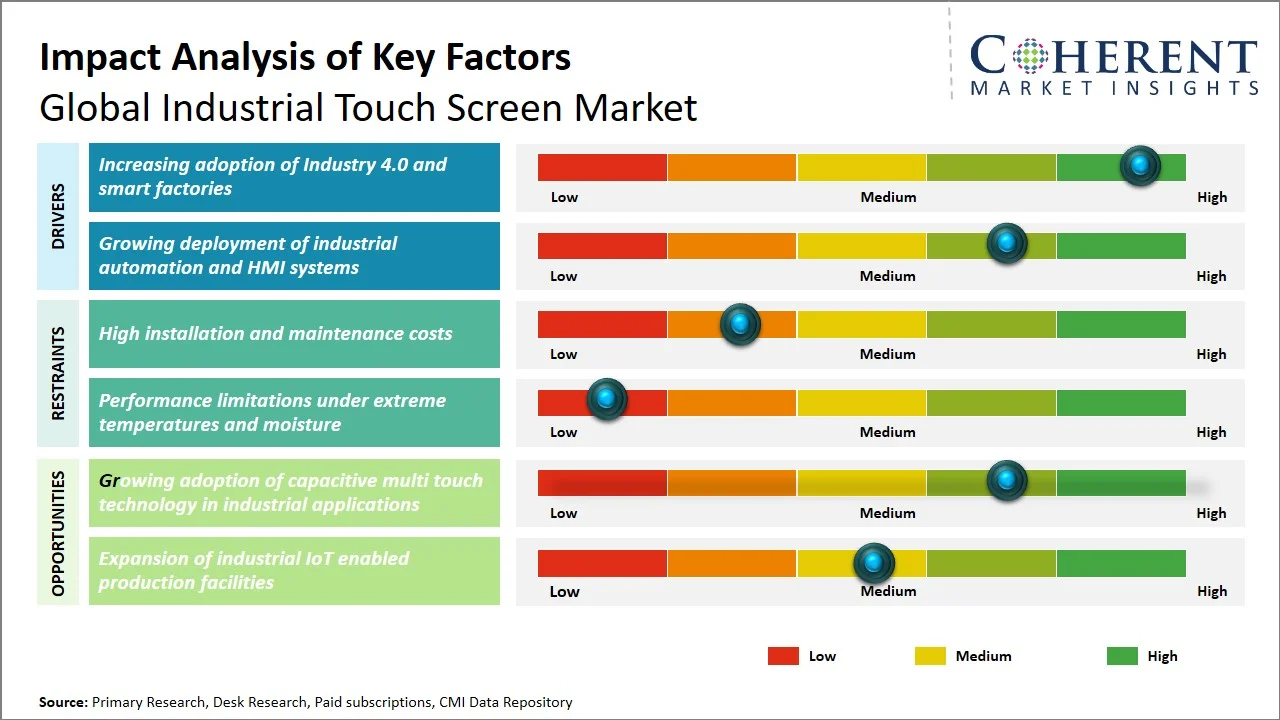
Increasing adoption of Industry 4.0 and smart factories
The increasing adoption of LEDs in automotive lighting and smart displays is emerging as a key driver for the global Industrial Touch Screen market, due to the growing demand for energy-efficient, durable, and high-performance lighting solutions. Automakers are increasingly using LED technology in headlamps, daytime running lights, adaptive lighting systems and interior ambient lighting to improve vehicle safety, design flexibility and energy efficiency. At the same time, the fast growth of smart displays in smartphones, TVs, wearable devices, digital signage and automotive infotainment systems is driving the adoption of advanced LED technologies such as mini-LED and micro-LED with better brightness, contrast, color accuracy and lower power consumption. These developments are promising to enable continual innovation of optoelectronic components and, at the same time, facilitate the development of next-generation connected automobiles and intelligent consumer electrical gadgets.
On October 7, 2025, Rockwell Automation, Inc. announced the highly anticipated launch of its newest controller, ControlLogix 5590, the powerhouse at the core of the Logix platform. Designed to meet the evolving demands of modern manufacturing, this all-in-one controller delivers seamless software integration and multidiscipline control across the enterprise to streamline operations like never before.
Growing deployment of industrial automation and HMI systems
The growing deployment of industrial automation and human-machine interface (HMI) systems, which allow operators to efficiently monitor, control and optimize complex manufacturing processes through intuitive graphical interfaces, is driving the increasing adoption of industrial touch screens. Modern HMI systems use industrial touch displays in programmable logic controllers (PLCs), distributed control systems (DCSs), supervisory control and data acquisition (SCADA) platforms, and robotic automation. This increases the speed of decision-making, enhances process accuracy, and minimizes machine downtime. Industrial touch screens are essential parts of machine control panels, packaging equipment, CNC machinery, process automation systems and industrial robotics as manufacturers are increasingly automating production lines to enhance productivity, product quality and operational efficiency. On November 20, 2025, at SPS 2025, Schneider Electric announced new EcoStruxure Automation Expert features that allow software-defined automation with integrated HMI, open automation architecture and interoperable control systems to ease deployment across industrial production plants.
Emerging Trends
Expansion of edge computing enabled industrial displays
Industrial touch screens are being increasingly deployed with embedded edge computing capabilities that enable local data processing, low-latency decision-making, and seamless connectivity with industrial IoT devices and smart factory ecosystems.
Rising demand for rugged and hygienic touch screen solutions
Industries such as food processing, pharmaceuticals, chemicals and outdoor energy operations are driving demand for robust touch screens with IP rated protection, antimicrobial surfaces, chemical resistance and wide operating temperature ranges for harsh industrial environments.
Regional Insights
Why is Asia Pacific a Strong Market for Industrial Touch Screen?
Asia Pacific is expected to account for a market share of 37.0% in 2026. Asia Pacific is the greatest manufacturing hub for industrial touch screens owing to large-scale expenditures in factory automation, semiconductor fabrication, electric vehicle production and industrial robotics. Smart manufacturing plants that demand tough human machine interaction systems are continuously increasing in China, Japan, South Korea, India and Taiwan. Leading electronics manufacturers, including as Foxconn, TSMC, Samsung Electronics, LG Electronics and BYD, are fitting innovative capacitive industrial touch panels to production lines for real-time equipment monitoring and quality control. While Japanese automotive and robotics makers such as Toyota, Fanuc and Yaskawa Electric continue to embed multi touch operator panels in automated assembly cells, Singapore has extended smart manufacturing initiatives via the Jurong Innovation District with digital factory deployments in precision engineering industries.
Why Does the North America Industrial Touch Screen Market Exhibit High Growth?
North America is projected to account for 33.0% of the global industrial touch screen market in 2026 and expected to register the fastest growth. North America benefits from strong adoption of industrial touch screens across automotive manufacturing, aerospace, food processing, pharmaceuticals, and logistics automation. And in the US and Canada, industrial IoT and digital factory programs are powering ongoing modernization of production facilities, driven by major automation providers like Rockwell Automation, Honeywell, Emerson and Eaton. Automotive EV manufacturers including Tesla, General Motors, Ford, Rivian, and Lucid Motors use tough touch screen HMIs for robotic welding, battery assembly, and automated inspection systems. Warehouse automation has also grown through the use of industrial touch terminals coupled with autonomous mobile robots and warehouse management systems in distribution facilities owned by Amazon, Walmart, UPS, and FedEx.
Global Industrial Touch Screen Market Outlook for Key Countries
Why is China Emerging as a Major Hub in the Industrial Touch Screen Market?
China’s Role in Industrial Touch Screen Adoption China has a significant presence in electronics manufacturing, electric car manufacture, and industrial automation, which all drive the growth of industrial touch screens. Under the acceleration of national intelligent manufacturing promotion policies, the installation of advanced HMI systems in factories producing semiconductors, batteries, consumer electronics and industrial machinery is still accelerating. Companies including Huawei, Xiaomi, Lenovo, BYD, CATL, Foxconn Zhengzhou, and Midea extensively utilize industrial touch displays for production monitoring and automated process control. Semiconductor investments by SMIC and Hua Hong Semiconductor, together with large scale battery manufacturing facilities operated by CATL and EVE Energy, continue increasing demand for high durability capacitive touch interfaces capable of operating continuously in demanding industrial environments.
Is the U.S. the Next Growth Engine for the Industrial Touch Screen Market?
The U.S. is one of the most technologically advanced markets for industrial touch screens, with the wide use of smart manufacturing technology. Tesla, Ford, General Motors and Stellantis use industrial touch panels in their automotive manufacturing plants for robotic assembly, predictive maintenance and digital quality inspection. Industrial grade touch interfaces for cleanroom production environments are required for semiconductor fabrication facilities from Intel, Micron Technology, Texas Instruments and Globalfoundries. Food and beverage manufacturers such as PepsiCo and Coca Cola continue to transition away from conventional operator panels to hygienic multi touch displays designed for washdown environments. Pharmaceutical manufacturing facilities employ industrial touch HMIs to facilitate regulatory compliance and batch production monitoring.
Germany Industrial Touch Screen Market Analysis and Trends
Germany is still Europe’s largest industrial touch screen market, driven by its sophisticated machine-building industry and broad use of Industry 4.0 technology. Industrial touch interfaces are used across the automated production facilities of manufacturing companies such as Siemens, Bosch, BMW, Mercedes Benz, Volkswagen, Audi, BASF and Thyssenkrupp for machine visualization, process control and predictive maintenance. Beckhoff Automation and Siemens continue to build out integrated HMI solutions supporting OPC UA, Profinet and edge computing architectures. German automobile companies are progressively employing high resolution multi touch displays in robotic production cells. At the same time, precision engineering facilities are continuing to replace conventional push button control systems with sophisticated touchscreen based operator stations.
Japan Industrial Touch Screen Market Analysis and Trends
Japan is one of the world's most advanced industrial touch screen markets, with broad use of factory automation, robotics and precision manufacturing technologies. Industrial touch screen human machine interfaces are used in robotic assembly lines, CNC machining centers, semiconductor production equipment and automated inspection systems by companies such as Toyota, Honda, Nissan, Denso, Fanuc, Yaskawa Electric, Mitsubishi Electric, Omron, Keyence and Panasonic Connect. Semiconductor manufacturers like as Renesas Electronics, Kioxia, Sony Semiconductor Solutions, and Rapidus are focusing more on advanced fabrication facilities, which require high reliability capacitive touch screens for use in cleanroom conditions.
DMG Mori and Okuma, two makers of industrial machinery, have introduced CNC systems and multi-touch operator screens to enhance the visibility of machines and production control. The Ministry of Economy, Trade and Industry continues to promote digital manufacturing and linked factory efforts under Society 5.0, spurring the deployment of industrial IoT enabled touch interfaces. Also, logistics automation is growing through automated warehouses run by businesses such as Daifuku and Murata Machinery, using durable industrial touch displays for warehouse control, autonomous material handling systems and real time production monitoring.
South Korea Industrial Touch Screen Market Analysis and Trends
South Korea is an important touch screen market in the industrial sector thanks to its leading semiconductor manufacturing, sophisticated electronics manufacturing, battery manufacturing and automotive assembly. Samsung Electronics and SK hynix are still building semiconductor production facilities that require industrial touch HMIs to monitor cleanroom equipment and automate processes. LG Electronics, Hyundai Motor Group, Kia and Samsung SDI make widespread use of tough industrial touch panels for production visualization and robotic control in automated manufacturing lines. Industrial touch displays integrated with AI based quality inspection systems are increasingly being implemented in battery manufacturing facilities supplying global electric vehicle manufacturers. Smart factory initiatives supported by the Korean government continue accelerating digital transformation across small and medium sized manufacturing enterprises.
Global Industrial Touch Screen Market - Human-Machine Interface Installation Base by Country (2025)
Country | HMI Installation Base (Thousand Units) |
China | 4,850 |
U.S. | 3,420 |
Japan | 2,180 |
Germany | 1,860 |
South Korea | 1,240 |
India | 980 |
Italy | 760 |
France | 690 |
Taiwan | 640 |
U.K. | 520 |
How is the Growing Adoption of Capacitive Multi Touch Technology in Industrial Applications Creating New Growth Opportunities in the Industrial Touch Screen Market?
The growing adoption of projected capacitive multi touch technology is creating new growth opportunities in the industrial touch screen market by enabling advanced operator interaction in highly automated production environments where conventional resistive interfaces are no longer sufficient. Modern manufacturing facilities operated by automotive, semiconductor, battery, and electronics producers are increasingly deploying multi touch human machine interfaces that support gesture based navigation, simultaneous multi user operation, and glove compatible input for machine diagnostics, production scheduling, and robotic cell management.
Siemens, Beckhoff Automation, Rockwell Automation and Mitsubishi Electric have now equipped their latest industrial automation platforms with projected capacitive touch displays that include edge computing, OPC UA connectivity and real time visualization software, allowing operators to access machine performance dashboards, predictive maintenance alerts and digital twin applications from a single interface. The technology is also helping to replace mechanical control panels in hygienic food processing and pharmaceutical production facilities with chemically resistant glass surfaces that can stand up to regular washdowns and still provide precise touch performance.
On July 15, 2025, Advantech announced the launch of its AMAX IoT Control Platform. This innovative solution combines PLC, HMI, and IoT functions into a single software-defined platform, simplifying traditional system integration while ensuring deterministic real-time performance for precision automation applications.
Market Players, Key Development, and Competitive Intelligence
Key Developments
- On December 18, 2025, Siemens showcased its next-generation industrial automation portfolio at SPS 2025, highlighting industrial AI-enabled HMI solutions, enhanced SIMATIC technologies, and zero-trust OT security designed for connected manufacturing facilities.
- On April 2, 2025, Beckhoff Automation announced the launch of its Next multi-touch panel series. The Next multi-touch panel series is advanced and cost-optimized, and further expands the diversity of Beckhoff's broad portfolio.
Competitive Landscape
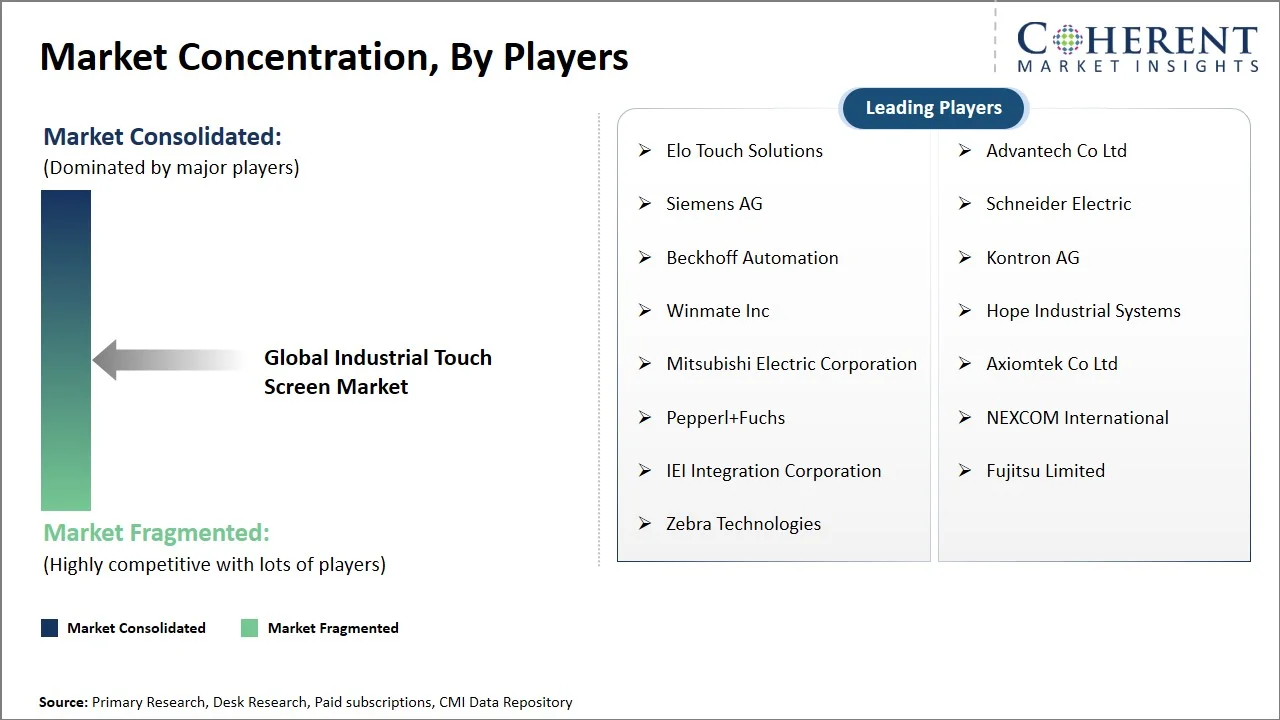
Companies like Elo Touch Solutions, Advantech, Siemens AG, Schneider Electric, Rockwell Automation, Beckhoff Automation, Winmate, Hope Industrial Systems, Kontron and Axiomtek are leading the global industrial touch screen market, differentiating themselves on ruggedization, industrial connectivity and software integration instead of price competition. Elo Touch Solutions has integrated PCAP touch technology into its industrial offering, designed for glove use and tough manufacturing settings, and Advantech continues to integrate industrial touch displays with edge AI computers and industrial IoT gateways for smart factory implementations.
Siemens reinforces its position with SIMATIC HMI panels that integrate easily into the TIA Portal engineering environment and are thus a favored solution for the automotive and industrial sectors. At Beckhoff Automation we are specialized in multi touch control panels for EtherCAT based automation architectures, especially in the fields of machine construction and packaging equipment. Hope Industrial Systems is a high durability industrial monitors specialist, certified for extreme temperatures, vibration and hazardous conditions in mining, metals and oil & gas activities. Winmate has expanded rugged touch panel offerings for logistics, marine, and warehouse automation, while Rockwell Automation leverages FactoryTalk software integration to provide unified visualization, predictive maintenance, and real time production monitoring across connected manufacturing facilities.
Market Report Scope
Industrial Touch Screen Market Report Coverage
| Report Coverage | Details | ||
|---|---|---|---|
| Base Year: | 2025 | Market Size in 2026: | USD 6.80 Bn |
| Historical Data for: | 2020 To 2024 | Forecast Period: | 2026 To 2033 |
| Forecast Period 2026 to 2033 CAGR: | 8.2% | 2033 Value Projection: | USD 11.90 Bn |
| Geographies covered: |
| ||
| Segments covered: |
| ||
| Companies covered: | Elo Touch Solutions, Advantech Co Ltd, Siemens AG, Schneider Electric, Beckhoff Automation, Kontron AG, Winmate Inc, Hope Industrial Systems, Mitsubishi Electric Corporation, Axiomtek Co Ltd, Pepperl+Fuchs, NEXCOM International, IEI Integration Corporation, Fujitsu Limited, Zebra Technologies | ||
| Growth Drivers: |
| ||
| Restraints & Challenges: |
| ||
Analyst Opinion (Expert Opinion)
- The future of the industry is expected to be shaped by the convergence of industrial touch screens with artificial intelligence, edge computing, and digital twin platforms rather than by display hardware improvements alone. Manufacturers are increasingly demanding intelligent HMI systems capable of processing operational data locally, supporting predictive maintenance, and providing real time visualization for autonomous production environments, making software integrated touch platforms the fastest evolving product category.
- The maximum opportunity is expected in projected capacitive multi touch industrial touch screens for automotive, semiconductor, and battery manufacturing applications in China, the United States, Japan, and South Korea. These industries are investing heavily in fully automated production lines where high resolution multi touch displays are required for robotic cell control, machine vision systems, automated guided vehicles, and AI enabled production analytics. The rapid proliferation of gigafactories and semiconductor fabs is predicted to drive the demand for rugged industrial touch interfaces that are cleanroom-compatible and provide industrial Ethernet connectivity.
- Manufacturers need to develop industrial touch screens with integrated edge processors, OPC UA and Time Sensitive Networking support, cybersecurity certified firmware and support for AI powered HMI applications. Strategic partnerships with automation platform providers such as Siemens, Rockwell Automation, Beckhoff Automation, Mitsubishi Electric, and Omron, together with investments in antimicrobial glass, high brightness optical bonding, and wide temperature projected capacitive technology, are expected to provide stronger competitive differentiation than competing primarily on hardware pricing.
Speak to the analyst
Want personalized insights?
Take the findings above to one of our principal consultants, or have the report rebuilt around the segments, geographies and competitors you actually track.
Market Segmentation
- Technology Insights (Revenue, USD Billion, 2021 – 2033)
- Resistive Touch Screen
- Capacitive Touch Screen
- Surface Acoustic Wave Touch Screen
- Infrared Touch Screen
- Optical Touch Screen
- Screen Size Insights (Revenue, USD Billion, 2021 - 2033)
- Up to 10 Inches
- 10 to 20 Inches
- Above 20 Inches
- Application Insights (Revenue, USD Billion, 2021 - 2033)
- Human Machine Interface
- Industrial Automation
- Process Control
- Robotics
- Machine Monitoring
- Others
- Regional Insights (Revenue, USD Billion, 2021 - 2033)
- North America
- U.S.
- Canada
- Latin America
- Brazil
- Argentina
- Mexico
- Rest of Latin America
- Europe
- Germany
- U.K.
- Spain
- France
- Italy
- Russia
- Rest of Europe
- Asia Pacific
- China
- India
- Japan
- Australia
- South Korea
- ASEAN
- Rest of Asia Pacific
- Middle East
- GCC Countries
- Israel
- Rest of Middle East
- Africa
- South Africa
- North Africa
- Central Africa
- North America
Sources
Primary Research Interviews
- Industrial IoT solution architects
- Factory automation system integrators
- Semiconductor manufacturing equipment OEM executives
- Automotive manufacturing automation engineers
- Industrial control panel manufacturers
Magazines
- Control Engineering
- Automation World
- Industrial Equipment News (IEN)
- Machine Design
Journals
- IEEE Transactions on Industrial Electronics
- IEEE Transactions on Industry Applications
- IEEE Industrial Electronics Magazine
Associations
- OPC Foundation
- Institute of Electrical and Electronics Engineers (IEEE) Industry Applications Society
- IEEE Industrial Electronics Society
- Manufacturing Enterprise Solutions Association (MESA International)
Public Domain Sources
- Japan Ministry of Economy, Trade and Industry (METI)
- China's Ministry of Industry and Information Technology (MIIT)
- India Ministry of Electronics and Information Technology (MeitY)
- Singapore Economic Development Board (EDB)
Proprietary Elements
- CMI Data Analytics Tool
- Proprietary CMI Existing Repository of Information for the Last 10 Years
Get access to 250+ pages report
Every segment, forecast, competitor profile and data table behind the analysis above — available for instant download.
- ESOMAR Member
- ISO 9001:2015 Certified
- D-U-N-S Registered
- GDPR & CCPA Compliant
Missing comfort of reading report in your local language? Find your preferred language:
Transform your Strategy with Exclusive Trending Reports
Frequently Asked Questions
The global industrial touch screen market is expected to stand at USD 6.80 Bn in 2026 and is expected to reach USD 11.90 Bn by 2033.
The CAGR of the global industrial touch screen market is projected to be 8.2% from 2026 to 2033.
Increasing adoption of Industry 4.0 and smart factories and growing deployment of industrial automation and HMI systems are the major factors driving the growth of the global industrial touch screen market.
High installation and maintenance costs and performance limitations under extreme temperatures and moisture are the major factors hampering the growth of the global industrial touch screen market.
In terms of technology, the resistive touch screen segment is estimated to dominate the market revenue share in 2026.
They offer better responsiveness, optical clarity, and support for multi touch gestures.
They serve as the primary human machine interface for connected production systems.