

Global Industrial Training Market Size and Forecast – 2026 To 2033
The global industrial training market is expected to grow from USD 7,546.1 Mn in 2026 to USD 14,841.7 Mn by 2033, registering a compound annual growth rate (CAGR) of 6.4% from 2026 to 2033. The global industrial training market growth is primarily driven by the growth of manufacturing industries across the globe.
On April 30, 2026, China's factory activity expanded for a second straight month in April, as manufacturers cranked up production to ship goods early to buyers worried the Iran war will further inflate costs, sending new export orders to their strongest level in two years.
(Source: Reuters)
Key Takeaways of the Global Industrial Training Market
- The predictive maintenance & condition monitoring segment is expected to account for 32% of the global industrial training market share in 2026. A major driver for the segment is substantial growth of digital e-learning platforms. On December 17, 2025, Coursera, Inc. and Udemy, Inc. announced that they have entered into a definitive merger agreement under which Coursera will combine with Udemy in an all-stock transaction. Based on the closing prices of Coursera and Udemy common stock on December 16, 2025, the implied equity value of the combined company is approximately USD 2.5 billion. (Source: Udemy)
- The ILT - Instructor-Led Training segment is estimated to capture 41.1% of the market share in 2026. The growing need for workplace safety and concerns are driving the demand for instructor led training. On March 16, 2026, in an effort to promote workplace safety, the U.S. Department of Labor’s Occupational Safety and Health Administration announced the launch of its Safety Champions Program, a new cooperative initiative designed to help employers develop and implement effective safety and health programs. (Source: U.S. Department of Labor)
- The oil & gas segment is projected to hold 24.7% of the global industrial training market share in 2026. The demand of industrial training in oil & gas sector is driven by the constant need for employees to upskill. On April 8, 2026, Shell trained local residents in Trinidad through structured upskilling initiatives, where 93 participants graduated with industry-recognized certifications in energy-sector disciplines such as operations and maintenance, directly preparing them for oil and gas jobs. (Source: Oil Now)
- North America is expected to dominate the industrial training market in 2026 with a market share of 30.8%. The growing adoption of AR and VR based learning solutions is driving the market growth in North America. On April 28, 2026, the Canadian government announced a new nationwide effort to recruit, train, and hire 80,000 to 100,000 new skilled trade workers by 2030-2031. (Source: BOE)
- Asia Pacific is expected to account for 25.3% share in 2026 and is projected to record the fastest growth over the forecast period. Increasing corporate investments in the region for employee development programs is a major driver. On January 8, 2026, as part of its resolve to strengthen skill development and promote employment-oriented training, officials from the Uttar Pradesh government in India declared the appointment of 83,277 youth as apprentices in industrial and MSME units in 2025-2026. (Source: Times of India)
- Advanced Technology Training: The growing adoption of modern technologies like IoT devices, AI, and machine learning has created the need for training employees to master these technologies. Organizations are looking more employees who are well efficient in operating data driven systems and advanced hardware.
- Compliance & Sustainability Training: The introduction of strict regulations and need to obligate ESG commitments are pushing the need for workplace compliance and environmental practices. The oil & gas and manufacturing sectors require regular certifications on standards laid out by authorities like International Organization for Standardization (ISO).
Segmental Insights
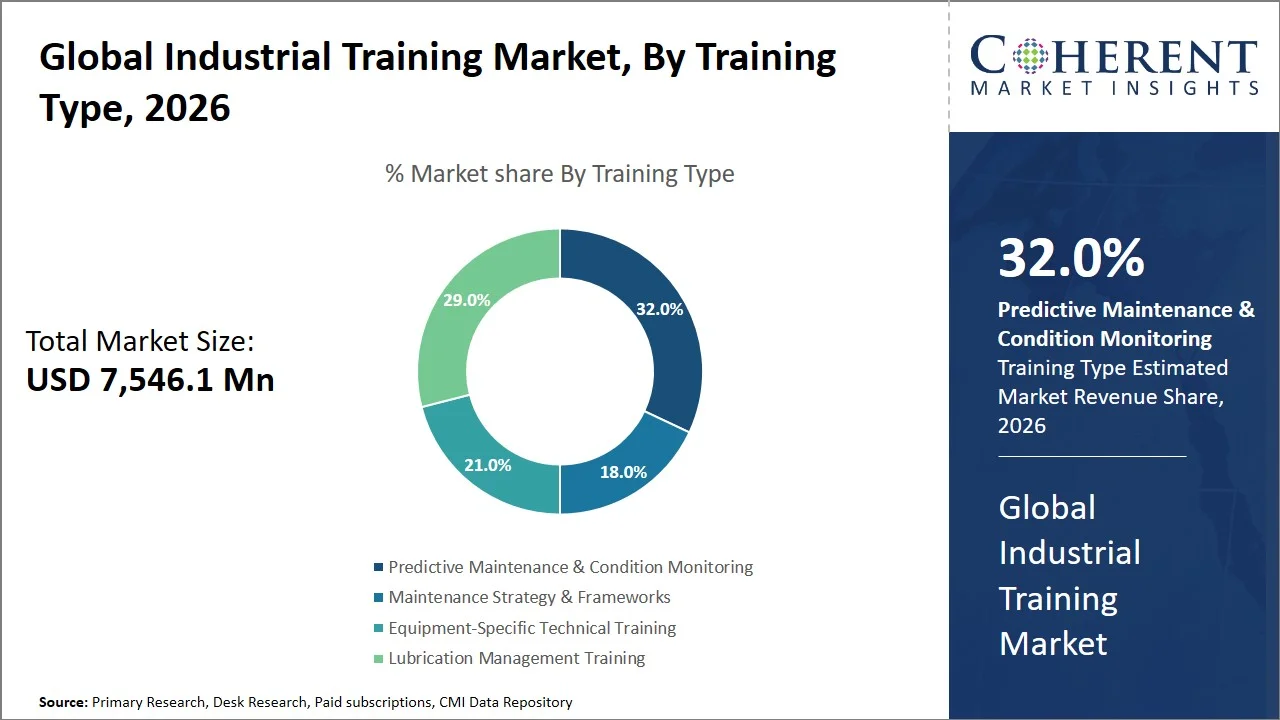
Why Does Predictive Maintenance & Condition Monitoring Segment Dominate the Global Industrial Training Market?
The predictive maintenance & condition monitoring segment is expected to account for 32% of the global industrial training market share in 2026. The growth of e-learning has driven the demand for the segment. The growing expansion of e-learning made training for scalable, cost-efficient and flexible for most organizations. On November 18, 2025, Coursera, a leading global online learning platform, announced two new Specializations from its new partner Anthropic, one of the world’s leading AI research companies. The two Specializations, Building with the Claude API and Real-World AI for Everyone, will teach developers and professionals how to effectively work with Claude, Anthropic’s trusted AI assistant.
(Source: Coursera)
- Current Industry Events of 2026
- Market Size Estimation
- Regional Breakdown
- Competitive Landscape
- Customer Intelligence
- Segmental Analysis
- Pricing Analysis
- Key Market Drivers, Challenges & Future Trends
- Customized Insights Section
Why is ILT - Instructor-Led Training the Most Preferred Delivery Mode?
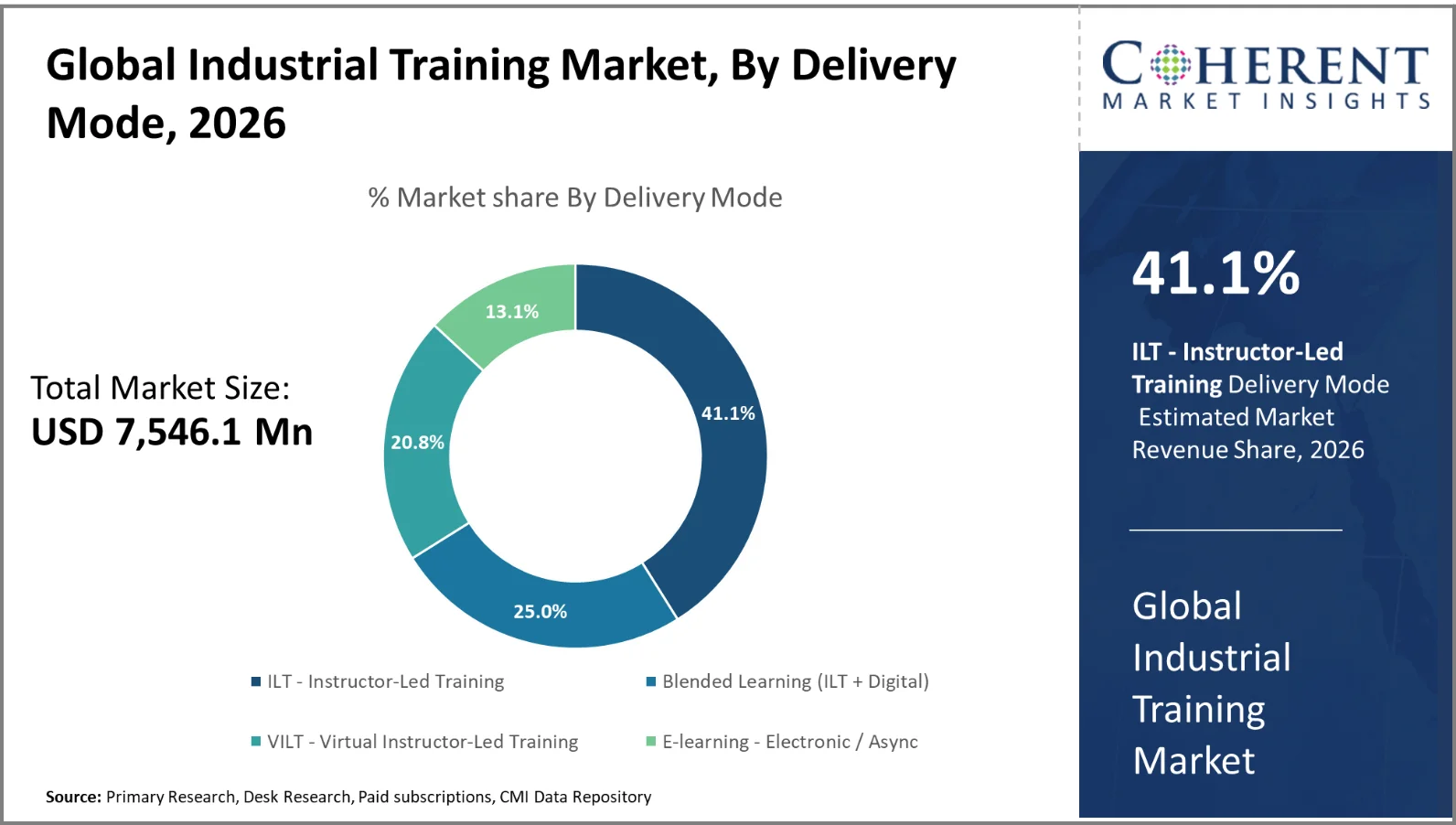
The ILT - Instructor-Led Training segment is expected to account for 41.1% of the global industrial training market share in 2026. The growing importance of workplace safety and compliance training is expected to fuel the segment growth. The introduction of strict regulations from organizations such as Health Administration and Occupational safety is increasingly encouraging companies to improve their compliance training standards. On February 17, 2026, a federal safety agency investigating an August 2025 blast at a U.S. Steel plant near Pittsburgh said that it had found a series of incomplete, outdated, or inadequate procedures. This incident exposed the lack of training procedures and standards in the plant and made authorities realize the need for workplace safety training even more.
(Source: Insurance Journal)
Oil & Gas Segment Dominates the Global Industrial Training Market
The oil & gas segment is expected to account for 24.7% of the global industrial training market share in 2026. In a landscape of evolving technologies, there is a surge for the need of continuous investments in employee upskilling to keep up with the pace, and this a key factor for the segment growth. The advent of modern machinery in the oil & gas sector has pushed the need for training employees to adopt the new technology accordingly. In October 2025, Chevron expanded its Bengaluru Engine center, where over 1,000 professionals are being trained in AI, digital twins, and petroleum engineering workflows, with a strong focus on continuous workforce upskilling as part of global operations restructuring.
(Source: Reuters)
Currents Events and their Impact
Current Events | Description and its Impact |
India - Labor Codes Implementation (2025–2026) |
|
EU Strategic Framework on Health and Safety at Work |
|
Global Industrial Training Market Dynamics
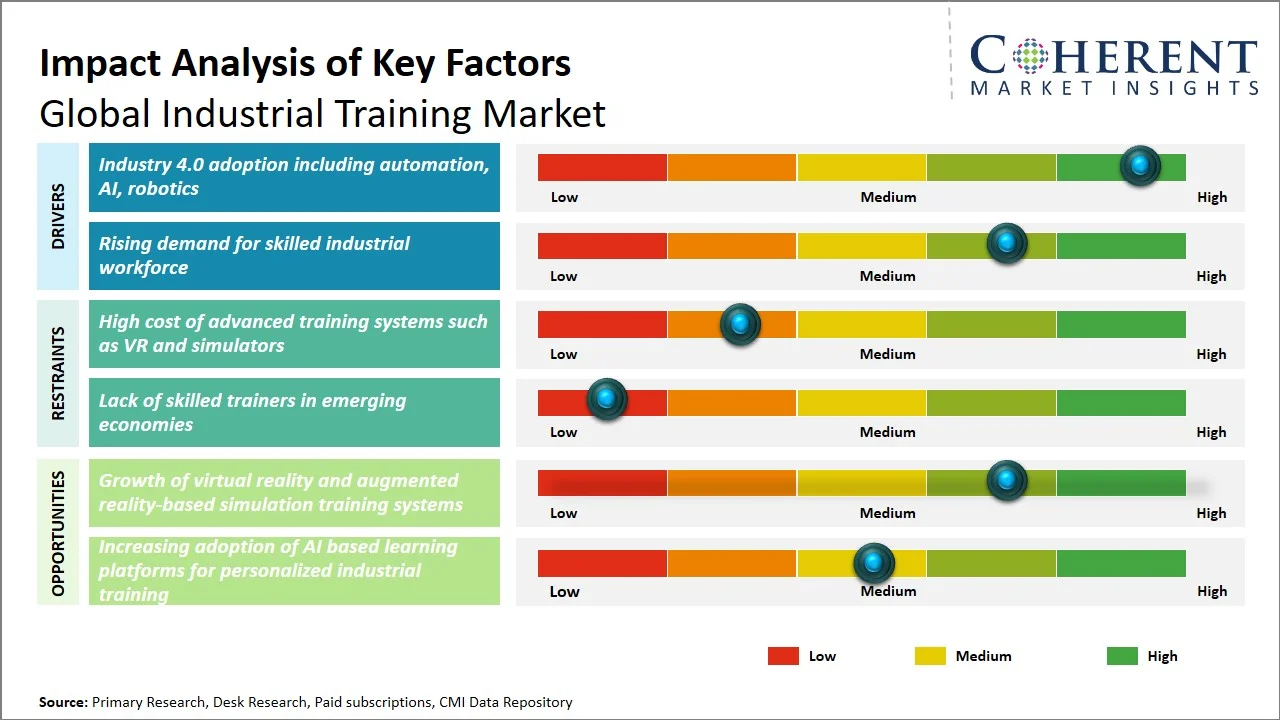
Market Drivers
- Industry 4.0 Adoption Including Automation, AI, Robotics: With the increasing use of Industry 4.0 tools such as robotic systems, the need for structured on-site training expands. Since automation spreads through production areas, familiarity with modern software platforms turns necessary for employees. Owing to such shifts, organizations start forming targeted learning programs. How well people apply advanced equipment affects the way leaders design workforce development across sites. On April 27, 2026, BITS Pilani, through its Work Integrated Learning Programs (WILP), opened its Smart Manufacturing Competency Centre (SMCC) at Electronic City in Bengaluru, India. The SMCC is designed as an integrated ecosystem that combines experiential learning, applied research, industry collaboration, and faculty development. The center will enable working professionals, students, and faculty to engage with real-world engineering challenges. (Source: The Hindu)
- Rising Demand for Skilled Industrial Workforce: The growing need for skilled industrial workforce has increased the frequency of training initiative efforts. Major technical intensive fields are facing a lack of qualified workforce. To mitigate this issue, governments and major companies are conducting reskilling and upscaling programs accompanied with vocational education. On April 16, 2026, Boeing announced that it is hiring around 100 to 140 factory workers a week, the highest pace since 2024, as the U.S. jetmaker replaces retirees and increases staffing to support higher production rates and new models. (Source: Reuters)
Emerging Trends
- Expansion of Digital and E-Learning Platforms: Where digital tools join practice, change takes root. Lessons appear on screens, shaped by tasks much like actual work. With place now less relevant, firms choose web-based systems out of need. Tradition fades when outcomes matter more than method. Shifts spread quietly through industries, led not by habit but by what proves useful.
- Integration of Smart Learning Analytics: As technology advances, job functions shift immediately. With every phase of work life, developing skills becomes more critical. Despite changes, adaptation remains a constant need. Firms arrange ongoing sessions where staff meet modern tools and processes. What counts is not what was known earlier, but how well one adjusts across years.
Regional Insights
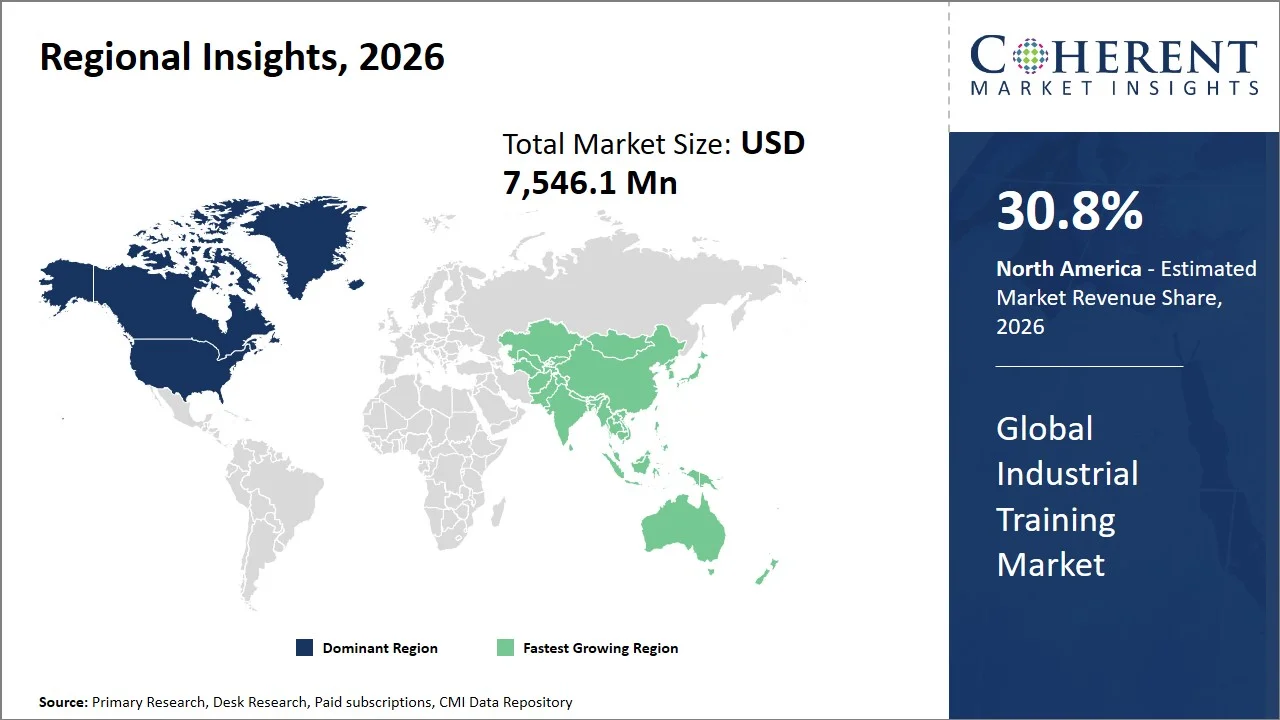
Why is North America a Strong Market for Industrial Training?
North America is expected to account for a market share of 30.8% in 2026. Immersive tools shape industrial training throughout North America, a shift fueled by steady uptake among major companies. Not limited to traditional classrooms anymore, organizations now operate regularly in digital environments. Walmart, staff train inside virtual stores developed with STRIVR, facing situations mirroring actual work conditions. Meanwhile, Boeing equips maintenance teams with augmented reality headsets from Microsoft, presenting step-by-step visual cues during intricate repairs. Within virtual environments at General Electric, practice sessions take shape ahead of actual operations, guided by immersive simulations. Such initiatives show sustained investment patterns across sectors, where hands-on digital experiences replace outdated models.
On April 4, 2025, Alaska Airlines announced an investment in Loft Dynamics, an industry leader in virtual flight training The investment made through Alaska Star Ventures, Alaska’s corporate venture capital arm, will support development of the first hyper-realistic, full-motion Boeing 737 VR simulator, using extended reality (XR) technology and techniques, with the goal of enhancing Alaska’s pilot training program and informing future training solutions across the industry. (Source: Alaska Air)
Why Does Asia Pacific Industrial Training Market Exhibit High Growth?
Asia Pacific is expected to account for a market share of 25.3% in 2026 and is expected to register the fastest growth rate over the forecast period. Asia Pacific industrial training market is growing rapidly due to aggressive corporate investments in workforce development tied to large-scale industrial expansion. For example, Toyota Motor Corporation has expanded its technical training centers across Southeast Asia to support localized manufacturing, while Tata Steel invests heavily in its Kalinganagar training academy to upskill workers in advanced steel production processes. Through partnerships with Chinese institutions, Huawei runs global ICT academies combined with hands-on training centers. Because of this approach, expertise in telecom and automation advances in structured ways. When educational activities match market requirements, progress follows naturally. Growth emerges where instruction meets real-world application consistently.
On January 23, 2026, Hitachi India announced plans to increase its local workforce by more than 5,000 over the next five years, as the Japanese conglomerate bets on rapid infrastructure development and digital transformation in India. (Source: Reuters)
Why is U.S. Emerging as a Major Hub in the Industrial Training Market?
Noticeably active in job-focused learning, the U.S. progresses due to deep investment from major companies shaping high-level training programs. Supported by enduring financial commitments, Amazon prepares workers using a strategy called "Upskilling 2025," targeting areas such as automated systems, online computing frameworks, and process management. Rather than rely on standard lecture settings, Siemens uses real-time industrial modeling at its U.S.-based centers to sharpen skills tied to smart manufacturing. Matching this effort, Lockheed Martin introduces interactive instructional formats built precisely for complex tasks in assembly and equipment maintenance. Steady growth in national capability emerges when private entities lead, focusing on advanced tools embedded in how they build. Rapid shifts in industrial training follow - driven by continuous adoption of technology across this environment.
Is China the Next Growth Engine for the Industrial Training Market?
China influences industrial education patterns significantly via large-scale initiatives supported by companies and government agencies, tied closely to current production demands. For example, Huawei, builds global centers for information technology and communications learning inside China, developing expertise in smart computing, next-gen connectivity, plus automation processes. At the same time, instruction in automated machinery and digital factory oversight expands nationwide through Foxconn's structured courses, supporting accurate electronics fabrication.
Meanwhile, BYD maintains dedicated education units centered on electric vehicle fabrication and energy storage innovations. Such targeted efforts in skilled labor enhancement reflect a growing influence of Chinese entities in expanding the global industrial training landscape.
India Industrial Training Market Analysis and Trends
Growth in India’s industrial training landscape follows major corporate efforts tied to advances in manufacturing and digital systems. At Tata Steel, one response appears through facilities like the center at Kalinganagar, India, where instruction covers blast furnace methods alongside automated steelmaking processes. In automobile manufacturing, parallels appear. Maruti Suzuki funds educational centers that focus on robot-based assembly methods along with advances in hybrid vehicle architecture. In different areas, initiatives supported by Larsen & Toubro provide targeted training, covering tasks like operating large machinery together with digital planning of construction projects. These efforts reflect a shift - workforce readiness adapting slowly to what sectors now require. Behind each choice lies alignment between skill development and evolving operational needs.
Driven by advanced production needs, Germany’s vocational system forms through company-led education paths. Within such frameworks, Siemens offers combined learning, blending classroom study with hands-on work inside smart plants focused on automation, robotics, and industrial software systems. Instead of traditional syllabi, Bosch creates expansive training spaces where apprentices engage deeply with modern techniques including connected manufacturing grids and machine-learning-optimized workflows. Elsewhere in car-making hubs, Volkswagen applies virtual simulations across local sites to sharpen worker abilities in assembling battery-powered vehicles alongside intelligent workflows. Away from broad public schemes, these specialized corporate approaches, deep in tech integration, are central to maintaining national strength in skilled labor cultivation.
Global Industrial Training Market - Carbon Price Trajectory & Volatility
Technology | Global Adoption Rate (% of Facilities Using) | Key Insight |
IoT-enabled Smart Systems | ~50% | About half of manufacturers have adopted or are scaling smart manufacturing systems for real-time monitoring and connectivity. |
Industrial Robotics | ~40%–55% | Automotive and electronics industries lead adoption, with robotics widely used for assembly and production automation. |
AI-driven Manufacturing Systems | ~35%–45% | Many manufacturers are still in pilot stages, but AI is increasingly used for predictive maintenance and production planning. |
Digital Twin Technology | ~28% | Used for simulation, monitoring, and optimization of production systems, especially in large manufacturers. |
Autonomous Mobile Robots (AMRs) | ~35% | Rapid adoption in logistics and warehouse manufacturing environments for material handling. |
How is Growth of Virtual Reality and Augmented Reality-Based Simulation Training Systems Creating New Growth Opportunities in the Global Industrial Training Market?
The expansion of VR and AR-based simulation training systems is opening up new growth avenues in the industrial training market by offering highly immersive, safe environments for skill development. Through these environments, team members refine responses to customer needs while navigating routine operations under guidance. As a result, learning grows more precise, costs reduce steadily, wider groups gain access to hands-on preparation - particularly vital when tasks involve complexity or high stakes. On March 2, 2026, Industrial Training International (ITI) showcased an expanded slate of products and offerings at CONEXPO-CON/AGG. The main attraction of ITI’s extended lineup was their enhanced VR Crane Simulator. The latest update introduced a new 10-ton overhead crane simulation that mirrors equipment commonly used in manufacturing, fabrication shops, and construction staging environments. (Source: ITI)
Global Industrial Training Market - Job Role vs Available Skill Supply
Job Role | Core Skill Area | Roles Unfilled Due to Skill Shortage |
Welders | Fabrication, metal joining, industrial safety | 35% – 50% |
CNC Operators | Precision machining, CAD/CAM programming | 30% – 45% |
Automation Engineers | PLCs, robotics, industrial automation systems | 40% – 60% |
Industrial Maintenance Technicians | Equipment servicing, predictive maintenance | 25% – 40% |
Electricians (Industrial) | Electrical systems, control panels, wiring | 20% – 35% |
Market Players, Key Development, and Competitive Intelligence
Key Developments
- On February 3, 2026, Coursera expanded its enterprise learning portfolio by launching new AI-focused professional certificates designed to support workforce upskilling in both industrial and digital transformation roles. These programs include structured learning tracks in generative AI, AI agents, machine learning applications, and applied AI for business operations, targeting professionals working in manufacturing, IT, logistics, and engineering-driven industries.
- On January 12, 2026, Honeywell International Inc. announced the launch of its new connected workforce solution, Honeywell Performance, for Guided Work. By combining voice-driven Guided Work Solutions with advanced analytics, the technology will deliver real-time insights, streamlined workflows and enhanced visibility into workforce operations.
Competitive Landscape
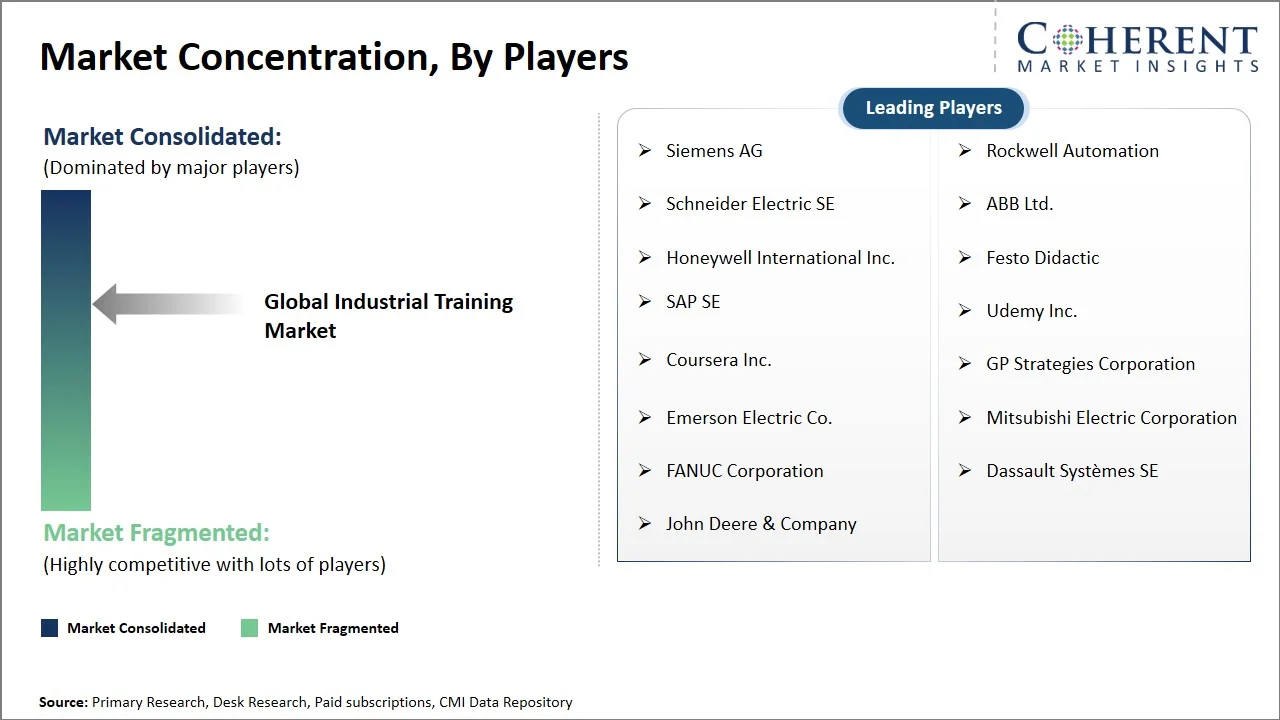
Even with heavy global rivalry, cross-border industrial education continues to grow thanks to varied contributors. Not only large technology firms but also specialized instructors and field-focused academies play distinct roles in progress. Among them are Siemens, working in parallel with Schneider Electric and Honeywell, delivering advanced instruction built on digital replicas and real-time scenarios. Such setups frequently connect straight into robotic operations and networked hardware. Where training shifts into simulated settings, firms like STRIVR dedicate effort entirely to digital immersion. Through web-based systems flexible enough for global deployment, Cornerstone OnDemand extends access broadly. Competition is further intensified by corporate training academies run by major industrial players, all aiming to enhance workforce skills and secure leadership in Industry 4.0-driven training solutions.
Market Report Scope
Industrial Training Market Report Coverage
| Report Coverage | Details | ||
|---|---|---|---|
| Base Year: | 2025 | Market Size in 2026: | USD 7,546.1 Mn |
| Historical Data for: | 2020 To 2024 | Forecast Period: | 2026 To 2033 |
| Forecast Period 2026 to 2033 CAGR: | 6.4% | 2033 Value Projection: | USD 14,841.7 Mn |
| Geographies covered: |
| ||
| Segments covered: |
| ||
| Companies covered: | Siemens AG, Rockwell Automation, Schneider Electric SE, ABB Ltd., Honeywell International Inc., Festo Didactic, SAP SE, Udemy Inc., Coursera Inc., GP Strategies Corporation, Emerson Electric Co., Mitsubishi Electric Corporation, FANUC Corporation, Dassault Systèmes SE, and John Deere & Company | ||
| Growth Drivers: |
| ||
| Restraints & Challenges: |
| ||
Analyst Opinion (Expert Opinion)
- The global industrial training market is widely regarded as a structurally expanding sector, supported by rapid adoption of Industry 4.0 technologies and ongoing shortages of skilled talent worldwide. Not just today but ahead, companies keep needing fresh ways because staying sharp matters more than ever before. Factories want workers who adapt fast - that push doesn’t fade anytime soon. Behind much of it sits tech, growing quieter but deeper in what it enables every day. Power systems also step forward, feeding time and money into teaching new skills across fields.
- Down the road, growth will come bit by bit, shaped by deeper adoption of hands-on tech like AR and VR. Learning tools powered by smart systems that adapt to each person start taking root. These pieces link together across factories and classrooms, forming live educational webs woven into real work environments. Growth emerges mainly through greater investment in digital instruction frameworks, particularly inside intelligent manufacturing sites and major production zones - where firms apply live simulations along with distance learning instruments aiming at stronger performance and reduced risk. A steady move also takes shape toward mixed-mode and internet-hosted instructional formats, enabling adaptable skill-building initiatives spanning multiple sectors worldwide.
Speak to the analyst
Want personalized insights?
Take the findings above to one of our principal consultants, or have the report rebuilt around the segments, geographies and competitors you actually track.
Market Segmentation
- Training Type Insights (Revenue, USD Million, 2021 - 2033)
- Maintenance Strategy & Frameworks
- RCM (Reliability Centered Maintenance)
- Preventive Maintenance Planning
- Asset Performance Management (APM)
- Maintenance Planning & Scheduling
- Predictive Maintenance & Condition Monitoring
- Vibration Analysis
- Thermography
- Ultrasound Testing
- Motor Current Analysis
- Oil Analysis & Fluid Diagnostics
- Equipment-Specific Technical Training
- Bearings
- Pumps & Motors
- Gearboxes
- Precision Alignment & Balancing
- Lubrication Management Training
- Lubrication Fundamentals
- Contamination Control
- Advanced Lubrication Techniques
- Lubrication Program Management
- Maintenance Strategy & Frameworks
- Delivery Mode Insights (Revenue, USD Million, 2021 - 2033)
- ILT - Instructor-Led Training
- Blended Learning (ILT + Digital)
- VILT - Virtual Instructor-Led Training
- E-learning - Electronic / Async
- By End-use Industry Insights (Revenue, USD Million, 2021 - 2033)
- Oil & Gas
- Energy & Power
- Mining
- Food & Beverage
- Cement & Metals
- Automotive & Transportation
- Pulp & Paper
- Others (Aerospace & Defense, Chemicals & Petrochemicals, etc.)
- Regional Insights (Revenue, USD Million, 2021 - 2033)
- North America
- U.S.
- Canada
- Latin America
- Brazil
- Argentina
- Mexico
- Rest of Latin America
- Europe
- Germany
- U.K.
- Spain
- France
- Italy
- Russia
- Rest of Europe
- Asia Pacific
- China
- India
- Japan
- Australia
- South Korea
- ASEAN
- Rest of Asia Pacific
- Middle East
- GCC Countries
- Israel
- Rest of Middle East
- Africa
- South Africa
- North Africa
- Central Africa
- North America
Sources
Primary Research Interviews
- Industrial Training Service Providers
- Corporate Learning & Development Managers
- Training Technology Solution Vendors
- Manufacturing Industry HR Directors
Magazines
- Training Industry Magazine
- Chief Learning Officer (CLO) Magazine
- Industrial Management & Technology Magazine
- Workforce Management Magazine
- Human Resource Executive Magazine
Journals
- International Journal of Training and Development
- Journal of Workplace Learning
- Industrial and Commercial Training Journal
Newspapers
- Financial Times
- The Wall Street Journal
- Reuters Business News
- Industrial Week
Associations
- Association for Talent Development (ATD)
- International Society for Performance Improvement (ISPI)
- Society for Human Resource Management (SHRM)
- National Association of Manufacturers (NAM)
- Industrial Training International Association
Public Domain Sources
- U.S. Bureau of Labor Statistics
- European Centre for the Development of Vocational Training (Cedefop)
- OECD Education and Training Statistics
- International Labor Organization (ILO) Reports
- World Economic Forum Skills Reports
Proprietary Elements
- CMI Data Analytics Tool
- Proprietary CMI Existing Repository of information for last 10 years
Get access to 250+ pages report
Every segment, forecast, competitor profile and data table behind the analysis above — available for instant download.
- ESOMAR Member
- ISO 9001:2015 Certified
- D-U-N-S Registered
- GDPR & CCPA Compliant
Missing comfort of reading report in your local language? Find your preferred language:
Transform your Strategy with Exclusive Trending Reports
Frequently Asked Questions
The global industrial training market is expected to stand at USD 7,546.1 Mn in 2026 and is expected to reach USD 14,841.7 Mn by 2033.
The CAGR of the global industrial training market is projected to be 6.4% from 2026 to 2033.
Industry 4.0 adoption including automation, AI, robotics and rising demand for skilled industrial workforce are the major factors driving the growth of the global industrial training market.
High cost of advanced training systems such as VR and simulators and lack of skilled trainers in emerging economies are the major factors hampering the growth of the global industrial training market.
In terms of training type, predictive maintenance & condition monitoring is estimated to dominate the market revenue share in 2026.
Automation is important because workers need skills to operate and maintain automated machines and smart systems.
AI enables personalized learning, predictive skill analysis, and smart training simulations.