

Global Integrated Business Solutions Market Size and Forecast – 2026-2033
The Global Integrated Business Solutions Market is estimated to be valued at USD 79.16 Bn in 2026 and is expected to reach USD 153.28 Bn by 2033, exhibiting a compound annual growth rate (CAGR) of 9.9% from 2026 to 2033.
Key Takeaways of the Global Integrated Business Solutions Market
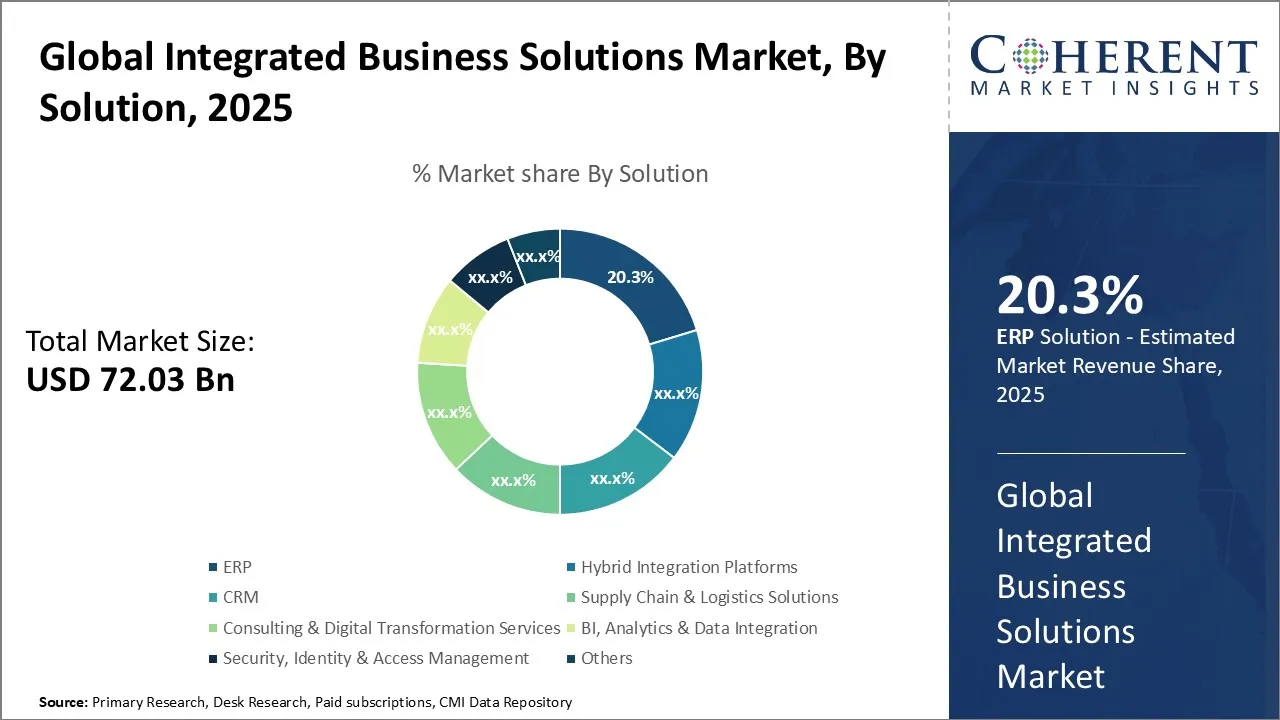
- The ERP segment leads the market holding an estimated share of 21.3% in 2026.
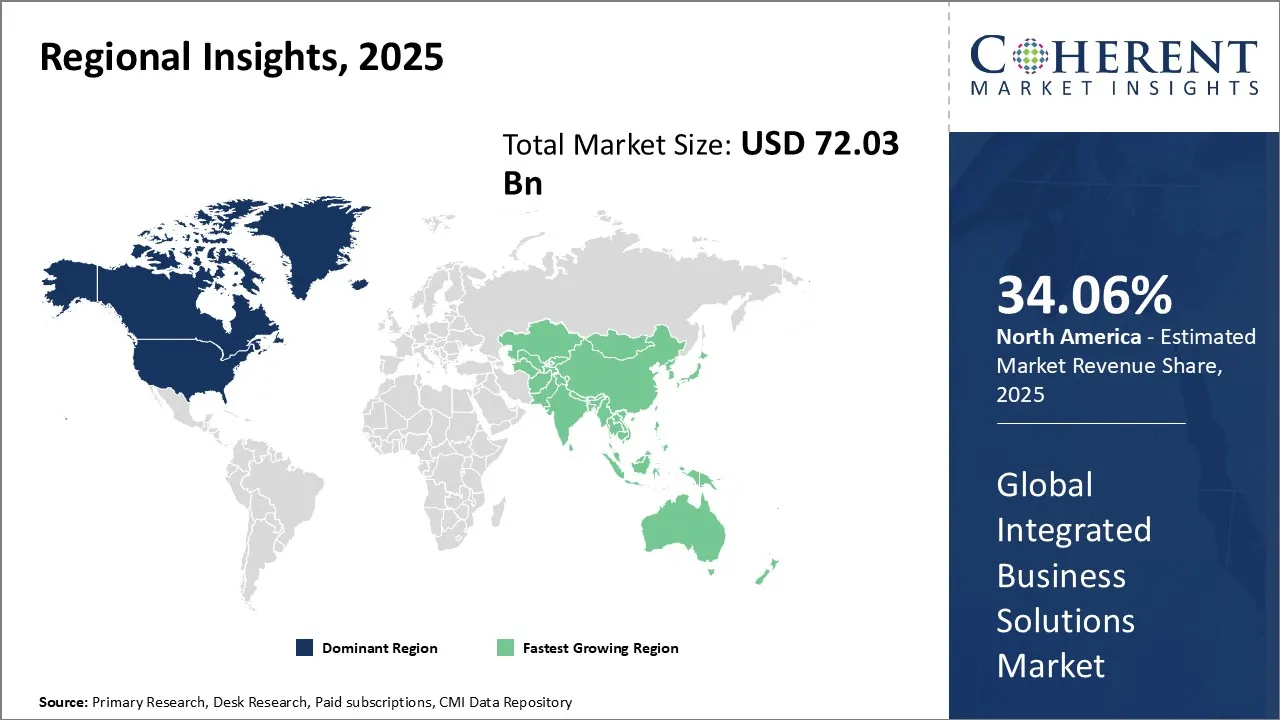
- North America, holding a share of 34.06% in 2026, is expected to dominate the market.
- Asia Pacific, holding a share of 26.4% in 2026, is projected to show the fastest growth in the market.
Market Overview
The market is seeing a big shift towards cloud-based integrated business solutions owing to advancements in AI, machine learning, and IoT technologies. Enterprises are prioritizing scalable, flexible systems that enable real-time data analytics and improve decision-making. Furthermore, the growing need for cost reduction, remote work capabilities, and enhanced cybersecurity measures is propelling market growth, positioning integrated business solutions as a critical component for future business resilience and innovation.
Current Events and Their Impact
Current Events | Description and its impact |
Geopolitical and Trade Developments |
|
Economic and Infrastructure Trends |
|
Segmental Insights
- Current Industry Events of 2026
- Market Size Estimation
- Regional Breakdown
- Competitive Landscape
- Customer Intelligence
- Segmental Analysis
- Pricing Analysis
- Key Market Drivers, Challenges & Future Trends
- Customized Insights Section
Global Integrated Business Solutions Market Insights, By Solution – Robust Need for Operational Efficiency and Integration Drive ERP’s Dominance
The ERP segment, expected to contribute 21.3% of the global integrated business solutions market in 2026, remains the largest because of its role in streamlining core business operations across finance, HR, supply chain, and production. Globalized operations and extended supply chains require tightly integrated workflows. Modern ERP platforms help standardize multi-site processes and ensure consistency across global operations. Siemens uses SAP S/4HANA globally to harmonize operations across 100+ manufacturing sites, improving process synchronization and reducing system fragmentation.
ERP systems support automated recordkeeping, audit trails, and compliance workflows. Pfizer expanded its Oracle ERP footprint to make compliance tracking stronger for manufacturing and quality processes across global operations.
Cloud-enabled ERP suites added with AI/ML improve forecasting, financial consolidation, and predictive maintenance, making ERP accessible to both enterprises and SMEs. Microsoft Dynamics 365 ERP infused Copilot AI features in 2024, enabling predictive insights for finance and supply chain users.
ERP platforms now have advanced analytics dashboards that help optimize inventory, workforce, and performance metrics. Toyota Material Handling leveraged Infor CloudSuite ERP to generate operational analytics that cut inventory imbalances across facilities.
Pricing Analysis of the Integrated Business Solutions Market:
Pricing Metric | Typical Range/Value (USD) |
Cloud ERP: Subscription per User (monthly) | USD 25 – USD 200/user/month |
On-Premise ERP: Per-User License (one-time) | USD 3,000 – USD 7,500/user |
ERP Implementation Cost (Small Business, Cloud) | USD 20,000 – USD 150,000 |
ERP Implementation Cost (Mid-market) | USD 150,000 – USD 750,000 |
ERP Implementation Cost (Large/Enterprise) | USD 1,000,000 – USD 10,000,000+ |
Professional Services/Consulting Rate (ERP/Integration) | USD 100 – USD 250/hour |
ERP Support/Maintenance (On-Prem License) | 15% – 25% of license cost per year |
Data Migration/Integration Cost (per system) | USD 5,000 – USD 50,000 |
TCO for 20-User ERP (5-Year, Cloud vs On-Prem) | Cloud SaaS TCO (5 yr): ~ USD 259,200 |
Deployment Model Analysis (Cloud vs. On-Premise vs. Hybrid)
Criteria | Cloud Deployment | On-Premise Deployment | Hybrid Deployment |
Definition | Solutions hosted on public/private cloud; delivered via SaaS/iPaaS models | Solutions hosted on client-owned infrastructure | Mix of on-prem systems with cloud applications and integration layers |
Cost Structure | Subscription-based (OpEx), lower upfront | High upfront license + hardware (CapEx), recurring maintenance | Mixed CapEx + OpEx; integration layer adds cost |
Implementation Speed | Fast deployment; minimal hardware setup | Slower due to infrastructure setup and customization | Moderate; depends on complexity of integration |
Scalability | Highly scalable; elastic resources | Limited to physical capacity | Scalable through cloud components; constrained by on-prem limits |
Data Control | Lower direct control; cloud vendor manages storage/security | Highest control; data stored on internal servers | Balanced—critical data on-prem; non-critical on cloud |
Security | Strong cloud-native security; shared responsibility model | Full control of security; higher responsibility for compliance | Combines both; complexity depends on architecture |
Integration Complexity | Low to moderate; APIs and iPaaS simplify connectivity | High; requires custom integrations and dedicated resources | High; synchronization between cloud and on-prem adds complexity |
Maintenance Burden | Low; vendor-managed updates and patches | High; internal IT manages hardware, updates, security | Medium; cloud segments vendor-managed, on-prem segments IT-managed |
Total Cost of Ownership (5-year) | Generally lower TCO; predictable costs | Higher TCO due to infrastructure + maintenance | Moderate TCO; depends heavily on integration volume |
Customization Capability | Moderate; standardized modules | High; deep customization possible | High; can customize core on-prem modules while using cloud add-ons |
Performance Reliability | Dependent on internet connectivity; high uptime SLAs | High reliability; internal network-driven | Strong; cloud boosts availability with local fail-safes |
Adoption Level (Global IBS Market) | Very high and rapidly increasing | Declining but significant in regulated/legacy-heavy sectors | Fastest-growing model for large enterprises |
Ideal Users | SMEs, mid-market firms, rapidly scaling enterprises | Large enterprises with strict compliance or legacy systems | Enterprises needing modernization without full cloud migration |
End-use Industry Adoption Breakdown – Integrated Business Solutions Market
Criteria | BFSI | IT & Telecom | Manufacturing |
Adoption Level (2025 est.) | Very High | High | Very High |
Market Share Contribution (IBS Market, % est.) | 24% | 15% | 18% |
Primary Adoption Drivers | • Regulatory compliance | • Need for unified IT service management | • Industry 4.0 expansion |
Popular Integrated Solutions | Core banking integration, CRM, risk & compliance suites, data platforms | OSS/BSS integration, cloud orchestration, network analytics, unified communication platforms | ERP + MES integration, SCM systems, IoT-driven production dashboards |
Key Challenges | Legacy core systems, strict compliance, risk of downtime | Complexity of multi-vendor tech stacks, cyberthreats | Integration with legacy equipment, high customization requirement |
Growth Outlook (2025–2030) | Strong, driven by digital banking & cybersecurity mandates | Strong, led by 5G, cloud-first adoption, AI-driven automation | Very Strong, due to industrial automation & smart factory rollouts |
Adoption Preference (Deployment) | Hybrid/Private Cloud | Hybrid/Public Cloud | Hybrid/On-Prem + Cloud |
Ideal IBS Capabilities Needed | High security, real-time analytics, regulatory tools | Network automation, API management, scalable cloud services | ERP–MES–SCM continuity, IoT integration, analytics |
Regional Insights
North America Integrated Business Solutions Market Analysis and Trends
North America is expected to hold a share of 34.06% in 2026, dominating the global integrated business solutions market. This growth can be seen because of a mature technological ecosystem, widespread adoption of digital transformation, and a robust presence of leading IT service providers. The region sees advanced infrastructure, a big pool of skilled professionals, and supportive government policies for fostering innovation and cybersecurity.
Moreover, the well-established enterprise landscape, ranging from SMEs to Fortune 500 companies, demands sophisticated integrated solutions that combine ERP, Customer Relationship Management (CRM), supply chain, and analytics capabilities. Trade dynamics, including strong cross-border collaboration between the U.S. and Canada, further enhance service and product delivery across the region.
Notable companies, such as IBM, Oracle, Microsoft, and Salesforce, dominate by offering comprehensive solutions that propel market growth through continuous R&D and strategic acquisitions. Their deep client relationships and ability to customize offerings for various industries provide a competitive edge in North America.
Asia Pacific Integrated Business Solutions Market Analysis and Trends
The Asia Pacific region, expected to hold a share of 26.4% in 2026, exhibits the fastest growth in the global integrated business solutions market, fueled by rapid digitalization, expanding IT infrastructure, and increasing government initiatives promoting Industry 4.0. Emerging economies like India, China, and Southeast Asian countries are experiencing a surge in demand for integrated solutions to streamline operations, improve decision-making, and enhance customer experiences.
The rising number of start-ups and digital-native firms further drives adoption. Favorable government programs, such as China’s Made in China 2026 and India’s Digital India initiative, accelerate technology penetration. Trade dynamics including the rise of regional trade agreements and increased foreign direct investments support expansion. Prominent players like Tata Consultancy Services (TCS), Infosys, Huawei, and SAP are expanding their footprint here by tailoring solutions to meet local needs and providing extensive consulting services, thereby catalyzing market acceleration.
Global Integrated Business Solutions Market Outlook for Key Countries
U.S. Integrated Business Solutions Market Analysis and Trends
The U.S. integrated business solutions market continues to lead due to its innovation-driven economy and early adoption of advanced business technologies. Key players like Microsoft, IBM, Oracle, and Salesforce provide cutting-edge integrated solutions across sectors such as finance, healthcare, and retail. The country’s focus on cloud adoption, AI integration, and cybersecurity makes demand for sophisticated business platforms. Continuous investments in technology infrastructure and a thriving tech startup ecosystem also add to ongoing market expansion.
China Integrated Business Solutions Market Analysis and Trends
China integrated business solutions market is growing fast, because of strong governmental support for digital transformation and local development of integrated business technologies. Companies such as Huawei, Alibaba Cloud, and Inspur are pivotal, focusing on cloud-based and AI-enabled business solutions that cater to manufacturing, logistics, and e-commerce sectors. The government's focus on self-reliance in technology and digitization across industries is adding to adoption, alongside initiatives made to boost the domestic technology ecosystem and attract multinational enterprises.
India Integrated Business Solutions Market Analysis and Trends
India integrated business solutions market sees a vibrant IT services industry and a growing base of tech-savvy enterprises. Big firms like Tata Consultancy Services (TCS), Infosys, and Wipro add to innovation and delivery of integrated solutions tailored to the needs of banking, telecommunications, and government sectors. The country’s digital infrastructure growth and supportive government policies, including incentives for digital payments and smart city initiatives, significantly enhance market uptake. Increasing outsourcing demands and cloud migrations also support its fast growth.
Germany Integrated Business Solutions Market Analysis and Trends
Germany continues to lead in Europe with a strong industrial base and a focus on Industry 4.0. Market leaders like SAP, Siemens, and Software AG provide state-of-the-art integrated business solutions tailored to the manufacturing, automotive, and engineering industries. The German government’s commitment to digital innovation, data security laws, and substantial investments in smart factory projects contribute to market maturity. The region’s well-established SMEs sector adopting integrated enterprise solutions further solidifies Germany’s position.
Brazil Integrated Business Solutions Market Analysis and Trends
Brazil integrated business solutions market is gaining traction because of digital transformation initiatives in both the private and public sectors. Companies such as TOTVS and Stefanini are big contributors, offering localized integrated business solutions that address challenges in logistics, retail, and finance. Government incentives for improving digital infrastructure and increasing internet penetration add to adoption. Also, the country’s integration into regional trade agreements helps facilitate the flow of technology and expertise, helping businesses streamline operations.
Market Players, Key Development, and Competitive Intelligence
Key Developments
- In September 2025, Wipro Ltd. agreed to acquire the Connected Services business of Harman International, a Samsung subsidiary, in a USD 375 million deal. The unit specializes in engineering connected products, cloud platforms, and embedded software for industries like automotive, healthcare, and industrial manufacturing.
- In September 2025, Accenture announced its intent to acquire French Orlade Group, which provides advisory and project management services for capital projects through its subsidiaries, which include Op2 and pmO. The acquisition would significantly expand Accenture’s capabilities to help clients optimize their investments in large-scale, long-term projects, such as nuclear power plants, power grids, rolling stock, defense systems and space launch systems.
- In August 2025, Cloud Software Group, Inc. entered into a definitive agreement to acquire Arctera, a global leader in data management, from funds affiliated with global investment firm Carlyle. Terms of the transaction were not disclosed. Upon close, Arctera will operate as a standalone business unit within the Cloud Software Group portfolio.
- In June 2025, NETGEAR acquired Exium, a cybersecurity company. This strategic acquisition adds to the company's efforts to deliver fully integrated networking and cybersecurity solutions to small and medium-sized businesses.
Top Strategies Followed by Integrated Business Solutions Market Players
- Established players dominate the market through a lot of investments in research and development (R&D), aiming to continuously innovate and enhance the performance of their product offerings.
- SAP has allocated several USD billions into growing Joule AI capabilities to enhance enterprise workflows and decision automation.
- Mid-level players operate with a different focus, aiming to make a sustainable presence by offering cost-effective integrated business solutions that balance quality and affordability.
- Zoho offers competitively priced Zoho One integrated business platform targeted at SMBs, especially in India, Southeast Asia, and the Middle East.
- Small-scale players stand out by focusing on specialized features or innovative product lines that address specific customer requirements.
- com, in its early years, used specialization in team workflow automation to stand out before expanding to full work OS capabilities.
Market Report Scope
Integrated Business Solutions Market Report Coverage
| Report Coverage | Details | ||
|---|---|---|---|
| Base Year: | 2025 | Market Size in 2026: | USD 79.16 Bn |
| Historical Data for: | 2020 To 2024 | Forecast Period: | 2026 To 2033 |
| Forecast Period 2026 to 2033 CAGR: | 9.9% | 2033 Value Projection: | USD 153.28 Bn |
| Geographies covered: |
| ||
| Segments covered: |
| ||
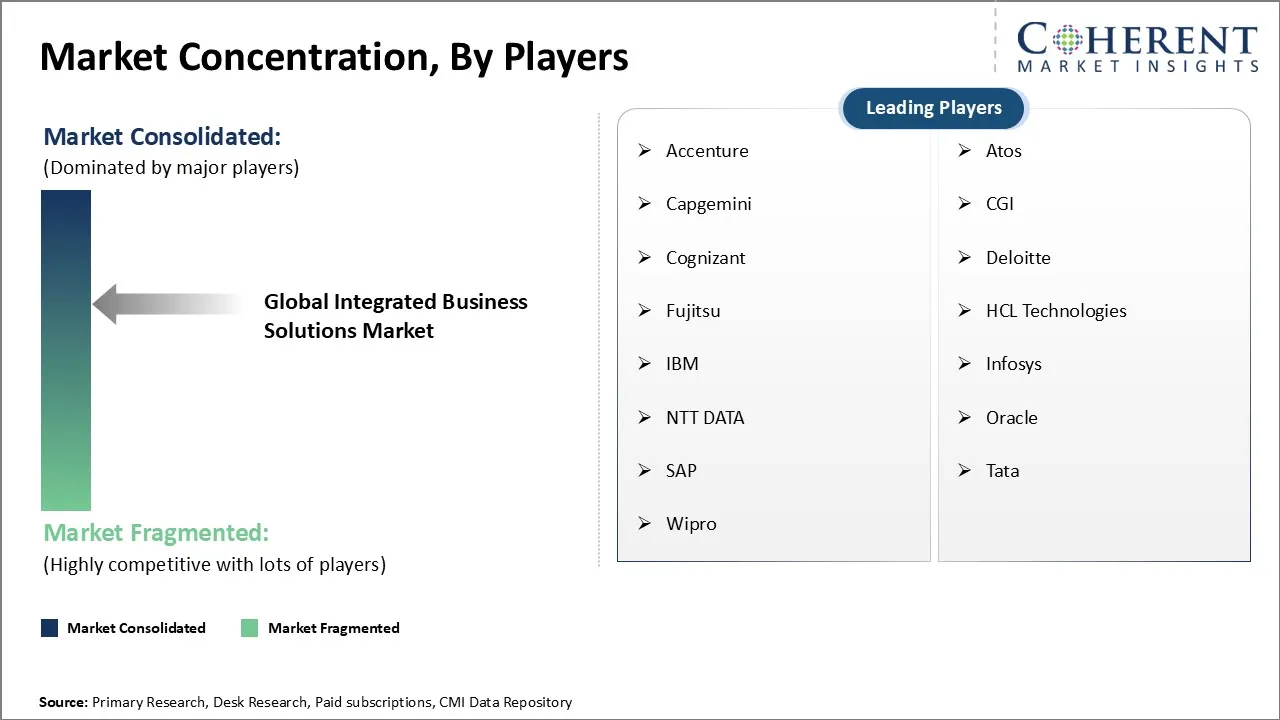
| Companies covered: | Accenture, Atos, Capgemini, CGI, Cognizant, Deloitte, Fujitsu, HCL Technologies, IBM, Infosys, NTT DATA, Oracle, SAP, Tata, and Wipro | ||
| Growth Drivers: |
| ||
| Restraints & Challenges: |
| ||
Market Dynamics
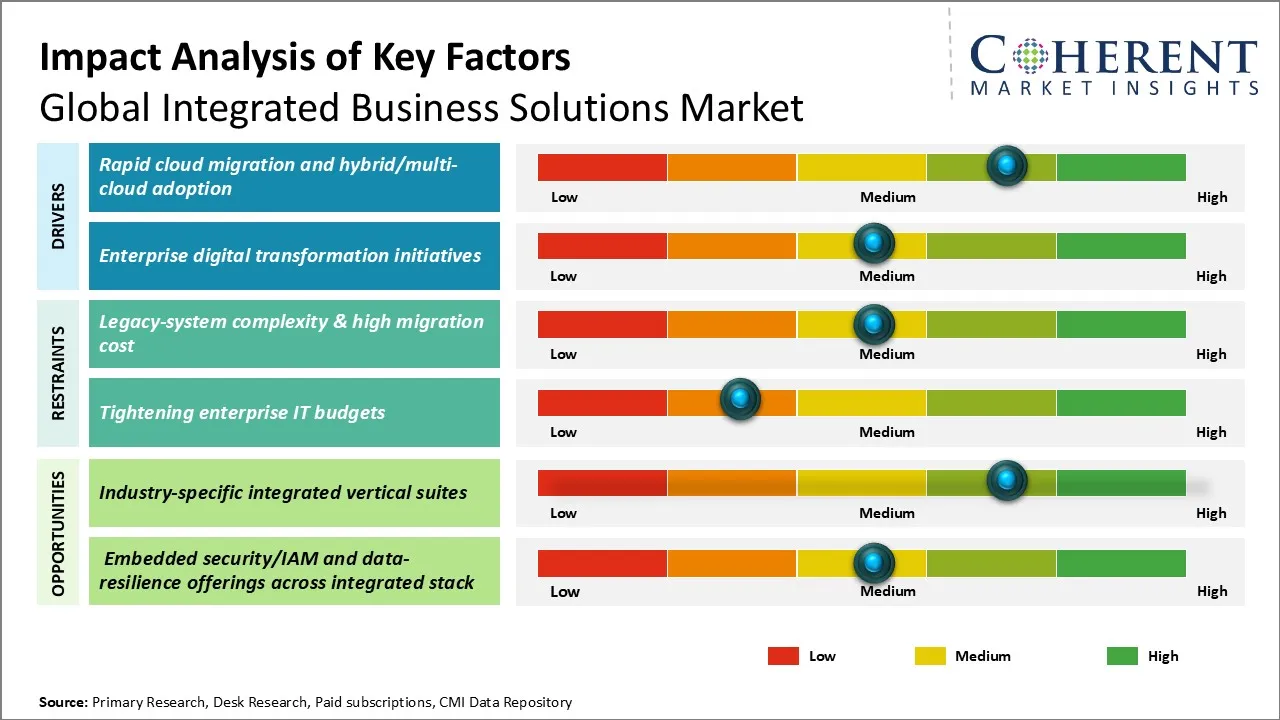
Global Integrated Business Solutions Market Driver – Rapid Cloud Migration and Hybrid/Multi-Cloud Adoption
The accelerated shift to cloud environments—especially hybrid and multi-cloud—continues to drive the demand for integrated business solutions. Organizations migrating legacy systems need seamless interoperability across cloud platforms, efficient data orchestration, and automated workflows across distributed infrastructures. As complexity rises, businesses rely heavily on integration tools that unify applications across on-premise and multi-cloud setups.
Microsoft reported rapid enterprise adoption of Azure Arc, enabling unified management across AWS, Google Cloud, and on-prem systems. This trend has increased the demand for integration-friendly platforms like Dynamics 365 and Power Platform, which support multi-cloud workflows and cross-environment data integration.
Global Integrated Business Solutions Market Opportunity – Industry-Specific Integrated Vertical Suites
Rising demand for industry-tailored digital systems is creating strong opportunities for integrated vertical suites designed for sectors such as BFSI, healthcare, retail, and manufacturing. These suites offer end-to-end workflows, regulatory compliance features, and specialized analytics aligned to sector needs, reducing deployment complexity and improving operational efficiency.
SAP expanded its SAP Industry Cloud portfolio with vertical-specific modules for manufacturing, retail, and healthcare. These solutions integrate seamlessly with SAP S/4HANA and provide pre-built industry workflows—driving rapid adoption among enterprises seeking plug-and-play vertical suites.
Analyst Opinion (Expert Opinion)
- Despite advancements in cloud and API technologies, most enterprises still operate in highly fragmented IT environments. Adding legacy systems with modern cloud platforms remains painfully complex and often needs excessive customization. Vendors promise “plug-and-play,” but the reality is that integration projects routinely run over budget and over timeline.
- While cloud-based solutions are marketed as cost-efficient, the overall TCO is significantly higher than many buyers anticipate. For small and mid-sized businesses, the financial burden is often prohibitive, causing delayed adoption or reliance on cheaper, less integrated alternatives.
- Enterprises remain cautious about moving critical business operations to integrated platforms because of persistent fears around data breaches, cross-border data flows, and compliance risks. With rising regulatory scrutiny (GDPR, industry-specific mandates), companies frequently postpone adoption until vendors provide airtight assurances—something the market still struggles to deliver consistently.
Speak to the analyst
Want personalized insights?
Take the findings above to one of our principal consultants, or have the report rebuilt around the segments, geographies and competitors you actually track.
Market Segmentation
- Solution Insights (Revenue, USD Bn, 2021 - 2033)
- ERP
- Hybrid Integration Platforms
- CRM
- Supply Chain & Logistics Solutions
- Consulting & Digital Transformation Services
- BI, Analytics & Data Integration
- Security, Identity & Access Management
- Others
- Regional Insights (Revenue, USD Bn, 2021 - 2033)
- North America
- U.S.
- Canada
- Latin America
- Brazil
- Argentina
- Mexico
- Rest of Latin America
- Europe
- Germany
- U.K.
- Spain
- France
- Italy
- Russia
- Rest of Europe
- Asia Pacific
- China
- India
- Japan
- Australia
- South Korea
- ASEAN
- Rest of Asia Pacific
- Middle East
- GCC Countries
- Israel
- Rest of Middle East
- Africa
- South Africa
- North Africa
- Central Africa
- North America
- Key Players Insights
- Accenture
- Atos
- Capgemini
- CGI
- Cognizant
- Deloitte
- Fujitsu
- HCL Technologies
- IBM
- Infosys
- NTT DATA
- Oracle
- SAP
- Tata
- Wipro
Sources
Primary Research Interviews
Stakeholders
- CIOs and IT Directors from multinational corporations
- Digital Transformation Consultants (e.g., Accenture Digital, Infosys Consulting)
- Enterprise Software Integrators (e.g., TCS, Capgemini, Wipro)
- Cloud Service Providers (e.g., AWS Partner Consultants, Azure Migration Specialists)
- Business Process Automation Experts
- ERP/CRM Implementation Partners (e.g., SAP Gold Partners, Oracle Fusion implementers)
- Data Security & Compliance Officers
- Industry-Specific Solution Architects (Healthcare, BFSI, Manufacturing)
- Mid-sized companies evaluating digital stack modernization
- System Administrators managing legacy-to-cloud transitions
Databases
- Eurostat
- U.S. Census
- OECD
- Cloud Native Computing Foundation (CNCF) Database
- Global Enterprise Software Deployment Dataset
- International Digital Transformation Index
- Construction Global
- World ICT Indicators Database
Magazines
- CIO Review
- Digital Transformation Today
- Enterprise Software Insider
- Cloud Computing Magazine
- TechWorld Enterprise
- ERP News Quarterly
Journals
- Journal of Information Systems and Technology Management
- International Journal of Enterprise Computing
- Cloud Architecture and Integration Journal
- Journal of Digital Transformation and Innovation
Newspapers
- The Guardian (UK)
- The Economic Times (India)
- The Wall Street Journal (Technology section)
- Financial Times (Digital Business segment)
- The Construction Index
- Construction Week Online
Associations
- International Association for Enterprise Integration
- Cloud Security Alliance (CSA)
- Software & Information Industry Association (SIIA)
- Global Digital Infrastructure Alliance
- American IT Systems Integration Consortium
- International Cloud Computing Alliance
- The Concrete Society (UK)
- National Association of Home Builders (NAHB)
Public Domain Sources
- U.S. Census Bureau
- EUROSTAT
- United Nations Economic Commission for Europe (UNECE)
- World Bank
- ResearchGate
- International Telecommunication Union (ITU) – ICT statistics
- World Digital Competitiveness Repository
Proprietary Elements
- CMI Data Analytics Tool
- Proprietary CMI Existing Repository of Information for Last 8 Years
Get access to 250+ pages report
Every segment, forecast, competitor profile and data table behind the analysis above — available for instant download.
- ESOMAR Member
- ISO 9001:2015 Certified
- D-U-N-S Registered
- GDPR & CCPA Compliant
Missing comfort of reading report in your local language? Find your preferred language:
Transform your Strategy with Exclusive Trending Reports
Frequently Asked Questions
The global integrated business solutions market is estimated to be valued at USD 79.16 billion in 2026 and is expected to reach USD 153.28 billion by 2033.
The CAGR of global integrated business solutions market is projected to be 9.9% from 2026 to 2033.
Rapid cloud migration and hybrid/multi-cloud adoption and enterprise digital transformation initiatives are the major factors driving the growth of the global integrated business solutions market.
Legacy-system complexity & high migration cost and tightening enterprise IT budgets are the major factors hampering the growth of the global integrated business solutions market.
In terms of solution, ERP is estimated to dominate the market revenue share in 2026.
Accenture, Atos, Capgemini, CGI, Cognizant, Deloitte, Fujitsu, HCL Technologies, IBM, Infosys, NTT DATA, Oracle, SAP, Tata, and Wipro are the major players.
North America is expected to lead the global integrated business solutions market in 2026.