

Global Intelligent Greenhouse Market Size and Forecast – 2026-2033
The Global Intelligent Greenhouse Market is estimated to be valued at USD 2.54 Bn in 2026 and is expected to reach USD 6.51 Bn by 2033, exhibiting a compound annual growth rate (CAGR) of 14.4% from 2026 to 2033.
Key Takeaways of the Intelligent Greenhouse Market
- Hydroponics will hold a 58.6% share of the global intelligent greenhouse market in 2026.
- The hardware segment is expected to make up 40.7% of the market in 2026.
- Asia Pacific is set to lead the global intelligent greenhouse market in 2026 with a 39. 8% share. North America, with a 19.5% share, will be the fastest-growing region.
Market Overview
The intelligent greenhouse market is witnessing significant technological advancement trends, with precision agriculture and data-driven farming becoming mainstream adoption strategies. Key market trends include the increasing implementation of automated climate control systems, AI-powered crop monitoring solutions, and the integration of renewable energy sources for sustainable operations. The market is experiencing heightened demand from commercial growers seeking to optimize crop yields while minimizing resource consumption. Additionally, government initiatives promoting smart agriculture and the growing focus on vertical farming in urban areas are creating substantial growth opportunities for intelligent greenhouse technology providers globally.
Current Events and Its Impact
Current Events | Description and its impact |
Signify Launches Updated Philips GrowWise Control System |
|
Government Initiatives Promoting Sustainable Agriculture |
|
Segmental Insights
- Current Industry Events of 2026
- Market Size Estimation
- Regional Breakdown
- Competitive Landscape
- Customer Intelligence
- Segmental Analysis
- Pricing Analysis
- Key Market Drivers, Challenges & Future Trends
- Customized Insights Section
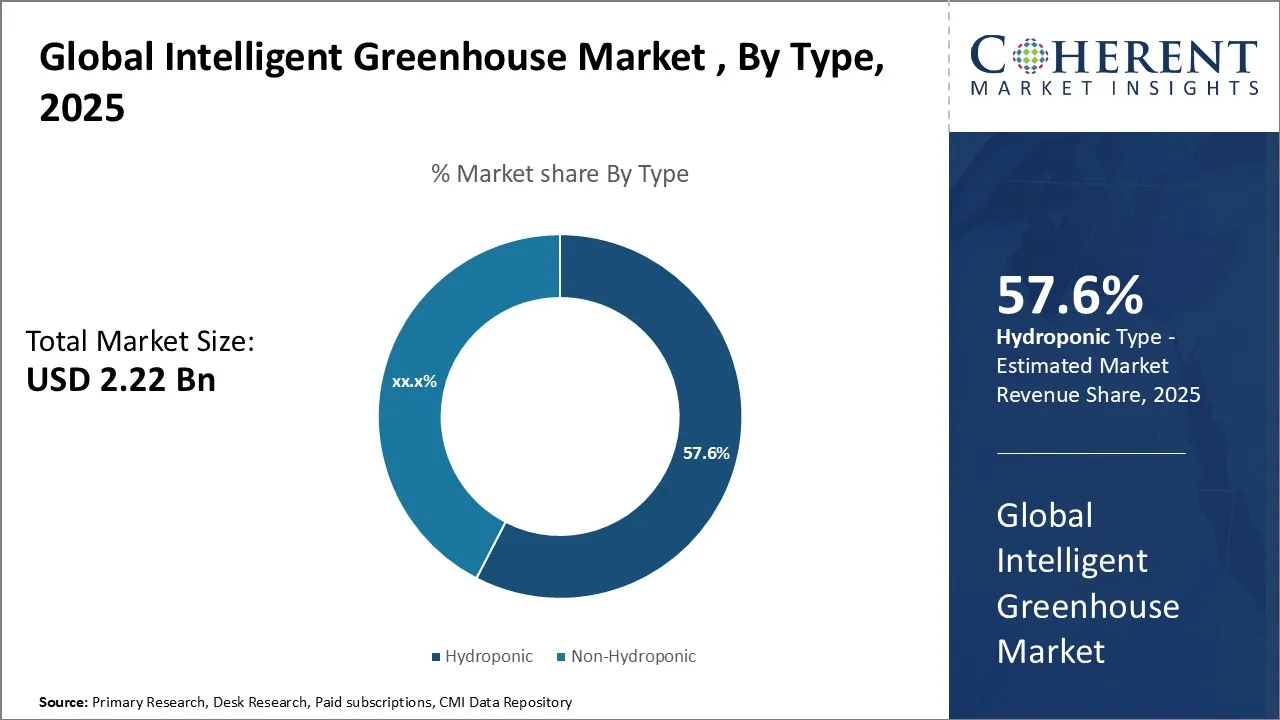
Intelligent Greenhouse Market Insights, By Type - The Hydroponic Segment Leads, Driven by Advanced Nutrient Control Systems
Hydroponic segment is expected to hold a 58.6% share of the global intelligent greenhouse market in 2026, owing to its superior compatibility with intelligent automation systems and precision agriculture technologies. The hydroponic segment's dominance stems from its inherent design that allows for complete control over growing conditions, making it the ideal foundation for implementing sophisticated greenhouse intelligence systems.
The primary driver of hydroponic segment growth lies in its ability to deliver precise nutrient management through automated systems. Unlike traditional soil-based cultivation, hydroponic systems enable real-time monitoring and adjustment of nutrient concentrations, pH levels, and electrical conductivity through integrated sensors and control mechanisms. This level of precision aligns perfectly with the core objectives of intelligent greenhouse operations, where data-driven decision making and automated responses are essential for optimizing plant health and yield outcomes.
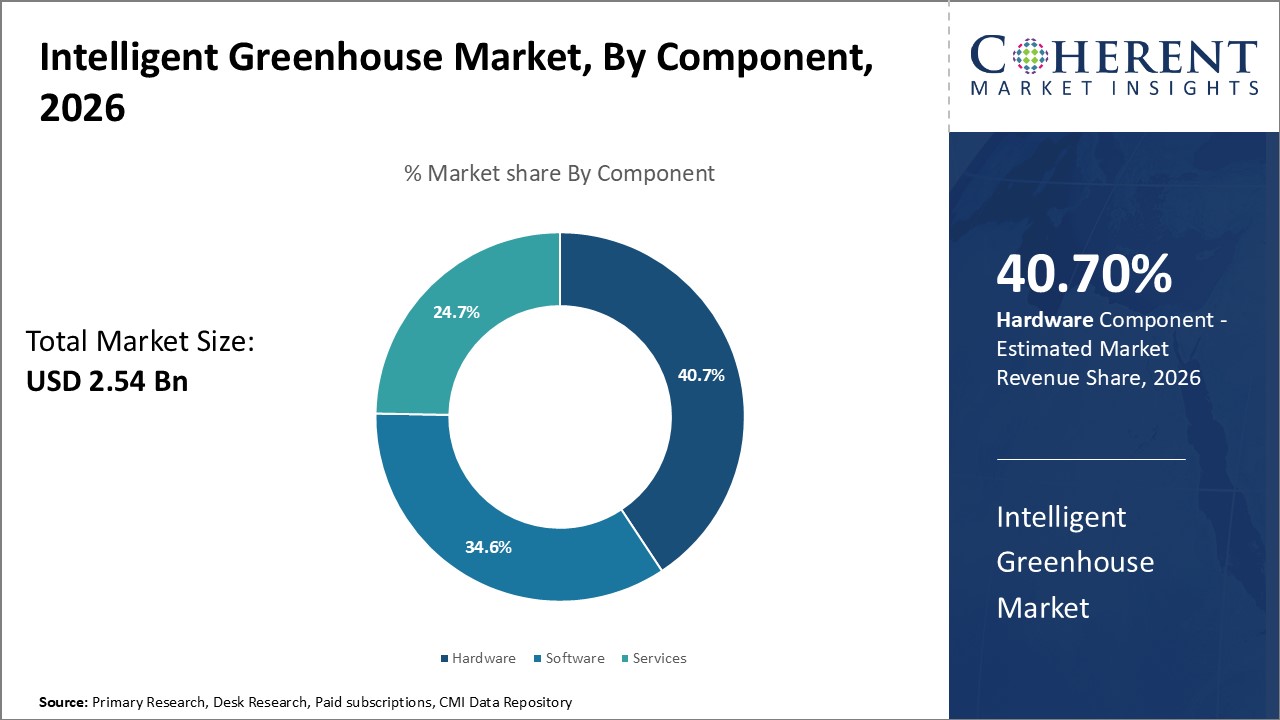
Intelligent Greenhouse Market Insights, By Component – The Hardware Segment Leads, Driven by Integration and Automation Systems
The hardware segment is expected to account for 40.7% share of the market in 2026, owing to the fundamental requirement for sophisticated sensor networks, environmental control systems, and automation equipment that form the backbone of intelligent greenhouse operations. The hardware segment's market leadership is driven by the critical need for physical infrastructure that enables data collection, environmental monitoring, and automated control functions essential for precision agriculture.
The proliferation of advanced sensor technologies represents the primary growth driver for the hardware segment. Modern intelligent greenhouses require extensive sensor networks to monitor temperature, humidity, light intensity, carbon dioxide levels, soil moisture, and plant health indicators. These sensing devices generate the foundational data required for intelligent decision-making systems, making them indispensable components of any smart greenhouse operation. The continuous evolution of sensor accuracy, durability, and cost-effectiveness drives ongoing hardware investments and upgrades.
Regional Insights
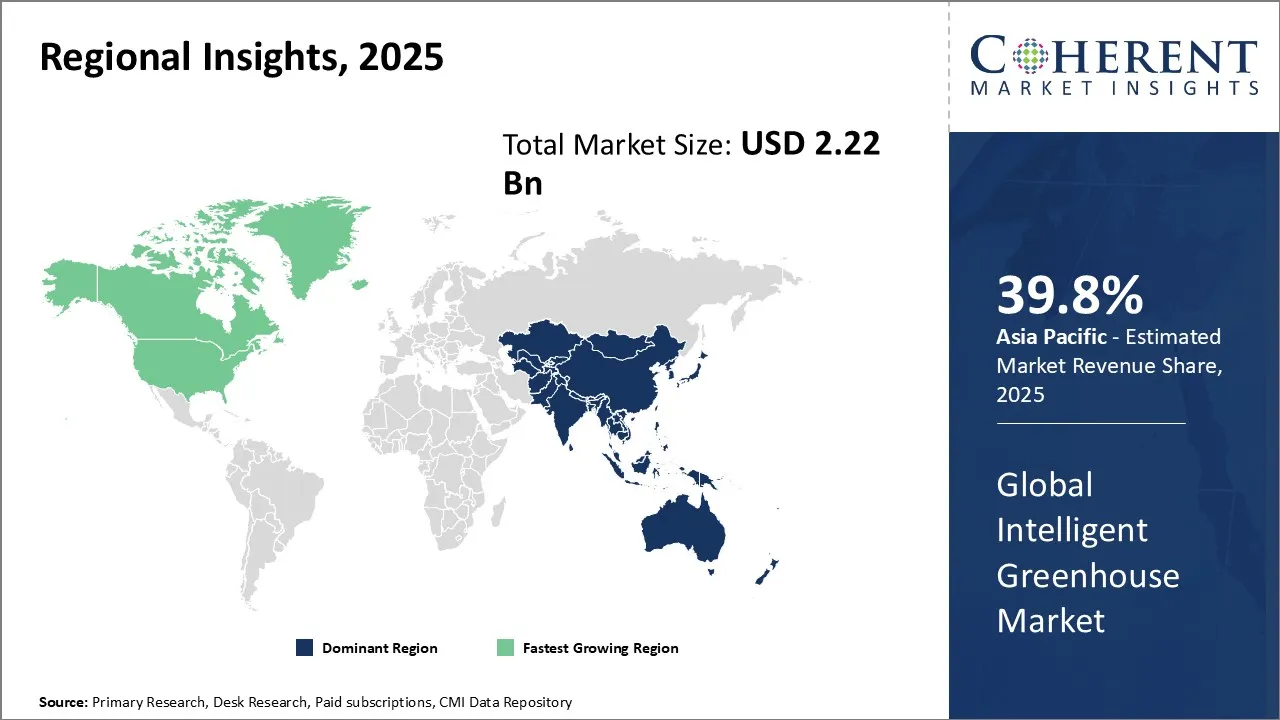
Asia Pacific Intelligent Greenhouse Market Analysis and Trends
The Asia Pacific region is projected to lead the market with a 39.8% share in 2026, driven by rapid urbanization, increasing food security concerns, and government initiatives promoting modern agriculture. The region's large population and limited arable land have created urgent demand for efficient food production methods, making intelligent greenhouses an attractive solution for maximizing yield per square meter.
China leads the growth trajectory with massive investments in modern agriculture and smart farming technologies. The Chinese government's agricultural modernization policies and the "Made in China 2026" strategy emphasize the development of high-tech agriculture, including intelligent greenhouse systems. The country's manufacturing capabilities have also made intelligent greenhouse technologies more affordable and accessible.
Japan's market growth is fueled by its aging farming population and the need for labor-efficient agricultural solutions. The country's technological expertise in robotics and automation has naturally extended to greenhouse applications, with companies developing sophisticated systems for crop monitoring and harvesting.
North America Intelligent Greenhouse Market Analysis and Trends
The North America region is expected to exhibit the fastest growth in the market, contributing 19.5% share in 2026. Stems from a combination of advanced technological infrastructure, substantial agricultural investment, and strong research and development capabilities. The region benefits from a mature agricultural sector that has been quick to adopt precision farming technologies and automated systems. The presence of major technology companies and agricultural equipment manufacturers has created a robust ecosystem for intelligent greenhouse solutions.
The United States leads the region with extensive adoption driven by large-scale commercial greenhouse operations and controlled environment agriculture facilities. Government initiatives supporting sustainable agriculture and food security have accelerated the implementation of smart greenhouse technologies. The U.S. Department of Agriculture’s various grant programs and research initiatives have provided funding for innovative greenhouse projects, encouraging farmers to invest in intelligent systems.
Intelligent Greenhouse Market Outlook for Key Countries
U.S. Intelligent Greenhouse Market Trends
The U.S. intelligent greenhouse market benefits from a well-established controlled environment agriculture sector and a strong technological innovation ecosystem. Major players include AppHarvest, which operates large-scale indoor farms using advanced automation and data analytics. Plenty operates vertical farms with sophisticated environmental controls, while Iron Ox has developed robotic greenhouse systems. The presence of technology companies like John Deere, with its precision agriculture solutions, and newer entrants like Bowery Farming, demonstrates the market's dynamism. Government support through USDA programs and state-level initiatives continues to drive adoption across commercial and research applications.
Netherlands Intelligent Greenhouse Market Trends
The Netherlands continues to lead European innovation in intelligent greenhouse technology, leveraging its position as a global leader in greenhouse horticulture. Companies like Priva specialize in integrated solutions for climate control and crop management. Ridder provides comprehensive greenhouse automation systems, while Royal Brinkman offers technology solutions for professional growers. The Dutch government's commitment to sustainable agriculture and the country's Greenhouse Horticulture and Flower Bulbs sector's focus on innovation create a favorable environment. The Wageningen University & Research collaboration with industry players ensures continuous technological advancement and knowledge sharing throughout the sector.
India Intelligent Greenhouse Market Trends
India's government has launched several schemes to promote smart agriculture, including subsidies for greenhouse construction and technology adoption. These initiatives aim to enhance food security and support sustainable farming practices across the country. National Horticulture Board (NHB) Subsidies: Under the National Horticulture Mission (NHM), farmers can avail up to a 50% subsidy for constructing greenhouses, with a maximum limit of ₹56 lakh.
Germany Intelligent Greenhouse Market Trends
The Germany intelligent greenhouse market is experiencing robust growth and transformation, driven by multiple factors including limited arable land, urbanization, and rising demand for agricultural products. This growth is underpinned by the need for more efficient, sustainable, and high-yield farming solutions amid environmental and resource constraints.
For instance, hydroponic systems—which allow for soil-free cultivation using mineral nutrient solutions—are gaining popularity in Germany due to their water and space efficiency, making them ideal for urban farming and high-value crop production. Traditional soil-based greenhouses are also evolving, incorporating technologies like automated irrigation, climate control, and LED lighting to remain competitive and sustainable.
Consumer Behavior and Adoption Rates
- The adoption of smart farming technologies, including those used in intelligent greenhouses, is steadily growing as consumers and businesses alike look for more efficient and sustainable agricultural practices. Consumer behavior in the context of smart farming reflects a shift toward greater acceptance of technology to enhance farming productivity, reduce resource consumption, and improve crop yield. This adoption rate varies between commercial and personal use.
- For commercial entities, the primary drivers include cost savings, automation benefits, and enhanced scalability. These businesses are increasingly integrating technologies like Internet of Things (IoT) sensors, environmental control systems, and data-driven farming tools into their operations, seeing the value in reducing labor costs and improving crop quality.
- Personal use adoption, on the other hand, is more influenced by individual interest in sustainability, organic farming, and home-based agriculture. As urbanization grows and more people live in urban settings, consumers are exploring smaller-scale smart farming solutions, like hydroponic systems and indoor gardening, to grow their own food.
Market Players, Key Development, and Competitive Intelligence
Key Developments
- In December 2024, BRIN, in collaboration with the Korea Institute of Science and Technology (KIST), organized a kick-off meeting to mark the commencement of the smart greenhouse infrastructure grants and smart farming technology development. The Head of the Research Centre for Sustainable Production Systems and Life Cycle Assessment of the National Research and Innovation Agency (BRIN) emphasized that the event symbolizes the beginning of a significant phase in advancing sustainable agricultural practices through innovative technologies.
- In October 2024, Turnkey Communication Services (TKC) launched the “TKC Smart Hydroponic Greenhouse” project, aimed at enhancing crop quality and improving the quality of life for Thai people. Introduced in July 2024, the project incorporates the Internet of Things (IoT) for hydroponic cultivation, utilizing water-based mineral nutrient solutions within a 12x6 meter greenhouse. The system features advanced sensors to measure temperature, humidity, and light intensity, along with other environmental parameters, allowing for efficient data processing and management via the internet.
Top Strategies Followed by Global Intelligent Greenhouse Market Players
- Established Players: Leading companies in the intelligent greenhouse market prioritize extensive R&D investment to maintain their competitive edge.
- For example, Philips has created advanced climate control systems, which optimize temperature and light conditions to ensure ideal growth environments for crops, significantly boosting yield and quality. Netafim leads the charge in precision irrigation solutions, providing water-saving technologies that reduce waste and improve crop efficiency. Moreover, Priva integrates IoT platforms, enabling greenhouse operators to monitor and control environments remotely for better resource management.
- Mid-Level Players: Mid-tier companies focus on delivering cost-effective solutions without compromising quality. They target price-sensitive segments by developing modular greenhouse systems and simplified automation technologies that provide essential smart features at competitive prices. This approach enables them to capture market share from budget-conscious small and medium-scale farmers.
- For example, Philips has established regional offices in China, India, and Brazil, responding to the increasing demand for high-tech farming solutions in these rapidly growing agricultural economies. By positioning manufacturing facilities and service centers in emerging markets, these companies ensure robust customer support and market penetration, especially in Asia-Pacific and Latin America, regions where agriculture is undergoing rapid transformation due to technology adoption.
- Small-Scale Players: Smaller companies excel through niche specialization, targeting specific crop types or regional requirements. They develop specialized solutions for unique applications such as urban farming, medicinal plant cultivation, or region-specific climate challenges. Technology adoption allows small players to remain competitive by incorporating emerging technologies like machine learning algorithms, advanced sensors, and blockchain-based traceability systems into their offerings.
- For instance, Urban Greening Solutions, a small-scale player, focuses on urban farming and develops hydroponic systems tailored for inner-city environments. These solutions allow individuals or businesses with limited space to grow crops like herbs, leafy greens, and tomatoes, making urban farming more feasible. Similarly, PlantLab targets medicinal plant cultivation and offers highly specialized controlled environments for growing high-value plants like cannabis and hemp, particularly in regions where such crops are regulated for medicinal use.
Market Report Scope
Intelligent Greenhouse Market Report Coverage
| Report Coverage | Details | ||
|---|---|---|---|
| Base Year: | 2025 | Market Size in 2026: | USD 2.54 Bn |
| Historical Data for: | 2020 To 2024 | Forecast Period: | 2026 To 2033 |
| Forecast Period 2026 to 2033 CAGR: | 14.4% | 2033 Value Projection: | USD 6.51 Bn |
| Geographies covered: |
| ||
| Segments covered: |
| ||
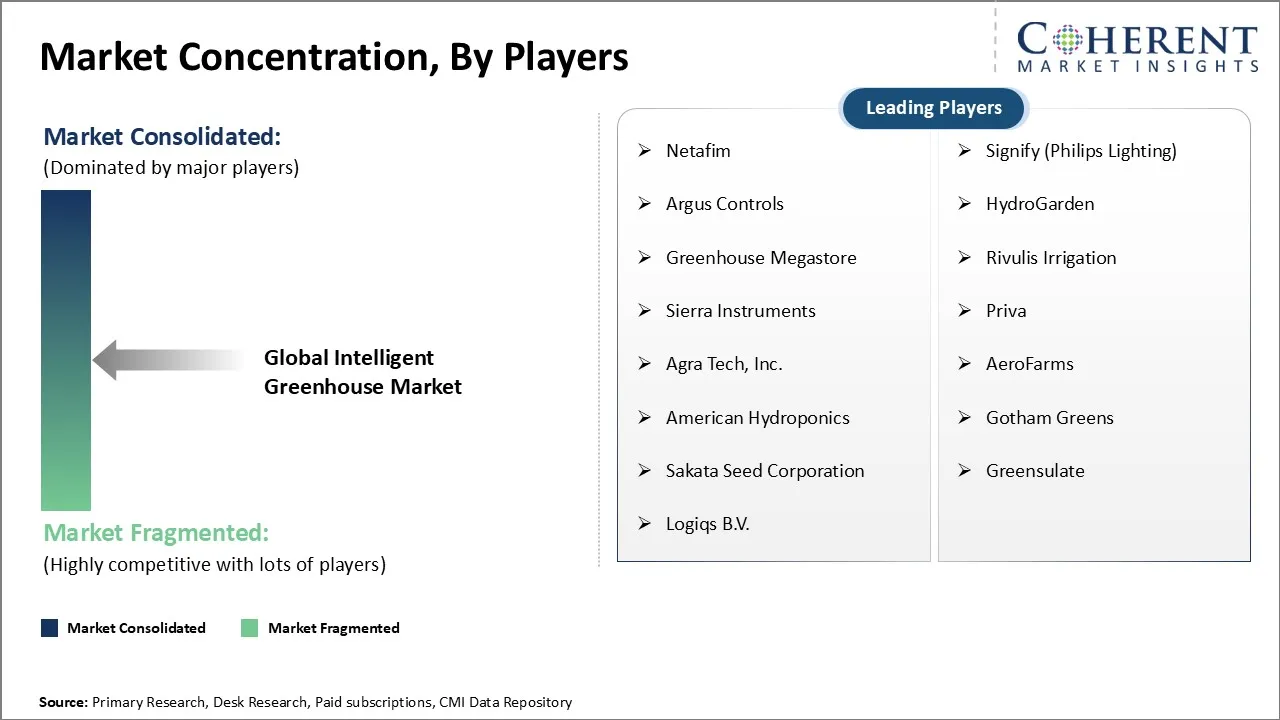
| Companies covered: | Netafim, Signify (Philips Lighting), Argus Controls, HydroGarden, Greenhouse Megastore, Rivulis Irrigation, Sierra Instruments, Priva, Agra Tech, Inc., AeroFarms, American Hydroponics, Gotham Greens, Sakata Seed Corporation, Greensulate, and Logiqs B.V. | ||
| Growth Drivers: |
| ||
| Restraints & Challenges: |
| ||
Intelligent Greenhouse Market Dynamics
Intelligent Greenhouse Market Driver - Increasing Demand for Sustainable Agriculture
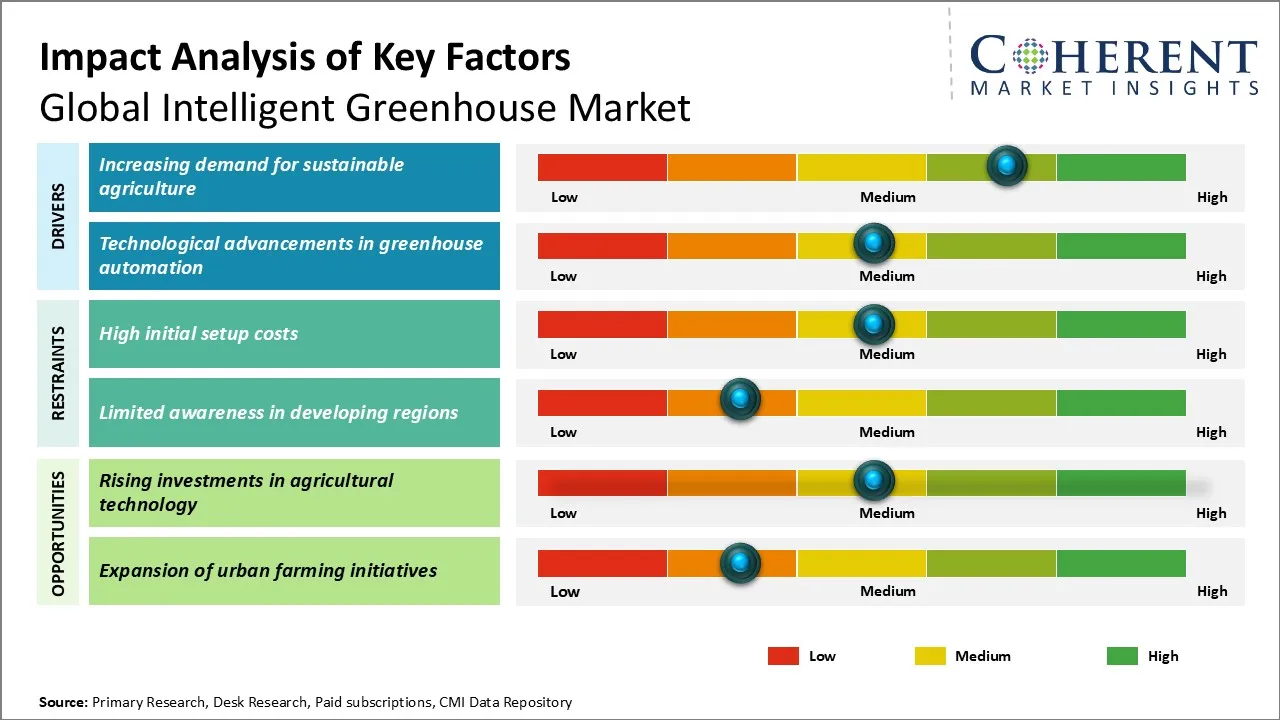
The global shift toward sustainable agriculture practices represents a fundamental driver propelling the intelligent greenhouse market forward. Agricultural stakeholders are increasingly recognizing the urgent need to adopt environmentally responsible farming methods that minimize resource consumption while maximizing crop productivity. Traditional organic farming approaches face mounting criticism for their excessive water usage, heavy reliance on chemical fertilizers, and contribution to soil degradation. Intelligent greenhouse systems address these concerns by incorporating advanced technologies such as precision farming precision irrigation, automated climate control, and nutrient optimization systems that significantly reduce water consumption and eliminate chemical runoff.
These sophisticated systems enable farmers to optimize water usage, reduce pesticide applications, minimize energy consumption, and significantly decrease carbon footprints compared to traditional farming methods. For instance, smart greenhouse facilities can reduce water consumption by up to 90% through precision irrigation systems that deliver exact amounts of water based on real-time soil moisture data and plant requirements. Similarly, automated nutrient delivery systems eliminate over-fertilization, preventing soil degradation and groundwater contamination while ensuring optimal plant nutrition.
Intelligent Greenhouse Market Opportunity - Rising Investments in Agricultural Technology
The intelligent greenhouse market is positioned to capitalize on an unprecedented surge in agricultural technology investments, driven by both public and private sector initiatives worldwide. Venture capital funding in Agtech reached US$ 8.9 Bn in 2023, with controlled environment agriculture receiving substantial attention from investors seeking sustainable food production solutions. Government initiatives across major economies, including the EU's Farm to Fork strategy, China's agricultural modernization programs, and various national food security policies, are channeling billions of dollars toward precision agriculture and smart farming technologies. This investment wave is particularly pronounced in regions facing acute food security challenges, where intelligent greenhouse systems offer viable solutions for maximizing yield per square meter while minimizing resource consumption.
Analyst Opinion (Expert Opinion)
- The intelligent greenhouse market is on the verge of significant expansion, fueled by the growing demand for sustainable agricultural practices and increased food production efficiency. Companies like Netafim and Hydroponic Systems are pioneering innovations in smart technology integration, utilizing IoT sensors and automation to optimize growing conditions.
- Recent conferences, such as the Greenhouse Canada Conference (2023) and the International Greenhouse Vegetable Production Conference (2022), have showcased advancements in climate control and resource management, emphasizing the importance of data-driven decision-making in modern agriculture. These platforms have highlighted success stories of increased yields and reduced resource consumption, positioning intelligent greenhouses as a vital solution in addressing global food security challenges. As the agricultural sector embraces technology, the intelligent greenhouse market is well-positioned for growth, driven by innovations that enhance productivity and sustainability.
Speak to the analyst
Want personalized insights?
Take the findings above to one of our principal consultants, or have the report rebuilt around the segments, geographies and competitors you actually track.
Market Segmentation
- Type Insights (Revenue, USD Bn, 2021 - 2033)
- Hydroponic
- Non-Hydroponic
- Component Insights (Revenue, USD Bn, 2021 - 2033)
- Hardware
- Software
- Services
- Application Insights (Revenue, USD Bn, 2021 - 2033)
- Flower Planting
- Vegetable Cultivation
- Fruit Cultivation
- Other
- Technology Insights (Revenue, USD Bn, 2021 - 2033)
- HVAC
- LED Grow Lights
- Irrigation Systems
- Control Systems
- Sensors
- Others
- Regional Insights (Revenue, USD Bn, 2021 - 2033)
- North America
- U.S.
- Canada
- Latin America
- Brazil
- Argentina
- Mexico
- Rest of Latin America
- Europe
- Germany
- U.K.
- Spain
- France
- Italy
- Russia
- Rest of Europe
- Asia Pacific
- China
- India
- Japan
- Australia
- South Korea
- ASEAN
- Rest of Asia Pacific
- Middle East
- GCC Countries
- Israel
- Rest of Middle East
- Africa
- South Africa
- North Africa
- Central Africa
- North America
- Key Players Insights
- Netafim
- Signify (Philips Lighting)
- Argus Controls
- HydroGarden
- Greenhouse Megastore
- Rivulis Irrigation
- Sierra Instruments
- Priva
- Agra Tech, Inc.
- AeroFarms
- American Hydroponics
- Gotham Greens
- Sakata Seed Corporation
- Greensulate
- Logiqs B.V.
Sources
Primary Research Interviews
- Agricultural Technology Leaders – Key executives in intelligent greenhouse technology development
- Farm Operations Managers – Farmers adopting intelligent greenhouse systems
- Sustainability Consultants – Experts in eco-friendly agricultural practices
- Technology Integrators – Providers of AI and IoT systems for greenhouse automation
- Retail & Wholesale Distributors – Companies involved in the distribution of greenhouse equipment and technology
Stakeholders
- Greenhouse Manufacturers
- End-use Sectors:
- Agricultural Producers (Fruits, Vegetables, and Flowers)
- Agricultural Technology Developers
- E-commerce Platforms for Greenhouse Supplies
- Urban Agriculture and Vertical Farming Sectors
- Regulatory & Certification Bodies
- Technology Providers:
- AI-based automation providers for greenhouse control systems
- Internet of Things (IoT) providers for environmental control
Databases
- FAO Database (Food and Agriculture Organization) – Agricultural statistics and greenhouse technology trends
- USDA Agricultural Statistics Database – Greenhouse production and farming technology use
Magazines
- Greenhouse Grower Magazine – Insights on greenhouse technologies and trends
- Agri-Tech East – Innovations in agricultural technology, including intelligent greenhouses
- Urban Agriculture Magazine – Developments in urban farming technologies, including intelligent greenhouses
- Tech in Agriculture – Focus on automation, IoT, and AI in agriculture
Journals
- Agricultural Systems Journal – Studies on automation and efficiency in greenhouses
- Journal of Agricultural Engineering – Technological advancements in greenhouse operations
- Biosystems Engineering – Use of AI and robotics in modern greenhouse technologies
- Precision Agriculture – Advancements in the precision control of greenhouse environments
Newspapers
- The Financial Times – Market dynamics and trends in intelligent agriculture
- The Guardian – Coverage on innovations in sustainable farming practices
- The New York Times – Urban agriculture trends and the shift toward intelligent farming
- Asia Health Journal – Growth of agricultural technologies in Asia-Pacific
- European Farming News – Regulations and technology adoption in European greenhouses
Associations
- International Society of Precision Agriculture (ISPA)
- Greenhouse Growers Association
- American Society of Agricultural and Biological Engineers (ASABE)
- European Innovation Partnership for Agricultural Productivity and Sustainability (EIP-AGRI)
- Agri-Tech East
Public Domain Sources
- FDA – Regulations for organic farming technologies, including intelligent greenhouse systems
- European Commission – Regulations regarding sustainable agricultural practices and technologies
- OECD – Data on agricultural technology and environmental sustainability in farming
- USDA – Guidelines for greenhouse operations and crop production systems
Proprietary Elements
- CMI Data Analytics Tool, Proprietary CMI Existing Repository of information for last 8 years
Get access to 250+ pages report
Every segment, forecast, competitor profile and data table behind the analysis above — available for instant download.
- ESOMAR Member
- ISO 9001:2015 Certified
- D-U-N-S Registered
- GDPR & CCPA Compliant
Missing comfort of reading report in your local language? Find your preferred language:
Transform your Strategy with Exclusive Trending Reports
Frequently Asked Questions
The global intelligent greenhouse market is estimated to be valued at USD 2.54 Bn in 2026 and is expected to reach USD 6.51 Bn by 2033.
The CAGR of global intelligent greenhouse market is projected to be 14.4% from 2026 to 2033.
Increasing demand for sustainable agriculture and technological advancements in greenhouse automation are the major factors driving the growth of global intelligent greenhouse market.
High initial setup costs and limited awareness in developing regions are the major factors hampering the growth of global intelligent greenhouse market.
In terms of type, hydroponic subsegment is estimated to dominate the market revenue share in 2026.
Netafim, Signify (Philips Lighting), Argus Controls, HydroGarden, Greenhouse Megastore, Rivulis Irrigation, Sierra Instruments, Priva, Agra Tech, Inc., AeroFarms, American Hydroponics, Gotham Greens, Sakata Seed Corporation, Greensulate, and Logiqs B.V. are the major players operating in the global intelligent greenhouse market.
Asia Pacific is expected to lead the global intelligent greenhouse market in 2026.