

Breathing Battery Market Size and Forecast – 2026 To 2033
The Breathing Battery Market is anticipated to grow at a CAGR of 9.2 with USD 24.8 Bn share in 2026 and is expected to reach USD 35.7 Bn in 2033. Rising demand for high-energy-density storage, increasing adoption of electric vehicles, expanding renewable energy systems, and growing investments in advanced battery technologies drive the breathing battery market. Rising demand for high-energy-density storage, increasing adoption of electric vehicles, expanding renewable energy systems, and growing investments in advanced battery technologies drive the breathing battery market. Global electric vehicle adoption continues to accelerate, with electric car sales surpassing 17 million units in 2024, accounting for over 20% of total car sales worldwide. Furthermore, EV sales exceeded 20 million units in 2025, representing more than one in four cars sold globally.
Key Takeaways
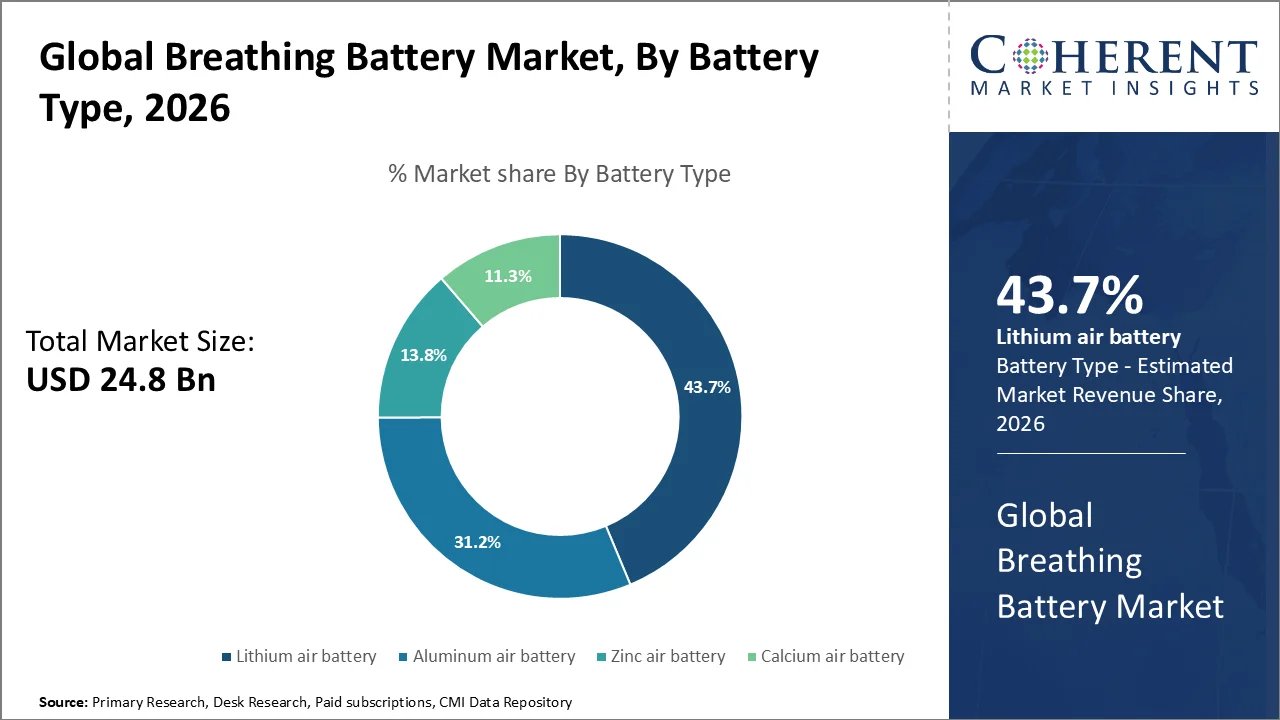
- Lithium air battery holds the largest market share of 43.7% in 2026 owing to the growing electric vehicle (EV) demand. The surge in EV adoption is significantly increasing the demand for lithium-based batteries, with global lithium-ion battery demand for electric vehicles estimated to exceed 950 GWh in 2024, reflecting strong year-on-year growth.
- Utility energy storage expected to hold largest market share of 35.6% in 2026 owing to the rapid growth of renewable energy integration.
- Asia Pacific is expected to acquire the dominant share of 37.5% in 2026 owing to the strong dominance in EV manufacturing and adoption. The region continues to lead the global EV market, with China alone accounting for nearly 60% of global electric vehicle sales in 2024, while overall EV sales across Asia Pacific surpassed 11 million units.
Current Events and Their Impact
Current Event | Description and its Impact |
China’s 2025 Export Restrictions on Advanced EV Battery Technologies |
|
EU Critical Raw Materials Act (CRMA) Expansion and Strategic Procurement Platform |
|
Segmental Insights
- Current Industry Events of 2026
- Market Size Estimation
- Regional Breakdown
- Competitive Landscape
- Customer Intelligence
- Segmental Analysis
- Pricing Analysis
- Key Market Drivers, Challenges & Future Trends
- Customized Insights Section
Why is Lithium air battery Acquiring the Largest Market Share?
Lithium air battery holds the largest market share of 43.7% in 2026. Rising demand for ultra-high energy density storage systems across electric vehicles, renewable energy integration, and portable electronics drives the lithium-air battery segment in the breathing battery market. The technology uses oxygen from the air, which reduces overall battery weight and makes it suitable for long-range EVs and aerospace applications. Lithium-air batteries offer a theoretical energy density of nearly 3,500 Wh/kg to 11,000 Wh/kg, significantly higher than conventional lithium-ion batteries, which typically range between 150–300 Wh/kg. Additionally, global electric vehicle sales surpassed 17 million units in 2024, accounting for over 20% of total vehicle sales worldwide, further increasing demand for next-generation high-energy-density battery technologies. For instance, in October 2025, the International Air Transport Association (IATA) introduced the “Travel Smart with Lithium Batteries” campaign, actively promoting air travel safety by educating passengers on seven clear rules for carrying mobile phones, laptops, power banks, and other lithium-powered devices safely during flights.
Which End Use segment dominates the market?
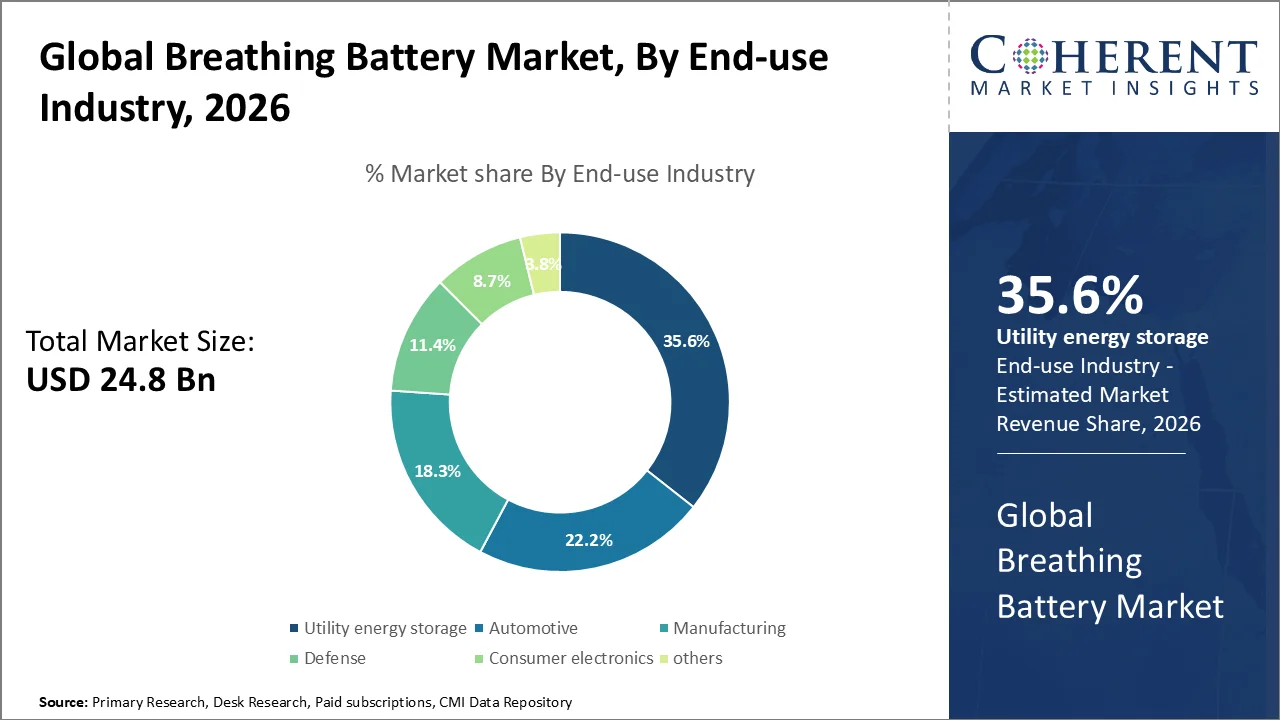
Utility energy storage expected to hold largest market share of 35.6% in 2026 owing to the cost pressure and need for lower LCOE storage. Growing integration of renewable energy sources such as solar and wind into power grids drives the utility energy storage segment in the breathing battery market. Utilities increasingly seek long-duration and large-scale storage solutions to maintain grid stability, manage peak loads, and ensure reliable backup power. Investments in grid modernization continue to rise, while efforts to reduce dependence on fossil fuel-based peaker plants support adoption. Ongoing advancements in high-energy-density battery technologies further enhance prospects for utility-scale applications.
Breathing Battery Market Trends
- Rising adoption of electric vehicles increases demand for high-energy-density breathing batteries that can extend driving range and reduce battery weight. Global EV sales exceeded 17 million units in 2024, representing more than 20% of total global car sales, significantly boosting demand for advanced battery technologies.
- Growing renewable energy installations accelerate the need for long-duration energy storage systems capable of supporting grid stability and backup power applications worldwide. Global renewable energy capacity additions surpassed 500 GW in 2024, while global energy storage installations are projected to exceed 400 GWh annually by 2030.
- Increasing investments in clean energy research and battery innovation encourage the development of sustainable alternatives to conventional lithium-ion technologies across industries. Global investments in battery and energy storage technologies exceeded USD 150 billion in 2025, driven by rising electrification and clean energy initiatives.
- Government initiatives supporting decarbonization, energy transition, and domestic battery manufacturing strengthen research activities and pilot-scale commercialization of breathing battery technologies globally. For instance, the U.S. and EU collectively announced more than USD 20 billion in battery manufacturing incentives and clean energy funding programs between 2024 and 2026.
Regional Insights
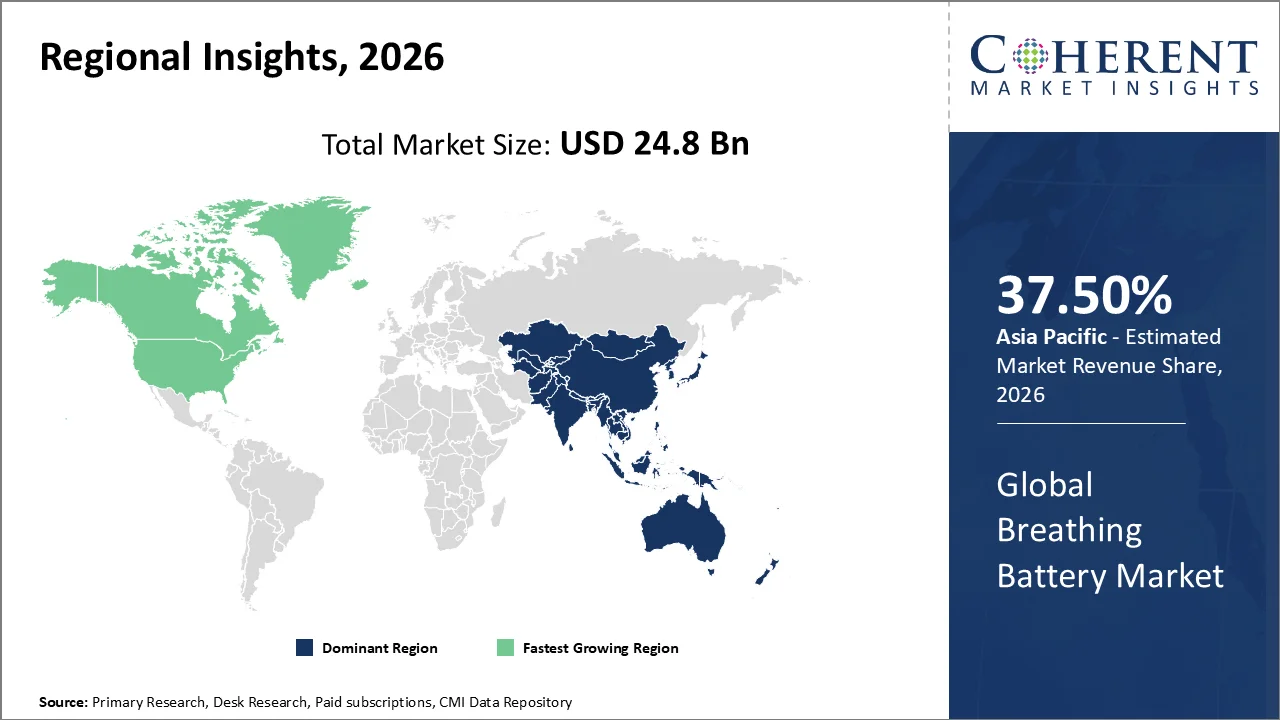
Asia Pacific dominates owing to government support and clean energy policies
Asia Pacific is expected to acquire the dominant share of 37.50% in 2026. Rising demand for electric vehicles, expanding renewable energy storage systems, and increasing adoption of advanced batteries in consumer electronics and industrial applications drive the Asia Pacific breathing battery market. China, Japan, South Korea, and India actively invest in clean energy technologies and battery innovation to strengthen regional growth. The region accounted for over 60% of global electric vehicle sales in 2024, with China alone selling more than 11 million EVs during the year. Additionally, Asia Pacific contributes more than 75% of global lithium-ion battery manufacturing capacity, supported by large-scale investments from major battery manufacturers. For instance, CMF confirms the upcoming launch of the Watch 3 Pro in India, bringing the smartwatch to the market months after its global debut.
North America Breathing Battery Market Trends
Increasing adoption of electric vehicles, rising investments in renewable energy storage, and continuous advancements in battery technology drive the North America breathing battery market. The United States leads regional growth by supporting clean energy initiatives and advancing research in energy storage systems. Consumer electronics, automotive, and industrial sectors continue to increase demand for high-performance batteries, shaping key market trends. Major battery manufacturers, expanding charging infrastructure, and a strong focus on sustainable and efficient energy solutions further accelerate market development across North America. For instance, LG Energy Solution and Toyota Tsusho Corporation have formed a joint venture, Green Metals Battery Innovations, LLC, to develop battery recycling operations in the United States. The partners will build and run a pre-processing facility in Winston-Salem, North Carolina, advancing a more sustainable battery supply chain.
Japan Breathing Battery Market Trends
Japan’s breathing battery industry is experiencing continuous growth driven by increasing investments in energy storage technologies, electric mobility, and renewable power systems. Advancements in metal-air and air electrode battery solutions are fostering innovation among local companies and research organizations. Rising need for compact, lightweight, and long-lasting batteries is supporting adoption in electric vehicles, consumer electronics, and energy storage networks. Government initiatives promoting clean energy and carbon reduction are also boosting market development, while manufacturers focus on sustainable and next-generation solid-state battery technologies to enhance Japan’s position in the global battery sector.
United States Breathing Battery Market Trends
Energy companies and research organizations across the United States are actively advancing the breathing battery market by developing efficient metal-air and air electrode technologies. Increasing deployment of renewable energy systems and electric vehicles is creating strong demand for reliable, long-duration energy storage solutions. Manufacturers are introducing lightweight and high-capacity batteries for applications such as portable electronics, backup systems, and grid-scale storage. Federal support for clean energy projects and domestic battery production is accelerating innovation, while industry participants continue investing in sustainable and advanced battery technologies to improve energy performance and storage efficiency.
Who are the Major Companies in Breathing Battery Industry
Some of the major key players in Breathing Battery are IBM Corporation, Zinc8 Energy Solutions Inc., PolyPlus Battery Company, Panasonic, Tesla, Fuji Pigment, and Breathe Battery Technologies Limited
Key News
- In May 2025, Battery management software provider Breathe Battery Technologies secured $21 million in Series B funding and launched a new suite of solutions, including battery simulation software, embedded software, and battery services.
- In May 2025, Whoop launched two new wearable devices, Whoop 5.0 and Whoop MG, featuring sleeker hardware, extended battery life, and enhanced in-app health insights.
Market Report Scope
Breathing Battery Market Report Coverage
| Report Coverage | Details | ||
|---|---|---|---|
| Base Year: | 2025 | Market Size in 2026: | USD 24.8 Bn |
| Historical Data for: | 2020 To 2024 | Forecast Period: | 2026 To 2033 |
| Forecast Period 2026 to 2033 CAGR: | 9.2% | 2033 Value Projection: | USD 35.7 Bn |
| Geographies covered: |
| ||
| Segments covered: |
| ||
| Companies covered: | IBM Corporation, Zinc8 Energy Solutions Inc., PolyPlus Battery Company, Panasonic, Tesla, Fuji Pigment, and Breathe Battery Technologies Limited | ||
Analyst Opinion
- The breathing battery market is still in a technology-validation phase, but its long-duration storage potential makes it one of the most strategically important battery segments for future energy systems. Conventional lithium-ion batteries remain expensive for multi-day storage, whereas metal-air and iron-air batteries can theoretically deliver energy storage durations exceeding 100 hours, making them highly attractive for renewable-heavy power grids.
- Grid instability and renewable intermittency are becoming the strongest catalysts for breathing battery adoption. In 2024, renewables accounted for more than 30% of global electricity generation, yet solar and wind curtailment losses continue to rise in major economies due to insufficient storage capacity. Analyst opinion suggests breathing batteries will gain faster traction in utility-scale applications because they use abundant materials such as iron, zinc, and aluminum rather than supply-constrained minerals like cobalt and nickel, reducing long-term raw material dependency risks.
- The market’s future will depend less on laboratory breakthroughs and more on whether manufacturers can achieve commercial durability at scale. Several prototypes already demonstrate operational lifecycles exceeding thousands of charge-discharge cycles, but industry experts believe the real competitive advantage lies in lowering system costs and improving recharge efficiency. Companies such as Form Energy are already attracting significant utility partnerships for iron-air battery deployment projects, signaling that large-scale energy providers are beginning to view breathing batteries as a realistic complement to lithium-ion systems rather than an experimental alternative.
Speak to the analyst
Want personalized insights?
Take the findings above to one of our principal consultants, or have the report rebuilt around the segments, geographies and competitors you actually track.
Market Segmentation
- By Battery Type: (Revenue, USD Bn, 2021-2033)
- Lithium air battery
- Aluminum air battery
- Zinc air battery
- Calcium air battery
- By End-use Industry: (Revenue, USD Bn, 2021-2033)
- Automotive
- Manufacturing
- Defense
- Utility energy storage
- Consumer electronics
- Others
- By Region: (Revenue, USD Bn, 2021-2033)
- North America
- U.S.
- Canada
- Latin America
- Brazil
- Mexico
- Argentina
- Rest of Latin America
- Europe
- Germany
- U.K.
- France
- Italy
- Spain
- Russia
- Rest of Europe
- Asia Pacific
- China
- India
- Japan
- Australia
- South Korea
- ASEAN
- Rest of Asia Pacific
- Middle East
- GCC
- Israel
- Rest of Middle East
- Africa
- South Africa
- Central Africa
- North Africa
- North America
- Key Players
- IBM Corporation
- Zinc8 Energy Solutions Inc.
- PolyPlus Battery Company
- Panasonic
- Tesla
- Fuji Pigment
- Breathe Battery Technologies Limited
Sources
Primary Research interviews
- Interviews with battery engineers, energy storage system designers, and utility-scale grid operators involved in pilot deployments of metal-air and iron-air batteries
- Discussions with renewable energy project developers integrating long-duration storage solutions into solar and wind farms
- Insights from academic researchers working on electrochemical storage and air electrode technologies
Databases
- National energy statistics and electricity generation datasets
- Patent databases tracking advancements in metal-air, zinc-air, and iron-air battery technologies
- Government energy storage and electrification databases
Magazines
- Industry-focused clean energy and advanced materials publications covering battery innovation and grid storage trends
- Technology magazines reporting on next-generation energy storage prototypes and demonstrations
Journals’
- Electrochemical energy storage and materials science journals featuring peer-reviewed research on air electrode and metal-air battery systems
- Renewable energy and power systems journals analyzing grid-scale storage integration and performance
Newspapers
- Business and financial newspapers reporting on energy transition investments, utility-scale storage projects, and pilot deployments
- Technology news coverage highlighting breakthroughs in next-generation battery chemistries
Associations
- Global and regional energy storage associations promoting research and standards for advanced battery systems
- Electric power and utility associations supporting grid modernization and renewable integration initiatives
Public Domain sources
- Government energy ministry reports and national renewable energy mission documents
- International energy and climate transition reports focusing on storage requirements and clean power adoption
- Public research papers and university publications on metal-air battery development
Proprietary Elements
- CMI Data Analytics Tool, and Proprietary CMI Existing Repository of information for last 10 years
Get access to 250+ pages report
Every segment, forecast, competitor profile and data table behind the analysis above — available for instant download.
- ESOMAR Member
- ISO 9001:2015 Certified
- D-U-N-S Registered
- GDPR & CCPA Compliant
Missing comfort of reading report in your local language? Find your preferred language:
Transform your Strategy with Exclusive Trending Reports
Frequently Asked Questions
The Breathing Battery Market is anticipated to grow with USD 24.8 Billion share in 2026 and is expected to reach USD 35.7 Billion in 2033..
The market is expected to witness a CAGR of 9.2% during the forecast period.
The cost of raw material required to manufacture breathing battery is low as compared to conventional batteries
The utility energy storage segment held the largest market share among end-use industry in the market.
Asia Pacific held the largest share in the market.
Major players operating in the market include IBM Corporation, Zinc8 Energy Solutions Inc., PolyPlus Battery Company, Panasonic, Tesla, Fuji Pigment, Breathe Battery Technologies Limited and others.