

Global Intralogistics Market Size and Forecast – 2026 To 2033
The global intralogistics market is expected to grow from USD 16,201.5 Mn in 2026 to USD 32,065.3 Mn by 2033, registering a compound annual growth rate (CAGR) of 10.2% from 2026 to 2033. The global intralogistics market growth is primarily driven by the rapid expansion of retail channels through partnerships among key players.
For instance, on February 17, 2025, Dematic, a global leader in supply chain solutions, and Transcend Retail Solutions, part of the Tesco group, announced a new partnership and introduced Tanscend MFC. It offers a scalable and repeatable end-to-end solution, enabling grocers to enhance capacity and efficiently fulfil orders close to their customers. (Source: Demantic)
Key Takeaways of the Global Intralogistics Market
- The robotic applications segment is expected to account for 74.5% of the global intralogistics market share in 2026. The growing importance and deployment of collaborative robots are major drivers for robotic applications. For instance, on April 22, 2026, ABB Robotics announced that it is combining the flexibility of cobots with higher payloads and performance, with the launch of its new PoWa cobot family. (Source: ABB)
- The semi-autonomous systems segment is estimated to capture 45.3% of the market share in 2026. The use of semi-autonomous systems is gaining importance with increasing requirement for good technologies at affordable rates. On February 5, 2026, at LogiMAT 2026, companies introduced retrofittable AMR-based systems that work in existing warehouses without structural changes. (Source: LogiMAT)
- The robotics application segment is projected to hold 74.5% of the global intralogistics market share in 2026. The segment growth is fueled by the growing need for improved palletizing for better bulk order fulfillments. On April 27, 2026, a report highlighted that food and consumer goods companies are rapidly investing in palletizing automation, with robot orders in this segment rising sharply. The report also focused on drivers like SKU proliferation, labor shortages, and the need for flexible palletizing systems. (Source: Food Industry Executive)
- Asia Pacific is expected to dominate the intralogistics market in 2026 with a share of 39.3%. The rapid growth of e-commerce warehouses and logistics networks in the region is a major factor pushing the growth. On October 24, 2024, JD Logistics, the logistics arm of Chinese e-commerce giant JD.com, announced the launch of express delivery service from China to seven Southeast Asia countries, namely Singapore, Malaysia, Thailand, Vietnam, Indonesia, the Philippines, and Brunei. (Source: JINGDONG)
- North America is expected to account for 26.5% share in 2026 and is projected to record the fastest growth over the forecast period. The regional market is being driven by the growing demand for real-time analytics in packaging solutions. On March 18, 2026, Veritiv Operating Company, announced the expansion of its strategic partnership with Packsize. This collaboration brings together two industry innovators with a shared commitment to delivering smarter, more efficient, and sustainable packaging for customers. (Source: Packsize)
- Need of Intralogistics in Omnichannel Fulfilment Centers: The fastest-growing opportunity for intralogistics lies in e-commerce-driven warehouses and omnichannel distribution hubs. With the continued expansion of retail e-commerce and same-day/next-day delivery expectations, companies are heavily investing in automated intralogistics systems such as autonomous mobile robots (AMRs), automated storage and retrieval systems (AS/RS), and AI-driven warehouse management systems.
- Need of Intralogistics in Industry 4.0 Enabled Factories: Another major growth area is smart manufacturing, where intralogistics are becoming an integral part of connected and automated production environments. Factories are increasingly adopting IoT-enabled material handling systems, real-time tracking technologies, and robotic intralogistics solutions to synchronize production and internal logistics.
Segmental Insights
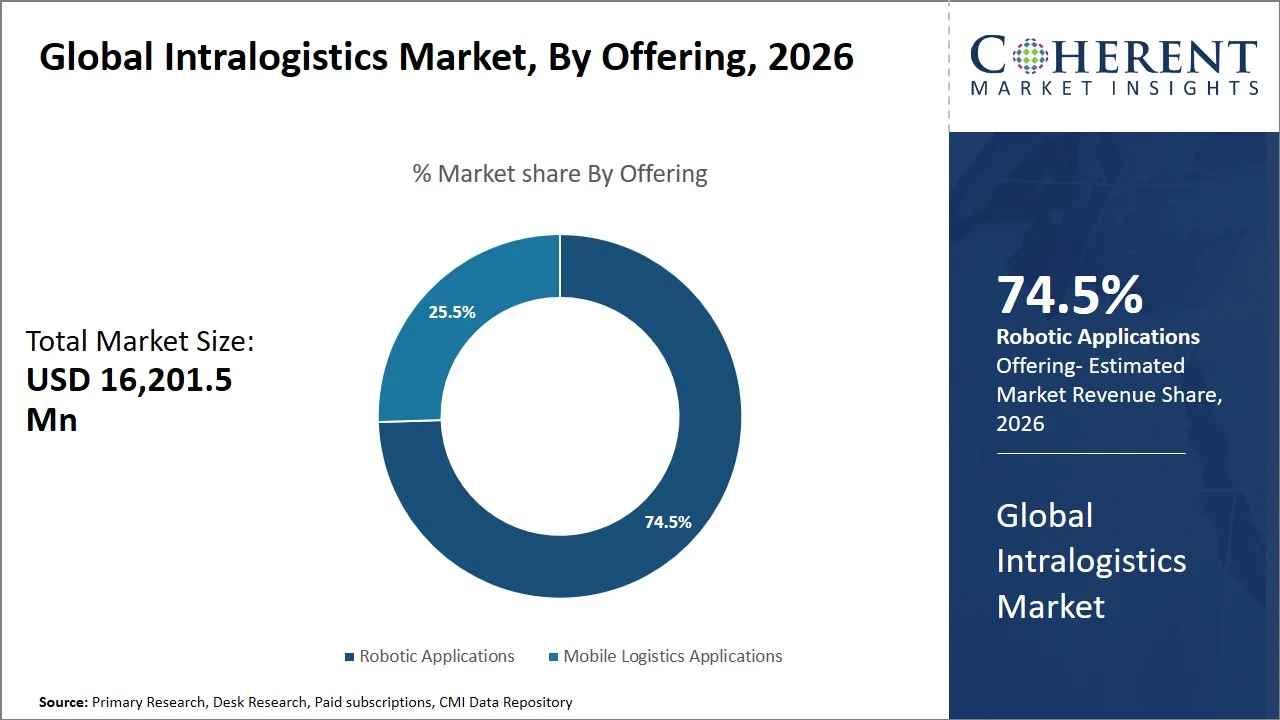
Why Does Robotic Applications Segment Dominate the Global Intralogistics Market?
The robotic applications segment is expected to account for 74.5% of the global intralogistics market share in 2026. The growing use of collaborative robots for warehouse operations are major boost for the growth of the segment. On April 20, 2026, FANUC America, the leading supplier of CNCs, robotics and automation, expanded its popular CRX collaborative robot series with the introduction of the CRX-3iA, an ultra-lightweight cobot designed for fast redeployment across small, high mix tasks. Weighing only 11 kg (24 lbs.), the CRX 3iA can be carried and set up in minutes, giving manufacturers a portable way to automate jobs such as welding, part handling, small assembly, screwdriving, tool positioning and inspection, especially in tight spaces or temporary work areas where permanent fixtures aren’t feasible. (Source: Fanuc)
- Current Industry Events of 2026
- Market Size Estimation
- Regional Breakdown
- Competitive Landscape
- Customer Intelligence
- Segmental Analysis
- Pricing Analysis
- Key Market Drivers, Challenges & Future Trends
- Customized Insights Section
Why are Semi-Autonomous Systems the Most Preferred Automation Level?
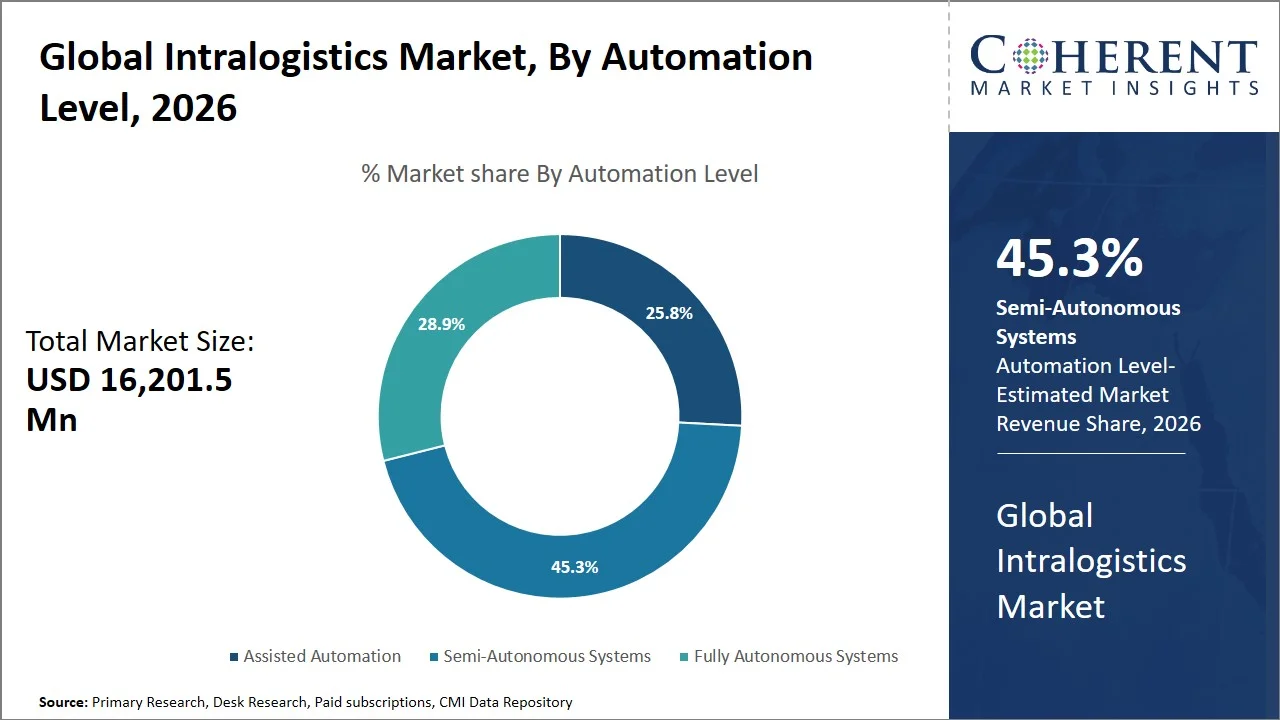
The semi-autonomous systems segment is expected to account for 45.3% of the global intralogistics market share in 2026. The adoption of semi-autonomous systems has seen a considerable rise after the introduction of multiple systems with advanced technological integrations at affordable prices for medium and small-scale players. Moreover, the increasing use of automated guided vehicles is also driving the growth of the segment. On January 6, 2026, a report by TATA Power published, highlighting the need for AGVs in the modern landscape. Modern AGVs possess built-in sensors and safety features to detect obstacles and avoid collisions, allowing them to operate alongside humans without causing disruptions. They are often integrated with a central control system that manages tasks, routes, and schedules, making them a crucial part of smooth and predictable workflows. (Source: Tata Power)
Robotics Application Segment Dominates the Global Intralogistics Market
The robotics application segment is expected to account for 74.5% of the global intralogistics market share in 2026. The increasing need for advanced palletizing and packaging solutions are major driver for the segment. On January 6, 2026, Universal Robots (UR), part of Teradyne Robotics, and Robotiq unveiled a groundbreaking robotic palletizing solution at CES 2026 in collaboration with Siemens. The joint demonstration in Las Vegas, U.S. highlighted how advanced robotics and digital twin technology can accelerate industrial transformation for manufacturers worldwide. The solution combines Robotiq’s PAL Ready palletizing cell with Universal Robots’ UR20 robot arm, integrated into Siemens’ automation hardware and new Digital Twin Composer software. (Source: Universal Robots)
Global Intralogistics Market - Warehouse Automation and Penetration
Industry | Estimated Automation Penetration/Adoption Intensity |
Retail & E-commerce | ~ 30–35% (high) |
Manufacturing | ~ 20–25% (medium) |
Healthcare & Pharmaceuticals | ~ 8–12% (moderate to medium |
3PL/Logistics Providers | ~ 10% (lower-medium) |
Automotive/Component Manufacturing | ~ 5–10% (low to medium) |
Currents Events and their Impact
Current Events | Description and its Impact |
UNCITRAL–UNIDROIT Model Law on Warehouse Receipts (2024) |
|
(Source: United Nations)
Global Intralogistics Market Dynamics
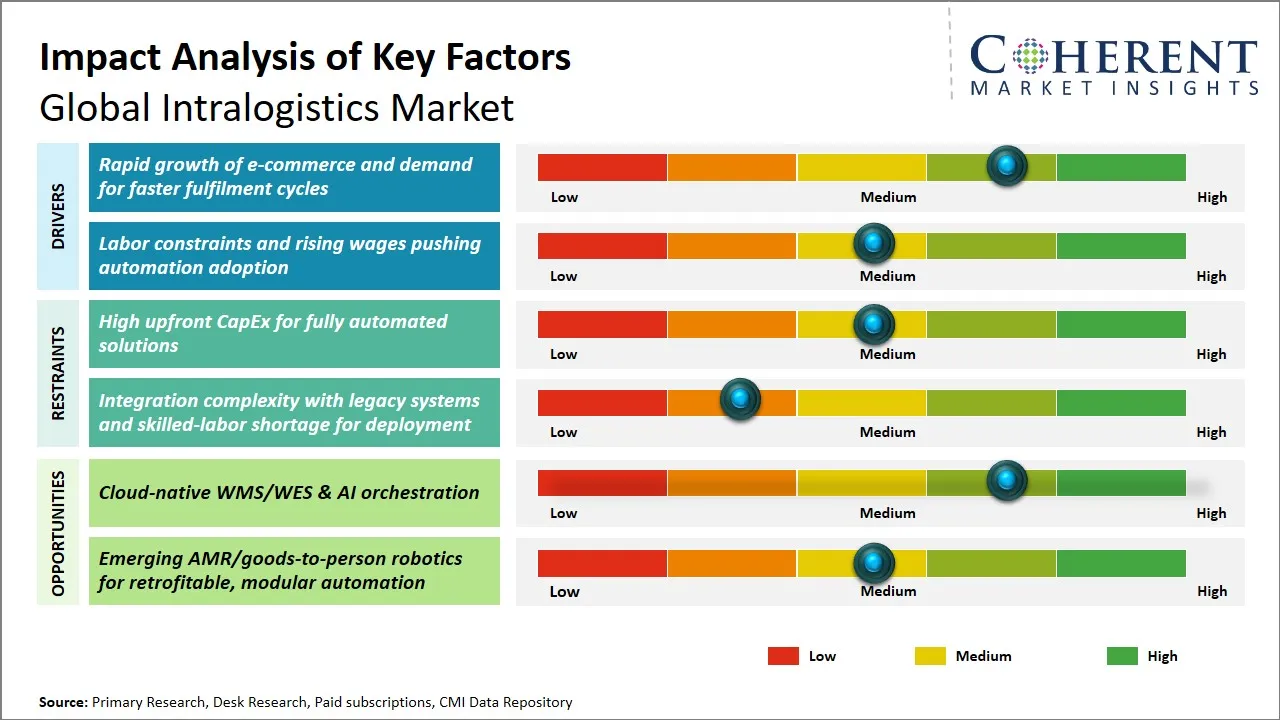
Market Drivers
- Rapid Growth of E-Commerce and Demand for Faster Fulfilment Cycles: The explosive rise of e-commerce has significantly accelerated demand for advanced intralogistics solutions. As consumers expect fast delivery, warehouses must enhance speed, accuracy, and flexibility. This drives a lot of investment in automation technologies such as AMRs, AS/RS, automated sortation, and AI-enabled picking systems. Faster fulfilment cycles now depend on real-time inventory visibility and automated workflows that can handle rising order volumes and SKU complexity. Amazon’s use of more than 750,000 robots across its fulfilment centers (2024) has reduced average order processing time by over 25%, enabling faster delivery across peak seasons. (Source: Amazon)
- Labor Constraints and Rising Wages Pushing Automation Adoption: Labor constraints and rising wages are a significant driver of the global intralogistics market, as industries face growing difficulty in recruiting and retaining workers for repetitive and physically demanding warehouse tasks. In many regions, especially developed economies, increasing wage levels are raising overall operational costs, pushing companies to seek automation as a cost-effective alternative. On July 2, 2025, Amazon announced that it had deployed its one millionth robot, with the company now positioned as the world's largest manufacturer and operator of mobile robotics. The company's fleet of robots across the globe includes Hercules, which can lift and move up to 1,250 pounds of inventory in warehouses, and Proteus, Amazon's first fully autonomous mobile robot, capable of navigating around employees in open areas while moving heavy carts. (Source: Supply Chain Brain)
Emerging Trends
- Rise in Adoption of AI-enabled Warehouse Intelligence: A major trend is the shift from basic automation to AI-powered decision-making systems. Warehouses are increasingly using artificial intelligence for real-time optimization of inventory flow, routing, and task allocation, rather than just mechanical handling.
- Advancements in Autonomous Mobile Robots (AMRs): AMRs are becoming the backbone of modern intralogistics due to their flexibility, scalability, and low infrastructure requirements. Companies are rapidly deploying AMR fleets for goods movement, picking support, and pallet transport.
Regional Insights
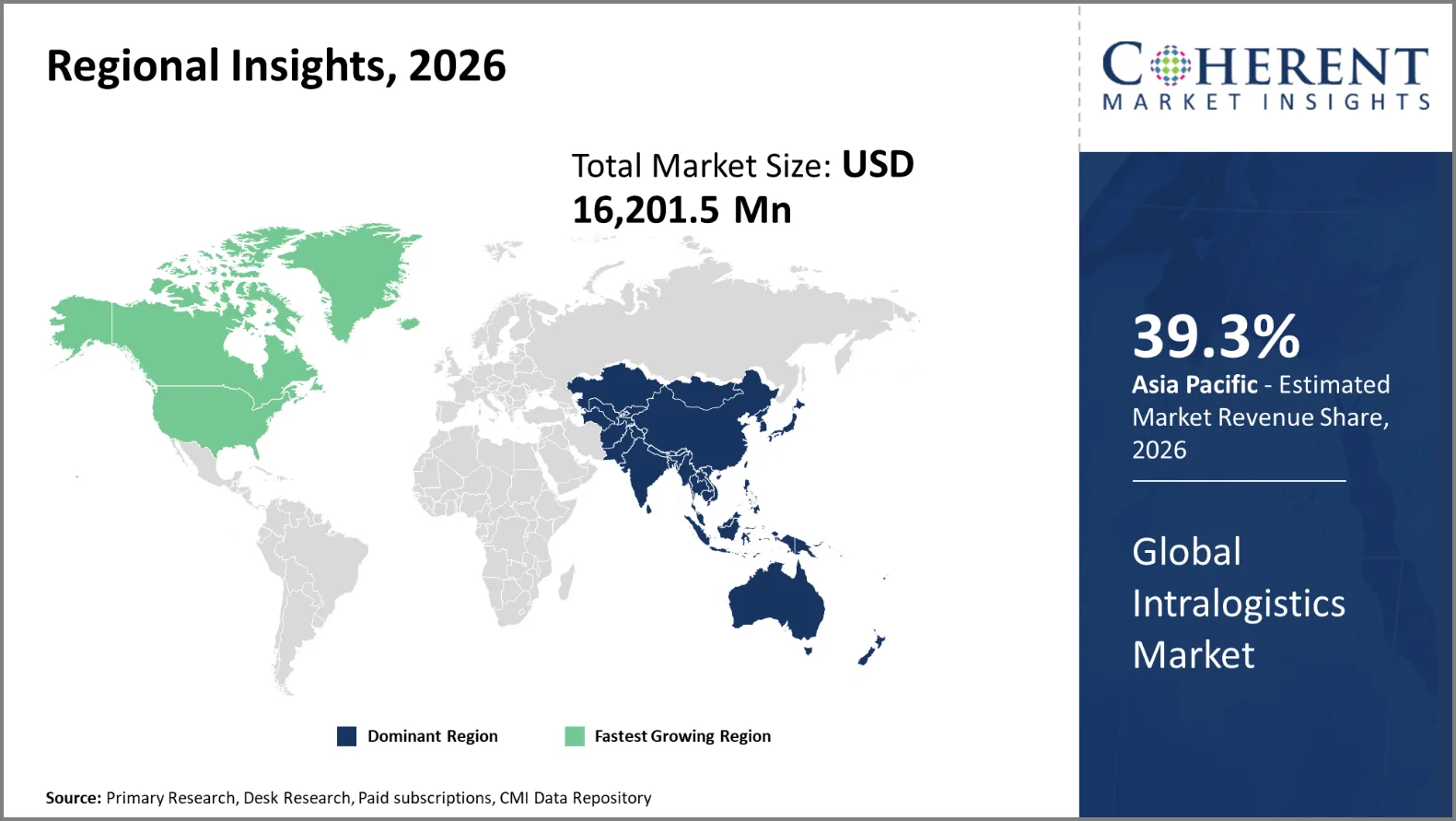
Why is Asia Pacific a Strong Market for Intralogistics?
Asia Pacific is expected to account for a market share of 39.3% in 2026. Across Asia Pacific, real-time analytics shape intralogistics adoption in clear ways. Government initiatives like “Made in China 2026,” “India’s Manufacturing Policy,” and Japan’s Society 5.0 strategy emphasize automation and digital integration, making a favorable environment for intralogistics innovation. Trade dynamics such as regional trade agreements (RCEP) further stimulate intra-Asia supply chains, making the need for sophisticated intralogistics capabilities.
Moreover, the growth of warehouse automation and development of logistics network is an added growth factor. In September 2024, Cainiao Group, the logistics arm of Chinese tech heavyweight Alibaba Group Holding Ltd, announced the expansion of its global five-day delivery service to key markets in Europe. (Source: Cainiao)
Why Does North America Intralogistics Market Exhibit High Growth?
North America is expected to account for a market share of 26.5% in 2026 and is expected to register the fastest growth rate over the forecast period. The region sees the presence of major industry leaders, strong robotics R&D, and a strong integration of AI, IoT, and cloud-based warehouse management systems. Labor shortages, rising warehouse wages, and increasing same-day/next-day delivery expectations have added to automation investment across distribution centers, 3PL facilities, and manufacturing warehouses.
Policies promoting domestic manufacturing, such as the CHIPS and Science Act, USMCA, and a renewed focus on supply chain resilience, make companies use advanced intralogistics solutions to enhance productivity and mitigate operational risks. Leading companies such as Honeywell Intelligrated, Körber Supply Chain, Zebra Technologies, Locus Robotics, and 6 River Systems add to innovation in robotics, AI-enabled automation software, and integrated fulfillment technologies aligned to high-performance logistics environments. (Source: Congress)
Why is China Emerging as a Major Hub in the Intralogistics Market?
China intralogistics market is growing fast, because of a colossal manufacturing sector and one of the world’s largest e-commerce markets. Government policies emphasizing smart manufacturing and logistics digitalization accelerate adoption of automated material handling systems. Local giants such as Hikrobot and Siasun Robot & Automation lead in making AI-powered robotics and sensor-based automation solutions tailored to the scale and complexity of Chinese warehouses. Furthermore, enhanced trade connectivity through initiatives like the Belt and Road expands demand for efficient intralogistics across logistics hubs.
Is U.S. the Next Growth Engine for the Intralogistics Market?
The U.S. intralogistics market sees a diverse industrial landscape, including retail, e-commerce, aerospace, and food manufacturing sectors. High labor costs and demand for faster order fulfillment add to investments into automation and AI-driven warehouse management. Companies like Honeywell Intelligrated, JBT Corporation, and 6 River Systems have a strong footprint, delivering solutions ranging from autonomous mobile robots (AMRs) to integrated software platforms. U.S. government initiatives focus on infrastructure modernization and supply chain resiliency, adding to growth in intelligent intralogistics solutions.
Germany Intralogistics Market Analysis and Trends
Germany intralogistics market remains a benchmark for advanced manufacturing and logistics excellence. The country’s engineering prowess and huge industrial base make demand for highly efficient material handling solutions, adding to the adoption of automated storage and retrieval systems (ASRS) and robotics. Major players such as Dematic and SSI Schaefer use Germany’s strong R&D infrastructure to make bespoke solutions for automotive, pharmaceuticals, and FMCG sectors. Germany’s supportive policies for digital transformation and energy efficiency also add to the continued innovation and adoption in intralogistics.
Japan continues to lead in precision automation and robotics integration within intralogistics. The country’s strong electronics and automotive sectors need high-reliability, compact automation solutions. Companies like Daifuku and Toyota Industries lead the market by offering integrated intralogistics solutions that include conveyor systems, ASRS, and smart forklifts. Japan’s focus on workforce aging and labor shortages adds to the push towards automation, supported by government programs incentivizing technological innovation in warehousing and distribution.
Global Intralogistics Market – Operational Efficiency Metrics
Metric | Before Automation | After Automation |
Order Throughput (lines/hour per worker) | 60–120 | 60–120 |
Picking Accuracy | 93%–97% | 99%–99.7% |
Order Cycle Time | 6–12 hours | 1–3 hours |
Labor Cost Share of Ops Costs | 50%–60% | 30%–40% |
Cost per Pick | USD 0.50–USD 1.20 | USD 0.20–USD 0.45 |
Space Utilization (storage density) | 60%–70% | 85%–95% |
Inventory Accuracy | 92%–96% | 98%–99.8% |
Uptime/Operational Availability | 85%–90% | 95%–98% |
Workplace Injuries Related to Material Handling | Baseline | 20–40% lower |
How is Integration with Cloud Native WMS/WES & AI Orchestration Creating New Growth Opportunities in the Global Intralogistics Market?
Cloud-native WMS/WES platforms combined with AI orchestration makes a big opportunity for next-generation warehouse optimization. These systems are scalable, add easily with robotics and IoT devices, and enable dynamic, predictive decision-making. AI-driven orchestration improves throughput by optimizing labor, equipment usage, and inventory routing in real time, helping warehouses adapt quickly to volatile demand. Walmart uses cloud-based Manhattan Active WMS across multiple DCs, enabling real-time visibility and AI-driven workflow optimization, resulting in double-digit improvements in order accuracy and throughput. On June 24, 2025, Walmart reinforced its commitment to provide its workforce with advanced technology and tools, announcing plans to equip store associates with a powerful new suite of AI tools designed to elevate their roles and experience. (Source: Walmart)
Market Players, Key Development, and Competitive Intelligence
Key Developments
- In April 2025, Swisslog, a global leader in warehouse automation and software solutions, participated in SITL 2025, held from April 1 to 3 at Paris Porte de Versailles. The company showcased its latest innovations in intralogistics automation solutions, including mobile robotics systems and tri-temperature storage.
- In April 2025, Locus Robotics, the global leader in AI-driven, mobile warehouse automation, surpassed the 5 billion units picked milestone across its global customer deployments.
- On March 17 2025, Honeywell announced that its warehouse execution software (WES) is now available as a cloud-based platform, providing a more scalable, flexible and cost-effective solution for distribution and fulfillment operations.
Competitive Landscape
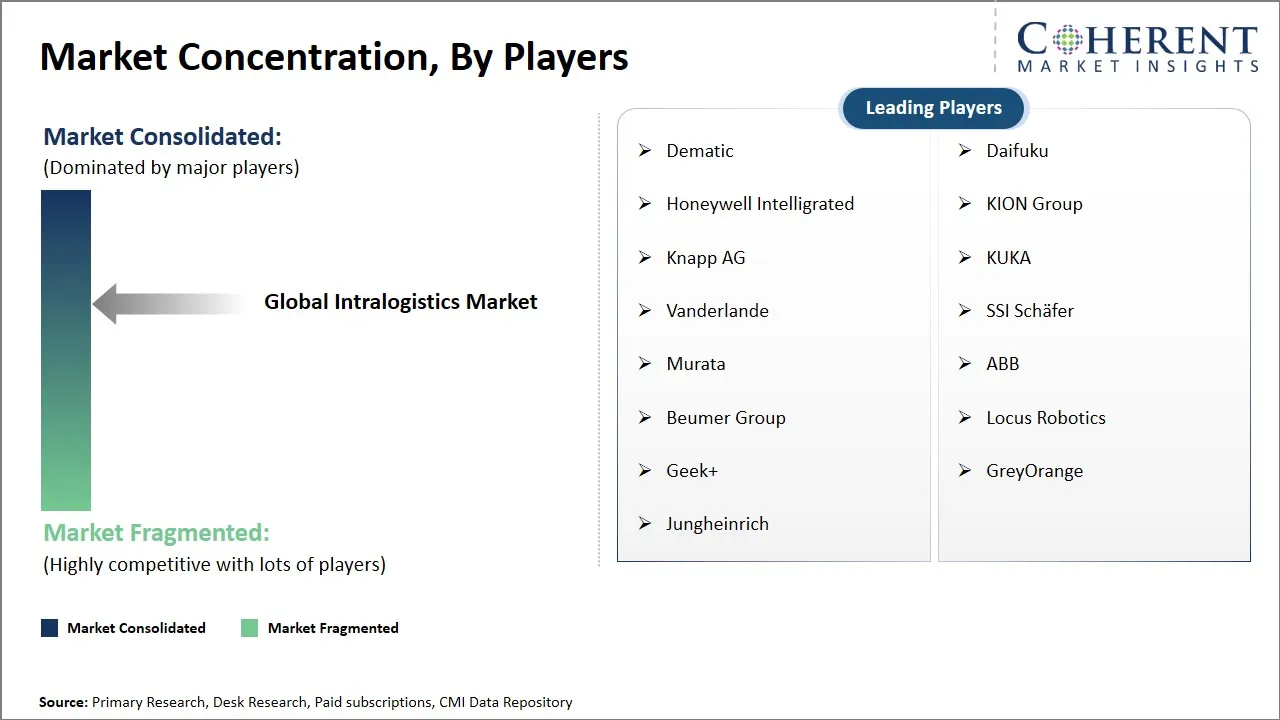
The global intralogistics market is characterized by a highly fragmented and innovation-led competitive environment, comprising established automation leaders as well as fast-growing robotics and software providers. Large companies such as Daifuku, KION Group (including Dematic), Honeywell Intelligrated, and SSI SCHAEFER continue to lead major warehouse automation projects, while robotics-focused players like ABB, KUKA, FANUC, and GreyOrange are expanding their influence in areas such as autonomous mobile robots and collaborative automation systems. In parallel, new entrants specializing in AI and cloud-based platforms are reshaping the market by offering real-time warehouse optimization and management solutions.
Market Report Scope
Intralogistics Market Report Coverage
| Report Coverage | Details | ||
|---|---|---|---|
| Base Year: | 2025 | Market Size in 2026: | USD 16,201.5 Mn |
| Historical Data for: | 2020 To 2024 | Forecast Period: | 2026 To 2033 |
| Forecast Period 2026 to 2033 CAGR: | 10.2% | 2033 Value Projection: | USD 32,065.3 Mn |
| Geographies covered: |
| ||
| Segments covered: |
| ||
| Companies covered: | Dematic, Daifuku, Honeywell Intelligrated, KION Group, Knapp AG, KUKA, Vanderlande, SSI Schafer, Murata, ABB, Beumer Group, Locus Robotics, Geek+, GreyOrange, and Jungheinrich | ||
| Growth Drivers: |
| ||
| Restraints & Challenges: |
| ||
Analyst Opinion (Expert Opinion)
- Despite strong marketing by automation suppliers, the reality is that high upfront capital costs are a big barrier, especially for mid-sized warehouses. Many businesses hesitate to invest in robotics or AS/RS systems because ROI timelines stretch far longer than the industry narrative suggests, often 4–7 years, not the idealized 18–24 months. This financial friction affects market penetration in developing regions.
- Intralogistics technologies are evolving faster than warehouse IT ecosystems can keep up. Adding WMS, WES, robotics platforms, IoT systems, and legacy infrastructure is far more complicated than vendors portray. The lack of interoperability standards is causing project delays, cost overruns, and operational disruptions.
- The labor shortage crisis actually pushes automation demand, but it simultaneously exposes a critical skills mismatch. Warehouses adopting robotics and AI-driven orchestration struggle to find technicians, engineers, and data-skilled operators to manage these systems. This “skills gap choke point” is stalling scaling efforts and forcing companies to operate hybrid (manual + automated) workflows longer than planned.
Speak to the analyst
Want personalized insights?
Take the findings above to one of our principal consultants, or have the report rebuilt around the segments, geographies and competitors you actually track.
Market Segmentation
- Offering Insights (Revenue, USD Million, 2021 - 2033)
- Robotic Applications
- Hardware
- Industrial Robot Arms
- Collaborative Robots (Cobots)
- End-Effectors
- Robotic Manipulation Systems - Vision Hardware
- Software
- Robot Operating Systems & Controllers
- AI Perception & Object Recognition
- Task Execution & Sequencing
- Integration Software (WMS / WES)
- Services
- Installation and Commissioning
- Maintenance and Lifecycle Support
- System Design and Simulation
- Hardware
- Mobile Logistics Applications
- Hardware
- Autonomous Mobile Robots (AMRs)
- Automated Guided Vehicles (AGVs)
- Pallet Movers & Forklifts
- Tow & Tug Robots
- Software
- Navigation & Localization (SLAM)
- Fleet Management Systems
- Traffic Control & Path Optimization
- Task Allocation & Orchestration
- WMS / ERP / MES Integration
- Services
- Site Assessment & Layout Planning
- Operational Optimization Services
- Managed Fleet Services
- Hardware
- Robotic Applications
- Automation Level Insights (Revenue, USD Million, 2021 - 2033)
- Assisted Automation
- Semi-Autonomous Systems
- Fully Autonomous Systems
- Application Insights (Revenue, USD Million, 2021 - 2033)
- Robotics Application
- Item Picking
- Piece Picking
- Bin Picking
- Order Fulfillment Picking
- Sorter Induction
- Depalletizing
- Palletizing
- Truck Loading and Unloading
- Kitting and Assembly
- Packaging and Labeling
- Returns Processing
- Quality Inspection and Verification
- Item Picking
- Mobile Logistics Automation
- Goods-to-Person Transport
- Pallet Transport
- Tow and Tug Operations
- Cross-Docking and Line Feeding
- Sortation and Transfer
- Truck Yard and Dock Operations
- Robotics Application
- End User Insights (Revenue, USD Million, 2021 - 2033)
- E-commerce and Retail
- Third-party Logistics and Contract Logistics (3PLs)
- Automotive
- Food and Beverage
- Pharmaceuticals
- Healthcare and Life Sciences
- General Manufacturing
- Others (Aerospace and Defense, Chemicals, Electronics, etc.)
- Regional Insights (Revenue, USD Million, 2021 – 2033)
- North America
- U.S.
- Canada
- Latin America
- Brazil
- Argentina
- Mexico
- Rest of Latin America
- Europe
- Germany
- U.K.
- Spain
- France
- Italy
- Russia
- Rest of Europe
- Asia Pacific
- China
- India
- Japan
- Australia
- South Korea
- ASEAN
- Rest of Asia Pacific
- Middle East
- GCC Countries
- Israel
- Rest of Middle East
- Africa
- South Africa
- North Africa
- Central Africa
- North America
Sources
Primary Research Interviews
- Intralogistics solution providers and system integrators
- Warehouse automation technology vendors
- Supply chain and logistics managers from manufacturing companies
- E-commerce and retail distribution center operators
Magazines
- Material Handling & Logistics
- Supply Chain Management Review
- Logistics Management Magazine
- Warehouse Management
Journals
- International Journal of Production Research
- Journal of Manufacturing Systems
- Supply Chain Management: An International Journal
Associations
- Material Handling Industry (MHI)
- International Warehouse Logistics Association (IWLA)
- Council of Supply Chain Management Professionals (CSCMP)
- European Materials Handling Federation (FEM)
Public Domain Sources
- International Trade Administration (ITA) reports
- European Commission industry statistics
- World Trade Organization (WTO) trade data
- National statistics offices of major economies
Proprietary Elements
- CMI Data Analytics Tool
- Proprietary CMI Existing Repository of information for last 10 years
Get access to 250+ pages report
Every segment, forecast, competitor profile and data table behind the analysis above — available for instant download.
- ESOMAR Member
- ISO 9001:2015 Certified
- D-U-N-S Registered
- GDPR & CCPA Compliant
Missing comfort of reading report in your local language? Find your preferred language:
Transform your Strategy with Exclusive Trending Reports
Frequently Asked Questions
The global intralogistics market is expected to stand at USD 16,201.5 Mn in 2026 and is expected to reach USD 32,065.3 Mn by 2033.
The CAGR of the global intralogistics market is projected to be 10.2% from 2026 to 2033.
Rapid growth of e-commerce and demand for faster fulfilment cycles and labor constraints and rising wages pushing automation adoption are the major factors driving the growth of the global intralogistics market.
Complex calibration & maintenance requirements and integration complexity with legacy systems and skilled labor shortage for deployment are the major factors hampering the growth of the global intralogistics market.
In terms of offering, robotic applications are estimated to dominate the market revenue share in 2026.
A WMS is software that controls and optimizes warehouse operations and inventory.
AI helps optimize routing, predict demand, and improve operational decision-making.