

Global Laser Diode Module Market and Forecast – 2026-2033
Coherent Market Insights estimates that the global laser diode module market is expected to reach USD 8 Bn in 2026 and will expand to USD 16.50 Bn by 2033, registering a CAGR of 10% between 2026 and 2033.
Key Takeaways of the Laser Diode Module Market
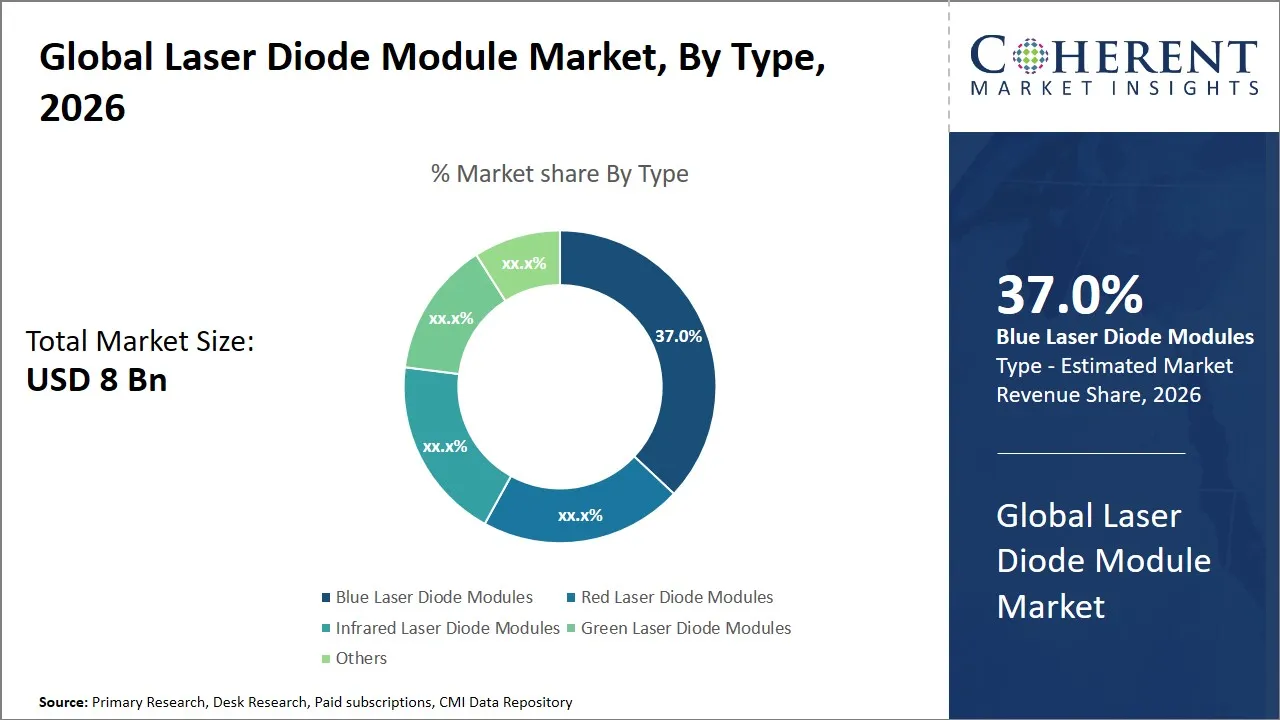
- The blue laser diode modules segment is expected to account for 37% of the laser diode module market share in 2026.
- The below 450 nm segment is estimated to hold 41% of the market share in 2026.
- The industrial segment is projected to capture 33% of the global laser diode module market share in 2026.
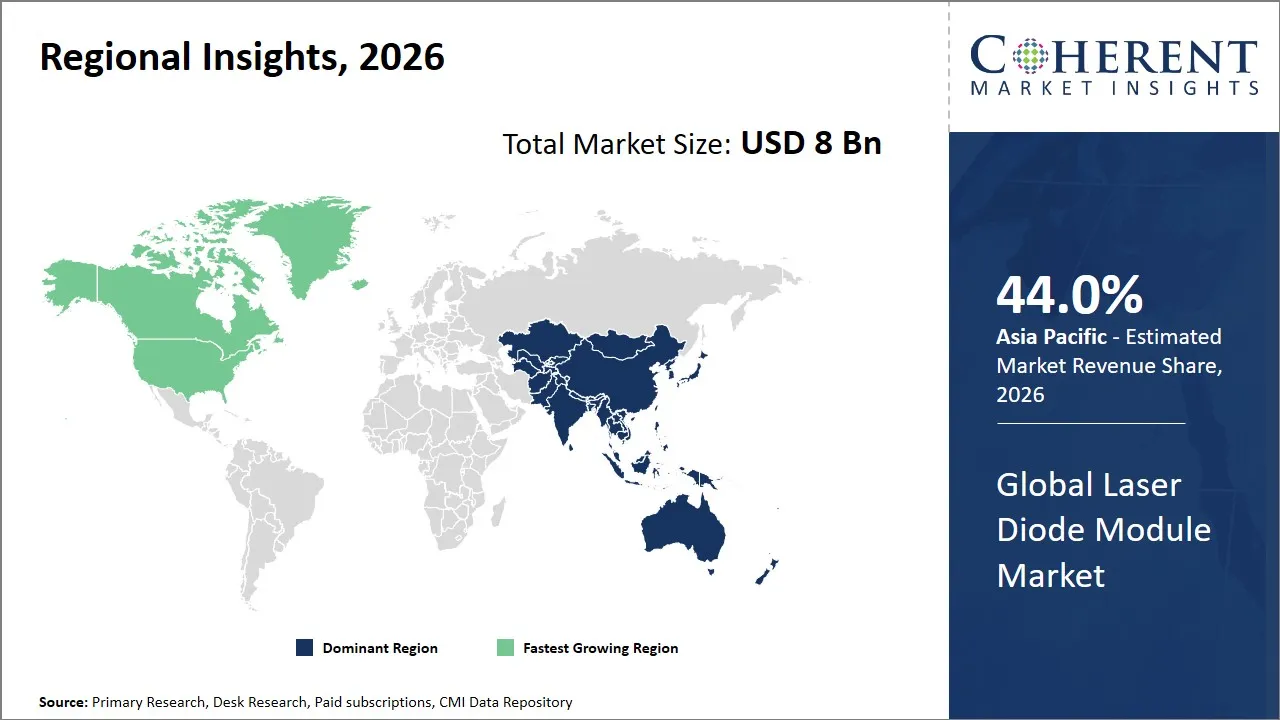
- Asia Pacific will dominate the laser diode module market in 2026 with an estimated 44% share.
- North America will hold 29% share in 2026 and is expected to record the fastest growth over the forecast period.
Current Events and Its Impact
Current Events | Description and its Impact |
Nichia BRACE Industry Recognition |
|
Segmental Insights
- Current Industry Events of 2026
- Market Size Estimation
- Regional Breakdown
- Competitive Landscape
- Customer Intelligence
- Segmental Analysis
- Pricing Analysis
- Key Market Drivers, Challenges & Future Trends
- Customized Insights Section
Why Does the Blue Laser Diode Modules Segment Dominate the Global Laser Diode Module Market in 2026?
The blue laser diode modules segment is expected to account for 37.0% of the global laser diode module market share in 2026. A major reason for expansion lies in distinct tech strengths alongside wide usability. At shorter wavelengths, blue laser diodes reach greater accuracy plus concentrated power when set against alternatives. Owing to this trait, they fit well within tasks needing fine detail, including storing data, screen displays, or healing procedures. Rising output of personal gadgets, notably Blu-ray units, projection tools, and augmented visual platforms, increases need sharply; image clarity and intensity improve noticeably under their light.
For instance, on March 5, 2025, ams OSRAM announced the launch of its new high-power blue laser diode, the PLPT9 450LC_E. This innovative product stands out with its impressive wall-plug efficiency of 43 percent and for the first time a wavelength of 455 nanometers (nm).
Below 450 nm Segment Dominates the Global Laser Diode Module Market
The below 450 nm segment is projected to account for 41.0% of the global laser diode module market share in 2026. Growth stems mainly from strong results in niche areas needing exactness at small light scales. What fits here matches well with blue laser diodes, especially those under 450 nm, offering tighter beams and cleaner output. Better control over how light meets matter comes through such sharp wavelengths - this matters deeply in health-related devices. In practice, systems using less than 450 nm appear often in eye and skin treatments relying on extreme accuracy and limited impact beyond target zones.
Why is Industrial the Most Crucial End User in the Global Laser Diode Module Market?
The industrial segment is expected to account for 33.0% of the laser diode module market share in 2026. Even with growing need, growth stems mainly from wider use of lasers in advanced manufacturing. As industries such as automotive, electronics, and precision engineering rely on small laser systems, operations like welding, cutting, marking, and inspection stay steady. Instead of shrinking, these applications hold firm due to their integration into daily processes. High accuracy combined with rapid execution defines these systems, where space savings and low discard rates matter most. Such traits support automated facilities aiming for lean output without excess resource loss.
Global Laser Diode Module Market - Replacement & Upgrade Cycle
Category | Estimate |
Typical Diode Lifetime | 25,000–50,000 hours |
Estimated Replacement Cycle | ~3–6 years |
Upgrade Cycle Considerations | 2–4 years |
Typical MTBF (Mean Time Between Failure) | ~25,000 hours |
Regional Insights
Asia Pacific Laser Diode Module Market Analysis and Trends
The Asia Pacific region is projected to lead the market with a 44% share in 2026. A rise in manufacturing volume emerges through closely connected industrial webs, where precision engineering combines with ongoing advances in technology development. Key hubs for semiconductors and electronic equipment form economic cores in regions including China, Japan, South Korea, and Taiwan.
Advancement proceeds amid policy frameworks favoring emerging industrial machinery, together with increasing investment directed at robotic assembly solutions. On top of that, widespread ownership of portable tech gear, together with broad deployment of communication grids, fuels consistent need for compact laser units.
Major firms such as Sony Corporation (Japan), Nichia Corporation (Japan), and Innolux Corporation (Taiwan) hold influential positions due to inventive development alongside collaborative partnerships, shaping regional dominance. In parallel, supportive trade frameworks under the Asia-Pacific Economic Cooperation (APEC), combined with refined local supply networks, strengthen cohesion across markets while expanding future potential.
For instance, on September 17, 2024, Sharp showcased a Laser Diode Module for Agricultural Applications, a laser diode module used for pest control and bird deterrence, as part of its 2024 innovation showcase in Tokyo, Japan.
(Source: blog.global.sharp)
North America Laser Diode Module Market Analysis and Trends
The North America region is expected to exhibit the fastest growth in the market contributing 29% share in 2026. Fueled by progress in technology, expansion appears across areas like medical systems, national security, vehicle engineering, and information transfer networks. Leading this shift, the U.S. draws strength from deep investment in research along with environments where new businesses thrive. Backed by official measures, such as budget boosts toward updating military tools and cleaner power sources, the need for powerful laser diodes rises steadily.
Companies including II-VI Incorporated, Coherent Inc., and Lumentum Holdings shape much of what happens next through persistent invention and rivalry that sharpens focus. With solid manufacturing foundations already in place, legal frameworks protecting ideas, and straightforward paths to building locally, turning discoveries into products moves quickly here. Expansion follows naturally under these conditions.
Global Laser Diode Module Market Outlook for Key Countries
Why is China Emerging as a Major Hub in the Laser Diode Module Market?
Driven forward through state-backed strategies, China’s sector advances via focused efforts on independent chipmaking and telecom growth, especially in 5G deployment. Despite differing scales, operations like San’an Optoelectronics and Wuhan Finenova shape production trends through tightly linked supply networks. Because materials move efficiently, component innovation spreads quickly - reaching automotive sensors, consumer devices, even automated industrial functions. National policy labeled “Made in China 2025” quietly supports such momentum behind specialized manufacturing growth.
Japan Laser Diode Module Market Analysis and Trends
Despite global shifts, Japan holds firm in optoelectronics due to deep-rooted engineering strengths. Firms like Nichia Corporation and Sony advance by refining compact, energy-saving laser systems over time. Backing from public initiatives in chip development adds stability to industry momentum. Owing to concentrated efforts in vehicle technology, healthcare tools, and measurement gear, standing remains resilient. Long-term direction emerges clearly within these focused domains.
Is U.S. the Next Growth Engine for the Laser Diode Module Market?
A strong network of top-tier research centers shapes how the U.S. market evolves, alongside a steady rise in new technology firms. Leading companies such as Coherent Inc., II-VI Incorporated, and Lumentum Holdings design high-performance laser diode systems used in aerospace, national security, and digital infrastructure. Federal initiatives focused on upgrading military capabilities and expanding clean energy solutions open pathways for growth in laser module development; at the same time, trade regulations favoring local production shift focus toward homegrown fabrication.
Germany Laser Diode Module Market Analysis and Trends
Fueled by precision engineering traditions, Germany's economy leans heavily on industrial automation and vehicle production. Dependable laser diode modules remain in steady demand due to these sectors. Companies such as Osram Opto Semiconductors together with Trumpf maintain strong presence here. National capabilities in exacting fabrication practices support their efforts. Progress unfolds gradually, lifted by European Union programs focused on tech growth and broader digital networks. Research funding flows into photonics along with semiconductor work where uses often connect directly to advancements in laser systems.
South Korea Laser Diode Module Market Analysis and Trends
Progress in South Korea stems largely from strength in consumer electronics and semiconductors. Though companies like Samsung Electronics collaborate with LG Innotek, attention turns to laser diodes applied in data storage, communication systems, and displays. Since government financing aids enhancements in chip manufacturing and original projects, circumstances encourage rapid integration of these optical elements.
Market Players, Key Development, and Competitive Intelligence
Key Developments
- On January 20, 2026, IPG Photonics Corporation, the global leader in fiber laser technology, announced it will showcase new and innovative laser solutions at the 2026 SPIE Photonics West Exhibition 2026, in San Francisco.
- On March 12, 2025, Coherent Corp, the leader in advanced laser technology, announced the launch of its groundbreaking 793nm pump laser diode, setting a new industry standard with an impressive 28W of reliable power and 97% polarization purity.
Top Strategies Followed by Global Laser Diode Module Market Players
Player Type | Strategic Focus | Example |
Established Market Leaders | ams OSRAM at SPIE 2025 | On January 27, 2025, ams OSRAM announced it will demonstrate how its solutions are helping improve lives at SPIE Photonics West Exhibition in San Francisco, U.S. The show is one of the world’s largest photonics technology events and includes a conference with nearly 5,000 speakers and 60 technical courses. |
Mid-Level Players | ProPhotonix at Photonics West 2026 | On January 13, 2026, ProPhotonix announced it will exhibit its latest innovations at Photonics West 2026, taking place in San Francisco, U.S. |
Small-Scale Players | Business Collaboration and Product Development | On June 4, 2024, Furukawa Electric Co., Ltd. and Nichia Corporation announced the joint development of a blue LDM with an output of 800W, which is over 1.5 times higher than the conventional product. By incorporating this blue LDM into our laser system, Furukawa Electric has achieved an output of 5kW, the world's highest level of brightness from optical fiber. |
Market Report Scope
Laser Diode Module Market Report Coverage
| Report Coverage | Details | ||
|---|---|---|---|
| Base Year: | 2025 | Market Size in 2026: | USD 8 Bn |
| Historical Data for: | 2020 To 2024 | Forecast Period: | 2026 To 2033 |
| Forecast Period 2026 to 2033 CAGR: | 10% | 2033 Value Projection: | USD 16.50 Bn |
| Geographies covered: |
| ||
| Segments covered: |
| ||
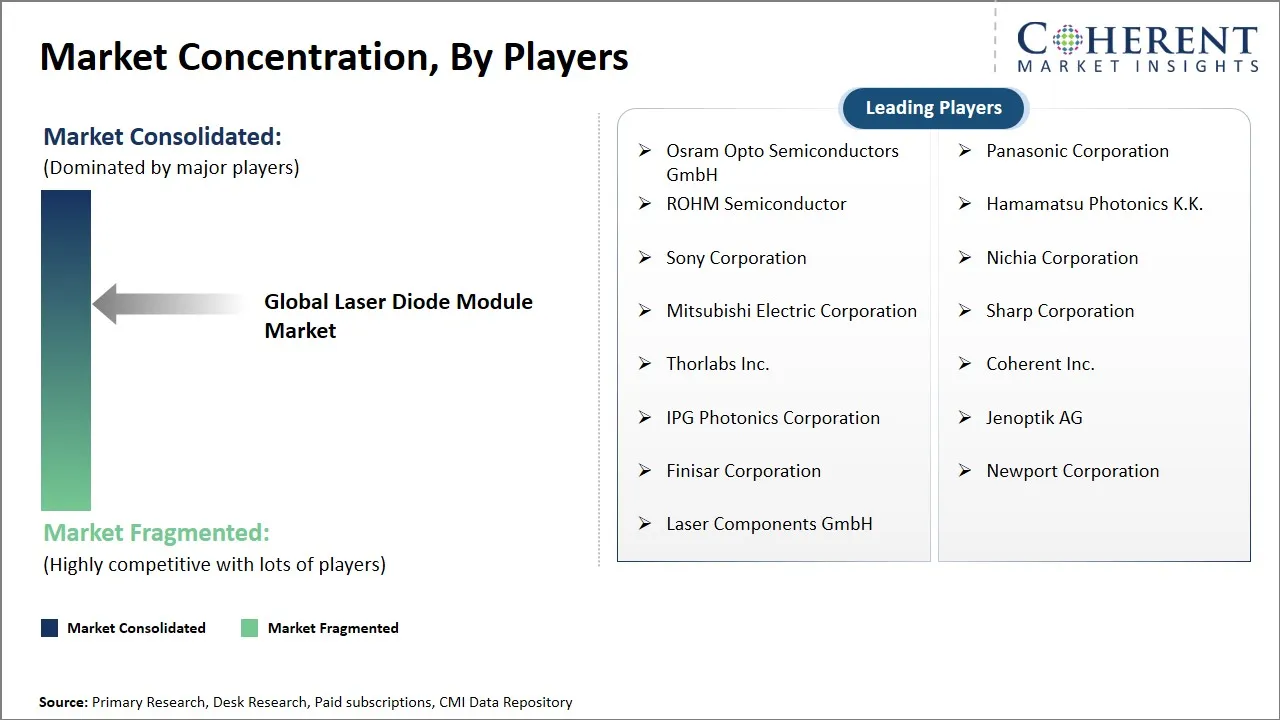
| Companies covered: | Osram Opto Semiconductors GmbH, Panasonic Corporation, ROHM Semiconductor, Hamamatsu Photonics K.K., Sony Corporation, Nichia Corporation, Mitsubishi Electric Corporation, Sharp Corporation, Thorlabs Inc., Coherent Inc., IPG Photonics Corporation, Jenoptik AG, Finisar Corporation, Newport Corporation, and Laser Components GmbH | ||
| Growth Drivers: |
| ||
| Restraints & Challenges: |
| ||
Global Laser Diode Module Market Dynamics
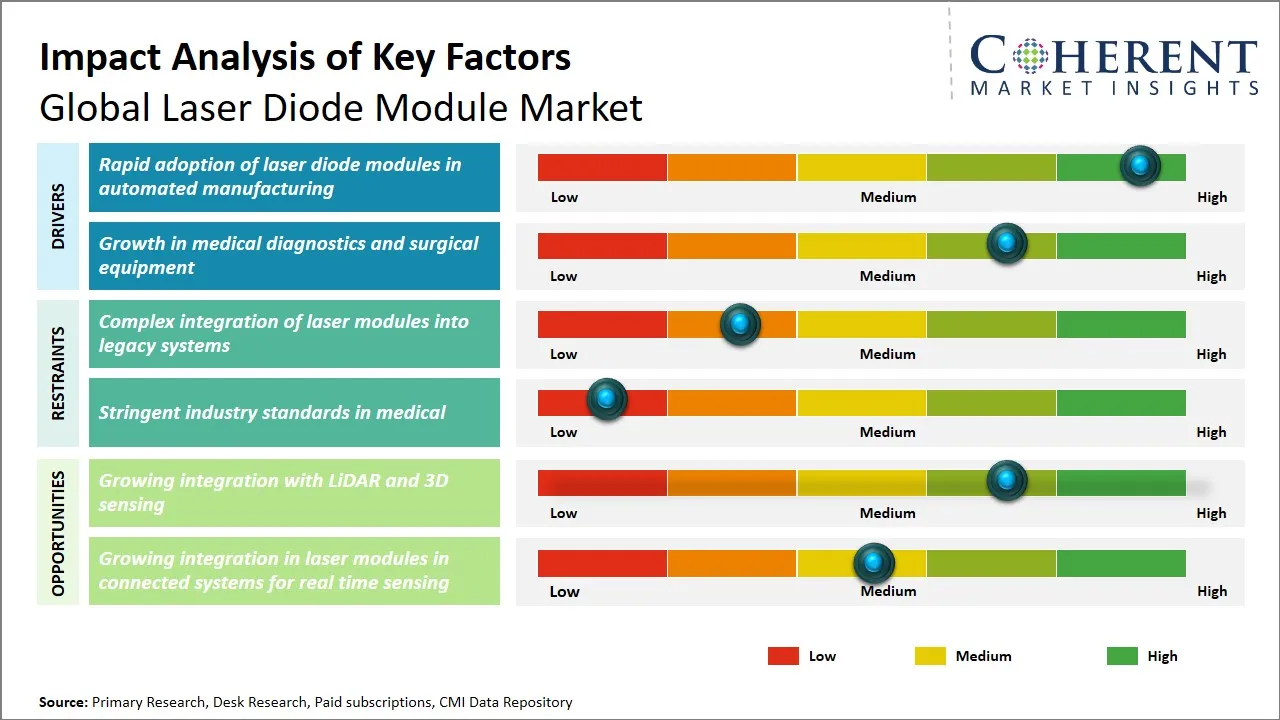
Global Laser Diode Module Market Driver - Rapid Adoption of Laser Diode Modules in Automated Manufacturing
The increasing integration of laser diode modules in automated manufacturing processes is a significant driver bolstering the demand within the global market. From tiny beams to heavy-duty tasks, laser diode modules handle work like shaping, marking, or joining materials with steady accuracy - common in today’s production setups. As they take up little space yet perform consistently under demand, these units fit well within automated processes focused on output gains alongside lower running expenses.
For instance, on August 12, 2025, FBH scientists announced they have made strong progress in an alternative approach: direct-diode AM laser modules tailored to address the shortcomings of existing systems. These advances were reported at the CLEO/Europe conference and Laser World of Photonics trade show in Munich, Germany.
(Source: fbh-berlin.de)
Global Laser Diode Module Market Opportunity - Growing Integration with LiDAR and 3D Sensing
Accurate depth detection grows more significant as LiDAR sensors and 3D sensing applications develop. autonomous vehicles, industrial robotics, and augmented reality progress pushes this shift across the worldwide laser diode module sector. Despite compact size, these units deliver high accuracy. Their efficiency in power consumption supports integration into current sensor systems. With precision comes suitability for advanced technological environments. In vehicles especially, integration of LiDAR rises steadily to improve safety functions and enable full autonomy. Such progress increases need for fast-pulsing, accurate laser diodes able to judge distances reliably. Performance under shifting conditions shapes their growing role across applications.
For instance, on January 7, 2025, ROHM developed a high output laser diode, the RLD8BQAB3, for use in ADAS (Advanced Driver Assistance Systems) equipped with LiDAR for distance measurement and spatial recognition. ROHM will initially start supplying samples targeting consumer and industrial applications such as drones, robot vacuum cleaners, AGVs (Automated Guided Vehicles), and service robots.
(Source: rohm.com)
Analyst Opinion (Expert Opinion)
- A trend of steady growth has emerged across global markets for laser diode modules, driven by increased adoption in industrial automation, medical devices, communication infrastructure, alongside consumer electronics. Owing to improvements in semiconductor fabrication techniques, such components achieve higher efficiency, occupy reduced volume, yet sustain precise optical emission - leading to cost reductions and easier integration into complex systems. Demand intensifies notably in applications including range finding, sensing mechanisms, along with fiber-optic data transmission, where reliable function within compact spaces becomes essential.
- Firms entering now focus on cost-effective offers along with personalized services, while older names stick to refined operations despite constant competition. Without stopping, progress moves forward even as consolidation happens slowly among industries. In the Asia Pacific region, making things remains strong, supported by tightly linked systems that produce electronics. Output levels there stay nearly equal to how much people use. High-end demand grows mainly in North American and European regions, especially within medical and military domains. Progress in technology offsets cost-related strain and logistical uncertainty overall. The future appears stable, shaped more by advancing uses than by shrinking margins.
Speak to the analyst
Want personalized insights?
Take the findings above to one of our principal consultants, or have the report rebuilt around the segments, geographies and competitors you actually track.
Market Segmentation
- Type Insights (Revenue, USD Billion, 2021 - 2033)
- Blue Laser Diode Modules
- Red Laser Diode Modules
- Infrared Laser Diode Modules
- Green Laser Diode Modules
- Others
- Wavelength Type Insights (Revenue, USD Billion, 2021 - 2033)
- Below 450 nm
- 450 to 650 nm
- 650 to 850 nm
- Above 850 nm
- End User Insights (Revenue, USD Billion, 2021 - 2033)
- Industrial
- Medical
- Defense
- Automotive
- Telecommunications
- Others
- Regional Insights (Revenue, USD Billion, 2021 - 2033)
- North America
- U.S.
- Canada
- Latin America
- Brazil
- Argentina
- Mexico
- Rest of Latin America
- Europe
- Germany
- U.K.
- Spain
- France
- Italy
- Russia
- Rest of Europe
- Asia Pacific
- China
- India
- Japan
- Australia
- South Korea
- ASEAN
- Rest of Asia Pacific
- Middle East
- GCC Countries
- Israel
- Rest of Middle East
- Africa
- South Africa
- North Africa
- Central Africa
- North America
- Key Players Insights
- Osram Opto Semiconductors GmbH
- Panasonic Corporation
- ROHM Semiconductor
- Hamamatsu Photonics K.K.
- Sony Corporation
- Nichia Corporation
- Mitsubishi Electric Corporation
- Sharp Corporation
- Thorlabs Inc.
- Coherent Inc.
- IPG Photonics Corporation
- Jenoptik AG
- Finisar Corporation
- Newport Corporation
- Laser Components GmbH
Sources
Primary Research Interviews
- Laser diode module manufacturers and suppliers
- Optical component distributors and retailers
- End-user industries (telecommunications, automotive, healthcare)
- Technology integrators and system developers
Databases
- Global Trade Atlas
Magazines
- Laser Focus World
- Photonics Spectra
- Optics & Photonics News
- Industrial Laser Solutions
Journals
- IEEE Journal of Quantum Electronics
- Applied Physics Letters
- Optics Express
Newspapers
- Financial Times
- The Wall Street Journal
- Reuters Business News
- MarketWatch
Associations
- Laser Institute of America (LIA)
- SPIE - The International Society for Optics and Photonics
- Optical Society of America (OSA)
- International Laser Display Association (ILDA)
Public Domain Sources:
- U.S. Patent and Trademark Office (USPTO)
- European Patent Office (EPO)
- World Trade Organization (WTO) Statistics
- National Institute of Standards and Technology (NIST)
Proprietary Elements
- CMI Data Analytics Tool
- Proprietary CMI Existing Repository of information for last 8 years
Get access to 250+ pages report
Every segment, forecast, competitor profile and data table behind the analysis above — available for instant download.
- ESOMAR Member
- ISO 9001:2015 Certified
- D-U-N-S Registered
- GDPR & CCPA Compliant
Missing comfort of reading report in your local language? Find your preferred language:
Transform your Strategy with Exclusive Trending Reports
Frequently Asked Questions
The global laser diode module market stood at USD 8 Bn in 2026 and is expected to reach USD 16.50 Bn by 2033.
The CAGR of global laser diode module market is projected to be 10% from 2026 to 2033.
Rapid adoption of laser diode modules in automated manufacturing and growth in medical diagnostics and surgical equipment are the major factors driving the growth of the global laser diode module market.
Complex integration of laser modules into legacy systems and stringent industry standards in medical are the major factors hampering the growth of the global laser diode module market.
In terms of type, blue laser diode modules are estimated to dominate the market revenue share in 2026.
Expansion of 5G and fiber-optic networks drives strong demand for laser diode modules in optical communication systems.
Customization is increasingly important as OEMs seek modules tailored to specific power, wavelength, and form-factor requirements.