

Global Laser Welding Machine Market Size and Forecast – 2026-2033
The Global Laser Welding Machine Market is estimated to be valued at USD 3.06 Bn in 2026 and is expected to reach USD 4.64 Bn by 2033, exhibiting a compound annual growth rate (CAGR) of 6.2% from 2026 to 2033.
Key Takeaways of the Global Laser Welding Machine Market
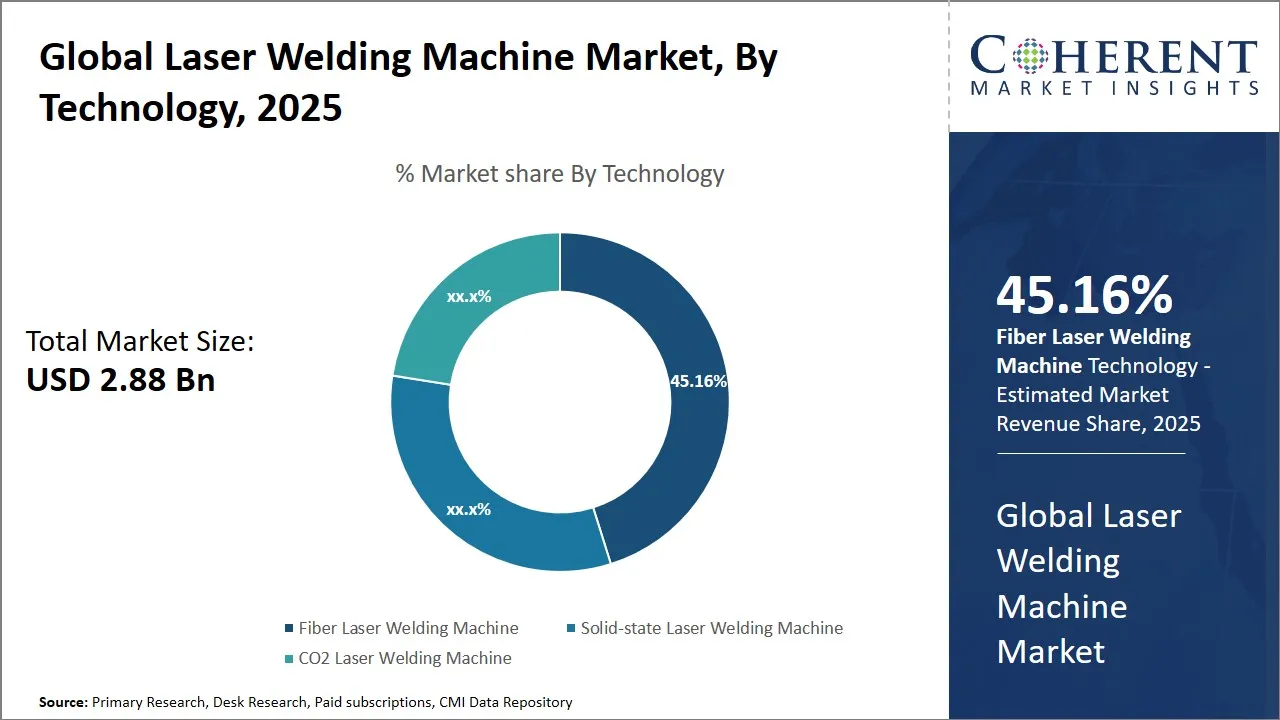
- The fiber laser welding machine segment leads the market holding an estimated share of 46.2 % in 2026.
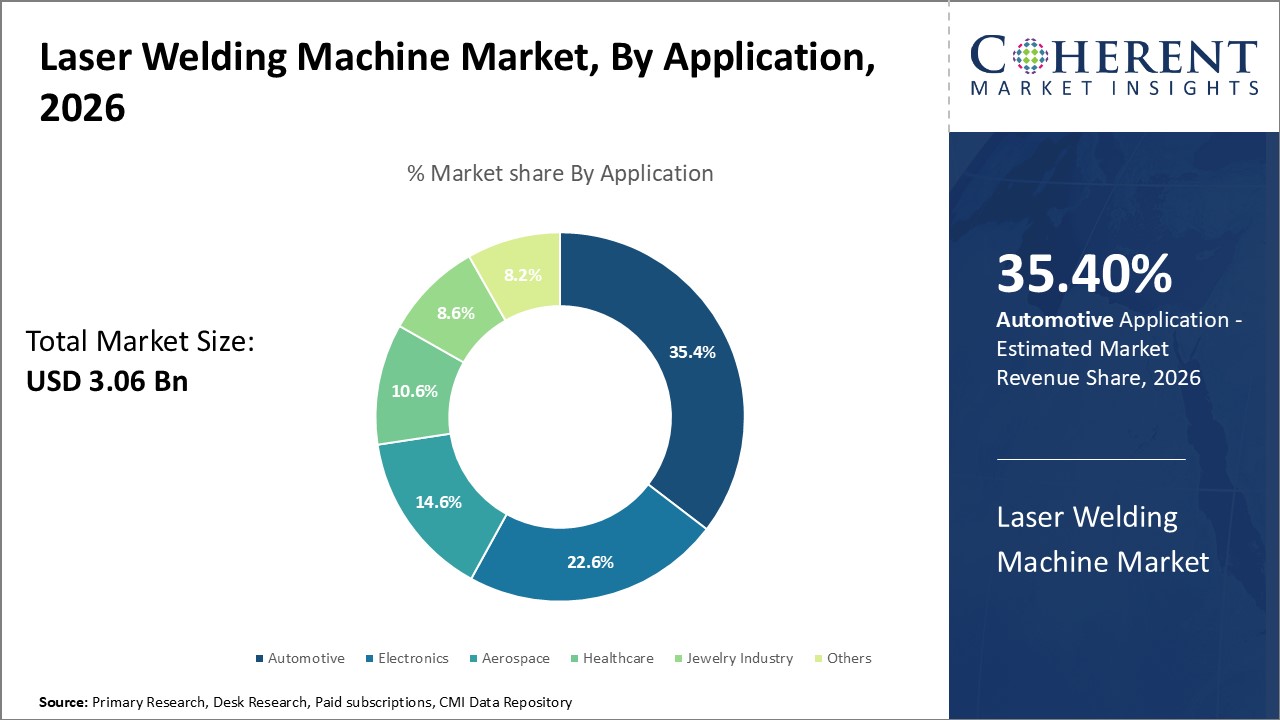
- The automotive segment dominates with an estimated share of 35.40 % in 2026.
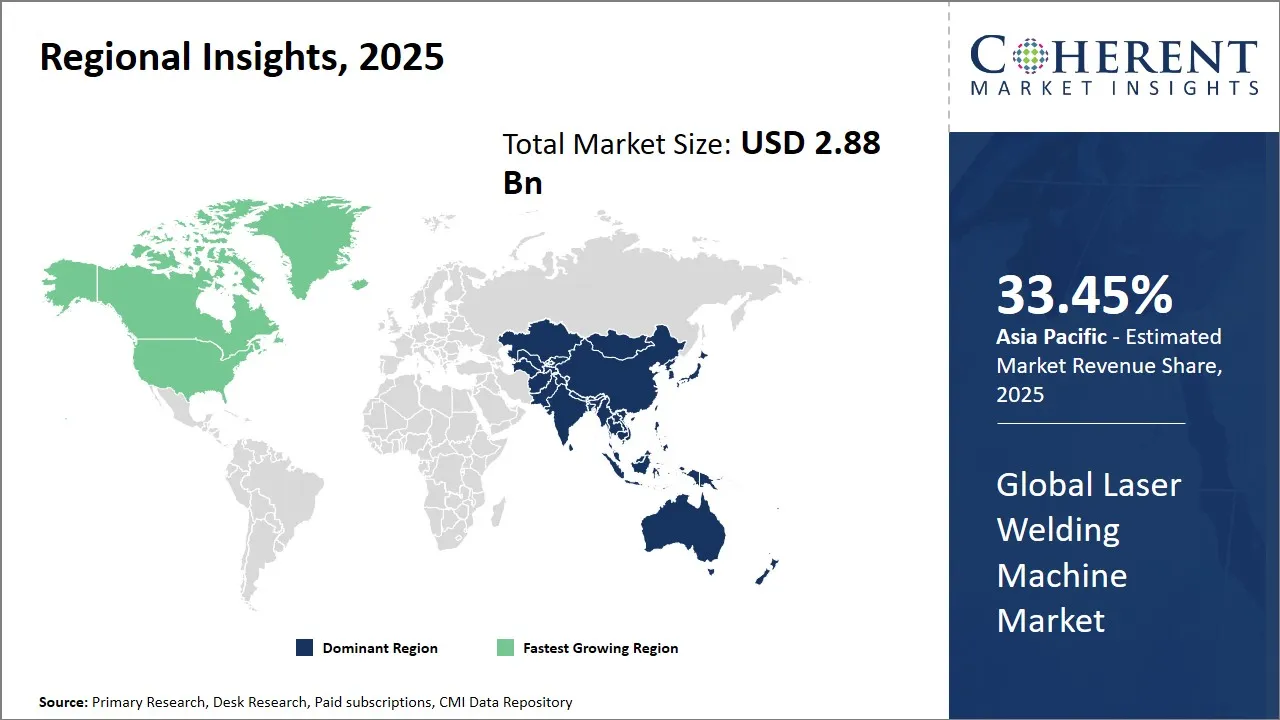
- Asia Pacific, holding a share of 33.45 % in 2026, is expected to dominate the laser welding machine market.
- North America, holding a share of 27.8 % in 2026, is projected to show the fastest growth in the laser welding machine market.
Market Overview
The market sees a big shift towards adding laser welding machines with Industry 4.0 technologies, such as IoT and AI, to enhance operational efficiency and real-time monitoring. Also, the growing preference for lightweight materials and the need for high-strength joints in automotive and aerospace sectors are making demand. The push for energy-efficient manufacturing processes is also encouraging the adoption of laser welding machines, further adding to market growth in the coming years.
Current Events and Its Impact
Current Events | Description and its impact |
Geopolitical and Trade Developments |
|
Economic & Infrastructure Trends |
|
Segmental Insights
- Current Industry Events of 2026
- Market Size Estimation
- Regional Breakdown
- Competitive Landscape
- Customer Intelligence
- Segmental Analysis
- Pricing Analysis
- Key Market Drivers, Challenges & Future Trends
- Customized Insights Section
Global Laser Welding Machine Market Insights, By Technology – Fiber Laser Welding Machine Leads Because of its Superior Precision and Efficiency
The fiber laser welding machine segment, holding 46.2% of the laser welding machine market share in 2026, is projected to dominate because of its beam quality, precision, and energy efficiency. Fiber lasers make narrow, high-quality welds with minimal heat impact—suited for complex, high-precision manufacturing. Their lower maintenance needs and ability to weld reflective metals like aluminum and copper make them indispensable in industries such as automotive and electronics.
Continuous innovations—like higher power outputs and robotic integration—further add to their market lead. In 2024, TRUMPF launched its TruLaser Weld 1000 fiber system, made for automated precision welding in automotive and electronics applications, showing ongoing innovation in this segment.
Global Laser Welding Machine Market Insights, By Application – Automotive Leads with Robust Demand Because of the Need for Lightweight, High-strength Components
The automotive segment, accounting for 35.40% of the laser welding machine market share in 2026, is expected to lead because of the rising demand for lightweight, fuel-efficient, and safe vehicles. Laser welding allows automakers to join dissimilar metals like aluminum and high-strength steel with exceptional accuracy—crucial for reducing vehicle weight and emissions.
The technology’s speed, automation compatibility, and weld integrity make it suited for large-scale automotive production and EV battery assembly. In September 2025, Tesla partnered with IPG Photonics to add high-precision fiber laser welding systems to its EV battery manufacturing lines, improving efficiency and weld strength in critical components.
Pricing Analysis of the Global Laser Welding Machine Market
Item (Product/Component/Service) | Typical Price Range (USD) |
Fiber laser source — up to 1 kW (industrial OEM module) | USD 15,000 – USD 50,000 |
Fiber laser source — 1–3 kW | USD 50,000 – USD 200,000 |
High-power fiber laser source — 4–10 kW | USD 200,000 – USD 700,000+ |
Laser welding head/processing head (precision weld head) | USD 3,000 – USD 25,000 |
Bench-top/precision Nd:YAG or small fiber welders (jewelry/repair) | USD 8,000 – USD 60,000 |
Handheld/portable fiber laser welding unit (1–3 kW portable units) | USD 3,000 – USD 50,000 |
Robotic laser welding cell (robot arm + laser + cell + controller) | USD 60,000 – USD 700,000 |
Turnkey automated battery-pack welding line (multi-station) | USD 500,000 – USD 4,000,000+ |
Laser + robot retrofitting/integration (per cell) | USD 10,000 – USD 120,000 |
OCT/in-line weld inspection/AI process-monitoring add-on | USD 15,000 – USD 120,000 |
Laser welding consumables & spare parts (per year, medium shop) | USD 2,000 – USD 50,000/year |
Installation, commissioning & operator training (per system) | USD 5,000 – USD 80,000 |
Used/refurbished industrial laser-welding machine | USD 10,000 – USD 400,000 |
Service contract/annual maintenance (percentage of CAPEX) | ~5% – 15% of equipment CAPEX per year |
Per-weld operating cost (materials/energy/consumables) — example | USD 0.005 – USD 1.50 per weld |
Annual End User CAPEX on Laser Welding Machine Market
Industry ↓ \ Region → | Asia Pacific (APAC) | Europe | North America | Rest of the World (RoW) | Industry Total (USD) |
Automotive (incl. EV battery welding) | USD 742,963,260.00 | USD 327,756,000.00 | USD 297,960,000.00 | USD 121,120,740.00 | USD 1,489,800,000.00 |
Electronics & Electrical | USD 388,986,000.00 | USD 171,600,000.00 | USD 156,000,000.00 | USD 63,414,000.00 | USD 780,000,000.00 |
Medical Devices | USD 233,391,600.00 | USD 102,960,000.00 | USD 93,600,000.00 | USD 38,048,400.00 | USD 468,000,000.00 |
Aerospace & Defense | USD 194,493,000.00 | USD 85,800,000.00 | USD 78,000,000.00 | USD 31,707,000.00 | USD 390,000,000.00 |
Jewelry & Watchmaking | USD 93,356,640.00 | USD 41,184,000.00 | USD 37,440,000.00 | USD 15,219,360.00 | USD 187,200,000.00 |
Other Industrial (energy, consumer, tooling, etc.) | USD 291,739,500.00 | USD 128,700,000.00 | USD 117,000,000.00 | USD 47,560,500.00 | USD 585,000,000.00 |
Environmental & Safety Compliance Overview – Global Laser Welding Machine Market
Compliance Area | Relevant Regulations/Standards | Description | Impact on Manufacturers/End Users |
Laser Safety & Operator Protection | ISO 11553-1/11553-2 (Safety of machinery – Laser processing machines); IEC 60825-1:2021 (Laser product safety) | Defines laser hazard classifications, enclosure design, protective housings, interlocks, emergency stop systems, and operator training requirements. | Mandates proper beam containment, eyewear, and safety interlocks; increases design and certification costs but ensures operator safety and regulatory approval for global export. |
Occupational Health & Workplace Standards | OSHA 29 CFR 1926 & 1910 Subpart I (US); EU Directive 2006/25/EC (Artificial Optical Radiation); ISO 45001 (Occupational Health and Safety) | Regulates exposure limits to optical radiation, noise, fumes, and mechanical hazards in laser welding environments. | Requires local ventilation, protective barriers, and worker training; adds operational expenses but reduces injury risks and insurance liabilities. |
Electrical and Machinery Safety | EU Machinery Directive 2006/42/EC, Low Voltage Directive (LVD), CE/UL/CSA certifications | Covers safe design, wiring, and electrical system protection in automated laser-welding equipment. | Mandatory for machine sales in the EU and North America; compliance ensures acceptance in regulated markets and lowers recall risk. |
Environmental Management & Energy Efficiency | ISO 14001:2015 (Environmental Management Systems); EU Ecodesign Directive (2009/125/EC); RoHS 3 (EU Directive 2015/863) | Encourages sustainable production, waste reduction, and restriction of hazardous substances in electronics and machinery. | Drives use of lead-free soldering, low-emission materials, and energy-efficient laser sources (e.g., fiber lasers), enhancing ESG scores and customer appeal. |
Waste Electrical & Electronic Equipment (WEEE) | EU Directive 2012/19/EU (WEEE) | Governs collection, recycling, and disposal of end-of-life laser equipment and components. | Increases responsibility for OEMs to offer take-back or recycling programs; modestly increases lifecycle management costs. |
Air Emissions & Fume Control | ISO 15011 Series (Health & Safety in Welding Fume Measurement); EPA Clean Air Act (US); REACH Regulation (EU) | Addresses laser welding fume emissions (metal vapors, ozone, particulates) and chemical substance registration. | Requires fume extraction systems and periodic monitoring; adds to CAPEX/OPEX but supports worker safety and environmental compliance. |
Radiation and Optical Hazard Labeling | ANSI Z136.1 & Z136.9 (US); IEC 60825-1 (global) | Specifies labeling, signage, and classification of laser products by emission level. | Requires hazard-class labeling (“Class 4 Laser Product”), user manuals, and site signage to prevent accidental exposure. |
Noise and Vibration Control | ISO 11201/ISO 3744 (Noise measurement); EU Directive 2003/10/EC (Noise exposure limits) | Defines acceptable sound levels and vibration limits for industrial machinery. | Promotes quieter machine designs and acoustic enclosures; minor design cost increase, improves operator comfort and workplace compliance. |
Chemical Handling (Cooling Fluids & Cleaners) | REACH (EU); OSHA Hazard Communication Standard (HCS); GHS (Globally Harmonized System) | Regulates chemical classification and labeling of coolants, solvents, and lubricants used in laser welding. | Requires proper labeling, SDS documentation, and worker training; modest cost for compliance documentation and safer coolant formulations. |
Sustainability & ESG Reporting | EU CSRD (Corporate Sustainability Reporting Directive); UN SDG Framework; ISO 26000 (Social Responsibility) | Pushes manufacturers toward transparent environmental reporting, low-carbon operations, and responsible sourcing. | Enhances brand reputation and investor trust; may require tracking carbon footprint and publishing ESG reports. |
Regional Insights
Asia Pacific Laser Welding Machine Market Analysis and Trends
Asia Pacific, holding a share of 33.45% in 2026, is expected to dominate the global laser welding machine market, driven by several interlinked factors. The region sees a strong manufacturing ecosystem, especially in countries such as China, Japan, South Korea, and India, where automotive, electronics, aerospace, and heavy industries depend a lot on precision welding technologies. Government policies in these countries emphasize industrial automation and smart manufacturing under initiatives like "Made in China 2026" and "Industry 4.0," fostering the adoption of advanced laser welding technologies.
Also, a strong presence of both domestic and multinational laser machine manufacturers, including companies like TRUMPF and Mitsubishi Electric, increases the accessibility and customization of laser welding solutions. The integrated supply chains, big manufacturing bases, and growing end-use industries add to Asia Pacific’s dominance. Trade dynamics also favor the region as many Asian countries have trade agreements making possible easier export and import of laser welding equipment and components, facilitating both production and international sales.
North America Laser Welding Machine Market Analysis and Trends
North America, holding a share of 27.8% in 2026, is expected to exhibit the fastest growth in the global laser welding machine market. This growth can be attributed to fast technological advancements and increasing demand from automotive, aerospace, defense, and medical device sectors. In the U.S. and Canada, there is an expanding shift towards high-precision and automated welding processes driven by the need for manufacturing efficiency and quality assurance. The region sees strong government support for manufacturing innovation through programs and subsidies for smart factories and clean technology, adding to investment in laser welding equipment.
Additionally, North American companies, such as Coherent Inc., IPG Photonics, and Lincoln Electric, are leading innovators in laser welding technology, introducing cutting-edge products that raise industry standards and application scopes. The region's advanced industrial infrastructure and increasing adoption in emerging application areas like battery manufacturing further add to market growth. Also, favorable trade policies and a strong domestic supply chain for high-tech components make market momentum in North America.
Global Laser Welding Machine Market Outlook for Key Countries
China Laser Welding Machine Market Analysis and Trends
China laser welding machine market grows because of a massive industrial base and government push toward digitization and automation, making it a hotspot for advanced manufacturing solutions. Chinese companies like Han’s Laser and Wuhan Golden Laser are big contributors, offering competitively priced and technologically advanced laser welding solutions. The automotive and electronics manufacturing centers in cities such as Shenzhen and Wuhan make a lot of demand. Furthermore, China’s focus on export-oriented manufacturing enhances the requirement for reliable laser welding equipment, reinforcing the market's vitality.
Japan Laser Welding Machine Market Analysis and Trends
Japan continues to lead because of its strong emphasis on R&D and precision manufacturing. Japanese corporations like Mitsubishi Electric and Panasonic are pioneers in adding laser welding machines with robotics and control systems, enhancing production line automation and accuracy. The automotive and electronics sectors’ focus on quality and miniaturization makes robust demand. Japanese industry sees government policies supporting innovation and sustainable manufacturing, which encourages continuous investment in laser welding technologies.
Germany Laser Welding Machine Market Analysis and Trends
Germany holds a strong position due to its established precision engineering and automotive industries. Companies such as Trumpf and Rofin-Sinar (now part of Coherent Inc.) contribute a lot by producing state-of-the-art laser welding machines known for reliability and high performance. The country’s commitment to Industry 4.0 and smart factory integration shows continued adoption of laser welding systems for automotive, machinery, and toolmaking sectors. Also, Germany’s strategic role as a European manufacturing hub benefits trade and supply chain dynamics improving market accessibility.
India Laser Welding Machine Market Analysis and Trends
India’s fast growing industrial sector, particularly automotive, heavy machinery, and electronics, is increasingly integrating laser welding technology to boost production efficiency and quality. Indian companies are now collaborating with global players to localize production and enhance technology transfer. Government programs focused on manufacturing growth such as "Make in India" and supportive policies for industry modernization are big factors in expanding the laser welding machine market. The emergence of automotive hubs in Maharashtra, Tamil Nadu, and Gujarat also propels the demand for sophisticated welding solutions.
Laser Source and Optics Supplier Ecosystem – Global Laser Welding Machine Market
Supplier Category | Representative Companies | Core Products/Technologies | Role in the Laser Welding Machine Ecosystem | Geographic Presence |
High-Power Fiber Laser Source Manufacturers | IPG Photonics (U.S.), nLIGHT (U.S.), Coherent Corp. (U.S.), TRUMPF Laser GmbH (Germany), Raycus Laser (China), Maxphotonics (China) | Continuous-wave (CW) and pulsed fiber lasers, high-brightness laser modules, fiber delivery systems | Provides the core light source used in precision metal welding applications, enabling high beam quality, energy efficiency, and compact integration | North America, Europe, East Asia |
Solid-State and Diode Laser Source Suppliers | Jenoptik (Germany), Lumentum (U.S.), Laserline GmbH (Germany), II-VI Incorporated (U.S.), Wuhan Chutian Laser (China) | Diode-pumped solid-state (DPSS) lasers, direct diode lasers, laser diode arrays | Supplies compact, cost-effective, and energy-efficient sources for medium-power industrial welding and hybrid systems | Europe, North America, China |
CO₂ Laser and Legacy Source Providers | FANUC (Japan), Synrad (U.S.), Universal Laser Systems (U.S.), Han’s Laser (China) | Sealed CO₂ lasers, RF-excited laser tubes, optical resonators | Serves niche markets for non-metal welding (plastics, ceramics) and older system retrofits | Asia Pacific, U.S. |
Laser Optics and Beam Delivery Components | Edmund Optics (U.S.), Thorlabs (U.S.), II-VI Optical Systems (U.S.), Zeiss Industrial Quality Solutions (Germany), OptoSigma (Japan) | Collimating lenses, beam expanders, mirrors, protective windows, isolators, fiber couplers | Supplies precision optical components that manage, shape, and protect the laser beam path | Global |
Focusing Head and Scan Optics Manufacturers | Scanlab GmbH (Germany), RayTools AG (Switzerland), Precitec GmbH (Germany), Ophir Optronics (Israel/U.S.) | Laser processing heads, 2D/3D scan systems, autofocus optics, galvo scanners | Enables accurate beam delivery, autofocus control, and scanning for high-speed welding automation | Europe, U.S., Israel |
Beam Combining and Control Module Suppliers | Focuslight Technologies (China), Powerlase (U.K.), OptoPower (U.S.), Civan Lasers (Israel) | Beam combiners, modulators, acousto-optic devices, polarization control systems | Enhances laser power scalability and precision control, critical for multi-kilowatt welding systems | Asia, Europe, North America |
Cooling System and Power Supply Providers | S&A Teyu (China), Donaldson Ultrafilter (Germany), AMETEK (U.S.), TDK-Lambda (Japan) | Industrial chillers, power converters, filters, cooling fluids | Supports stable thermal management and reliable power delivery for laser sources and optics | Global |
Protective Optics & Safety Component Suppliers | Laservision GmbH (Germany), NoIR LaserShield (U.S.), Gentex Corporation (U.S.) | Laser safety glasses, windows, beam shutters, interlock components | Ensures operator safety and compliance with IEC/ANSI laser protection standards | Europe, North America |
Laser System Integrators (Downstream OEMs) | TRUMPF, Coherent, IPG Photonics, AMADA, Bystronic, Han’s Laser | Turnkey laser welding machines, automated systems, robotic integration | Combines laser, optics, and motion systems into complete welding solutions for automotive, electronics, and aerospace sectors | Global |
Emerging Photonics Startups/R&D Providers | Nuburu (U.S.), Blue Laser Technologies (UK), BWT Beijing (China), Hyperion Optics (China) | Blue and green laser modules, micro-optics, photonic beam shaping | Innovating new wavelength and precision solutions for reflective materials (e.g., copper, aluminum) | U.S., China, U.K. |
Regional Manufacturing Output Correlation: Laser Welding Demand Vs Industrial Growth Index
Region | Industrial Growth Index (2025, est.) (Base 100 = 2020) | Avg. Manufacturing Output Growth (2023–2025) | Laser Welding Machine Demand Growth (2023–2025) | Correlation Strength (Laser Welding vs Industrial Output) | Key Contributing Industries | Interpretation |
Asia Pacific (APAC) | 138.5 | +6.8% CAGR | +9.2% CAGR | 0.89 (Very High) | Automotive, EV batteries, Electronics, Aerospace | Laser welding demand is strongly correlated with manufacturing expansion—particularly due to rapid industrialization in China, South Korea, and India. EV & electronics sectors drive above-average growth. |
Europe | 117.4 | +3.2% CAGR | +3.8% CAGR | 0.83 (High) | Automotive, Medical Devices, Precision Engineering | Stable correlation due to automation modernization and high adoption of fiber lasers in automotive & metal fabrication, but tempered by energy costs and slower industrial output. |
North America | 121.8 | +3.8% CAGR | +5.4% CAGR | 0.86 (High) | Aerospace, Automotive, Defense, Industrial Equipment | Healthy correlation as reshoring initiatives and defense manufacturing sustain laser adoption; moderate output growth offset by capex-heavy industries. |
Middle East & Africa (MEA) | 109.2 | +2.6% CAGR | +4.1% CAGR | 0.77 (Moderate–High) | Oil & Gas, Metal Fabrication, Construction Equipment | Emerging correlation due to industrial diversification (Saudi Vision 2030, U.A.E manufacturing). Growth mainly project-driven, not structural. |
Latin America | 111.5 | +2.9% CAGR | +3.7% CAGR | 0.74 (Moderate) | Automotive (Brazil, Mexico), Energy, Mining | Moderate correlation—industrial recovery in Brazil and Mexico boosts demand, but inconsistent investments limit broader adoption. |
Rest of World (RoW) | 103.8 | +1.8% CAGR | +2.5% CAGR | 0.68 (Moderate–Low) | Small-scale Metal Fabrication | Weak correlation due to fragmented markets, low automation, and limited capital investment. |
Market Players, Key Development, and Competitive Intelligence
Key Developments
- In June 2025, high-tech company, TRUMPF, made a new system solution that enables users to increase the quality and efficiency of their welding processes. The solution combines several sensors that monitor all process steps during laser welding.
- In December 2024, IPG Photonics Corporation completed its acquisition of Clean-Lasersysteme GmbH (cleanLASER), a leader in laser cleaning systems. The purchase of cleanLaser strengthens IPG’s global position in high-precision laser systems for cleaning applications by bringing additional know-how, complementary market exposure, and product and technology synergies.
- In October 2024, Coherent Corp., a global leader in industrial laser technology, announced the launch of the EDGE FLTM high-power fiber laser series, made for cutting applications in the machine tool industry.
- In May 2024, IPG Photonics Corporation, the world leader in fiber laser solutions, announced the launch of an automated cobot laser welding and cleaning system for fabrication and manufacturing industries.
Top Strategies Followed by Laser Welding Machine Market Players
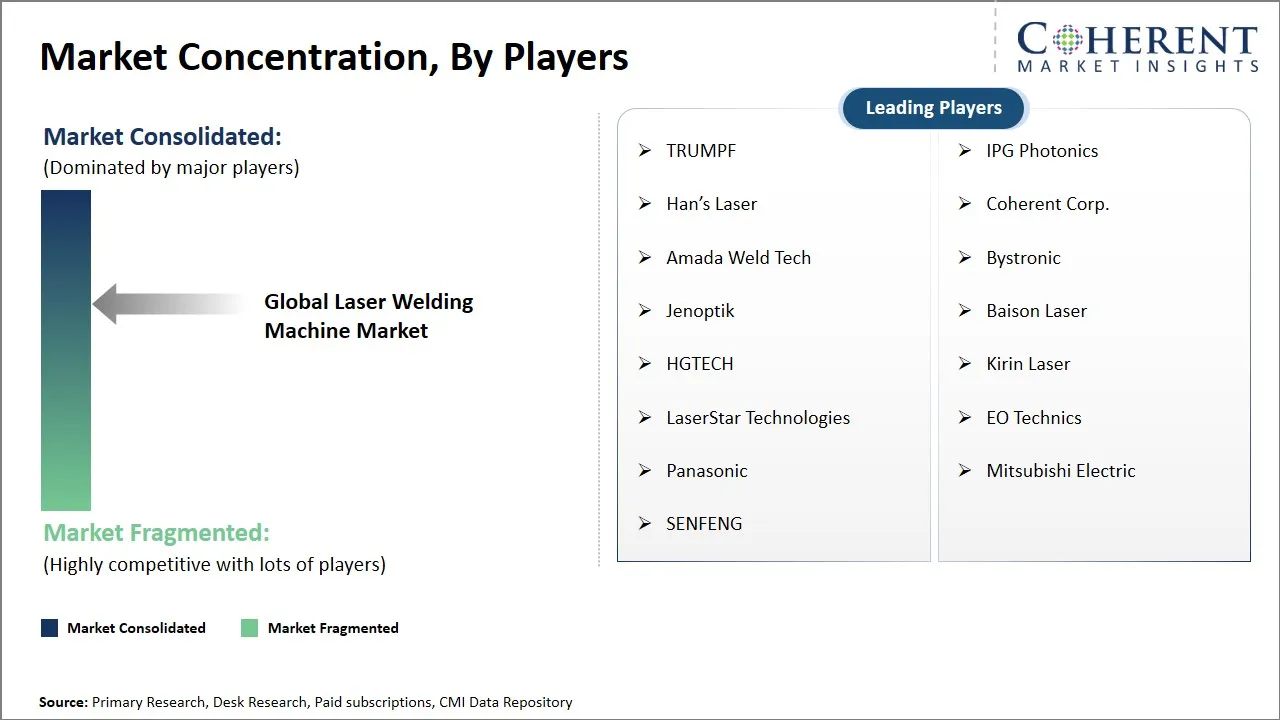
- Established players dominate the landscape through huge investments in research and development (R&D).
- TRUMPF’s high R&D expenditure (≈10% of annual revenue) focuses on AI-driven laser control and smart factory integration. In 2024, TRUMPF launched its TruLaser Weld 1000 and 7000 systems with AI-based seam tracking and integrated laser beam oscillation for improved welding precision and reduced rework time.
- Mid-level players in the laser welding machine industry use a more balanced approach by focusing on cost-effective solutions that do not compromise quality.
- Han’s Laser uses economies of scale and domestic supply chain strength to deliver affordable yet reliable welding machines, positioning itself between premium European brands and low-cost regional entrants.
- Small-scale players differentiate themselves by focusing on specialized laser welding machine features or making innovative products tailored to specific applications or industries.
- Nuburu differentiates itself through wavelength innovation, addressing limitations of infrared lasers on reflective metals — a fast growing niche in electrification manufacturing.
Market Report Scope
Laser Welding Machine Market Report Coverage
| Report Coverage | Details | ||
|---|---|---|---|
| Base Year: | 2025 | Market Size in 2026: | USD 3.06 Bn |
| Historical Data for: | 2020 To 2024 | Forecast Period: | 2026 To 2033 |
| Forecast Period 2026 to 2033 CAGR: | 6.2% | 2033 Value Projection: | USD 4.64 Bn |
| Geographies covered: |
| ||
| Segments covered: |
| ||
| Companies covered: | TRUMPF, IPG Photonics, Han’s Laser, Coherent Corp., Amada Weld Tech, Bystronic, Jenoptik, Baison Laser, HGTECH, Kirin Laser, LaserStar Technologies, EO Technics, Panasonic, Mitsubishi Electric, and SENFENG | ||
| Growth Drivers: |
| ||
| Restraints & Challenges: |
| ||
Market Dynamics
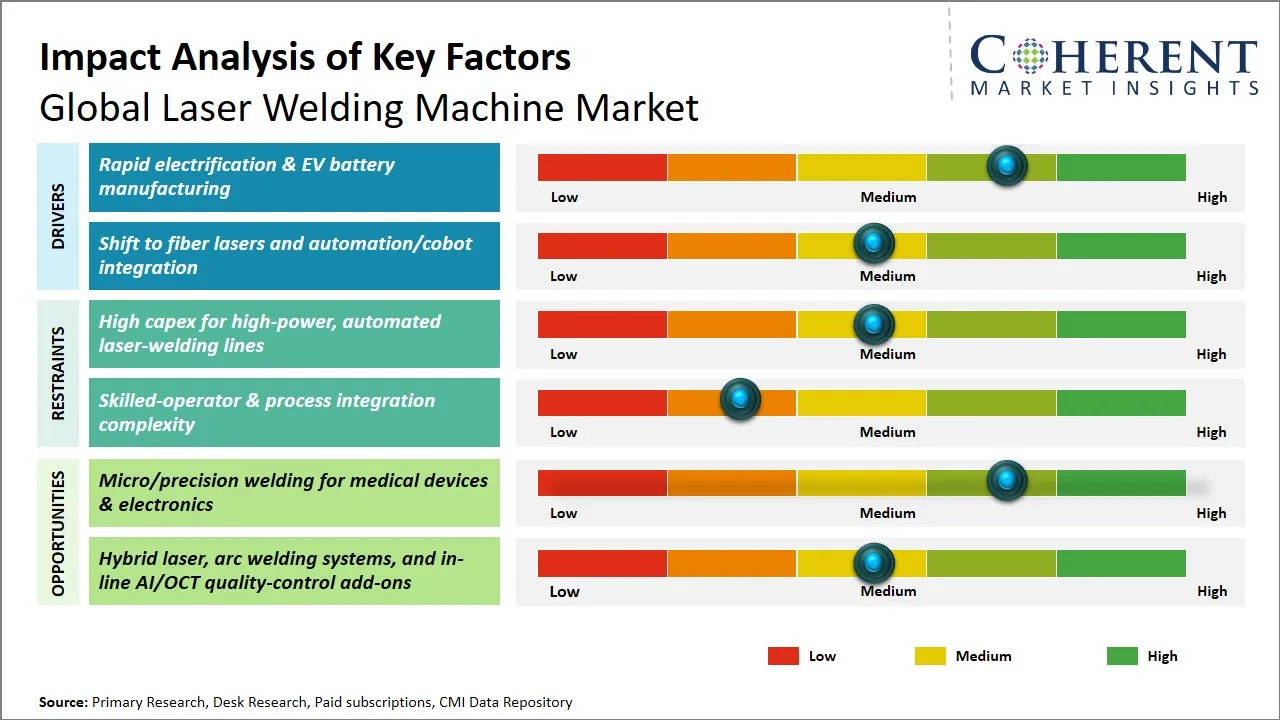
Global Laser Welding Machine Market Driver – Rapid Electrification & EV Battery Manufacturing
The accelerating shift toward electric vehicles (EVs) is fueling the demand for precision welding technologies. EV battery production needs accurate, contamination-free joints for components like battery tabs, busbars, and housings, where laser welding ensures high-speed, distortion-free results for aluminum and copper parts.
In 2024, Tesla and Panasonic expanded their Nevada Gigafactory with TRUMPF fiber laser systems for automated battery pack welding, improving precision and production efficiency.
Global Laser Welding Machine Market Opportunity – Expansion of Micro and Precision Welding in Medical Devices and Electronics
The rise of miniaturized medical and electronic devices is creating strong opportunities for micro and precision laser welding. These systems deliver clean, low-heat welds essential for implants, sensors, and microcircuits. IPG Photonics partnered with Medtronic in 2023 to deploy micro-laser welding systems for next-generation surgical instruments, enabling faster production and enhanced joint reliability in minimally invasive devices.
Analyst Opinion (Expert Opinion)
- Despite their unmatched precision and efficiency, laser welding systems remain prohibitively expensive for small and mid-sized manufacturers. The combination of costly laser sources, and optics continues to deter widespread adoption, particularly in emerging markets. Without scalable, modular pricing models, market penetration beyond large industrial players will remain slow.
- The market faces a persistent skills gap in laser process optimization and system maintenance. Unlike traditional welding, laser-based systems demand expertise in optics alignment, beam parameter tuning, and software control. This dependency on specialized labor often leads to operational inefficiencies and higher downtime — a clear bottleneck for manufacturers pursuing automation.
- The laser source and optics supply chain remains heavily concentrated in Europe, the U.S., and China, making the market sensitive to geopolitical disruptions and export restrictions. Any strain in the photonics or semiconductor supply line — such as during recent U.S.–China technology tensions — can significantly impact lead times, pricing, and innovation cycles across the entire ecosystem.
Speak to the analyst
Want personalized insights?
Take the findings above to one of our principal consultants, or have the report rebuilt around the segments, geographies and competitors you actually track.
Market Segmentation
- Technology Insights (Revenue, USD Bn, 2021 - 2033)
- Fiber Laser Welding Machine
- Solid-state Laser Welding Machine
- CO2 Laser Welding Machine
- Application Insights (Revenue, USD Bn, 2021 - 2033)
- Automotive
- Electronics
- Aerospace
- Healthcare
- Jewelry Industry
- Others
- Regional Insights (Revenue, USD Bn, 2021 - 2033)
- North America
- U.S.
- Canada
- Latin America
- Brazil
- Argentina
- Mexico
- Rest of Latin America
- Europe
- Germany
- U.K.
- Spain
- France
- Italy
- Russia
- Rest of Europe
- Asia Pacific
- China
- India
- Japan
- Australia
- South Korea
- ASEAN
- Rest of Asia Pacific
- Middle East
- GCC Countries
- Israel
- Rest of Middle East
- Africa
- South Africa
- North Africa
- Central Africa
- North America
- Key Players Insights
- TRUMPF
- IPG Photonics
- Han’s Laser
- Coherent Corp.
- Amada Weld Tech
- Bystronic
- Jenoptik
- Baison Laser
- HGTECH
- Kirin Laser
- LaserStar Technologies
- EO Technics
- Panasonic
- Mitsubishi Electric
- SENFENG
Sources
Primary Research Interviews
Stakeholders
- Laser Welding Machine Manufacturers and Integrators (e.g., TRUMPF, IPG Photonics, Coherent Corp., Han’s Laser)
- Laser Component and Optics Suppliers (e.g., Jenoptik, II-VI, Raycus Laser)
- Industrial Automation and Robotics Integrators (e.g., FANUC, ABB, KUKA)
- Automotive OEMs and EV Battery Manufacturers (e.g., Tesla, BYD, Volkswagen Group)
- Aerospace and Defense Equipment Manufacturers
- Medical Device and Electronics OEMs (e.g., Medtronic, Bosch, Sony)
- Contract Manufacturing and Metal Fabrication Firms
- Laser Safety and Regulatory Consultants
- Photonics Research Institutes and University Laboratories
Databases
- UNIDO Industrial Statistics Database
- World Manufacturing Output Database (WMD)
- OECD Industrial Production and Technology Indicators
- Eurostat Manufacturing and Equipment Index
- U.S. Bureau of Labor Statistics (BLS) – Machine Tools & Fabrication Segment
- Japan Photonics Industry Database (JPID)
- China National Industrial Equipment Database (CNIED)
Magazines
- Industrial Laser Solutions
- Laser Focus World
- Photonics Spectra
- Manufacturing Global
- Metal Forming & Fabrication Magazine
- Automotive Manufacturing Solutions (AMS)
Journals
- Journal of Laser Applications
- Optics and Lasers in Engineering
- Journal of Manufacturing Processes
- Materials & Design Journal
- Welding Journal (AWS)
- IEEE Transactions on Industrial Electronics
Newspapers
- The Engineer (UK)
- Manufacturing Weekly (US)
- Nikkei Asia Industry News
- China Daily Business
- The Economic Times (India)
- Financial Express Manufacturing Edition
Associations
- Laser Institute of America (LIA)
- European Photonics Industry Consortium (EPIC)
- Optoelectronics Industry Development Association (OIDA)
- American Welding Society (AWS)
- German Engineering Federation (VDMA – Laser and Laser Systems Division)
- Japan Laser Processing Society (JLPS)
Public Domain Sources
- World Bank – Global Manufacturing and Technology Reports
- United Nations Industrial Development Organization (UNIDO)
- EUROSTAT – Machinery and Industrial Equipment Statistics
- U.S. Energy Information Administration (EIA) – Manufacturing Sector Data
- ResearchGate Publications – Laser Welding Applications
- OECD Science, Technology and Industry Outlook
Proprietary Elements
- CMI Data Analytics Tool, Proprietary CMI Repository of information for the last 8 years
Get access to 250+ pages report
Every segment, forecast, competitor profile and data table behind the analysis above — available for instant download.
- ESOMAR Member
- ISO 9001:2015 Certified
- D-U-N-S Registered
- GDPR & CCPA Compliant
Missing comfort of reading report in your local language? Find your preferred language:
Transform your Strategy with Exclusive Trending Reports
Frequently Asked Questions
The global laser welding machine market is estimated to be valued at USD 3.06 billion in 2026 and is expected to reach USD 4.64 billion by 2033.
The CAGR of the global laser welding machine market is projected to be 6.2% from 2026 to 2033.
Rapid electrification & EV battery manufacturing and shift to fiber lasers and automation/cobot integration are the major factors driving the growth of the global laser wielding machine market.
High capex for high-power, automated laser-welding lines and skilled-operator & process integration complexity are the major factors hampering the growth of the global laser wielding machine market.
In terms of technology, fiber laser welding machine is estimated to dominate the market revenue share in 2026.
Manufacturers are introducing modular systems, automation, and AI-based monitoring to improve efficiency and lower lifecycle costs.
It offers faster processing speeds, superior accuracy, and lower heat distortion, but at higher initial investment.