

Global LED Car Screen Market Size and Forecast – 2026 To 2033
The global LED car screen market is expected to grow from USD 6.05 Bn in 2026 to USD 13.10 Bn by 2033, registering a compound annual growth rate (CAGR) of 7.7% from 2026 to 2033. The global LED car screen market is driven by increasing demand for dynamic high brightness vehicle mounted advertising. On August 20, 2024, Adonix launched a digital cartop platform using high-definition LED screens on taxis, rideshare vehicles, and transit vehicles, supported by real-time vehicle tracking and display-management software.
Key Takeaways of the Global LED Car Screen Market
- The Full Color segment is expected to account for 46.0 % of the global LED car screen market share in 2026. Increasing adoption of full color LED screens over static advertising is driving the growth of the segment. On May 20, 2026, Huawei demonstrated its updated XPixel smart-headlight system at the 2026 Beijing Auto Show with full RGB projection capable of displaying images of up to 100 inches on nearby surfaces.
- The Passenger Vehicles segment is estimated to capture 54.0 % of the market share in 2026 Increasing integration of LED screens with GPS IoT and cloud based content management is majorly driving the growth of the segment. On February 23, 2026, Motio acquired a 13.33% stake in Adonix launched Motio Drive using digital taxi-top screens capable of location-based advertising as vehicles move through Sydney. The network was already operating on 40 taxis.
- The Rear Mounted LED Screens segment is estimated to capture 38.0 % of the market share in 2026. Growing demand for real time route traffic and public information displays is majorly driving the growth of the segment. On June 24, 2026, Pysae introduced a passenger display screen in July 2025 designed to provide live transport information without requiring passengers to install an application.
- Asia Pacific is expected to dominate the LED Car Screen market in 2026 with a market share of 38.0 %. Expansion of full color LED screens in Asia Pacific is driving the growth of the regional market. For instance, Proluxon offers double-sided dynamic taxi-top LED displays across P2, P2.5, P3.33, P4, and P5 configurations, with wireless transmission through 4G and Wi-Fi.
- North America is expected to account for 25.0% share in 2026 and is projected to record the fastest growth over the forecast period. Integration with smart city communication networks in North America is driving the growth of the regional market. On March 17, 2026, GMV was awarded a USD 43 million contract to continue providing technology for Los Angeles DASH and Commuter Express through 2030, including fleet modernization, advanced digital signage, and real-time passenger information.
Segmental Insights
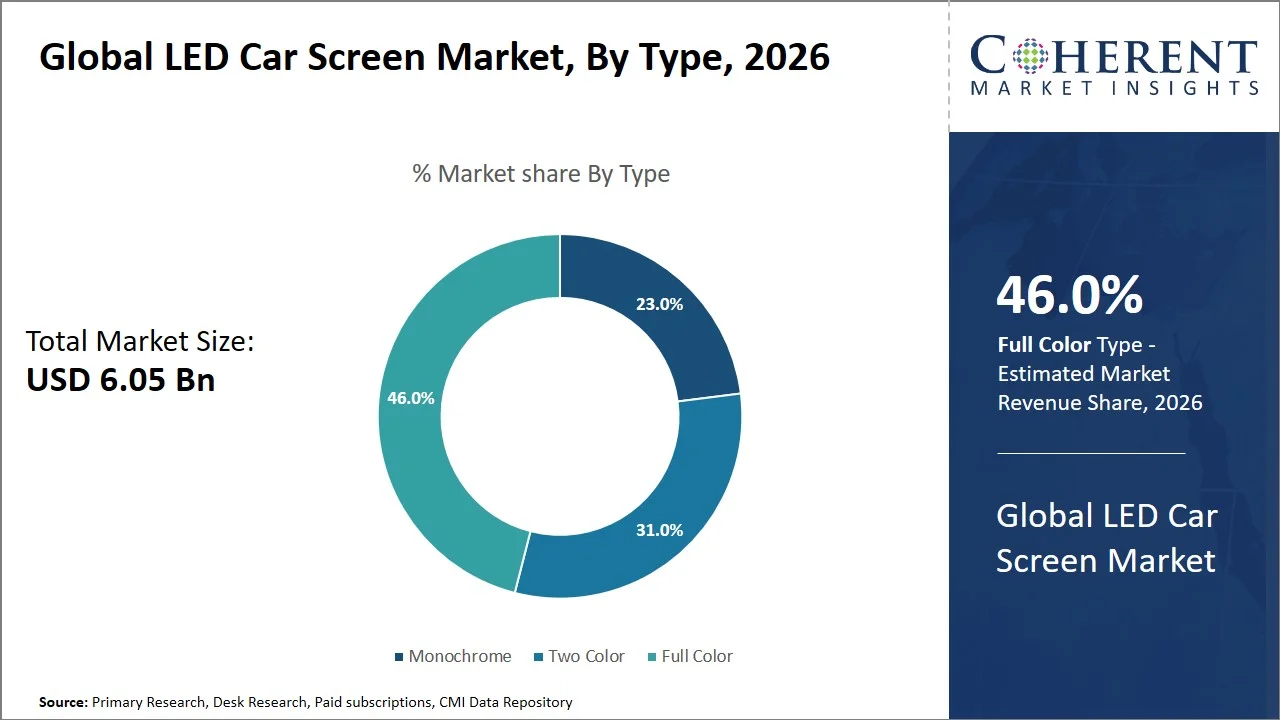
Why Does Full Color Dominate the Global LED Car Screen Market?
The full color segment is expected to account for 46.0% of the global LED car screen market share in 2026. Full color leads the worldwide LED car screen market since it offers more visual impact and greater flexibility for dynamic content than the monochrome and two-color displays. Full-color displays are particularly appropriate for taxi advertising, busses and commercial fleets that operate in high-traffic metropolitan locations, since vibrant advertisements, route information, brand images, movies and real-time messages may all be reproduced. It also enables marketers and fleet operators to change content remotely and adjust messages to location, time or audience, enhancing the commercial potential of vehicle-mounted displays. On April 25, 2025, Hyundai Mobis showcased Communication Lighting on its MOBION technology vehicle at the 2025 Seoul Mobility Show. When a pedestrian is identified, the light signals on the front bumper interact with pedestrians and reflect a crossing pattern onto the road.
- Current Industry Events of 2026
- Market Size Estimation
- Regional Breakdown
- Competitive Landscape
- Customer Intelligence
- Segmental Analysis
- Pricing Analysis
- Key Market Drivers, Challenges & Future Trends
- Customized Insights Section
Why is Passenger Vehicles the Most Crucial Vehicle Type?
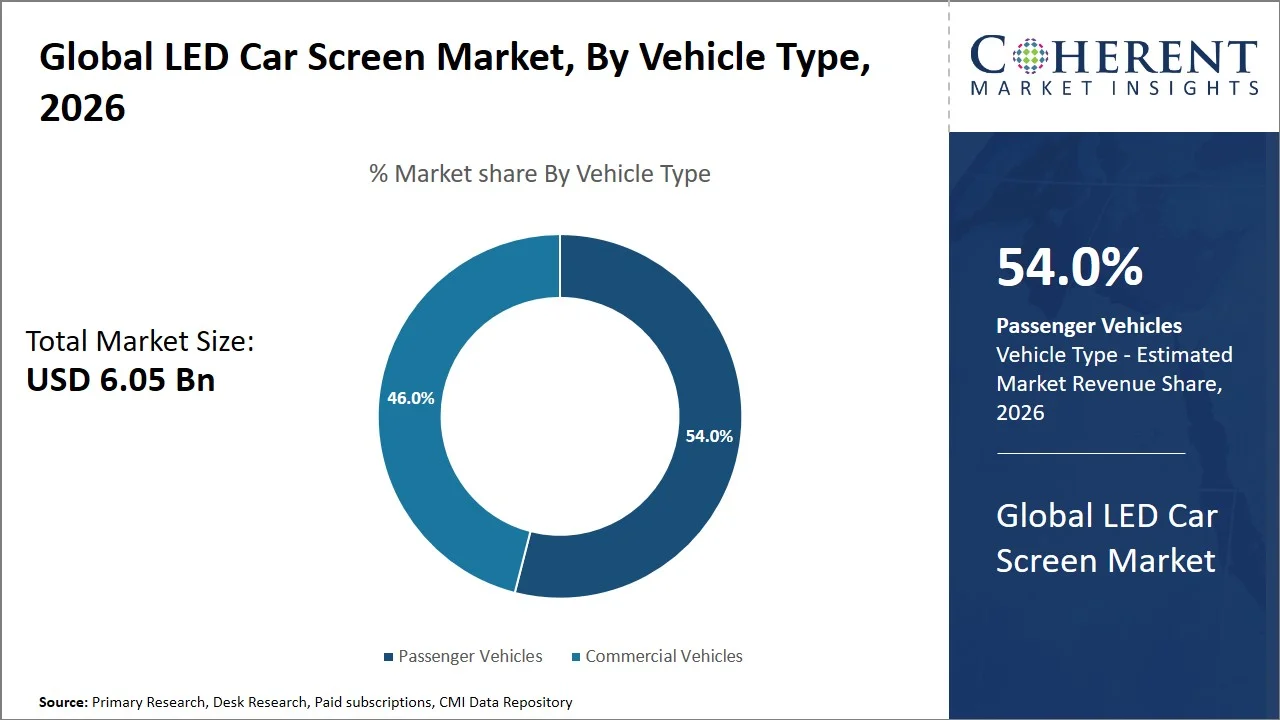
The passenger vehicles segment is expected to account for 54.0% of the global LED car screen market share in 2026. Passenger vehicles are an important vehicle type as the high operating frequency and wide movement across urban and commercial areas provide continuous exposure for the digital material shown on the vehicle. Long durations in high population areas make ride-hailing, taxi, corporate mobility and commercial transportation cars ideal for LED screens to target different audiences throughout the day. Their relatively small size also allows them to be installed flexibly on the back, on the roof or on the side sections which makes passenger vehicles viable for targeted advertising, navigation-related information and real-time communication applications. On January 5, 2026, Uber and Lucid announced that they are preparing electric autonomous SUVs for commercial ride-hailing operations in the San Francisco Bay Area. The vehicles will be configured to carry up to six passengers and offer substantially more passenger and luggage space than conventional robotaxi configurations.
Rear Mounted LED Screens Dominates the Global LED Car Screen Market
The rear mounted LED screens segment is expected to account for 38.0% of the global LED car screen market share in 2026. Most applications prefer rear-mounted LED screens as they offer a good viewing angle for drivers and pedestrians behind the car, especially in busy urban traffic where vehicles are in the same view for long periods. This placement provides an ideal display platform for advertisements, route information, safety messages and real-time public information without considerably obscuring the side profile or forward visibility of the vehicle. The back surface also provides ample room for high brightness full color LED modules, guaranteeing good visibility during both daytime and evening operations. On November 27, 2025, Linsn released a rear-window LED display for vehicles, cabs and busses with a transparent design, 3,000-7,000 nits brightness, IP65 protection, wireless content control and automated brightness adjustment.
Current Events and their Impact
Current Events | Description and its Impact |
China Advertising Restrictions For Advanced Driving Assistance Claims, 2025 |
|
India Outdoor Advertising Safety and Structural Requirements |
|
LED Car Screen Market Dynamics
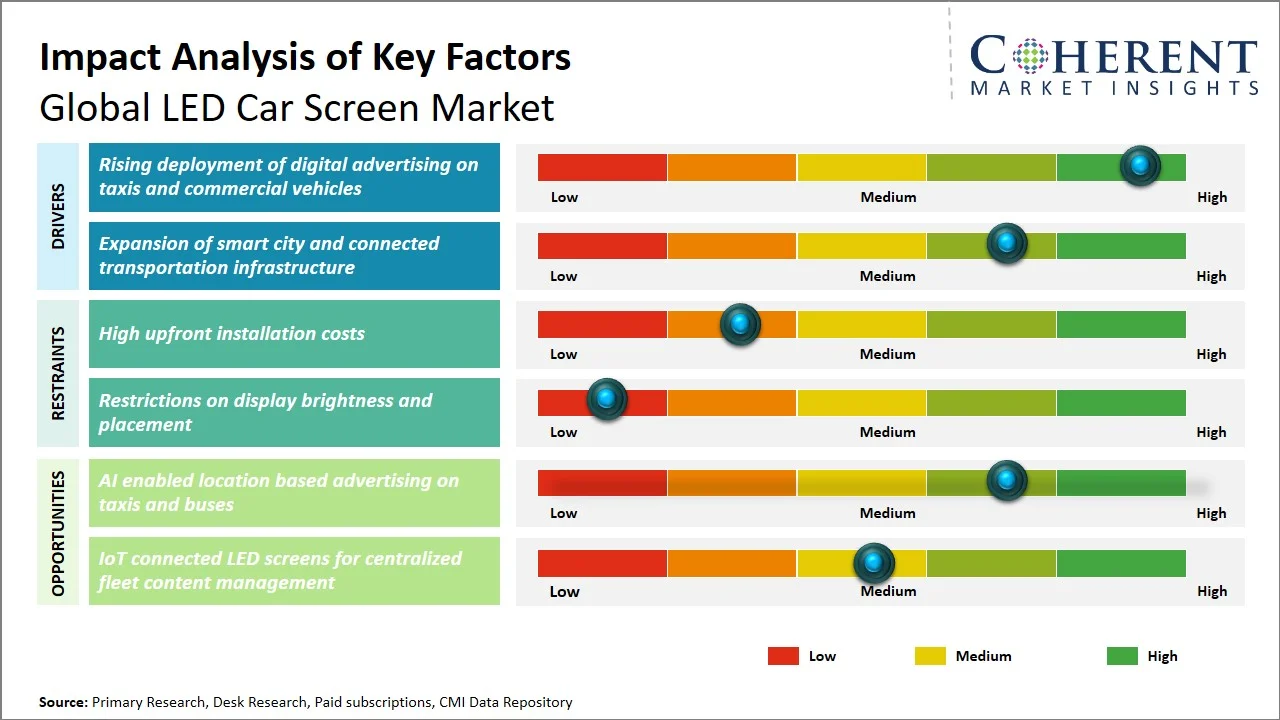
Market Drivers
- Rising deployment of digital advertising on taxis and commercial vehicles: The rising deployment of digital advertising on taxis and commercial vehicles is creating demand for LED car screens, as these vehicles provide advertisers continuous exposure across high-traffic urban locations rather than limiting campaigns to fixed advertising structures. Full-color rear and roof-mounted LED screens are particularly attractive to brands looking for flexible outdoor advertising formats as taxi fleets, ride-hailing vehicles, delivery vans and busses can carry dynamic advertisements that can be remotely updated by location, time or campaign needs. In July 2025, Adonix worked with Affinity on a digital rooftop campaign for Posca Hydrate, where cabs traveled around metropolitan areas and showed the nearest retailer and real-time distance to the viewer.
- Expansion of smart city and connected transportation infrastructure: The emergence of smart city and connected transportation infrastructure is opening up new applications of LED car screens in addition to traditional advertising, as it allows vehicles to operate as mobile information platforms. LED displays on connected busses, taxis, emergency vehicles and municipal fleets can display route information, traffic alerts, public-service messages, emergency instructions and location-specific information, and integration with GPS, IoT platforms and centralized fleet-management systems allows for remote content updates synchronized with real-time transportation conditions. On June 5 2025, Qualcomm Technologies, Inc. completed the acquisition of Autotalks, an industry leader in direct vehicle-to-everything (V2X) communication solutions. Through this acquisition, automakers and the broader ecosystem will gain access to a comprehensive portfolio of production-ready, automotive-qualified global V2X solutions for deploying in roadside infrastructure, vehicles, as well as 2-wheelers.
Emerging Trends
- Integration of AI and location-based advertising: Vehicle-mounted LED screens are increasingly being connected with AI-driven advertising platforms that can use vehicle location, traffic conditions, time of day, and audience characteristics to determine which content should be displayed, improving the relevance of campaigns across taxi and commercial vehicle
- Shift toward high-resolution full-color and mini led displays: Manufacturers are moving to higher pixel densities, better brightness control, and mini led technologies to deliver sharper graphics and video while maintaining visibility under varying outdoor lighting conditions, creating opportunities for more sophisticated outdoor advertising and information applications.
- Integration with connected vehicle and smart city platforms: LED car screens are increasingly being seen as communication interfaces in connected transportation ecosystems, enabling busses, taxis, emergency vehicles and municipal fleets to receive centrally managed content for route information, traffic alerts, public announcements and emergency communications.
- Growth of multifunctional vehicle displays: LED systems mounted on vehicles are evolving from pure advertising solutions to multi-functional platforms that merge commercial advertising with passenger information, public safety messages, fleet communication and real-time notifications, increasing the utilization and commercial value of each installed display.
Regional Insights
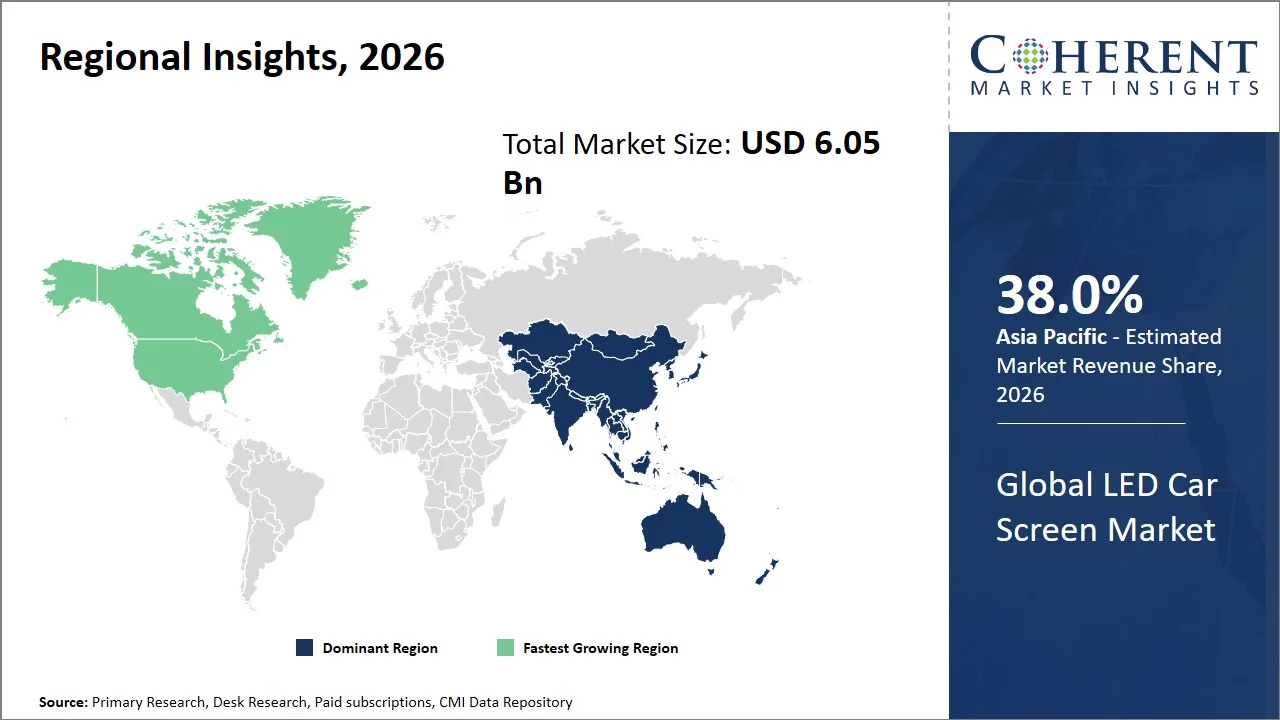
Why is Asia Pacific a Strong Market for LED Car Screen?
Asia Pacific is expected to account for a market share of 38.0% in 2026. Asia Pacific is exploiting the confluence of big taxi and ride-hailing fleets, intense urban traffic and quick deployment of digital out-of-home advertising, with China, India, Japan and South Korea each being unique demand centers. LytAds is installing high resolution LED screens on the roofs and supports of taxi and ridesharing vehicles in India and conducting campaigns based on location, time, weather and events. Delhi is also developing bus shelters with LED boards for route and bus number information. South Korea has also been the focus of machine-learning research predicting the next position of a taxi, using rooftop taxi advertising as a test case, reflecting the country’s focus on data-driven targeted mobile advertising. The region is therefore developing both advertising-led and transportation-information applications rather than relying on a single use case.
Why Does North America LED Car Screen Market Exhibit High Growth?
North America is expected to register the fastest growth with a CAGR of 8.5% over the forecast period. North America is projected to account for 25.0% of the global LED car screen market in 2026. North America is backed by a well-established digital-out-of-home advertising ecosystem and the ability to monetize car fleets through location-specific advertising, especially in large metropolitan areas. In New York and San Francisco, for example, digital taxi advertising is already operational, but the technology is progressively trending toward location-based targeting instead of static branding on vehicles. The region's opportunity is further strengthened by the commercial value of premium urban audiences, where taxis and fleet vehicles can act as continuously moving advertising assets across airports, business districts, entertainment zones, and major events. This creates demand for bright, remotely managed LED systems capable of delivering different campaigns as vehicles move between high-value locations.
Global LED Car Screen Market Outlook for Key Countries
Why is China Emerging as a Major Hub in the LED Car Screen Market?
China has a particularly strong growth base because vehicle-mounted displays are being integrated with the country's highly regulated taxi and outdoor-advertising environment, while its domestic LED manufacturing ecosystem provides access to display modules, controllers, and related electronics. Local transport regulations suggest LED screens are already being integrated into taxi roof-lighting systems. Chongqing’s taxi standards require an LED status display integrated with the vehicle’s meter, and a dedicated advertising location on the roof light. Chinese authorities are also strengthening limits around digital advertising brightness, location, cybersecurity and closeness to road infrastructure, such as requiring electronic displays to satisfy lighting standards and prohibitions around signal-controlled crossings. This combination of established vehicle-display infrastructure and tighter technical standards is encouraging more controlled and professionally engineered LED solutions.
Is U.S. the Next Growth Engine for the LED Car Screen Market?
The U.S. is being driven primarily by the monetization of taxi, rideshare, and commercial fleet mobility through digital advertising rather than by public-transport information alone. New York and San Francisco have already demonstrated the commercial viability of digital taxi advertising, providing established reference markets for location-targeted vehicle displays. The major growth opportunity is the increasing ability to combine LED vehicle screens with digital advertising technologies so that campaigns can be activated according to neighborhood, traffic flow, time of day, or specific events. This makes vehicle-mounted LED systems particularly relevant for brands seeking mobile exposure across dense metropolitan areas where conventional fixed signage is expensive or spatially constrained.
South Korea LED Car Screen Market Analysis and Trends
South Korea is developing the market around sophisticated taxi-top advertising and data-driven targeting, supported by the country's advanced digital infrastructure and strong electronics ecosystem. Motov is recognized as a major company in South Korea's taxi rooftop advertising sector, and academic research has created machine-learning methods to forecast a taxi’s next point of interest, allowing for more accurate targeted advertising based on geographical demographics. This leads to a special opportunity for LED car screens to develop from simple advertising boards into connected media platforms, which may choose content dynamically based on expected vehicle routes and the audience around. This has resulted in a technology-driven advertising landscape in the country that prioritizes intelligent, networked displays over static LED signage.
Japan LED Car Screen Market Analysis and Trends
Japan is at the intersection of vehicle mounted displays and highly organized taxi services, improved automobile electronics, and urban information requirements. Its importance is also demonstrated by the country’s participation in multi-country intelligent transportation research, such as the Road Damage Dataset that includes over 47,000 road images from Japan, India, the U.S., China, Norway and the Czech Republic for the purpose of automated road-condition analysis. The technology-rich transport environment provides chances for LED car screen displays to provide route information, safety messages, local services and advertising while running reliably in tough urban circumstances. Japanese demand is therefore differentiated by the potential convergence of vehicle displays with broader intelligent transportation and automotive electronics systems rather than advertising alone.
India LED Car Screen Market Analysis and Trends
India is being driven by the rising digitization of outdoor advertising on taxis, rideshare cars, busses and other urban transport assets as advertisers look for measurable options other than static billboards. LytAds is placing high-resolution LED screens on taxis and ridesharing vehicles and enables real-time triggers based on location, time, weather, events and third-party data, showing the trend toward programmatic and context-sensitive vehicle advertising. Delhi is also seeing an information-led opportunity in public transport. The city plans to have contemporary bus wait shelters with LED boards displaying bus routes and numbers and use advertising revenue to fund transport improvements. As Nagpur officials clamp down on high intensity LED advertising installations that broke rules on brightness, video content and screen arrangement, the significance of controlling brightness and content is growing along with regulatory enforcement.
Global LED Car Screen Market - LED Car Screen Installation Volume By Vehicle Type (2025)
Vehicle Type | Estimated LED Car Screen Installations | Share of Global Installations |
Taxis | 310,000 units | 45.9% |
Buses | 185,000 units | 27.4% |
Trucks and Commercial Vehicles | 128,000 units | 18.9% |
Police and Emergency Vehicles | 31,000 units | 4.6% |
Private Cars and Ride-Sharing Vehicles | 15,000 units | 2.2% |
Other Vehicles | 7,000 units | 1.0% |
How is AI Enabled Location Based Advertising On Taxis and Buses Creating New Growth Opportunities in the LED Car Screen Market?
AI-enabled location-based advertising is creating a new growth opportunity by converting LED car screens from fixed-content displays into dynamically programmable advertising platforms that can select content according to a vehicle’s real-time position, predicted route, time, weather, nearby events, and audience characteristics. In Mumbai, LytAds operates connected rooftop LED screens that can trigger different advertisements based on location, time, weather, events, and third-party data, while its platform provides real-time campaign reporting and allows advertisers to target specific areas. South Korea provides another technology example, where research on taxicab rooftop advertising has used deep learning to predict a taxi’s next point of interest and improve advertising based on the demographics associated with locations.
This capability allows a taxi approaching a shopping district to display a retail promotion, switch to a restaurant campaign near dinner hours, or prioritize event-related content near a venue, increasing the number of commercially valuable use cases for high-resolution LED screens and creating additional demand for GPS connectivity, cloud content-management systems, real-time data interfaces, and analytics-enabled display hardware. On September 26, 2025, Firefly detailed its GPS-enabled advertising system, which combines real-time GPS tracking with programmatic advertising so that taxi-top screens can change advertisements when vehicles enter defined geographic zones.
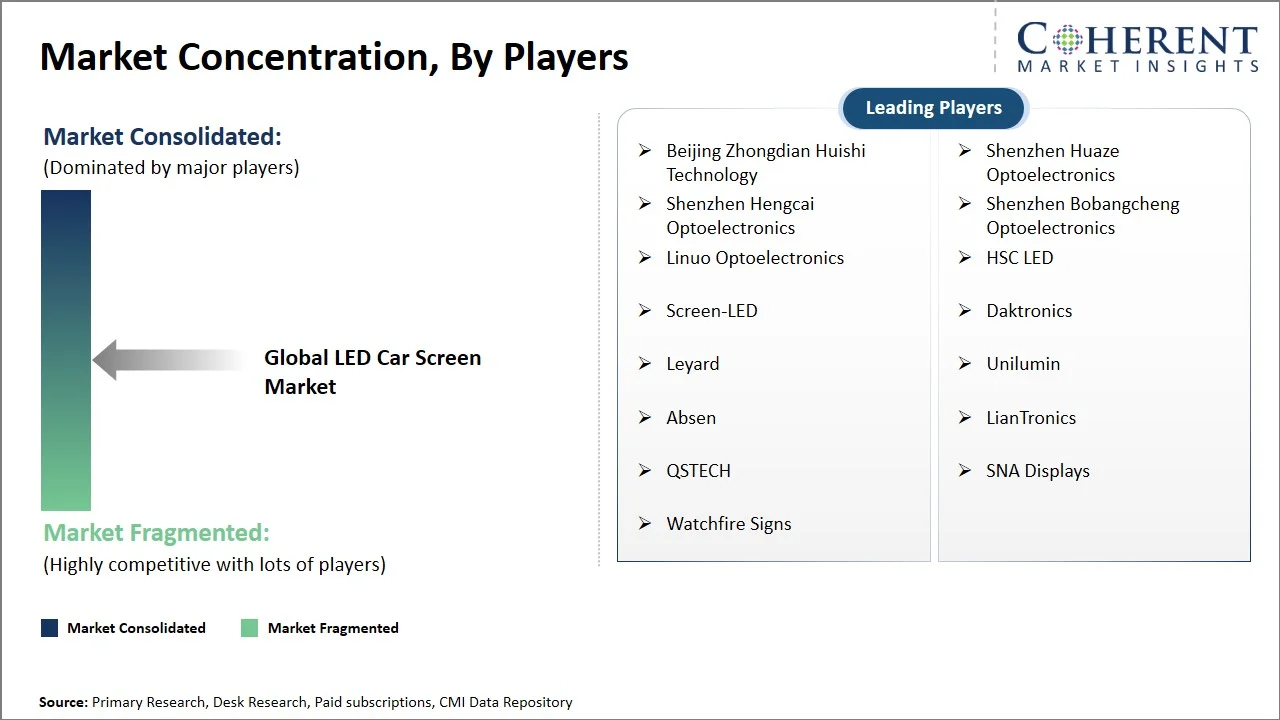
Market Players, Key Development, and Competitive Landscape
Key Developments
- On September 9, 2025, Valeo, a global leader in automotive lighting, and Ennostar, a global leader in optoelectronic solutions, announced a collaboration on smart automotive exterior displays. Their first collaborative product is showcased at IAA Mobility 2025 in Munich, Germany.
- On January 9, 2025, AUO announced it is collaborating with Sony Honda Mobility to showcase the world’s first Micro LED Media Bar Solution mounted on the exterior of the AFEELA at CES 2025. The new solution brings groundbreaking application to human-machine engagement, connects the cockpit to the world outside the vehicle, inspiring innovative car designs.
Competitive Landscape
The competitive landscape is developing around two distinct groups, namely specialized vehicle-mounted LED manufacturers and technology-enabled mobile advertising operators. Shenzhen NSELED is positioned strongly in taxi-top LED hardware, while HSC LED focuses on taxi-top display products such as its TD-series systems, highlighting the importance of purpose-built outdoor displays rather than conventional signage hardware. On the media-technology side, LytAds has differentiated itself in India by combining rooftop LED hardware with location, time, weather, event, and third-party data triggers, while its platform provides real-time campaign reporting and area-specific targeting; its Mumbai deployment includes more than 100 smart screens according to its advertiser platform. In South Korea, Motov has been identified as a leading taxicab rooftop advertising company, with research specifically examining machine-learning prediction of taxis' next locations to improve targeted advertising. This indicates that competition is shifting from simply supplying LED panels toward controlling the complete stack of display hardware, fleet connectivity, content management, targeting, and campaign measurement.
Market Report Scope
LED Car Screen Market Report Coverage
| Report Coverage | Details | ||
|---|---|---|---|
| Base Year: | 2025 | Market Size in 2026: | USD 6.05 Bn |
| Historical Data for: | 2020 To 2024 | Forecast Period: | 2026 To 2033 |
| Forecast Period 2026 to 2033 CAGR: | 7.7% | 2033 Value Projection: | USD 13.10 Bn |
| Geographies covered: |
| ||
| Segments covered: |
| ||
| Companies covered: | Beijing Zhongdian Huishi Technology, Shenzhen Huaze Optoelectronics, Shenzhen Hengcai Optoelectronics, Shenzhen Bobangcheng Optoelectronics, Linuo Optoelectronics, HSC LED, Screen-LED, Daktronics, Leyard, Unilumin, Absen, LianTronics, QSTECH, SNA Displays, Watchfire Signs | ||
| Growth Drivers: |
| ||
| Restraints & Challenges: |
| ||
Analyst Opinion (Expert Opinion)
- The future of the industry is expected to move toward connected full-color rooftop LED systems rather than basic static vehicle displays. The strongest evidence is already visible in platforms such as LytAds, where screens can change content according to location, time, weather, events, and external data, while specialized suppliers are competing through higher-resolution taxi-top products. This suggests that the winning product will increasingly be an outdoor-rated LED system combined with connectivity, sensors, remote content management, and measurable advertising performance.
- The maximum opportunity is expected in full-color displays for taxis, ride-hailing fleets, and urban buses in India, China, and other high-density Asian cities. India is particularly attractive because LytAds is already demonstrating location-specific taxi advertising in Mumbai, while China combines extensive taxi deployment with a large domestic LED manufacturing base. In North America, the opportunity is more concentrated around premium mobile digital-out-of-home networks, where rooftop LED fleets can be integrated with programmatic advertising and broader DOOH campaigns rather than being sold solely as individual screens.
- To gain an edge, manufacturers should not simply compete on LED brightness or pixel pitch, but rather provide open, API-compatible platforms that allow advertising operators to link to third-party ad servers, GPS, fleet-management systems and analytical tools. This is particularly essential considering that operators have expressed worries that cab top screens are locked into proprietary CMS and API setups which create hurdles to interoperability. Advertising networks and fleet operators are likely to sign long-term contracts with suppliers offering ruggedized outdoor hardware with open software interfaces, automated brightness control, location-triggered content, measurable impressions and the ability to push content updates quickly across a whole fleet.
Speak to the analyst
Want personalized insights?
Take the findings above to one of our principal consultants, or have the report rebuilt around the segments, geographies and competitors you actually track.
Market Segmentation
- Type Insights (Revenue, USD Billion, 2021 - 2033)
- Monochrome
- Two Color
- Full Color
- Vehicle Type Insights (Revenue, USD Billion, 2021 - 2033)
- Passenger Vehicles
- Commercial Vehicles
- Display Configuration Insights (Revenue, USD Billion, 2021 - 2033)
- Rear Mounted LED Screens
- Roof Mounted LED Screens
- Side Mounted LED Screens
- Interior LED Screens
- Application Insights (Revenue, USD Billion, 2021 - 2033)
- Taxi Advertisement
- Bus Route
- Police Car Electronic Screen
- Others
- Regional Insights (Revenue, USD Billion, 2021 - 2033)
- North America
- U.S.
- Canada
- Latin America
- Brazil
- Argentina
- Mexico
- Rest of Latin America
- Europe
- Germany
- U.K.
- Spain
- France
- Italy
- Russia
- Rest of Europe
- Asia Pacific
- China
- India
- Japan
- Australia
- South Korea
- ASEAN
- Rest of Asia Pacific
- Middle East
- GCC Countries
- Israel
- Rest of Middle East
- Africa
- South Africa
- North Africa
- Central Africa
- North America
- Key Players Insights
- Beijing Zhongdian Huishi Technology
- Shenzhen Huaze Optoelectronics
- Shenzhen Hengcai Optoelectronics
- Shenzhen Bobangcheng Optoelectronics
- Linuo Optoelectronics
- HSC LED
- Screen-LED
- Daktronics
- Leyard
- Unilumin
- Absen
- LianTronics
- QSTECH
- SNA Displays
- Watchfire Signs
Sources
Primary Research Interviews
- LED display manufacturers and vehicle display OEMs
- Taxi-top digital advertising companies
- Bus and transit advertising operators
Journals
- International Journal of Advertising
- Journal of Marketing
Associations
- Out of Home Advertising Association of America
- World Out of Home Organization
Public Domain Sources
- U.S. Department of Transportation
- Federal Highway Administration
Proprietary Elements
- CMI Data Analytics Tool
- Proprietary CMI Existing Repository of Information for the Last 10 Years
Get access to 250+ pages report
Every segment, forecast, competitor profile and data table behind the analysis above — available for instant download.
- ESOMAR Member
- ISO 9001:2015 Certified
- D-U-N-S Registered
- GDPR & CCPA Compliant
Missing comfort of reading report in your local language? Find your preferred language:
Transform your Strategy with Exclusive Trending Reports
Frequently Asked Questions
The global LED car screen market is expected to stand at USD 6.05 Bn in 2026 and is expected to reach USD 13.10 Bn by 2033.
The CAGR of the global LED car screen market is projected to be 7.7% from 2026 to 2033.
AI enables advertisers to select and change content according to vehicle location, time, weather, traffic conditions, events, and audience characteristics.
Weather-based advertising allows screens to display context-specific campaigns such as beverage promotions during hot conditions or weather-related services during rainfall.
Cloud-based content management allows operators to remotely schedule, modify, monitor, and distribute content across multiple vehicle-mounted screens.
Connected systems can record campaign duration, vehicle location, geographic coverage, and other operational data that can be used to provide advertisers with campaign performance reports.
Rising deployment of digital advertising on taxis and commercial vehicles and Expansion of smart city and connected transportation infrastructure are the major factors driving the growth of the global LED car screen market.