

Global Lip and Face Oil Market Size & Forecast – 2026 To 2033
The Global Lip and Face Oil Market is estimated to be valued at USD 6,942.6 Mn in 2026 and is expected to reach USD 9,322.1 Mn by 2033, exhibiting a compound annual growth rate (CAGR) of 4.30% from 2026 to 2033. Market expansion reflects consumer preference for concentrated products that provide moisturization, radiance, barrier support, color, and visible-ageing care within simplified beauty routines.
Lightweight textures, botanical oils, skincare-infused lip colors, and non-sticky applicators are also widening adoption of lip and face oil across mass and premium categories. In March 2025, rms beauty introduced Legendary Lip Oil in Japan, combining color and shine with bitter cherry seed oil, organic jojoba oil, and an adaptogenic herbal blend for conditioning and moisturizing benefits.
Key Takeaways of the Global Lip and Face Oil Market
- Face oils are expected to command 68.4 % of the global lip and face oil market in 2026 because they address hydration, barrier support, radiance, massage, and overnight care within one concentrated format. In January 2024, Keys Soulcare launched Deeply Replenishing Squalane Facial Oil through Amazon Premium Beauty, widening access to a non-comedogenic oil positioned for overnight replenishment.
- Natural and plant derived oils are expected to hold 71.8 % of the global lip and face oil market in 2026 as buyers increasingly evaluate botanical provenance, sensoriality, and recognizable ingredients alongside performance. In February 2024, Guerlain launched KissKiss Bee Glow Oil in Japan, formulated with 92% natural-origin ingredients and combining honey-derived components with light-reflecting vegetal oils for lip care and color.
- The mass segment is expected to account for 43.7% of the market share in 2026, as affordable lip oils allow consumers to try multiple shades, routine replenishment, and impulse purchases across drugstores and online channels. In December 2024, Rimmel London introduced Oh My Gloss Lip Oil in Japan, pairing moisturizing care with glossy color in a broadly accessible makeup format.
- North America is expected to lead the global lip and face oil market with a 32.4 % share in 2026, supported by sophisticated skincare routines, clean-beauty screening, premium specialty retail, and rapid direct-to-consumer launches in the region. In July 2025, U.S.-based Sacred Rituel announced MADE SAFE certification for Sacred Serum, an organic raw facial oil with broad-spectrum SPF 10.
- Asia Pacific is expected to be the fastest-growing region and hold 30.1 % of the market share in 2026, supported by skincare layering, facial massage traditions, humid-climate formulation needs, and strong department-store and digital beauty ecosystems in the region. In November 2025, Shiseido announced Ultimune Powerizing Oil for a March 2026 Japan launch, extending its flagship serum franchise into a multi-treatment facial oil.
- Growing Shift Toward Skincare-Infused Lip Products : Lip oils are evolving from simple gloss alternatives into treatment-led products combining conditioning, barrier support, tint, and plumping effects. This convergence encourages skincare and color-cosmetics teams to coordinate formulation and claims development. Brands that balance visible finish with lasting comfort can improve repeat purchasing, create shade extensions, and secure placement across both makeup and treatment-focused retail assortments.
- Climate-Responsive Lip Oil Formulations: Formulators are prioritizing fast-absorbing, non-sticky, and non-comedogenic oil systems suited to varied climates and skin types. Lightweight esters, squalane, gel-oil structures, and controlled applicators can reduce concerns around heaviness and shine. This will shift investment toward texture engineering and stability testing, while enabling brands to localize products for humid, dry, sensitive-skin, and premium sensorial-use occasions.
Segmental Insights
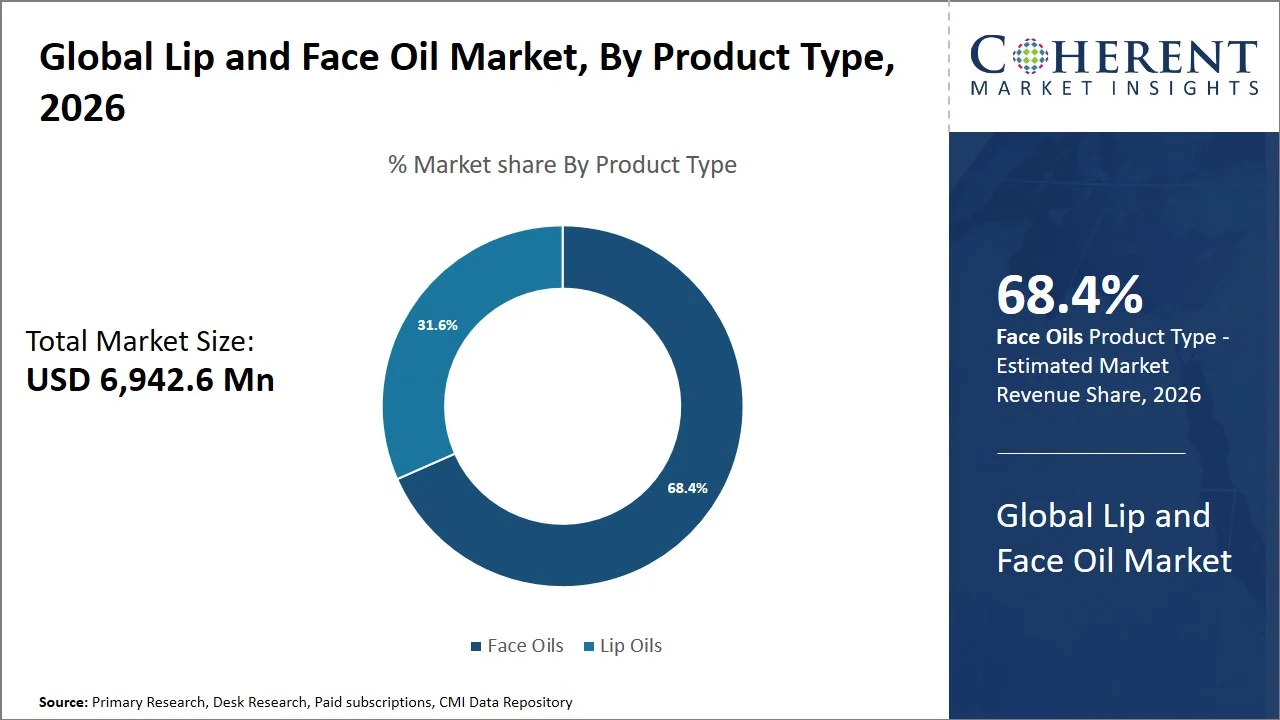
Why Do Face Oils Dominate the Global Lip and Face Oil Market?
Face oils are expected to account for 68.4% of the global lip and face oil market in 2026 because they serve a wider skincare role than lip-only formats. Consumers use them to seal in moisture, improve surface softness, and add radiance in morning or overnight routines. Suppliers formulate anhydrous or low-water systems with concentrated emollients, antioxidants, and oil-soluble actives, while droppers and controlled pumps enable precise dosing. The category also supports premiumization through texture, fragrance, ingredient provenance, and clinical positioning. For manufacturers, success depends on oxidation control, non-greasy absorption, and compatibility with layered skincare. In April 2024, Irene Forte Skincare introduced Pistachio Face Oil, combining phytomelatonin, pistachio oil, antioxidants, and vitamins in a targeted age-support formula, illustrating continued investment in high-performance facial oil architecture.
- Current Industry Events of 2026
- Market Size Estimation
- Regional Breakdown
- Competitive Landscape
- Customer Intelligence
- Segmental Analysis
- Pricing Analysis
- Key Market Drivers, Challenges & Future Trends
- Customized Insights Section
Why Do Natural and Plant Derived Oils Represent the Largest Ingredient Source in the Global Lip and Face Oil Market?
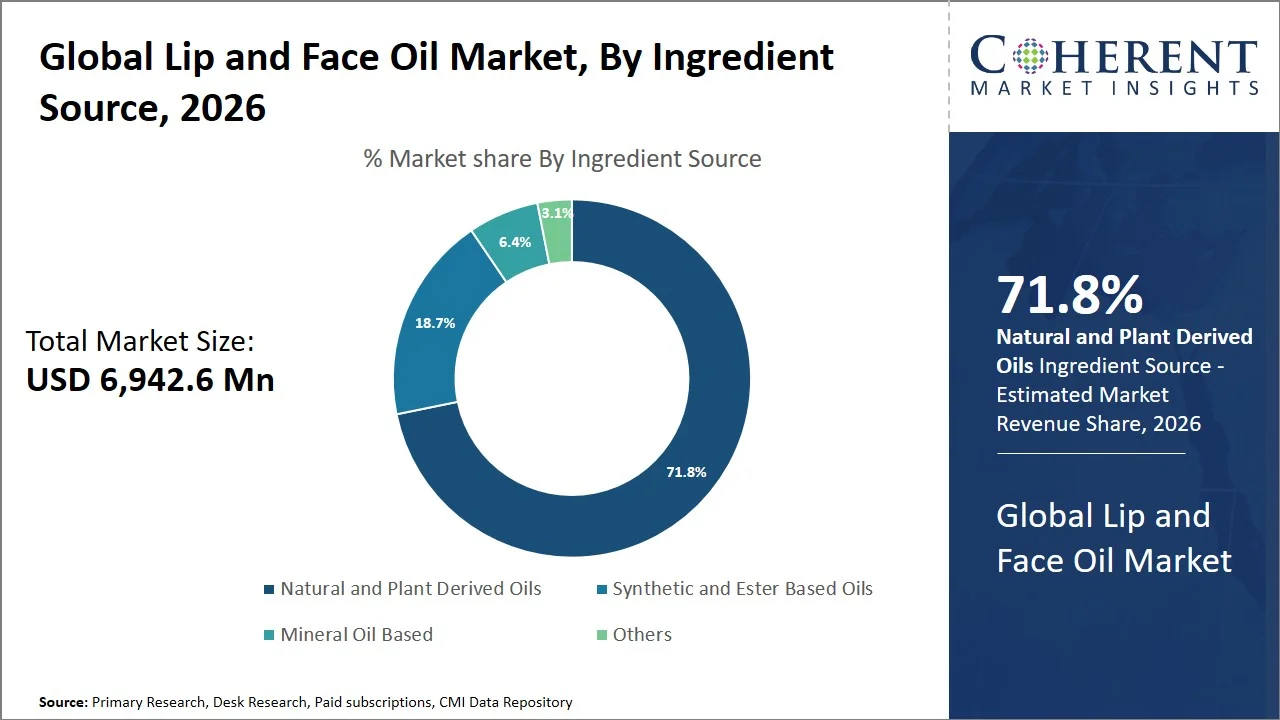
Natural and plant derived oils are expected to hold 71.8% of the global lip and face oil market in 2026 because they provide recognizable ingredient stories alongside emollience, fatty acids, antioxidants, and sensorial differentiation. Jojoba, rosehip, argan, avocado, meadowfoam, and seed oils allow brands to tailor products for dryness, dullness, mature skin, or lip conditioning while meeting buyer interest in botanical provenance. Supply-side value increasingly comes from cold pressing, purification, deodorization, traceability, and oxidation-stability management rather than simply claiming natural content. These requirements favor suppliers that can standardize color, odor, and performance across harvests. In August 2025, Anatomy Naturals launched its Plant Poetry Face Oils collection using botanical blends including sacha inchi, cranberry, sea buckthorn, borage, and argan oils, demonstrating how ingredient diversity can support targeted positioning and portfolio expansion.
Why Does the Mass Segment Dominate the Global Lip and Face Oil Market?
The mass segment is expected to represent 43.7% of the global lip and face oil market in 2026 because accessible pricing lowers the risk of trying unfamiliar textures, shades, flavors, and applicators. Lip and face oils are frequently replenished and influenced by short beauty cycles, making broad drugstore, supermarket, marketplace, and social-commerce availability commercially important. High-volume contract manufacturing, standardized base systems, compact packaging, and rapid shade extensions allow suppliers to maintain low unit costs while refreshing assortments. The segment benefits from younger buyers, impulse purchasing, gifting, and consumers seeking skincare-makeup hybrids without prestige pricing. In June 2024, essence used its official beauty platform to promote Hydra Kiss Lip Oil and Juicy Glow Juicy Bomb Lip Oil as affordable options, combining glossy finishes with jojoba oil, meadowfoam oil, vitamin E, and hyaluronic acid, supporting mass-market product education and conversion.
Global Lip and Face Oil Market Dynamics
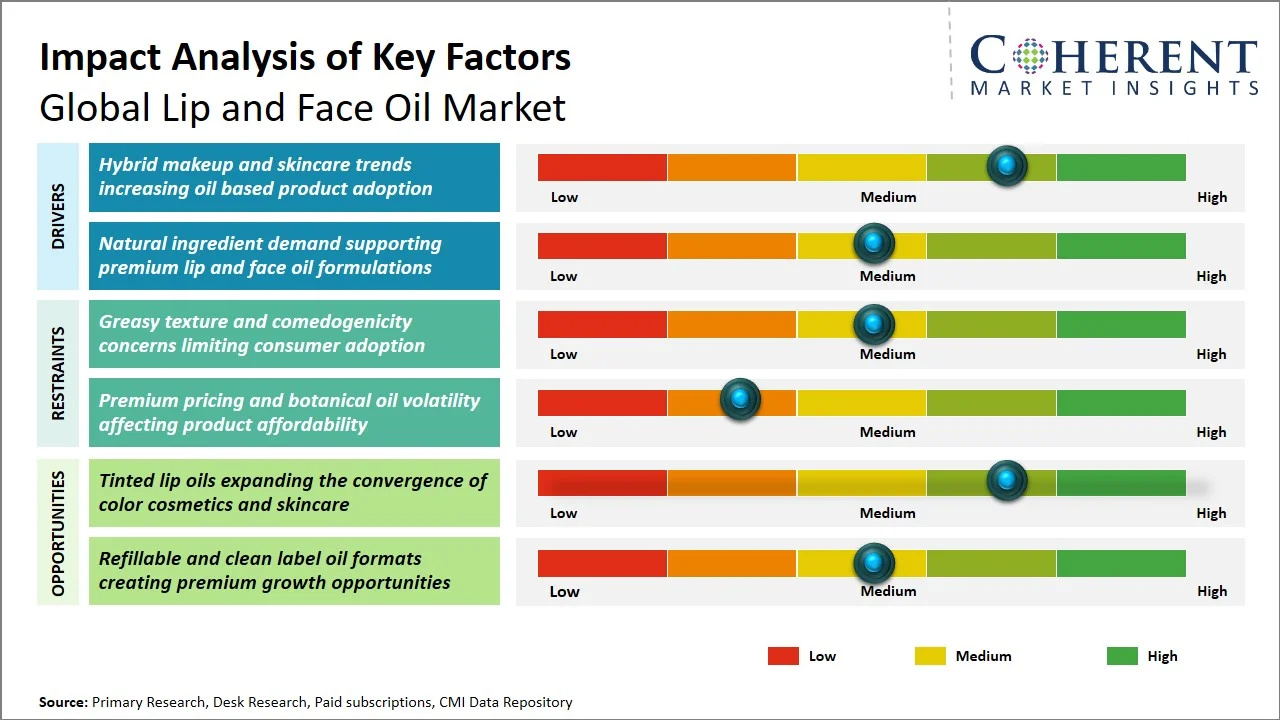
Key Market Drivers
- Hybrid Makeup and Skincare Formats Expand Oil-Based Product Adoption: Hybrid makeup and skincare trends are expanding oil-based products beyond traditional treatment routines by combining gloss, tint, nourishment, barrier comfort, and sensorial application in a single format. Lip oils benefit most directly because consumers can replace separate balm and color steps, while face oils increasingly function as primers, glow boosters, or finishing products layered with makeup. This raises average selling potential and supports faster shade, texture, and applicator extensions. Color-cosmetics brands, skincare specialists, contract formulators, and specialty retailers benefit from products that can be merchandised across multiple categories. The commercial challenge is to balance visible payoff with non-sticky wear, controlled dosing, and credible care claims. In April 2025, Valentino Beauty introduced Puffer Gloss, explicitly combining lip-gloss shine with lip-oil comfort and care, demonstrating how prestige brands are commercializing cross-category performance rather than maintaining a strict divide between treatment and makeup.
- Botanical Provenance Strengthens Premium Oil Formulation Value: Natural ingredient demand supports premium lip and face oil formulations because plant oils provide both functional emollience and a clear origin story that consumers can understand. Jojoba, rosehip, hazelnut, argan, seed, and fruit oils allow brands to differentiate around fatty-acid profile, harvesting method, certification, traceability, and sensorial character. This shifts value toward ingredient suppliers capable of standardized quality, oxidation control, sustainable sourcing, and consistent color and odor across batches. Premium brands benefit from higher perceived authenticity, while retailers gain products suited to clean-beauty and ingredient-led merchandising. However, botanical positioning requires careful allergen disclosure, stability testing, and evidence-based claims. In September 2025, Clarins highlighted the tenth anniversary of Lip Comfort Oil, reporting a formula containing natural-origin ingredients and multiple plant oils, alongside traceability through its T.R.U.S.T. platform. The development illustrates how botanical provenance is being integrated with product performance, transparency, and premium brand equity.
Emerging Market Trends
- Treatment-Grade Oils Gain Ground: Lip and face oils are shifting toward active formulations targeting pigmentation, barrier repair, visible aging, and lip plumping. Brands are incorporating oil-soluble antioxidants, stabilized actives, ceramide-supporting lipids, and encapsulated ingredients to compete directly with serums and treatment balms. This favors companies with clinical testing and formulation expertise, while basic botanical blends face weaker differentiation and greater pricing pressure. As a result, brands are increasingly investing in R&D and clinical validation to support efficacy claims and justify premium pricing.
- Packaging Performance Shapes Product Success: Packaging is becoming critical to oil stability, dosing, hygiene, and user experience. Face oils increasingly use controlled droppers and airless pumps to reduce oxidation and leakage, while lip oils require applicators matched to formula viscosity and color payoff. Brands using compatibility-tested, lightweight, and refill-ready components can improve product reliability and premium positioning, whereas generic packaging increases return, contamination, and shelf-life risks. This trend is also driving closer collaboration between formulation teams and packaging suppliers to ensure optimal product performance.
Current Events and their Impact
Current Event | Description and Its Impact |
U.S. FDA Updates Cosmetics Direct – February 2026 |
|
EU Restricts Selected Cosmetic Ingredients – April 2024 |
|
Regional Insights
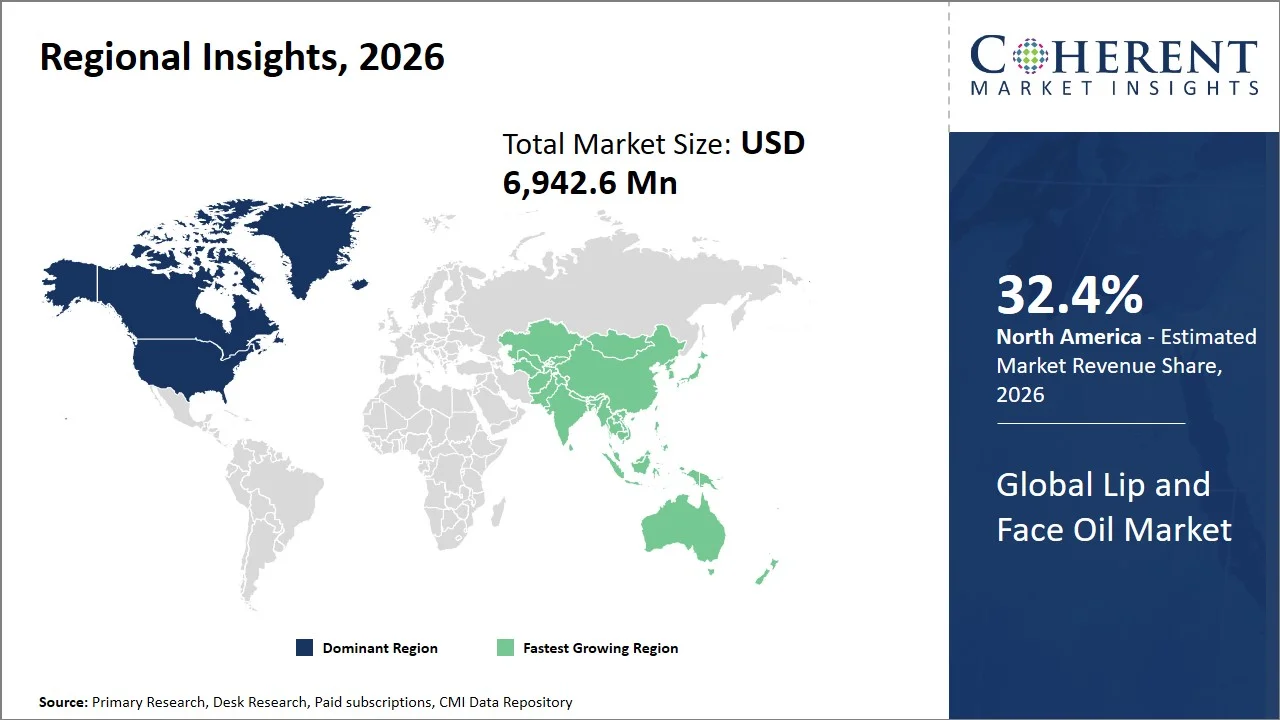
Why Does North America Dominate the Global Lip and Face Oil Market?
North America is expected to account for 32.4% of the global lip and face oil market in 2026 because consumers routinely combine skincare and color cosmetics, creating demand for products that deliver moisture, radiance, tint, barrier support, and sensorial application. The region’s specialty beauty chains, premium marketplaces, direct-to-consumer brands, and creator-led discovery channels allow facial and lip oils to move quickly from niche launches into national assortments. Strong formulation capabilities also support lightweight, non-comedogenic, plant-derived, and hybrid oil systems suited to diverse skin tones and climatic conditions. In June 2024, Too Faced entered the U.S. Amazon Premium Beauty Store with an assortment that included Kissing Jelly Lip Oil Gloss. The launch illustrates how prestige lip-oil formats are gaining broader access through convenient digital distribution, product education, influencer activation, and rapid delivery.
Why is Asia Pacific Emerging as the Fastest-Growing Region in the Global Lip and Face Oil Market?
Asia Pacific is expected to be the fastest-growing region in the global lip and face oil market and hold a 30.1% share in 2026. Expansion is supported by established skincare-layering habits, strong interest in luminous finishes, frequent product experimentation, and the commercial influence of Korean and Japanese beauty routines. Manufacturers can also tailor oil viscosity, absorption, applicators, and botanical positioning for humid, tropical, dry, and sensitive-skin environments across the region. Cross-border e-commerce and travel retail further accelerate the movement of lip and facial oil innovations between markets. In February 2026, Amorepacific reported that Japan and other Asia Pacific markets delivered solid growth during 2025, led partly by LANEIGE and its lip and skincare portfolio. This demonstrates the region’s ability to scale treatment-oriented lip products through coordinated online, department-store, specialty-retail, and cross-border channels.
Global Lip and Face Oil Market Outlook for Key Countries
Why is the U.S. a Key Market for the Global Lip and Face Oil Market?
The U.S. is a key market for lip and face oils because it combines advanced cosmetic research, high beauty spending, extensive specialty retail, and a large base of independent brands capable of commercializing new textures rapidly. Consumers frequently evaluate oils through ingredient transparency, clinical positioning, skin-barrier compatibility, shade inclusivity, and social-media performance, encouraging suppliers to develop differentiated formulations rather than basic emollient blends. Domestic manufacturing and research infrastructure also allow companies to test, scale, and replenish liquid makeup and skincare products efficiently. In May 2025, L’Oréal marked fifty years at its North Little Rock manufacturing site and confirmed the completion of a North America Research and Innovation Center in New Jersey. This investment environment supports faster development of stable oil dispersions, hybrid lip products, lightweight facial treatments, and packaging systems suited to the U.S. omnichannel market.
Why is India Important in the Global Lip and Face Oil Market?
India is important in the global lip and face oil market because consumers increasingly combine traditional botanical ingredients with contemporary makeup and skincare routines. Demand is developing across affordable lip oils, premium facial oils, Ayurvedic blends, and multifunctional products designed for hydration, glow, pigmentation concerns, and climate-responsive wear. Online beauty platforms reduce discovery barriers for emerging brands, while physical stores provide sampling and shade evaluation that remain important for color-led lip products. Domestic founders also benefit from access to Indian plant oils, contract manufacturing, and digital creator communities. In June 2026, Nykaa announced its partnership with Rare Beauty for the brand’s India launch, expanding local access to an internationally recognized color-cosmetics portfolio. The development shows how India’s omnichannel retailers are introducing hybrid beauty formats while supporting product education, authenticity assurance, physical trial, and nationwide distribution.
Why Does China Support Growth in the Global Lip and Face Oil Market?
China supports growth in the global lip and face oil market through large-scale cosmetics manufacturing, sophisticated e-commerce, rapid social-commerce testing, and a consumer base that actively evaluates texture, ingredient efficacy, and packaging. Local formulators can adapt facial oils for sensitive, dry, mature, or oil-prone skin while positioning lip oils around tint, gloss, nourishment, and long wear. The country’s ingredient suppliers and manufacturing clusters also provide speed in pilot production, applicator development, and packaging customization. Regulatory modernization is becoming equally important because differentiated botanical oils and functional esters require clear safety documentation and compliant claims. In June 2025, China’s National Medical Products Administration issued provisions supporting innovation in cosmetic raw materials. The policy direction can improve pathways for scientifically assessed ingredients, encouraging suppliers to invest in distinctive oil systems while strengthening safety, filing, and quality-management capabilities.
Why is Japan a Strategic Country in the Global Lip and Face Oil Market?
Japan is a strategic country in the global lip and face oil market because its beauty industry emphasizes precise formulation, refined sensory performance, skin compatibility, and disciplined product routines. Consumers generally expect facial oils to absorb cleanly, layer without pilling, and deliver moisture without an excessively greasy finish. Lip oils similarly compete through applicator precision, elegant shine, treatment benefits, and compatibility with other color cosmetics. Japan’s research ecosystem enables brands to combine traditional oils with advanced barrier technologies and rigorous testing, supporting premium domestic sales and exportable product concepts. In July 2026, Kao announced Curél Moist Barrier Oil Serum for a September launch in Japan, combining an oil-based formula with ceramide-care technology for dry, sensitive skin. The product demonstrates how Japanese companies are converting oil formats into targeted, dermatology-informed solutions rather than relying solely on natural-ingredient storytelling.
Why is Brazil an Important Growth Market for the Global Lip and Face Oil Market?
Brazil is an important growth market for lip and face oils because beauty routines are shaped by strong personal-care engagement, diverse skin tones, warm climatic conditions, and broad interest in botanical ingredients associated with Brazilian biodiversity. Lightweight facial oils and tinted lip oils can address consumers seeking radiance and nourishment without heavy residue, while local plant-derived ingredients provide opportunities for distinctive sourcing narratives. Direct selling, digital commerce, shopping malls, pharmacies, and specialist beauty stores create multiple routes to reach customers across income groups. In October 2025, Natura opened a new sensory retail concept at Shopping Morumbi that incorporated digital skin analysis and virtual makeup tools. The format demonstrates how Brazilian beauty companies are combining consultation, physical trial, technology, and nature-based brand positioning to guide consumers toward personalized facial-care and makeup routines, including oil-based products.
Technology Adoption Landscape in the Global Lip and Face Oil Market
Technology | Adoption Level | Key Application Area | Business Impact |
Anhydrous blending and nitrogen blanketing | High | Facial oils, lip oils, and concentrated botanical formulations | Limits oxygen exposure during production, improving stability and extending usable product life. |
Cold pressing and supercritical fluid extraction | Medium | Premium seed, fruit, flower, and botanical oils | Preserves selected natural components and supports differentiated sourcing and premium positioning. |
Sensorial ester and lipid engineering | High | Lightweight, fast-spreading, non-sticky oil textures | Improves absorption, glide, shine, and skin feel while reducing perceived greasiness. |
Lipid encapsulation and active stabilization | Medium | Retinoid alternatives, antioxidants, vitamins, and brightening actives | Protects unstable ingredients and supports more targeted performance and credible efficacy claims. |
Metered droppers, airless pumps, and calibrated lip applicators | High | Controlled facial dosing and uniform lip-oil application | Reduces leakage and overuse while improving hygiene, application precision, and user experience. |
Accelerated oxidation and packaging-compatibility testing | High | Quality control and formulation validation | Identifies rancidity, discoloration, odor changes, seal failure, and component interaction before launch. |
How are Sensitive-Skin Oil Systems Creating New Growth Opportunities in the Global Lip and Face Oil Market?
Fragrance-free, clinically positioned oil systems for sensitive, barrier-impaired, and post-treatment skin represent a high-potential opportunity that remains less developed than general glow and botanical products. These customers often avoid facial oils because of concerns about essential oils, allergens, heaviness, breakouts, or interaction with dermatological routines. Companies can address the gap through minimal-ingredient formulas, non-comedogenic testing, controlled oxidation, tamper-resistant packaging, and clear guidance on layering with moisturizers or prescribed products.
Relevant channels include pharmacies, dermatology clinics, professional skincare distributors, specialty beauty retailers, and direct subscription models. Commercial capture will require clinical advisory input, safety substantiation, fragrance-allergen management, and disciplined claims that avoid implying medical treatment. Specialists with expertise in sensitive-skin formulation may lead early adoption, while established brands can scale through broader distribution and consumer education. Suppliers should also develop multiple viscosities and dose formats for facial use, localized dry areas, and overnight application, creating premium differentiation without depending on rare botanical ingredients or short-lived color trends.
Market Players, Key Development, and Competitive Landscape
Key Developments
- In March 2026, Dabur announced an investment in RAS Beauty, a digital-first natural skincare company offering face elixirs, serums, and products containing essential oils and nature-derived actives. This is important for the global lip and face oil market because the investment supports R&D, omnichannel expansion, manufacturing capabilities, and the scaling of farm-to-face premium skincare formulations.
- In January 2025, PANPURI Japan launched Lip Tint Oil Peony Pink, a vegan formulation incorporating plant-derived color, argan oil, wild mango butter, and a hyaluronic-acid delivery technology. This is important for the global lip and face oil market because it combines botanical positioning, skincare benefits, tinted makeup performance, and recyclable packaging within a single premium product proposition.
Competitive Landscape
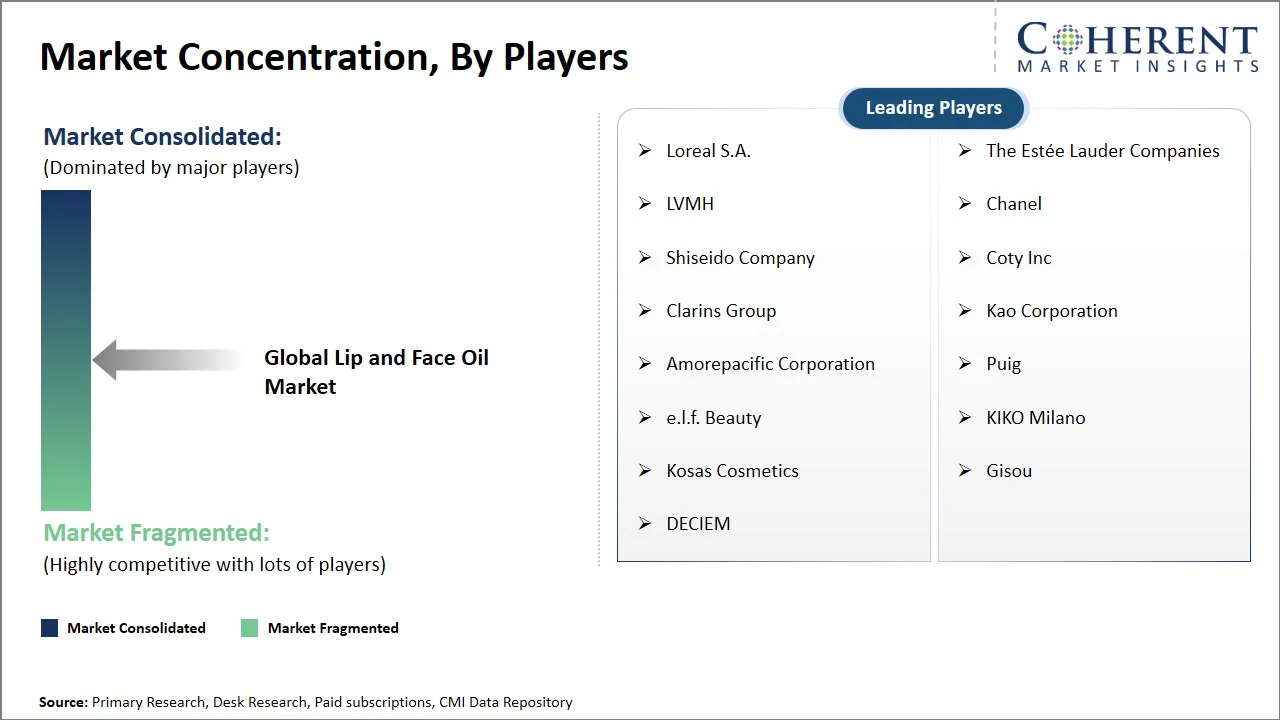
The global lip and face oil market is fragmented, with competition among multinational cosmetics groups, luxury beauty houses, mass-market brands, botanical skincare specialists, digital-native companies, contract manufacturers, and private-label suppliers. Market positioning depends on sensorial performance, ingredient credibility, shade and finish selection, claims substantiation, packaging functionality, and channel visibility. Regional and independent brands can compete effectively through local botanicals and agile launches, while larger companies benefit from formulation laboratories, regulatory teams, retailer relationships, and global marketing resources.
Key focus areas include
- Texture performance: Lightweight spreadability, absorption, non-stickiness, shine, and after-feel strongly influence repurchase decisions.
- Ingredient traceability: Documented origin, certification, processing methods, and supplier transparency support premium positioning.
- Oxidation management: Stable raw materials, antioxidants, controlled production, and protective packaging reduce rancidity risks.
- Applicator differentiation: Droppers, pumps, rollers, and doe-foot applicators influence dosing, convenience, and perceived quality.
- Claims substantiation: Hydration, barrier support, plumping, radiance, and non-comedogenic claims require credible testing.
- Channel execution: Specialty retail, marketplaces, direct-to-consumer platforms, pharmacies, and social commerce require different assortment strategies.
- Contract manufacturing flexibility: Low minimum-order quantities and rapid formulation changes help brands respond to short beauty cycles.
- Pricing architecture: Entry, premium, and luxury tiers require distinct ingredient, packaging, communication, and distribution models.
Market Report Scope
Lip and Face Oil Market Report Coverage
| Report Coverage | Details | ||
|---|---|---|---|
| Base Year: | 2025 | Market Size in 2026: | USD 6,942.6 Mn |
| Historical Data for: | 2020 To 2024 | Forecast Period: | 2026 To 2033 |
| Forecast Period 2026 to 2033 CAGR: | 4.30% | 2033 Value Projection: | USD 9,322.1 Mn |
| Geographies covered: |
| ||
| Segments covered: |
| ||
| Companies covered: | Loreal S.A., The Estée Lauder Companies, LVMH, Chanel, Shiseido Company, Coty Inc, Clarins Group, Kao Corporation, Amorepacific Corporation, Puig, e.l.f. Beauty, KIKO Milano, Kosas Cosmetics, Gisou, and DECIEM | ||
| Growth Drivers: |
| ||
| Restraints & Challenges: |
| ||
Analyst Opinion (Expert Opinion)
- The global lip and face oil market leadership is likely to shift from brands selling isolated oils toward companies developing complete oil-based routines covering cleansing, treatment, makeup preparation, color, and overnight care. Suppliers that explain product sequencing and compatibility with serums, creams, sunscreen, and makeup will build stronger customer retention than those relying on a single botanical hero ingredient.
- Digitally accessible ingredient information may materially weaken vague natural and clean-beauty positioning. Retailer filters, regulatory product databases, ingredient-analysis tools, and informed customers will make unsupported claims easier to challenge. Brands with transparent sourcing, standardized botanical specifications, safety documentation, and defensible performance evidence will be better positioned than businesses relying mainly on packaging language.
- Companies should invest in oxidation control, applicator engineering, fragrance-allergen management, dual raw-material sourcing, and market-specific regulatory expertise. Pharmacy, professional skincare, and sensitive-skin channels deserve greater attention. Suppliers should avoid excessive investment in rare oils with unstable availability or weak consumer recognition, as volatile input costs and limited formulation flexibility can quickly erode margins.
Speak to the analyst
Want personalized insights?
Take the findings above to one of our principal consultants, or have the report rebuilt around the segments, geographies and competitors you actually track.
Market Segmentation
- Product Type Insights (Revenue, USD Mn, 2021 - 2033)
- Face Oils
- Lip Oils
- Ingredient Source Insights (Revenue, USD Mn, 2021 - 2033)
- Natural and Plant Derived Oils
- Synthetic and Ester Based Oils
- Mineral Oil Based
- Others
- Price Range Insights (Revenue, USD Mn, 2021 - 2033)
- Mass
- Premium
- Luxury
- Distribution Channel Insights (Revenue, USD Mn, 2021 - 2033)
- Online Retail
- Specialty Beauty Stores
- Supermarkets and Hypermarkets
- Department Stores
- Others
- Regional Insights (Revenue, USD Mn, 2021 - 2033)
- North America
- U.S.
- Canada
- Latin America
- Brazil
- Argentina
- Mexico
- Rest of Latin America
- Europe
- Germany
- U.K.
- Spain
- France
- Italy
- Russia
- Rest of Europe
- Asia Pacific
- China
- India
- Japan
- Australia
- South Korea
- ASEAN
- Rest of Asia Pacific
- Middle East
- GCC Countries
- Israel
- Rest of Middle East
- Africa
- South Africa
- North Africa
- Central Africa
- North America
- Key Players Insights
- Loreal S.A.
- The Estée Lauder Companies
- LVMH
- Chanel
- Shiseido Company
- Coty Inc
- Clarins Group
- Kao Corporation
- Amorepacific Corporation
- Puig
- l.f. Beauty
- KIKO Milano
- Kosas Cosmetics
- Gisou
- DECIEM
Sources
Primary Research Interviews
- Lip and face oil manufacturers, cosmetic formulators, ingredient suppliers, contract manufacturers, and packaging companies
- R&D, sourcing, quality, regulatory, marketing, retail, and distribution executives
- Dermatologists, aestheticians, makeup artists, and consumers
Stakeholders
- Skincare, color-cosmetics, clean-beauty, premium, and luxury brands
- Botanical-oil, active-ingredient, packaging, and applicator suppliers
- OEMs, ODMs, retailers, distributors, e-commerce platforms, and testing laboratories
End-use Sectors
- Facial moisturization, radiance, barrier care, and anti-aging routines
- Lip hydration, tinting, gloss, plumping, and nourishment
- Professional facial treatments, spas, salons, gifting, and travel retail
Regulatory & Government Bodies
- U.S. Food and Drug Administration
- European Commission, SCCS, and European Chemicals Agency
- Health Canada, UK OPSS, India CDSCO and BIS
- China NMPA, Japan MHLW, South Korea MFDS, Brazil ANVISA, and Australian authorities
Databases
- UN Comtrade, ITC Trade Map, WTO Statistics, Eurostat, and USITC DataWeb
- World Bank, OECD, CosIng, FDA Cosmetics Direct, and national cosmetics databases
- SEC EDGAR, company filings, retail listings, pricing, and consumer-review databases
Magazines and Journals
- Cosmetics & Toiletries
- Cosmetics Business
- Beauty Packaging
- Global Cosmetic Industry
- International Journal of Cosmetic Science
- Journal of Cosmetic Dermatology
Associations
- Personal Care Products Council
- Cosmetics Europe
- Cosmetic, Toiletry and Perfumery Association
- International Federation of Societies of Cosmetic Chemists
- Independent Beauty Association
- National cosmetics, ingredient, packaging, and retail associations
Public Domain Sources
- FDA, European Commission, Health Canada, CDSCO, NMPA, and ANVISA
- UN, WTO, ITC, World Bank, OECD, and customs authorities
- Company reports, product catalogues, ingredient lists, safety documents, and press releases
- Retailer, pharmacy, specialty beauty, and online marketplace listings
Key Standards and Regulations
- ISO 22716, ISO 16128, ISO 11930, and ISO 17516
- U.S. FD&C Act and MoCRA
- EU Cosmetics Regulation, CosIng, and REACH
- Canada Cosmetic Regulations and Ingredient Hotlist
- India Cosmetics Rules and IS 4707
- China CSAR, ASEAN Cosmetic Directive, and national ingredient, claims, and labelling requirements
Proprietary Elements
- CMI Data Analytics Tool, Proprietary CMI Existing Repository of information for last 10 years.
Get access to 250+ pages report
Every segment, forecast, competitor profile and data table behind the analysis above — available for instant download.
- ESOMAR Member
- ISO 9001:2015 Certified
- D-U-N-S Registered
- GDPR & CCPA Compliant
Missing comfort of reading report in your local language? Find your preferred language:
Transform your Strategy with Exclusive Trending Reports
Frequently Asked Questions
The CAGR of the global lip and face oil market is projected to be 4.30% from 2026 to 2033.
The global lip and face oil market is estimated to be valued at USD 6,942.6 million in 2026 and is expected to reach USD 9,322.1 million by 2033.
Key trends include the rise of hybrid makeup-skincare products, increasing demand for clean and vegan formulations, and growing popularity of multifunctional beauty oils.
E-commerce is driving the market growth by enabling easy product discovery, influencer-driven marketing, wider product availability, and convenient purchasing options.
Opportunities lie in developing innovative formulations, targeting niche segments such as organic and vegan products, leveraging digital marketing, and expanding into emerging markets.
Hybrid makeup and skincare trends increasing oil based product adoption and natural ingredient demand supporting premium lip and face oil formulations are the major factors driving the growth of the global lip and face oil market.
Greasy texture and comedogenicity concerns limiting consumer adoption and premium pricing and botanical oil volatility affecting product affordability are the major factors hampering the growth of the global lip and face oil market.