

Shea Butter Market Size and Share Analysis - 2026 To 2033
The global Shea Butter market size is estimated to be valued at USD 2.76 Bn in 2026 and is expected to reach USD 4.67 Bn by 2033, exhibiting a CAGR of 7.8% during the forecast period (2026–2033). This growth is mostly due to increasing demand for natural and organic ingredients in cosmetics and personal care products, rising consumer preference for clean-label skincare formulations, and expanding use of shea butter in the food and pharmaceutical industries.
Key Takeaways from the Shea Butter Market Report
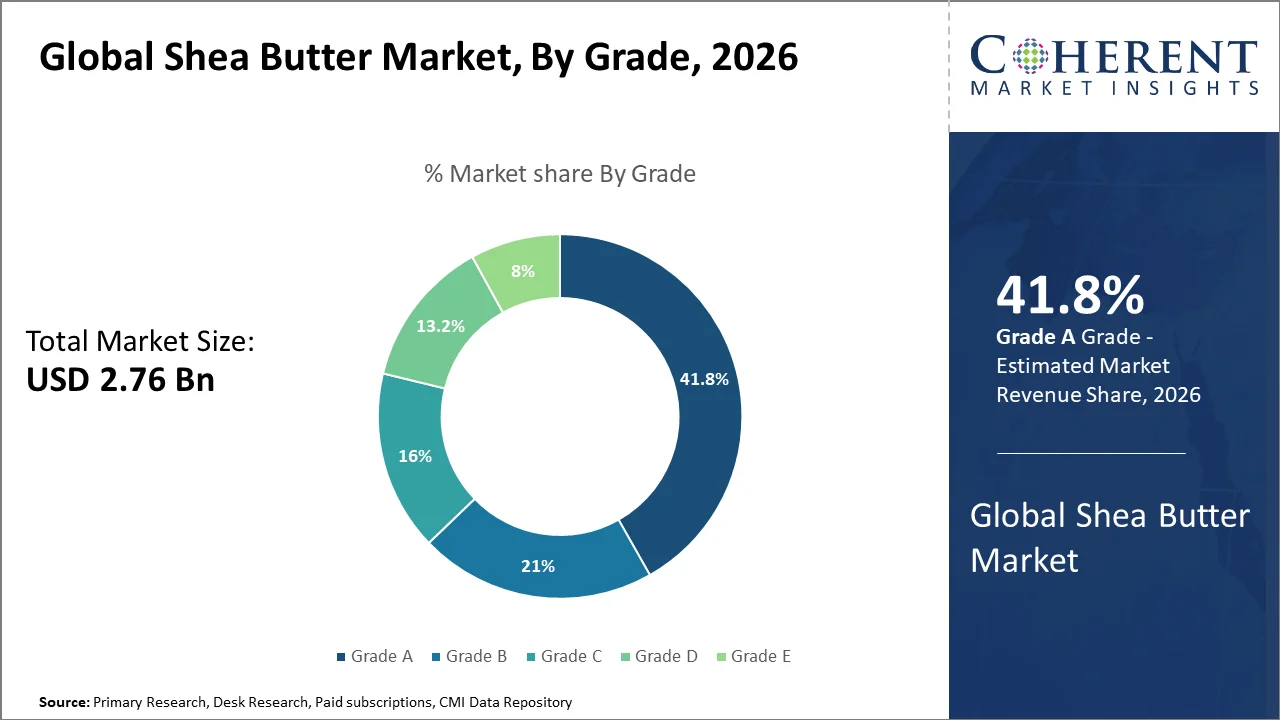
- Grade A shea butter is expected to lead the market with a share of 41.8% in 2026 as it is widely used in premium skincare, haircare, and natural cosmetics due to its high nutrient content. This is supported by a 2025 NSF survey which found that 74% of consumers consider organic ingredients important when buying personal care products, showing the rising driving demand for natural and minimally processed ingredients like Grade A shea butter.
- Personal care segment is expected to account for the largest market share of 60% in 2026 due to wide use of shea butter in moisturizers, lotions, soaps, lip balms, and haircare products. For example, NielsenIQ reported that global beauty sales grew by 7.3% in 2025, increasing demand for personal care products made with natural ingredients such as shea butter.
- Europe is expected to lead the global shea butter industry with a share of 35% in 2026 due to high demand from the cosmetics and confectionery industries and growing use of natural personal care ingredients. For example, more than 31,100 cosmetic products carry the COSMOS ORGANIC or COSMOS NATURAL certification, showing strong demand for natural ingredients in Europe.
- Asia Pacific, registering a CAGR of 10.8% , is poised to emerge as the fastest-growing market for shea butter during the forecast period, thanks to rising demand for natural personal care products, expanding cosmetics and food industries, and increasing use of plant-based ingredients.
Shea Butter Market Overview
The global shea butter market is projected to register steady growth during the forecast period. This growth is primarily driven by increasing demand for natural and organic ingredients in cosmetics, personal care products, and food applications. Rising consumer preference for clean-label and sustainable products, expanding use of shea butter in skincare and haircare formulations, and growing awareness of its moisturizing and healing properties are also supporting market growth.
Shea butter is a natural vegetable fat obtained from the nuts of Vitellaria paradoxa (African Shea tree). It is an ivory to off-white colored semi-solid fat primarily composed of triglycerides and is widely used as a plant-based source of stearic acid in cosmetics, personal care products, and the chocolate industry.
Shea butter is considered a sustainable ingredient due to its renewable sourcing and increasing use in natural and clean-label products. Based on quality and process used, Shea butter is usually categorized into five grades which include; Grade A, which is raw or unrefined butter obtained through traditional water processes, Grade B, which is refined butter, Grade C, highly refined butter extracted with solvents like hexane, Grade D, which is low quality without detectable contaminants and Grade E, with contaminants.
The shea butter market is primarily driven by its increasing use as a substitute for cocoa butter in the chocolate and confectionery industry. Shea butter is also widely used in cosmetics and personal care products, including moisturizers, soaps, lotions, and hair care products, due to its skin-conditioning properties. It is used as a raw material for producing soap, margarine, candles, and detergents.
Increasing adoption in food and confectionery applications is expected to boost sales of shea butter during the forecast period. Beyond cosmetics, shea butter is gaining popularity as a cocoa butter equivalent and plant-based fat in chocolates, bakery products, confectionery, and specialty foods because of its favorable fatty acid composition and texture-enhancing properties.
Segmental Insights
Which Grade Leads the Global Shea Butter Market?
Grade A Leads the Market with More Than Two-Fifths of Share in 2026
As per Coherent Market Insights’ latest shea butter market analysis, grade A segment is set to lead the market, accounting for a revenue share of 41.8% in 2026. This dominance can be attributed to its superior purity, light color, low impurity content, and high concentration of natural vitamins A and E.
Grade A shea butter is extracted using traditional or mechanical methods without chemical solvents. This is making it the preferred choice for premium skincare, cosmetics, personal care, and pharmaceutical applications. Rising consumer demand for natural and organic beauty products is also expected to boost growth of grade A segment during the forecast period.
The COSMOS Standard in May 2025 recorded that 56,810 products and materials in 82 countries had been certified to meet the natural and organic standard for cosmetics. This shows the rising demand for naturally sourced ingredients in personal care products, which is expected to support the adoption of premium-quality ingredients such as Grade A shea butter.
- Current Industry Events of 2026
- Market Size Estimation
- Regional Breakdown
- Competitive Landscape
- Customer Intelligence
- Segmental Analysis
- Pricing Analysis
- Key Market Drivers, Challenges & Future Trends
- Customized Insights Section
Which End-Use Industry Leads in Shea Butter Consumption?
Personal Care Continues to Lead Shea Butter Consumption
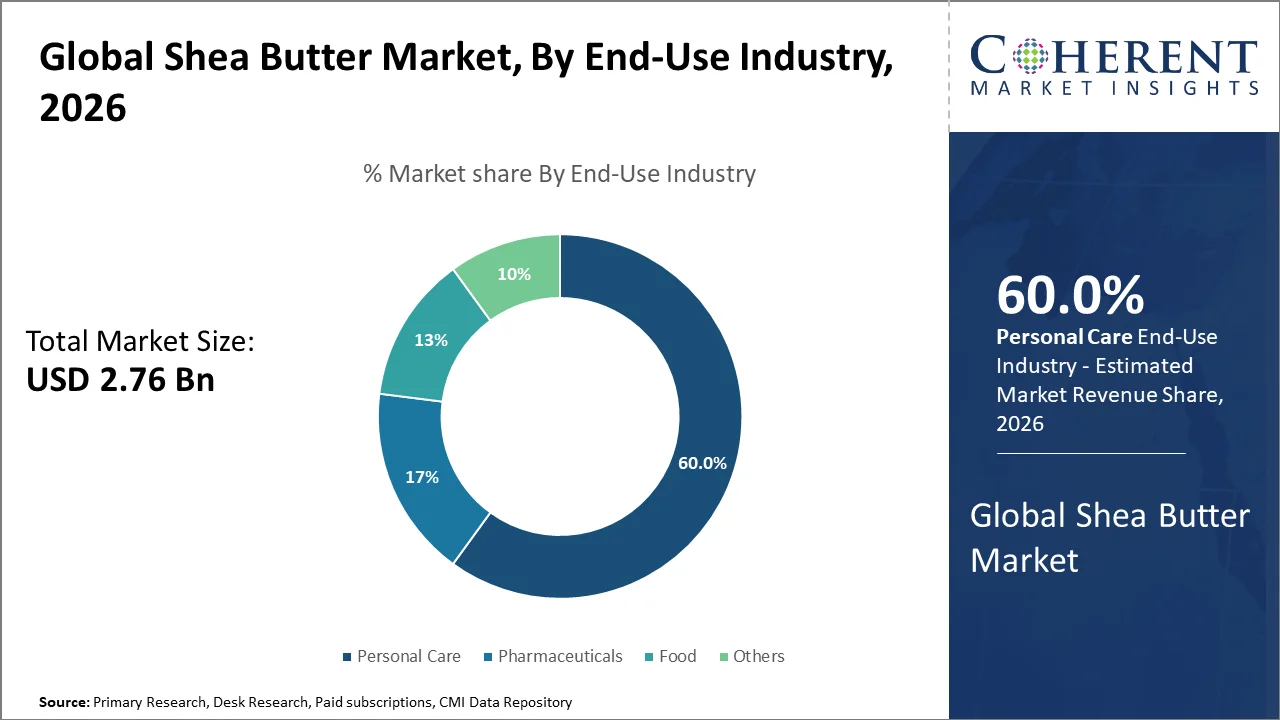
Based on end-use industry, personal care segment is projected to account for the largest market share of 60% in 2026. This is mostly due to widespread use of shea butter in skincare, haircare, and cosmetic products because of its excellent moisturizing as well as anti-inflammatory and skin-repair properties.
Rising consumer preference for natural and organic personal care products and growing demand for clean-label beauty formulations are also driving segment growth. Manufacturers are increasingly incorporating shea butter into lotions, creams, lip balms, shampoos, conditioners, and body butters to meet the rising demand for plant-based ingredients.
Shea Butter Market Growth Drivers
Rising Demand for Natural and Clean-Label Personal Care Products
Growing preference for natural personal care products is expected to boost growth of shea butter market during the forecast period. Consumers in the contemporary world are increasingly choosing skincare and haircare products made with natural, plant-based, and chemical-free ingredients. This, in turn, is putting ingredients like shea butter into the spotlight. Shea butter is widely valued for its moisturizing, anti-inflammatory, antioxidant, and skin barrier-repair properties, making it a preferred ingredient in clean beauty and natural skincare products.
Shea Butter Market Opportunities
Booming Cosmetics and Personal Care Industry
Expansion of the global cosmetics and personal care industry is anticipated to create lucrative growth opportunities for shea butter market during the forthcoming period. Shea butter is widely used in lotions, creams, lip balms, soaps, sunscreens, and hair conditioners due to its moisturizing as well as skin-conditioning properties. Rising consumer demand for premium skincare, clean-label beauty products, and multifunctional formulations is encouraging manufacturers to incorporate shea butter into a wider range of personal care products, creating new growth prospects across both developed and emerging markets.
Shea Butter Market Trends
Growing Preference for Sustainable and Ethically Sourced Ingredients
Shift towards sustainable and ethically sourced ingredients is a key growth-shaping trend in the shea butter market. In today’s society, consumers and the beauty industry are focusing increasingly on fair trade, traceable, and sustainable sources of raw material. Shea butter being sourced mainly from women’s cooperatives in West Africa, ethical sourcing is making it more popular among cosmetics manufacturers around the world.
Current Events and Their Impact on the Shea Butter Market
Current Event | Description and its Impact |
Nigeria Expands Local Shea Processing (2026) |
|
Ghana Supports Local Shea Processing |
|
Regional Insights
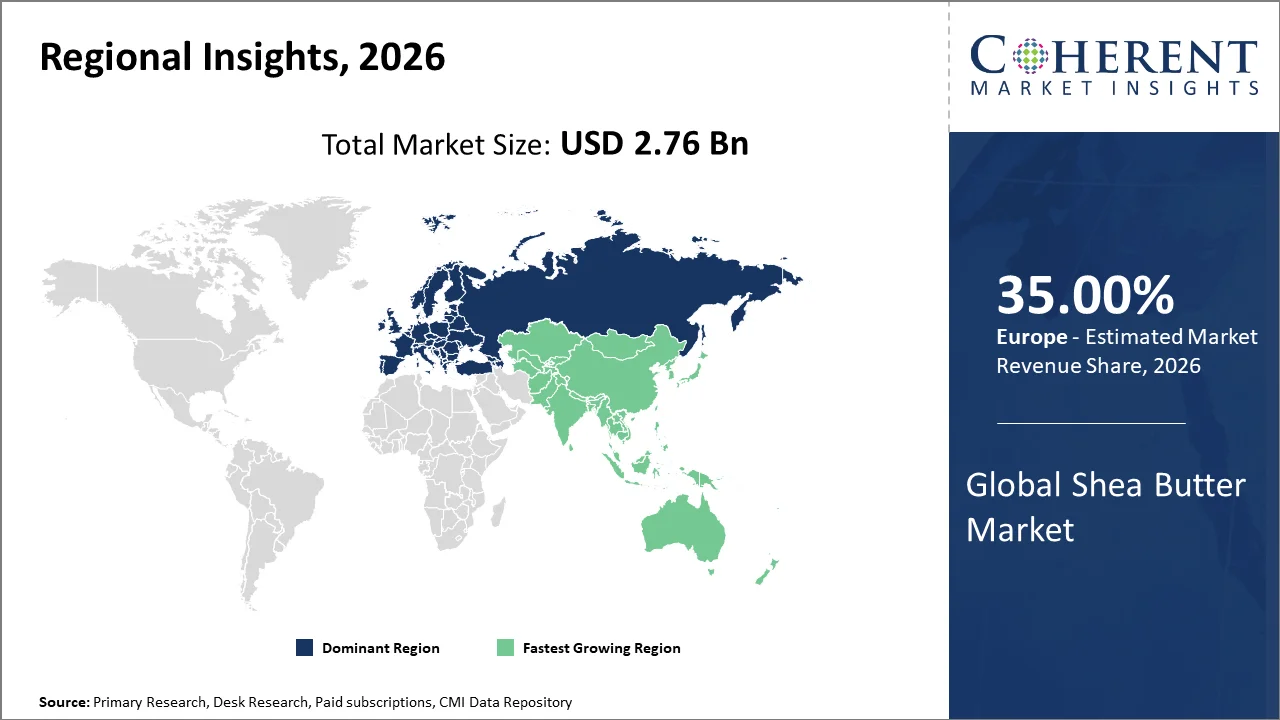
Europe Remains at the Epicenter of Shea Butter Market Growth
Europe is expected to dominate the global shea butter market, accounting for a share of 35% in 2026. This can be attributed to rising demand for natural and organic cosmetics, growing preference for ethically sourced ingredients as well as strong adoption of clean beauty products. Increasing use of shea butter in skincare, haircare, and personal care formulations is also supporting market growth across nations like Germany, France, and Italy.
Growing demand for natural cosmetic ingredients is a key factor driving shea butter consumption in Europe. According to the Centre for the Promotion of Imports (CBI), Europe accounted for around 38% of the global natural and organic cosmetics market in 2024. The report also states that European imports of vegetable oils under HS Code 151590 (including shea butter) increased from €1.29 billion in 2023 to €1.39 billion in 2024, showing rising demand for plant-based ingredients in cosmetics.
Asia Pacific Becoming a Hotbed for Shea Butter Companies
Asia Pacific shea butter market is poised to grow at the highest CAGR of 10.8% during the forecast period, making it a highly lucrative pocket for manufacturers of shea butter. This is mostly due to expanding beauty and personal care industries, rising consumer preference for natural skincare products, increasing disposable incomes, and growing influence of K-beauty and J-beauty trends. In India, 59% of consumers already use K-beauty products, 27% plan to try them, and only 14% remain uninterested.
Higher demand for plant-based cosmetic ingredients is also contributing to increased shea butter consumption across China, Japan, South Korea, and India. Similarly, rapid expansion of the skincare and cosmetics industry is expected to create strong demand for shea butter in Asia Pacific during the forecast period.
Shea Butter Market Outlook – Country-wise
Germany Shea Butter Market Trends
Germany is anticipated to remain a leading market for shea butter during the forecast period. This is attributable to its strong cosmetics, personal care, and food processing industries. The country has high demand for natural and organic skincare ingredients, and many international cosmetic manufacturers source shea butter for their formulations. Germany is also one of Europe's largest cosmetics markets, which is a key factor driving demand for shea butter in the country.
China Shea Butter Market Forecast
The shea butter market in China is poised to exhibit robust growth throughout the forecast period. This is attributed to the rapid growth of the cosmetics, personal care, and food industries. Rising disposable incomes, increasing demand for natural skincare products, and the expansion of e-commerce are significantly boosting shea butter consumption in China.
Who are the Major Companies in the Shea Butter Market?
Some of the major players in shea butter market are Star Shea Ltd., Bread For Life, All Pure Nature Ltd., Lovinah Naturals Shea Radiance, Jedwards International, Inc., Maison Karite Sociedad Limitada, Vink Chemicals Gmbh & Co. Kg, Shebu Industries, Shea Therapy Ltd, and The Pure Company.
Key Strategies Adopted by Industry Players
Leading manufacturers of shea butter are adopting various organic and inorganic strategies to boost their revenue as well as gain a competitive edge in the industry. These include new product launches, mergers, collaborations, partnerships, and acquisitions, new facility expansions, and distribution agreements.
- In January 2026, AAK AB and Beiersdorf AG expanded their partnership to strengthen sustainable shea sourcing through the Kolo Nafaso program in Ghana and Burkina Faso. The initiative supports over 10,500 women and focuses on improving sustainable production and supply chains.
- In August 2025, Manorama Industries Limited signed an MoU with the Government of Burkina Faso to set up a shea nuts and mango kernels processing facility. The move aims to strengthen raw material sourcing and expand the company’s shea butter supply chain.
Market Report Scope
Shea Butter Market Report Coverage
| Report Coverage | Details | ||
|---|---|---|---|
| Base Year: | 2025 | Market Size in 2026: | USD 2.76 Bn |
| Historical Data for: | 2020 To 2024 | Forecast Period: | 2026 To 2033 |
| Forecast Period 2026 to 2033 CAGR: | 7.8% | 2033 Value Projection: | USD 4.67 Bn |
| Geographies covered: |
| ||
| Segments covered: |
| ||
| Companies covered: | Star Shea Ltd., Bread For Life, All Pure Nature Ltd. Lovinah Naturals Shea Radiance, Jedwards International, Inc., Maison Karite Sociedad Limitada, Vink Chemicals Gmbh & Co. Kg, Shebu Industries, Shea Therapy Ltd, and The Pure Company. | ||
| Growth Drivers: |
| ||
| Restraints & Challenges: |
| ||
Analyst Opinion (Expert Opinion)
- Rising demand for natural and clean-label ingredients is set to boost shea butter market growth during the forthcoming period. Cosmetic, skincare, and food companies are using shea butter more often because it is plant-based and multifunctional. This increases demand across personal care and food applications.
- More brands are sourcing certified and ethically produced shea butter to meet consumer expectations for sustainability and fair trade. This creates better opportunities for producers that can meet quality and traceability standards.
- As reported by FAO, 14 million metric tons of shea nuts have been exported by six countries of West Africa between 2007 to 2017 which clearly highlights the importance of international business in the shea value chain. The increased number of exports increases the demand for shea butter in the long term.
Speak to the analyst
Want personalized insights?
Take the findings above to one of our principal consultants, or have the report rebuilt around the segments, geographies and competitors you actually track.
Market Segmentation
- By Grade Insights ( Revenue, USD Bn, 2021 - 2033)
- Grade A
- Grade B
- Grade C
- Grade D
- Grade E
- By End-Use Industry Insights ( Revenue, USD Bn, 2021 - 2033)
- Personal Care
- Pharmaceuticals
- Food
- Others
- By Distribution Channel Insights ( Revenue, USD Bn, 2021 - 2033)
- Hypermarket
- Supermarket
- Specialty Stores
- Online Stores
- Convenience Stores
- Others
- By Region Insights ( Revenue, USD Bn, 2020 - 2033)
- North America
- U.S.
- Canada
- Latin America
- Brazil
- Argentina
- Mexico
- Rest of Latin America
- Europe
- Germany
- U.K.
- Spain
- France
- Italy
- Russia
- Rest of Europe
- Asia Pacific
- China
- India
- Japan
- Australia
- South Korea
- ASEAN
- Rest of Asia Pacific
- Middle East
- GCC Countries
- Israel
- Rest of Middle East
- Africa
- South Africa
- North Africa
- Central Africa
- North America
Sources
Primary Research Interviews
- Manufacturers
- Shea butter processors
- Raw material suppliers and distributors
- Cosmetic and personal care companies
- Food and beverage manufacturers
- Industry experts
- Regulatory professionals
Databases
- UN Comtrade Database
- ITC Trade Map
- FAOSTAT
- World Bank Open Data
- UN Data, Eurostat
Magazines
- Cosmetics & Toiletries
- Personal Care Magazine
- Food Business News
- BeautyMatter
- Food Ingredients First
Journals
- Journal of the American Oil Chemists' Society
- Food Chemistry
- Industrial Crops and Products
- Journal of Food Science
- International Journal of Cosmetic Science
Newspapers
- Financial Times
- The Wall Street Journal
- The Guardian
- Business Standard
- The Economic Times
Associations
- Global Shea Alliance (GSA)
- Cosmetic, Toiletry and Perfumery Association (CTPA)
- Personal Care Products Council (PCPC)
- Institute of Food Technologists (IFT)
- Sustainable Trade Initiative (IDH)
Public Domain sources
- Food and Agriculture Organization (FAO)
- World Trade Organization (WTO)
- World Bank, International Trade Centre (ITC)
- United Nations Conference on Trade and Development (UNCTAD)
- U.S. Department of Agriculture (USDA)
- European Commission
Proprietary Elements
- CMI Data Analytics Tool
- Proprietary CMI Existing Repository of information for last 10 years
Get access to 250+ pages report
Every segment, forecast, competitor profile and data table behind the analysis above — available for instant download.
- ESOMAR Member
- ISO 9001:2015 Certified
- D-U-N-S Registered
- GDPR & CCPA Compliant
Missing comfort of reading report in your local language? Find your preferred language:
Transform your Strategy with Exclusive Trending Reports
Frequently Asked Questions
The global market is estimated to be valued at USD 2.76 Bn in 2026.
The global Shea Butter Market value is expected to reach USD 4.67 Bn by 2033.
The global market is poised to exhibit a CAGR of 7.8% from 2026 to 2033.
Major growth factors include rising demand for natural and clean-label personal care products, growing adoption of plant-based ingredients in cosmetics, expansion of the skincare and beauty industry, increasing consumer preference for sustainable and ethically sourced products, and rising use of shea butter in food and pharmaceutical applications.
Grade A shea butter is expected to lead the market with a share of 41.8% in 2026.
Some major companies in the Shea Butter Market include Star Shea Ltd., Bread For Life, All Pure Nature Ltd., Lovinah Naturals Shea Radiance, Jedwards International, Inc., Maison Karite Sociedad Limitada, Vink Chemicals Gmbh & Co. Kg, Shebu Industries, Shea Therapy Ltd, and The Pure Company.
Europe, with a 35% share in 2026, is set to lead the market during the forecast period.