

Global Manual Tile Cutter Market Size and Forecast – 2026-2033
Coherent Market Insights estimates that the global manual tile cutter market is expected to reach USD 450 Mn in 2026 and will expand to USD 670 Mn by 2033, registering a CAGR of 5% between 2026 and 2033.
Key Takeaways of the Manual Tile Cutter Market
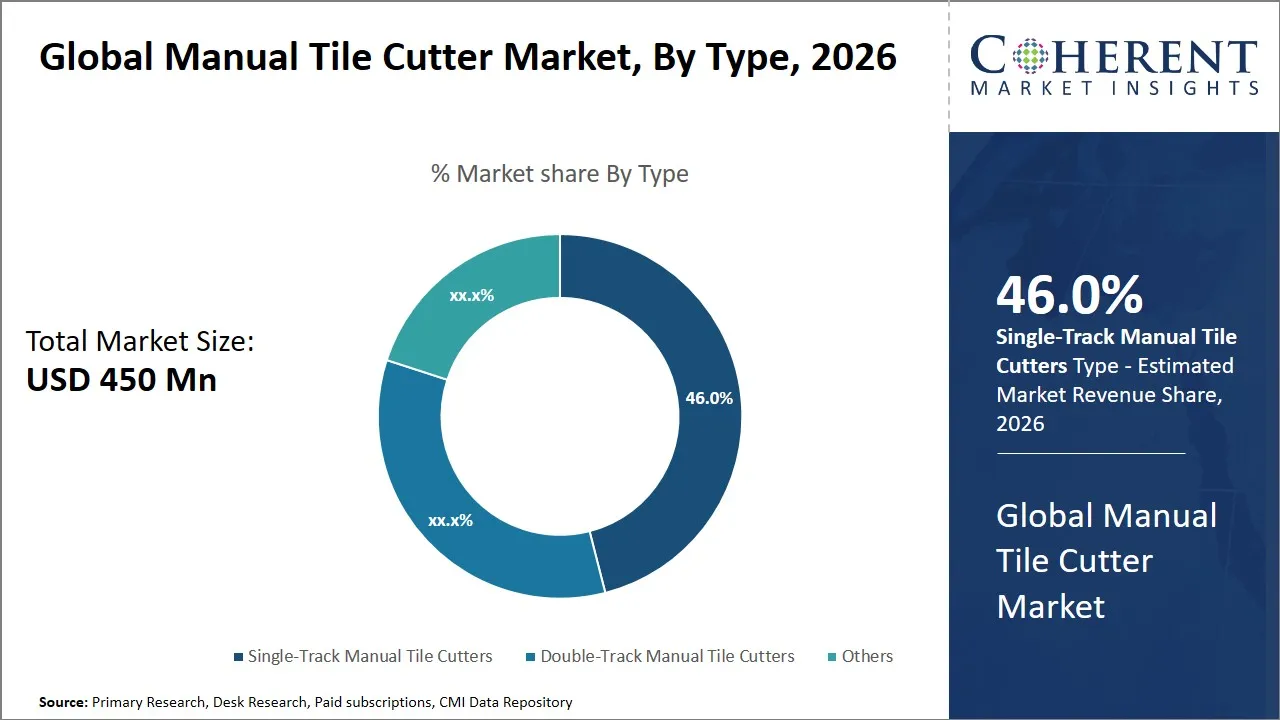
- The single-track manual tile cutters segment is expected to account for 46% of the manual tile cutter market share in 2026.
- The commercial segment is projected to hold 59% of the market share in 2026.
- Asia Pacific will dominate the manual tile cutter market in 2026 with an estimated 39% share.
- North America will hold 25% share in 2026 and is expected to record the fastest growth over the forecast period.
Current Events and Its Impact
Current Events | Description and its Impact |
RUBI Product Launch |
|
Segmental Insights
- Current Industry Events of 2026
- Market Size Estimation
- Regional Breakdown
- Competitive Landscape
- Customer Intelligence
- Segmental Analysis
- Pricing Analysis
- Key Market Drivers, Challenges & Future Trends
- Customized Insights Section
Why Does the Single-Track Manual Tile Cutters Segment Dominate the Global Manual Tile Cutter Market in 2026?
The single-track manual tile cutters segment is expected to account for 46.0% of the global manual tile cutter market share in 2026. As structures stay simple, different users adopt them easily - learning takes little effort. Built only for standard tiling tasks, these tools match common sizes and surfaces seen every day. Using a single guide rail brings better precision, yet cuts down preparation far more than bulkier systems needing multiple rails - this helps during frequent use. Price matters greatly; reduced cost becomes noticeable where spending limits shape decisions.
Though built with fewer components than double-track models, these tools cost less to produce. Their affordability often appeals to independent workers who handle minor construction tasks. Price reductions do not remove core performance needed for routine cuts. Accuracy remains consistent during standard operations. Value emerges through reliable results without added expense.
Commercial Segment Dominates the Global Manual Tile Cutter Market
The commercial segment is projected to account for 59.0% of the global manual tile cutter market share in 2026. From vast construction projects unfolding worldwide, growth takes shape. Where skyscrapers rise, so do demands for precise tools. Retail spaces, hotels, administrative structures - each requires extensive tile fitting. With such builds multiplying, the need for reliable cutters increases accordingly. Progress in one area fuels demand in another. Among influences shaping progress in business-related construction, project size concentrated in city zones stands out clearly.
With urban landscapes evolving rapidly, expectations for resilient surfacing solutions increase noticeably. Precision matters greatly when surfaces must endure constant foot traffic without compromising visual appeal. In these cases, hand-operated tile cutters become preferred tools since they consistently produce sharp, accurate results under demanding conditions. Quality remains central where long-term performance cannot be compromised. These devices support reliable outcomes even during intensive application phases.
Global Manual Tile Cutter Market Cut Accuracy & Tile Breakage Rates
Performance Metric | Manual Tile Cutter (Standard) | Manual Tile Cutter (Premium/Laser-assisted) |
Cut Accuracy (straight line) | ±0.5 mm per meter | ±0.2 mm per meter |
Typical Tile Breakage Success Rate | ~90–95 % | ~95–98 % |
Error (deviation from intended line) | 0.5–1.0 mm | 0.2–0.5 mm |
Tile Chipping Rate (minor edge chips) | ~5–10 % | ~2–5 % |
Maximum Tile Thickness Reliable for Clean Cut | ~8–12 mm | ~12–20 mm |
Global Manual Tile Cutter Market Material Versatility Index
Tile Material | Typical Manual Cutter Suitability | MVI Score (0–100) |
Ceramic (standard) | Excellent | 90 |
Porcelain (thin ≤ 8–10 mm) | Good | 75 |
Glass tiles | Fair | 45 |
Terracotta tiles | Good | 80 |
Natural Stone (marble) | Low | 20 |
Natural Stone (granite/slate) | Very Low | 10 |
Mosaic tiles | Good | 70 |
Large-format tiles (standard porcelain) | Moderate | 55 |
Regional Insights

Asia Pacific Manual Tile Cutter Market Analysis and Trends
The Asia Pacific region is projected to lead the market with a 39% share in 2026. From rising construction and renovation activities, growth takes shape - driven by swift urban spread and improved infrastructure. As cities swell, need builds slowly for instruments applied in tile work. Within countries such as China, India, and Japan, production units run near full output, meeting local needs alongside overseas orders; thus, the region becomes a hub for making and distributing manual cutting tools.
Though development pushes forward, supply chains adapt without delay. Owing to supportive state measures aimed at boosting industry, funding poured into construction, and ready access to basic materials, business conditions remain favorable. Firms such as Sigma, Montolit, and Rubi Tools, based or heavily active in Asia Pacific, play key roles by refining designs and adapting offerings to diverse users. With lower workforce expenses and efficient transport networks, trading patterns help keep these instruments available and priced within reach across locales.
North America Manual Tile Cutter Market Analysis and Trends
The North America region is expected to exhibit the fastest growth in the market contributing 25% share in 2026. Growth continues within the North American market for manual tile cutters, supported by a rise in do-it-yourself building efforts, repair work, and new constructions. As these devices offer reliable results without high costs, they see frequent use among tradespeople along with individuals handling personal projects. Rising home ownership, particularly seen in parts of the United States and Canada, links to more buying activity involving residential or commercial areas. As years pass, design changes occur: hand grips become easier to hold, precision during slicing gets finer, room inside grows enough to handle larger items - this strengthens interest in models without electric power. Even though powered alternatives like water-cooled blades hold ground on big job sites, human-powered units stay preferred when mobility matters and budgets constrain choices. Key figures like RUBI, Montolit, or Raimondi keep updating offerings and this strengthens expansion within the sector. Environmental focus grows; efficiency in power use becomes more valued instead.
Global Manual Tile Cutter Market Outlook for Key Countries
Why is China Emerging as a Major Hub in the Manual Tile Cutter Market?
Manufactured under industrial demand, China's supply of hand-operated tile cutting tools reflects its role in global building practices. With operations rooted in precision engineering, firms like Sigma operate within clusters of component providers, creating models suited for basic tasks up to demanding applications. Rather than relying on imported parts, localized assembly supports consistent output while maintaining adaptability in design changes.
Support from national programs focused on public works indirectly fuels domestic equipment needs alongside overseas shipments. Distribution thrives through networks that extend beyond metropolitan zones into developing regions with rising renovation activity. Although competition remains intense, access to skilled labor and material sources sustains long-term positioning in international trade flows.
Is India the Next Growth Engine for the Manual Tile Cutter Market?
Urban expansion across India, together with national initiatives focused on low-cost homes, raises need for hand-operated tile cutting tools. With local manufacturers, international firms including Rubi Tools and Sigma deliver tools, expanding options as standards rise. Driven by policies tied to initiatives such as “Make in India,” output shifts toward national sources, cutting import reliance while matching diverse construction needs. Training adjusts behind the scenes during these changes, ensuring proper operation of basic tile-cutting devices across small projects or large developments, aiding broader adoption.
Germany Manual Tile Cutter Market Analysis and Trends
Still ahead in Europe, Germany shapes the manual tile cutter sector through a developed building sector, strict quality demands, efficient production methods. Firms like Montolit, active across German sites, distribute resilient hand-powered cutters known for fine engineering details. Because of tough national rules on equipment reliability, progress in design tends to accelerate over time. Supported by expert repair shops and lending networks for gear, consistent need arrives from remodelers, builders alike. Operating inside predictable EU commerce frameworks helps maintain smooth material flows across regions.
Brazil Manual Tile Cutter Market Analysis and Trends
Among construction crews, hands-on tiling tools grow more common as urban renewal pushes forward in Brazil. Because government funds move toward infrastructure improvements, simple cutting devices see increased preference on job sites. Companies like Cortag and Bellota stay visible due to gear that withstands heavy work without high cost, qualities widely respected locally. Tool availability improves through broader retail reach alongside better follow-up assistance. International trade agreements also influence the landscape: premium machines arrive faster from overseas, whereas local brands strengthen competitiveness beyond national borders.
Mexico Manual Tile Cutter Market Analysis and Trends
Growth in homebuilding and business-related structures fuels demand for hand-operated tile cutting tools across Mexico. Collaboration among global vendors and regional sellers brings together dependable performance and accessible pricing within the marketplace. Companies like Rubi Tools now operate more widely in this region, introducing updated models suited to evolving building needs. Support from national policies on upgrading facilities helps increase usage of these instruments. Located near the U.S., cross-border exchange allows smoother entry of sophisticated parts and know-how into local supply chains.
Market Players, Key Development, and Competitive Intelligence

Key Developments
- On September 22, 2025, Montolit showcased the Masterpiuma P5 Top manual tile cutter and precision tools at Cersaie 2025. The new line of machines Power 5 is based on the fundamental advantage of “All in One” (always ready for action!) and includes the distinctive characteristics that have made the “Masterpiuma” the worldwide leader in the field of professional tile cutters.
- On September 16, 2025, RUBI unveiled new tile cutting innovations for 2025, including the TK manual ceramic cutter, the first asymmetrical monoguide manual cutter on the market, showcased at Cersaie 2025, and new product ranges featured in the 2025 RUBI catalogue.
Top Strategies Followed by Global Manual Tile Cutter Market Players
- Even with strong market rivalry, leading companies distinguish themselves by persistently advancing manual ceramic tile cutters. Driven primarily by focused development work, progress unfolds through improvements in precision and handling comfort. Scoring mechanisms gain accuracy while ergonomically designed grips appear, increasing stability mid-cut. Materials built for durability enter production to resist wear across demanding environments. Separation from competitors forms quietly, shaped more by subtle engineering than loud promises. What sets products apart is attention to functional detail and deliberate design choices. What gets expected from how things work guides what they are made of, picking strength while avoiding heaviness. Instead of big shifts, small refinements tend to set brands apart when methods differ widely.
- Even when focusing on lower price ranges, certain manufacturers maintain consistent operation while keeping essential functions of hand-operated tile cutters intact. Without aiming for high-end labels, their audience includes self-employed contractors, people updating homes, and developing regions reached via cost-effective strategies. What matters most stays unchanged - choices in parts and design favor low expense alongside long life. Slowly, alliances emerge - sometimes with creators of new tools, local factories, or transport systems - to improve reach within scattered areas. Not depending only on being cheap, these businesses refine focus by tuning distribution paths to fit specific area needs.
- Smaller companies work in specific areas or specialized markets, standing out by solving problems in new ways that match exact customer situations. Instead of trying to serve everyone, they build tools tailored to unique tasks, take handheld tile cutters, redesigned to save room, made from eco-conscious materials, sometimes combining measurement and cutting into one motion where gaps exist. While larger brands pass over subtle requirements, these organizations respond, using technologies such as robotics and digital controls - not to produce more, yet to maintain accuracy and reduce waste. Excellence stays a priority, reached not by making large volumes, but through careful steps ensuring reliability even when budgets are limited. Distinctiveness grows quietly, rooted in attention to overlooked practicalities instead of widespread distribution.
Market Report Scope
Manual Tile Cutter Market Report Coverage
| Report Coverage | Details | ||
|---|---|---|---|
| Base Year: | 2025 | Market Size in 2026: | USD 450 Mn |
| Historical Data for: | 2020 To 2024 | Forecast Period: | 2026 To 2033 |
| Forecast Period 2026 to 2033 CAGR: | 5% | 2033 Value Projection: | USD 670 Mn |
| Geographies covered: |
| ||
| Segments covered: |
| ||
| Companies covered: | RUBI, Hangzhou John Hardware Tools, Montolit, Battipav, Sigma, ISHII Tools, Raimondi, SIRI, Romway Industrial, Zhejiang Shijing Tools, WenZhou TEGU, Zhejiang Xidele, Ningbo Sanding Edge Industrial, Yongkang TOPVEI, and RK TOOLS | ||
| Growth Drivers: |
| ||
| Restraints & Challenges: |
| ||
Global Manual Tile Cutter Market Dynamics
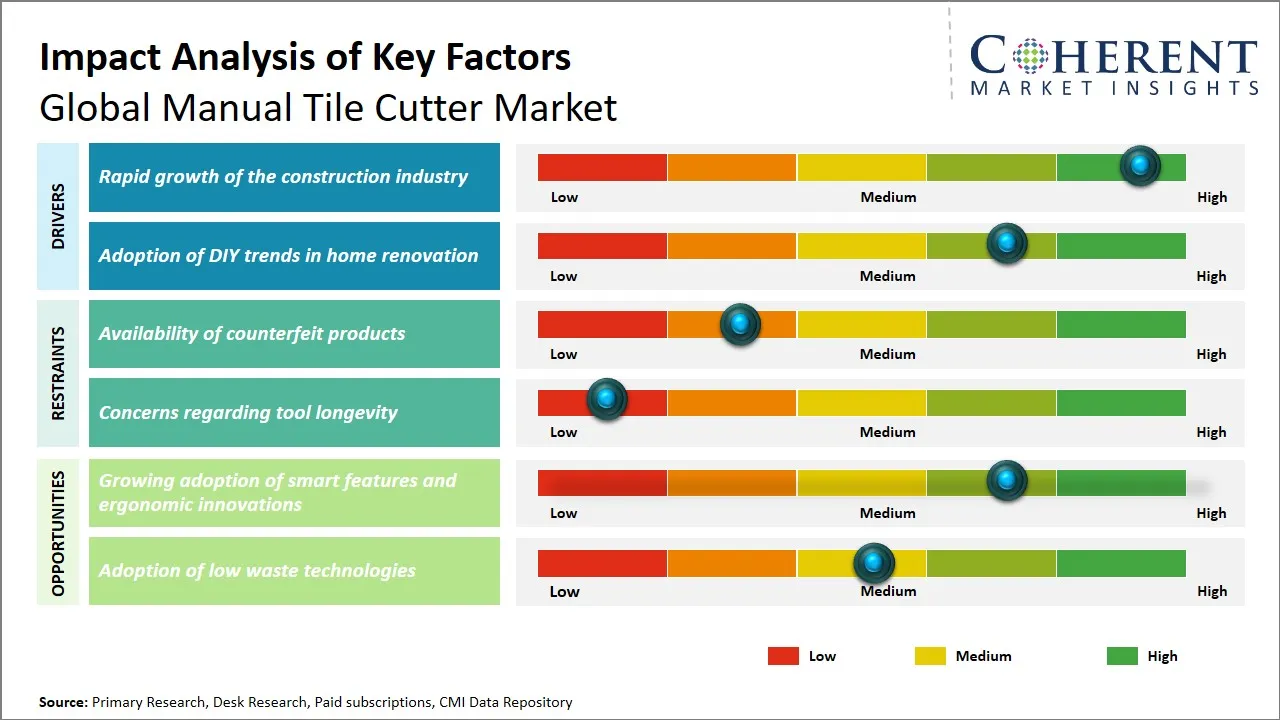
Global Manual Tile Cutter Market Driver - Rapid Growth of the Construction Industry
Worldwide growth in building activities raises the need for hand-operated tile cutters. With more homes, offices, and public works underway, tools that deliver accurate cuts at low cost gain importance. These devices work reliably where electricity is scarce or absent, fitting well into off-grid environments. Their function remains steady even when conditions are less than ideal.
For instance, on January 22, 2026, EquipmentShare.com Inc, a leader in connected jobsite technology and one of the largest equipment rental providers in the U.S., announced that it priced its initial public offering of 30,500,000 shares of its Class A common stock, par value USD 0.00000125 per share, at a price to the public of USD 24.50 per share.
(Source: equipmentshare.com)
Global Manual Tile Cutter Market Opportunity - Growing Adoption of Smart Features and Ergonomic Innovations
With advancements in construction materials and projects rising across regions, demand grows for handheld tile cutters featuring smarter functions. Precision machine tools become a priority when renovations occur at larger scales. Tools now include digital displays instead of basic markings. Laser indicators appear alongside angle adjustments on newer models. User comfort influences design choices more than before. Efficiency gains emerge through updated engineering methods. Shifts in construction methods shape how products adapt during renovations. Where precision aligns with usability, updates emerge slowly. Over time, changing demands prompt subtle modifications. Fewer mistakes occur because of intelligent design, while schedules grow tighter - this draws both skilled workers and independent builders without distinction.
Analyst Opinion (Expert Opinion)
- Even with widespread changes in automated tools, manual tile cutters remain common in certain areas. Because home renovations matter more than construction projects, demand stays steady where spending must be limited. In places that value function above complexity, basic design turns into benefit. Stored inside garages or left at worksites, they perform adequately whenever exact cuts are less critical. Ceramic work dominates their application, though some handle thin porcelain with care. What they lack in speed they make up for in dependability. Portability matters just as much as price for many users. Longevity emerges quietly through consistent performance across thousands of cuts.
- A shift toward gradual growth seems likely, driven by consistent market interest even without major leaps in fundamental design. Rather than radical change, progress shows a preference for accuracy, extended durability, and improved grip - refinement shaping outcomes more than disruption. Under heavy workloads, electric units and systems relying on liquid-based cooling gain favor across large building projects. Meanwhile, manually powered alternatives remain common in budget-sensitive contexts, particularly for solo operators and minor tasks. Out of small improvements, rather than sweeping shifts, resilience tends to grow. Where cost meets consistency, strength often follows - especially when access widens across digital platforms and physical stores alike. Staying competitive quietly favors those who adjust without overturning.
Speak to the analyst
Want personalized insights?
Take the findings above to one of our principal consultants, or have the report rebuilt around the segments, geographies and competitors you actually track.
Market Segmentation
- Type Insights (Revenue, USD Million, 2021 - 2033)
- Single-Track Manual Tile Cutters
- Double-Track Manual Tile Cutters
- Others
- Application Insights (Revenue, USD Million, 2021 - 2033)
- Commercial
- Residential
- Regional Insights (Revenue, USD Million, 2021 - 2033)
- North America
- U.S.
- Canada
- Latin America
- Brazil
- Argentina
- Mexico
- Rest of Latin America
- Europe
- Germany
- U.K.
- Spain
- France
- Italy
- Russia
- Rest of Europe
- Asia Pacific
- China
- India
- Japan
- Australia
- South Korea
- ASEAN
- Rest of Asia Pacific
- Middle East
- GCC Countries
- Israel
- Rest of Middle East
- Africa
- South Africa
- North Africa
- Central Africa
- North America
- Key Players Insights
- RUBI
- Hangzhou John Hardware Tools
- Montolit
- Battipav
- Sigma
- ISHII Tools
- Raimondi
- SIRI
- Romway Industrial
- Zhejiang Shijing Tools
- WenZhou TEGU
- Zhejiang Xidele
- Ningbo Sanding Edge Industrial
- Yongkang TOPVEI
- RK TOOLS
Sources
Primary Research Interviews
- Manual tile cutter manufacturers and suppliers
- Construction industry professionals and contractors
- Tile installation specialists and craftsmen
- Home improvement retailers and distributors
Databases
- Global Trade Atlas
- Euromonitor International
Magazines
- Tile & Stone Journal
- Construction Equipment Magazine
- Tools & Hardware International
- Professional Builder Magazine
Journals
- Journal of Construction Engineering and Management
- International Journal of Advanced Manufacturing Technology
- Construction Materials and Equipment Review
Newspapers
- Construction Dive
- Building Design + Construction
- Construction News International
- Hardware Retailing News
Associations
- Tile Council of North America (TCNA)
- International Association of Certified Home Inspectors
- National Tile Contractors Association
- European Ceramic Tile Manufacturers' Federation
Public Domain Sources
- U.S. Census Bureau Manufacturing Reports
- European Union Trade Statistics
- World Bank Industrial Production Data
- National Statistical Offices Publications
Proprietary Elements
- CMI Data Analytics Tool
- Proprietary CMI Existing Repository of information for last 8 years
Get access to 250+ pages report
Every segment, forecast, competitor profile and data table behind the analysis above — available for instant download.
- ESOMAR Member
- ISO 9001:2015 Certified
- D-U-N-S Registered
- GDPR & CCPA Compliant
Missing comfort of reading report in your local language? Find your preferred language:
Transform your Strategy with Exclusive Trending Reports
Frequently Asked Questions
The global manual tile cutter market is expected to stand at USD 450 Mn in 2026 and is expected to reach USD 670 Mn by 2033.
The CAGR of global manual tile cutter market is projected to be 5% from 2026 to 2033.
Rapid growth of the construction industry and adoption of DIY trends in home renovation are the major factors driving the growth of the global manual tile cutter market.
Availability of counterfeit products and concerns regarding tool longevity are the major factors hampering the growth of the global manual tile cutter market.
In terms of type, single-track manual tile cutters are estimated to dominate the market revenue share in 2026.
They are generally less suitable for large projects, where electric cutters offer higher efficiency.
Price is a major factor, especially in developing regions and among individual users.