

Global Marine Composites Market Size and Forecast – 2026 to 2033
According to Coherent Market Insights, the global marine composites market is estimated to be valued at USD 3.98 Bn in 2026 and is expected to reach USD 5.83 Bn by 2033, exhibiting a compound annual growth rate (CAGR) of 5.6% from 2026 to 2033.
Key Takeaways of the Marine Composites Market
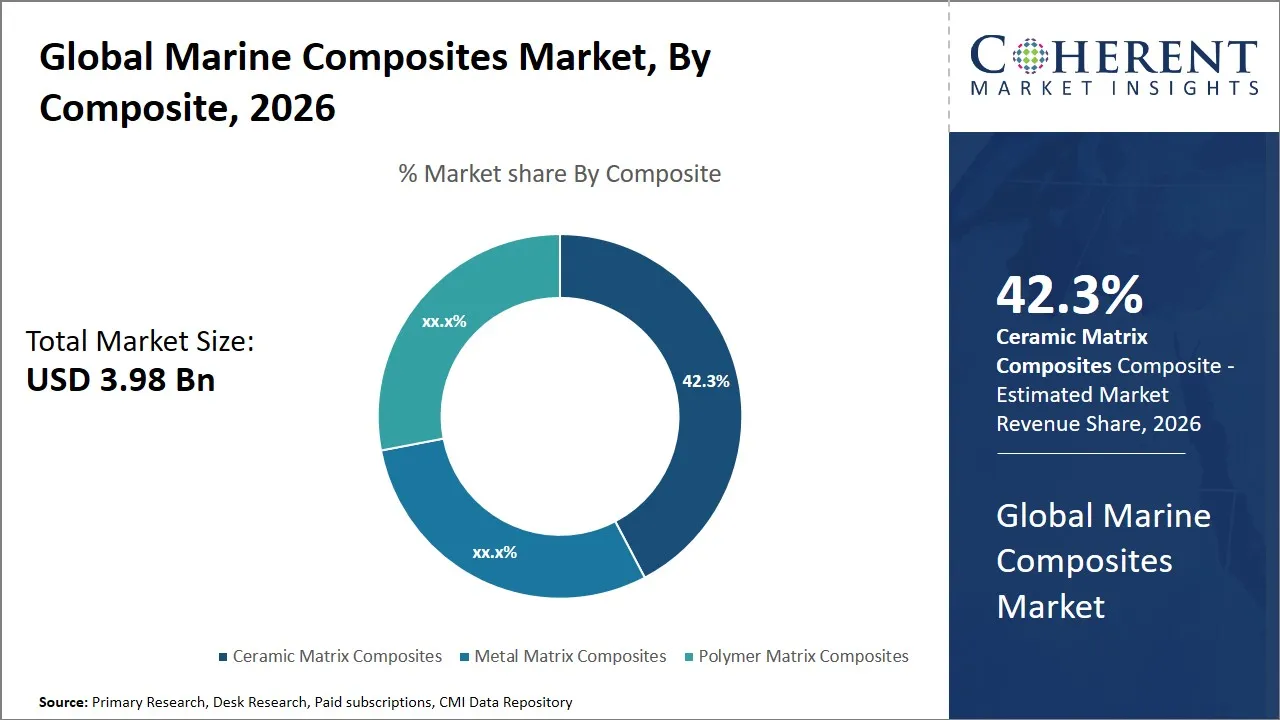
- The ceramic matrix composites segment is projected to hold 42.3% of the global marine composites market in 2026.
- The power boats segment is expected to account for 44.9% of the global marine composites market in 2026.
- The polyester segment is expected to lead the global marine composites market with a 39.7% share in 2026.
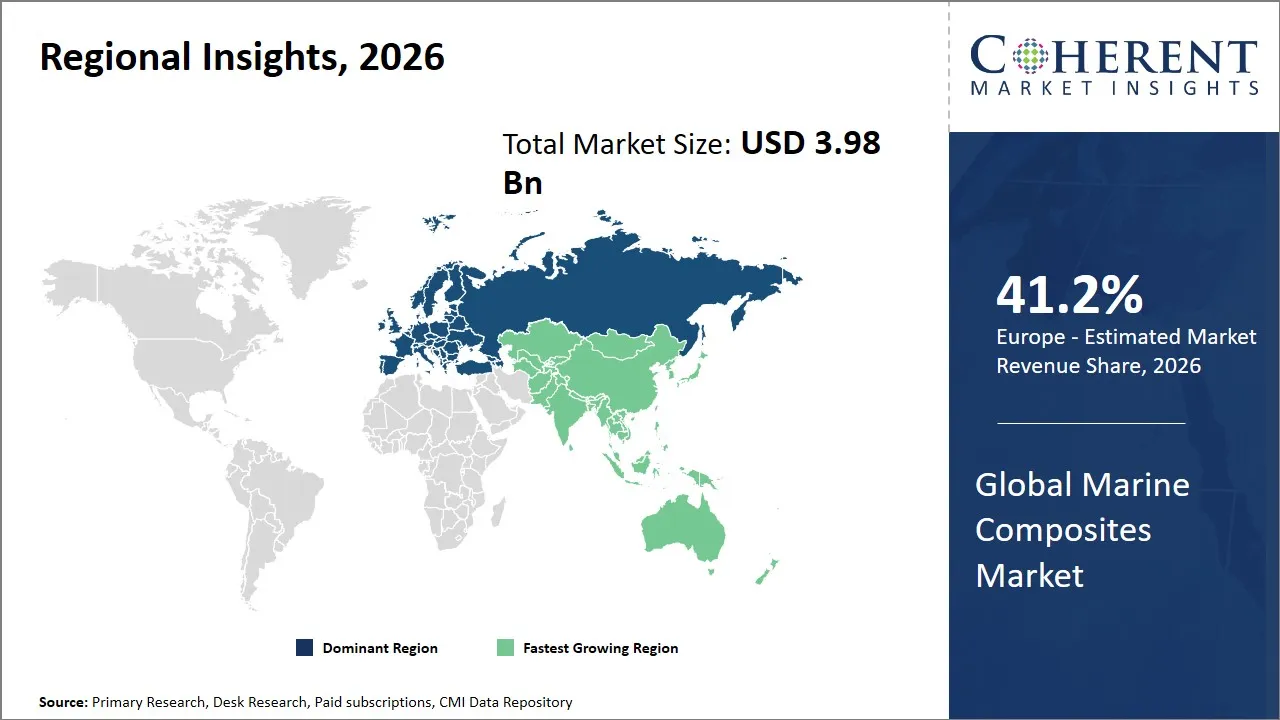
- Europe is expected to lead the market with a 41.2% share in 2026.
- The Asia Pacific region is projected to experience the fastest market growth, capturing a 22.3% share in 2026.
Market Overview
- A key market trend is the rising adoption of advanced composite materials such as carbon fiber-reinforced polymers in recreational boats, commercial vessels, and naval ships.
- Additionally, environmental regulations are pushing for greener manufacturing processes, fueling innovation in sustainable composites.
- Integration of smart composites with sensors for structural health monitoring is also gaining traction, helping improve safety and performance, thereby further accelerating the market growth.
Currents Events and Its Impacts
Current Events | Description and its impact |
Rising Demand for Sustainable/Lightweight Marine Materials |
|
Expansion of Recreational & Commercial Marine Sectors |
|
Segmental Insights
- Current Industry Events of 2026
- Market Size Estimation
- Regional Breakdown
- Competitive Landscape
- Customer Intelligence
- Segmental Analysis
- Pricing Analysis
- Key Market Drivers, Challenges & Future Trends
- Customized Insights Section
Why Does the Ceramic Matrix Composites Segment Dominate the Marine Composites Market in 2026?
Ceramic matrix composites segment is expected to contribute 42.3% share of the global marine composites market in 2026, as the composites have some of the best mechanical and thermal capability, making them highly suitable in the marine settings which are challenging. Ceramic matrix composites have been specifically designed to perform excellently in harsh environments and have high strength to weight ratios and excellent corrosion, wear, and thermal degradation resistance. The traits are essential in marine boats that are subjected to extreme salty environments, variable temperatures, and excessive mechanical forces.
Among the leading growth factors that have seen CMCs used in marine applications is the fact that they increase fuel efficiency. Ships that have composite materials that are light and more durable have a lower weight and this directly affects the fuel consumption since less fuel is needed to propel the ship. This is an added efficiency and especially so in the current times of increasing fuel prices and strict rules regarding the number of emissions in the maritime industry, where cost-effectiveness and environmental sustainability are of high priority.
Power Boats Dominate the Marine Composites Market
Power boats segment is projected to hold 44.9% share of the global marine composites market in 2026, with much of its success largely attributable to the acute demand to harness the speed, maneuverability, and fuel economy through the use of lightweight, durable, and high-strength material. Power boats are performance oriented, which is normally used in recreational purposes, fishing as well as commercial purposes that involve agile maneuvering and high-speed acceleration. This requires the implementation of the composite materials, which enhance the ratio of the power to the weight without affecting the structural integrity.
An example of a company that offers power boats is Brunswick Corporation, which is known for its range of high-performance power boats designed for recreational, fishing, and commercial purposes. The company utilizes advanced marine composites to enhance speed, maneuverability, and fuel efficiency while maintaining structural integrity.
Why Does the Polyester Segment Dominate the Marine Composites Market?
The polyester segment leads the global marine composites market, holding an estimated share of 39.7% in 2026, owing to their extensive availability, reasonably cheap, and acceptable performance features that can fit in a wide variety of marine products. One of the most widely used thermosetting resins in the marine industry with an underlying basis on the dominance in the boatbuilding field and composite fabrication is polyester resin.
One of the reasons why polyester resins are dominant is the fact that they are cost effective as compared to other resin types such as epoxy or the vinyl ester. Marine companies usually have a very limited budget, particularly when making small to medium size boats like fishing boats, sail boats as well as some commercial craft. Polyester resin provides the balance of price and performance to be appealing and allow working on mass production without losing basic mechanical characteristics that make this material useful in the marine environment.
Regional Insights
Europe Marine Composites Market Analysis and Trends
The Europe region is projected to lead the market with a 41.2% share in 2026, due to a well-established maritime industry in addition to strict environmental laws that have demanded the use of lightweight and fuel-efficient materials. The area enjoys the advantage of a developed market ecosystem where there exists a powerful network of suppliers, manufacturers, and research houses working together in order to come up with innovative composite technologies. Marine composites have been facilitated by governments in European countries which have put measures to encourage the use of sustainable materials in shipbuilding and offshore works.
Some of the major players in Europe such as Gurit AG (Switzerland), Hexcel Corporation (with a major presence in France and UK), and DSM Composite Resins (Netherlands) have technological innovations and strategic alliances that influence the market leadership. The fact that countries like Italy, Germany, and the U.K. have the top shipyards, consolidates the fact that Europe is a solid hub of composite solutions. The dynamics of trade are also in favor of Europe and with effective port infrastructures, it is easy to export high value composite parts that are used in cruise ship, naval vessels, and luxury yachts.
Asia Pacific Marine Composites Market Analysis and Trends
The Asia Pacific region is expected to exhibit the fastest growth in the market contributing 22.3% share in 2026, due to increased industrialization and build of more ships and especially in China, South Korea and Japan. The offshore oil and gas industry that is growing and the increments in investments in modernization of its navy are all factors that increase the demand for advanced composites. The growth of emerging government programs that encourage the use of green shipbuilding and local production capacity is spurring the use of marine composites.
An example of that is China’s Made in China 2025 project, which facilitates the production of high-technological materials, such as composites, in the marine industry. Large firms like Teijin Group (Japan), Sinopec (China), and Hanwha Advanced Materials (South Korea) have been increasing their capacity and product range to fulfill the regional needs. Moreover, Asia Pacific has the advantage of low cost base and large supply chain networks that increase competitiveness and trigger market penetration. The rapid growth trend is also supported by the rising number of maritime construction projects as well as the market of leisure boats and yachts.
Global Marine Composites Market Outlook for Key Countries
U.S. Marine Composites Market Trends
The marine composites market in the U.S. is highly dominated by a powerful defense industry and a growing recreational boating market. Large players like Hexcel Corporation and Owens Corning are well established, and they have come up with high-performance composite materials that are specifically geared to military ships and luxury yachts. The modernization of the naval fleet as well as its compliance with environmental emissions policies adopted by the U.S. government contributes to the increased use of lightweight corrosion-resistant composites. Also, the availability of high-level research centers encourages the production of future-generation composite resins and reinforcement applied in the marine industry.
How Is Germany Shaping the Marine Composites Market?
Germany is still the European leader in the marine composites market with its reputable shipbuilding and offshore wind industries. Companies, such as SGL Carbon and BASF, are also central players in refining the carbon fiber and resin technologies to be used in marine conditions. The focus on sustainable industrial practices and policies based on innovations have stimulated the need to use composites that will help lower fuel consumption and prolong the life of the vessels in the country. The export of marine components of composites to other European markets is also made easier by Germany’s trade infrastructure and access to North Sea shipping routes.
China Marine Composites Market Trends
The marine composites market of China is seeing a high level of growth as it is driven by the fact that the country has been leading in terms of shipbuilding production in the world, and the growing modernization efforts in the military. Local companies like Sinopec and China National Offshore Oil Corporation (CNOOC) specialize in the production of high-end composite materials to be used in commercial and offshore production.
Government programs that have enhanced indigenous technology and green manufacturing practices are some of the major growth drivers. Further, the large coastline of China, with the rise of the leisure marine market, presents a substantial opportunity of lightweight composites that can be used to substitute the traditional materials, which is durable.
What are the Key Trends in Japan's Marine Composites Market?
The marine composites market’s growth in Japan's well-established reputation for precision and high-quality standards in manufacturing and materials science. The country focuses on technological development with some companies such as Teijin and Toray Industries leading in innovations in carbon and glass fiber composites in order to offer more fuel efficiency and performance improvements to the marine vessels.
The government policies on strategies in Japan promote innovations that minimize environmental harm, which will strengthen the usage of composites in both the commercial shipping and recreational marine industries. Moreover, its deep-sea ports and export orientation help in selling advanced composite solutions all over the world.
South Korea Marine Composites Market Trends
The South Korea marine composite market is influenced by the fact that the country boasts a large shipbuilding industry, which is among the largest in the world. Companies like Hanwha Advanced Materials and Hyosung deliver the much-needed composite material to container ships, LNG carriers, and the highly advanced naval ships. The South Korean government is assisting in R&D projects to improve the functionality and affordability of marine composites.
The complementation of supply chain in the country of shipyards and composite manufacturers improves productivity and innovation. Also, South Korea is undergoing a boom in the number of offshore wind farms installed which is providing ancillary demand for strong, lightweight composite materials in the construction of turbines.
Defense & Offshore Demand Stability, Corrosion & Lifecycle Cost Advantage
Factor | Description | Impact on Market |
Demand Stability (Defense & Offshore) | Demand driven by long-term contracts and steady investment in offshore projects. | Ensures a steady, continuous demand for composites in defense and offshore sectors, reducing market volatility. |
Corrosion Resistance | High resistance to corrosion from saltwater and harsh marine environments. | Increased adoption in marine applications due to lower maintenance and longer product lifespan. |
Lifecycle Cost Advantage | Reduced maintenance costs and fewer replacements due to durable composites. | Lowers overall lifecycle cost, making marine composites an attractive choice for long-term projects. |
Market Players, Key Development, and Competitive Intelligence
Key Developments
- In September 2025, Hexcel and HyPerComp unveiled an advanced Type IV composite pressure vessel built with HexTow IM11-R carbon fiber. Although targeted at high-pressure gas storage, such technologies are increasingly relevant to next-generation marine propulsion systems, particularly hydrogen-powered vessels requiring lightweight, robust storage modules.
- In September 2025, Gurit announced a multi-year contract to supply its Corecell SAN structural foam to the subsea sector and confirmed plans to open a new manufacturing site near Brisbane, Australlia. Corecell’s proven performance in wet, pressure-intensive environments reinforces its strong position in marine hulls, decks, and offshore structures where damage tolerance and long-term durability are essential.
- In June 2025, Hexcel signed a five-year partnership agreement with Kongsberg Defence & Aerospace for the supply of HexWeb honeycomb and HexPly prepregs. While primarily supporting defense platforms, the agreement strengthens Hexcel’s broader composite supply capabilities, which benefit marine builders relying on similar honeycomb and prepreg technologies for high-strength, lightweight structural components.
- In March 2025, Arkema entered a circular-economy alliance with Groupe Beneteau, Veolia, Composite Recycling, Owens Corning, and Chomarat to advance recyclable composite solutions for boat manufacturing. Using Arkema’s Elium resin and recycled glass fibers, the collaboration supports closed-loop production models and reduces lifecycle emissions, directly aligning with the marine sector’s growing focus on sustainability.
Top Strategies Followed by Global Marine Composites Market Players
Player Type | Strategic Focus | Example |
Established Market Leaders | Heavy investment in R&D and innovation | For example, Owosso Motor Company has been heavily engaged in the development of composite materials that improve the performance and durability of the vessels with special consideration on lightweight but resilient materials. |
Mid-Level Players | Balance cost and sustainability | For example, Sika AG entered a strategic alliance with a European shipbuilding consortium to provide cost-effective composite materials with high-performance at a lower cost point. |
Small-Scale Players | Niche specialization & innovative variants | For instance, Greenboats GmbH is a small German manufacturer that has come up with eco-friendly composite solutions constructed using renewable resources, which are making inroads to the environmentally conscious markets. These businesses are focused on fulfilling some of the new demands, which include high-performance material in leisure boats or coastal vessels, where composites should be durable as well as sustainable. |
Market Report Scope
Marine Composites Market Report Coverage
| Report Coverage | Details | ||
|---|---|---|---|
| Base Year: | 2025 | Market Size in 2026: | USD 3.98 Bn |
| Historical Data for: | 2020 To 2024 | Forecast Period: | 2026 To 2033 |
| Forecast Period 2026 to 2033 CAGR: | 5.6% | 2033 Value Projection: | USD 5.83 Bn |
| Geographies covered: |
| ||
| Segments covered: |
| ||
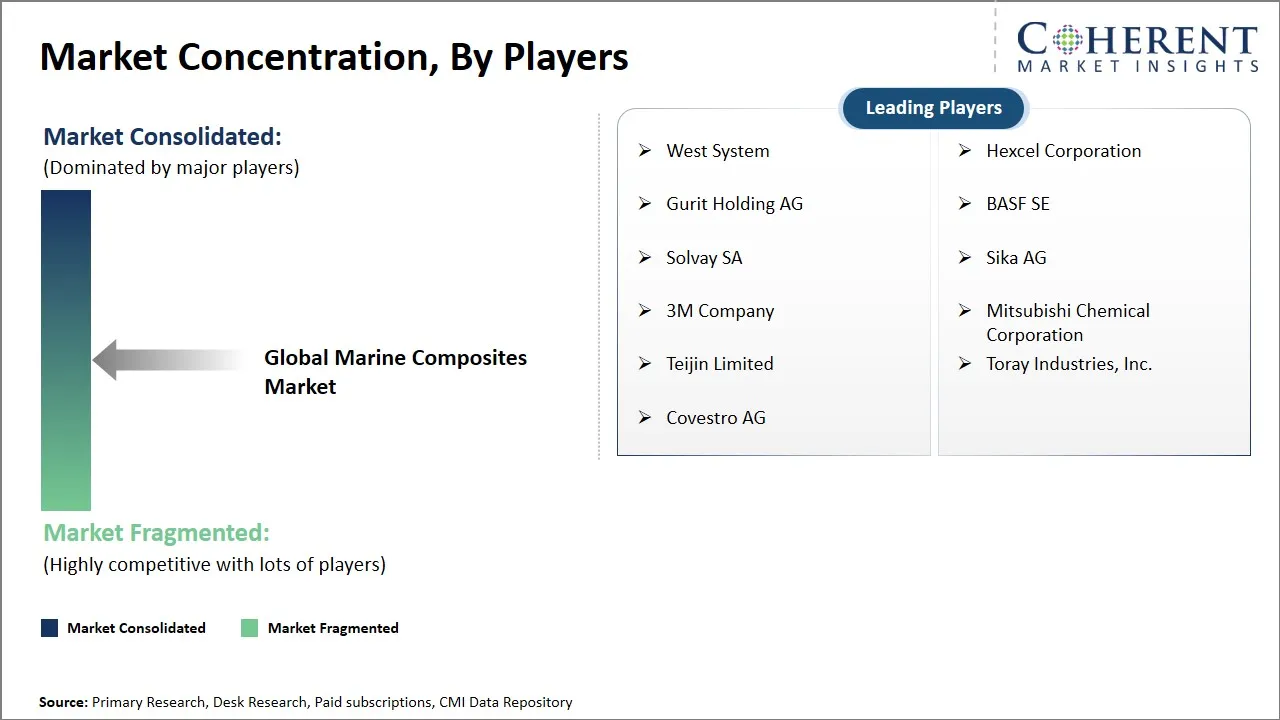
| Companies covered: | West System, Hexcel Corporation, Gurit Holding AG, BASF SE, Solvay SA, Sika AG, 3M Company, Mitsubishi Chemical Corporation, Teijin Limited, Toray Industries, Inc., and Covestro AG | ||
| Growth Drivers: |
| ||
| Restraints & Challenges: |
| ||
Marine Composites Market Dynamics
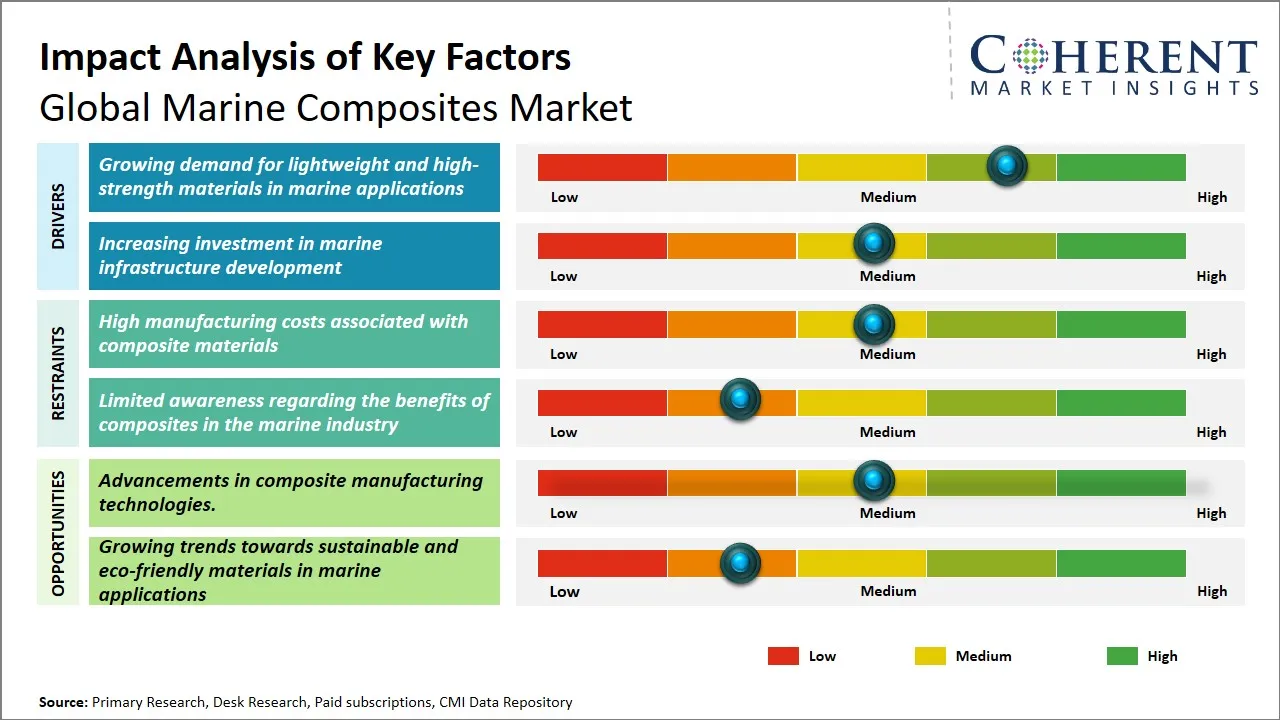
Marine Composites Market Driver - Growing Demand for Lightweight and High-strength Materials in Marine Applications
The growing interest in the marine industry to focus on increasing fuel efficiency, emissions, and overall vessel performance is ensuring that lightweight and high-strength materials are a preferred solution, making marine composites an option of choice. Conventional materials, such as alloy steel and aluminum, are strong and stiffen the ships, which increase the weight of the ship and subsequent fuel consumption and operation expenses. Conversely, composites have better strength to weight ratio and this reduces greatly the weight in the vessels without loss of structural integrity or safety. This feature allows ship designers to create faster, more fuel-efficient ships that have higher carrying capacity. Moreover, marine composites are very resistant to corrosion, saltwater and harsh marine conditions and this will increase the life of marine vessels and consequently save on maintenance.
An example, in 2024, The CMA CGM Group incorporated composites into the construction of its new generation of container ships to reduce maintenance costs and enhance durability in marine environments.
Marine Composites Market Opportunity - Advancements in Composite Manufacturing Technologies
The potential of constant improvement of composite manufacturing technologies is a significant growth opportunity that the global marine composites market can utilize. Automated fiber placement (AFP), resin transfer molding (RTM), and additive manufacturing are some of the innovations transforming the production processes through precision, material waste minimization, and shortening production schedules. These advancements in technology allow manufacturers to develop high-performance composite materials that are exceptionally strong to weight ratios, corrosion resistant, and long-lasting and this is necessary in the marine industry as the ships are subject to severe environments.
An example, Lockheed Martin’s production of large Active Fire Protection systems, which enables it to manufacture large composite components with lower cost of labor and shorter turnaround time, and which improves production efficiency. Besides, BASF came up with a superior RTM technology that guarantees higher accuracy when using the composite material in shipbuilding that allows manufacturers to build even stronger and lighter vessels.
Analyst Opinion (Expert Opinion)
- The marine composites market is at an active stage of development, with the growing demand for lightweight and strong materials that improve the performance of the vessels and their fuel efficiency. The International Boat Show (2023) and the Composites in Marine Engineering Conference (2022) had some insights, and companies such as Gurit and Hexcel were at the forefront of high-performance composite materials in this industry.
- The recent introduction of a new bio-based resin system by Gurits with a lower environmental impact shows the way the industry is moving towards sustainable procedures and preserve the level of performance. At these conferences, discussions have highlighted the importance of composites in the contemporary shipbuilding and repairing especially as the industry shifts towards fulfilling the strict environmental standards.
- The issues like the expensive price of high-tech materials and the necessity to use specific manufacturing processes were often mentioned as obstacles to their broader usage. The company that invests in cost-effective solutions, through R&D, and cooperates with boat manufacturers in creating products unique to them is bound to have an advantage over their competitors. Finally, the success of the marine composites market will be determined by its innovation and responsiveness to environmental changes in the industry and sustainability efforts.
Speak to the analyst
Want personalized insights?
Take the findings above to one of our principal consultants, or have the report rebuilt around the segments, geographies and competitors you actually track.
Market Segmentation
- Composite Insights (Revenue, USD Bn, 2021 - 2033)
- Ceramic Matrix Composites
- Metal Matrix Composites
- Polymer Matrix Composites
- Vessel Type Insights (Revenue, USD Bn, 2021 - 2033)
- Power Boats
- Sailboats
- Cruise Ships
- Others
- Resin Type Insights (Revenue, USD Bn, 2021 - 2033)
- Polyester
- Vinyl Ester
- Epoxy
- Others
- Regional Insights (Revenue, USD Bn, 2021 - 2033)
- North America
- U.S.
- Canada
- Latin America
- Brazil
- Argentina
- Mexico
- Rest of Latin America
- Europe
- Germany
- U.K.
- Spain
- France
- Italy
- Russia
- Rest of Europe
- Asia Pacific
- China
- India
- Japan
- Australia
- South Korea
- ASEAN
- Rest of Asia Pacific
- Middle East
- GCC Countries
- Israel
- Rest of Middle East
- Africa
- South Africa
- North Africa
- Central Africa
- North America
- Key Players Insights
- West System
- Hexcel Corporation
- Gurit Holding AG
- BASF SE
- Solvay SA
- Sika AG
- 3M Company
- Mitsubishi Chemical Corporation
- Teijin Limited
- Toray Industries, Inc.
- Covestro AG
Sources
Primary Research Interviews
- CEO – Leading Marine Composites Producer (e.g., Gurit or Hexcel equivalent)
- Supply Chain Director – Major Composites Distributor for Marine Applications
- Production Lead – Boatbuilding and Yacht Composites Manufacturer
- Sustainability Officer – Marine Composites Certification Authority
Stakeholders
- Manufacturers
- Toray Industries, Inc., Hexcel Corporation, Gurit Holding AG, Owens Corning, SGL Carbon SE, Teijin Limited, BASF SE, Mitsubishi Chemical Corporation
- End-use Sectors
- Boat and Yacht Building (Recreational, Commercial Vessels)
- Offshore Wind Energy and Platforms
- Shipbuilding and Marine Structures
- Regulatory & Certification Bodies (e.g., EPA for composite materials handling, REACH compliance in EU for resins and fibers)
- E-commerce Platforms and Retailers (Alibaba, Industrial Suppliers, Composites Suppliers like Composites One)
- Technology Integration Players: Advanced marine composites producers for lightweight vessels and tidal turbines
Databases
- UN Comtrade Database (for composites trade data)
- India Import Export (EXIM) Database
- USGS Mineral Commodity Summaries (related raw materials)
- Eurostat Trade Statistics for Composites and Chemicals
Magazines
- CompositesWorld – Trends in marine composites manufacturing
- Reinforced Plastics – Marine applications and innovations
- Boat International – Composites in yacht building
Journals
- Composites Part A: Applied Science and Manufacturing – Marine composite processing
- Composites Part B: Engineering – Durability in marine environments
- Journal of Marine Science and Engineering – Composites for ships
- Marine Structures – Environmental degradation of marine composites
Newspapers
- The Wall Street Journal – Global demand for marine composites
- Business Standard (India) – Asia shipbuilding and composites growth
- Reuters – Supply chain in composites for marine sector
Associations
- American Composites Manufacturers Association (ACMA)
- Composites Association
- International Marine Composites Alliance or equivalent
- European Composites Industry Association (EuCIA)
- Boatbuilders Associations (e.g., National Marine Manufacturers Association)
Public Domain Sources
- EPA – Guidelines for composite materials and styrene in marine applications
- European Commission – REACH regulations on composite resins and fibers
- World Health Organization – Safety standards for composite exposure
- USGS – Statistics on composite raw materials
- OECD – Trade and sustainability reports for advanced materials
Proprietary Elements
- CMI Data Analytics Tool
- Proprietary CMI Existing Repository of information for last 8 years.
Get access to 250+ pages report
Every segment, forecast, competitor profile and data table behind the analysis above — available for instant download.
- ESOMAR Member
- ISO 9001:2015 Certified
- D-U-N-S Registered
- GDPR & CCPA Compliant
Missing comfort of reading report in your local language? Find your preferred language:
Transform your Strategy with Exclusive Trending Reports
Frequently Asked Questions
The global marine composites market is estimated to be valued at USD 3.98 Bn in 2026 and is expected to reach USD 5.83 Bn by 2033.
Engineered materials made from fiber reinforcements and a polymer matrix used in boats, ships, and offshore structures.
Hand lay-up, resin transfer molding (RTM), vacuum infusion, and automation.
The CAGR of global marine composites market is projected to be 5.6% from 2026 to 2033.
Growing demand for lightweight and high-strength materials in marine applications and increasing investment in marine infrastructure development are the major factors driving the growth of the global marine composites market.
High manufacturing costs associated with composite materials and limited awareness regarding the benefits of composites in the marine industry are the major factors hampering the growth of the global marine composites market.
Europe is expected to lead the global marine composites market in 2026.