

Global Medical Coding Platform Market Size and Forecast – 2026 To 2033
The global medical coding platform market is expected to grow from USD 37,621.3 Mn in 2026 to USD 79,545.0 Mn by 2033, registering a compound annual growth rate (CAGR) of 11.3% from 2026 to 2033. The market for medical coding platforms is poised for significant expansion, fueled by the rapid adoption of Electronic Health Records (EHRs) across healthcare systems.
According to the U.S. Office of the National Coordinator for Health Information Technology (ONC), over 99% of non-federal acute care hospitals and 91% of office-based physicians had adopted certified electronic health records (EHR) systems by 2024, creating strong demand for advanced medical coding platforms that automate coding workflows and improve reimbursement accuracy.
Key Takeaways of the Global Medical Coding Platform Market
- Services are projected to hold 72.9 % of the global medical coding platform market share in 2026, making it the dominant type segment, across North America due to stringent healthcare documentation and reimbursement compliance requirements. For instance, the U.S. Centers for Medicare & Medicaid Services (CMS) mandates accurate medical coding using ICD-10-CM/PCS and CPT/HCPCS for claims processing under the Medicare program, driving demand for professional coding services and platform-based coding solutions.
- Outpatient coding is projected to hold 57.1 % of the global medical coding platform market share in 2026, making it the dominant patient type segment, across Europe due to standardized clinical coding and outpatient reimbursement requirements. For instance, the NHS England mandates the use of SNOMED CT for clinical terminology and ICD-10/OPCS-4 for secondary uses and reimbursement, supporting accurate outpatient documentation and coding across healthcare providers.
- Web-based is projected to hold 68.5 % of the global medical coding platform market share in 2026, making it the dominant operational mode segment across Asia Pacific owing to government-led healthcare digitalization initiatives. For instance, India's National Health Authority (NHA), through the Ayushman Bharat Digital Mission (ABDM), has established a nationwide digital health ecosystem with interoperable health records and Health Information Exchange (HIE), accelerating the adoption of cloud-based medical coding and health information platforms.
- North America maintains its dominance with an expected share of 56.0 % in 2026, bolstered by stringent healthcare data interoperability requirements. For instance, in 2025, the U.S. Office of the National Coordinator for Health Information Technology (ONC) expanded the implementation of the Trusted Exchange Framework and Common Agreement (TEFCA), enabling nationwide interoperable exchange of electronic health information and strengthening demand for integrated medical coding platforms that support standardized clinical documentation and billing.
- Asia Pacific is expected to exhibit the fastest growth with an estimated contribution of 14.8 % share in 2026, propelled by government-led healthcare digitalization initiatives. For instance, Japan's Ministry of Health, Labour and Welfare (MHLW) is advancing the nationwide adoption of electronic medical records (EMRs) and standardized healthcare information exchange under its healthcare DX reforms, increasing demand for integrated medical coding platforms that support accurate clinical documentation and reimbursement.
Segmental Insights
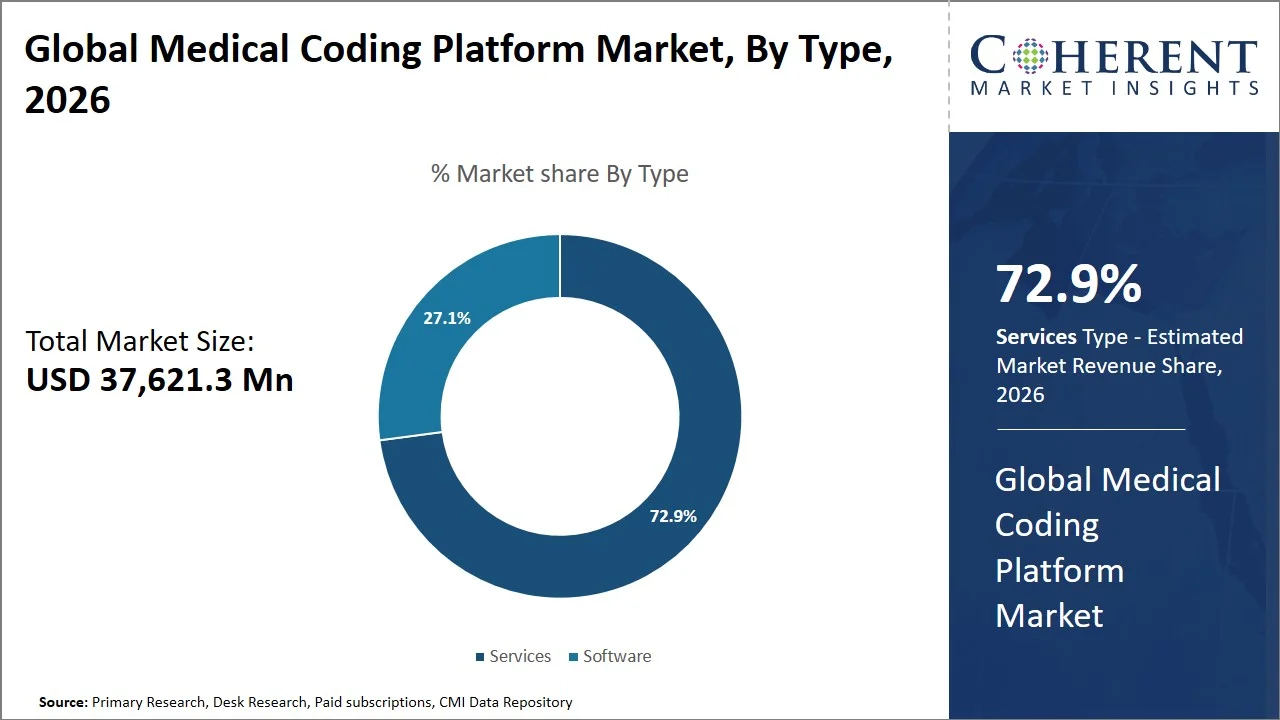
Why Do Services Dominate the Global Medical Coding Platform Market?
Services are projected to hold a market share of 72.9% in 2026, attributed to the need for qualified and experienced resources that specialize in proper code selection, regulatory adherence, and effective claim payment within an increasingly intricate global healthcare setting. Organizations often outsource these professional medical coding services due to challenges concerning the dynamic coding guidelines, the audit requirements of healthcare organizations and the need to increase the cash cycle efficiency. For instance, in October 2025, GeBBS Healthcare launched its AI-enabled medical coding workflow, powered by Amazon Bedrock to automate and transform coding, integrating AI with human supervision in a workflow designed to address the current demand for tech-enabled coding services.
- Current Industry Events of 2026
- Market Size Estimation
- Regional Breakdown
- Competitive Landscape
- Customer Intelligence
- Segmental Analysis
- Pricing Analysis
- Key Market Drivers, Challenges & Future Trends
- Customized Insights Section
Why Does Outpatient Coding Represent the Largest Patient Type Segment in the Medical Coding Platform Market?
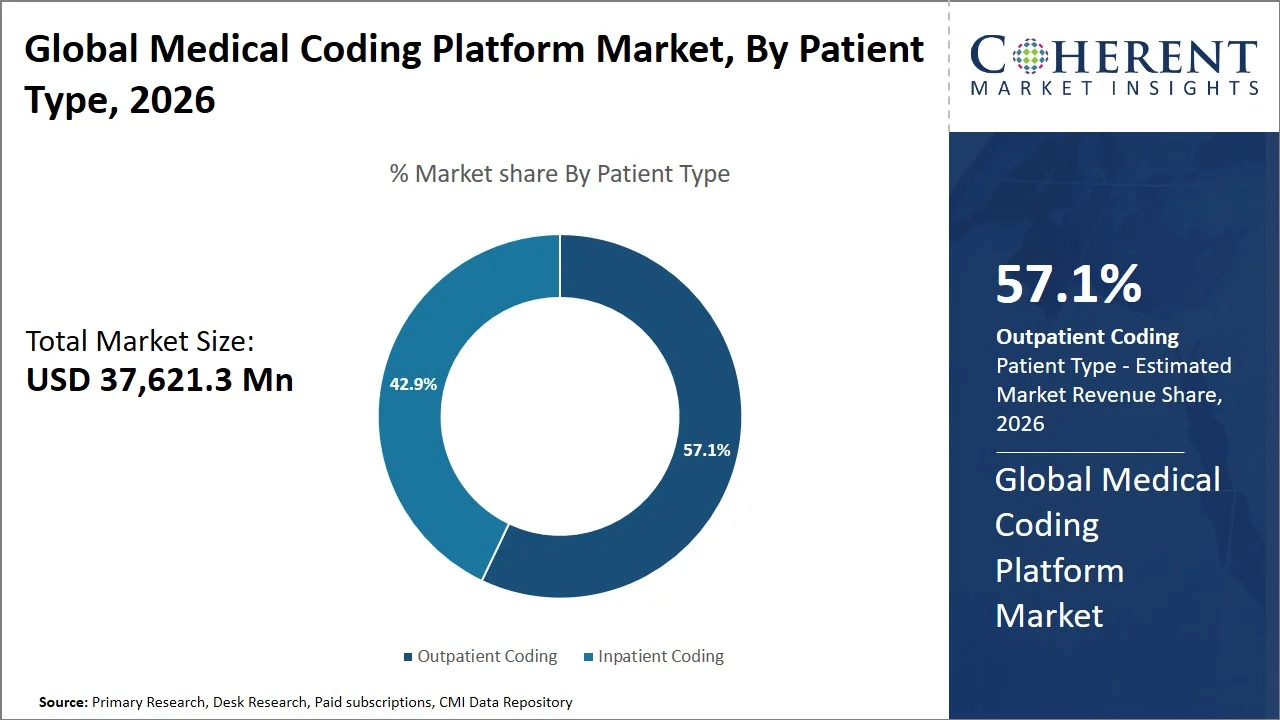
Outpatient coding is projected to hold a market share of 57.1% in 2026, owing to the increasing frequency and proportion of physician office visits, same-day services and same-day hospital care procedures that need timely, efficient and accurate coding and charging. The newest coding technology offers solutions to clinicians for efficient documentation improvement, maximization of reimbursement and minimize coding errors with regard to outpatient settings workflows. For instance, in March 2026, OpenEvidence released Coding Intelligence, a solution designed using Artificial Intelligence to help physicians identify coding opportunities to maximize and improve their documentation to achieve complete capture of revenue from outpatient services.
Web-based Segment Dominates the Global Medical Coding Platform Market
The web-based segment is projected to hold a market share of 68.5% in 2026, due to remotely-secured applications, rapid deployment, and ease of integration to electronic health records (EHR) and revenue cycle management systems (RCM). Their cloud-based infrastructure facilitates centrally managed upgrades and real-time collaboration across all sites and scaled deployment in a healthcare organization. For instance, In August 2024, CodaMetrix launched access to its AI driven coding solution through Epic Toolbox enabling cloud-based solutions, and integrated coding workflows with improved efficiency, interoperability and scalability readily available to healthcare customers.
Current Events and their Impact
Current Events | Description and its Impact |
U.S. Centers for Medicare & Medicaid Services (CMS) Releases FY 2026 ICD-10-CM/PCS Coding Updates (July 2025) |
|
European Commission Advances the European Health Data Space (EHDS) Regulation (March 2025) |
|
Global Medical Coding Platform Market Dynamics
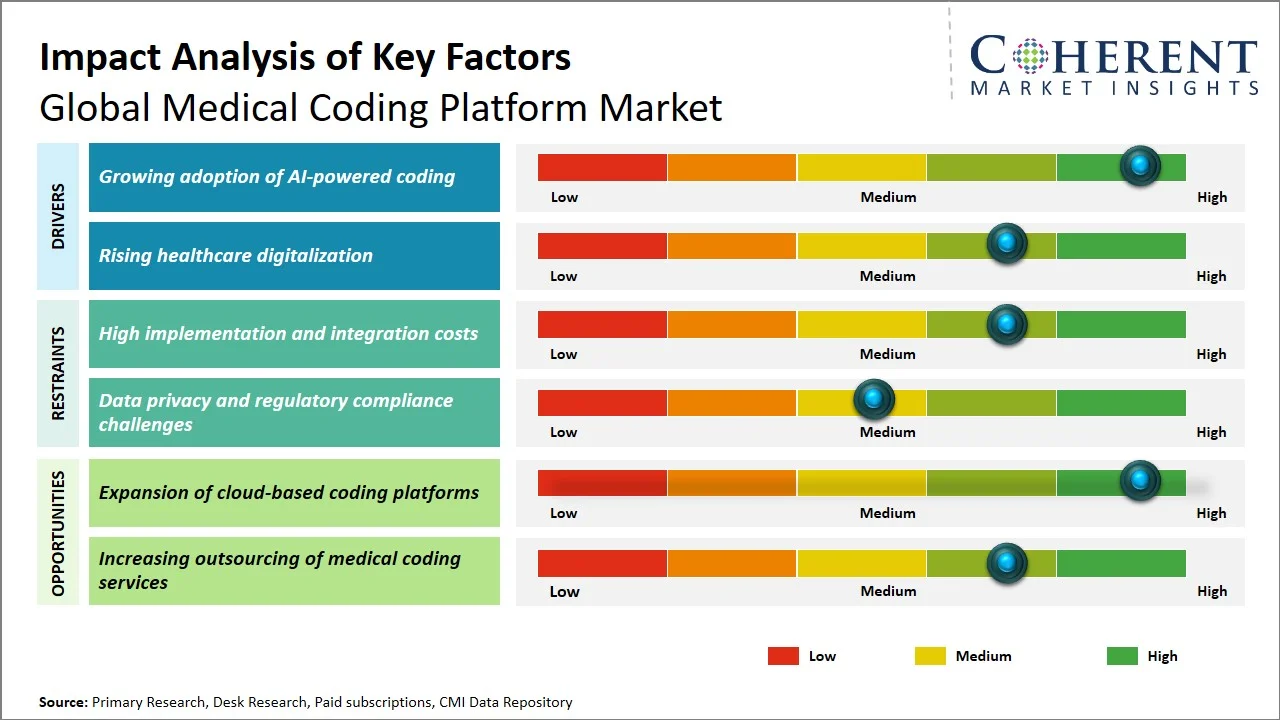
Market Drivers
- Growing adoption of AI-powered coding: AI-powered medical coding is rapidly transforming healthcare revenue cycle operations by automating code assignment, improving coding accuracy, and reducing administrative workload through machine learning and natural language processing (NLP). These intelligent platforms also enhance regulatory compliance by continuously adapting to evolving coding guidelines and clinical documentation requirements. For instance, in June 2025, CodaMetrix launched its CMX CARE contextual coding automation platform and Emergency Department (ED) solution, enabling end-to-end AI-driven coding workflows that improve coding quality, reduce manual intervention, and streamline revenue cycle management.
- Rising healthcare digitalization: Rising healthcare digitalization is accelerating the adoption of medical coding platforms by enabling seamless integration with electronic health records (EHRs), health information exchanges, and digital hospital management systems. As healthcare providers transition to interoperable digital ecosystems, there is increasing demand for coding platforms that automate clinical documentation, improve coding accuracy, and support efficient reimbursement workflows. For instance, in February 2025, the Government of India announced that over 159,000 (1.59 lakh) health facilities had adopted Ayushman Bharat Digital Mission (ABDM)-enabled software, reflecting the rapid expansion of interoperable digital health infrastructure that supports advanced medical coding solutions.
- Increasing focus on revenue cycle optimization: Healthcare providers are increasingly investing in advanced medical coding platforms to improve revenue cycle performance by reducing coding errors, minimizing claim denials, and accelerating reimbursement timelines. Automated coding solutions enable accurate code assignment and compliance with payer requirements, helping organizations enhance financial outcomes while reducing administrative costs. For instance, in January 2025, the American Hospital Association (AHA) reported that hospitals continue to face significant financial pressures from rising operational costs and reimbursement challenges, prompting greater investment in technologies that improve revenue cycle efficiency, including medical coding platforms.
Emerging Trends
- Rise of Ambient Clinical Intelligence (ACI) for Real-Time Coding: Healthcare providers are increasingly adopting ambient clinical intelligence solutions that automatically capture clinician-patient conversations and convert them into structured clinical documentation. Medical coding platforms are integrating with these ambient documentation tools to generate coding recommendations in real time, reducing physician administrative burden and improving coding completeness.
- Growing Adoption of Computer-Assisted Coding (CAC) in Specialty Care: Medical coding platforms are increasingly incorporating specialty-specific computer-assisted coding capabilities for high-complexity areas such as oncology, cardiology, orthopedics, and radiology. These tailored solutions improve coding precision for complex procedures while supporting specialty-specific reimbursement and compliance requirements.
- Increasing Integration of Clinical Documentation Improvement (CDI) with Coding Platforms: Healthcare organizations are moving toward unified platforms that combine clinical documentation improvement (CDI) and medical coding into a single workflow. This integration enables real-time documentation quality checks, concurrent coding validation, and stronger audit preparedness, helping providers improve coding accuracy and financial performance.
Regional Insights
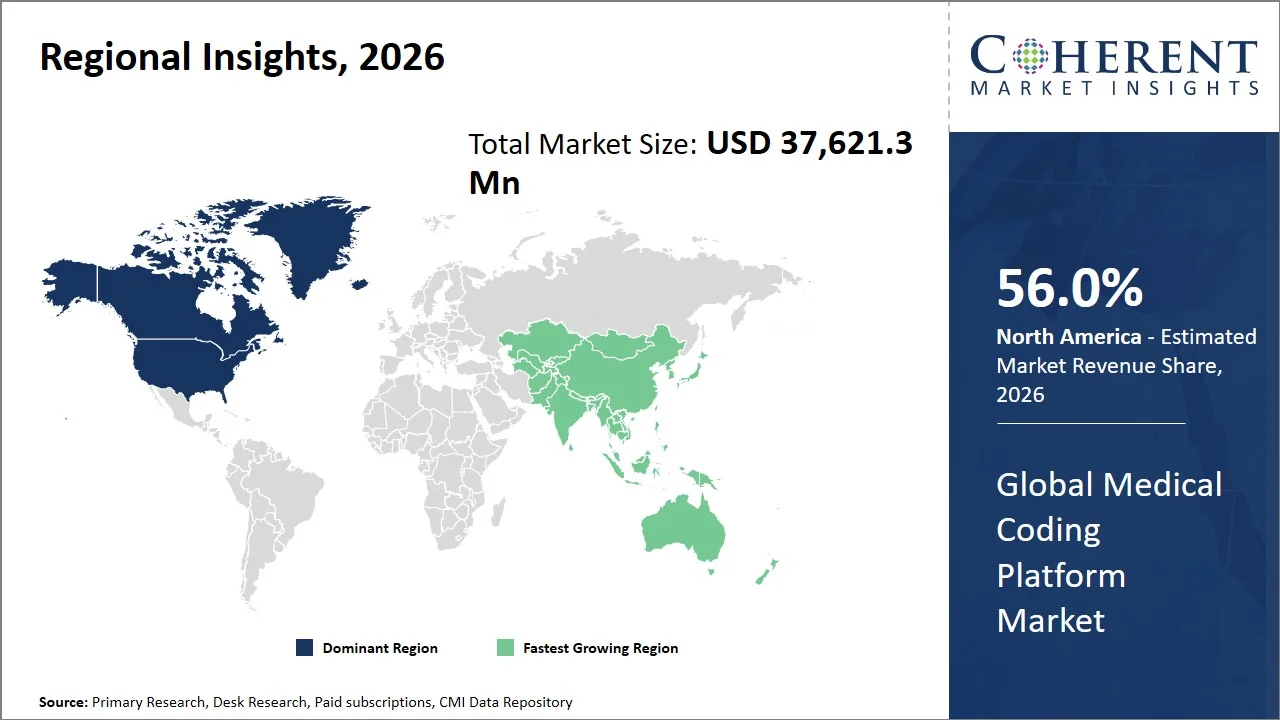
Why is North America a Strong Market for Medical Coding Platforms?
North America leads the global medical coding platform market, accounting for an estimated 56.0% share in 2026, due to the presence of a mature healthcare ecosystem, established infrastructure for the digital health sector, and efficient medical payment mechanism in the region. High rates of electronic health records (EHRs) penetration in the region, together with strong governmental support in terms of initiatives and policies for digitized healthcare solutions and better health data exchange systems are contributing towards regional dominance.
For instance, the U.S. Office of the National Coordinator for Health Information Technology (ONC) announced the HTI-1 Final Rule that enhances current standards for certified health IT and supports the seamless and secure movement of electronic health data, helping to enable and improve new advanced medical coding software and other innovative healthcare tools. Furthermore, the imposition of strict coding norms, changing medical reimbursement guidelines, and the integration of AI powered clinical documentations and EMR features have also favored higher demand of the top-tiered medical coding platforms in these organizations.
Why Does the Asia Pacific Medical Coding Platform Market Exhibit High Growth?
The Asia Pacific medical coding platform market is expected to exhibit the fastest growth with an estimated contribution of 14.8% share to the global market in 2026, owing to the hastened pace of digitalization in healthcare facilities, expanding healthcare infrastructure, and a surge in investments within the health IT domain. Cloud medical applications and electronic medical records, with its growing popularity in the region, further fuel up the necessity of smart medical coding platforms. Additionally, the shift towards increased emphasis on standardize clinical documentation, coding conventions, as well as interactive health information systems is proving to be suitable market place for use of AI enabled intelligent medical coding solutions.
For instance, in January 2026, Singapore's Ministry of Health (MOH) announced new health information bill to support more integrated, holistic care and help facilitate secure sharing of health information of patients among health providers. It is expected that the initiative supports the standardization of clinical records and interoperability, and helps accelerate broad adoption of advance coding and charting tools.
Global Medical Coding Platform Market Outlook for Key Countries
Why is the U.S. Leading Innovation and Adoption in the Medical Coding Platform Market?
The U.S. holds the largest market share for innovation and adoption in medical coding platform market driven by a highly optimized reimbursement landscape and high interoperability of coding platform solutions with clinical documentation improvement (CDI), revenue cycle management (RCM), and electronic health record (EHR) systems. The expansion of major health IT vendors (such as Optum, Inc., Oracle Health, 3M, and Nuance Communications, Inc.), innovative features provided by powerful AI algorithms and the introduction of new products on the market, has helped promote widely adopted intelligent medical coding solutions to use throughout enterprises of different organizations.
Is the U.K. a Favorable Market for Medical Coding Platforms?
The U.K. medical coding platform market presents an opportunity due to ongoing National Health Service (NHS) digitalization and its growing tendency for standardization of clinical codes by healthcare providers. The rise in electronic health records (EHR), clinical documentation improvement (CDI), and interoperability solutions would spur the use of leading coding platforms. Furthermore, the trend in terms of healthcare technology, such as artificial intelligence, data standards, or repayment integrity would continue to enhance the development of medical coding.
Is China Emerging as a Key Growth Hub for the Medical Coding Platform Market?
China medical coding platform market is set to observe a rapid expansion due to its accelerating digitalization of the healthcare sector, with an increasing prevalence of hospital information systems in the market. The country's increased emphasis on standardized clinical data management, artificial intelligence (AI) based healthcare technology, and interoperable electronic medical records is fueling demand for cutting-edge medical coding software systems. Also, the increased investments from local health IT companies also aid in accelerating the implementation of intelligent coding software in hospitals.
Why Does Germany Top the European Medical Coding Platform Market?
Germany leads the European medical coding platform market due to country’s highly digitalized hospital landscape coupled with excellent adoption of hospital information systems, a prevalent clinical documentation process and its focus towards coding standardization for both reimbursement purposes and hospital financial aspects. Along with prominent healthcare IT vendors (such as CompuGroup Medical SE & Co. KGaA, Dedalus Group, Oracle Health, and 3M) and consistent investments in hospital digital health infrastructure has prompted AI powered medical coding and revenue cycle management adoption.
Is Medical Coding Platform Market Developing in Japan?
The medical coding platform market in Japan is gradually expanding due to the accelerating digitalization trend within the country and the gradual upgrade of hospital information systems. Factors like adoption of electronic medical records, advancement of AI into clinical documentation workflow and substantial investments made by health IT players will escalate the demand of these solutions. The ongoing expansion of digital health programs and adoption of healthcare interoperability platforms also build a long-term trajectory in the market.
Evolution of Medical Coding Platforms Across the Healthcare Continuum
Healthcare Stage | Traditional Approach | Current Medical Coding Platform | Future Evolution |
Clinical Documentation | Manual physician notes | AI-assisted documentation capture | Ambient AI documentation |
Code Assignment | Manual coding | Computer-Assisted Coding (CAC) | Autonomous coding |
Claims Processing | Manual validation | Automated claim validation | Predictive reimbursement optimization |
Compliance & Audit | Periodic audits | Real-time compliance monitoring | Continuous AI-driven auditing |
Revenue Cycle | Reactive corrections | Integrated RCM workflows | End-to-end intelligent revenue cycle |
How is the expansion of cloud-based coding platforms creating new growth opportunities in the global medical coding platform market?
The rise of cloud-based medical coding platforms presents numerous growth prospects through highly scalable, cost-effective, and readily available cloud-based medical coding solutions that seamlessly connect with systems such as electronic health records (EHRs), and revenue cycle management system. As the cloud infrastructure offers frequent software updates, easier collaboration and compliance, organizations are increasingly adopting it with evolving coding standards while reducing IT infrastructure costs. For instance, in October 2024, Oracle health data intelligence launched AI-driven capabilities to extend cloud service for clinical workflow to more than 200 providers and provide real-time healthcare operations intelligence to more than 1,100 organizations ultimately leading to increased data quality, interoperability and financial success.
Market Players, Key Development, and Competitive Landscape
Key Developments
- On July 29, 2026, Ebix Health expanded its medical content and coding capabilities to strengthen its healthcare technology portfolio. The enhanced solutions are designed to improve coding accuracy, streamline clinical documentation, and support evolving reimbursement and regulatory requirements. This development reflects the growing emphasis on advanced medical coding platforms that enhance operational efficiency and revenue cycle performance.
- In April 2026, IKS Health launched its AI-driven audit-ready autonomous coding capabilities to enhance revenue cycle management and medical coding workflows. The solution combines AI-powered code assignment with expert human review, delivering up to 95% coding accuracy while reducing claim denials. Integrated with Epic Connection Hub, the platform strengthens coding efficiency, compliance, and reimbursement outcomes.
- In April 2026, Arintra introduced new AI-powered documentation improvement capabilities to its medical coding platform. The enhancement helps healthcare organizations identify documentation gaps that impact coding accuracy, reimbursement, and claim denials. The launch further strengthens AI-enabled coding workflows, supporting improved revenue cycle performance and clinical documentation quality.
Competitive Landscape
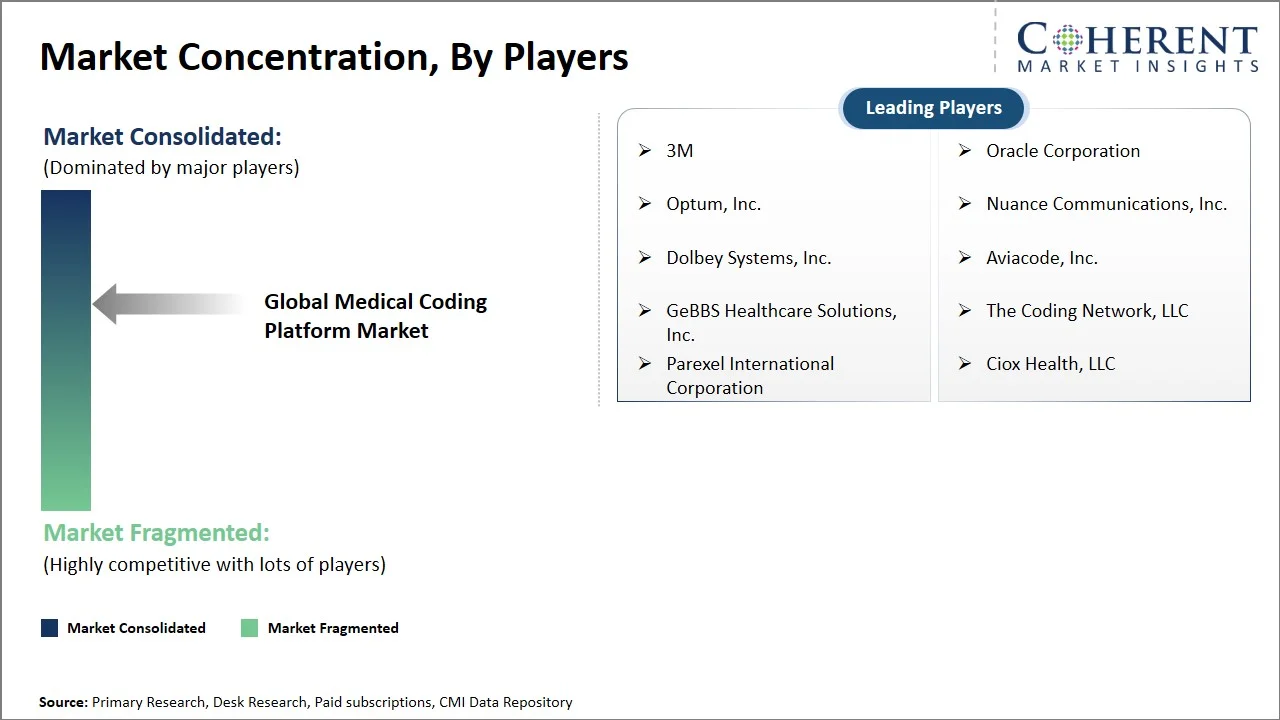
The global medical coding platform market is moderately consolidated, with competition centered on AI-powered coding automation, computer-assisted coding (CAC), cloud-native deployment, and seamless integration with electronic health record (EHR) and revenue cycle management (RCM) systems. Market participants are focusing on enhancing coding accuracy, regulatory compliance, and workflow automation through continuous product innovation, strategic partnerships, and AI advancements to strengthen their competitive position. Key focus areas include:
- Development of AI-Driven and Autonomous Medical Coding Solutions
- Expansion of Computer-Assisted Coding (CAC) and Clinical Documentation Improvement (CDI) Capabilities
- Integration with Electronic Health Records (EHRs) and Revenue Cycle Management (RCM) Systems
- Cloud-Based, Interoperable, and ICD-11-Ready Medical Coding Platforms
- Strategic Partnerships, Acquisitions, and Healthcare IT Collaborations
Market Report Scope
Medical Coding Platform Market Report Coverage
| Report Coverage | Details | ||
|---|---|---|---|
| Base Year: | 2025 | Market Size in 2026: | USD 37,621.3 Mn |
| Historical Data for: | 2020 To 2024 | Forecast Period: | 2026 To 2033 |
| Forecast Period 2026 to 2033 CAGR: | 11.3% | 2033 Value Projection: | USD 79,545.0 Mn |
| Geographies covered: |
| ||
| Segments covered: |
| ||
| Companies covered: | 3M, Oracle Corporation, Optum, Inc., Nuance Communications, Inc., Dolbey Systems, Inc., Aviacode, Inc., GeBBS Healthcare Solutions, Inc., The Coding Network, LLC, Parexel International Corporation, and Ciox Health, LLC | ||
| Growth Drivers: |
| ||
| Restraints & Challenges: |
| ||
Analyst Opinion (Expert Opinion)
- In the coming years, the global medical coding platform market will be shaped by the convergence of artificial intelligence (AI), autonomous coding, and cloud-native healthcare ecosystems. As healthcare systems worldwide continue to digitize and reimbursement models become increasingly value-based, medical coding platforms will evolve from standalone coding tools into intelligent revenue cycle management solutions that automate coding, enhance compliance, and deliver real-time clinical and financial insights.
- The maximum opportunities are foreseen within web-based medical coding platforms for outpatient coding across the Asia Pacific region. Rapid healthcare digitalization, expanding ambulatory care infrastructure, and increasing investments in interoperable health information systems in countries such as India, China, and Japan are creating strong demand for scalable, AI-enabled coding solutions that improve coding accuracy and reimbursement efficiency.
- In order to gain a competitive advantage market players should prioritize the development of AI-driven autonomous coding capabilities, strengthen interoperability with EHR and hospital information systems, and ensure readiness for evolving coding standards such as ICD-11. Strategic partnerships with healthcare providers, EHR vendors, and revenue cycle management companies, coupled with investments in cloud-native, cybersecurity-focused platforms and specialty-specific coding solutions, will be critical to sustaining long-term market leadership.
Speak to the analyst
Want personalized insights?
Take the findings above to one of our principal consultants, or have the report rebuilt around the segments, geographies and competitors you actually track.
Market Segmentation
- Type Insights (Revenue, USD Mn, 2021 - 2033)
- Services
- Software
- Patient Type Insights (Revenue, USD Mn, 2021 - 2033)
- Outpatient Coding
- Inpatient Coding
- Operational Mode Insights (Revenue, USD Mn, 2021 - 2033)
- Web-based
- Cloud-based
- Specialty Area Insights (Revenue, USD Mn, 2021 - 2033)
- Cardiology
- Radiology
- Oncology
- Respiratory
- Urology
- Neurology
- Gastroenterology
- Others
- Application Insights (Revenue, USD Mn, 2021 - 2033)
- Automated Code Assignment
- Revenue Cycle Management
- Electronic Health Record (EHR) Integration
- Compliance and Risk Management
- Others
- End User Insights (Revenue, USD Mn, 2021 - 2033)
- Healthcare Providers
- Healthcare Payers
- Others
- Regional Insights (Revenue, USD Mn, 2021 - 2033)
- North America
- U.S.
- Canada
- Latin America
- Brazil
- Argentina
- Mexico
- Rest of Latin America
- Europe
- Germany
- U.K.
- Spain
- France
- Italy
- Russia
- Rest of Europe
- Asia Pacific
- China
- India
- Japan
- Australia
- South Korea
- ASEAN
- Rest of Asia Pacific
- Middle East
- GCC Countries
- Israel
- Rest of Middle East
- Africa
- South Africa
- North Africa
- Central Africa
- North America
- Key Players Insights
- 3M
- Oracle Corporation
- Optum, Inc.
- Nuance Communications, Inc.
- Dolbey Systems, Inc.
- Aviacode, Inc.
- GeBBS Healthcare Solutions, Inc.
- The Coding Network, LLC
- Parexel International Corporation
- Ciox Health, LLC
Sources
Primary Research Interviews
- Executives from medical coding platform providers and healthcare revenue cycle management (RCM) companies
- Hospital Chief Information Officers (CIOs), Health Information Management (HIM) Directors, and Clinical Documentation Improvement (CDI) leaders
- Certified medical coders, coding auditors, and revenue cycle managers from hospitals and ambulatory care centers
- Executives from healthcare BPOs and medical coding outsourcing organizations
- Experts in artificial intelligence (AI), clinical documentation improvement (CDI), and healthcare interoperability
Stakeholders
- Medical coding platform providers
- Revenue Cycle Management (RCM) solution providers
- Healthcare IT and digital health companies
- Hospitals and integrated delivery networks (IDNs)
- Ambulatory surgery centers (ASCs) and physician practices
- Health insurance companies (Payers)
- Medical coding outsourcing service providers
- Government healthcare agencies and regulatory bodies
- End-use Sectors
- Hospitals
- Physician Practices
- Ambulatory Surgery Centers (ASCs)
- Diagnostic & Imaging Centers
- Health Insurance Companies (Payers)
- Medical Billing & Coding Service Providers
- Regulatory & Health Bodies
- U.S. Centers for Medicare & Medicaid Services (CMS)
- Office of the National Coordinator for Health Information Technology (ONC), U.S.
- National Center for Health Statistics (NCHS), CDC
- U.S. Department of Health and Human Services (HHS)
- World Health Organization (WHO)
- NHS England
- Australian Digital Health Agency (ADHA)
Databases
- U.S. Centers for Medicare & Medicaid Services (CMS) Data & Research
- HealthIT.gov
- CDC – National Center for Health Statistics (NCHS)
- WHO Global Health Observatory (GHO)
- OECD Health Statistics
- World Bank Open Data
Magazines
- Healthcare IT News
- HealthTech Magazine
- Healthcare Innovation
- Modern Healthcare
- Becker's Health IT
Journals
- Journal of the American Medical Informatics Association (JAMIA)
- International Journal of Medical Informatics
- Journal of AHIMA
- BMC Health Services Research
- npj Digital Medicine
Newspapers
- Financial Times (Healthcare Section)
- The Wall Street Journal (Health Section)
- The New York Times (Health Section)
Associations
- Healthcare Information and Management Systems Society (HIMSS)
- American Health Information Management Association (AHIMA)
- American Medical Informatics Association (AMIA)
- Healthcare Financial Management Association (HFMA)
- Association of Clinical Documentation Integrity Specialists (ACDIS)
Public Domain Sources
- U.S. Centers for Medicare & Medicaid Services (CMS)
- Office of the National Coordinator for Health Information Technology (HealthIT.gov)
- National Center for Health Statistics (CDC)
- U.S. Department of Health and Human Services (HHS)
- World Health Organization (WHO)
- Organisation for Economic Co-operation and Development (OECD)
- European Commission (DG SANTE)
- NHS England
Proprietary Elements
- CMI Data Analytics Tool, Proprietary CMI Existing Repository of information for last 10 years.
Get access to 250+ pages report
Every segment, forecast, competitor profile and data table behind the analysis above — available for instant download.
- ESOMAR Member
- ISO 9001:2015 Certified
- D-U-N-S Registered
- GDPR & CCPA Compliant
Missing comfort of reading report in your local language? Find your preferred language:
Transform your Strategy with Exclusive Trending Reports
Frequently Asked Questions
The global medical coding platform market is estimated to be valued at USD 37,621.3 Mn in 2026 and is expected to reach USD 79,545.0 Mn by 2033.
Services dominate due to the growing demand for outsourced coding expertise, regulatory compliance, continuous coding updates, and AI-assisted coding support that improve reimbursement accuracy and operational efficiency.
A medical coding platform is a software solution that converts clinical documentation into standardized medical codes to support billing, reimbursement, compliance, and healthcare data management.
The CAGR of the global medical coding platform market is projected to be 11.3% from 2026 to 2033.
Growing adoption of AI-powered coding, and rising healthcare digitalization are the major factors driving the growth of the global medical coding platform market.
ICD-11 compatibility enables medical coding platforms to support the latest global disease classification standards, ensuring regulatory compliance, interoperability, and more accurate clinical reporting.
The medical coding platform market is expected to witness strong growth, driven by increasing adoption of AI-powered coding, cloud-based deployment, evolving ICD-11 standards, and growing demand for automated revenue cycle management and regulatory compliance solutions.