

Global Men Skin Care Products Market Size and Forecast – 2026 To 2033
The Global Men Skin Care Products Market is estimated to be valued at USD 21.34 Bn in 2026 and is expected to reach USD 34.95 Bn by 2033, growing at a compound annual growth rate (CAGR) of 7.3% from 2026 to 2033. Market expansion is being supported by men moving beyond basic shaving products toward facial cleansers, moisturizers, acne-control products, serums, sun protection, and anti-ageing solutions. Greater availability through specialty beauty retail, marketplaces, and direct-to-consumer channels is also reducing barriers to product discovery and encouraging broader skincare routines.
In October 2025, Ulta Beauty launched its UB Marketplace with more than 100 additional beauty and wellness brands, including men’s grooming brands ATWATER and Oars + Alps under Grooming & Personal Care. This expansion illustrates how major beauty retailers are widening digital access to specialized men’s grooming and skincare brands.
Key takeaways of the Global Men Skin Care Products Market
- Facial Care Products is expected to register a CAGR of 7.8% during 2026–2033 and account for 46.8 % of the global men skin care products market in 2026, supported by routine-use demand for cleansers, moisturizers, serums and anti-ageing solutions. Facial products capture repeat purchases because they address visible concerns and fit daily grooming habits. In October 2025, Kao announced NIVEA MEN Active Age One-Step Care, combining cleansing and moisturizing functions.
- Normal Skin is expected to register a CAGR of 6.8% during 2026–2033 and account for 30.8 % of the global men skin care products market in 2026, reflecting broad demand for uncomplicated hydration and maintenance-oriented products rather than highly targeted corrective care. This segment benefits from wide product compatibility and lower routine complexity. In June 2025, Shiseido announced a new SHISEIDO MEN Ultimune serum designed to address multiple male-skin concerns through one daily-use formulation.
- Mass is expected to register a CAGR of 6.7% during 2026–2033 and account for 55.6 % of the global men skin care products market in 2026, as accessible pricing lowers trial barriers and supports frequent repurchase across younger and first-time users. High-volume retail availability further strengthens this position. In June 2025, Amorepacific introduced Prep by B.READY through Daiso, explicitly positioning essential men’s skincare and grooming products at reasonable prices for easier adoption.
- Asia Pacific is expected to register a CAGR of 7.6% during 2026–2033 and account for 34.8 % of the global men skin care products market in 2026, supported by dense urban consumer bases, established beauty manufacturing, advanced formulation capabilities and strong offline-to-digital retail ecosystems. In August 2025, Edgewell highlighted Schick Japan’s Progista launch, a dermatologist-backed grooming line combining pre-shave protection, shaving and post-shave skincare for Japanese men.
- North America is expected to register a CAGR of 8.4% during 2026–2033 and account for 30.2 % of the global Men Skin Care Products Market in 2026, representing the fastest-growing regional market. Expansion is supported by strong direct-to-consumer models, brand investment and widening men’s self-care participation. In June 2025, Unilever announced its agreement to acquire U.S.-based men’s personal-care brand Dr. Squatch and scale it internationally.
Segmental Insights
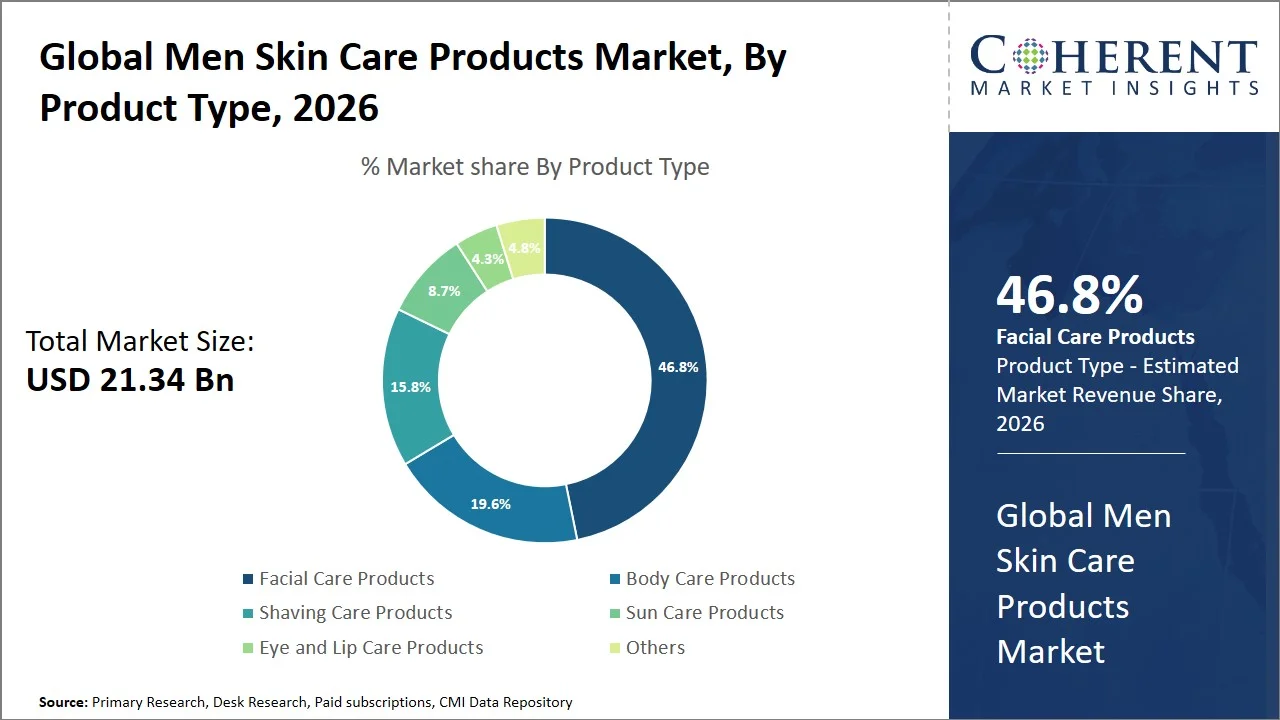
Why Does Facial Care Products Dominate the Global Men Skin Care Products Market?
Facial Care Products are lead with expected market share 46.8% in 2026 because the face concentrates the most frequent male skincare occasions cleansing, moisturizing, anti-ageing, acne management and daily sun protection. Facial products also support routine layering, enabling manufacturers to sell cleansers, moisturizers, serums and SPF products as complementary purchases rather than isolated SKUs. Suppliers benefit from active-ingredient differentiation, while retailers can build repeat-purchase regimes around visible skin concerns. Lightweight textures and multifunctional formulas further reduce barriers for consumers accustomed to simple grooming routines. In April 2026, PAPATUI introduced its Facial Moisturizer with Broad Spectrum SPF 30 Mineral Sunscreen, formulated specifically for everyday men’s use and combining hydration with mineral UV protection. The launch illustrates how facial care is expanding through convenient multifunctional products designed to convert grooming users into regular skincare consumers.
- Current Industry Events of 2026
- Market Size Estimation
- Regional Breakdown
- Competitive Landscape
- Customer Intelligence
- Segmental Analysis
- Pricing Analysis
- Key Market Drivers, Challenges & Future Trends
- Customized Insights Section
Why Does Normal Skin Represent the Largest Skin Type Segment in the Global Men Skin Care Products Market?
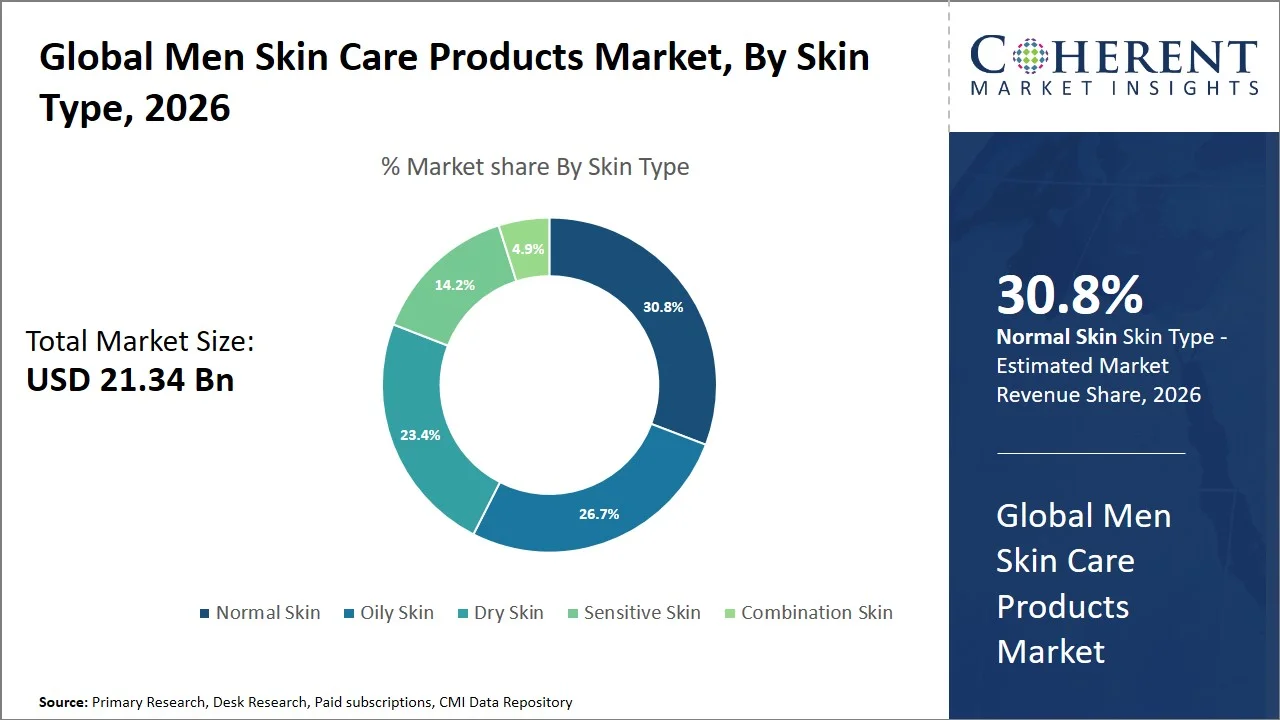
Normal Skin is representing the largest skin-type segment with expected market share 30.8% in 2026 because consumers in this group generally require maintenance rather than intensive corrective care, making straightforward cleansing, hydration and protection products suitable for routine use. For manufacturers, this creates a commercially broad formulation target: balanced moisturization, mild cleansing and comfortable textures can address large consumer groups without the tighter formulation constraints required for very oily, dry or sensitive skin. Normal-skin users can therefore be served through versatile core ranges with fewer specialized SKUs, supporting manufacturing efficiency and wider retail placement. In January 2024, Every Man Jack published its men’s anti-ageing guidance around a simplified regimen featuring its Daily Face Moisturizer, emphasizing lightweight, non-greasy everyday hydration alongside cleansing and sun protection. This reflects suppliers’ focus on uncomplicated maintenance products that fit routine male skincare behavior.
Why Does Mass Dominate the Price Range of the Global Men Skin Care Products Market?
Mass is expected to dominate with expected market share 55.6% in 2026 the price range because affordable products make experimentation and routine replenishment easier for men who are still developing skincare habits. Broad availability through supermarkets, pharmacies, marketplaces, quick commerce and general retail also reduces purchase friction compared with prestige-only distribution. For manufacturers, the segment rewards scalable formulations, standardized packaging and high-volume production, while retailers benefit from faster turnover and accessible entry prices across face wash, moisturizers and creams. Mass-market competition therefore depends heavily on combining acceptable efficacy with convenience and distribution depth. In March 2026, KT Professional launched KT Men in India with face wash, face creams and other grooming products, positioning the range around accessible everyday grooming and a nationwide, multi-channel rollout. The entry demonstrates how affordability and broad channel reach are being used to recruit mainstream male consumers.
Current Events and their Impact
Current Event | Description and Its Impact |
U.S. FDA MoCRA Registration and Listing Enforcement – July 2024 |
|
European Union Restricts Retinol and Other Cosmetic Ingredients – April 2024 |
|
Canada Expands Cosmetic Fragrance-Allergen Disclosure – April/August 2026 |
|
Global Men Skin Care Products Market Dynamics
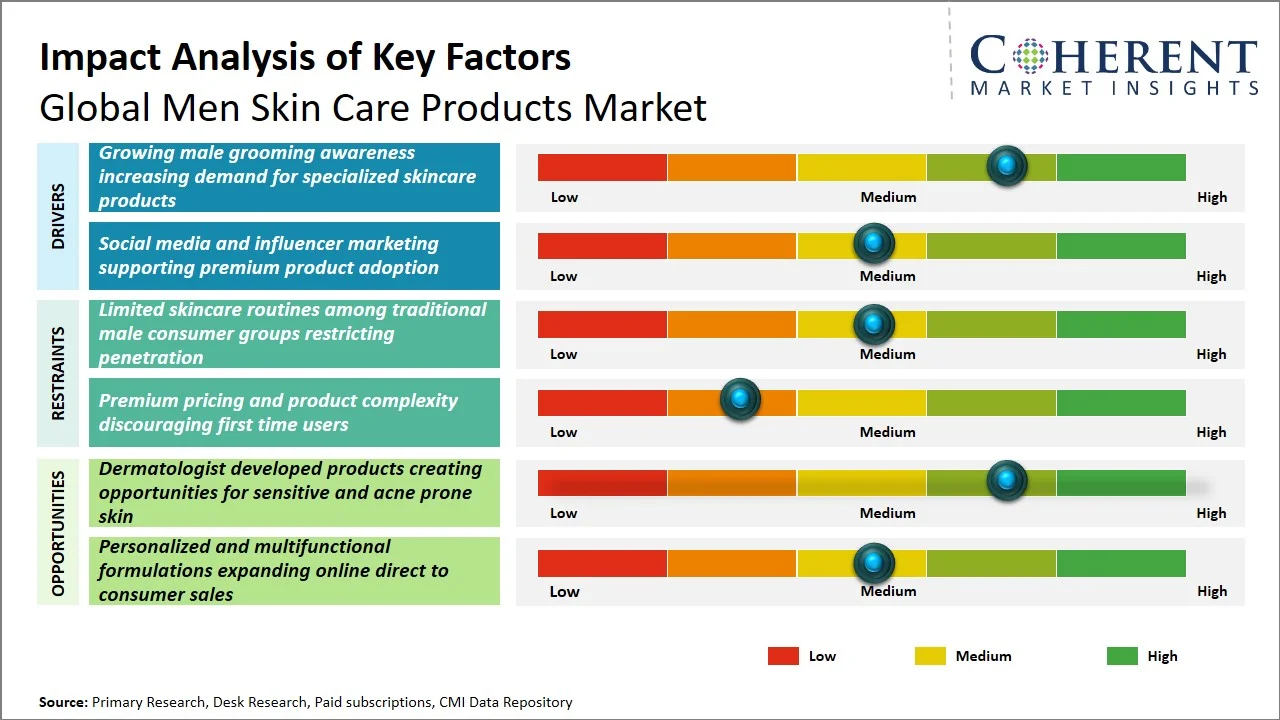
Key Market Drivers
- Growing male grooming awareness increasing demand for specialized skincare products: Growing male grooming awareness is increasing demand for skincare designed around male-specific concerns such as oil control, post-shave irritation, acne, dehydration and visible ageing. The commercial mechanism is straightforward: as skincare becomes part of routine self-care rather than an occasional grooming purchase, men move from basic cleansers or aftershaves toward multi-product regimens with moisturizers, serums, eye care and targeted treatments. This widens basket size and creates room for premium, dermatology-led and specialist brands, while retailers benefit from clearer category segmentation and education-led merchandising. Manufacturers that can combine simple routines with credible efficacy are positioned to gain repeat purchases. In August 2024, Estée Lauder Companies launched Lab Series, a performance-driven skincare brand engineered for men, in the U.S. Amazon Premium Beauty store, expanding access to tailored education and targeted product recommendations.
- Social media and influencer marketing supporting premium product adoption: Digital creators, athletes and lifestyle partnerships are making premium skincare more relevant to younger male consumers by demonstrating product use and simplifying ingredient and benefit communication. This improves engagement with higher-value moisturizers, serums and treatment products while strengthening shoppable digital pathways. In October 2025, Beiersdorf extended the NIVEA MEN–Real Madrid partnership through 2030, adding a new social film and limited-edition products; the company said the collaboration had improved brand perception and purchase intention across markets.
Emerging Market Trends
- Concern-Led Skin Health Positioning: Men’s skincare is shifting from generic “for men” products toward solutions for acne, sensitivity, oil control, pigmentation, sun protection and ageing. Brands are increasingly competing on efficacy, tolerability and skin-specific benefits, favoring dermatology-oriented and specialist skincare players.
- Connected Discovery-to-Replenishment Channels: Men increasingly discover skincare through digital content, pharmacies, barbershops and specialty retail before purchasing or replenishing online or offline. Brands that connect education, recommendation, trial and repeat purchase across channels are better positioned to improve conversion, cross-selling and customer retention.
Regional Insights
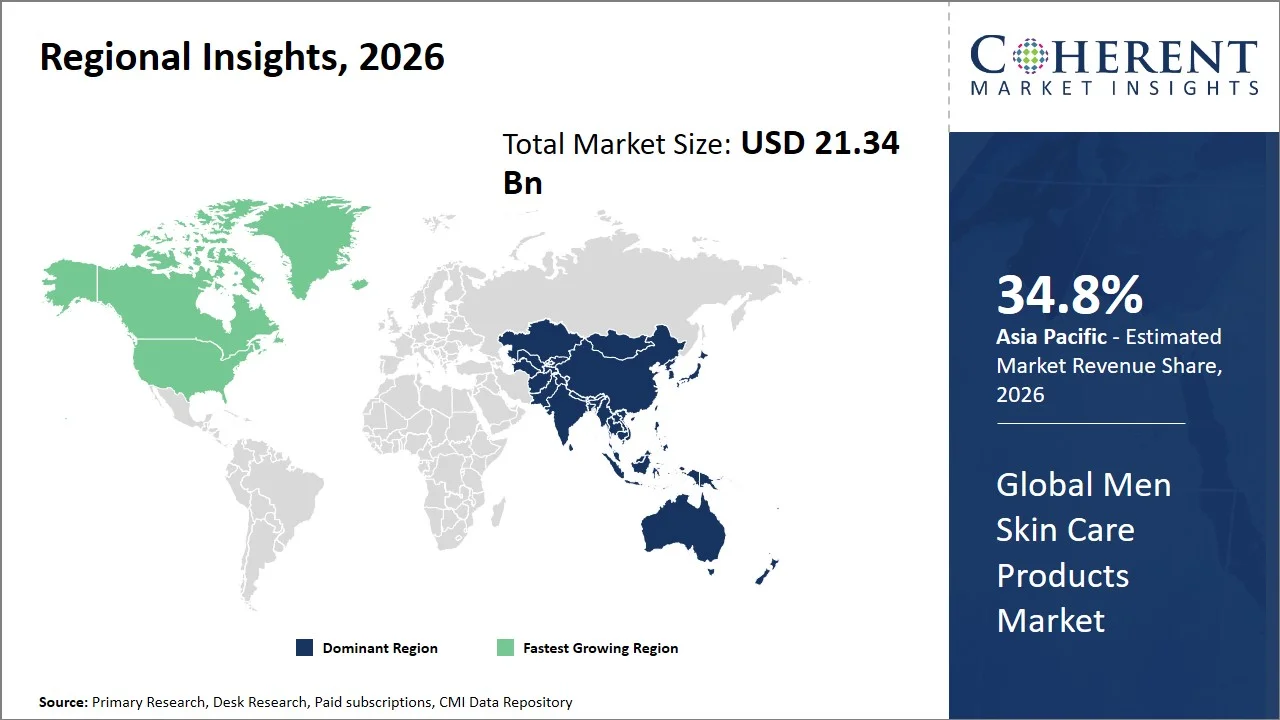
Why Does Asia Pacific Dominate the Global Men Skin Care Products Market?
Asia Pacific is expected to retain leadership as men’s skincare with expected share 34.8% in 2026 is increasingly integrated into everyday grooming across China, Japan, South Korea and India. The region combines large male consumer populations with mature skincare cultures, extensive local manufacturing and strong drugstore, beauty-specialty and digital-commerce networks. Product demand is also broadening beyond young consumers toward middle-aged men seeking anti-ageing, sensitivity, oil-control and post-shave solutions. Regional manufacturers can respond quickly with lightweight textures, multifunctional products and formulations suited to humid climates and frequent shaving. In August 2025, Mandom launched its LUCIDO Medicated Advanced Repair skincare series in Japan for middle-aged men, targeting seven concerns including dryness, spots, wrinkles, razor irritation and shine. This illustrates how Asia Pacific suppliers are widening men’s skincare by age group and functional need.
Why Is North America Emerging as the Fastest-Growing Region in the Global Men Skin Care Products Market?
North America is expected to have the fastest regional expansion with expected market share 30.2% in 2026 as men move from conventional shaving and basic grooming toward dedicated facial cleansing, moisturization, serums and technology-assisted skincare. The region benefits from high product accessibility through direct-to-consumer platforms, marketplaces, mass retailers and specialty channels, allowing emerging brands to scale rapidly without relying solely on traditional beauty counters. Dermatologist-tested formulations, simple regimens and premium grooming positioning are particularly suited to male consumers who want visible benefits without complex routines. In May 2025, U.S.-based MANSCAPED launched Skin Ultra, a dermatologist-tested men’s facial skincare range comprising face wash, brightening serum and moisturizer, alongside the Face Buffer Pro electric cleansing device. The launch demonstrates how North American grooming specialists are moving directly into higher-value skincare and device-integrated routines.
Global Men Skin Care Products Market Outlook for Key Countries
Why Is the U.S. a Key Market for the Global Men Skin Care Products Market?
The U.S. is strategically important because men’s skincare increasingly intersects with wellness, grooming, creator culture and mass retail rather than remaining confined to traditional beauty channels. Large omnichannel retailers make moisturizers, body lotions, lip care and cleansing products accessible to consumers who may not actively visit specialty beauty stores. Younger men are also being recruited through digital creators and lifestyle communities, lowering the cultural barrier around regular skincare use. This structure supports both affordable entry-level products and premium specialist ranges. In July 2025, Target introduced TONE by AMP across its stores and online platform. The sixteen-product men’s personal-care assortment includes hydrating body wash, everyday body lotion and lip balm, demonstrating how U.S. retailers are using creator-led brands and accessible pricing to bring younger male consumers into routine skin and personal care purchasing.
Why Is China Important in the Global Men Skin Care Products Market?
China is a key market because male skincare demand is increasingly organized around specific concerns such as excess sebum, acne, enlarged pores and sun protection rather than generic grooming claims. Strong domestic formulation capabilities, rapid product iteration and sophisticated e-commerce ecosystems enable brands to target these concerns with specialized cleansers, gels, wipes and sunscreen products. Younger urban consumers also provide a commercially attractive audience for efficacy-led skincare that combines convenience with measurable performance. In May 2025, Shanghai Jahwa showcased GF’s new oil-control and anti-acne men’s skincare series at the China Beauty Expo. The range included oil-control facial cleanser, cleansing wipes, hydrogel products and sunscreen, with products specifically designed for oily and acne-prone male skin. The development reflects the increasingly functional and problem-specific direction of China’s men’s skincare category.
Why Does India Support Growth in the Global Men Skin Care Products Market?
India supports market growth through a large young male population, expanding urban middle class and increasing acceptance of skincare beyond shaving products. Heat, pollution, oiliness and frequent outdoor exposure create practical demand for face washes, oil-control products, moisturizers, brightening products and sun protection. The market also benefits from the coexistence of mass FMCG distribution and rapidly expanding digital-first grooming brands, allowing suppliers to address both value-conscious and premium consumers. In January 2025, Emami rebranded Fair and Handsome as Smart and Handsome, repositioning it toward comprehensive male grooming and skin health. Emami stated that younger men are increasingly looking for solutions addressing hydration, oil control and overall skin health, highlighting the transition from fairness-oriented positioning toward broader functional skincare requirements in India.
Why Is Japan a Strategic Country in the Global Men Skin Care Products Market?
Japan is strategically important because men’s skincare adoption is expanding across multiple age groups rather than remaining concentrated among younger consumers. Demand is increasingly moving from basic face washing toward lotions, essences, creams, masks, anti-ageing products and multifunctional formulations that minimize routine complexity. Drugstores and established cosmetics distribution also make skincare easy to incorporate into regular household purchasing. In September 2025, KOTRA reported that Japan’s men’s basic cosmetics market reached USD 0.31 billion in 2024, increasing 14.8% year over year and approximately 1.8 times compared with 2019. Basic skincare accounted for around USD 0.27 billion, while essences, cleansing products and masks were among expanding formats. This indicates that Japanese male consumers are broadening both product usage and skincare sophistication.
Why Is South Korea an Important Growth Market for the Global Men Skin Care Products Market?
South Korea is important because its established skincare culture makes functional products such as oil-control treatments, pore care, sun protection, masks and all-in-one lotions commercially relevant to male consumers. Domestic brands can leverage sophisticated formulation capability and beauty-specialty platforms such as Olive Young and Musinsa to shorten the path between product innovation, consumer discovery and purchase. The market is especially supportive of products that combine skincare efficacy with convenience and discreet appearance enhancement. In June 2025, Korean men’s grooming and skincare brand OBgE reported that its Pore Zero line ranked first in Olive Young’s men’s-care category on June 19. The brand also lists dedicated skincare, suncare and multifunctional formats, illustrating the depth of concern-specific male product development and specialty-retail engagement within South Korea.
Technology Adoption Landscape in the Global Men Skin Care Products Market
Technology | Adoption Level | Key Application Area | Business Impact |
Encapsulation and Controlled-Release Active Delivery | High | Retinoids, antioxidants, vitamins and sensitive actives | Improves active stability, controlled release and formulation tolerability, supporting stronger efficacy positioning and differentiated premium products. |
Microbiome-Compatible Formulation Platforms | Medium | Sensitive skin, acne-prone skin and barrier-support products | Enables gentler formulations designed to maintain skin-barrier balance and expands opportunities in dermatology-oriented men’s skincare. |
Advanced UV-Filter Dispersion and Photostabilization | High | Facial SPF, moisturizers with sun protection and outdoor skincare | Improves sunscreen uniformity, sensory performance and protection consistency while helping brands reduce greasiness and visible residue. |
Reconstructed Human Epidermis and In-vitro Skin Testing | High | Safety, irritation, penetration and efficacy evaluation | Shortens formulation screening, supports safety substantiation and improves evidence generation before clinical or consumer testing. |
Waterless and Concentrated Formulation Technology | Medium | Cleansers, solid skincare and concentrated treatments | Reduces water content and packaging requirements while enabling lighter logistics and differentiated product formats. |
Airless Dispensing and Contamination-Control Packaging | High | Serums, moisturizers and oxidation-sensitive formulations | Protects sensitive formulations from air and repeated contact, improving product stability, dosage consistency and shelf performance. |
How Are Barrier-Repair and Post-Shave Recovery Solutions Creating New Growth Opportunities in the Global Men Skin Care Products Market?
Barrier-repair and post-shave recovery products represent an underdeveloped opportunity because many men still treat shaving, cleansing and moisturization as separate tasks even though repeated shaving can disrupt comfort and increase sensitivity. The opportunity is to build products that bridge grooming and dermatological skincare through soothing cleansers, alcohol-free post-shave treatments, ceramide-rich moisturizers, redness-control formulas and lightweight protective products designed for frequent use. Target customers include men with sensitive, acne-prone or irritation-prone skin, frequent shavers, beard users, urban consumers exposed to pollution, and consumers using dermatology or aesthetic services. Companies can capture this space by combining clinical tolerability testing with fast-absorbing textures, clear claims and distribution through pharmacies, dermatology-linked channels, barbershops and digital education. Participation requires formulation expertise, safety substantiation, packaging that supports hygienic daily use and disciplined claims management. The opportunity can favor both established skincare groups with R&D scale and specialist men’s brands able to communicate a focused problem-solution proposition.
Market Players, Key Development, and Competitive Landscape
Key Developments
- In February 2026, Kenvue launched Neutrogena Evenly Clear, a dermatologist co-designed collection addressing adult acne, breakouts and post-acne marks through cleansers, moisturizers, exfoliants, retinoid treatment and other formats. The development is relevant to the global men skin care products market because adult acne and barrier-conscious treatment create an addressable problem-solution category for male consumers beyond conventional cleansing and shaving care, while supporting greater use of clinically positioned treatment products.
- In January 2025, L’Oréal Groupe unveiled Cell BioPrint at CES 2025, a lab-on-chip skin-analysis system using advanced proteomics to assess skin characteristics and likely responsiveness to ingredients. Although designed for skincare consumers broadly, the technology is relevant to the global men skin care products market because diagnostic-led product selection can reduce trial-and-error purchasing and create new pathways for treatment-oriented skincare recommendations to male users.
- In December 2024, Procter & Gamble reported that Gillette had introduced its House of Grooming concept in France to make it easier for male consumers to identify products for the face, beard and intimate grooming. The development is important because it broadens competition beyond razor performance toward integrated grooming and skincare selection, creating opportunities for cross-category purchasing and stronger consumer education around pre-shave, post-shave and facial-care needs.
Competitive Landscape
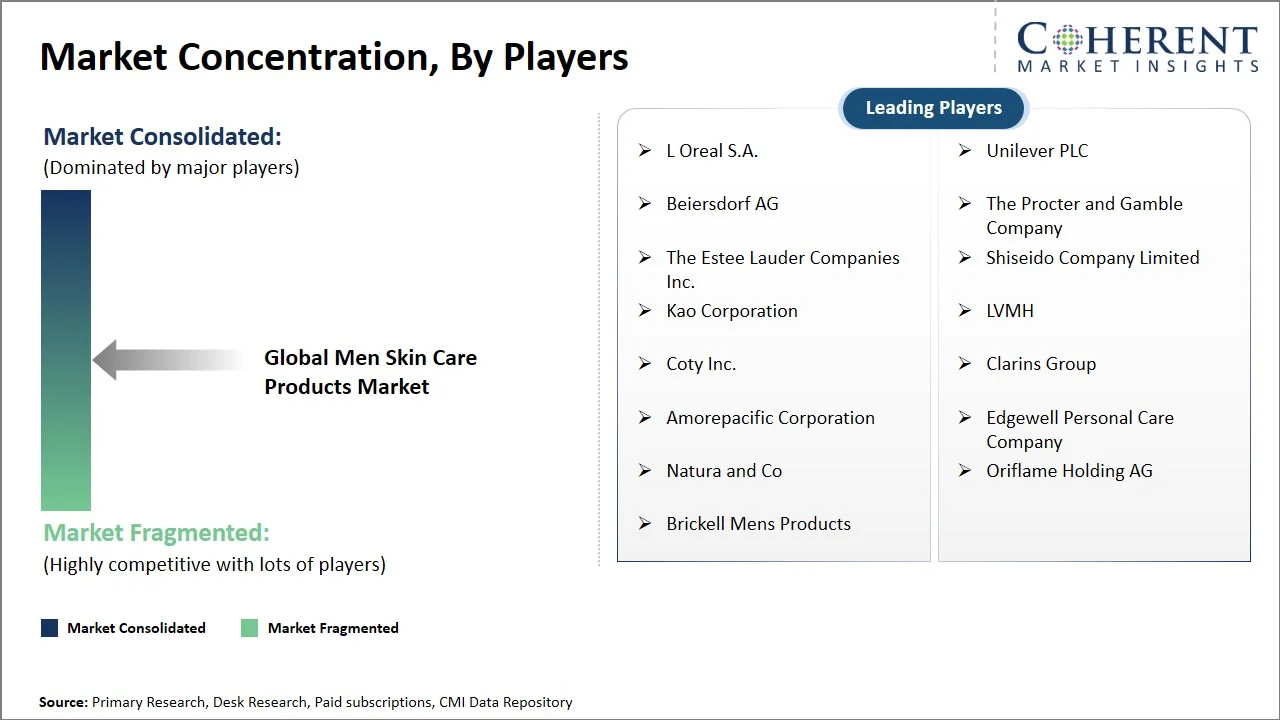
The global men skin care products market is moderately fragmented, combining multinational beauty and personal-care groups, dermatological skincare brands, premium grooming labels, digitally native men’s specialists and regional manufacturers. Competition increasingly depends on solving identifiable skin concerns rather than offering a broad masculine product range. Global companies benefit from R&D, retail access and marketing scale, while specialist brands can compete through sharper positioning, faster product development and closer relationships with defined consumer communities. Pricing remains important in mass channels, but texture, demonstrated efficacy, ingredient credibility, regulatory compliance, supply reliability and omnichannel availability increasingly influence repeat purchasing.
Key focus areas include
- Efficacy and sensory performance: Lightweight, non-greasy, fast-absorbing products can differentiate brands where men value convenience alongside functional results.
- Dermatological credibility: Clinical substantiation, ingredient transparency and skin-tolerance positioning are becoming stronger competitive tools.
- Price-tier architecture: Companies need accessible entry products while maintaining premium treatment options that support margin expansion.
- Distribution execution: Pharmacy, specialty beauty, mass retail, marketplaces and direct channels require differentiated merchandising and education strategies.
- Manufacturing flexibility: Faster reformulation and smaller innovation batches help brands respond to ingredient restrictions and changing consumer preferences.
- Private-label capability: Retailers can use contract manufacturing to build value-oriented or specialized men’s skincare portfolios without owning production.
- Regional adaptation: Climate, skin concerns, grooming routines, fragrance preferences and purchasing channels make local formulation and assortment decisions commercially important.
Market Report Scope
Men Skin Care Products Market Report Coverage
| Report Coverage | Details | ||
|---|---|---|---|
| Base Year: | 2025 | Market Size in 2026: | USD 21.34 Bn |
| Historical Data for: | 2020 To 2024 | Forecast Period: | 2026 To 2033 |
| Forecast Period 2026 to 2033 CAGR: | 7.3% | 2033 Value Projection: | USD 34.95 Bn |
| Geographies covered: |
| ||
| Segments covered: |
| ||
| Companies covered: | L Oreal S.A., Unilever PLC, Beiersdorf AG, The Procter and Gamble Company, The Estee Lauder Companies Inc., Shiseido Company Limited, Kao Corporation, LVMH, Coty Inc., Clarins Group, Amorepacific Corporation, Edgewell Personal Care Company, Natura and Co, Oriflame Holding AG, Brickell Mens Products | ||
| Growth Drivers: |
| ||
| Restraints & Challenges: |
| ||
Analyst Opinion (Expert Opinion)
- The global men skin care products market leadership is likely to shift from brands that simply label products “for men” toward companies that can own clearly defined skin problems and build credibility around outcomes. Gender-coded packaging will remain commercially useful, but it will become less defensible as a primary source of differentiation. Brands capable of translating dermatological formulation expertise into approachable men’s propositions should be better positioned to capture value across both specialist and mainstream skincare channels.
- The traditional separation between grooming and skincare may weaken substantially as consumers expect shaving, beard maintenance, cleansing, moisturization and skin protection to work as one interconnected care system. This could pressure businesses organized around isolated categories and favor suppliers able to design products around complete usage occasions. Formulation compatibility across grooming steps, cross-category merchandising and coordinated product architecture could therefore become more important than maintaining large collections of stand-alone SKUs.
- Market participants should prioritize clinically credible formulations, comfortable textures, ingredient transparency, regulatory-ready product development and stronger links between skincare education and purchase channels. Sensitive skin, post-shave recovery, adult acne and everyday protection merit greater attention, while excessive SKU proliferation should be avoided because it can increase inventory, formulation and marketing costs without improving consumer adoption. Companies should also build flexible manufacturing and supplier relationships so regulatory ingredient changes can be absorbed without prolonged product interruptions.
Speak to the analyst
Want personalized insights?
Take the findings above to one of our principal consultants, or have the report rebuilt around the segments, geographies and competitors you actually track.
Market Segmentation
- Product Type Insights (Revenue, USD Bn, 2021 - 2033)
- Facial Care Products
- Body Care Products
- Shaving Care Products
- Sun Care Products
- Eye and Lip Care Products
- Others
- Skin Type Insights (Revenue, USD Bn, 2021 - 2033)
- Normal Skin
- Oily Skin
- Dry Skin
- Sensitive Skin
- Combination Skin
- Price Range Insights (Revenue, USD Bn, 2021 - 2033)
- Mass
- Premium
- Luxury
- Distribution Channel Insights (Revenue, USD Bn, 2021 - 2033)
- Supermarkets and Hypermarkets
- Online Retail
- Specialty Beauty Stores
- Pharmacies and Drugstores
- Department Stores
- Others
- Regional Insights (Revenue, USD Bn, 2021 - 2033)
- North America
- U.S.
- Canada
- Latin America
- Brazil
- Argentina
- Mexico
- Rest of Latin America
- Europe
- Germany
- U.K.
- Spain
- France
- Italy
- Russia
- Rest of Europe
- Asia Pacific
- China
- India
- Japan
- Australia
- South Korea
- ASEAN
- Rest of Asia Pacific
- Middle East
- GCC Countries
- Israel
- Rest of Middle East
- Africa
- South Africa
- North Africa
- Central Africa
- North America
- Key Players Insights
- L Oreal S.A.
- Unilever PLC
- Beiersdorf AG
- The Procter and Gamble Company
- The Estee Lauder Companies Inc.
- Shiseido Company Limited
- Kao Corporation
- LVMH
- Coty Inc.
- Clarins Group
- Amorepacific Corporation
- Edgewell Personal Care Company
- Natura and Co
- Oriflame Holding AG
- Brickell Mens Products
Sources
Primary Research Interviews
- Men’s skincare manufacturers, dermatocosmetic companies, personal-care brands, and contract manufacturers
- Facial cleansers, moisturizers, serums, anti-ageing, acne-care, shaving-care, sun-care, and body-care suppliers
- Dermatologists, aestheticians, grooming professionals, barbers, and male skincare consumers
- Distributors, beauty retailers, pharmacies, e-commerce platforms, private-label suppliers, and industry experts
Stakeholders
- Men’s skincare and personal-care product manufacturers
- Cosmetic ingredient, active ingredient, fragrance, preservative, and packaging suppliers
- Dermatology, grooming, shaving-care, sun-care, and dermo cosmetic companies
- Distributors, importers, exporters, pharmacies, specialty beauty retailers, and e-commerce companies
End-use Sectors
- Facial care and daily skincare
- Shaving and post-shave care
- Anti-ageing and treatment skincare
- Acne, oil-control, and sensitive-skin care
- Sun protection and outdoor skincare
- Body care, eye care, lip care, and multifunctional grooming
Regulatory and Government Bodies
- U.S. FDA and Federal Trade Commission
- European Commission, SCCS, ECHA, and national cosmetic regulatory authorities
- China National Medical Products Administration and State Administration for Market Regulation
- India CDSCO, Ministry of Health & Family Welfare, and Bureau of Indian Standards
- Japan Ministry of Health, Labour and Welfare and Pharmaceuticals and Medical Devices Agency
- South Korea Ministry of Food and Drug Safety
- Health Canada
Databases
- UN Comtrade, ITC Trade Map, Eurostat, USITC, World Bank, and OECD
- FDA cosmetic facility registration and product-listing resources
- European Commission cosmetic ingredient and regulatory databases
- China NMPA cosmetic registration and notification databases
- WIPO PATENTSCOPE and Espacenet
- Company annual reports, investor presentations, product catalogues, pricing records, and retail listings
Magazines and Journals
- International Journal of Cosmetic Science
- Journal of Cosmetic Dermatology
- Skin Research and Technology
- Contact Dermatitis
- Journal of Dermatological Science
- Cosmetics & Toiletries
- Personal Care Magazine
- Global Cosmetic Industry
Associations
- Personal Care Products Council
- Cosmetics Europe
- International Federation of Societies of Cosmetic Chemists
- Cosmetic, Toiletry and Perfumery Association
- Japan Cosmetic Industry Association
- Korea Cosmetic Association
- Indian Beauty & Hygiene Association
- National cosmetics, personal-care, dermatology, and retail associations
Public Domain Sources
- Product catalogues, ingredient lists, technical specifications, labels, and safety documentation
- Product claims covering hydration, oil control, acne care, anti-ageing, sensitive skin, SPF, and post-shave benefits
- Ingredient, formulation, packaging, product-format, and dermatological-testing information
- Retail pricing, distribution presence, online product listings, and consumer-facing product portfolios
- Annual reports, patents, regulatory registrations, product launches, manufacturing expansions, partnerships, and investments
Key Standards and Regulations
- EU Cosmetics Regulation (EC) No. 1223/2009
- U.S. Federal Food, Drug, and Cosmetic Act and Modernization of Cosmetics Regulation Act
- China Cosmetic Supervision and Administration Regulation
- India Cosmetics Rules, 2020
- Canada Cosmetic Regulations
- ISO 22716 Cosmetics Good Manufacturing Practices
- ISO 24444 sunscreen SPF testing requirements
- ISO 11930 preservative efficacy evaluation
- ISO 16128 guidelines for natural and organic cosmetic ingredients
- Cosmetic labeling, ingredient disclosure, safety assessment, claims substantiation, allergen, GMP, and product-notification requirements
Proprietary Elements
- CMI Data Analytics Tool, Proprietary CMI Existing Repository of information for the last 10 years
Get access to 250+ pages report
Every segment, forecast, competitor profile and data table behind the analysis above — available for instant download.
- ESOMAR Member
- ISO 9001:2015 Certified
- D-U-N-S Registered
- GDPR & CCPA Compliant
Missing comfort of reading report in your local language? Find your preferred language:
Transform your Strategy with Exclusive Trending Reports
Frequently Asked Questions
The CAGR of global men skin care products market is projected to be 7.3% from 2026 to 2033.
The global men skin care products market is estimated to be valued at USD 21.34 billion in 2026 and is expected to reach USD 34.95 billion by 2033
The market includes facial care, body care, shaving care, sun care, eye and lip care, and other specialized men’s skincare products.
Concern-specific skincare, multifunctional formulations, dermatologist-backed products, simplified routines, and omnichannel product discovery are key trends shaping the market.
Supermarkets and hypermarkets, online retail, specialty beauty stores, pharmacies and drugstores, and department stores are the key distribution channels.
Major consumers include men seeking daily facial care, acne and oil-control solutions, anti-ageing products, sensitive-skin care, shaving-related skincare, and sun protection.
Growing male grooming awareness increasing demand for specialized skincare products and Social media and influencer marketing supporting premium product adoption are the major factor driving the growth of global men skin care products market.