

Global MiFi Market Size and Forecast – 2026 To 2033
The global MiFi market is expected to grow from USD 3 Bn in 2026 to USD 9 Bn by 2033, registering a compound annual growth rate (CAGR) of 16% from 2026 to 2033. The global MiFi market is driven by the increasing adoption of IoT devices requiring mobile connectivity. On May 18, 2026, Vodafone accelerated investment in its hyperscale IoT infrastructure and connectivity platforms to support growing deployments across smart cities, utilities, logistics, and industrial automation. (Source: Vodafone)
Key Takeaways of the Global MiFi Market
- The consumer MiFi devices segment is expected to account for 61.0 % of the global MiFi market share in 2026. High demand of MiFi from travel, logistics, and field operations is driving the growth of the segment. On May 4, 2026, Inseego announced the availability of MiFi PRO M4 with AT&T, delivering a powerful new way for consumers, enterprises and organizations to enable more secure, reliable wireless connectivity on AT&T's nationwide high-speed 5G wireless network, with availability through both AT&T Business channels and AT&T retail locations. (Source: Inseego)
- The individual consumers segment is estimated to capture 37.0 % of the market share in 2026. Growth in rural broadband alternatives is a prime factor driving the growth of the segment. On April 28, 2026, T-Mobile unveiled SuperBroadband, a revolutionary business internet solution that brings together the largest nationwide 5G Advanced network and Starlink Broadband to deliver ultimate redundancy, unmatched coverage and simplified operations for businesses nationwide. (Source: T-Mobile)
- Asia Pacific is expected to dominate the MiFi market in 2026 with a market share of 34.0 %. The increasing use of MiFi in emergency & disaster connectivity systems in Asia Pacific is driving the growth of the regional MiFi market. On March 26, 2026, Singapore’s Defence Science and Technology Agency (DSTA) signed an expanded agreement with AST SpaceMobile to demonstrate space-based cellular broadband for humanitarian assistance, disaster relief, and emergency response operations. (Source: Asia Pacific Defense Reporter)
- North America is expected to account for 29.0 % share in 2026 and is projected to record the fastest growth over the forecast period. Rising adoption of MiFi devices in smart cities & IoT ecosystems is key driver for the MiFi market in North America. On September 23, 2024, Inseego expanded its enterprise MiFi portfolio with the MiFi X PRO 5G, designed to support connected sensors, smart infrastructure, public safety applications, and distributed IoT deployments across North America. (Source: Inseego)
- Rapid Shift Toward 5G-Enabled MiFi Devices: There is a fast transition from 4G LTE to 5G MiFi router with ultra-low latency, faster speed and better multi-device connectivity happening in the industry. This shift is powering smoother streaming, cloud gaming and enterprise-grade remote work solutions, making 5G MiFi a vital growth engine.
- Integration with IoT and Smart Connectivity Ecosystems: MiFi devices are expanding from personal hotspots to connection hubs for IoT devices and ecosystems, enabling smart devices in logistics, healthcare and smart cities. This trend is driving manufacturers to create more powerful, multi-device-capable routers.
Segmental Insights
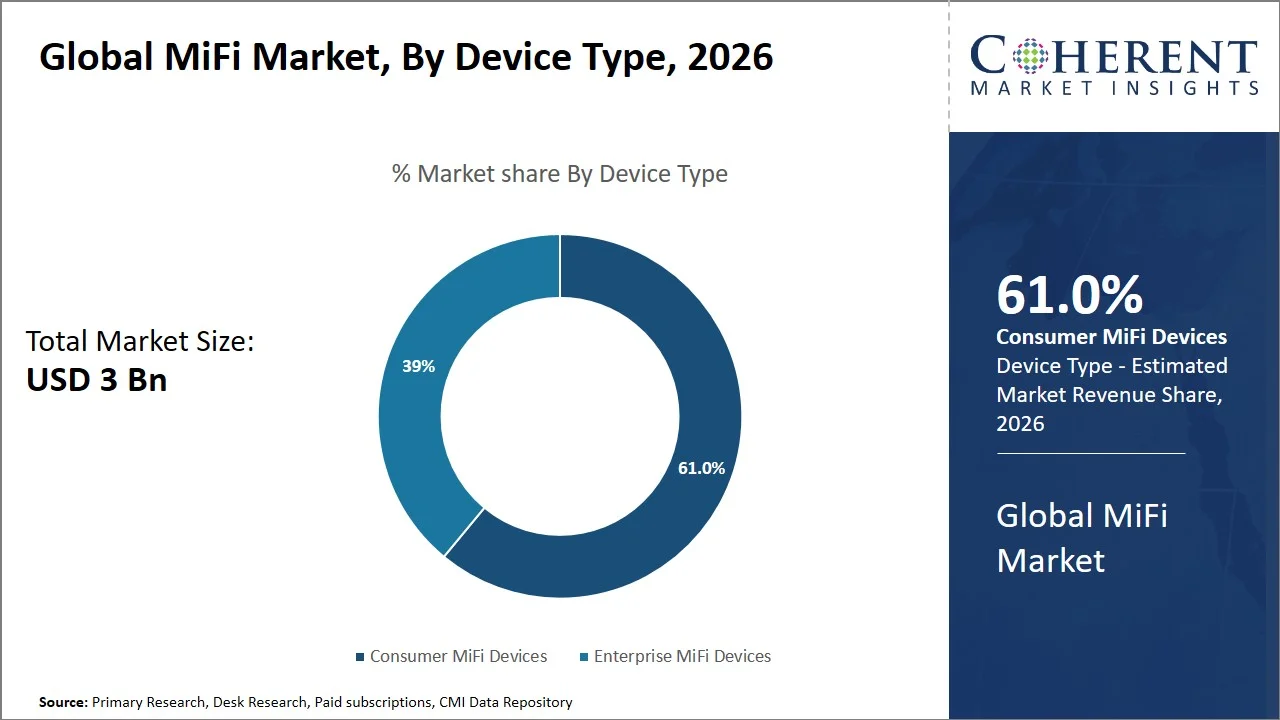
Why Do Consumer MiFi Devices Dominate the Global MiFi Market?
The consumer MiFi devices segment is expected to account for 61.0% of the global MiFi market share in 2026. MiFi devices for consumers are generally low-cost and easy to use, and are extensively adopted by individual users for everyday internet needs like as travel, home backup access and mobile hotspot sharing. This vast consumer base results in much greater volume demand than enterprise-only devices, with the consumer segment accounting for the greatest proportion of the overall market.
On November 17, 2025, NETGEAR Inc. announced the launch of the Nighthawk 5G M7 Portable WiFi 7 Hotspot (MH7150) supported by a new mobile app (iOS and Android) and eSIM Marketplace. The innovative device combines reliable, portable connectivity with groundbreaking flexibility, allowing users to choose coverage that fits their needs, connecting instantly to high-speed internet in more than 140 countries. (Source: NETGEAR)
- Current Industry Events of 2026
- Market Size Estimation
- Regional Breakdown
- Competitive Landscape
- Customer Intelligence
- Segmental Analysis
- Pricing Analysis
- Key Market Drivers, Challenges & Future Trends
- Customized Insights Section
Why are Individual Consumers the Most Crucial End Users?
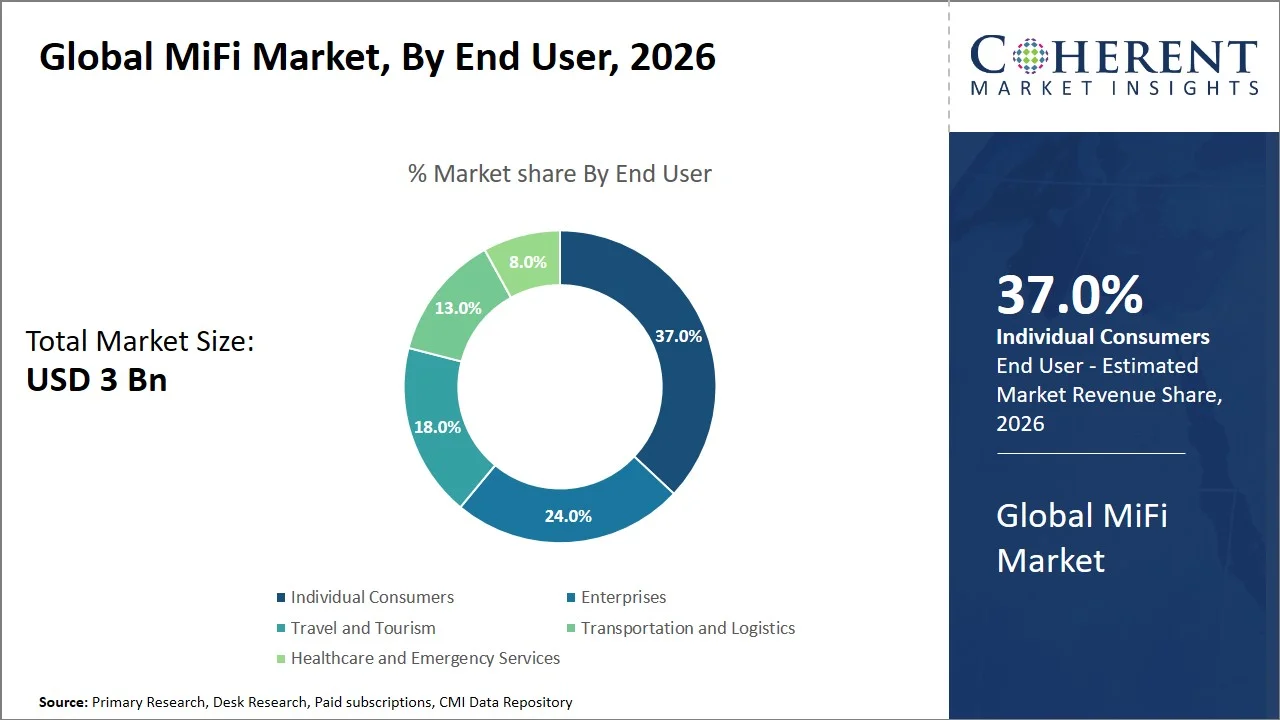
The individual consumers segment is expected to account for 37.0% of the global MiFi market share in 2026. The most important end users are individual customers, who increasingly depend on constant, portable internet connectivity for daily activities such as streaming, social media, online learning, gaming and remote work. Among other end-user categories, MiFi usage is the largest and most continuous among individual consumers due to the always-on need for flexible Internet access outside of fixed broadband networks.
On January 30, 2026, NETGEAR Inc. launched an integrated eSIM marketplace that allows users to activate local data plans directly from the hotspot application while traveling internationally. The feature was specifically developed to simplify connectivity for consumers who require uninterrupted internet access across multiple countries. (Source: NETGEAR)
Currents Events and their Impact
Current Events | Description and its Impact |
European Union - Radio Equipment Directive (RED) Update (Cybersecurity Delegated Act, 2025 rollout) |
|
U.S. - FCC 5G and Spectrum Expansion Policies |
|
MiFi Market Dynamics
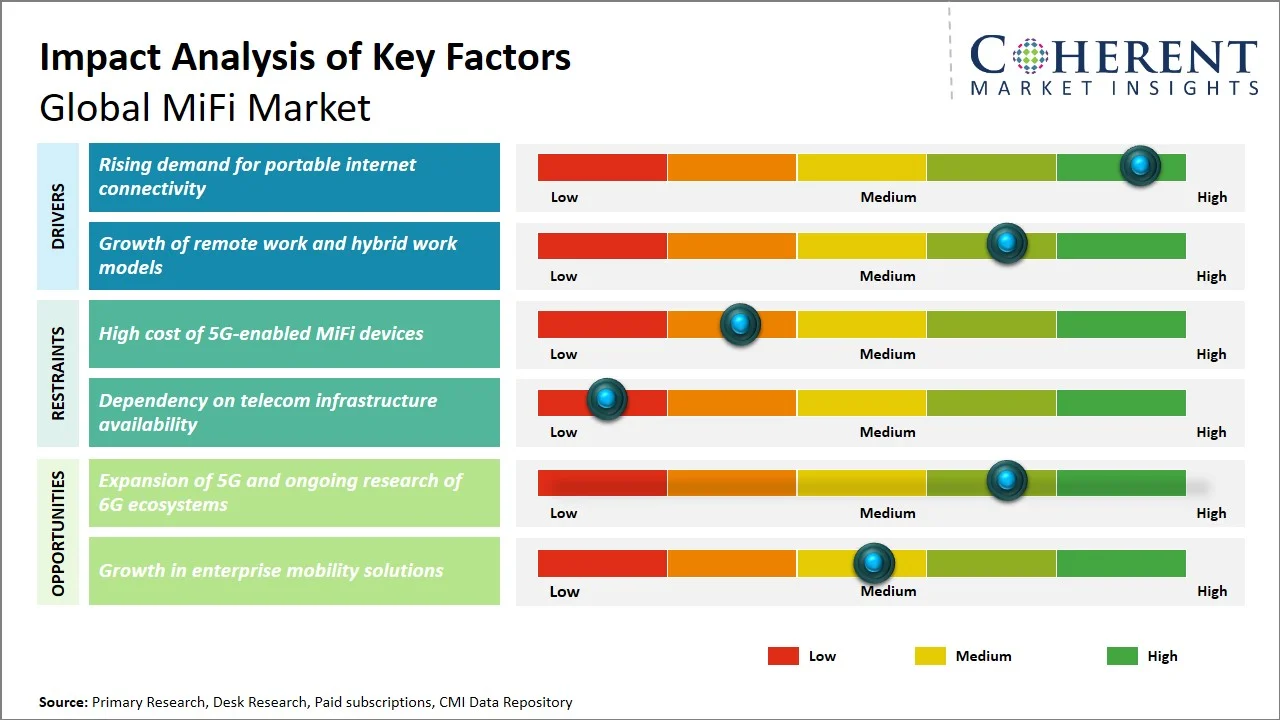
Market Drivers
Rising demand for portable internet connectivity
The increasing requirement for always-on, flexible access to the internet on the go at work, while traveling and in daily life is driving the increasing demand for portable internet connectivity. With 5G networks rolling out, customers are gravitating towards smaller form factors like MiFi devices and mobile hotspots to accommodate remote and hybrid work arrangements and growing demand for digital services such streaming, online learning and cloud apps. The trend towards continuous, location-independent internet access is underscored by recent technologies like satellite-enabled mobile connectivity and plug-and-play 5G routers from T-Mobile, Verizon, Netgear and others.
On October 1, 2025, T-Mobile US expanded its T-Satellite service with SpaceX Starlink, allowing users to stay connected in areas without cellular towers using satellite-enabled mobile connectivity. The service is now being integrated into mainstream plans and works automatically on compatible smartphones and hotspot ecosystems. (Source: T-Mobile)
Growth of remote work and hybrid work models
The growth of remote work and hybrid work models has led to an increased need for reliable and flexible internet connectivity, since employees are now working from home, co-working spaces and while travelling. This has driven the need for portable solutions such as MiFi devices and mobile hotspots to maintain constant access to business software, video conferencing and cloud-based tools. The MiFi industry continues to rise as organizations continue to offer flexible work arrangements and the requirement for secure, high-speed, always-available access. For instance, on May 12, 2026, Times of India reported that Deloitte India, KPMG India, EY India, Tata Motors, and Mercedes-Benz India continuing or reviewing hybrid work policies while limiting non-essential travel and increasing digital collaboration. (Source: Times of India)
Emerging Trends
- Rising Demand from Remote & Hybrid Work Culture: As hybrid work becomes permanent in many industries, employees are increasingly dependent on portable and secure internet access devices. Public Wi-Fi is not always stable, especially for business travelers and field workers and MiFi routers are becoming a solid option.
- Focus on Longer Battery Life & Compact Design Innovation: Manufacturers are working on energy efficient chips, lightweight designs, and longer battery backup, solving one of the main user pain concerns. MiFi devices are becoming smaller, tougher and able to last all day.
Regional Insights
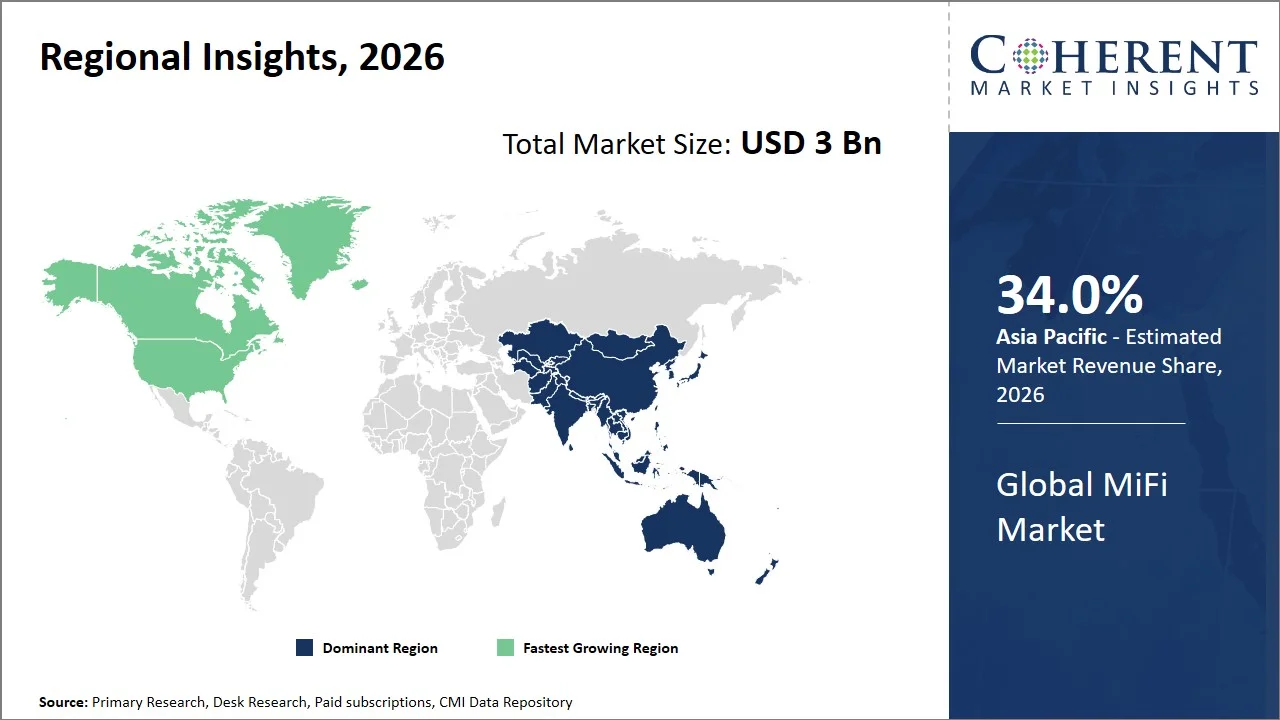
Why is Asia Pacific a Strong Market for MiFi?
Asia Pacific is expected to account for a market share of 34.0% in 2026. Asia Pacific is leading the way in MiFi adoption, with quick 5G rollout in China, South Korea and Japan, and increasing demand for low-cost mobile internet in densely populated metropolitan environments. Telecom providers are aggressively integrating MiFi devices with prepaid and postpaid data plans in the region, notably targeting students, gig workers and rural users with limited fixed broadband connectivity. On March 11, 2026, Huawei officially launched the brand-new mobile phone router, the Wi-Fi X. The company announced it in December, 2025, revealing a few special traits of this product. Now the OEM has brought it to the stage alongside full specifications and price. (Source: Huawei)
Why Does the North America MiFi Market Exhibit High Growth?
North America is projected to account for 29.0% of the global MiFi market and is expected to register the fastest growth. A key driver for the North America MiFi market is the availability of enterprise-grade mobile connection, notably in logistics, field services and remote IT operations where organizations favor secure dedicated hotspots over public Wi-Fi. Verizon, AT&T and other carriers are increasingly bundling MiFi devices with business mobility solutions for connecting the hybrid workforce, including unlimited data plans. For example, Verizon continued expanding its dedicated hotspot offerings with plans providing up to 150 GB of premium hotspot data and access to its 5G Ultra Wideband network. The carrier also strengthened business-focused hotspot and data-only offerings to support mobile workforces and remote operations. (Source: Verizon)
Global MiFi Market Outlook for Key Countries
Why is China Emerging as a Major Hub in the MiFi Market?
Huawei and ZTE are strong indigenous manufacturers dominating China’s MiFi industry with strong government-backed 5G infrastructure expansion across Tier 2 and Tier 3 cities. Demand is focused on large-scale urban mobility applications where portable routers are typically employed in transport, live streaming and e-commerce delivery networks.
Is the U.S. the Next Growth Engine for the MiFi Market?
The U.S. MiFi industry is being influenced by 5G home internet services from T-Mobile, Verizon and AT&T, which offer fixed wireless access (FWA) and are decreasing the dependence on traditional broadband. Remote workers and business travelers who utilize MiFi devices to provide backup connectivity during outages and mobility needs continue to show significant demand.
South Korea MiFi Market Analysis and Trends
South Korea’s world-leading 5G penetration and ultra-fast mobile networks offered by SK Telecom, KT Corporation and LG Uplus also influence the MiFi market, with portable routers heavily used for high-bandwidth applications such as 4K/8K streaming, cloud gaming and real-time content creation. Young urban consumers and digital creators, in particular, have a great demand for MiFi devices, which they use to obtain steady access outside of fixed internet locations, including cafes, studios and co-working spaces. The country’s dense urban infrastructure also impacts the market as emphasis is placed on seamless mobility between networks rather than traditional fixed-line expansion.
India MiFi Market Analysis and Trends
Rapid growth in the India MiFi market is being driven by the low-cost data plans offered by Reliance Jio and Airtel, along with the patchy penetration of fixed broadband in semi-urban and rural areas. The demand is particularly great among students, small businesses and migratory workers who rely on portable hotspots as their primary means of internet connectivity, rather than simply as a backup.
Global MiFi Market - 5G Network Coverage Expansion
Country | 5G Population Coverage (2025–2026) |
South Korea | 100% |
Japan | ~98–99% |
U.S. | ~95–97% |
China | ~95% |
Germany | ~95–96% |
U.K. | ~95–96% |
Australia | ~91–92% |
Canada | ~90% |
How is the Expansion of 5G and Ongoing Research of 6G Ecosystems Creating New Growth Opportunities in the MiFi Market?
The MiFi market is being driven greatly by the expansion of 5G networks as they provide higher-speed, low-latency, multi-device portable connection, which is making the mobile hotspots appropriate for data-intensive use cases including cloud computing, video conferencing, and AR/VR applications. At the same time, continuing 6G research is opening up future possibilities by targeting ultra-high bandwidth, AI-powered network optimization, and seamless integration of satellite and terrestrial networks, which will lead to additional improvements in the performance of future MiFi devices. The commercialization of 5G and development of 6G are revolutionizing MiFi from a mere connection tool to an essential facilitator of intelligent, always-connected mobile ecosystems.
On March 1, 2026, Qualcomm Technologies, Inc. and T-Mobile announced an expanded strategic collaboration to accelerate the wireless industry’s transition from 5G Advanced to 6G, with commercial deployments targeted beginning in 2029. This collaboration aligns with Qualcomm Technologies' broader 6G industry initiative unveiled at MWC Barcelona 2026 to accelerate global readiness for the next generation of wireless innovation. (Source: Qualcomm)
Market Players, Key Development, and Competitive Intelligence
Key Developments
- On March 2, 2026, Qualcomm Technologies, Inc. announced the launch of Qualcomm X105 5G Modem-RF, the world’s leading 5G Advanced platform featuring the industry’s first 3GPP Release 19-ready modem, laying the foundation for 6G development and testing. Building on Qualcomm Technologies’ decades of leadership in connectivity, the Qualcomm X105 achieves significant improvements in data speeds and power efficiency, while introducing breakthroughs in quad-band GNSS and integrated NR-NTN support.
- On June 19, 2025, China Telecom and Huawei launched the innovative 5G-A Intelligent Ultra Pooling Uplink technology that offers intelligent orchestration and uplink spectrum decoupling and pooling. Designed to maximize multi-antenna uplink coverage, this technology leverages the distributed user-centric network (UCN) and real-time sharing of time, frequency, radio access technology (RAT), space, and power resources.
Competitive Landscape
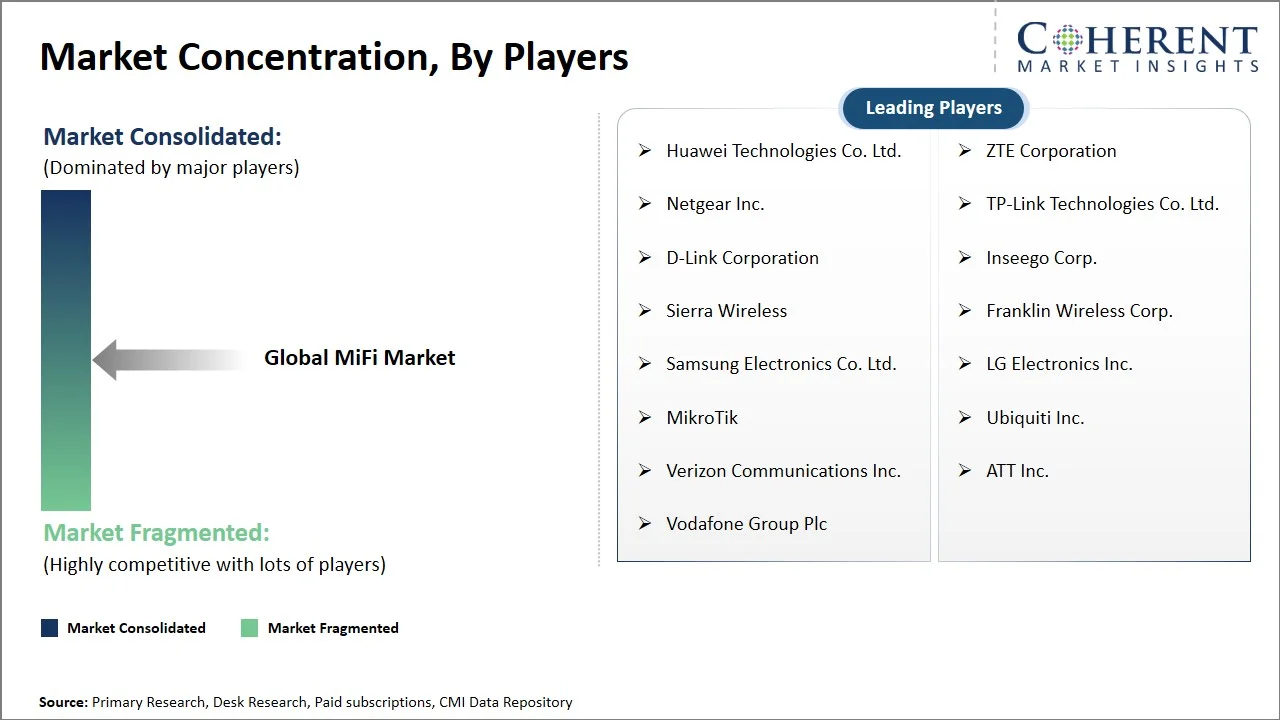
The global MiFi market is highly consolidated with intense competition amongst competitors such as Huawei, ZTE, Netgear, TP-Link and Inseego, comprising telecom carriers, networking equipment manufacturers, and technology businesses driven by chipsets. Intense competition is being driven by rapid 5G device upgrades, product innovation in Wi-Fi 6/7-enabled hotspots and aggressive bundling strategies by telecom operators, with pricing pressure and supply chain optimization being consistently prioritized to maintain market dominance.
Market Report Scope
MiFi Market Report Coverage
| Report Coverage | Details | ||
|---|---|---|---|
| Base Year: | 2025 | Market Size in 2026: | USD 3 Bn |
| Historical Data for: | 2020 To 2024 | Forecast Period: | 2026 To 2033 |
| Forecast Period 2026 to 2033 CAGR: | 16% | 2033 Value Projection: | USD 9 Bn |
| Geographies covered: |
| ||
| Segments covered: |
| ||
| Companies covered: | Huawei Technologies Co. Ltd., ZTE Corporation, Netgear Inc., TP-Link Technologies Co. Ltd., D-Link Corporation, Inseego Corp., Sierra Wireless, Franklin Wireless Corp., Samsung Electronics Co. Ltd., LG Electronics Inc., MikroTik, Ubiquiti Inc., Verizon Communications Inc., ATT Inc., and Vodafone Group Plc | ||
| Growth Drivers: |
| ||
| Restraints & Challenges: |
| ||
Analyst Opinion (Expert Opinion)
- The shift to 5G-enabled connectivity and the growing reliance on portable broadband solutions in the consumer and enterprise segments have been seen to be significantly influencing the MiFi market. Strong growth momentum has been attributed to increased mobility needs and hybrid work acceptance, however competitive substitution from smartphone tethering and fixed wireless access services have been cited as issues.
- The MiFi market will be increasingly affected by 5G Advanced and early 6G ecosystem advancements with devices likely to be integrated with AI-based network optimization and satellite connectivity features. Enterprise mobility, IoT ecosystems and remote connectivity solutions are expected to have strong development potential, with MiFi moving from a single hotspot device into a multi-network intelligent gateway.
Speak to the analyst
Want personalized insights?
Take the findings above to one of our principal consultants, or have the report rebuilt around the segments, geographies and competitors you actually track.
Market Segmentation
- Device Type Insights (Revenue, USD Billion, 2021 - 2033)
- Consumer MiFi Devices
- Enterprise MiFi Devices
- End User Insights (Revenue, USD Billion, 2021 - 2033)
- Individual Consumers
- Enterprises
- Travel and Tourism
- Transportation and Logistics
- Healthcare and Emergency Services
- Regional Insights (Revenue, USD Billion, 2021 - 2033)
- North America
- U.S.
- Canada
- Latin America
- Brazil
- Argentina
- Mexico
- Rest of Latin America
- Europe
- Germany
- U.K.
- Spain
- France
- Italy
- Russia
- Rest of Europe
- Asia Pacific
- China
- India
- Japan
- Australia
- South Korea
- ASEAN
- Rest of Asia Pacific
- Middle East
- GCC Countries
- Israel
- Rest of Middle East
- Africa
- South Africa
- North Africa
- Central Africa
- North America
- Key Players Insights
- Huawei Technologies Co. Ltd.
- ZTE Corporation
- Netgear Inc.
- TP-Link Technologies Co. Ltd.
- D-Link Corporation
- Inseego Corp.
- Sierra Wireless
- Franklin Wireless Corp.
- Samsung Electronics Co. Ltd.
- LG Electronics Inc.
- MikroTik
- Ubiquiti Inc.
- Verizon Communications Inc.
- ATT Inc.
- Vodafone Group Plc
Sources
Primary Research Interviews
- MiFi device manufacturers and OEMs
- Telecommunications service providers and carriers
- Technology distributors and retailers
- Enterprise and individual end users
Magazines
- Mobile World Live
- Wireless Week Magazine
- RCR Wireless News
- Connected World Magazine
Journals
- IEEE Communications Magazine
- Journal of Network and Computer Applications
- Wireless Communications and Mobile Computing
Associations
- Global System for Mobile Communications Association (GSMA)
- Telecommunications Industry Association (TIA)
- Wireless Internet Service Providers Association (WISPA)
- Mobile & Wireless Forum (MWF)
Public Domain Sources
- Federal Communications Commission (FCC) reports
- International Telecommunication Union (ITU) publications
- World Trade Organization (WTO) telecommunications reports
- Government telecommunications regulatory websites
Proprietary Elements
- CMI Data Analytics Tool
- Proprietary CMI Existing Repository of information for last 10 years
Get access to 250+ pages report
Every segment, forecast, competitor profile and data table behind the analysis above — available for instant download.
- ESOMAR Member
- ISO 9001:2015 Certified
- D-U-N-S Registered
- GDPR & CCPA Compliant
Missing comfort of reading report in your local language? Find your preferred language:
Transform your Strategy with Exclusive Trending Reports
Frequently Asked Questions
The global MiFi market is expected to stand at USD 3 Bn in 2026 and is expected to reach USD 9 Bn by 2033.
The CAGR of the global MiFi market is projected to be 16% from 2026 to 2033.
Rising demand for portable internet connectivity and growth of remote work and hybrid work models are the major factors driving the growth of the global MiFi market.
High cost of 5G-enabled MiFi devices and dependency on telecom infrastructure availability are the major factors hampering the growth of the global MiFi market.
5G is enabling faster, more reliable portable connectivity and supporting advanced applications.
In terms of device type, the consumer MiFi devices segment is estimated to dominate the market revenue share in 2026.
Yes, most modern MiFi devices can connect multiple users and devices at the same time.