

Global Military Communication Market Size and Forecast: 2026-2033
The Global Military Communication Market is estimated to be valued at USD 36.82 Bn in 2026 and is expected to reach USD 60.68 Bn by 2033, exhibiting a compound annual growth rate (CAGR) of 7.4% from 2026 to 2033.
Key Takeaways of the Military Communication Market
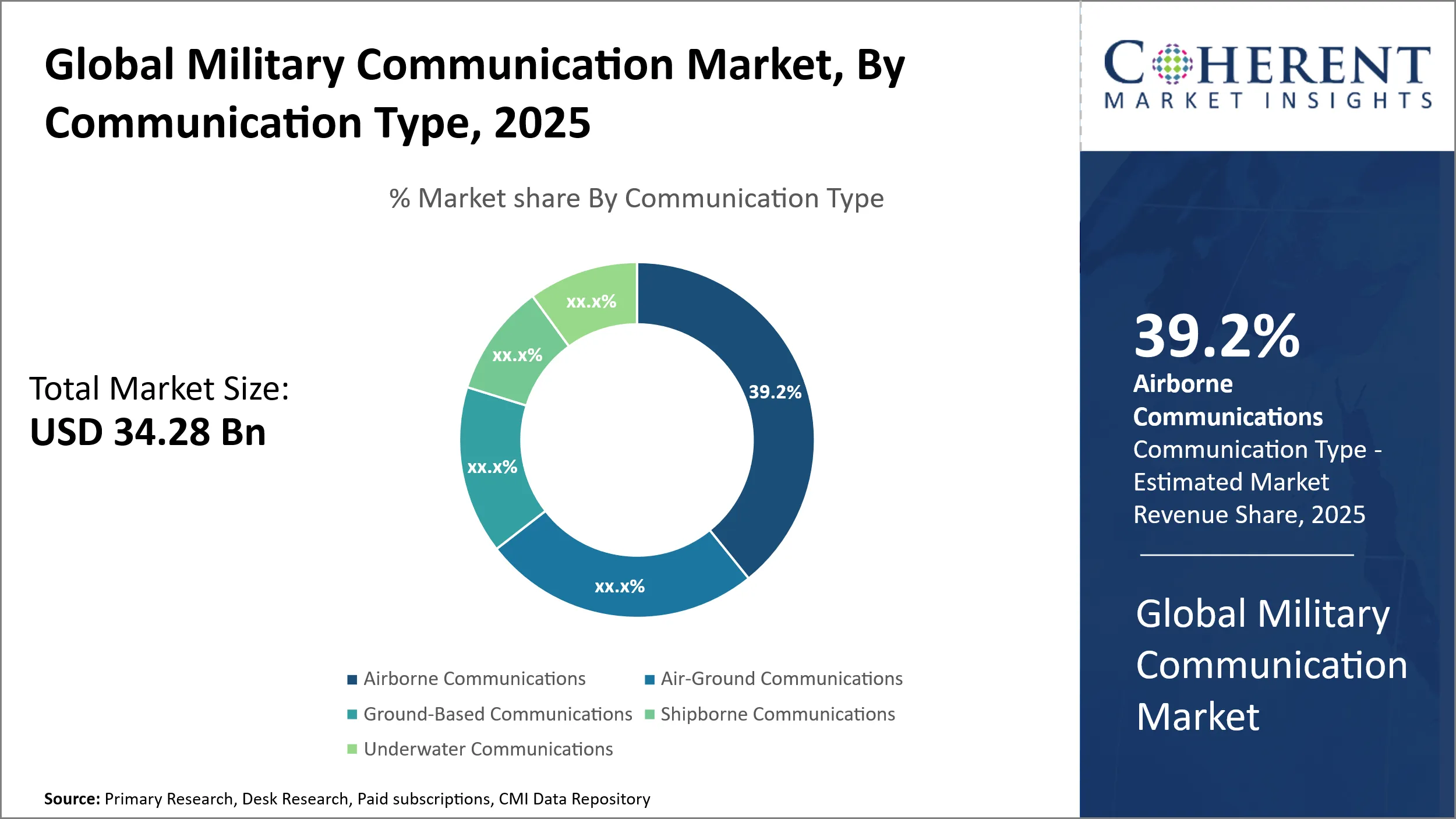
- The Airborne Communications segment leads the market holding an estimated share of 40.2% in 2026.
- The Military Satcom Systems segment is projected to lead the market with a share of 35.2% in 2026.
- North America is estimated to lead the market with a share of 48. 3% in 2026.
- Asia Pacific, holding a share of 20. 4% in 2026, is projected to be the fastest growing region.
Market Overview
The market is seeing a strong focus on integrating advanced technologies such as 5G, artificial intelligence, and cyber-secure communication networks to improve operational efficiency and situational awareness. There is also greater focus on satellite communication, tactical radios, and data encryption to support real-time battlefield communication. Also, the shift towards network-centric warfare and interoperability between allied forces is adding to innovation and adoption of next-generation communication solutions.
Current Events and their Impact
Current Events | Description and its impact |
Geopolitical and Trade Developments |
|
Economic and Infrastructure Trends |
|
Segmental Insights
- Current Industry Events of 2026
- Market Size Estimation
- Regional Breakdown
- Competitive Landscape
- Customer Intelligence
- Segmental Analysis
- Pricing Analysis
- Key Market Drivers, Challenges & Future Trends
- Customized Insights Section
Global Military Communication Market Insights, By Communication Type – Airborne Communications Lead Due to Enhanced Battlefield Connectivity and Increasing Emphasis on Aerial Surveillance
Airborne communications, holding a projected share of 40.2% in 2026, have emerged as a critical segment within the global military communication market. Modern military operations need instantaneous data transmission between air assets, ground forces, naval vessels, and command centers, creating demand for reliable and secure airborne communication systems.
The market is seeing rising integration of advanced technologies such as high-frequency radios, satellite links, and secure data encryption protocols tailored specifically for airborne use. Also, the expansion of modern warfare tactics emphasizing network-centric operations creates need for seamless airborne communications that can relay video feeds, radar information, and command instructions with minimal latency.
Another major driver is the increased deployment of drones and remotely piloted vehicles for intelligence, surveillance, and reconnaissance (ISR) purposes. The proliferation of unmanned aerial vehicles (UAVs) in various military applications—from border patrol to combat support—has consequently amplified the demand for advanced airborne communication technologies designed to overcome bandwidth limitations and extend operational ranges. For instance, as part of the Joint All-Domain Command and Control (JADC2) strategy, the U.S. Air Force has been deploying the Advanced Battle Management System (ABMS) to enhance airborne communications and real-time data integration across multiple military platforms.
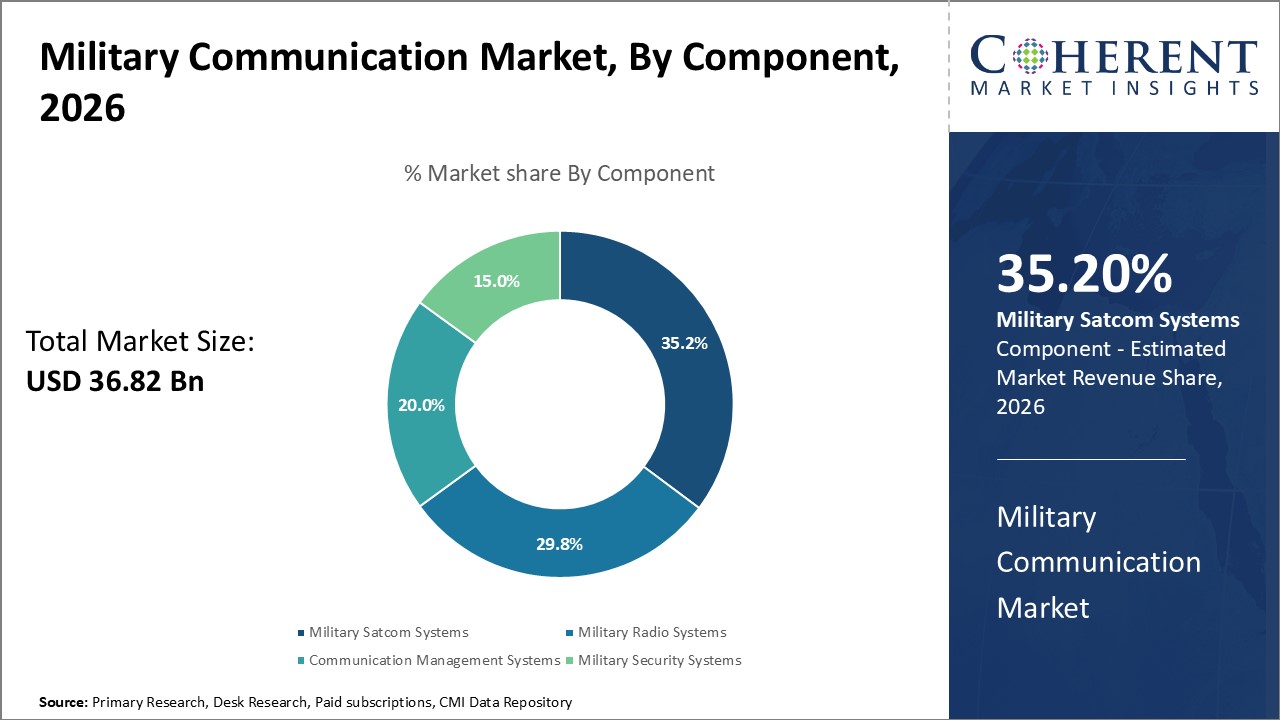
Global Military Communication Market Insights, By Component – Military Satcom Systems Dominate Due to their Pivotal Role in Secure, Long-Range, and Global Connectivity for Military Operations
Military Satcom systems, holding an estimated share of 35.2% in 2026, stand out as the dominating segment in the military communication market. Satcom enables armed forces to maintain continuous communication links over vast distances, including remote and harsh environments where traditional communication networks are inaccessible or vulnerable. Modern military missions often span multiple theaters and require interoperable communication channels that can transcend geographic limitations. Satellite networks facilitate beyond-line-of-sight (BLOS) communication, ensuring that command centers can remain in constant contact with deployed units regardless of their locations—be it land, sea, or air.
The growing sophistication of satellite technologies, such as high-throughput satellites (HTS), laser communication links, and low Earth orbit (LEO) satellite constellations, significantly enhance bandwidth, reduce latency, and improve resilience against electronic warfare threats. Security considerations further reinforce the dominance of Satcom systems.
Military Satcom platforms provide standardized communication frameworks, enabling seamless data exchange between diverse communication systems deployed by different nations. Governments prioritize enhancing their satellite communication assets to support these critical defense functions as part of broader military modernization efforts. The U.S. Space Force, in collaboration with the Space Development Agency (SDA) and defense contractors like Boeing, Lockheed Martin, and Northrop Grumman, is advancing the Protected Tactical Satcom (PTS) program to develop secure, anti-jam, and high-throughput satellite communication systems for military operations.
Impact of Artificial Intelligence (AI) on the Military Communication Market
Artificial Intelligence (AI) is significantly transforming military communication systems by enabling faster, more secure, and autonomous decision-making. AI-powered tools are increasingly being used for signal intelligence, real-time language translation, threat detection, and network optimization, allowing defense forces to analyze vast datasets quickly and respond with agility. In battlefield environments, AI enhances situational awareness by integrating sensor inputs, automating data processing, and assisting in command-and-control (C2) operations.
A notable real-world instance is the U.S. Department of Defense’s Joint All-Domain Command and Control (JADC2) program, which integrates AI-driven systems across land, air, sea, cyber, and space domains. In a 2023 test, the U.S. Air Force demonstrated the use of an AI algorithm that autonomously analyzed satellite and drone imagery, relayed target coordinates via secure tactical networks, and triggered autonomous drone action—all within seconds.
Regional Insights
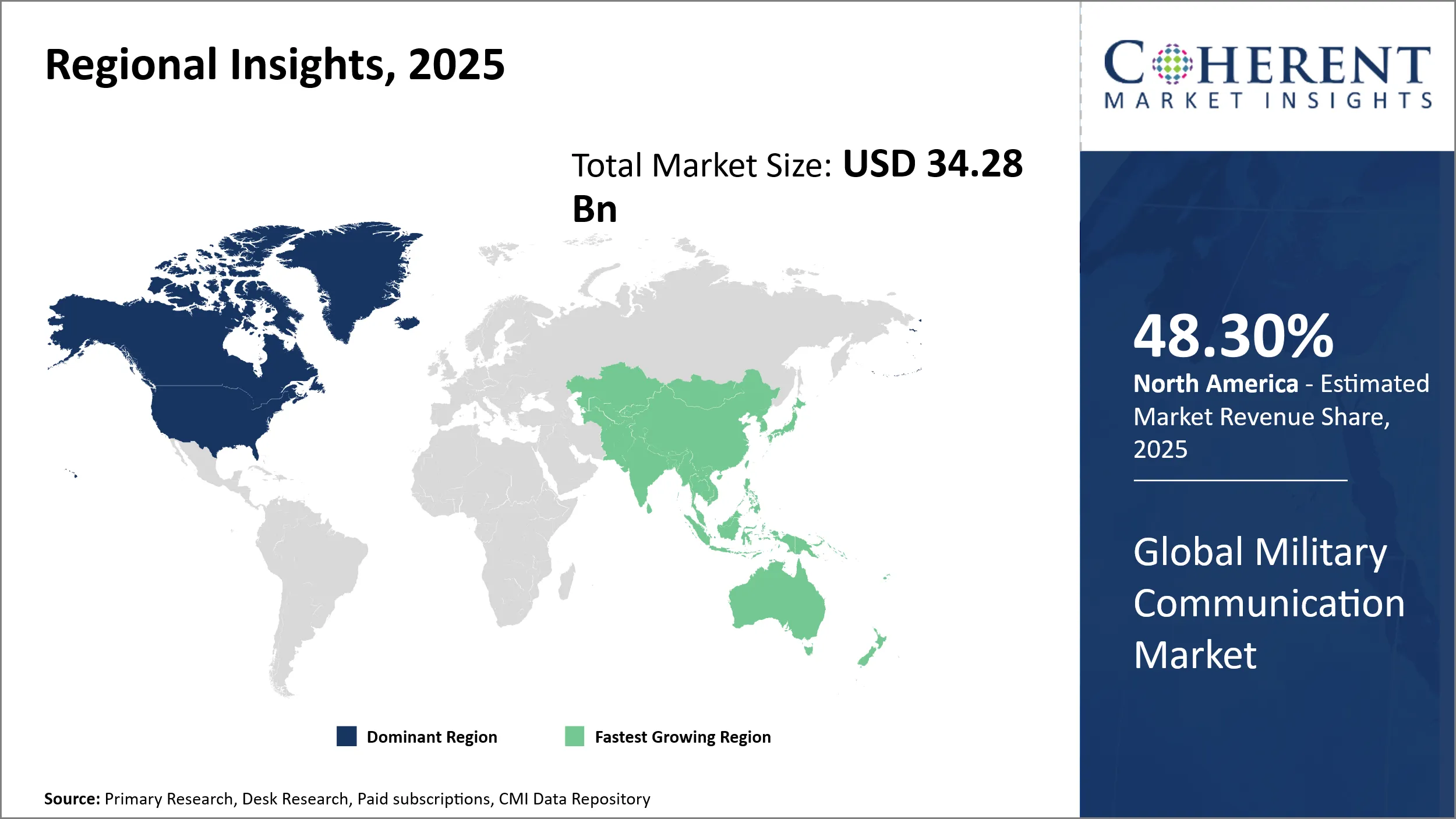
North America Military Communication Market Analysis and Trends
North America, holding an estimated share of 48.30% in 2026, dominates the global military communication market, attributed to the region’s advanced technological infrastructure, significant defense budgets, and well-established military-industrial complex. The U.S. and Canada have robust ecosystems that support innovation in secure communication systems, such as tactical radios, satellite communication, and cybersecurity solutions tailored for defense use. For instance, L3Harris’ AN/PRC-163 is a next-generation, multi-channel tactical radio that supports both line-of-sight (LOS) and beyond-line-of-sight (BLOS) communication, including satellite, mobile ad hoc networks (MANET), and Link 16 data sharing.
Government policies strongly emphasize modernization and digital transformation of military communications, encouraging public-private partnerships and R&D investments. Prominent defense contractors like Lockheed Martin, Northrop Grumman, and Raytheon Technologies actively contribute by developing cutting-edge communication platforms, enhancing interoperability, and ensuring secure data transmission.
Asia Pacific Military Communication Market Analysis and Trends
The Asia Pacific region, holding a projected share of 20.4% in 2026, exhibits the fastest growth driven by escalating defense spending in emerging economies and geopolitical tensions prompting modernization of military communication infrastructures. Countries such as India, Japan, South Korea, and Australia are increasing investments to upgrade their defense communication systems, focusing on network-centric warfare, satellite-based communications, and mobile data technologies. For instance, in February 2021, BEL, a key defense PSU in India, signed a contract to develop indigenous Software Defined Radios – Tactical (SDR-Tac) for the Indian Armed Forces.
The evolving regional security dynamics fuel demand for advanced solutions. Government initiatives promoting indigenization and collaborations with global defense firms accelerate market expansion. Notable companies like Bharat Electronics Limited (BEL) in India, Huawei in China, and NEC Corporation in Japan play pivotal roles in adapting communication technologies to regional defense needs, enhancing both tactical and strategic communication capabilities.
Global Military Communication Market Outlook for Key Countries
U.S. Military Communication Market Analysis and Trends
The U.S. remains the largest market due to sustained investments in military communication modernization, focusing on next-generation tactical radios, secure satellite communications, and cyber-resilient networks. Major companies such as Lockheed Martin and Raytheon Technologies lead the development of integrated communication systems that support joint operations and rapid data exchange. Government initiatives prioritize interoperability across forces, fostering advanced R&D in AI and software-defined radios that enhance battlefield communication effectiveness.
India Military Communication Market Analysis and Trends
India military communication market is growing rapidly, driven by the government’s push for ‘Make in India’ initiatives and upgrade requirements due to regional security challenges. Bharat Electronics Limited (BEL) and Tata Advanced Systems play key roles in developing indigenous communication solutions that include tactical radios, satellite communication networks, and encrypted communication devices.
China Military Communication Market Analysis and Trends
China continues to lead as a significant force in military communications, with a focus on expanding its strategic communication capabilities through satellite networks, cyber warfare tools, and advanced encrypted messaging systems. Companies like Huawei’s defense division and China Electronics Corporation contribute to the integration of 5G-based secure communication platforms, enhancing the People’s Liberation Army’s command and control systems.
Germany Military Communication Market Analysis and Trends
Germany is shaped by its advanced defense technology infrastructure and strong emphasis on NATO interoperability standards. Key players like Rheinmetall AG and Hensoldt contribute significantly through innovations in secure communication terminals, battlefield network solutions, and electronic warfare systems that integrate into NATO operations.
South Korea Military Communication Market Analysis and Trends
South Korea military communication market is expanding in response to regional security threats and the evolving nature of modern warfare. Companies such as LIG Nex1 and Hanwha Systems are prominent, delivering advanced tactical radio systems, integrated communication devices, and network-centric warfare solutions tailored to the Korean Peninsula’s unique defense requirements.
Market Players, Key Development, and Competitive Intelligence
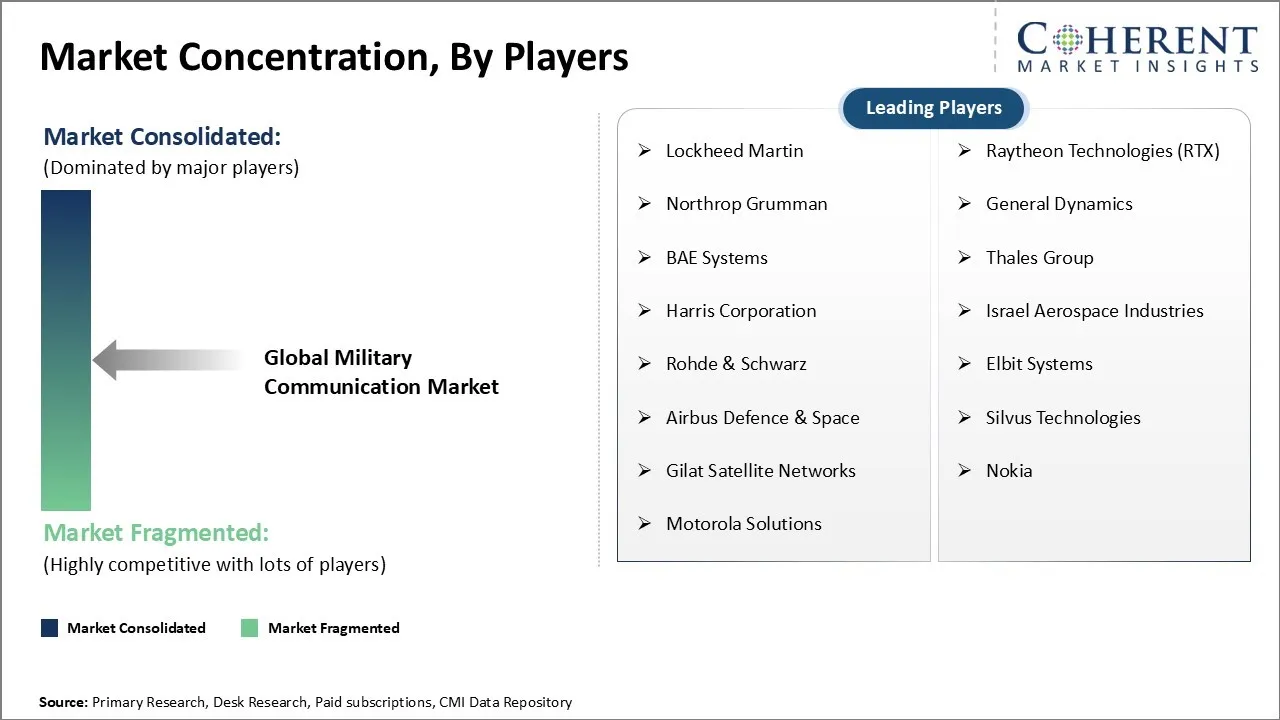
Key Developments
- In June 2025, the Swedish Armed Forces joined Telia and Ericsson’s NorthStar 5G innovation program. Through access to the latest 5G technology, the Armed Forces will be able to test new solutions with the potential to boost Sweden’s defense capabilities. The aim is to strengthen military communications, logistics and security, while supporting Sweden’s operational role and interoperability within the NATO alliance.
- In May 2025, Nokia and blackned GmbH, in which the Düsseldorf-based technology group Rheinmetall holds a 51% stake, entered into a memorandum of understanding to create advanced deployable tactical networks for the defense sector. The partnership brings together Nokia’s 5G technology and blackned’s expertise in defense digitalization to develop high-performance, next-generation tactical communications solutions that provide secure and reliable connectivity for military operations in the field.
- In May 2025, Motorola Solutions entered into a definitive agreement to acquire Silvus Technologies, Inc. for USD 4.4 billion in up-front consideration. Silvus designs and develops software-defined high-speed mobile ad-hoc network (MANET) technology that enables highly secure data, video and voice communications without the need for fixed infrastructure. Silvus’ wide range of customers spans autonomous systems manufacturers, military, law enforcement and enterprises around the world.
- In December 2024, the European Commission signed the concession contract for the Infrastructure for Resilience, Interconnectivity and Security by Satellite (IRIS²), a multi-orbital constellation of 290 satellite, with the SpaceRISE consortium. This partnership aims to develop, deploy, and operate the European Union's new system. IRIS² represents the European Union's third flagship programme, designed to address pressing long-term challenges in security, safety, and resilience.
Top Strategies Followed by Military Communication Market Players
- Established industry leaders typically pursue aggressive investment in research and development (R&D) to drive the innovation of high-performance and technologically advanced communication solutions.
- Lockheed Martin is heavily investing in the Joint All-Domain Operations (JADO) framework, contributing advanced AI-enabled communication tools that integrate air, land, sea, space, and cyber domains.
- Mid-level competitors in the military communication market navigate the competitive space by focusing on offering cost-effective solutions that balance quality with affordability.
- Israel’s Elbit Systems has focused on cost-effective tactical communication suites like E-LynX radios, which are scalable for use by small units or entire battalions.
- Small-scale players carve out niche segments by focusing on specialized features or inventive products aimed at fulfilling unique communication requirements.
- Silvus Technologies (U.S.), prior to being acquired by Motorola Solutions in 2025, carved out a niche in MANET radios used by Special Forces and drones.
Market Report Scope
Military Communication Market Report Coverage
| Report Coverage | Details | ||
|---|---|---|---|
| Base Year: | 2025 | Market Size in 2026: | USD 36.82 Bn |
| Historical Data for: | 2020 To 2024 | Forecast Period: | 2026 To 2033 |
| Forecast Period 2026 to 2033 CAGR: | 7.4% | 2033 Value Projection: | USD 60.68 Bn |
| Geographies covered: |
| ||
| Segments covered: |
| ||
| Companies covered: | Lockheed Martin, Raytheon Technologies (RTX), Northrop Grumman, General Dynamics, BAE Systems, Thales Group, Harris Corporation, Israel Aerospace Industries, Rohde & Schwarz, Elbit Systems, Airbus Defence & Space, Silvus Technologies, Gilat Satellite Networks, Nokia, and Motorola Solutions | ||
| Growth Drivers: |
| ||
| Restraints & Challenges: |
| ||
Market Dynamics
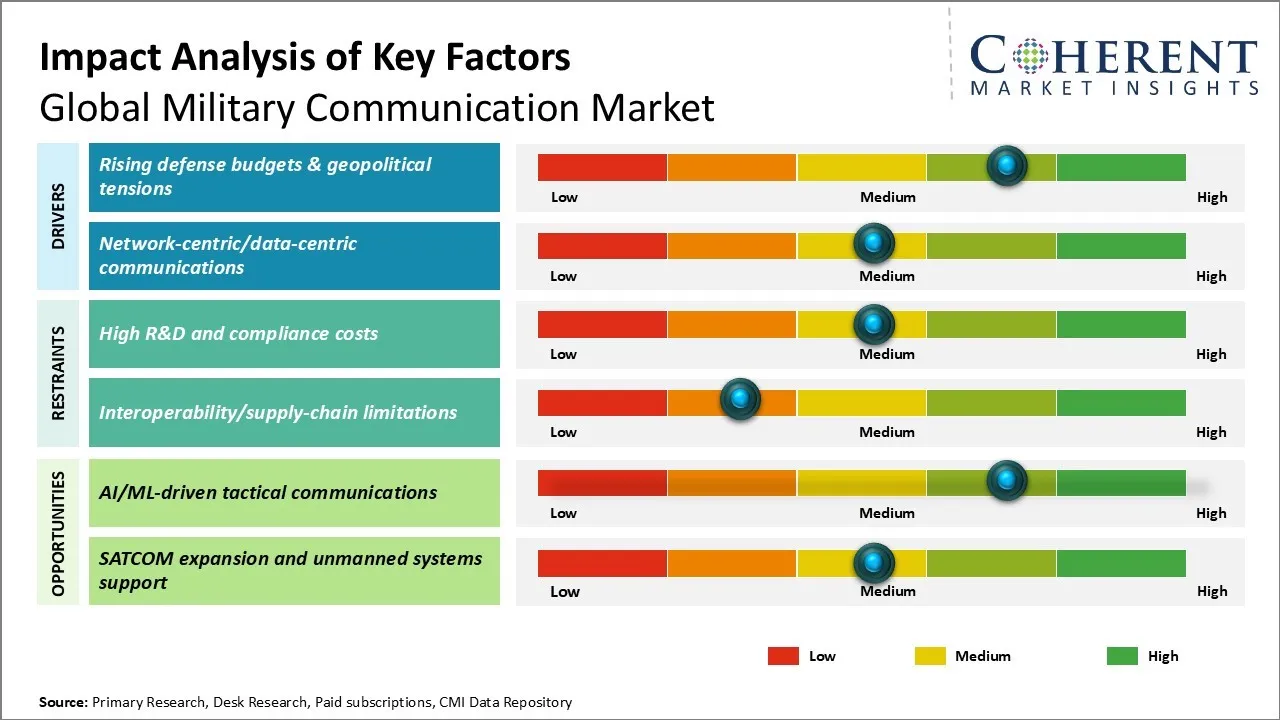
Global Military Communication Market Driver – Rising Defense Budgets & Geopolitical Tensions
Governments are channeling more resources into modernizing their military infrastructure, with a strong focus on acquiring advanced communication technologies that ensure secure, reliable, and real-time information exchange on the battlefield. In 2024, Japan approved a record defense budget of USD 55 billion (¥7.95 trillion)—marking a nearly 16% increase year-on-year—to modernize its military amid escalating tensions in the East China Sea and Taiwan Strait. This trend is closely linked to escalating geopolitical tensions worldwide, where nations are striving to strengthen their defense capabilities amid regional conflicts, border disputes, and global security challenges.
Military communication systems are critical for enhancing situational awareness, command and control functions, and interoperability among allied forces, which are all crucial in complex and dynamic threat environments. As a result, defense agencies are prioritizing investments in next-generation communication solutions, such as encrypted radios, satellite communications, and network-centric warfare technologies, which support rapid decision-making and coordinated operations.
Global Military Communication Market Opportunity – AI/ML-Driven Tactical Communications
Modern military operations demand rapid, reliable, and secure information exchange in dynamic and often hostile environments, and AI/ML-driven communication solutions greatly enhance situational awareness and decision-making capabilities. These technologies enable real-time data analysis, predictive threat detection, and adaptive network management, which optimize bandwidth allocation and reduce communication latency. Additionally, AI-powered encryption and cybersecurity mechanisms can proactively identify and mitigate cyber threats, ensuring the integrity and confidentiality of sensitive communications. The growing adoption of unmanned systems and autonomous vehicles further fuels the need for intelligent communication networks capable of seamless coordination and interoperability across diverse platforms.
Governments worldwide are increasingly investing in AI/ML-enabled defense technologies as part of their digital modernization strategies, driving demand for advanced military communication equipment embedded with these smart capabilities. In 2023, the U.S. Department of Defense field-tested Project Convergence, led by the U.S. Army Futures Command, where AI/ML algorithms were used to autonomously analyze battlefield data from sensors, drones, and satellites. Moreover, AI/ML algorithms facilitate improved voice and data signal processing, enhancing communication clarity and reliability even in electronically contested or jammed environments.
Analyst Opinion (Expert Opinion)
- As advanced technologies like AI, quantum encryption, and autonomous systems become embedded in military communication platforms, regulatory bodies such as ITAR (U.S.) and Wassenaar Arrangement are tightening oversight. This is leading to longer approval cycles for cross-border tech collaborations and system exports, especially between Western countries and emerging defense markets.
- While AI/ML is revolutionizing tactical communications through real-time battlefield data processing and autonomous decision-making, most defense regulatory policies globally lag behind in defining ethical boundaries, fail-safes, and accountability. The absence of standardized testing and validation protocols creates uncertainty in multi-nation deployments or joint operations.
- With the growing deployment of software-defined radios (SDRs), 5G-based tactical networks, and mesh networking, national regulators are now actively shaping spectrum allocation policies, data encryption norms, and resilience standards. This regulatory momentum is encouraging players to embed compliance-by-design in product development, especially for government or NATO procurement programs.
Speak to the analyst
Want personalized insights?
Take the findings above to one of our principal consultants, or have the report rebuilt around the segments, geographies and competitors you actually track.
Market Segmentation
- Communication Type Insights (Revenue, USD Bn, 2021 - 2033)
- Airborne Communications
- Air‑Ground Communications
- Ground‑Based Communications
- Shipborne Communications
- Underwater Communications
- Component Insights (Revenue, USD Bn, 2021 - 2033)
- Military Satcom Systems
- Military Radio Systems
- Communication Management Systems
- Military Security Systems
- Regional Insights (Revenue, USD Bn, 2021 - 2033)
- North America
- U.S.
- Canada
- Latin America
- Brazil
- Argentina
- Mexico
- Rest of Latin America
- Europe
- Germany
- U.K.
- Spain
- France
- Italy
- Russia
- Rest of Europe
- Asia Pacific
- China
- India
- Japan
- Australia
- South Korea
- ASEAN
- Rest of Asia Pacific
- Middle East
- GCC Countries
- Israel
- Rest of Middle East
- Africa
- South Africa
- North Africa
- Central Africa
- North America
- Key Players Insights
- Lockheed Martin
- Raytheon Technologies (RTX)
- Northrop Grumman
- General Dynamics
- BAE Systems
- Thales Group
- Harris Corporation
- Israel Aerospace Industries
- Rohde & Schwarz
- Elbit Systems
- Airbus Defence & Space
- Silvus Technologies
- Gilat Satellite Networks
- Nokia
- Motorola Solutions
Sources
Primary Research Interviews
Stakeholders
- Defense Forces Personnel
- Military Communication Equipment Manufacturers
- System Integrators and Tactical Network Engineers
- Defense Technology Procurement Officials and MoD Representatives
- Satellite Communication Providers and Network Infrastructure Firms
- Cybersecurity Experts specializing in Defense Communications
- Research Institutions and Military Academies (e.g., DRDO, NDU, RAND-affiliated researchers)
Databases
- Eurostat
- U.S. Census
- Defense Procurement Database (U.S. and EU)
- OECD
- Global Defense Expenditure Tracker
Magazines
- Defense Electronics Magazine
- Military Communications Journal
- Defense Technology International (DTI)
- Tactical Networks & ISR Monthly
- Secure Battlefield Systems Review
Journals
- Journal of Defense Modeling and Simulation
- Journal of Military and Strategic Communication
- IEEE Transactions on Aerospace and Electronic Systems
- Defence Studies Journal
- Journal of Network and Computer Applications (Special Issues on Military Networks)
Newspapers
- Defense News
- Janes Defence Weekly
- The Diplomat
- The Economic Times (India)
- The Guardian (UK)
Associations
- Armed Forces Communications and Electronics Association (AFCEA)
- Global Military Communications Association
- International Association of Defence ICT Professionals (IADICTP)
- European Defence Agency (EDA)
- Defense Information Systems Agency (DISA)
Public Domain Sources
- U.S. Census Bureau
- EUROSTAT
- United Nations Office for Disarmament Affairs (UNODA)
- World Bank
- ResearchGate
Proprietary Elements
- CMI Data Analytics Tool, Proprietary CMI Existing Repository of information for last 8 years
Get access to 250+ pages report
Every segment, forecast, competitor profile and data table behind the analysis above — available for instant download.
- ESOMAR Member
- ISO 9001:2015 Certified
- D-U-N-S Registered
- GDPR & CCPA Compliant
Missing comfort of reading report in your local language? Find your preferred language:
Transform your Strategy with Exclusive Trending Reports
Frequently Asked Questions
The global military communication market is estimated to be valued at USD 36.82 Bn in 2026 and is expected to reach USD 60.68 Bn by 2033.
The CAGR of global military communication market is projected to be 7.4% from 2026 to 2033.
Rising defense budgets & geopolitical tensions and network‑centric/data‑centric communications are the major factors driving the growth of the global military communication market.
High R&D and compliance costs and interoperability/supply‑chain limitations are the major factors hampering the growth of the global military communication market.
In terms of Communication Type, Airborne Communications segment is estimated to dominate the market revenue share 2026.
Lockheed Martin, Raytheon Technologies (RTX), Northrop Grumman, General Dynamics, BAE Systems, Thales Group, Harris Corporation, Israel Aerospace Industries, Rohde & Schwarz, Elbit Systems, Airbus Defence & Space, Silvus Technologies, Gilat Satellite Networks, Nokia, and Motorola Solutions are the major players.
North America is expected to lead the global military communication market in 2026.