

Global Milking Machine Market Size and Forecast – 2026- 2033
The global milking machine market is estimated to be valued at USD 5.71 Bn in 2026 and is expected to reach USD 8.82 Bn by 2033, exhibiting a compound annual growth rate (CAGR) of 6.4% from 2026 to 2033.
Key Takeaways of the Milking Machine Market
- The fully-automatic milking machines segment is projected to account for 62.6% share in 2026.
- The portable segment is expected to capture 68.9% share in 2026.
- The cow segment is projected to command a 36.6% share in 2026.
- Asia Pacific is projected to lead the global milking machine market in 2026 with a 41.5% share. Europe, with an estimated share of 22.5% in 2026, is the fastest-growing region.
Market Overview
A prominent market trend is the integration of automation and IoT-enabled smart systems within milking machines and coffee machine, allowing for real-time monitoring and improved herd management as well as enhanced brewing efficiency. Additionally, growing emphasis on animal welfare, labor cost reduction, sustainable dairy farming practices, and the rising demand for coffee are accelerating the shift towards automated milking and coffee solutions. These innovations are expected to play a crucial role in shaping market dynamics and driving continued growth in the coming years.
Currents Events and their Impact
Current Events | Description and its Impact |
Expansion of AI-powered Precision Dairy Farming |
|
Policy and Funding Changes in Key Markets |
|
Segmental Insights
- Current Industry Events of 2026
- Market Size Estimation
- Regional Breakdown
- Competitive Landscape
- Customer Intelligence
- Segmental Analysis
- Pricing Analysis
- Key Market Drivers, Challenges & Future Trends
- Customized Insights Section
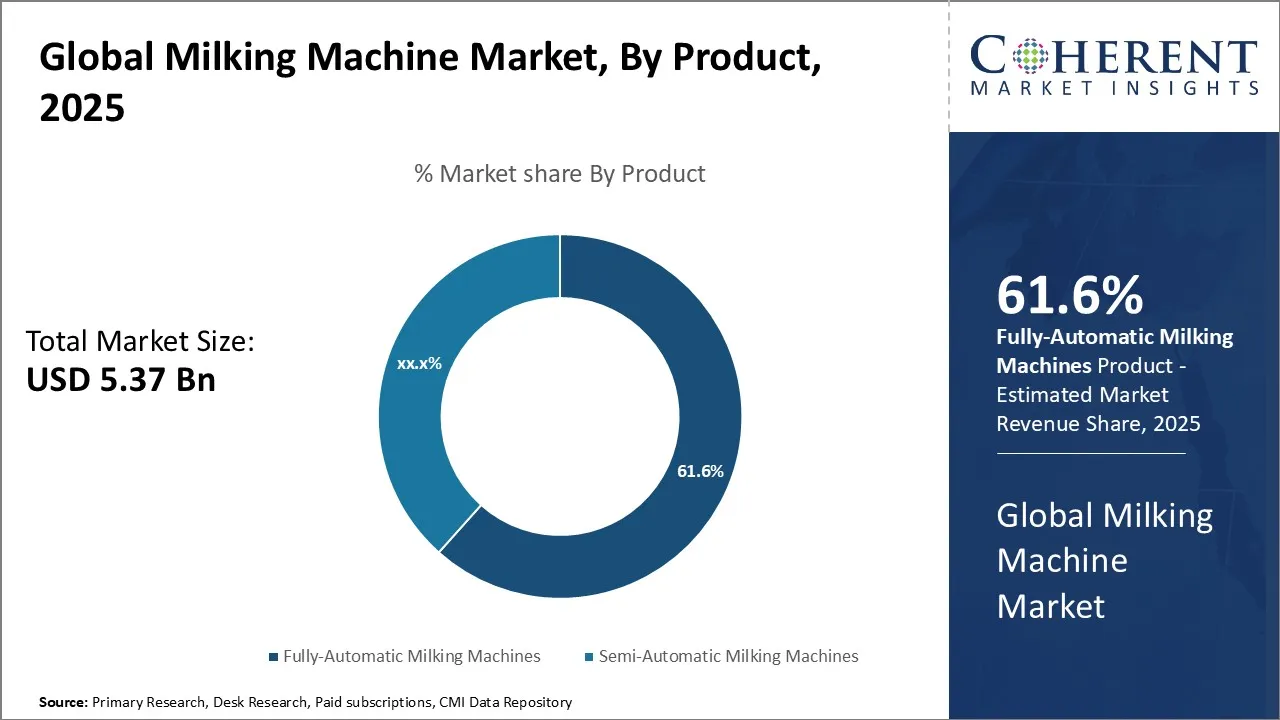
Milking Machine Market Insights, By Product - Fully-Automatic Milking Machines Segment Dominates the Market Due to Leading Automation in Milking
The fully-automatic milking machines segment is expected to capture 62.6% share in 2026, due to their ability to revolutionize dairy farming operations with high efficiency and labor savings. These machines offer seamless integration of advanced robotics and sensor technologies that allow for precise milking with minimal human intervention. This automation improves not only the speed and consistency of milking but also animal welfare by reducing physical stress on livestock.
For instance, large-scale dairy farms in Europe, such as those in the Netherlands, have widely adopted fully-automatic milking systems like DeLaval’s Voluntary Milking System (VMS), enabling farmers to milk over 60 cows per unit per day with improved productivity, real-time health monitoring, and reduced labor dependence.
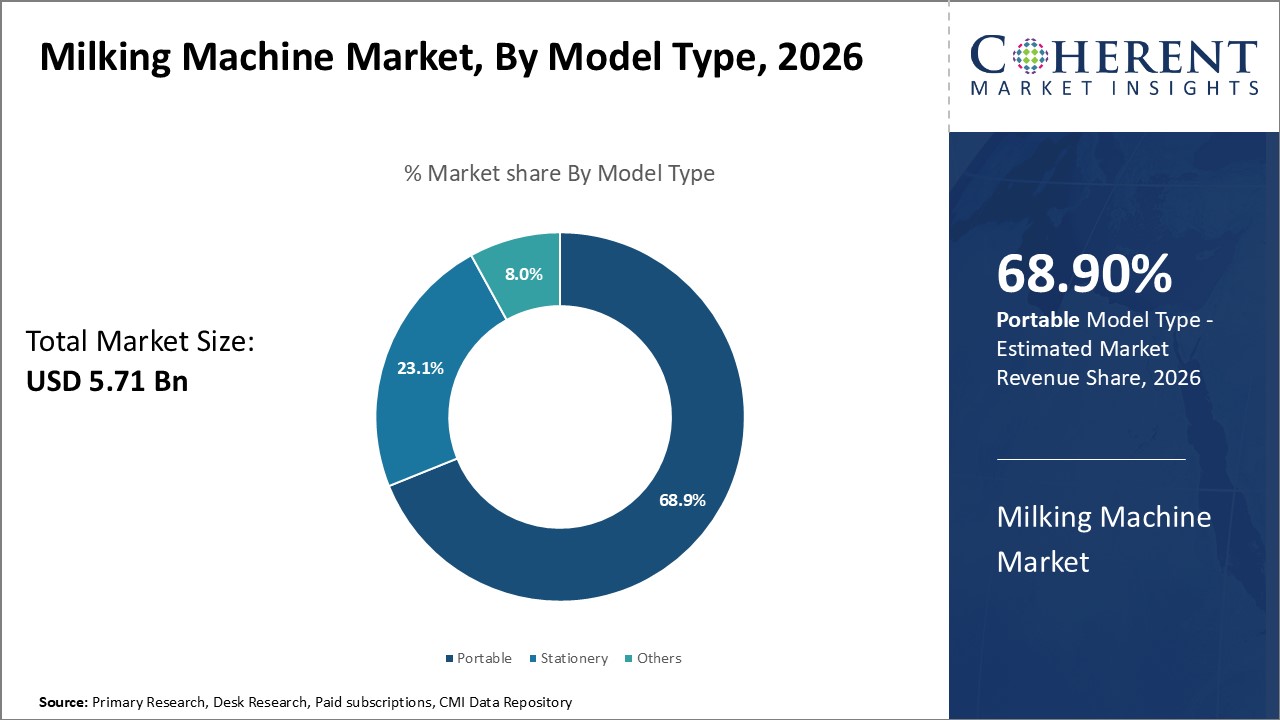
Milking Machine Market Insights, By Model Type - Portable Segment Dominates the Market due to the Prime Choice for Flexibility and Convenience
The portable segment is projected to account for 68.9% share in 2026, due to their flexibility and adaptability across different farming conditions and environments. Portable milking units offer a significant advantage by allowing dairy farmers to easily move the equipment between animal enclosures or locations, making them suitable for small to medium-sized farms, mobile herds, and regions with limited infrastructure.
One of the primary factors driving the growth of portable milking machines is their convenience. Farmers can efficiently carry out the milking process in various settings without the need for permanent installation, which also reduces initial capital expenditure and maintenance complexities. This mobility is especially important for regions where livestock grazing occurs over dispersed pastures, making portable systems a practical choice that aligns with traditional herding practices and seasonal movement of animals.
Milking Machine Market Insights, By Livestock - Cow Segment Dominates the Market due to Catering to the Backbone of Dairy Farming
The cow segment is projected to hold 36.6% share in 2026, reflecting the prominence of cow milk in the global dairy industry. The demand for cow milking machines is sustained by the widespread prevalence of cattle farming as the primary source of milk worldwide. The economic importance of dairy cows in both developed and developing countries drives innovation and investment in customized milking solutions that cater to this livestock segment.
Several factors contribute to the dominant position of cow milking systems in the market. The breed diversity and the relatively uniform anatomical characteristics of cows allow manufacturers to design more standardized yet highly efficient milking equipment, highly focused on maximizing yield and ensuring animal comfort. Milking machines tailored for cows incorporate features such as adjustable teat cups, controlled vacuum pressure, and pulsation systems that mimic natural suckling to reduce the risk of udder injury and infections like mastitis.
Macro and Micro Economic Factors Impacting on Milking Machine Market Growth
Macroeconomic Factors
- Global Dairy Demand and Population Growth: Rising global population and increasing demand for dairy products are driving the need for milking machines to increase milk production efficiency and meet market demand.
- Technological Advancements: The adoption of robotics, automation, AI, IoT, and data analytics in dairy farming are major growth drivers. These technologies improve productivity, reduce labor costs, and enhance animal welfare.
- Economic Conditions and Investment Capacity: Developed regions like North America and Europe with favorable economic conditions and high technological adoption rates experience faster market growth. Emerging economies in Asia-Pacific also show strong growth due to modernization in agriculture and rising dairy production.
- Labor Costs and Shortages: Rising labor costs and shortages in dairy farming labor are pushing farms to adopt automated milking solutions to reduce dependency on human labor.
- Government Policies and Incentives: Government support through agricultural development programs, subsidies, and regulations promoting animal welfare and sustainable farming practices are positively affecting market growth.
Microeconomic Factors
- Farm Size and Structure: Large-scale (macro) dairy farms dominate the market for milking machines due to their capacity to invest in advanced and fully automated equipment that meets high volume demands. Smaller farms are increasingly adopting scaled-down robotic solutions due to improved affordability.
- Initial Capital Cost: The high upfront cost of fully automated systems can be a barrier, especially for small and micro dairy farms in developing regions, affecting adoption rates and market penetration.
- Technological Complexity and Maintenance: The need for trained personnel to operate, maintain, and repair sophisticated milking machinery can limit adoption in regions where technical support is insufficient.
- Focus on Animal Welfare: Increasing emphasis on animal comfort and sustainable practices drives demand for modern milking machines that reduce stress on livestock and promote hygienic milking processes.
Regional Insights
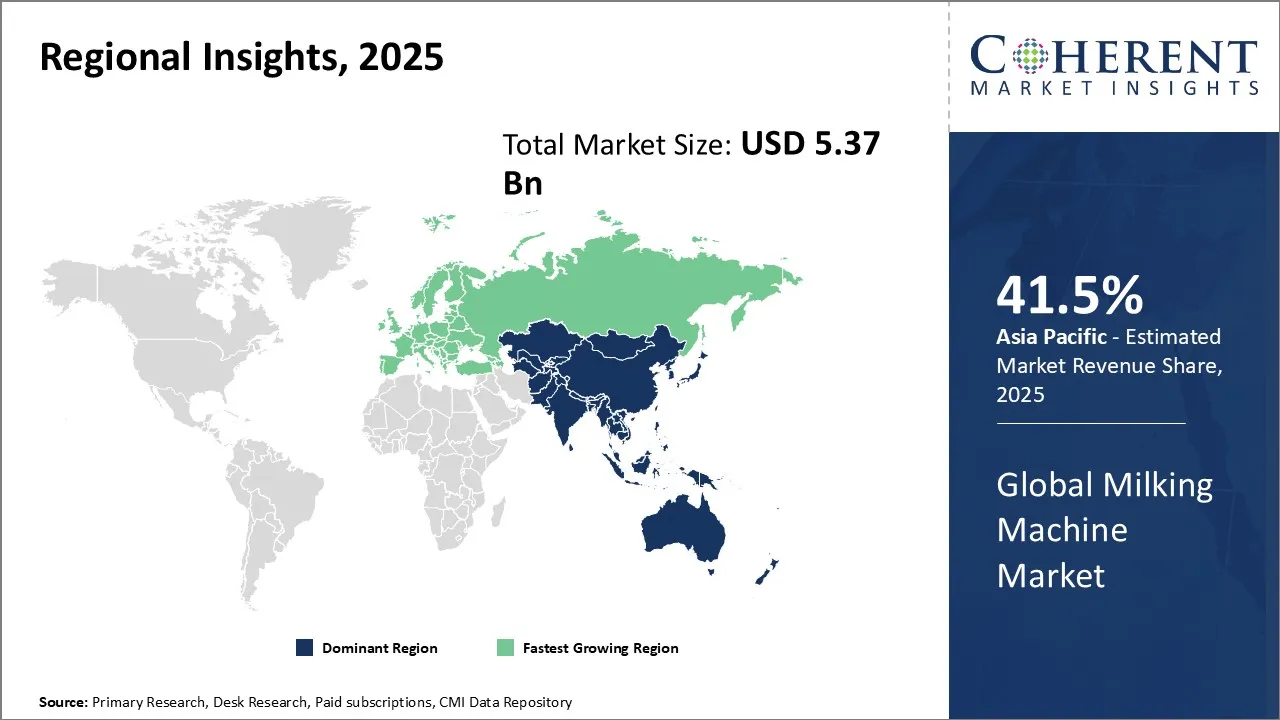
Asia Pacific Milking Machine Market Analysis and Trends
The Asia Pacific region is projected to lead the market with a 41.5% share in 2026, propelled by the growing dairy consumption, rising farm mechanization, and government initiatives to modernize agriculture. Nations in this region, particularly India, China, and Australia, are experiencing increasing investment in dairy infrastructure supported by supportive trade policies and rural development programs.
The market gains momentum due to the relatively low mechanization base compared to Europe, offering abundant growth opportunities. Companies such as BouMatic, Lely (Netherlands), and local manufacturers are tailoring products to meet the unique needs of small to medium-sized farms prevalent in this region, fostering rapid adoption of milking machines.
Europe Milking Machine Market Analysis and Trends
The Europe region is expected to exhibit the fastest growth in the market contributing 22.5% share in 2026, driven by a well-established dairy industry, advanced agricultural technology adoption, and stringent government regulations promoting dairy efficiency and animal welfare. Countries such as Germany, the Netherlands, and France have a deeply integrated market ecosystem that supports high investment in mechanized milking solutions, focusing on automation and sustainability.
European policies emphasize precision farming, subsidies for technological upgrades, and support for environmental standards, fostering innovation and broad adoption of advanced milking machines. Major companies like GEA Group (Germany), DeLaval (Sweden), and SAC (France) play significant roles by offering cutting-edge systems that prioritize milk quality, animal comfort, and operational efficiency, further strengthening Europe's leadership in this market.
Global Milking Machine Market Outlook for Key Countries
Germany Milking Machine Market Analysis and Trends
The German milking machine market benefits from strong agricultural innovation, government incentives for dairy modernization, and the presence of key industry players like GEA Group and Ruland. The focus on automated, high-efficiency systems aligns with the country's dairy-centric farming culture. Germany’s robust export orientation also allows manufacturers to influence global market trends, making it a critical hub for product development and technological refinement.
India Milking Machine Market Analysis and Trends
India milking machine market is expanding due to government initiatives such as subsidies for agricultural equipment, increasing dairy farming modernization, and a growing the demand for milk products. Local companies, alongside international brands like BouMatic and Lely, are collaborating to design cost-effective, scalable milking solutions suited to diverse farm sizes. The presence of a vast rural population also fuels the demand, positioning India as a vital growth market in the Asia Pacific.
U.S. Milking Machine Market Analysis and Trends
The U.S. maintains its position as a leader with widespread adoption of advanced milking technologies, supported by agricultural innovation and substantial investment from companies such as DeLaval and BouMatic. Strong veterinary and farming infrastructure encourages integration of automated and robotic milking systems, emphasizing efficiency and animal health. The U.S. milking machine market also drives trends in data-driven milking analytics and sustainable farming practices.
China Milking Machine Market Analysis and Trends
China milking machine market landscape is rapidly evolving thanks to government policies that encourage modernization of the dairy sector and food safety standards. The growing middle-class fuels increased milk consumption, and technological transfer from both domestic and multinational companies like Lely and DeLaval is accelerating mechanization. Challenges remain regarding farm size variability, but focus on automation is intensifying to improve productivity.
Australia Milking Machine Market Analysis and Trends
Australia offers a dynamic market primarily composed of highly mechanized dairy farms concentrated in regions such as Victoria and New South Wales. Government support for sustainable farming practices and an established supply chain infrastructure bolster the demand for innovative milking solutions. Leading manufacturers such as Tasmanian Micron Group and international players provide tailored technologies designed for extensive farming environments common in this region, highlighting the country’s role in advancing milking machine technology.
Market Players, Key Development, and Competitive Intelligence
Key Developments
- In April 2025, GEA Group unveiled the DairyRotor T8600, a new generation of energy-efficient rotary milking parlors designed to lower operational costs while improving cow comfort. This modular system combines advanced digital technologies with an ergonomic and adaptable design, making it well-suited for medium to large dairy herds.
- In February 2025, DeLaval launched the DeLaval Plus Performance Portal, an AI-driven system integrated into its robotic milking platform. Leveraging DeLaval BioSensor ear tags, the system tracks individual cow behaviour and processes the data using its proprietary AI engine, DeLaval DeepBlue, to deliver advanced behavioral insights and performance analysis.
Top Strategies Followed by Global Milking Machine Market Players
- Established players, often industry veterans with substantial resources, invest heavily in research and development (R&D) to innovate high-performance and technologically advanced milking machines. Their focus lies in enhancing efficiency, animal welfare, and automation, catering to the evolving demands of large-scale dairy farms worldwide. These collaborations not only enhance product offerings but also solidify their market presence globally.
- For example, in 2024, GEA Group launched its “DairyRobot R9500” next-generation automatic milking system, which integrates advanced sensor technology and smart data management to improve udder health monitoring, maximize milk yield per cow, and reduce manual intervention — a clear reflection of the R&D-driven innovation strategy of top players.
- Mid-level players in the milking machine market adopt a somewhat different approach by focusing primarily on cost-effective solutions that strike a balance between quality and affordability. Recognizing the significant price sensitivity among small to medium-sized dairy farms, these players design products that meet fundamental operational needs without compromising reliability. By emphasizing value-for-money, they attract a broad customer base in both developed and developing regions.
- For example, Fullwood Packo emphasizes mid-range robotic and semi-automatic parlors that provide automation benefits without the premium cost of top-tier robotic systems.
- Small-scale players distinguish themselves in the global milking machine market by specializing in niche segments, often focusing on innovative and tailored product offerings. These companies embrace cutting-edge technologies such as IoT-enabled systems, mobile milking units, or eco-friendly components to stay competitive against larger rivals. By developing unique features or customized solutions, they cater to specific regional needs or small dairy operations that demand flexibility and innovation.
- For example, Milkline develops portable and mobile milking systems, which are particularly useful for small-scale farms and remote regions where infrastructure for fixed parlors is limited.
Market Report Scope
Milking Machine Market Report Coverage
| Report Coverage | Details | ||
|---|---|---|---|
| Base Year: | 2025 | Market Size in 2026: | USD 5.71 Bn |
| Historical Data for: | 2020 To 2024 | Forecast Period: | 2026 To 2033 |
| Forecast Period 2026 to 2033 CAGR: | 6.4% | 2033 Value Projection: | USD 8.82 Bn |
| Geographies covered: |
| ||
| Segments covered: |
| ||
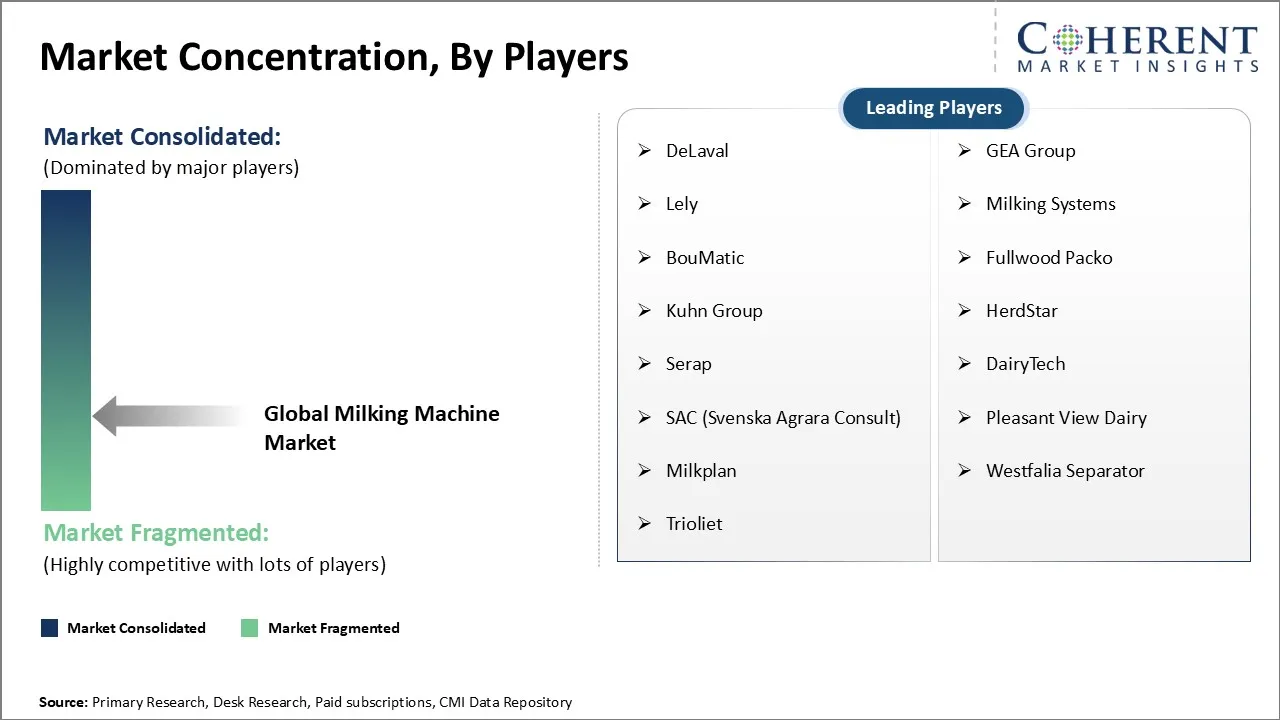
| Companies covered: | DeLaval, GEA Group, Lely, Milking Systems, BouMatic, Fullwood Packo, Kuhn Group, HerdStar, Serap, DairyTech, SAC (Svenska Agrara Consult), Pleasant View Dairy, Milkplan, Westfalia Separator, and Trioliet | ||
| Growth Drivers: |
| ||
| Restraints & Challenges: |
| ||
Milking Machine Market Dynamics
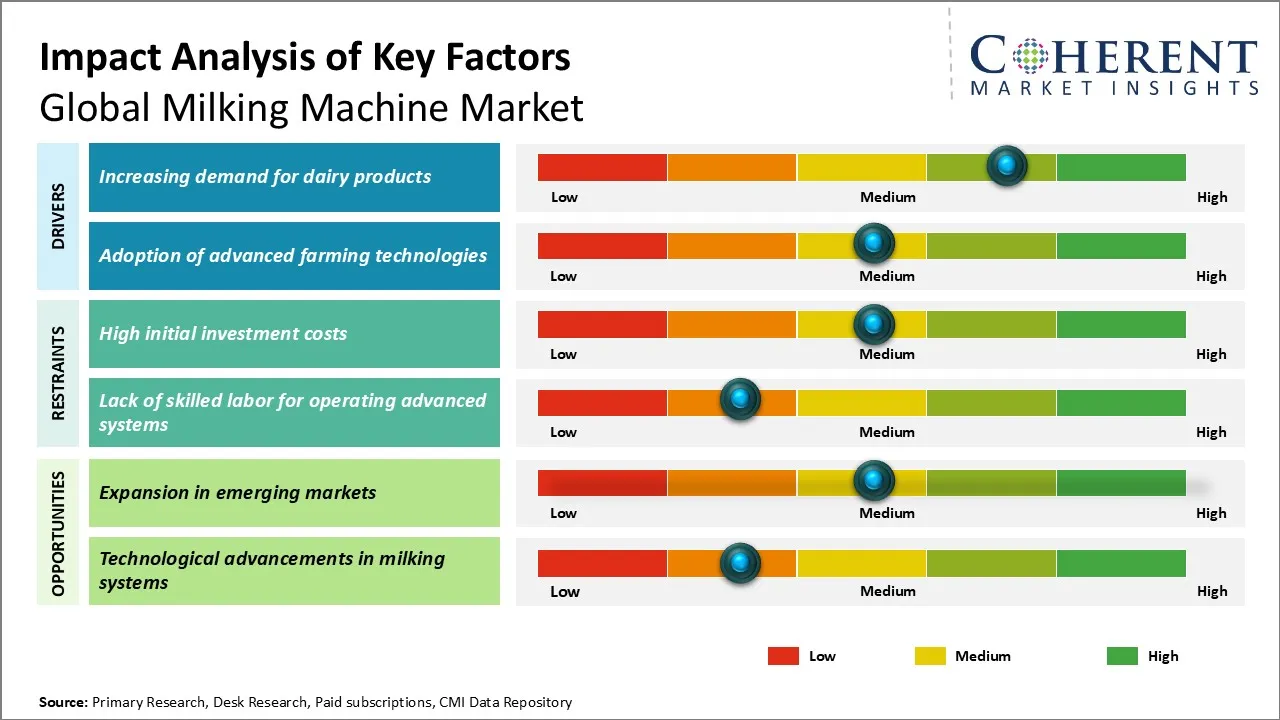
Milking Machine Market Driver - Increasing Demand for Dairy Products
The rising global demand for dairy products is a significant driver for the expansion of the milking machine market, as consumers increasingly prioritize milk and its derivatives for their nutritional value and convenience. This surge in consumption is fueled by growing populations, rising incomes, and shifting dietary preferences toward protein-rich foods, especially in developing regions. As traditional manual milking methods struggle to meet the escalating production needs, dairy farmers are turning to automated and semi-automated milking machines to enhance efficiency, productivity, and hygiene standards.
In February 2023, the International Dairy Foods Association (IDFA)—a major U.S.-based dairy trade organization—reported that U.S. dairy exports soared to a record high of USD 9.51 Bn in 2022, up significantly from the previous record of USD 7.61 Bn in 2021. This substantial rise in export-driven demand underscores the growing need for efficient milking technologies to support higher production volumes and global distribution.
Milking Machine Market Opportunity - Expansion in Emerging Markets
The global milking machine market presents a significant growth opportunity through expansion in emerging markets, driven by increasing dairy consumption, rising disposable incomes, and the growing adoption of mechanized dairy farming techniques. Countries in Asia Pacific, Latin America, and Africa are witnessing rapid urbanization and a shift towards modern agricultural practices, which are fueling the demand for efficient and hygienic milking solutions. For instance, nations such as India, China, Brazil, and Kenya have large cattle populations with predominantly manual milking processes, creating a substantial untapped market for automated milking machines.
In India, the National Dairy Development Board (NDDB) reported that the country produced 230 million tons of milk in FY2022–23, making it the world’s largest milk producer. However, more than 70% of Indian dairy farms still rely on manual milking methods, highlighting a major gap between production scale and mechanization.
Analyst Opinion (Expert Opinion)
- The global milking machine market is poised for significant growth, driven by advancements in dairy farming technology and increasing the demand for efficient milk production. Insights from the International Dairy Expo (2023) and the Global AgriTech Conference (2022) highlighted key innovations, with companies like DeLaval and Lely leading the charge in developing automated and robotic milking systems.
- DeLaval’s recent launch of its advanced robotic milking system, which incorporates AI for optimizing cow health and milk yield, exemplifies the industry's trend towards automation and data-driven solutions. Discussions at these events emphasized the importance of sustainability and animal welfare, reflecting growing consumer expectations for responsibly sourced dairy products. However, challenges such as the high initial investment costs and the need for skilled operators were noted as potential barriers to adoption.
- Companies that prioritize R&D to enhance system efficiency and reduce operational costs will likely gain a competitive advantage. Additionally, forming partnerships with dairy cooperatives can facilitate market penetration. Ultimately, the milking machine market's future will depend on its ability to innovate while addressing the evolving needs of dairy producers and consumers alike.
Speak to the analyst
Want personalized insights?
Take the findings above to one of our principal consultants, or have the report rebuilt around the segments, geographies and competitors you actually track.
Market Segmentation
- Product Insights (Revenue, USD Bn, 2021 - 2033)
- Fully-Automatic Milking Machines
- Semi-Automatic Milking Machines
- Model Type Insights (Revenue, USD Bn, 2021 - 2033)
- Portable
- Stationery
- Others
- Livestock Insights (Revenue, USD Bn, 2021 - 2033)
- Cow
- Ship
- Goat
- Others
- End User Insights (Revenue, USD Bn, 2021 - 2033)
- Large-Scale Dairy Farms
- Small-Scale Dairy Farms
- Medium-Scale Dairy Farms
- Regional Insights (Revenue, USD Bn, 2021 - 2033)
- North America
- U.S.
- Canada
- Latin America
- Brazil
- Argentina
- Mexico
- Rest of Latin America
- Europe
- Germany
- U.K.
- Spain
- France
- Italy
- Russia
- Rest of Europe
- Asia Pacific
- China
- India
- Japan
- Australia
- South Korea
- ASEAN
- Rest of Asia Pacific
- Middle East
- GCC Countries
- Israel
- Rest of Middle East
- Africa
- South Africa
- North Africa
- Central Africa
- North America
- Key Players Insights
- DeLaval
- GEA Group
- Lely
- Milking Systems
- BouMatic
- Fullwood Packo
- Kuhn Group
- HerdStar
- Serap
- DairyTech
- SAC (Svenska Agrara Consult)
- Pleasant View Dairy
- Milkplan
- Westfalia Separator
- Trioliet
Sources
Primary Research Interviews
- R&D Director – Leading Dairy Equipment Manufacturer
- Procurement Manager – Large-Scale Dairy Cooperative
- Product Development Head – Global Milking System Brand
- Sustainability Manager – Dairy Industry Certification Body
Stakeholders
- Manufacturers (milking machines, automated robotic systems, rotary parlors, etc.)
- End Use Sectors
- Dairy Farms (small, medium, large-scale)
- Commercial Dairy Processing Units
- Cooperative Dairy Societies
- Regulatory & Certification Bodies
- E-commerce Platforms and Agricultural Equipment Retailers
- Technology Integration Players (AI & IoT providers for precision dairy farming)
Databases
- UN Comtrade Database (dairy machinery imports/exports)
- FAOSTAT – Food and Agriculture Organization Dairy Production Data
- India Import Export (EXIM) Database (dairy equipment trade flow)
Magazines
- Dairy Global – Innovations in dairy machinery and automation
- Progressive Dairy – Milking equipment trends and farm adoption
- World Dairy Journal – Global updates on dairy mechanization
- Dairy Industries International – Technology trends and sustainability in dairy farming
- AgriBusiness Global – Equipment updates for the livestock sector
Journals
- Journal of Dairy Science – Efficiency and impact of milking machines
- International Journal of Dairy Technology – Advancements in dairy mechanization
- Animal Science Journal – Impact of automated milking on herd health
- Journal of Agricultural Engineering – Engineering designs of milking systems
- Precision Livestock Farming Journal – Role of robotics and AI in milking
Newspapers
- The Financial Times – Market growth of dairy machinery and automation
- The Guardian – Dairy sustainability and mechanization adoption
- Asia Dairy Times – Expansion of automated milking in Asia-Pacific
- European Dairy News – Policy and regulations for milking machines
- The New York Times – Technological shift in U.S. dairy farms
Associations
- International Dairy Federation (IDF)
- European Dairy Association (EDA)
- National Dairy Development Board (NDDB – India)
- Dairy Farmers of America (DFA)
- American Dairy Products Institute (ADPI)
- International Farm Comparison Network (IFCN)
Public Domain Sources
- Food and Agriculture Organization (FAO) – Reports on dairy mechanization
- European Commission – Agricultural machinery regulations
- USDA – Dairy production and farm mechanization statistics
- World Health Organization – Dairy safety and milk quality standards
Proprietary Elements
- CMI Data Analytics Tool, Proprietary CMI Existing Repository of information for last 8 years.
Get access to 250+ pages report
Every segment, forecast, competitor profile and data table behind the analysis above — available for instant download.
- ESOMAR Member
- ISO 9001:2015 Certified
- D-U-N-S Registered
- GDPR & CCPA Compliant
Missing comfort of reading report in your local language? Find your preferred language:
Transform your Strategy with Exclusive Trending Reports
Frequently Asked Questions
The global milking machine market is estimated to be valued at USD 5.71 Bn in 2026 and is expected to reach USD 8.82 Bn by 2033.
The CAGR of the global milking machine market is projected to be 6.4% from 2026 to 2033.
Increasing demand for dairy products and adoption of advanced farming technologies are the major factors driving the growth of the global milking machine market.
High initial investment costs and lack of skilled labor for operating advanced systems are the major factors hampering the growth of the global milking machine market.
In terms of product, the fully-automatic milking machines segment is estimated to dominate the market revenue share in 2026.
DeLaval, GEA Group, Lely, Milking Systems, BouMatic, Fullwood Packo, Kuhn Group, HerdStar, Serap, DairyTech, SAC (Svenska Agrara Consult), Pleasant View Dairy, Milkplan, Westfalia Separator, and Trioliet are the major players.
Asia Pacific is expected to lead the global milking machine market in 2026.