

Global Minibus Market Size and Forecast – 2026-2033
The global minibus market is estimated to be valued at USD 11.39 Bn in 2026 and is expected to reach USD 15.71 Bn by 2033, exhibiting a compound annual growth rate (CAGR) of 4.7% from 2026 to 2033.
Key Takeaways of the Global Minibus Market
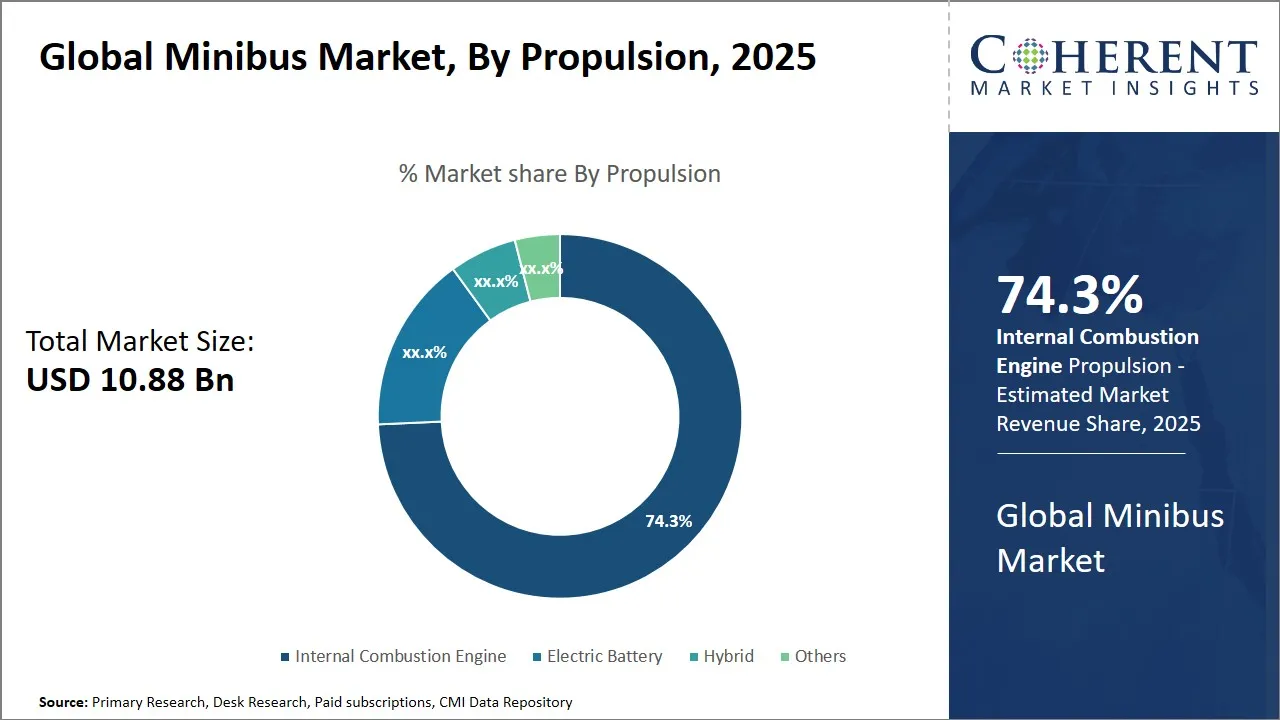
- The internal combustion engine segment leads the market holding an estimated share of 75.3% in 2026.
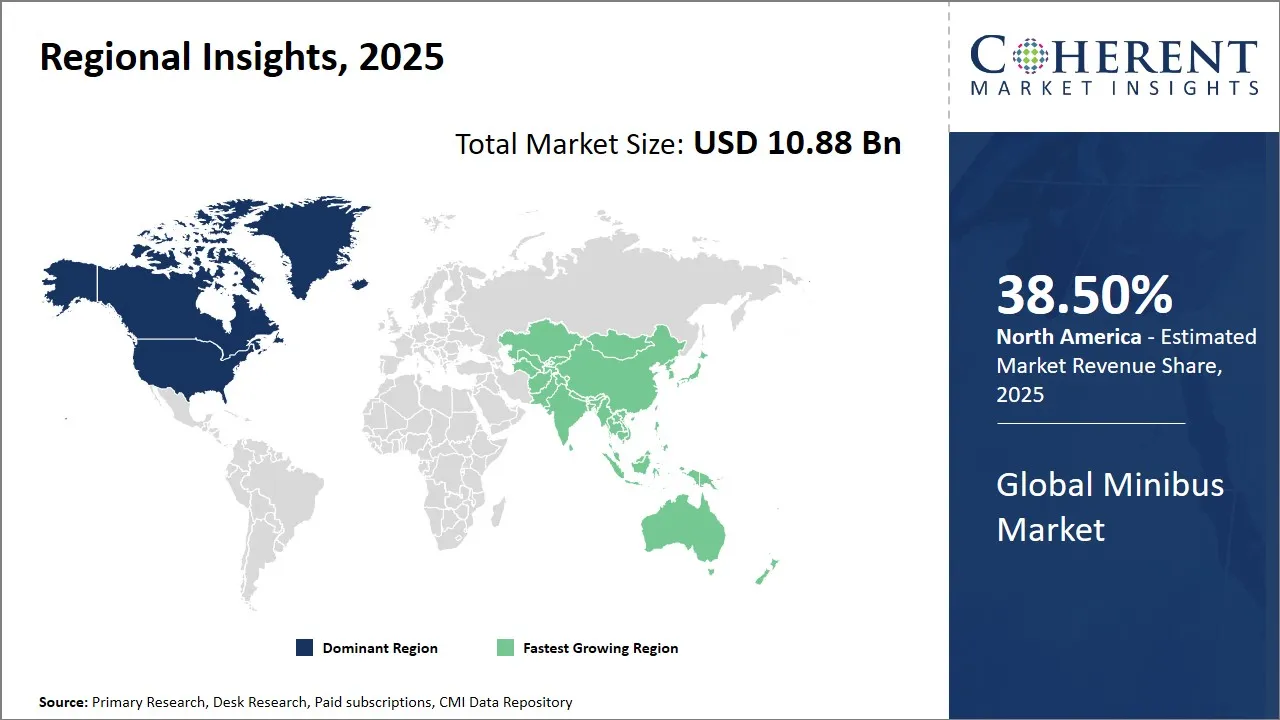
- North America is estimated to lead the market with a share of 38.5 % in 2026.
- Asia Pacific, holding an estimated share of 23.6% in 2026, and it is projected to be the fastest growing region.
Market Overview
A key market trends include a growing focus on eco-friendly and electric minibuses as governments impose stricter emission regulations, encouraging adoption of sustainable vehicles. Additionally, advancements in smart technology integration, such as GPS and real-time tracking systems, are enhancing operational efficiency and passenger safety. The rise in ride-sharing services and the demand for last-mile connectivity further stimulate innovation and diversification in the minibus industry, positioning it for sustained growth in the coming decade.
Current Events and Its Impact
Current Events | Description and its Impact |
Geopolitical and Trade Developments |
|
Economic and Infrastructure Trends |
|
Segmental Insights
- Current Industry Events of 2026
- Market Size Estimation
- Regional Breakdown
- Competitive Landscape
- Customer Intelligence
- Segmental Analysis
- Pricing Analysis
- Key Market Drivers, Challenges & Future Trends
- Customized Insights Section
Global Minibus Market Insights, by Propulsion – Internal Combustion Engine Segment Leads Owing to Widespread Infrastructure and Cost-Effectiveness
The internal combustion engine segment is projected to account for 75.3% share in 2026. One of the core driving elements is the extensive and well-established fueling infrastructure for conventional fuels such as diesel and gasoline. Across most regions, refueling stations are readily available and well-distributed, making Internal Combustion Engine (ICE)-powered minibuses practical for both urban and long-distance operations.
Cost-effectiveness remains another significant factor. ICE minibuses are generally priced lower upfront compared to electric or hybrid counterparts, making them more attractive to fleet operators who often face limited capital budgets. Additionally, the maintenance network for ICE engines is mature and widely accessible, with a vast pool of skilled mechanics and readily available spare parts. This translates into more affordable and faster servicing, ensuring these vehicles remain operational with minimal interruption and costs.
Another key driver is the performance familiarity and reliability that ICE engines offer. Operators and drivers have extensive experience with ICE vehicles, which builds trust in their capabilities in terms of power output, reliability in varied weather conditions, and ease of repairs. Furthermore, ICE-powered minibuses continue to deliver versatile performance in various application scenarios, ranging from public transit in developing markets to tourism and shuttle services in areas where charging infrastructure is limited or inconsistent. In 2024, several U.S. airport shuttle operators—including the Dallas–Fort Worth Airport fleet contractor ABM Transportation—ordered new Ford Transit diesel minibuses to replace aging vehicles.
Pricing Analysis of the Minibus Market
Seating Capacity / Propulsion | Estimated Price Range (USD) per Minibus |
Small minibus, < 10 seats, ICE/diesel | 30,000 – 60,000 |
10-20 seats, ICE/diesel | 60,000 – 120,000 |
10-20 seats, Electric/Battery EV | 120,000 – 200,000+ |
> 20 seats, ICE/diesel | 100,000 – 180,000 |
> 20 seats, Electric/Hybrid | 180,000 – 300,000+ |
Special variants (e.g. hydrogen fuel cell, luxury conversion / coach-style) | 250,000 – 400,000+ |
Regional Insights
North America Minibus Market Analysis and Trends
North America region is projected to lead the market with a 38.5% share in 2026, propelled by high demand for school transportation, airport shuttles, and corporate or community transit services. The region features an extensive highway network and well-developed logistics infrastructure, enabling efficient distribution and fleet operations across vast distances. Supportive federal and state incentives—such as tax credits for electric vehicles and funding under the U.S. Infrastructure Investment and Jobs Act—are accelerating the shift toward low-emission and electric minibuses.
Established automotive manufacturers like Ford, General Motors, and Blue Bird operate large-scale production and engineering facilities, while specialized body builders and upfitters provide customized configurations for paratransit, luxury, and shuttle markets. Robust financing options and a mature leasing ecosystem make fleet expansion easier for public transit agencies and private operators alike. In addition, strong trade agreements between the U.S., Canada, and Mexico foster integrated supply chains, ensuring a steady flow of components and finished vehicles and reinforcing North America’s position as both a dominant market and a key innovation hub for next-generation minibus technologies.
Asia Pacific Minibus Market Analysis and Trends
The Asia Pacific region, holding an estimated share of 23.6% in 2026, exhibits the fastest growth in the global minibus market, fueled by rapid urbanization, increasing middle-class populations, and expanding public transportation networks. Government initiatives focusing on improving rural and urban accessibility have heightened demand for minibuses as cost-effective, flexible transit solutions. The growing presence of regional manufacturers such as Toyota, Tata Motors, and Hino alongside international entrants expands the market’s breadth and depth. Trade liberalization policies among Asia Pacific countries facilitate the import and export of components and finished vehicles, accelerating innovation adoption and model availability. The region’s developing infrastructure combined with government subsidies for electric and hybrid vehicles is propelling diversification and the market penetration.
Global Minibus Market Outlook for Key Countries
Germany Minibus Market Analysis and Trends
Germany reflects its status as a global automotive hub, with major players like Mercedes-Benz and MAN Truck & Bus leading the minibus segment. The country’s emphasis on emission standards and green technology has accelerated the deployment of electric minibuses in urban mobility projects. Robust government incentives and a well-established dealer network support sustained demand, while continuous technological advancement drives product differentiation. Germany also benefits from its position within the European Union, allowing manufacturers to capitalize on regional trade benefits and innovation collaboration.
Japan Minibus Market Analysis and Trends
Japan is characterized by its focus on high-quality, fuel-efficient minibuses from domestic leaders such as Toyota and Hino. With a highly urbanized populace and aging demographics, demand for comfortable, accessible, and smaller capacity vehicles is strong, particularly in public transit and tourism sectors. The government’s proactive policies toward reducing carbon emissions and promoting hybrid vehicles have resulted in early adoption of eco-friendly minibus models. Japan also has a sophisticated supply chain infrastructure, promoting innovation and efficient production.
China Minibus Market Analysis and Trends
China stands out with its dynamic minibus market, supported by expansive infrastructure development and government initiatives promoting electric vehicle adoption. Key domestic manufacturers like BYD and Foton have made significant contributions by focusing on electric and affordable minibus variants suited for both urban and rural markets. China’s policy framework favors localized production and use of new energy vehicles, coupled with subsidies and mandates that spur market growth. The evolving regulatory environment, alongside increasing consumer interest in sustainable transport options, drives ongoing transformation.
U.S. Minibus Market Analysis and Trends
The U.S. revolves around diverse applications, including shuttle services, schools, and tourism. Companies like Ford and Blue Bird Corporation play pivotal roles with versatile minibuses designed for durability and fuel efficiency. The market benefits from federal and state-level policies promoting alternative fuel vehicles and improved transit accessibility. Moreover, the U.S. robust aftermarket and servicing ecosystem enhances vehicle lifecycle management. Trade policies and competitive domestic manufacturing support the availability of innovative minibus models addressing urban and rural mobility needs.
India Minibus Market Analysis and Trends
India minibus market is expanding due to rising urbanization, increasing the demand for mass public transportation, and government initiatives aimed at improving rural connectivity. Domestic manufacturers such as Tata Motors and Ashok Leyland are key contributors, offering affordable and rugged minibuses suited for diverse terrains. The government’s push toward electric mobility and vehicle safety regulations is gradually reshaping the market, encouraging innovation and improved standards. The growing logistics network and trade partnerships also facilitate easier access to raw materials and parts, supporting the market expansion.
Market Players, Key Development, and Competitive Intelligence
Key Developments
- In March 2025, Marco Polo announced plans to introduce the G8 to Australia. The G8 is the latest evolution in the company’s lineup of premium coaches, designed with a focus on efficiency, safety and passenger comfort. Launched in 2021 amid the challenges of the COVID pandemic, the G8 introduced a new level of innovation to long-distance travel, reflecting Marcopolo’s decades of experience in bus manufacturing.
- In January 2025, Yutong published its 2024 year-end review. As per the report, by the end of 2024, Yutong had promoted more than 196,000 new energy buses globally. 46,918 buses were sold by Yutong in 2024, an increase of 28.48% (year-on-year). At present, Yutong has set up knock-down factories in 16 countries around the world, operating new energy vehicles in stable quantities in more than 40 countries and regions.
- In September 2024, HORSE, a division of HORSE Powertrain Limited and a global leader in innovative and low-emission powertrain systems, partnered with Marcopolo, the largest bus manufacturer in South America, and WEG, the Brazilian multinational manufacturer of electronic equipment, to develop the new Volare Attack 9 hybrid microbus. This new vehicle is the first hybrid ethanol microbus to make use of a Range Extender solution, and was presented at the Marcopolo stand at Lat.Bus 2024 Expo.
- In May 2024, the 2024 King Long M-series bus tour exhibition was launched in East China. This exhibition showcased the company's two models, including the previously acclaimed M8 and the short rear overhang product M7 of the M-series.
Top Strategies Followed by Minibus Market Players
- Established players dominate the market by leveraging substantial investments in research and development (R&D) to innovate high-performance minibuses that meet stringent safety, environmental, and efficiency standards.
- Daimler invested over USD 46.9 million (€40 million) to develop the next-generation eSprinter platform, expanding range and charging speed for minibus and shuttle variants.
- Mid-level players strategically position themselves by offering cost-effective and reliable minibus solutions that strike a balance between quality and affordability.
- Ashok Leyland introduced the DOST CNG and Sunshine school minibus variants in India at competitive price points to capture budget-focused school and city transport fleets.
- Small-scale players in the minibus market adopt more targeted strategies to survive and thrive amid heavyweight competition.
- Karsan offers the e-Jest autonomous-ready minibus and later a hydrogen fuel-cell prototype targeting zero-emission urban micro-transit and pilot autonomous shuttle projects.
Market Report Scope
Minibus Market Report Coverage
| Report Coverage | Details | ||
|---|---|---|---|
| Base Year: | 2025 | Market Size in 2026: | USD 11.39 Bn |
| Historical Data for: | 2020 To 2024 | Forecast Period: | 2026 To 2033 |
| Forecast Period 2026 to 2033 CAGR: | 4.7% | 2033 Value Projection: | USD 15.71 Bn |
| Geographies covered: |
| ||
| Segments covered: |
| ||
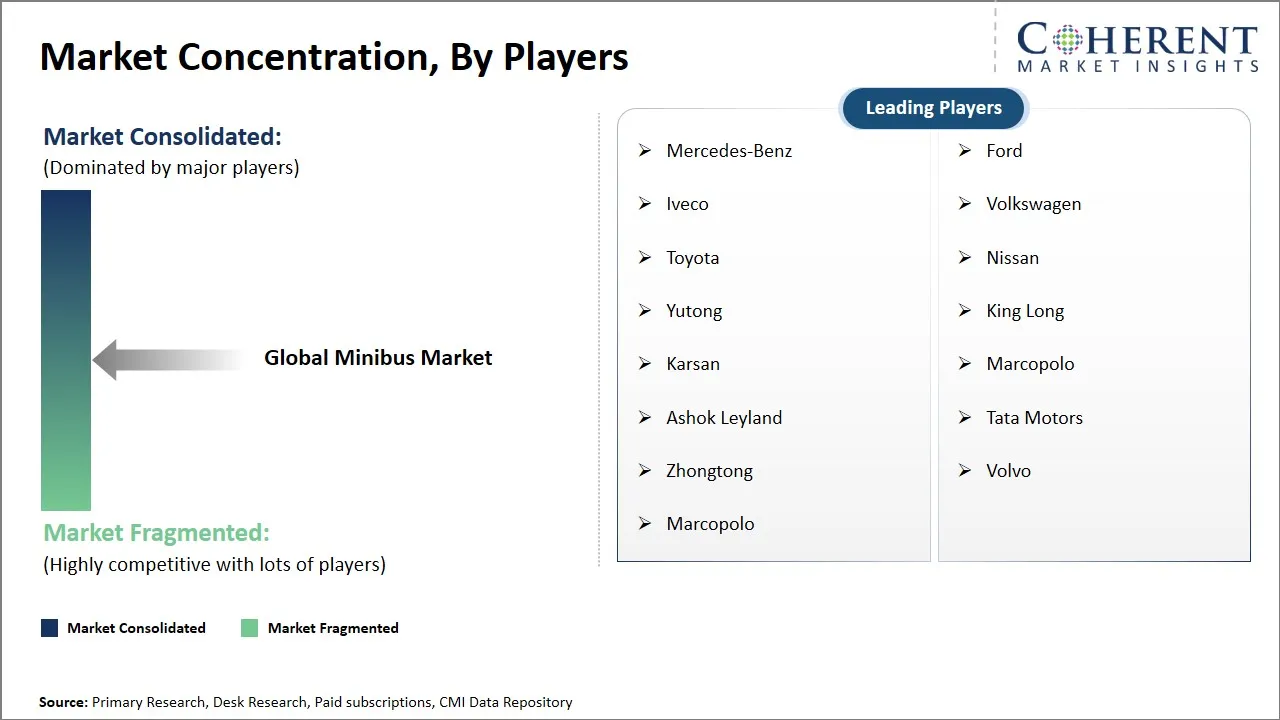
| Companies covered: | Mercedes-Benz, Ford, Iveco, Volkswagen, Toyota, Nissan, Yutong, King Long, Karsan, Marcopolo, Ashok Leyland, Tata Motors, Zhongtong, Volvo, and Marcopolo | ||
| Growth Drivers: |
| ||
| Restraints & Challenges: |
| ||
Market Dynamics
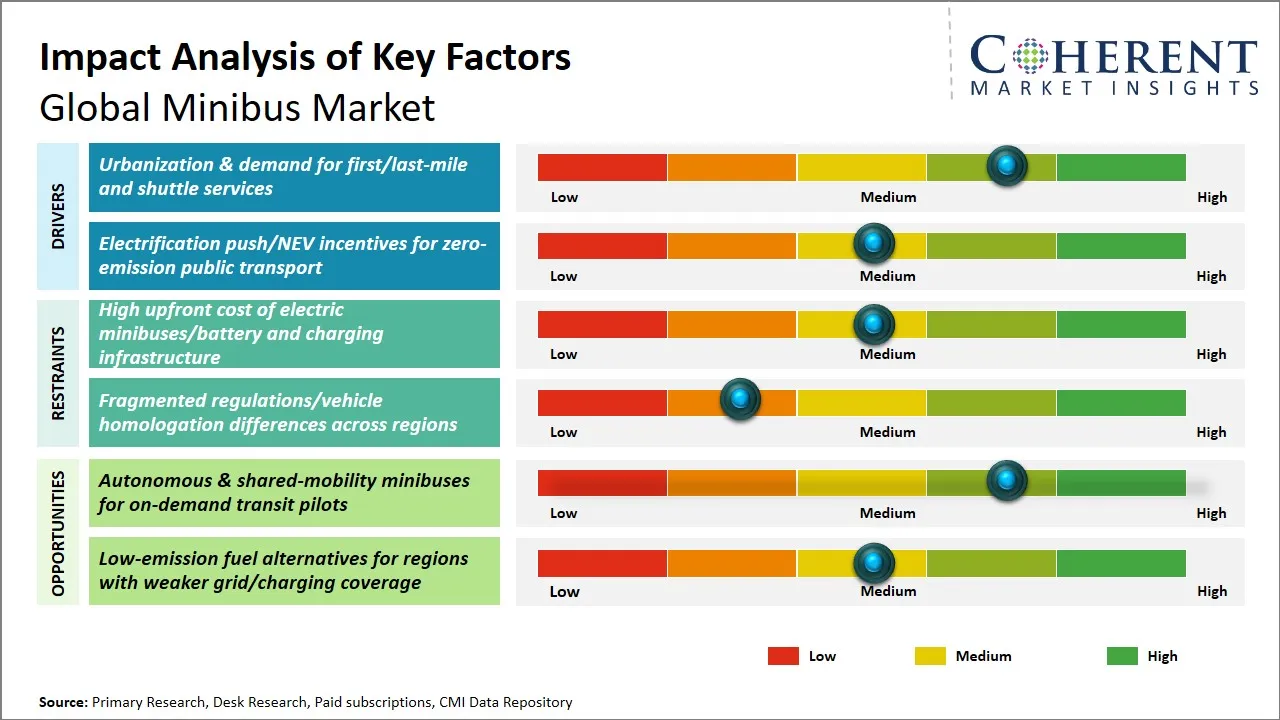
Global Minibus Market Driver – Urbanization & Demand for First/Last-Mile and Shuttle Services
Rapid urbanization across the globe has significantly transformed the transportation landscape, driving increased demand for efficient and flexible mobility solutions such as minibuses. As cities expand and populations become denser, conventional public transit often struggles to provide comprehensive coverage, particularly in suburban and peri-urban areas. This gap has elevated the importance of first-mile and last-mile connectivity, where minibuses offer an ideal solution by bridging the distance between major transit hubs and passengers’ final destinations.
Furthermore, with the rising emphasis on reducing traffic congestion and lowering emissions, minibuses are increasingly deployed for shuttle services within urban centers, commercial complexes, and educational or corporate campuses. Their smaller size and maneuverability allow for frequent service on narrower routes, enhancing accessibility and convenience for commuters. In 2023, the Delhi Transport Corporation (DTC) introduced hundreds of small electric and CNG minibuses for feeder routes linking metro stations with residential areas.
Global Minibus Market Opportunity – Autonomous & Shared-Mobility Minibuses for On-Demand Transit Pilots
Autonomous minibuses offer a breakthrough opportunity to enhance urban and suburban transit efficiency by reducing operational costs associated with drivers while improving safety through advanced sensor and AI systems. Shared-mobility models further amplify this potential by optimizing vehicle utilization rates and providing flexible, user-centric transportation options that align with evolving consumer preferences towards convenience and sustainability. On-demand transit pilots enable municipalities and service providers to test these innovative solutions in controlled environments, gathering valuable data to refine service models and gain public trust. In January 2025 at CES, May Mobility partnered with European electric minibus manufacturer Tecnobus to develop a new high-capacity, autonomous electric minibus platform designed for European and Canadian markets.
Additionally, these pilots help address urban challenges such as traffic congestion, emission reduction, and last-mile connectivity, which are pivotal in smart city planning. As governments and private players invest in smart infrastructure and mobility-as-a-service (MaaS) platforms, the deployment of autonomous shared-minibuses can fill critical gaps in public transport networks, especially in under-served or low-density areas.
Analyst Opinion (Expert Opinion)
- Solid-state and high-density lithium-ion batteries are lowering total cost of ownership and extending range, making electric minibuses practical for full-day urban duty cycles. Fleet operators are increasingly shifting procurement toward battery-electric models as charging networks expand and subsidies remain strong.
- Cities in Europe, North America, and Asia Pacific are trialing autonomous shuttle-type minibuses equipped with lidar, V2X communication, and AI-driven fleet management. These pilots are expected to evolve into commercial on-demand micro-transit services, creating a new revenue stream and reshaping urban mobility planning.
- Hydrogen fuel-cell minibuses, along with bio-CNG and hybrid range-extender technologies, are gaining traction where battery charging infrastructure is limited. This diversification reduces dependence on a single energy source and supports stricter zero-emission targets in markets such as Europe and parts of the Middle East.
Speak to the analyst
Want personalized insights?
Take the findings above to one of our principal consultants, or have the report rebuilt around the segments, geographies and competitors you actually track.
Market Segmentation
- Propulsion Insights (Revenue, USD Bn, 2021 - 2033)
- Internal Combustion Engine
- Electric Battery
- Hybrid
- Others
- Regional Insights (Revenue, USD Bn, 2021 - 2033)
- North America
- U.S.
- Canada
- Latin America
- Brazil
- Argentina
- Mexico
- Rest of Latin America
- Europe
- Germany
- U.K.
- Spain
- France
- Italy
- Russia
- Rest of Europe
- Asia Pacific
- China
- India
- Japan
- Australia
- South Korea
- ASEAN
- Rest of Asia Pacific
- Middle East
- GCC Countries
- Israel
- Rest of Middle East
- Africa
- South Africa
- North Africa
- Central Africa
- North America
- Key Players Insights
- Mercedes-Benz
- Ford
- Iveco
- Volkswagen
- Toyota
- Nissan
- Yutong
- King Long
- Karsan
- Marcopolo
- Ashok Leyland
- Tata Motors
- Zhongtong
- Volvo
- Marcopolo
Sources
Primary Research Interviews
Stakeholders
- Minibus & Light Commercial Vehicle OEM Executives
- Electric Drivetrain and Battery Suppliers
- Public Transit Authorities and Fleet Managers across North America, Europe, and Asia Pacific
- Municipal Transport Planners & Urban Mobility Consultants
- Dealership Networks and Aftermarket Service Providers
- Shared-mobility & Ride-hailing Operators running on-demand shuttle pilots
- Autonomous Vehicle Technology Developers focusing on low-speed urban transit
Databases
- Eurostat – Passenger road transport & fleet registration data
- U.S. Department of Transportation / BTS – Transit fleet composition and ridership
- International Energy Agency (IEA) – EV and alternative-fuel adoption statistics
- World Road Transport Database (fictitious) – Annual production and export numbers for minibuses
- Urban Mobility Observatory (fictional) – Data on first/last-mile projects in major cities
Magazines
- Commercial Vehicle Today
- Fleet Management Weekly
- Urban Transport International
- Electric & Hybrid Vehicle Technology International
Journals
- Journal of Sustainable Transportation
- International Journal of Electric and Hybrid Vehicles
- Urban Mobility & Transport Systems Journal
- Journal of Autonomous Vehicle Systems
Newspapers
- Automotive News Europe
- The Economic Times (India)
- The Guardian (UK) – Transport section
- Nikkei Asia – Mobility & EV desk
Associations
- International Association of Public Transport (UITP)
- Society of Motor Manufacturers and Traders (SMMT, UK)
- American Public Transportation Association (APTA)
- European Automobile Manufacturers Association (ACEA)
- Zero Emission Bus Rapid Alliance (fictional industry coalition)
Public Domain Sources
- U.S. Census Bureau – Vehicle manufacturing economic indicators
- World Bank – Urbanization and infrastructure statistics
- United Nations Economic Commission for Europe (UNECE) – Vehicle regulations and trade flows
- ResearchGate – Academic papers on electric buses and shared mobility
Proprietary Elements
- CMI Data Analytics Tool, Proprietary CMI Existing Repository of information for last 8 years
Get access to 250+ pages report
Every segment, forecast, competitor profile and data table behind the analysis above — available for instant download.
- ESOMAR Member
- ISO 9001:2015 Certified
- D-U-N-S Registered
- GDPR & CCPA Compliant
Missing comfort of reading report in your local language? Find your preferred language:
Transform your Strategy with Exclusive Trending Reports
Frequently Asked Questions
The global minibus market is estimated to be valued at USD 11.39 billion in 2026 and is expected to reach USD 15.71 billion by 2033.
The CAGR of the global minibus market is projected to be 4.7% from 2026 to 2033.
Urbanization & demand for first/last-mile and shuttle services and electrification push/NEV incentives for zero-emission public transport are the major factors driving the growth of the global minibus market.
High upfront cost of electric minibuses/battery and charging infrastructure and fragmented regulations/vehicle homologation differences across regions are the major factors hampering the growth of the global minibus market.
In terms of propulsion, the internal combustion engine segment is estimated to dominate the market revenue share in 2026.
Mercedes-Benz, Ford, Iveco, Volkswagen, Toyota, Nissan, Yutong, King Long, Karsan, Marcopolo, Ashok Leyland, Tata Motors, Zhongtong, Volvo, and Marcopolo are the major players.
Autonomous driving, advanced telematics, solid-state batteries, and hydrogen fuel cells are key areas of innovation.