

Global Molecular Computing Market and Forecast – 2026-2033
The global molecular computing market is estimated to be valued at USD 5.71 Bn in 2026 and is expected to reach USD 14.46 Bn by 2033, reflecting a compound annual growth rate (CAGR) of 14.2% from 2026 to 2033.
Key Takeaways of the Molecular Computing Market
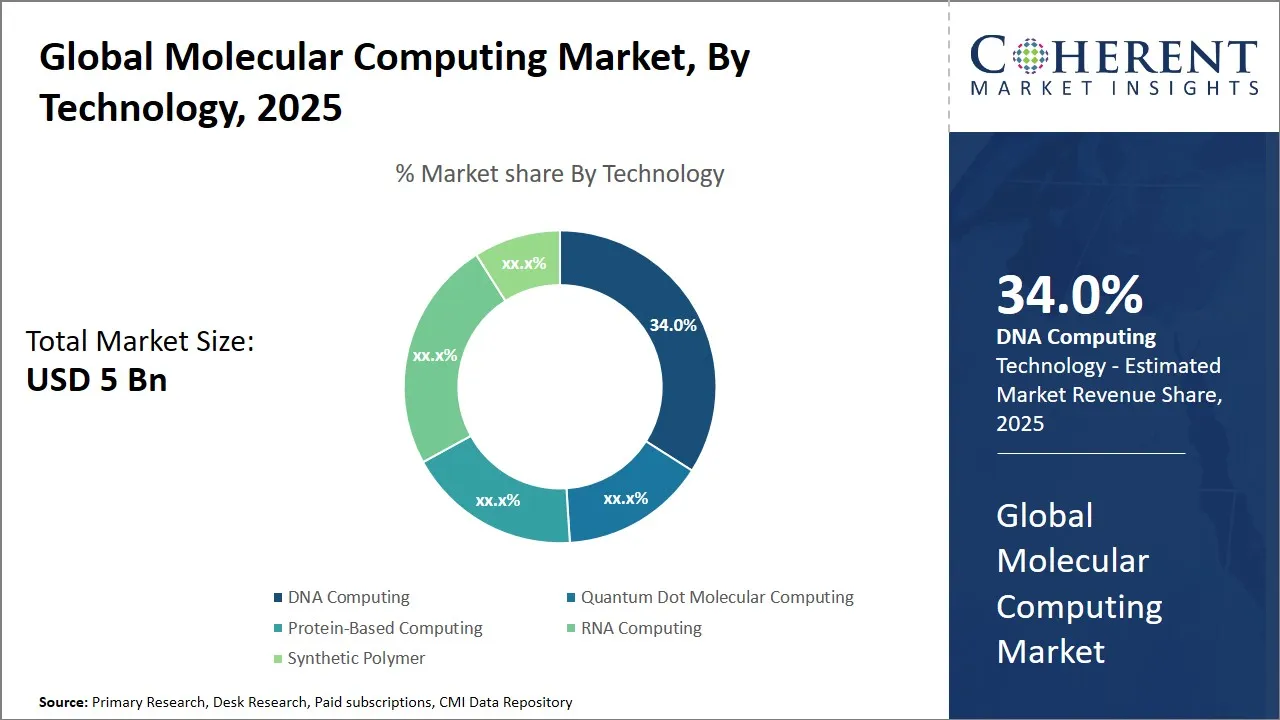
- The DNA computing segment is expected to account for 35% of the molecular computing market share in 2026.
- The molecular hardware segment is projected to capture 31% of the market share in 2026.
- The cryptography and data security segment is expected to command 38% share in 2026.
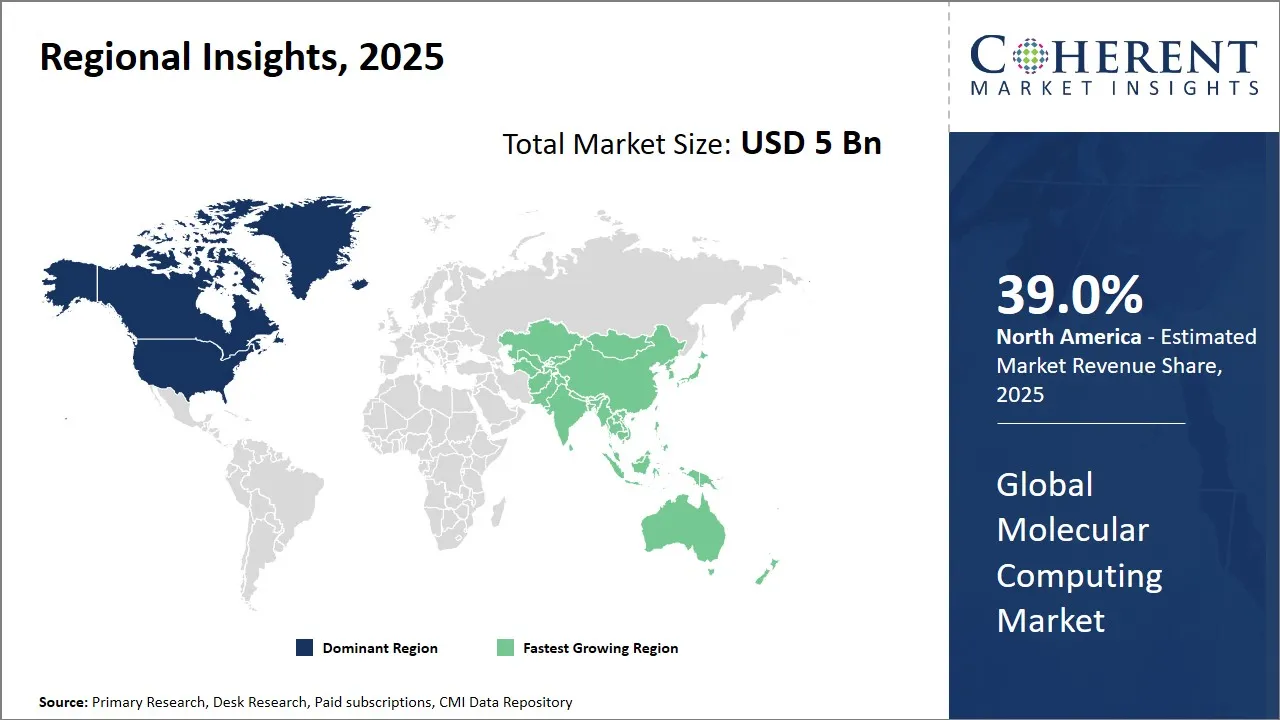
- North America will dominate the molecular computing market in 2026 with an estimated 39%
- Asia Pacific will hold 27% share in 2026 and record the fastest growth.
Current Events and Its Impact
Current Events | Description and its Impact |
IonQ Collaboration |
|
Segmental Insights
- Current Industry Events of 2026
- Market Size Estimation
- Regional Breakdown
- Competitive Landscape
- Customer Intelligence
- Segmental Analysis
- Pricing Analysis
- Key Market Drivers, Challenges & Future Trends
- Customized Insights Section
Why Does DNA Computing Dominate the Global Molecular Computing Market in 2026?
The DNA computing segment is expected to hold 35.0% of the molecular computing market share in 2026. The growth comes from its strong parallel processing, dense data storage, or built-in compatibility with biological systems. Because DNA can store huge volumes of data in a tiny area, it enables calculations beyond what standard silicon methods offer - either in scale or intricacy. Its core strength handles advanced operations or analytical challenges by using natural bonding traits and spontaneous strand organization, enabling computation via chemical processes.
The need for advanced, high-performance computing that manages large datasets and intricate calculations boosts DNA computing’s growth. Because of its ability to process multiple tasks simultaneously at a molecular level, sectors like drug development, biotech, or security tech are adopting DNA-based methods which cut down time and energy use more than traditional approaches. Moreover, rising focus on tailored treatments and genetic research supports this field, since DNA computation works directly with biological information, allowing sharper analysis and accurate medical insights.
For instance, in November 2025, a new DNA-based computing method was published in Nature Communications, showcasing clear, expandable decision-making through DNA strand interactions. Instead of traditional circuits, it encodes logic directly into genetic material. While handling complex structures, it manages more than ten layers with hundreds of strands involved.
(Source: Nature.com)
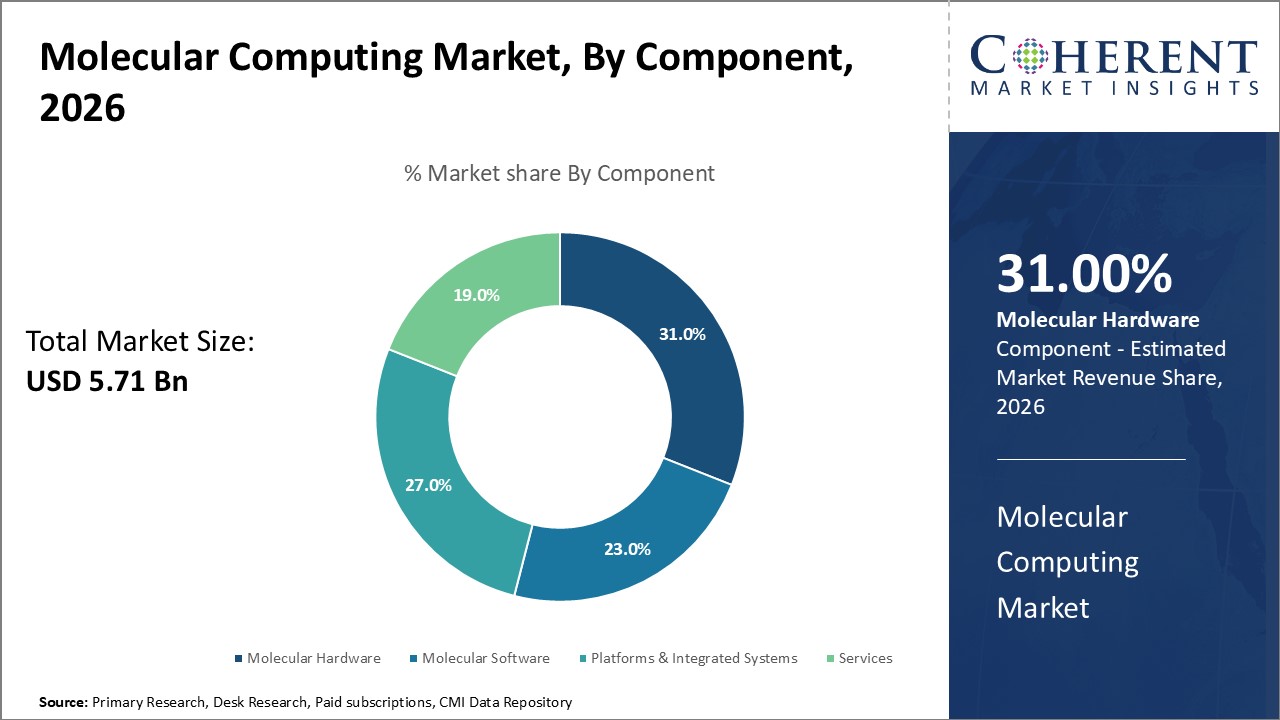
Molecular Hardware Segment Dominates the Molecular Computing Market
The molecular hardware segment is expected to hold 31.0% of the global molecular computing market share in 2026. The rise stems from broad innovation focused on building tiny devices able to compute consistently. Alongside this, molecular hardware includes tangible parts like switches, logic units, and storage pieces, all key for supporting overall system design. Instead of just lab tests, efforts now center on crafting molecules that act as dependable, repeatable parts, enabling use beyond theory into actual technology.
For instance, in November 2026, NVIDIA unveiled ALCHEMI, a new platform with NVIDIA NIM microservices designed to accelerate AI for discovering new materials and chemicals, speeding up R&D for sustainable energy (batteries, solar) by using AI, at the Supercomputing Conference.
(Source: nvidia.com)
Why is Cryptography and Data Security the most Widespread Application in the Molecular Computing Market?
The cryptography and data security segment is expected to hold 38.0% of the market share in 2026. The rise comes from stronger worldwide focus on safeguarding private data while improving digital defenses. Because molecular computing offers new possibilities for encryption methods, thanks to the intricate nature of chemical reactions - ideal for forming codes that resist standard breaches or future quantum exploits.
A key reason behind this growth is the rising demand for protecting online communication, banking activities, or state information from advanced hacking attempts. As molecular computing offers tools like molecule-based coding, hidden data storage using DNA, and tiny memory systems with built-in biological safeguards, breaking into data becomes far harder. Also, since quantum machines could soon break current encryption, decision-makers are turning toward molecular models as a future-ready defense against these new threats.
Material Dependency & Supply-Chain Risk Mapping
Material | Approx. Cost | Key Supplier Regions | Supply-Chain Risk Level (1–5) |
Synthetic DNA (Oligonucleotides) | USD 0.02–0.10 per base | U.S., China, EU | 3 |
Enzymes (Polymerases, Ligases, Nucleases) | USD 50–500 per gram | U.S., EU, Japan | 3 |
Biochemical Reagents & Buffers | USD 5–50 per liter | Global (widely distributed) | 2 |
CMOS Semiconductor Wafers | USD 3,000–7,000 per 300 mm wafer | Taiwan, South Korea, U.S. | 4 |
Nanofabrication Materials (Gold, Platinum, Graphene) | Gold: USD 70/g; Graphene: USD 100–500/m² | China, Africa, Latin America | 4 |
Regional Insights
North America Molecular Computing Market Analysis and Trends
North America is projected to lead the market with a 39% share in 2026. In North America, strong performance in molecular computing stems from a well-developed tech landscape, active industrial base, or favorable public policies. The U.S. is notable for its many research hubs working together with innovative companies focused on advancing this area. Government initiatives aimed at improving quantum technologies and advanced materials boost development work.
In addition, strong intellectual property rules along with top-tier labs enable quicker market entry. Major names like IBM, Intel, Microsoft play influential roles, particularly through merging molecular methods into quantum platforms which helps maintain regional strength.
Asia Pacific Molecular Computing Market Analysis and Trends
Asia Pacific is expected to exhibit the fastest growth in the market contributing 27% share in 2026. The expansion comes from stronger research, more government support, or faster tech uptake. Nations like China and Japan are pushing molecular and quantum computing through targeted programs or local innovation centers. Rapid growth in semiconductor tech, combined with breakthroughs in biology, creates favorable conditions for progress in molecular systems.
Moreover, closer ties between universities but companies speed up innovation sharing or product development. Firms like Sony, Hitachi, also Huawei help push forward both study efforts plus real-world uses here.
Molecular Computing Market Outlook for Key Countries
Why is U.S. Emerging as a Major Hub of Molecular Computing?
The U.S. leads in molecular computing thanks to advanced research alongside major tech firms. While agencies like DARPA and the National Science Foundation offer strong financial support, they help drive breakthroughs in molecular logic and system designs. Instead of relying on conventional chips, companies such as IBM and Intel explore molecular methods to boost performance. With active collaboration between new ventures and universities, progress continues in circuit development and data storage - keeping the nation ahead in this evolving field.
Is China the Next Growth Engine for the Molecular Computing Market?
China’s molecular computing sector is growing fast, thanks to solid government backing through programs such as "Made in China 2026," which highlights advanced computing methods. Firms like Huawei and Alibaba are putting resources into this field - aiming to boost performance in artificial intelligence and cloud systems. At the same time, academic centers across the country are turning attention to molecular-level computation, supported by public investment that speeds up innovation. With clear strategic direction along with skilled workers and production strength, China is becoming a major force in shaping the future of this technology worldwide.
Japan Molecular Computing Market Analysis and Trends
Japan stays ahead in precise tech and material research, boosting its molecular computing sector. Companies such as Sony use nanotech knowledge along with chip-making skills to build new computing parts. Support from national authorities drives progress via special projects on next-gen computing, funding joint efforts between firms and agencies. With trained professionals plus a strong electronics base, Japan scales innovations efficiently - playing a key role in defining how molecular computing evolves.
South Korea Molecular Computing Market Analysis and Trends
In South Korea, government agencies work closely with major firms like Samsung and LG Electronics to advance molecular computing. Owing to targeted funding in emerging tech fields such as molecular and quantum systems, research centers have grown active across the country. The nation’s well-developed semiconductor industry, along with its expertise in advanced materials, supports production needs for key components used in these computers. Meanwhile, broader policy goals centered on innovation and domestic technological strength help speed up progress; both new ventures and big corporations now aim to bring practical molecular devices to market.
Germany Molecular Computing Market Analysis and Trends
Germany's molecular computing market gains strength from its solid industrial background, especially in precise machinery and automated systems. Thanks to centers such as the Max Planck Institute and Fraunhofer Society, breakthroughs in molecular-scale tech move forward steadily. Firms across the country now link molecular research with smart production models under Industry 4.0 initiatives. Funding and guidance from national and European authorities help universities work hand-in-hand with businesses, speeding up practical use of discoveries. As a result, Germany holds a key position in expanding real-world uses of molecular computing throughout Europe.
Market Players, Key Development, and Competitive Intelligence
Key Developments
- In September 2025, Cadence Design Systems, Inc. announced ROCS X at miniCUP Boston, an AI-powered virtual screening tool enabling 3D searches of trillions of drug-like molecules. Developed in collaboration with Treeline Biosciences, ROCS X has helped identify over 150 novel compounds for potential use in cancer drug development.
- In May 2025, Qubit Pharmaceuticals launched FeNNix-Bio1, a quantum AI foundation model designed to revolutionize molecular simulations in biomolecular and pharmaceutical research. Trained on synthetic quantum chemistry data, it integrates DFT, QMC, and CI methods to model interatomic forces, utilizing transfer learning for accurate scalability. The model was developed with support from exascale computing resources provided by GENCI, EuroHPC, and Argonne.
Top Strategies Followed by Global Molecular Computing Market Players
Player Type | Strategic Focus | Example |
Established Market Leaders | Collaboration | In November 2025, IBM announced a collaboration across four national quantum innovation centers to help drive the future of quantum-centric supercomputing. |
Mid-Level Players | Major Collaboration | On December 7, 2025, Algorithmiq and Microsoft announced a partnership to advance fault-tolerant quantum solutions for chemistry and drug discovery. |
Small-Scale Players | Investment | On December 6, 2025, private-equity firm Bedford Ridge Capital led a USD 100 million investment in Quantum Art that will bolster the Israeli startup’s plans to break new ground in the hot area of quantum computing. |
Market Report Scope
Molecular Computing Market Report Coverage
| Report Coverage | Details | ||
|---|---|---|---|
| Base Year: | 2025 | Market Size in 2026: | USD 5.71 Bn |
| Historical Data for: | 2020 To 2024 | Forecast Period: | 2026 To 2033 |
| Forecast Period 2026 to 2033 CAGR: | 14.2% | 2033 Value Projection: | USD 14.46 Bn |
| Geographies covered: |
| ||
| Segments covered: |
| ||
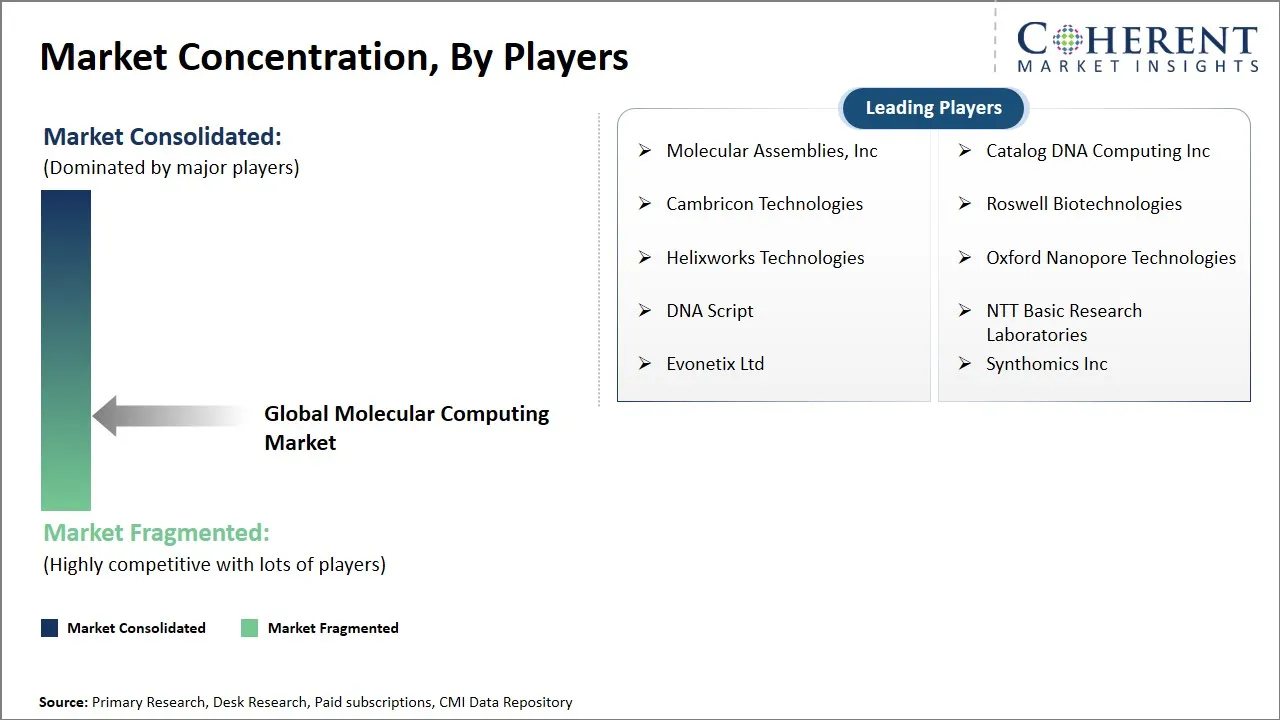
| Companies covered: | Molecular Assemblies, Inc, Catalog DNA Computing Inc, Cambricon Technologies, Roswell Biotechnologies, Helixworks Technologies, Oxford Nanopore Technologies, DNA Script, NTT Basic Research Laboratories, Evonetix Ltd, and Synthomics Inc | ||
| Growth Drivers: |
| ||
| Restraints & Challenges: |
| ||
Global Molecular Computing Market Dynamics
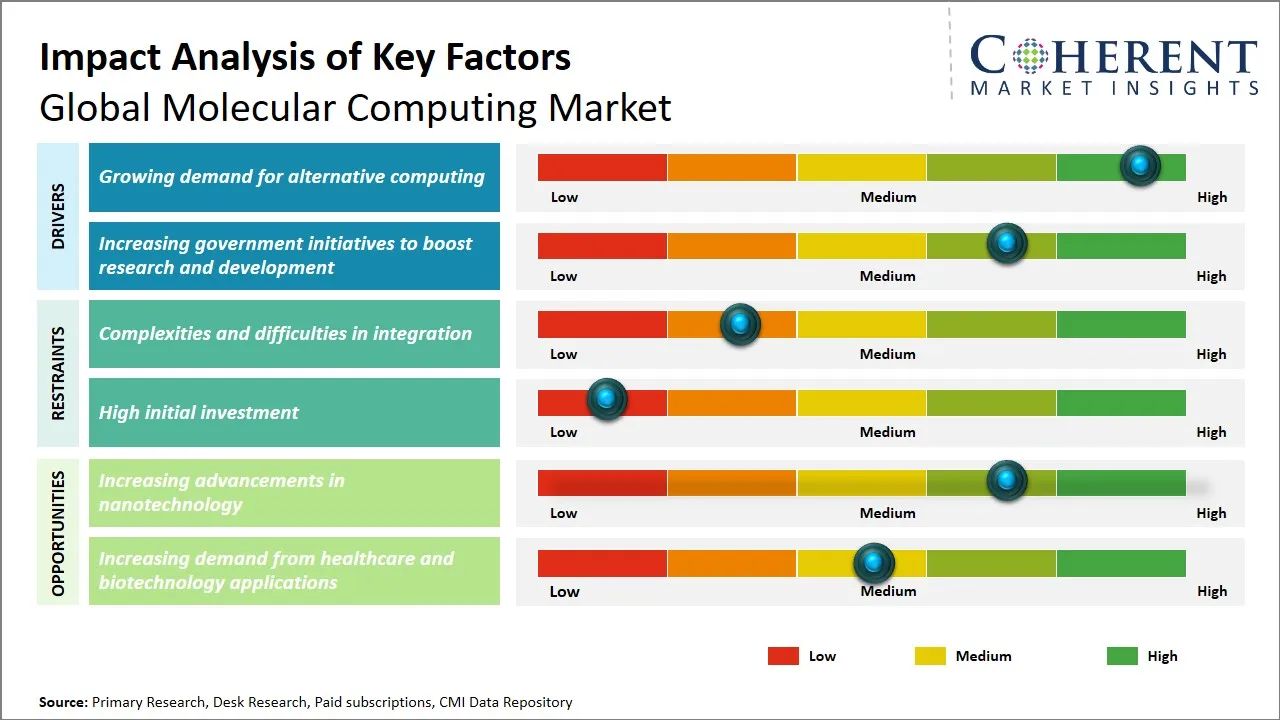
Global Molecular Computing Market Driver - Growing Demand for Alternative Computing
The increasing volume of intricate data across various areas has created a demand for high performance computing solutions outside traditional silicon-based systems. Rather than sticking to outdated models, researchers are investigating small units able to handle data close to atomic scales. Since conventional machines struggle with expanding requirements such as generative artificial intelligence or massive datasets, multiple groups are trying molecular approaches to overcome speed barriers.
At the same time, there’s rising interest in small yet powerful tools consuming minimal power, prompting companies to fund molecular technologies ideal for confined environments and low-energy settings. Turning attention to chemical and biological processes for information handling could drive innovation, enabling industries meet future digital challenges effectively while reducing reliance on standard electronic circuits.
Global Molecular Computing Market Opportunity - Increasing Advancements in Nanotechnology
The fast progress in nanotechnology opens major chances for the worldwide molecular computing sector, pushing new ideas forward while broadening real-world uses. As it allows control over materials at the atom level, key for building tiny computers, it supports faster operation, lower power needs, and smaller sizes than standard chip systems. As studies continue refining accuracy, durability, and mass production of nano parts, this field moves closer to solving issues around function and compatibility.
Meanwhile, combining nano-science with biological molecules leads instead to fresh designs like DNA circuits or chemical switches working where regular electronics fail. Such overlap draws growing funding from companies and governments alike, encouraging partnerships across industries, universities, and labs.
Analyst Opinion (Expert Opinion)
- The global molecular computing field is shifting from research-focused labs toward initial commercial use, fueled by progress in DNA computing, quantum-assisted simulations, and AI-supported chemical modeling. Soon, expansion will depend not on isolated "molecular machines" but on combined systems, using molecular methods alongside traditional, quantum, or online computing solutions. Major tech firms are building foundational tools like cloud services, quantum device access, and software layers; meanwhile, smaller dedicated companies focus on breakthroughs in DNA-driven circuits, molecule-level information handling, and tiny-scale processing units.
- For investors and businesses, the opportunity looks strong though returns may take years. Instead of broad computing uses, sales will probably focus on areas such as drug development, material design, or genetic testing. Owing to this, companies are teaming up strategically, seeking government-backed grants, while building patent portfolios to gain edge. As performance, size flexibility, and common technical standards get better over time, molecular systems could become essential infrastructure.
Speak to the analyst
Want personalized insights?
Take the findings above to one of our principal consultants, or have the report rebuilt around the segments, geographies and competitors you actually track.
Market Segmentation
- Technology Insights (Revenue, USD Billion, 2021 - 2033)
- DNA Computing
- Quantum Dot Molecular Computing
- Protein-Based Computing
- RNA Computing
- Synthetic Polymer
- Component Insights (Revenue, USD Billion, 2021 - 2033)
- Molecular Hardware
- Molecular Software
- Platforms and Integrated Systems
- Services
- Application Insights (Revenue, USD Billion, 2021 - 2033)
- Cryptography and Data Security
- Drug Discovery and Molecular Modeling
- Diagnostics and Biosensing
- Nanorobotics and Smart Materials
- High Performance Computing
- Others
- Regional Insights (Revenue, USD Billion, 2021 - 2033)
- North America
- U.S.
- Canada
- Latin America
- Brazil
- Argentina
- Mexico
- Rest of Latin America
- Europe
- Germany
- U.K.
- Spain
- France
- Italy
- Russia
- Rest of Europe
- Asia Pacific
- China
- India
- Japan
- Australia
- South Korea
- ASEAN
- Rest of Asia Pacific
- Middle East
- GCC Countries
- Israel
- Rest of Middle East
- Africa
- South Africa
- North Africa
- Central Africa
- North America
- Key Players Insights
- Molecular Assemblies, Inc
- Catalog DNA Computing Inc
- Cambricon Technologies
- Roswell Biotechnologies
- Helixworks Technologies
- Oxford Nanopore Technologies
- DNA Script
- NTT Basic Research Laboratories
- Evonetix Ltd
- Synthomics Inc
Sources
Primary Research Interviews
- Molecular computing technology developers and researchers
- Biotechnology and pharmaceutical company executives
- DNA storage and computing solution providers
- Academic researchers in computational biology
Databases
- IEEE Xplore Digital Library
- PubMed/MEDLINE
- Nature Database
- ScienceDirect
Magazines
- Nature Biotechnology Magazine
- IEEE Computer Magazine
- BioWorld Intelligence Database Magazine
- Technology Review Magazine
Journals
- Journal of Computational Biology
- Nature Nanotechnology
- Biosystems Journal
Newspapers
- Financial Times
- The Wall Street Journal
- Reuters Technology News
- Bloomberg Technology
Associations
- International Society for Computational Biology (ISCB)
- IEEE Computer Society
- Biotechnology Innovation Organization (BIO)
- Association for Computing Machinery (ACM)
Public Domain Sources
- National Institute of Standards and Technology (NIST) publications
- European Commission research reports
- U.S. Department of Energy databases
- World Health Organization (WHO) publications
Proprietary Elements
- CMI Data Analytics Tool
- Proprietary CMI Existing Repository of information for last 8 years
Get access to 250+ pages report
Every segment, forecast, competitor profile and data table behind the analysis above — available for instant download.
- ESOMAR Member
- ISO 9001:2015 Certified
- D-U-N-S Registered
- GDPR & CCPA Compliant
Missing comfort of reading report in your local language? Find your preferred language:
Transform your Strategy with Exclusive Trending Reports
Frequently Asked Questions
The global molecular computing market is estimated to be valued at USD 5.71 Bn in 2026 and is expected to reach USD 14.46 Bn by 2033.
The CAGR of global molecular computing market is projected to be 14.2% from 2026 to 2033.
Growing demand for alternative computing and increasing government initiatives to boost research and development are the major factors driving the growth of the global molecular computing market.
Complexities and difficulties in integration and high initial investment are the major factors hampering the growth of the global molecular computing market.
In terms of technology, the DNA computing is estimated to dominate the market revenue share in 2026.
DNA computing relies on biochemical reactions for parallel processing, while quantum computing exploits quantum states such as superposition and entanglement.
AI accelerates molecular design, simulation, and error correction, making molecular computing systems more practical.