

Global Neon Gas Market Size and Forecast – 2026 To 2033
The Global Neon Gas Market is estimated to be valued at USD 25.81 Bn in 2026 and is expected to reach USD 39.32 Bn by 2033, exhibiting a compound annual growth rate (CAGR) of 6.2% from 2026 to 2033. The semiconductor industry, which is a core end market for neon, is expanding globally, with the number of operational fabs projected to increase by approximately 10–12% by 2032. This growth is driven by new node investments and national semiconductor policies in the U.S., Europe, China, and Asia Pacific. Each advanced manufacturing line (especially EUV and DUV lithography) requires 2–5× more neon gas per wafer compared to older processes, directly increasing the demand for neon per unit of chip output.
Key Takeaways of the Global Neon Gas Market
- The cylinders segment is projected to hold 44.5 % of the global neon gas market share in 2026, making it the dominant source mode segment. For example, industrial gas suppliers such as Messer supply cylinders of high-purity neon to electronics and laser manufacturers, without requiring a huge investment in on-site infrastructure. (Source: Messer North America, Inc.)
- The lasers segment is expected to hold 32.1 % of the neon gas market share in 2026, underlining the importance of neon in excimer and HeNe laser systems. Strong and steady demand for these lasers drives semiconductor lithography, precision metrology and medical instrumentation. The U.S. Geological Survey (USGS) reports that lasers use a large amount of neon, due to its importance in electronics and high precision uses.
- The direct sales segment is expected to hold 39.6 % of the neon gas market share in 2026, driven by the demand for customized gas solutions, rapid response, and technical support. Industrial buyers such as semiconductor fabs, laser manufacturers, and specialty lighting companies prefer direct interaction with suppliers to meet precise purity and supply requirements. Real-world examples include SK Hynix and TEMC, which collaborate directly with suppliers to ensure consistent neon supply for fabs.
- The Asia Pacific region is expected to hold the largest share of 32.5 % in 2026, driven by high semiconductor manufacturing activity in China, Taiwan, and South Korea. The region’s dominance is supported by rapid urbanization and heavy investment in electronics and precision industries, with neon being critical for excimer lithography and industrial lasers. According to the International Energy Agency and regional production reports, neon demand in APAC continues to rise with expanding fab capacities.
- The North America neon gas market is projected to grow fastest, with an estimated 22.3 % contribution to the global market in 2026, supported by ongoing semiconductor fab expansions, laser technology adoption, and government incentives (e.g., the CHIPS Act). The region’s growth is further driven by domestic neon recycling initiatives at fabs, enhancing supply security and operational sustainability. Examples include Messer’s supply of recycled and high-purity neon cylinders to U.S. semiconductor manufacturers.
- Semiconductor Supply Chain Resilience: Adoption of neon recycling and recovery systems in fabs is strengthening supply stability amid geopolitical tensions, reducing dependency on imported neon and ensuring uninterrupted semiconductor
- Industrial & Laser Technology Growth Drivers: Rising demand for neon in excimer lasers, HeNe lasers, and precision LED lighting, combined with technological advancements and government support for high‑purity gas applications, is driving robust market growth globally.
Segmental Insights
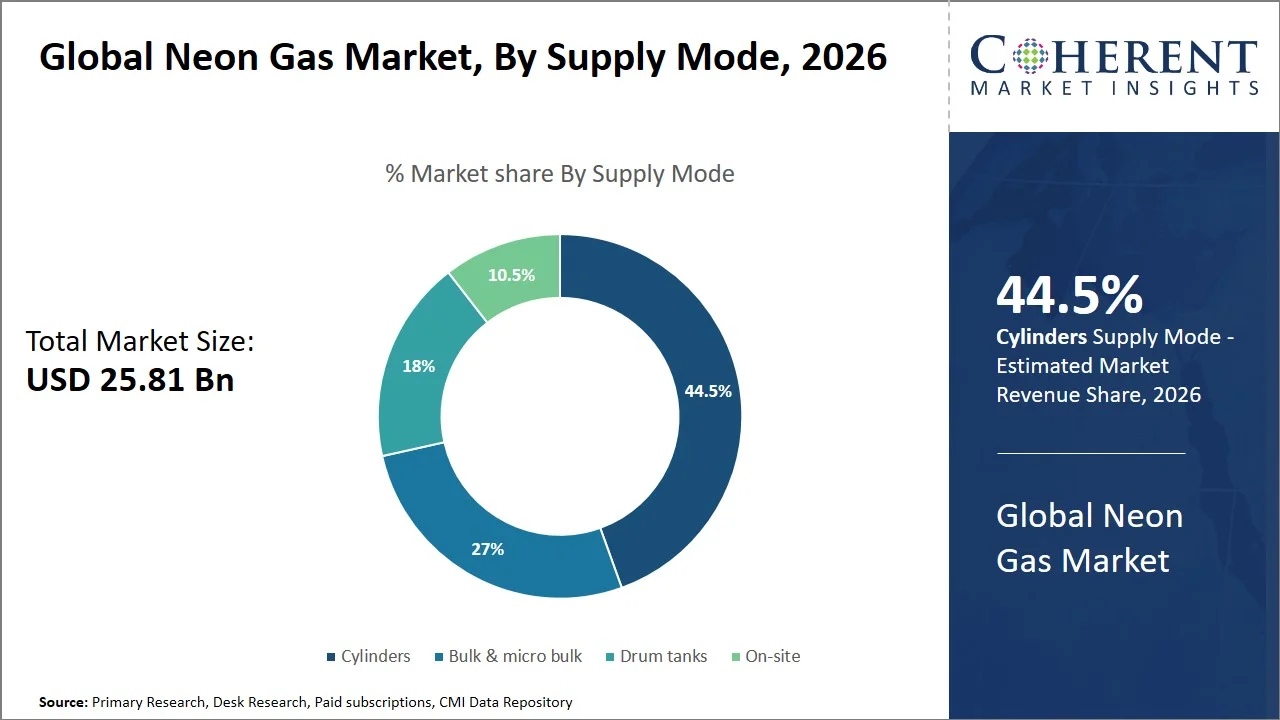
Why Does the Cylinders Segment Dominate the Neon Gas Market?
The cylinders segment is expected to hold 44.5% of the neon gas market in 2026, as the cylinders are highly convenient, flexible, and ready-to-use delivery requirements which is suitable to a wide range of industrial customers. Neon is an inert gas that is liberated by cryogenic fractional distillation of air, and is only present in the atmosphere in trace amounts (~1 part in 65,000). Because of the need for special facilities for extraction and purification, storage and transportation of this product is most conveniently done in pressurized cylinders after extraction. (Source: SFA (Oxford))
- Current Industry Events of 2026
- Market Size Estimation
- Regional Breakdown
- Competitive Landscape
- Customer Intelligence
- Segmental Analysis
- Pricing Analysis
- Key Market Drivers, Challenges & Future Trends
- Customized Insights Section
Why is the Lasers Segment the Most Preferred Application in the Global Neon Gas Market?
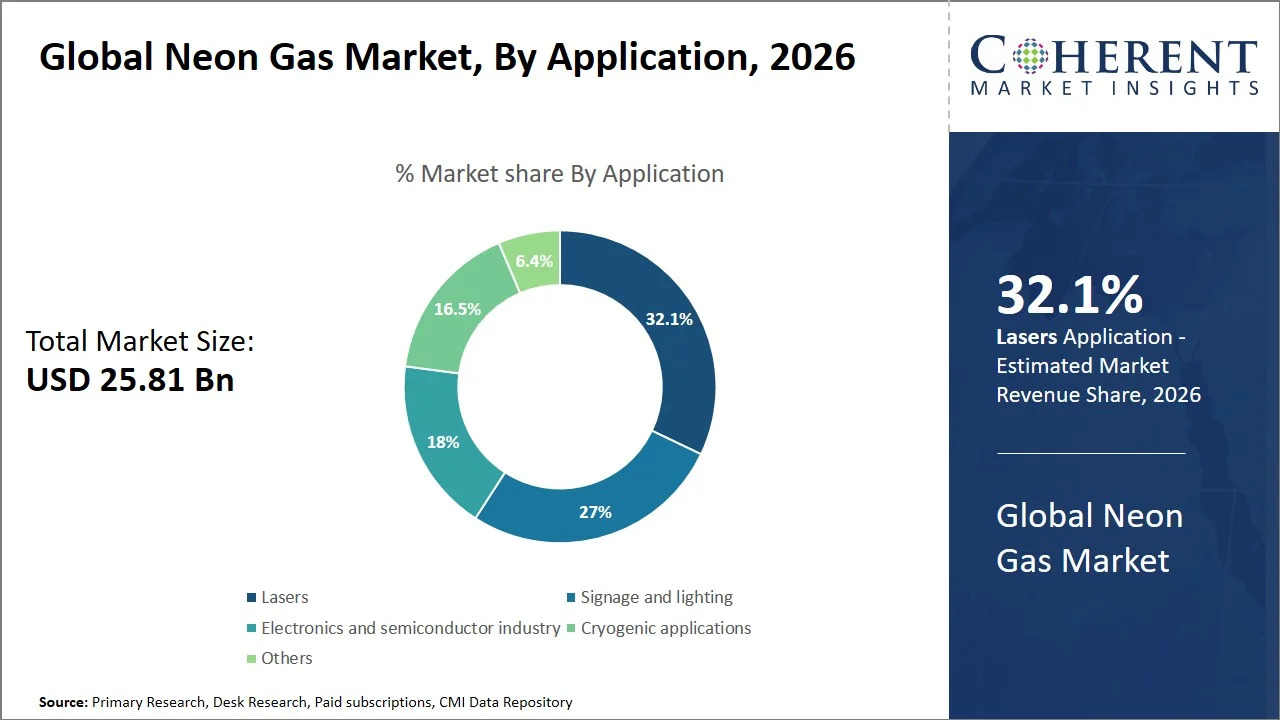
The lasers segment is expected to hold 32.1% share of the neon gas market in 2026. This leadership stems primarily from the essential role neon plays in the functioning of laser systems, especially neon-based gas lasers such as helium-neon (HeNe) lasers. Strong demand for neon gas is expected in industrial, medical and scientific applications. In the case of Helium‑neon (HeNe) lasers, for instance, a mixture of helium (≈85–90%) and neon (≈10–15%) is used as the lasing medium, and the output is a stable, monochromatic red laser (632.8 nm) that is widely utilized for metrology, alignment systems, scientific instruments, and industrial scanning/inspection.
Direct Sales Channel Segment Dominates the Neon Gas Market
The demand for unique service, quick response, and personalized solutions in the market is driving the direct sales segment to account for an estimated 39.6% of the neon gas market in 2026. Neon gas buyers, including industries like electronics manufacturing, laser technology companies, and specialized lighting businesses, appreciate the direct connection with suppliers to meet their unique and specific gas needs.
Most of the leading industrial gas companies offer integrated services such as custom-made blends of neon, purity certification, delivery arrangements, safety training and technical services relating to application, which are best delivered through direct sales rather than intermediaries.
Currents Events and their Impact
Current Events | Description and its Impact |
Trade Tensions Between the U.S. and Russia |
|
Environmental Compliance in Europe |
|
Neon Gas Market Dynamics
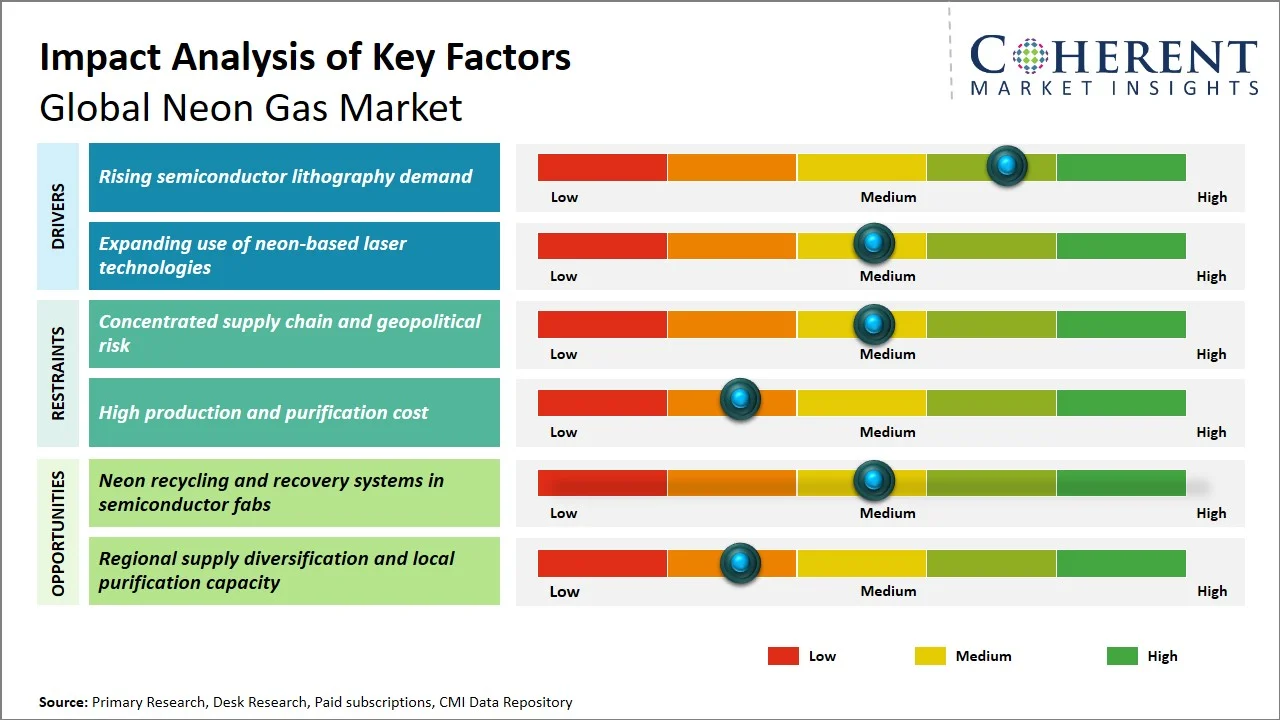
Market Driver
Rising Semiconductor Lithography Demand Fuels Neon Gas Market Expansion
The increasing demand for neon gas is largely attributed to its essential applications in semiconductor lithography, which is a fundamental step in the production of integrated circuits and microchips. Precision and reliability of lithography techniques are becoming more significant as semiconductor devices become more complex. Excimer Lasers are widely used in photolithography because they emit deep ultraviolet light which is required to etch out complex patterns on semiconductor wafers, and this process requires the use of Neon gas.
Semiconductor manufacturing consumes up to 90% of the demand for neon gas lasers and a qualified gas source can take 3 to 18 months to switch, explaining why chipmakers rely on stable supply of neon. The demand base is growing even more as SIA projected semiconductor sales of USD 791.7 billion world-wide in 2025 which is 25.6% higher than in 2024. (Source: Congress)
Expanding Use of Neon-based Laser Technologies
Neon gas is being used as a component of laser gas mixtures for semiconductor lithography, precision medical applications (LASIK), micromachining and research. Neon is used as a buffer gas with excimer lasers, which is made with a mixture of a noble gas and a halogen. Helium-Neon and excimer lasers are examples of gas lasers that are commonly used in a variety of industrial, medical, and scientific applications, according to the U.S. Occupational Safety and Health Administration (OSHA). (Source: OSHA)
Emerging Trends
- Rising Demand from Advanced Electronics & Semiconductors: As semiconductor fabrication nodes shrink and photonic technologies advance, the demand for ultra‑high‑purity neon (and neon‑based gas mixtures) is increasing. This trend is driving suppliers to develop tighter impurity controls and certification capabilities to meet stringent industry requirements.
- Integration with Specialty Laser and Lighting Technologies: Beyond traditional neon lighting, there is growing adoption in niche laser systems, scientific instrumentation, and next‑generation signage. Laser cooling, gas lasers, and photonics research are expanding the use cases, increasing the strategic value of neon supply in high‑tech ecosystems.
Regional Insights
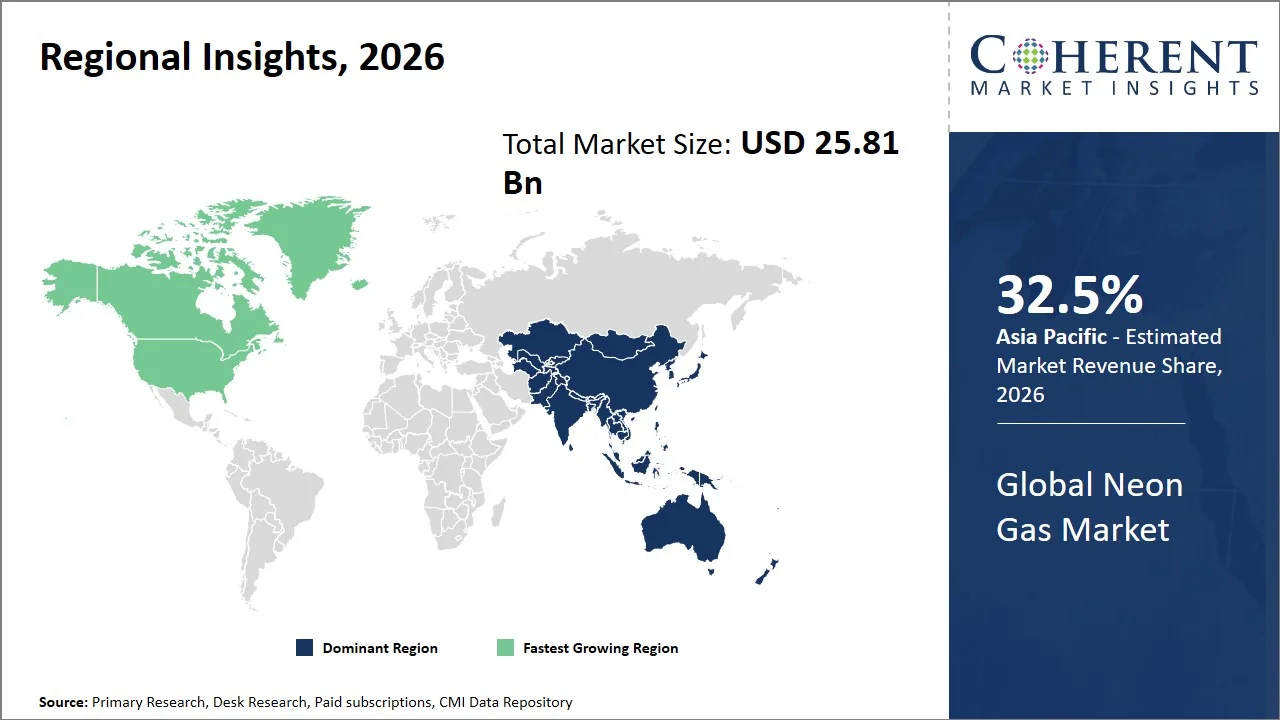
Why is Asia Pacific a Strong Market for Neon Gas?
Asia Pacific leads the global neon gas market, accounting for an estimated 32.5% share in 2026, due to the high growth rate of industrialization and growing electronics manufacturing hubs in the region's countries. Neon gas is increasingly being used in consumer electronics, and the government is pushing the advancement of semiconductors, thereby increasing the demand for this gas.
Foreign direct investment, growth of local supply chains, and expansion of capacity for the production of specialty gases will benefit the market ecosystem. The trade pattern here is one of increasing dependence on imports alongside improved trade-facilitating capacities. Some major companies are actively participating in the market by establishing partnerships and transferring technologies and even establishing production units to cover the increasing demand in the region such as Air Liquide, Showa Denko (Japan), and Taiyo Nippon Sanso Corporation.
Why Does the North America Neon Gas Market Exhibit High Growth?
The North America neon gas market is expected to exhibit the fastest growth with an estimated contribution of 22.3% share to the global market in 2026, due to its well established industrial ecosystem and advanced technological infrastructure. In the U.S., neon gas is vital to the production of semiconductor chips, as well as other high-tech applications, and is needed constantly and in high quality because of several large semiconductor fabrication facilities, especially in Silicon Valley and in other states.
The government's policies fostering technological innovations and enormous investments in electronics and defense industries have helped increase the demand for specialty gases including neon. The favorable trading environment is related to the high production capacities of the domestic market and import/export channels of raw materials and components. Companies like Air Products and Chemicals Inc., Linde plc (North America), and Praxair are well established here and can provide complete supply chains and tailored solutions to meet the complex requirements of semiconductor, lighting and healthcare businesses.
Neon Gas Market Outlook for Key Countries
Why is the U.S. Leading Innovation and Adoption in the Neon Gas Market?
Neon gas is used in high-purity levels in the advanced semiconductor manufacturing and specialized lighting industries that drive the U.S. neon gas market. The U.S. Geological Survey (USGS) reported that U.S. production of rare gas includes ~110 million liters of neon (crude and purified), and also significant import volumes are reported in a similar range, suggesting import reliance as well as production. (Source: U.S. Geological Survey)
Is China Emerging as a Key Growth Hub for the Neon Gas Market?
The China neon gas market is expanding rapidly due to its strategic push towards becoming a leader in semiconductor manufacturing. Market growth is encouraged by the government's policies of research, development and huge investments in infrastructure. Historically, the world's largest producers of neon were Ukraine and Russia, and China has been increasing its production capacity for neon gas for the booming semiconductor and electronics industry. China is expected to manufacture large portions of the neon capacity in Asia Pacific (e.g. tens of millions of cubic meters per year).
Is South Korea a Favorable Market for Neon Gas?
The South Korea neon gas market is closely linked with the semiconductor manufacturer industry and the top fabricators include Samsung Electronics and SK Hynix. These companies need secure, ultra-high purity neon for excimer lasers in photolithography (which is key to advanced chip patterning). For example, POSCO's air separation plant in Gwangyang can yield tens of thousands of cubic meters of neon a year, a significant portion of the country's demand.
Why Does Germany Top the European Neon Gas Market?
The industrial base in Germany is strong, with the automotive, electronics, and healthcare industries relying on neon gas to manufacturing and lighting purposes. Germany is an important industrial consumer, and a historically large importer of rare gases such as neon from Russia and Ukraine, but has made a strong effort to diversify its supply since the onset of global geopolitical upheavals. Germany is not a large producer of neon, but it has strong air separation and logistics capabilities throughout the EU industrial gas producers. Historically, EU rare gas imports are highly dependent on Russia and Ukraine, and diversification is taking place to suppliers from China and the U.S. and also towards regional purification capacity, where available.
Is the Neon Gas Market Developing in Japan?
The market in Japan benefits from established industrial players and advanced manufacturing ecosystems, backed by companies like Showa Denko and Taiyo Nippon Sanso Corporation, which are key regional and global suppliers. Japan has always been a well-developed neon gas consumer because of its advanced electronics industry, precision manufacturing and laser system industries. In excimer lasers used for lithography, and in certain specialty industrial applications, neon plays a vital role.
How Does the Demand for Sustainable Neon Supply Create Opportunities in the Global Neon Gas Market
The growing reliance on neon in semiconductor fabrication, particularly for photolithography and excimer laser processes, is creating a significant opportunity for advanced neon recycling and recovery systems. Semiconductor fabs are increasingly adopting these solutions to enhance sustainability, ensure supply stability, and reduce costs amid the geopolitical instability of neon supply, particularly from Ukraine. Support from the Japanese Ministry of Economy, Trade and Industry (METI) for rare gas recycling further highlights the economic and strategic potential of neon recovery. Implementing efficient recovery systems allows fabs to secure a stable neon supply, optimize operational costs, and strengthen environmental sustainability, positioning neon recycling as a key growth avenue in the semiconductor industry.
Macro- and Micro-Economic Factors Impacting the Neon Gas Market
Factor Type | Specific Factor | Description / Impact | Likely Effect on the Neon Gas Market |
Macro | Global Energy Prices | Neon production is energy-intensive; price spikes increase production cost | ↑ Cost, potential price pass-through |
Macro | Global GDP Growth | Industrial expansion in semiconductor, lighting, electronics sectors | ↑ Demand for neon |
Micro | Input Cost Volatility | Fluctuating costs of electricity and air separation chemicals | ↑ Cost unpredictability |
Micro | Supply Chain Efficiency | Storage, transport, and just-in-time logistics impact availability | ↓ Supply risk, ↑ reliability advantage |
Market Players, Key Development, and Competitive Intelligence
Key Developments
- In June 2024, Air Liquide announced a USD 250 million investment to build a new industrial gas production facility in Idaho, U.S., supporting Micron Technology’s semiconductor fab and other local customers. The plant will supply ultra-pure nitrogen and other gases, create hundreds of jobs, and operate with 5% greater energy efficiency and a target of 100% renewable electricity.
- In June 2024, EFC Gases & Stanford Advanced Materials launched an innovative Neon Gas Recycling System for semiconductor manufacturing. The system captures spent neon from laser exhausts, reconditions it, and reuses it in new laser mixes. This reduces energy-intensive neon production, lowers carbon footprint, and ensures stable neon supply for chip fabrication.
Competitive Landscape
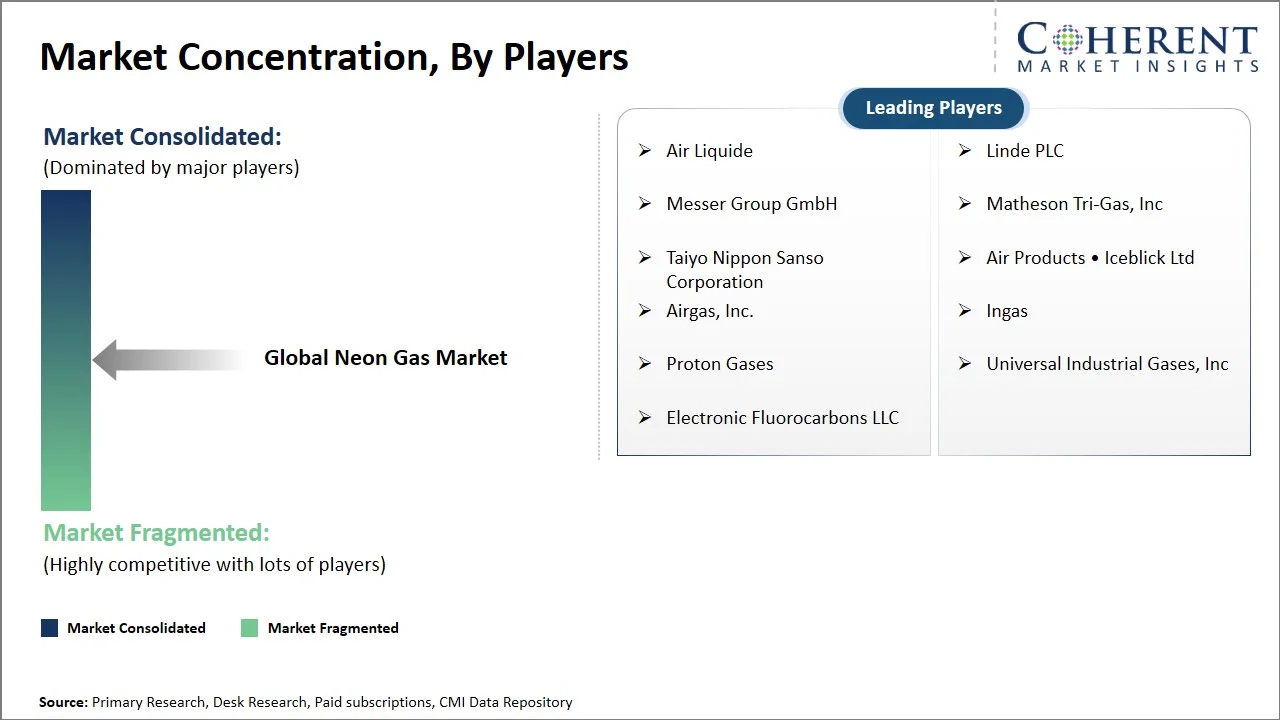
The neon gas market is moderately concentrated, with a mix of established global suppliers and regional specialty producers. Competition is shaped by the strategic importance of neon in high‑tech applications, limited global supply capacity, and the cost‑intensive nature of extraction and purification processes. Key focus areas include:
- Reliability and high purity supplies
- Logistics and long-term contracts
- Capacity expansion and geographical diversification
Market Report Scope
Neon Gas Market Report Coverage
| Report Coverage | Details | ||
|---|---|---|---|
| Base Year: | 2025 | Market Size in 2026: | USD 25.81 Bn |
| Historical Data for: | 2020 To 2024 | Forecast Period: | 2026 To 2033 |
| Forecast Period 2026 to 2033 CAGR: | 6.2% | 2033 Value Projection: | USD 39.32 Bn |
| Geographies covered: |
| ||
| Segments covered: |
| ||
| Companies covered: | Air Liquide, Linde PLC, Messer Group GmbH, Matheson Tri-Gas, Inc, Taiyo Nippon Sanso Corporation, Air Products Iceblick Ltd, Airgas, Inc., Ingas, Proton Gases, Universal Industrial Gases, Inc, and Electronic Fluorocarbons LLC | ||
| Growth Drivers: |
| ||
| Restraints & Challenges: |
| ||
Analyst Opinion (Expert Opinion)
- The neon gas industry is forecasted to experience steady growth during the next decade. The primary factors contributing to such a forecast include high demand for neon in various high-tech applications such as lighting, semiconductors, and lasers. Growth in the electronics sector on an international level will also stimulate increased demand for neon gas products. Global resources are few and extraction is costly, thus there is an inherent risk associated with the inability of suppliers to increase the available supply, thereby creating an even more lucrative market.
- Maximizing opportunities are anticipated in industrial lighting and semiconductor applications in the Asia Pacific region, especially in countries like China, Japan, and South Korea. The high volume of electronics manufacturing and the continued urban development in these areas are driving continual demand for neon-based lighting solutions and specialty gas solutions. There are additional opportunities for growth in niche applications, such as gas lasers and scientific instruments with high dollar revenues, which exist in North America and Europe.
Speak to the analyst
Want personalized insights?
Take the findings above to one of our principal consultants, or have the report rebuilt around the segments, geographies and competitors you actually track.
Market Segmentation
- Supply Mode Insights (Revenue, USD Bn, 2021 - 2033)
- Cylinders
- Bulk & micro bulk
- Drum tanks
- On-site
- Application Insights (Revenue, USD Bn, 2021 - 2033)
- Lasers
- Signage and lighting
- Neon signs
- Neon lighting for architecture
- Neon art and decorative lighting
- Electronics and semiconductor industry
- Plasma display panels (PDPs)
- Neon indicator lamps
- Gas lasers
- Cryogenic applications
- Cryogenic refrigeration
- Cryogenic pumping systems
- Others
- Distribution Channel Insights (Revenue, USD Bn, 2021 - 2033)
- Direct Sales
- Distributors and Wholesalers
- Online Retail
- Regional Insights (Revenue, USD Bn, 2021 - 2033)
- North America
- U.S.
- Canada
- Latin America
- Brazil
- Argentina
- Mexico
- Rest of Latin America
- Europe
- Germany
- U.K.
- Spain
- France
- Italy
- Russia
- Rest of Europe
- Asia Pacific
- China
- India
- Japan
- Australia
- South Korea
- ASEAN
- Rest of Asia Pacific
- Middle East
- GCC Countries
- Israel
- Rest of Middle East
- Africa
- South Africa
- North Africa
- Central Africa
- North America
- Key Players Insights
- Air Liquide
- Linde PLC
- Messer Group GmbH
- Matheson Tri-Gas, Inc
- Taiyo Nippon Sanso Corporation
- Air Products • Iceblick Ltd
- Airgas, Inc.
- Ingas
- Proton Gases
- Universal Industrial Gases, Inc
- Electronic Fluorocarbons LLC
Sources
Primary Research Interviews
- Industrial gas manufacturer (neon purification specialist)
- Supply Chain Director of semiconductor-grade noble gas producer
- Cryoin Engineering Ltd. (Ukrainian neon producer)
Stakeholders
- Manufacturers of neon gas and noble gases (e.g., Air Liquide S.A., Linde AG, The Messer Group GmbH, Airgas, Inc., Praxair Technology Inc., Air Products and Chemicals, Inc., Nippon Sanso Holdings, Taiyo Nippon Sanso Corporation)
- End-use Sectors
- Semiconductor Manufacturing (e.g., TSMC, Intel, Samsung, SK Hynix) – primary consumer for excimer laser gas mixtures
- LCD/Flat Panel Display Manufacturers (e.g., LG Display, BOE, Samsung Display) – LTPS backplane annealing
- Lighting & Signage Manufacturers (neon signs, advertising displays)
- Laser Technology Companies (medical lasers, industrial cutting lasers)
- Regulatory & Certification Bodies
- Compressed Gas Association (CGA) – safety standards for gas handling/storage/transportation
- ASTM International – performance standards for noble gas purity
- ISO (International Organization for Standardization) – gas purity specifications
- E-commerce Platforms and Retailers
- Industrial gas distributors (Airgas local branches, Linde Gas distributors)
- Grainger, MSC Industrial Supply – industrial gas suppliers
- Amazon Business, Alibaba – small-quantity neon gas sales
- Technology Integration Players: BASF (specialty gases and materials)
- ASML (semiconductor lithography systems using neon laser gases)
- Cymer (excimer laser technology for semiconductor manufacturing)
Databases
- UN Comtrade Database (HS Code 2804.29 for other rare gases including neon)
- India Import Export (EXIM) Database – neon gas import/export data
- USGS Construction Materials Reports – rare gases production statistics
- Eurostat Trade Statistics for Industrial Gases
Magazines
- Industrial Gases Magazine – Trends in noble gas production and supply chain
- Semiconductor Engineering – Neon gas in chip manufacturing
- Professional Roofing Magazine – (reference format adaptation)
- Lighting Design & Application – Neon lighting applications
- Laser Focus World – Laser technology and excimer gas mixtures
- Gas World – Industrial gas market news and analysis
- Chemical & Engineering News – Noble gas market dynamics
Journals
- Journal of Building Engineering – (reference format adaptation)
- Semiconductor Science and Technology – Neon gas in lithography processes
- Journal of Vacuum Science & Technology – Ultra-high purity gas standards
- Applied Physics Letters – Excimer laser gas mixtures and performance
- Cryogenics – Neon as cryogenic refrigerant
- Journal of Industrial Gas Technology – Noble gas purification methods
Newspapers
- The Wall Street Journal – Construction demand for building materials
- Business Standard (India) – Growth in housing and wraps imports
- Construction Dive – Supply chain for envelopes
Associations
- National Roofing Contractors Association (NRCA)
- Building Enclosure Technology and Environment Council (BETEC)
- Sealant, Waterproofing & Restoration Institute (SWRI)
- Vinyl Siding Institute (VSI)
- International Institute of Building Enclosure Consultants (IIBEC)
- American Institute of Architects (AIA) Building Enclosure Councils
Public Domain Sources
- EPA – Guidelines for building product VOCs and synthetics
- International Code Council (ICC) – Standards for weather barriers
- US Department of Energy – Energy-efficient envelope guidelines
- OECD – Sustainable construction materials trade reports
Proprietary Elements
- CMI Data Analytics Tool, Proprietary CMI Existing Repository of information for last 10 years.
Get access to 250+ pages report
Every segment, forecast, competitor profile and data table behind the analysis above — available for instant download.
- ESOMAR Member
- ISO 9001:2015 Certified
- D-U-N-S Registered
- GDPR & CCPA Compliant
Missing comfort of reading report in your local language? Find your preferred language:
Transform your Strategy with Exclusive Trending Reports
Frequently Asked Questions
The global neon gas market is estimated to be valued at USD 25.81 Bn in 2026 and is expected to reach USD 39.32 Bn by 2033.
The CAGR of global neon gas market is projected to be 6.2% from 2026 to 2033.
The neon gas market covers the global production, distribution, and consumption of neon — a rare, inert noble gas used across multiple industries including semiconductors, lasers, lighting, and more.
Rising semiconductor lithography demand and expanding use of neon-based laser technologies are the major factors driving the growth of global neon gas market.
While alternatives exist for some lighting uses, in semiconductor lithography and certain laser systems, neon’s properties (e.g., purity and emission characteristics) are difficult to replace fully.
Concentrated supply chain and geopolitical risk and high production and purification cost are the major factors hampering the growth of the global neon gas market.
In terms of supply mode, cylinders are estimated to dominate the market revenue share in 2026.