

North America and U.S. Trocar Market Size and Forecast – 2026 To 2033
The North America and U.S. trocar market is expected to grow from USD 329.7 Mn in 2026 to USD 511.0 Mn by 2033, registering a compound annual growth rate (CAGR) of 6.5% from 2026 to 2033. The North America and U.S. trocar market is poised for significant expansion, fueled by the rising utilization of minimally invasive and robotic-assisted surgical procedures.
In January 2025, a study published by the National Library of Medicine indicated that hospitals implementing robotic-assisted surgery saw a growth in minimally invasive surgery from 60.5% to 65.8%. The adoption of these minimally invasive procedures is predicted to lead to an increasing demand in trocar systems for laparoscopic and robotic surgery.
(Source: National Library of Medicine)
Key Takeaways of the North America and U.S. Trocar Market
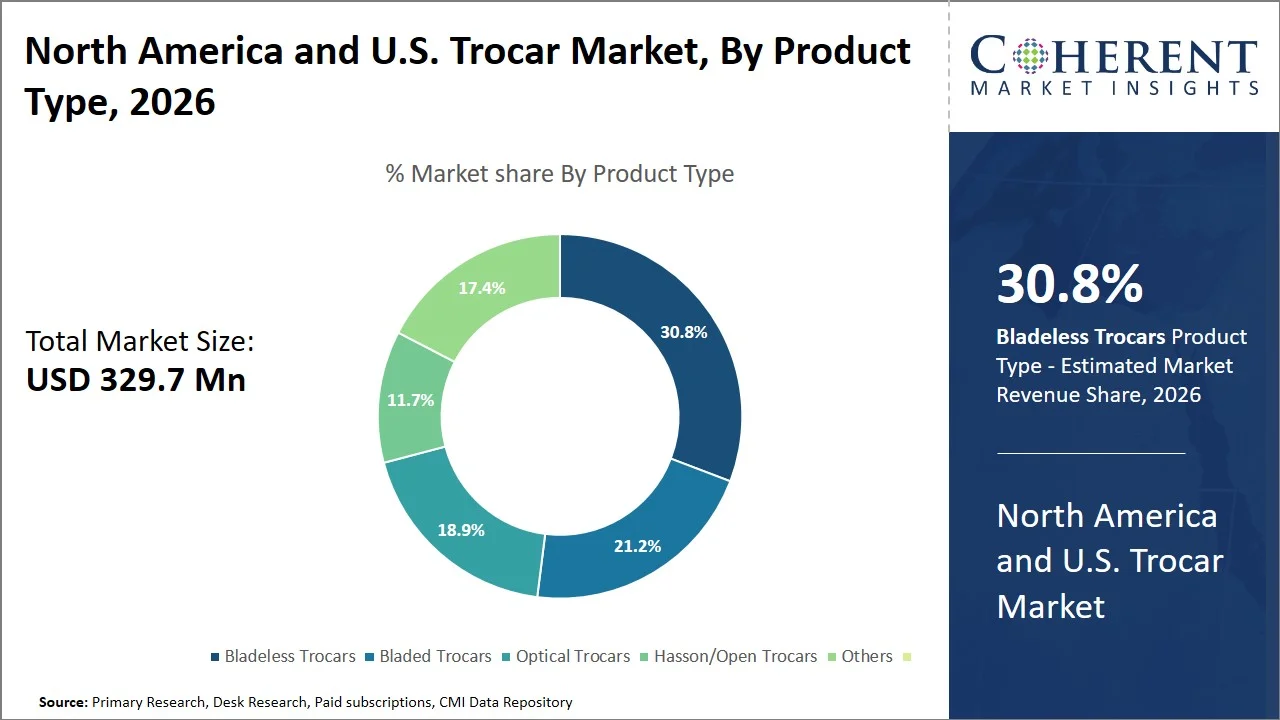
- Bladeless trocars are projected to hold 30.8 % of the North America and U.S. trocar market share in 2026, making it the dominant product type segment, owing to their ability to reduce tissue trauma and improve safety during minimally invasive procedures. The segment continues to benefit from increasing adoption of advanced laparoscopic access technologies. For instance, Applied Medical's Kii Bladeless Trocar System remains one of the most widely used bladeless access platforms in the U.S., featuring a fixation sleeve technology designed to enhance stability and reduce inadvertent tissue damage during surgery. (Source: Applied Medical Resources Corporation)
- Disposable is projected to hold 72.6 % of the North America and U.S. trocar market share in 2026, making it the dominant usability segment, due to growing emphasis on infection control, operating room efficiency, and elimination of reprocessing costs. The segment is further supported by healthcare-acquired infection (HAI) prevention initiatives across healthcare facilities. For instance, the U.S. Centers for Disease Control and Prevention estimates that approximately 1 in 31 hospital patients acquires at least one healthcare-associated infection on any given day, encouraging healthcare providers to adopt single-use surgical devices wherever feasible. (Source: Centers for Disease Control and Prevention)
- General surgery is projected to hold 33.8 % of the North America and U.S. trocar market share in 2026, making it the dominant application segment, driven by the high volume of laparoscopic procedures performed for hernia repair, appendectomy, and cholecystectomy. The segment continues to benefit from the growing adoption of minimally invasive surgical techniques aimed at improving patient outcomes. For instance, according to the American College of Surgeons (ACS), minimally invasive surgery (MIS) often provides patients with fewer complications, shorter hospital stays, and faster recovery compared with open surgery across a range of procedures, including general surgery. (Source: American College of Surgeons)
- Increasing Adoption of Robotic-Assisted Surgery: The increased use of robotic-assisted surgeries in various hospitals and surgical specialty centers leads to a considerable demand for high-end trocar systems. Robotic procedures require multiple access ports with enhanced stability, sealing capabilities, and compatibility with robotic instruments. As healthcare providers continue expanding robotic surgery programs into general surgery, gynecology, and urology, the utilization of premium trocar devices is expected to increase significantly.
- Rising Utilization of Minimally Invasive Surgery in Aging Population: With the rise in the elderly population across North America, the demand for minimally invasive surgery procedures will increase because of their association with post-operative pain reduction, hospital discharge in fewer days and quick recovery times. The increase in the elderly undergoing laparoscopic procedures for gastrointestinal, urological, and gynecological applications should spur demand for these trocar access devices underlining a long-term trend.
Segmental Insights
Why Do Bladeless Trocars Dominate the North America and U.S. Trocar Market?
Bladeless trocars are projected to hold a market share of 30.8% in 2026, as the design allows them to separate the layers instead of cutting them, aiding in minimal tissue damage and increase safety during the surgical procedure. Furthermore, the design of the system allows the surgeons to have controlled entry and the minimal damage to the abdominal wall, increasing surgeon confidence during laparoscopic procedures. Health professionals have started to concentrate more on the patient safety and efficiency of the minimally invasive surgeries and are hence inclining towards the bladeless trocars. For instance, optical and bladeless access techniques are cited by the Society of American Gastrointestinal and Endoscopic Surgeons (SAGES) as methods used to improve safe entry into the abdomen during laparoscopic surgery. Increased focus on safer access techniques and reduction in complications is driving the preference for bladeless trocar technologies in North America surgical centers. (Source: Society of American Gastrointestinal and Endoscopic Surgeons)
- Current Industry Events of 2026
- Market Size Estimation
- Regional Breakdown
- Competitive Landscape
- Customer Intelligence
- Segmental Analysis
- Pricing Analysis
- Key Market Drivers, Challenges & Future Trends
- Customized Insights Section
Why Does Disposable Represent the Largest Usability Segment in the North America and U.S. Trocar Market?
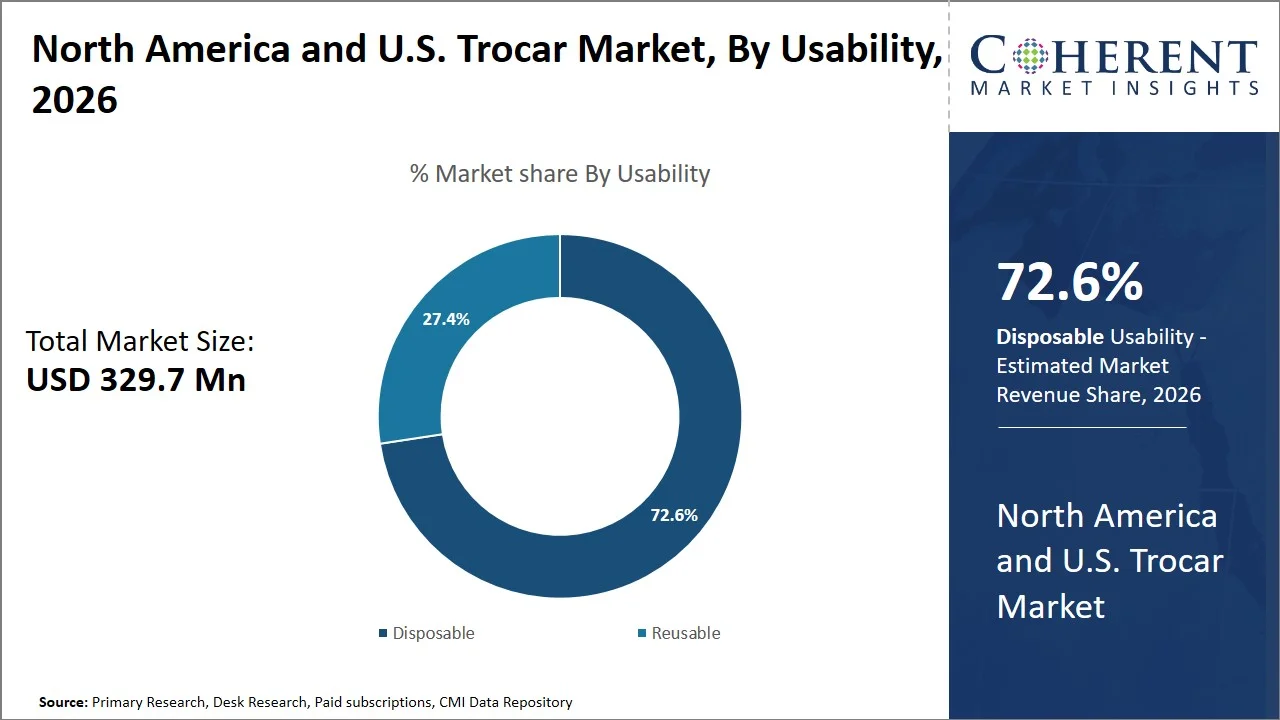
Disposable is projected to hold 72.6% of the market share in 2026, as they eliminate the need for reprocessing, decrease the procedure turnaround time and have assured device consistency. Hospitals are emphasizing the use of single use surgical devices in order to decrease the workload involved in sterilization procedures and minimize the operational hazards by eliminating the usage of reusable surgical instruments. This trend is particularly apparent in high-volume hospitals and ambulatory surgical centers performing minimally invasive procedures. For instance, the U.S. FDA defines Single-use devices (SUDs) as devices that are supposed to be used one time or on only one patient during only one procedure. The reprocessed Single-use devices (SUDs) are covered under strict regulatory standards just like the original device manufacturers, and therefore healthcare providers favor clean, sterile, and ready-to-use disposable devices, such as disposable trocars. (Source: Food and Drug Administration)
General Surgery Segment Dominates the North America and U.S. Trocar Market
The general surgery segment is expected to hold 33.8% of the North America and U.S. trocar market share in 2026, due to high volumes of laparoscopic procedures, for conditions such as gall bladder diseases, appendicitis, hernias, and colorectal diseases that occur at large volumes annually. These procedures require a high number of access points to visualize the operative field and allow instruments into the operative area and therefore using a large volume of trocars. An increasing trend toward minimally invasive surgery in standard abdominal operations further supports the segment growth. For instance, cholecystectomy is the most common intra-abdominal operation in the U.S., with over 1.2 million cases performed annually, with laparoscopic cholecystectomy being the most common approach. The sustained procedural volume of one of the most frequently performed general surgeries continues to drive considerable demand for trocar devices. (Source: National Library of Medicine)
Currents Events and their Impact
Current Events | Description and its Impact |
U.S. FDA Quality Management System Regulation (QMSR) Implementation (Effective February 2026) |
|
CMS Expansion of Ambulatory Surgical Center (ASC) Payment Policies (November 2025) |
|
(Source: Food and Drug Administration, Centers for Medicare & Medicaid Services)
North America and U.S. Trocar Market Dynamics
Market Drivers
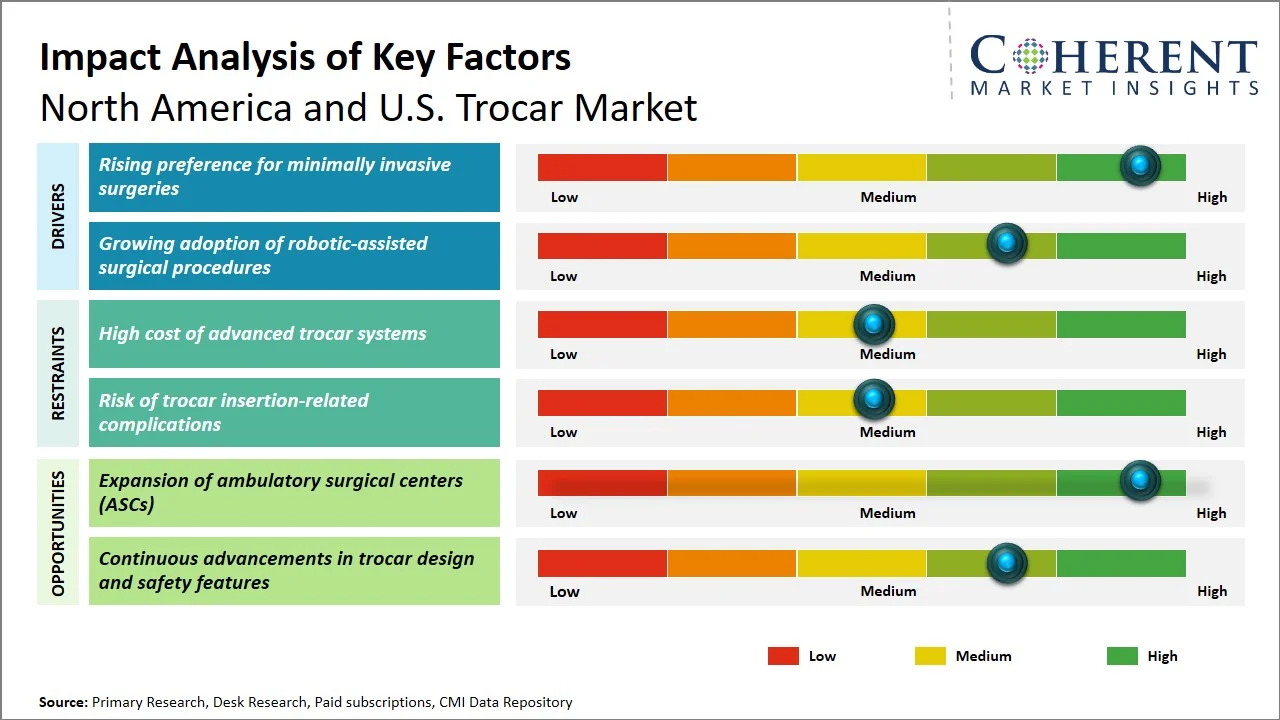
- Rising preference for minimally invasive surgeries: The increasing adoption rate of minimally invasive surgery (MIS) is the main factor driving the North America and U.S. trocar market. In comparison to the open surgery, MIS has more benefits like less postoperative pain, fewer complications, shorter hospital stay and faster recovery time, thus leading to the greater use in most surgeries across various specialties. As trocar is one of the basic surgical instruments in laparoscopy surgery, the increasing number of minimally invasive surgery (MIS) procedure will continuously drive the market for trocars. For instance, according to the American Society for Metabolic and Bariatric Surgery (ASMBS), in the U.S., approximately more than 280,000 bariatric surgeries are performed each year, with the vast majority conducted using minimally invasive laparoscopic techniques. Growing procedural volume is fueling sustained demand for trocar-based surgical access systems. (Source: American Society for Metabolic and Bariatric Surgery)
- Growing adoption of robotic-assisted surgical procedures: Rising adoption of robotic-assisted surgery across North America and the U.S. is leading to the rising demand for innovative trocar systems. Access ports in robotic surgery need more stability, better sealing capacity and good compatible with the surgical robot; thereby making trocar an indispensable part of the surgical work-flow. Additionally, the growing popularity of robotic surgery among general surgery, gynecology, colorectal surgery and urology is providing an impetus to the market. For instance, Intuitive Surgical reported that its da Vinci 5 robotic platform was used in more than 32,000 procedures during its first year on the market in 2024. This indicates the quick adoption of robotic assisted surgery into U.S healthcare and will likely fuel the demand for custom trocar and surgical access devices with greater robotic utilization. (Source: Intuitive Surgical)
Emerging Trends
- Shift Toward Disposable and Infection-Control Focused Trocar Systems: Due to concerns of cross-contamination and eliminated need for reprocessing, healthcare institutions throughout North America are expanding their use of disposable trocars. This expansion is most pronounced in the hospital and ambulatory surgery centers that are focusing on bolstering infection prevention measures and increasing OR efficiency.
- Growing Preference for Bladeless and Optical Entry Technologies: Bladeless and optical trocars are gaining popularity among surgeons as they offer improved visualization upon insertion and less trauma to the tissue, as well as fewer access related complications. This is spurring manufacturers toward safety- enhanced access devices which help to increase the accuracy and reliability of Minimally Invasive Surgery.
Regulatory and Reimbursement Factors Influencing the North America and U.S. Trocar Market
Framework Area | Current Scenario | Impact on Market | Outlook |
FDA Device Approval Pathways | 510(k)-based approvals for most trocar systems | Accelerates commercialization of innovative trocar technologies | Positive |
Reimbursement for MIS Procedures | Strong CMS and private payer support for laparoscopic procedures | Encourages adoption of trocar-based minimally invasive surgeries | Positive |
Ambulatory Surgical Center (ASC) Expansion | Increasing shift of procedures to ASCs | Drives demand for disposable and cost-effective trocars | Highly Positive |
Infection Prevention Requirements | Growing emphasis on reducing cross-contamination risks | Supports adoption of single-use trocar systems | Positive |
Robotic Surgery Adoption | Expanding utilization across hospitals and ASCs | Increases demand for advanced trocar and access platforms | Highly Positive |
How are the continuous advancements in trocar design and safety features creating new growth opportunities in the North America and U.S. trocar market?
Increased emphasis on simplifying the minimally invasive surgery access pathway is leading to opportunities for the North America and U.S. trocar market. Hospitals and surgeons are increasingly electing to use trocars that have optical visualization, have a bladeless design and high seal performance. The emergence of complex laparoscopic techniques and robotics, which rely on maintaining consistent access and pneumoperitoneum has further increased its adoption. For instance, in October 2024, Johnson & Johnson MedTech released its ECHELON ENDOPATH Staple Line Reinforcement (SLR) for bariatric, thoracic and general surgical use. This launch supports the industry-wide trend towards achieving better surgical results, procedure consistency and safety by utilizing the latest advancements in minimally invasive surgical technologies. (Source: Johnson & Johnson)
Market Players, Key Development, and Competitive Intelligence
Key Developments
- On June 3, 2026, Medtronic filed 510(k) submissions in the U.S. to extend use of its Hugo robot-assisted surgery system to general surgery and gynecologic surgical applications. These filings were designed to bring robotic-assisted minimally invasive surgeries to more surgical specialties. It is anticipated that demand for state-of-the-art robotic trocar and surgical access devices would continue to grow.
- In October 2025, Bayou Surgical released the advanced 5 mm troCarWash System, an automated scope cleaner, which aims to aid physicians with clear visualization while performing minimal access procedures. The system was designed to minimize interruptions caused by lens contamination and thus streamline procedures. The new product is illustrative of the technology advancing in the realm of laparoscopy to complement and expand the scope of trocars in minimally invasive techniques.
Competitive Landscape
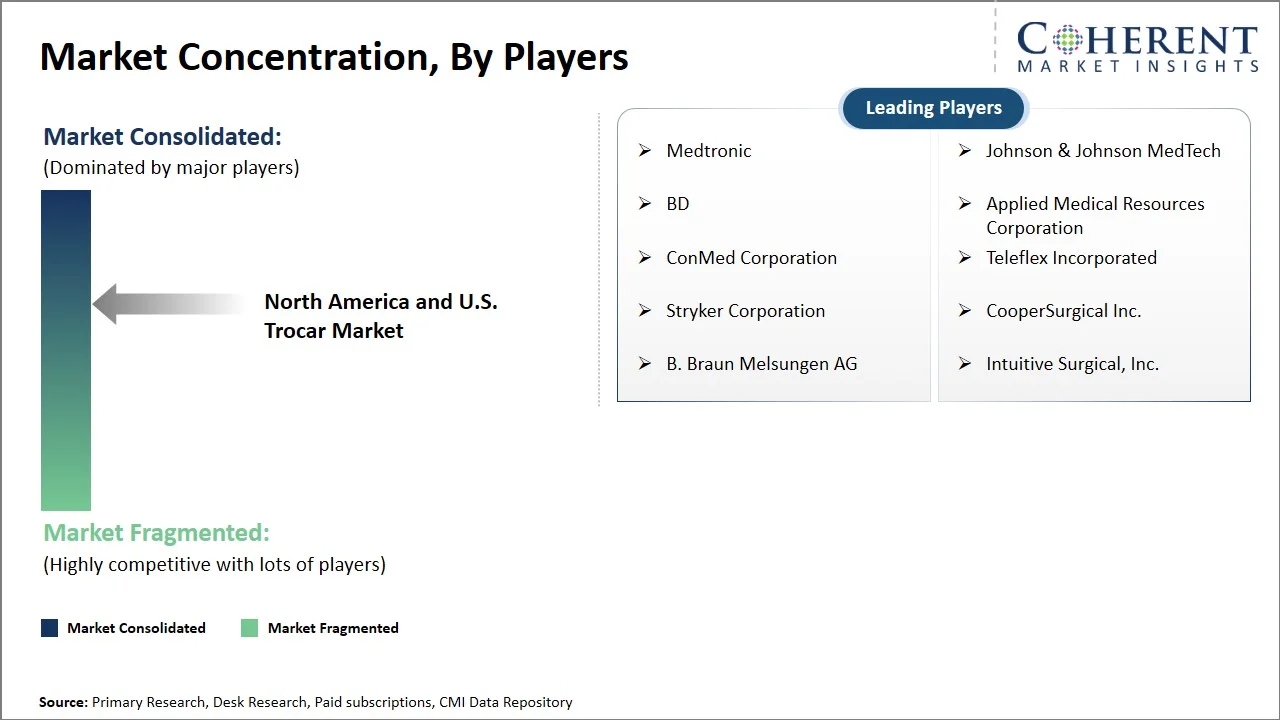
The North America and U.S. trocar market is highly competitive, dominated by leading medical device companies interested in the development of innovative products, in improving surgeons' safety and further expanding the field of minimally invasive surgery. Companies continue to invest heavily in trocar technologies that increase access stability, minimize the occurrence of insertion related complications and enhance portability with laparoscopic and robotic-assisted surgical procedures. New product development and a growing number of minimally invasive surgery products continue to be a priority. Key focus areas include:
- Development of bladeless, optical, and safety-enhanced trocar systems
- Expansion of robotic surgery-compatible access and port technologies
- Innovation in disposable trocars to support infection prevention initiatives
- Enhancement of sealing mechanisms for improved pneumoperitoneum maintenance
- Strengthening distribution networks and partnerships with hospitals and ambulatory surgical centers (ASCs)
Market Report Scope
North America and U.S. Trocar Market Report Coverage
| Report Coverage | Details | ||
|---|---|---|---|
| Base Year: | 2025 | Market Size in 2026: | USD 329.7 Mn |
| Historical Data for: | 2020 To 2024 | Forecast Period: | 2026 To 2033 |
| Forecast Period 2026 to 2033 CAGR: | 6.5% | 2033 Value Projection: | USD 511.0 Mn |
| Segments covered: |
| ||
| Companies covered: | Medtronic, Johnson & Johnson MedTech, BD, Applied Medical Resources Corporation, ConMed Corporation, Teleflex Incorporated, Stryker Corporation, CooperSurgical Inc., B. Braun Melsungen AG, and Intuitive Surgical, Inc. | ||
| Growth Drivers: |
| ||
| Restraints & Challenges: |
| ||
Analyst Opinion (Expert Opinion)
- The North America and U.S. trocar market is expected to continue evolving toward minimally invasive and robotic-assisted surgical procedures, which are increasingly becoming the standard of care across general surgery, gynecology, urology, and bariatric surgery. Future demand is likely to shift toward advanced trocar systems offering enhanced safety features, improved visualization capabilities, and compatibility with robotic surgical platforms. Additionally, the adoption of disposable trocars is expected to increase due to the growing emphasis on infection prevention and patient safety.
- The maximum growth opportunity lies within robotic-assisted general surgery in the U.S, as hospitals are increasing robotic surgery programs more quickly outside of the typical specialty applications of urology and gynecology. Disposable bladeless trocars are expected to grow substantially due to safety and convenience, as a higher volume of minimally invasive procedures in hospitals and ambulatory centers are likely to favor the product.
- In order to create an advantage for themselves, the competitors must focus on enhancing the availability of robotic surgery compatible trocar platforms, building and maintaining partnerships with hospitals and ambulatory surgical centers (ASCs) and invest in safety-increasing technologies like optical access and bladeless systems. Products will need to be coupled with surgeon training, generation of clinical data and value-based pricing schemes to consolidate market position.
Speak to the analyst
Want personalized insights?
Take the findings above to one of our principal consultants, or have the report rebuilt around the segments, geographies and competitors you actually track.
Market Segmentation
- Product Type Insights (Revenue, USD Mn, 2021 - 2033)
- Bladeless Trocars
- Bladed Trocars
- Optical Trocars
- Hasson/Open Trocars
- Others
- Usability Insights (Revenue, USD Mn, 2021 - 2033)
- Disposable
- Reusable
- Application Insights (Revenue, USD Mn, 2021 - 2033)
- General Surgery
- Gynecology
- Urology
- Bariatric
- Others
- End User Insights (Revenue, USD Mn, 2021 - 2033)
- Hospitals
- Ambulatory Surgical Centers (ASCs)
- Specialty Clinics
- Day Care Surgical Centers
- Others
- Key Players Insights
- Medtronic
- Johnson & Johnson MedTech
- BD
- Applied Medical Resources Corporation
- ConMed Corporation
- Teleflex Incorporated
- Stryker Corporation
- CooperSurgical Inc.
- Braun Melsungen AG
- Intuitive Surgical, Inc.
Sources
Primary Research Interviews
- General Surgeons – laparoscopic procedure trends, trocar selection criteria, and minimally invasive surgery adoption
- Bariatric Surgeons – trocar utilization in weight-loss and metabolic surgeries
- Gynecologic Surgeons – demand for laparoscopic and robotic-assisted access devices
- Urologists – robotic surgery penetration and trocar performance requirements
- Directors of Surgery / Operating Room Managers – surgical device procurement and utilization trends
- Ambulatory Surgical Center (ASC) Administrators – adoption of disposable trocars and outpatient surgery trends
- Hospital Procurement Managers – purchasing patterns for trocar and laparoscopic access systems
- Clinical Engineering & Sterile Processing Teams – reusable versus disposable trocar preferences
Stakeholders
- Trocar and Minimally Invasive Surgery Device Manufacturers (e.g., Medtronic, Johnson & Johnson MedTech, Applied Medical, BD, ConMed)
- End-use Sectors
- Hospitals
- Ambulatory Surgical Centers (ASCs)
- Specialty Surgical Clinics
- Academic Medical Centers
- Regulatory & Health Bodies
- U.S. Food and Drug Administration (FDA)
- Health Canada
- Centers for Medicare & Medicaid Services (CMS)
Databases
- U.S. FDA 510(k) Database – trocar approvals, clearances, and device classifications
- CMS Data Repository – surgical utilization and outpatient procedure trends
- CDC National Center for Health Statistics (NCHS) – hospital and surgical procedure statistics
- National Library of Medicine (PubMed) – clinical studies on laparoscopic and robotic surgery
- ClinicalTrials.gov – ongoing trials involving minimally invasive and robotic-assisted procedures
- American College of Surgeons National Surgical Quality Improvement Program (ACS NSQIP) – surgical outcomes and procedural trends
Magazines
- OR Manager – operating room technologies and surgical device adoption
- Medical Design & Outsourcing – minimally invasive surgical device innovations
- MedTech Dive – medical device developments and regulatory updates
- Surgical Products Magazine – laparoscopic instrumentation and access device trends
- Healthcare Purchasing News – hospital procurement and surgical equipment purchasing trends
Journals
- Surgical Endoscopy – laparoscopic and robotic surgery research
- Journal of Minimally Invasive Gynecology – gynecologic MIS procedures and technologies
- Annals of Surgery – surgical outcomes and procedural advancements
- Journal of Laparoendoscopic & Advanced Surgical Techniques – trocar and access device innovations
- International Journal of Medical Robotics and Computer Assisted Surgery – robotic surgery developments
- JAMA Surgery – evidence-based surgical practice and MIS adoption
Newspapers
- The Wall Street Journal (Health & Business Section) – medical device industry developments, hospital investments, and surgical technology trends
- The New York Times (Health Section) – minimally invasive surgery advancements, robotic surgery adoption, and healthcare innovation
- The Washington Post (Health & Science Section) – healthcare policy developments, surgical care trends, and medical technology adoption
- USA Today (Health News) – healthcare technology advancements, surgical procedures, and patient care developments
- The Globe and Mail (Health & Business Section) – Canadian healthcare developments, medical device regulation, and surgical technology trends in North America
Associations
- American College of Surgeons (ACS)
- Society of American Gastrointestinal and Endoscopic Surgeons (SAGES)
- American Association of Gynecologic Laparoscopists (AAGL)
- American Urological Association (AUA)
- Association of periOperative Registered Nurses (AORN)
- Advanced Medical Technology Association (AdvaMed)
Public Domain Sources
- U.S. Food and Drug Administration (FDA) – device approvals, recalls, and safety communications
- Centers for Disease Control and Prevention (CDC) – surgical procedure and infection prevention data
- Centers for Medicare & Medicaid Services (CMS) – reimbursement and outpatient surgery statistics
- National Center for Health Statistics (NCHS) – healthcare utilization and procedure data
- Health Canada – medical device licensing and regulatory updates
- American College of Surgeons (ACS) – surgical guidelines, quality initiatives, and minimally invasive surgery adoption trends
Proprietary Elements
- CMI Data Analytics Tool, Proprietary CMI Existing Repository of information for last 10 years.
Get access to 250+ pages report
Every segment, forecast, competitor profile and data table behind the analysis above — available for instant download.
- ESOMAR Member
- ISO 9001:2015 Certified
- D-U-N-S Registered
- GDPR & CCPA Compliant
Missing comfort of reading report in your local language? Find your preferred language:
Transform your Strategy with Exclusive Trending Reports
Frequently Asked Questions
The North America and U.S. trocar market is estimated to be valued at USD 329.7 Mn in 2026 and is expected to reach USD 511.0 Mn by 2033.
Bladeless trocars dominate due to their ability to reduce tissue trauma, minimize insertion-related complications, and enhance patient safety during minimally invasive procedures.
A trocar is a surgical access device consisting of an obturator and cannula that creates an entry port for instruments during minimally invasive surgeries.
The CAGR of the North America and U.S. trocar market is projected to be 6.5% from 2026 to 2033.
Bladeless trocars separate tissue layers rather than cutting them, reducing the risk of tissue damage and insertion-related injuries.
Disposable trocars help minimize cross-contamination risks, eliminate reprocessing requirements, and support infection control protocols.
Rising preference for minimally invasive surgeries, and growing adoption of robotic-assisted surgical procedures are the major factors driving the growth of the North America and U.S. trocar market.