

North America Self Leveling Concrete Market Size and Forecast – 2026-2033
The North America self leveling concrete market is estimated to be valued at USD 2,112.7 Mn in 2026 and is expected to reach USD 2,780.1 Mn by 2033, exhibiting a compound annual growth rate (CAGR) of 4.0% from 2026 to 2033.
Key Takeaways of the North America Self Leveling Concrete Market
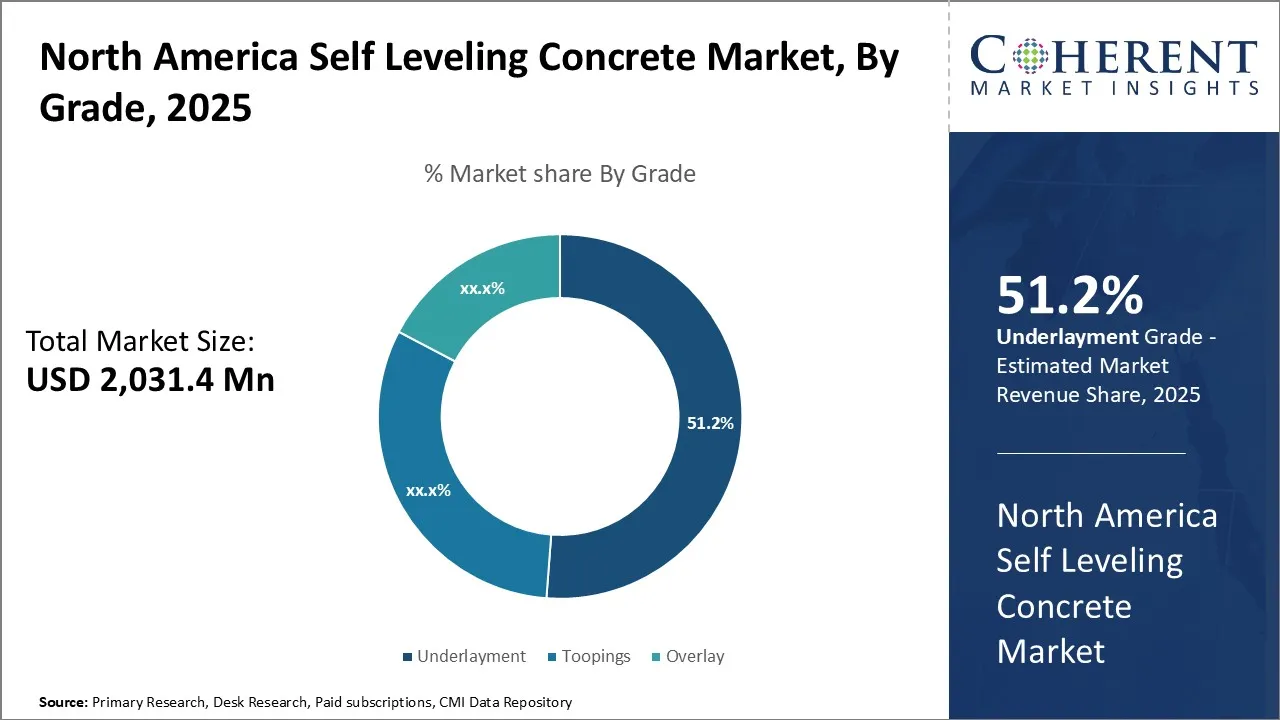
- The underlayment segment is projected to hold a 52.2% of the market share in 2026.
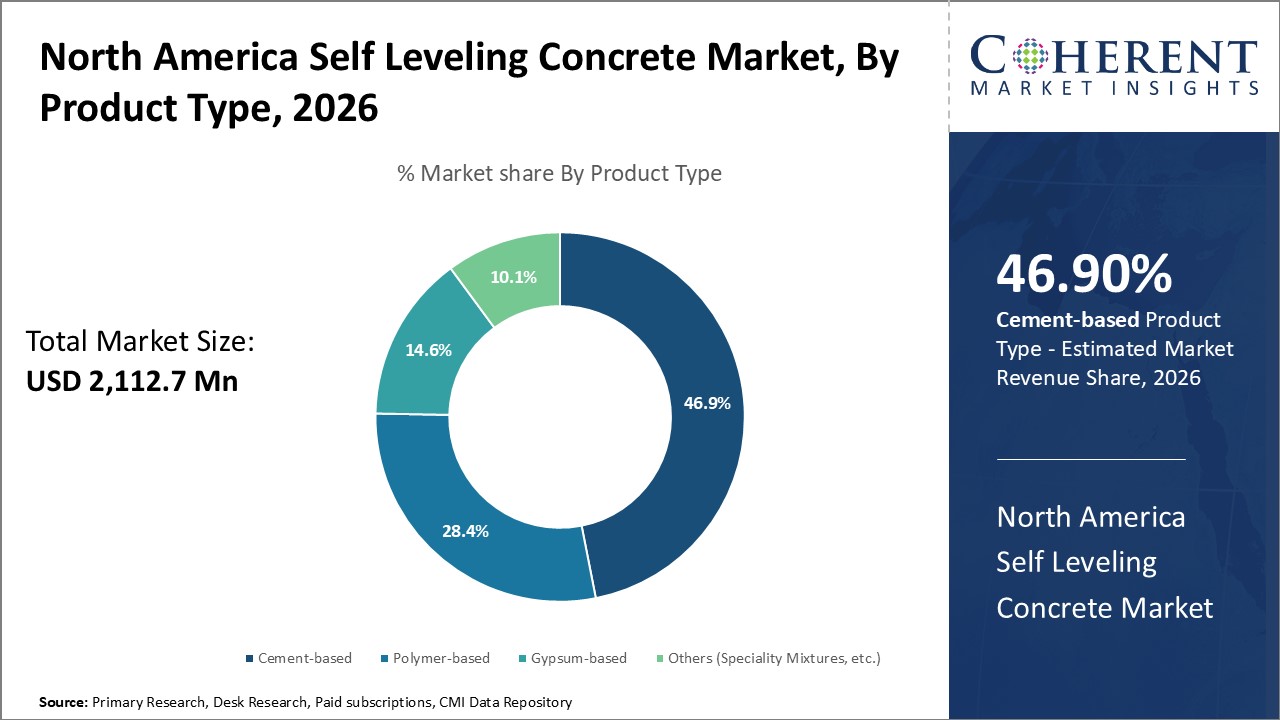
- The cement-based segment is expected to accounts for 46.9 % of the market share in 2026.
- The direct sales segment is projected to captures 64.8 % share in 2026.
Market Overview
A notable market trend is the growing emphasis on sustainable and eco-friendly construction materials, prompting manufacturers to innovate self-leveling concrete with recycled components and reduced environmental impact. Additionally, advancements in polymer technology and improved formulation are enhancing the performance and versatility of self-leveling concrete, expanding its application in infrastructure projects and renovation activities across North America.
Currents Events and their Impact
Current Events | Description and its Impact |
Federal infrastructure outlays accelerating |
|
Canada housing and community projects uptick |
|
Segmental Insights
- Current Industry Events of 2026
- Market Size Estimation
- Regional Breakdown
- Competitive Landscape
- Customer Intelligence
- Segmental Analysis
- Pricing Analysis
- Key Market Drivers, Challenges & Future Trends
- Customized Insights Section
North America Self Leveling Concrete Market Insights, By Type – Underlayment Segment Dominates the Market Driven by Versatile Applications and Structural Necessity
The underlayment segment is projected to account for 52.2% of the market share in 2026, underpinned primarily by its indispensable role in flooring preparation and surface stabilization. Underlayment is an important base floor coating that is used on top of the subfloors to create a flat layer of hard surface that can be easily covered with different types of floors including tiles, hardwood, vinyl, and carpet. The strong underlayment demand is closely connected with the boom in residential and commercial structure remodeling where the flooring up types are prevalent.
For example, Ardex Americas supplied self-leveling underlayment for the renovation of the Chicago O’Hare International Airport Terminal 5 expansion project, where over 500 000 ft² of terminal flooring required rapid-curing, crack-resistant leveling before installation of terrazzo and vinyl surfaces. The product’s fast-set chemistry enabled installation crews to cover large zones within 24 hours, minimizing downtime for one of North America’s busiest hubs.
North America Self Leveling Concrete Market Insights, by Product Type - Cement-Based Segment Dominates the Market Due to their Robust Performance and Cost-Effectiveness
Cement-based segment is projected to hold 46.9% share in 2026, fueled by its established performance characteristics and economic advantages. Formulations made of cement have been noted to have outstanding strength, durability, and flexibility, thus becoming the preferred material in wide range of construction works including retail areas and industrial flooring.
The mechanical strength and wear, abrasion, and heavy loads are paramount parameters in flooring systems that have high foot traffic and movement of equipment, yet cement inherent qualities guarantee good mechanical stability and resistiveness. Cement-based self-leveling concrete is also versatile which means that it can bond well onto a wide range of substrates such as concrete, wood, and metal and provides a stable base upon which a finish can be applied. This compatibility minimizes the labor time and the cost associated with surface preparation thereby increasing project efficiency.
North America Self Leveling Concrete Market Insights, By Sales Channel - Direct Sales Segment Dominates the Market due to Strong Client Relationships and Customized Solutions
Direct sales segment is expected to capture 65.8% of the market share in 2026, fueled by the increasing preference for tailored services and close engagement between manufacturers and end users. Direct sales model enables suppliers to establish a good relationship with contractors, builders and distributors which ensures a high level of responsiveness with regard to client needs and customization requirements.
The technical complexity and application specificity of self-leveling concrete products is one of the major motivation factors behind the dominance of direct sales. Construction and flooring companies may need an expert opinion on the choice of products, adjustment to the mix and troubleshooting on-site, which can be best offered through direct contact with the manufacturers. The individual and personalized service improves consumer satisfaction and creates a repeat business, gaining the direct sales the edge over the indirect channels which might not provide the same specialized attention.
Macro and Micro Economic Factors Impacting on North America Self Leveling Concrete Market Growth
Contractor and Installer Demand
- Proficient contractors have in depth understanding of self-leveling concrete properties, setting times, flow nature as well as curing needs. Such knowledge helps them select the appropriate product to fit certain applications and in certain environmental conditions. Effective deployment of self-leveling concrete involves certain methods and these include the correct mixing, pouring and finishing of the concrete. These techniques are practice and this is why experienced contractors are skilled in these techniques and will prevent problems that develop such as lack of smooth surfaces or premature placement.
- The ability of skilled contractors to perform projects more efficiently is because of their knowledge of self-leveling products. They are familiar with the surface preparation and material mix and application to ensure a reduction of downtime. Such efficiency is especially necessary in many infrastructure projects of large magnitude where time is commonly of the essence. The experienced contractors are in a better position to foresee and overcome the challenges that might arise during the application process. They can also troubleshoot problems on-site which can help avoid expensive delays and keep the projects on time.
- Contractors have a tendency of using a brand that has been found to be trustworthy with time. Contractors would refer others to a specific self-leveling product when it continues to perform well on a specific level like good flow, rapid setting times and good adhesion. This consistency generates loyalty resulting in repeat buying and brand loyalty.
- Contractors prefer products that are easily mixed and applied, and which are easy to understand. When a self-leveling compound is convenient to handle and yields constant results, then the contractors would embrace the use of that compound in future projects. This convenience may have a great impact on their buying and referral choices.
Infrastructure Investment
- Government spending on infrastructure projects boosts the construction sector, increasing the need for self-leveling compounds in commercial and public projects. Governments often allocate substantial budgets for infrastructure development to enhance economic growth and improve public services. North American governments have committed significant resources to various infrastructure projects, including transportation networks, public utilities, and urban development initiatives. For instance, according to U.S. Department of The Treasury report of November 2023 the government provided US$ 1.2 trillion of federal funds towards transportation, energy, and climate infrastructure projects, most of which is distributed via state and local governments.
- This kind of investment creates a boom in the construction sector resulting in high demand of construction materials. Since these developments are spreading, more and more products of this type are needed in both commercial and public works because smooth surfaces in flooring are created by self-leveling compounds to produce smooth floors.
- The growth in the number of infrastructure projects has a direct relationship with the high demand of self-leveling compounds. These resources play an important role in effective finishes of flooring systems in different locations, including commercial buildings, and civic amenities like schools and hospitals. Government funding will lead to an increase in construction activities, and producers of self-leveling compounds will probably experience increased demand.
- Due to the infrastructure work, there is need of taking hard ware materials that can withstand the heavy traffic and environmental pressures. The self-leveling compounds are designed to offer high strength and toughness and hence can be used in construction of civil projects where durability matters a lot.
Market Players, Key Development, and Competitive Intelligence
Key Development
- In November 2023, MAPEI Corporation announced the expansion of its existing Calhoun, Georgia, facility with an open-house event held on October 20, 2023, with customers, employees and other guests. The remodeled existing 210,000-square-foot (19 510-m2) facility now features an additional 45,000 square feet (4 181 m2) of production space as well as an additional 20,000 square feet (1 858 m2) of office space. Strategically located in an important hub for the resilient flooring industry, MAPEI’s Calhoun facility features 210,000 square feet (19 510 m2) designed for the manufacturing of multi-flooring adhesives, including resilient flooring, carpet tile flooring, vinyl sheet flooring, sport flooring, coatings and other products. It is equipped with the latest fully automatic production lines.
Top Strategies Followed by North America Self Leveling Concrete M arket Players
- The existing players control the market with enormous investment in research and development (R&D) and have continuously innovated to produce high-performance level self-setting concrete products that provide greater durability, shorter setting times, and better environmental sustainability.
- For example, Ardex Americas, launched innovative self-leveling underlayment with quicker drying periods permitting same-day laying floors that minimize project downtimes.
- The mid-level players in the North America self leveling concrete market have a more focused approach that strikes a balance between quality and cost-efficiency and is willing to serve price-sensitive market segments without jeopardizing the key performance of the product. These companies put a strong emphasis on development and promotion of low-cost but high quality products that focus specifically on commercial and residential projects where economic aspects are critical.
- For example, USG introduced middle-end Levelrock products to the market that are popular in multi-family housing projects, which respond to the needs of the price-sensitive construction companies.
- The North America self leveling concrete market provides small-scale players with a distinct opportunity to serve the niche customer needs or emerging construction trends with specialized product attributes and innovations. Their plans usually include incorporation of the latest technologies like environmentally friendly formulations, fast-setting compounds, or tailor-made blends that are used in special uses.
- For example, Duraamen creates decorative and customizable blends of self-leveling overlays to use in retail and hospitality premium flooring applications.
Market Report Scope
North America Self Leveling Concrete Market Report Coverage
| Report Coverage | Details | ||
|---|---|---|---|
| Base Year: | 2025 | Market Size in 2026: | USD 2,112.7 Mn |
| Historical Data for: | 2020 To 2024 | Forecast Period: | 2026 To 2033 |
| Forecast Period 2026 to 2033 CAGR: | 4.0% | 2033 Value Projection: | USD 2,780.1 Mn |
| Segments covered: |
| ||
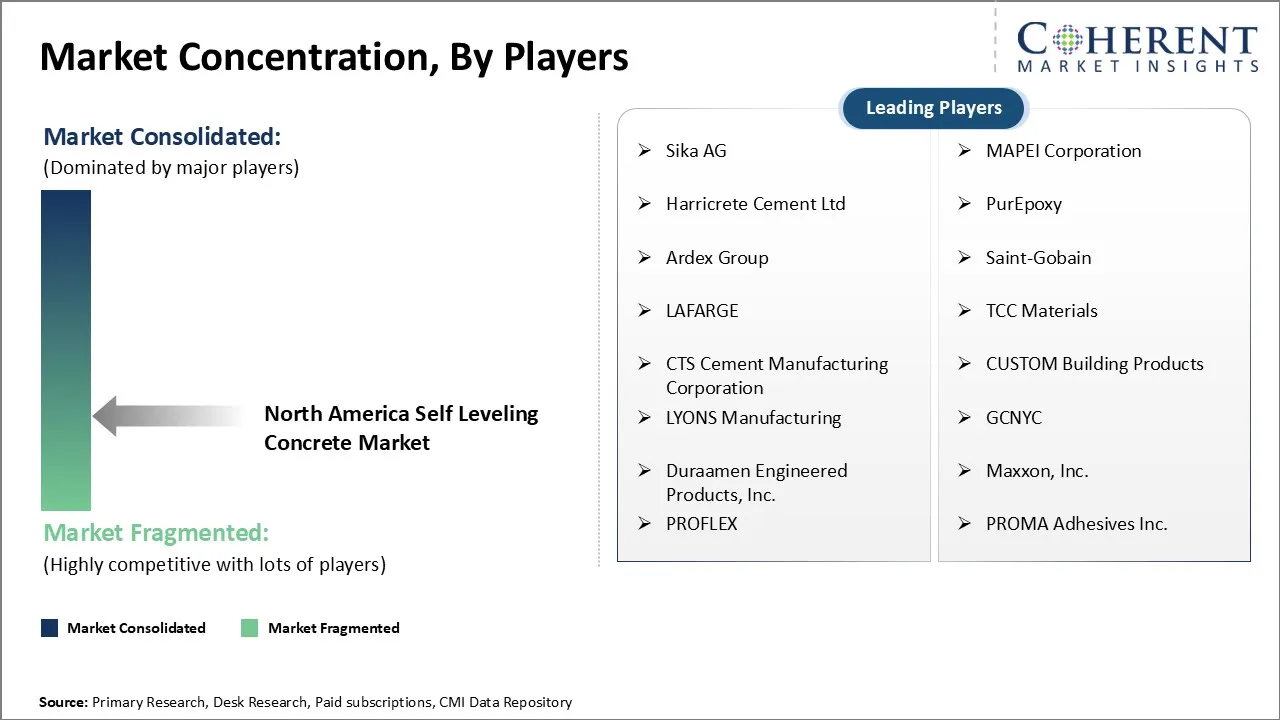
| Companies covered: | Sika AG, MAPEI Corporation, Harricrete Cement Ltd, PurEpoxy, Ardex Group, Saint-Gobain, LAFARGE, TCC Materials, CTS Cement Manufacturing Corporation, CUSTOM Building Products, LYONS Manufacturing, GCNYC, Duraamen Engineered Products, Inc., Maxxon, Inc., PROFLEX, and PROMA Adhesives Inc. | ||
| Growth Drivers: |
| ||
| Restraints & Challenges: |
| ||
North America Self Leveling Concrete Market Dynamics
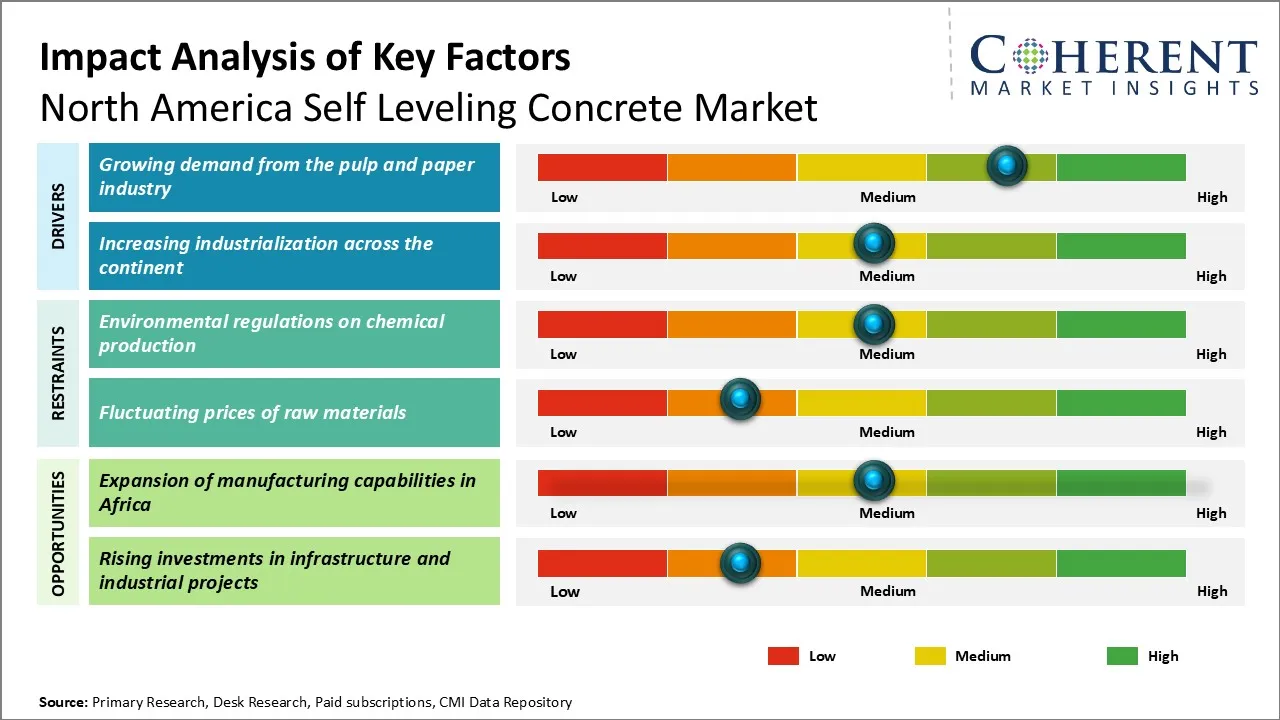
North America Self Leveling Concrete Market Driver - Growing Demand from the Pulp and Paper Industry
A key contributor to the increased the demand of self leveling concrete in North America is the pulp and paper industry which requires heavy machinery and constant exposure to moisture, necessitating durable and smooth flooring solutions that can be able to withstand these conditions and characteristics. The manufacturing facilities of this industry demand industrial flooring, flooring products with great ability to provide high resistance to chemical spills, mechanical abrasion and frequent cleaning which are major drawbacks in the production plants of paper. Self-leveling supports the safe running of conveyor systems and heavy machinery as it allows the formation of smooth, level surfaces which require less downtime because of repairing floors or rough edges.
In the case of resolute forest products operate pulp and paper plants, located in Ontario and Quebec, and invest in industrial flooring upTypes to handle the unceasing exposure to water and chemical residues. Self-leveling concrete solutions improve hygiene, minimize repair rates and operational continuity.
North America Self Leveling Concrete Market Opportunity - Expansion of Manufacturing Capabilities in Africa
The growth of manufacturing capabilities in Africa constitutes a major opportunity to the North America self leveling concrete market, which is mainly induced by the strategic advantages of inexpensive manufacturing and better resilience of the supply chain. Africa presents competitive advantages in the form of low-cost labor, availability of raw materials and growing infrastructural development programs which can facilitate growth of concrete product manufacturing of specialization, as manufacturers strive to optimize operational costs and diversify production bases. Having plants in Africa allows the North American companies to reduce risks of supply chain interference, inflation and tariffs as well as exploiting the opportunities of good deals between Africa and other parts of the world.
As an example, the rapid growth of localized cement and concrete production, centralized in Africa, as in the case of Dangote Cement (Nigeria), can serve the domestic market and external markets. Regional hubs can be cost-effective and can be exploited by North American self-leveling concrete producers.
Analyst Opinion (Expert Opinion)
- The self leveling concrete market in North America is geared towards a significant growth with the surging construction industry and rising need of high performance flooring solutions. The insights of the North American Concrete Expo (2023) and the World of Concrete Conference (2022) have revealed some important innovations, and such companies as Mapei and Sika are at the forefront of product developments.
- The recent introduction of eco-friendly self-leveling compounds of Mapeis is an example of a strategic reaction to the increasing demand on sustainable building materials among consumers. Debates at these conferences also pointed out the issue of labor shortage and rising and falling prices of raw materials that might hamper market momentum. On top of this, it was over and over again that the focus was on improving product performance to satisfy the strict regulatory requirements.
- Firms investing in research and development to come up with faster moving, stronger formulations are likely to have a competitive advantage. Also, market penetration can be achieved through the forging of strategic partnerships with contractors and architects. Finally, the North America self leveling concrete market will grow basing on its capacity to innovate in terms of its labor and supply chain issues and ensure that it responds to the changing demand of the construction industry.
Speak to the analyst
Want personalized insights?
Take the findings above to one of our principal consultants, or have the report rebuilt around the segments, geographies and competitors you actually track.
Market Segmentation
- Type Insights (Revenue, USD Mn, 2021 - 2033)
- Underlayment
- Toopings
- Overlay
- Product Type Insights (Revenue, USD Mn, 2021 - 2033)
- Cement-based
- Polymer-based
- Gypsum-based
- Others (Speciality Mixtures, etc.)
- Sales Channel Insights (Revenue, USD Mn, 2021 - 2033)
- Direct Sales
- Indirect (Via Distributors)
- End Users Insights (Revenue, USD Mn, 2021 - 2033)
- Residential
- Commercial
- Industrial
- Infrastructure
- Key Players Insights
- Sika AG
- MAPEI Corporation
- Harricrete Cement Ltd
- PurEpoxy
- Ardex Group
- Saint-Gobain
- LAFARGE
- TCC Materials
- CTS Cement Manufacturing Corporation
- CUSTOM Building Products
- LYONS Manufacturing
- GCNYC
- Duraamen Engineered Products, Inc.
- Maxxon, Inc.
- PROFLEX
- PROMA Adhesives Inc.
Sources
Primary Research Interviews
- Operations Director – Major North America Self-Leveling Concrete Manufacturer
- Procurement Manager – Commercial Construction Company (U.S. & Canada)
- R&D Manager – Leading Flooring Solutions Brand
- Sustainability Program Lead – Industry Standards Certification Body
Stakeholders
- Self-Leveling Concrete Manufacturers
- End Use Sectors:
- Commercial Construction (offices, airports, public buildings)
- Residential Flooring and Renovation
- Industrial Warehouses and Logistics Facilities
- Regulatory & Certification Agencies
- Distributors and Retailers (building materials stores, e-commerce platforms)
- Technology Integration Players: IoT-based construction analytics, smart batching providers
Databases
- UN Comtrade Database (cement, concrete, construction material flows)
- US International Trade Commission Data
- Canada Import Export Database (Industry Canada; StatCan)
Magazines
- Concrete Construction Magazine – Trends in flooring and leveling technologies
- North America Construction Review – Market growth, innovations, and case studies
- The Builder’s Journal – Industry updates for construction materials
- Floor Trends Magazine – Advances and preferences in North American flooring solutions
Journals
- Cement and Concrete Research – Scientific studies on self-leveling mixes
- Journal of Building Engineering – Application trends and market analysis
- Construction Materials Journal – Performance reviews and durability studies
- Journal of Architectural Engineering – Case studies for self-leveling applications
Newspapers
- The Wall Street Journal – Market and investment trends in construction materials
- New York Times – Major project launches and adoption trends
- Toronto Star – Construction innovation and regional demand shifts
- Globe & Mail – Canadian market drivers and import/export updates
- Financial Times – Macro impacts on building material markets in North America
Associations
- American Concrete Institute (ACI)
- Portland Cement Association (PCA)
- National Ready Mixed Concrete Association (NRMCA)
- Concrete Flooring Contractors Association (CFCA)
- Canadian Concrete Masonry Producers Association (CCMPA)
Public Domain Sources
- US EPA – Environmental guidance for cement and concrete industries
- Canada Standards Association (CSA) – Floor and concrete specifications
- Federal Highway Administration (FHWA) – Concrete application standards
- OSHA (Occupational Safety and Health Administration) – Workplace safety compliance
Proprietary Elements
- CMI Data Analytics Tool, Proprietary CMI Existing Repository of information for last 8 years.
Get access to 250+ pages report
Every segment, forecast, competitor profile and data table behind the analysis above — available for instant download.
- ESOMAR Member
- ISO 9001:2015 Certified
- D-U-N-S Registered
- GDPR & CCPA Compliant
Missing comfort of reading report in your local language? Find your preferred language:
Transform your Strategy with Exclusive Trending Reports
Frequently Asked Questions
The North America self leveling concrete market is estimated to be valued at USD 2,112.7 Mn in 2026 and is expected to reach USD 2,780.1 Mn by 2033.
The CAGR of the North America self leveling concrete market is projected to be 4.0% from 2026 to 2033.
Growing demand from the pulp and paper industry and increasing industrialization across the continent are the major factors driving the growth of the North America self leveling concrete market.
Environmental regulations on chemical production and fluctuating prices of raw materials are the major factors hampering the growth of the North America self leveling concrete market.
In terms of type, the underlayment segment is estimated to dominate the market revenue share in 2026.
Sika AG, MAPEI Corporation, Harricrete Cement Ltd, PurEpoxy, Ardex Group, Saint-Gobain, LAFARGE, TCC Materials, CTS Cement Manufacturing Corporation, CUSTOM Building Products, LYONS Manufacturing, GCNYC, Duraamen Engineered Products, Inc., Maxxon, Inc., PROFLEX, and PROMA Adhesives Inc. are the major players.