

Cellulose Acetate Fibers Market Size and Forecast — 2026-2033
The Global Cellulose Acetate Fibers Market size is estimated to be valued at USD 3.00 billion in 2026 and is expected to reach USD 4.5 billion by 2033, exhibiting a compound annual growth rate (CAGR) of 7.3% from 2026 to 2033.
Overview
Cellulose Acetate Fibers are semi-synthetic fibers derived from purified cellulose, typically sourced from wood pulp, and chemically modified with acetic anhydride. They provide a soft, silky hand feel, excellent drape, and high breathability, making them ideal for apparel, linings, home textiles, cigarette filter tow, and specialty industrial applications. Their resistance to shrinkage, good dyeability, and ability to mimic natural silk have contributed to their long-standing popularity in the textile sector. Cellulose acetate fibers are also used in nonwovens, medical materials, and photographic films due to their stability, biodegradability, and consistent performance across processing environments.
Key Takeaways
In the Fiber Type segment, acetate staple dominates with a 55% market share, driven by widespread adoption in textile manufacturing, while tow and filament remain vital for technical applications.
Cigarette filters hold a commanding 63% share within the application segment, underscoring strong reliance on cellulose acetate fibers in tobacco product formulation.
Asia Pacific leads as the dominant region, accounting for over 38% industry share, propelled by strong manufacturing bases in China and India with scalable production infrastructure.
North America is prominent for innovation-driven market strategies, while the Middle East & Africa, despite smaller market revenue contributions, exhibit steady growth driven by emerging industrial demand.
Cellulose Acetate Fibers Market Segmentation Analysis
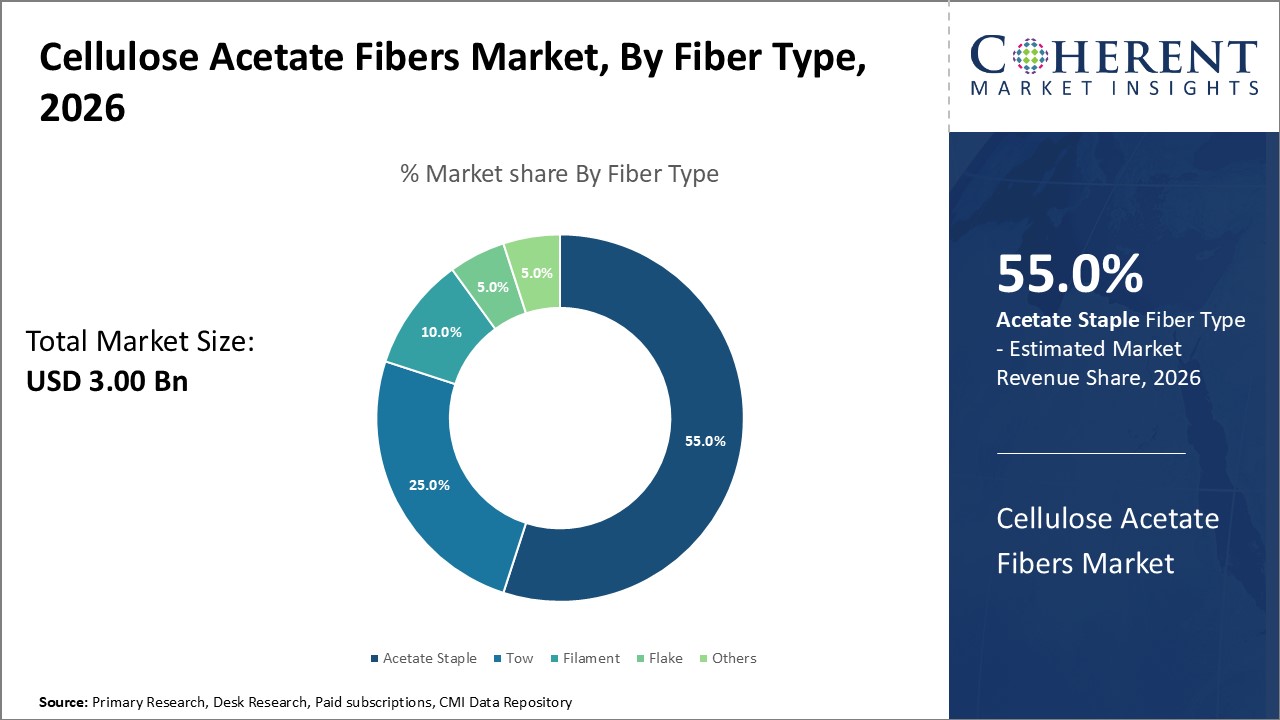
Cellulose Acetate Fibers Market Insights, By Fiber Type
Acetate Staple dominates due to its versatility in textile manufacturing and ease of blending with other fibers, driving substantial uptake in eco-friendly apparel collections. The segment benefits from strong demand across Asia Pacific and Europe, where sustainable textile initiatives are a priority. The tow segment, while smaller, is currently the fastest-growing subsegment, propelled by increased use in technical textiles and filtration media that require enhanced fiber alignment and strength. Filament and Flake segments serve niche markets such as specialized packaging and biochemical applications, offering steady but moderate industry expansion.
Cellulose Acetate Fibers Market Insights, By Application
Cigarette Filters sustain dominance, accounting for the majority of the cellulose acetate fibers market revenue due to their specialized fiber properties and established industry integration. Despite challenges in tobacco consumption trends, emerging markets keep demand buoyant. Meanwhile, Packaging applications are the fastest-growing segment, driven by increased demand for biodegradable food packaging materials, aligning with global regulatory shifts. Other Filters segment growth is supported by industrial needs for eco-friendly filtration products, especially in automotive and HVAC industries, adopting cellulose acetate blends.
Cellulose Acetate Fibers Market Insights, By End-User Industry
Textiles and Apparel dominate by volume, anchored by rising sustainable fashion trends and consumer preference shifts. The Automotive sector is the fastest-growing end user, fueled by stringent emission regulations demanding cellulose acetate-based filter media and composite materials with lighter weight and biodegradability. Industrial applications grow steadily, encompassing air and liquid filtration systems leveraging cellulose acetate fibers for environmental compliance. Consumer Goods cover non-textile applications such as packaging films and non-woven fabrics, supporting niche expansions.
Cellulose Acetate Fibers Market Trends
The Cellulose Acetate Fibers industry is rapidly advancing towards closed-loop production systems, aiming to reduce waste generation substantially.
For example, key manufacturers in Europe have integrated chemical recycling technologies by 2026, reducing fiber waste by 20%.
Additionally, the integration of bio-based cellulose acetate fibers in high-end fashion brands has reshaped consumer market dynamics, with 2025 data showing apparel collections with up to 31% sustainable fiber content gaining a 16% sales premium.
Apart from this, regulatory pressures on cigarette filter biodegradability have spurred R&D investments, leading to novel filter prototypes that degrade 41% faster in landfill conditions, anticipated to redefine market growth trajectories.
Cellulose Acetate Fibers Market Insights, By Geography
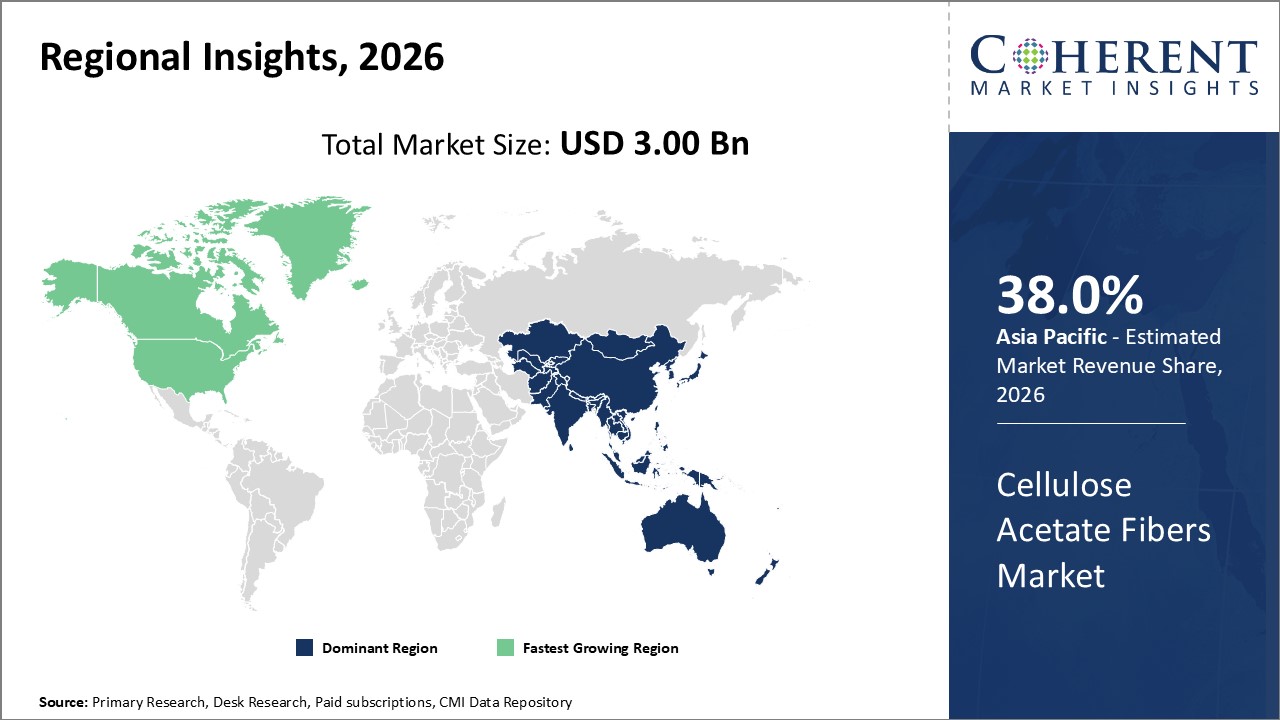
Asia Pacific Cellulose Acetate Fibers Market Analysis and Trends
In the Asia Pacific, the dominance in the Cellulose Acetate Fibers market is underpinned by extensive manufacturing capabilities and government incentives promoting bio-based materials. China and India, in particular, contribute heavily with large-scale production units and rising domestic consumption. The region accounts for over 38% of the industry share, driven by expanding textile and cigarette manufacturing sectors alongside rising export volumes.
Asia Pacific Cellulose Acetate Fibers Market Analysis and Trends
Meanwhile, North America exhibits the fastest growth with a CAGR exceeding 8%, supported by technological innovation hubs, strict environmental regulations favoring biodegradable fibers, and growing industrial filtration applications. Regulatory frameworks in the U.S. incentivize sustainable materials, bolstered by leading companies investing substantially in capacity expansions.
Cellulose Acetate Fibers Market Outlook for Key Countries
USA Cellulose Acetate Fibers Market Analysis and Trends
The USA's Cellulose Acetate Fibers market benefits from innovative fiber technologies and integration in high-performance textiles and filtration. Leading manufacturers such as Eastman Chemical have expanded production capacity by 20% since 2025, catering to increased demand from automotive and industrial filtration sectors. The market's revenue is buoyed by stringent emissions regulations stimulating demand for cellulose acetate-based filter media and rising interest from sustainable apparel manufacturers.
China Cellulose Acetate Fibers Market Analysis and Trends
China's market is driven by a robust manufacturing ecosystem and government backing for sustainable fiber production. Major market players have scaled up acetate staple fiber production significantly during 2025-2026, combining favorable policies that incentivize renewable resource utilization. In addition, the expanding cigarette manufacturing industry, especially in China, accounts for a major proportion of the cellulose acetate fibers market share regionally, while export-oriented textile manufacturers leverage this growth to solidify international trade positions.
Analyst Opinion
The surge in demand from sustainable textile manufacturing has been a primary driver. Data from 2025 indicates a 13% rise in cellulose acetate fiber consumption by eco-conscious apparel brands, revealing a significant shift towards biodegradable materials that complement circular economy initiatives.
Production capacity expansion in the Asia Pacific reached over 15,000 tons in 2025 alone, fostering competitive pricing that stimulated import volumes across Europe and North America by 9% and 7% respectively. This reflects a stable supply-side growth underpinning market revenue increases.
Filter application utilization contributed to an augmented market share as stringent air quality regulations galvanized the automotive and HVAC industries. Notably, filter media incorporating cellulose acetate fibers achieved a 15% penetration in new vehicle production lines in 2026, a rise supported by environmental agencies’ emission standards.
Pricing trends observed a moderate increase of approximately 4.5% YoY in 2025 due to feedstock variability, but remained competitive relative to synthetic alternatives, thus maintaining demand-side growth momentum in emerging economies that collectively witnessed a 11% market revenue jump.
- Current Industry Events of 2026
- Market Size Estimation
- Regional Breakdown
- Competitive Landscape
- Customer Intelligence
- Segmental Analysis
- Pricing Analysis
- Key Market Drivers, Challenges & Future Trends
- Customized Insights Section
Market Scope
| Report Coverage | Details | ||
|---|---|---|---|
| Base Year: | 2025 | Market Size in 2026: | USD 3.00 billion |
| Historical Data for: | 2020 To 2024 | Forecast Period: | 2026 To 2033 |
| Forecast Period 2026 to 2033 CAGR: | 7.3% | 2033 Value Projection: | USD 4.5 billion |
| Geographies covered: |
| ||
| Segments covered: |
| ||
| Companies covered: | Aksa Akrilik Kimya Sanayii A.S., Kolon Industries Inc., Kuraray Co., Ltd., Rhodia Solvay Group, Hengli Group, Nitto Boseki Co., Ltd., Zhejiang Fulida New Material Co., Ltd., Shandong Gobang New Materials Co., Ltd., Jilin Chemical Fiber Group Co., Ltd., Toray Advanced Materials Korea Inc. | ||
| Growth Drivers: |
| ||
Cellulose Acetate Fibers Market Growth Factors
The escalating demand for sustainable and biodegradable fibers has become a foremost growth driver, catalyzed by mounting regulatory pressure against synthetic fibers and plastic waste. This has propelled cellulose acetate fibers to the forefront between 2025 and 2026, particularly in Europe and North America, where market revenue linked to eco-textiles surged by 19% in 2025 alone. The cigarette filter market continues as a dominant application, driven by increasing tobacco consumption in developing countries and stricter product quality requirements in developed regions. Cigarette filters made from cellulose acetate fibers accounted for nearly 63% market share, supporting industry trends upwards in production and consumption. Technological advancements facilitating improved fiber functionalization and blending have unlocked new applications in industrial filtration and packaging, leading to diversified market growth.
Cellulose Acetate Fibers Market Development
In 2023, Eastman Chemical Company launched Naia™ Renew, a sustainable filament yarn made with significant recycled content to support eco-conscious apparel brands. The product is engineered to reduce environmental impact through advanced molecular recycling, offering a lower-carbon, traceable alternative for fashion manufacturers seeking high-performance yet sustainable textiles.
In 2020, Celanese Corporation introduced BlueRidge Cellulosic Pellets, a bio-based and fully compostable material designed to align with circular-economy principles. The pellets deliver strong processing performance for consumer goods, packaging, and textile applications while helping manufacturers transition away from traditional petrochemical-based plastics.
Key Players
Leading Companies of the Market
Aksa Akrilik Kimya Sanayii A.S.
Kolon Industries Inc.
Kuraray Co., Ltd.
Rhodia Solvay Group
Hengli Group
Nitto Boseki Co., Ltd.
Zhejiang Fulida New Material Co., Ltd.
Shandong Gobang New Materials Co., Ltd.
Jilin Chemical Fiber Group Co., Ltd.
Toray Advanced Materials Korea Inc.
Competitive strategies among these players focus on capacity expansions and strategic acquisitions. For instance, Eastman Chemical’s 2025 expansion in the North American acetate staple fiber plant resulted in a 21% increase in market share locally. Similarly, Daicel Corporation’s partnership with major textile manufacturers in Asia in 2026 enhanced supply chain integration, supporting a revenue growth of 16% in the region.
Cellulose Acetate Fibers Market Future Outlook
Future demand for cellulose acetate fibers is expected to be influenced by rising interest in biodegradable, bio-based materials as industries move away from fully synthetic fibers. The apparel industry is increasingly adopting these fibers for premium and eco-conscious products. Cigarette filter demand may gradually decline in mature markets, but will remain stable in developing economies. Innovation in acetate-based performance fibers, sustainable dyeing technologies, and new industrial applications such as filtration and specialty textiles will expand long-term opportunities. As environmental regulations strengthen globally, cellulose acetate fibers are well-positioned to benefit from their renewable sourcing and lower ecological footprint.
Cellulose Acetate Fibers Market Historical Analysis
The Cellulose Acetate Fibers market historically developed through its early use in textiles, cigarette filters, and industrial applications. Derived from purified cellulose, the fibers gained popularity for their breathability, color retention, and soft feel, making them suitable for apparel and home furnishings. The cigarette industry became a major consumer, using cellulose acetate tow for filter production—a demand that shaped global production capacity. Advancements in fiber spinning technologies and chemical modification improved fiber quality, dyeability, and biodegradability. Growth in sustainable materials and semi-synthetic fiber adoption also supported long-term market stability.
Sources
Primary Research Interviews:
Fiber Technologists
Textile Manufacturers
Filter Production Managers
Databases:
TextileWorld Data
GlobalData Fibers
UN Comtrade Fiber Trade Statistics
Magazines:
Textile World
Fibre2Fashion Magazine
Nonwovens Industry
Journals:
Textile Research Journal
Journal of Polymer Science
Cellulose Journal
Materials Today
Newspapers:
Business Standard (Textiles)
Financial Times (Manufacturing)
The Hindu Business Line (Industry)
Associations:
ITMF
American Chemical Society (ACS)
CEFIC
Textile Association of India
Get access to 250+ pages report
Every segment, forecast, competitor profile and data table behind the analysis above — available for instant download.
- ESOMAR Member
- ISO 9001:2015 Certified
- D-U-N-S Registered
- GDPR & CCPA Compliant
Missing comfort of reading report in your local language? Find your preferred language:
Transform your Strategy with Exclusive Trending Reports
Frequently Asked Questions
The market is led by companies such as Eastman Chemical Company, Daicel Corporation, Celanese Corporation, and Lenzing AG, which collectively hold a substantial share through capacity expansions and strategic alliances in global supply chains.
The market size is forecasted to grow from USD 3.00 billion in 2026 to USD 4.5 billion by 2033, with a CAGR of 7.3%, driven by growing eco-friendly fiber applications and expanding industrial sectors.
Textiles and cigarette filter industries are the largest end-user segments, with cigarette filters alone holding a 62% market share, while emerging segments such as industrial filtration and packaging offer expanding opportunities.
Trends point towards enhanced sustainability initiatives, incorporation of recycled feedstocks, and adoption of digital fiber technologies, broadening application landscape and increasing market revenue.
Intense competition exists among established players focusing on capacity growth and technology innovation; challenges include raw material price volatility and market penetration barriers in non-traditional regions.
Strategies focus on strategic partnerships with textile and automotive industries, geographic expansions, and investments in sustainable production technologies to ensure robust business growth and market share expansion.