

Global Oleic Acid Market Size and Forecast – 2026 To 2033
The Global Oleic Acid Market is estimated to be valued at USD 702.4 Mn in 2026 and is expected to reach USD 1,113.2 Mn by 2033, exhibiting a compound annual growth rate (CAGR) of 6.8% from 2026 to 2033. The rise is attributed to growing demand from cosmetics, food, pharmaceuticals, lubricants and industrial chemicals, while there is greater awareness about the need for natural additives and vegetable-origin ingredients, as well as bio-based products. The use of oleic acid as an emollient, emulsifier, surfactant intermediate and lubricant additive is gaining strength in consumer and industrial products.
For instance, in November 2025, BASF inaugurated expanded production capacity for alkyl polyglucosides in Bangpakong, Thailand to strengthen regional supply of bio-based and biodegradable surfactants for personal care, home care, industrial cleaning, and industrial formulations, highlighting the growing commercial shift toward renewable oleochemical-based ingredients. (Source: BASF)
Key Takeaways of the Global Oleic Acid Market
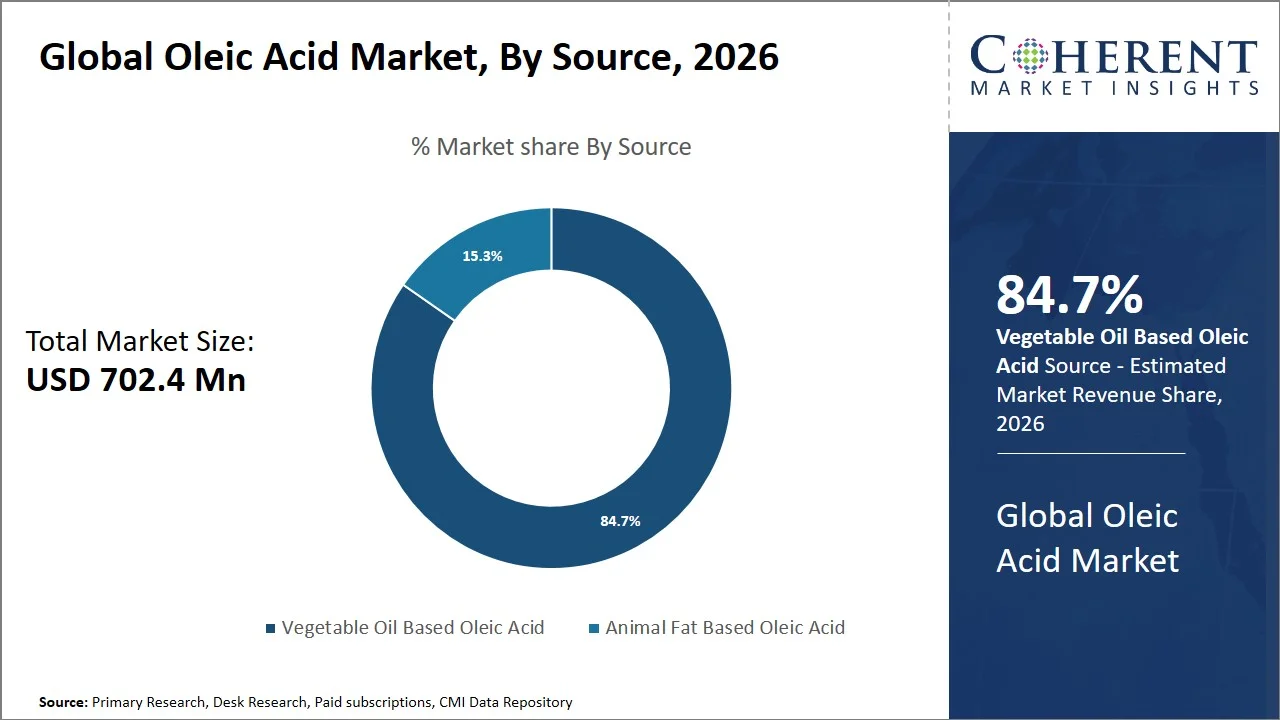
- Vegetable oil based oleic acid is expected to hold 84.7 % of the market share in 2026, positioning plant-derived feedstocks as the commercial backbone of the market due to broader sustainability alignment and compatibility across personal care, soaps, lubricants, and food applications. In March 2026, IOI Group highlighted its vegetable-origin Palmac fatty acids and oleic acids for global downstream use.
- The technical grade segment is expected to hold 46.8 % of the market share in 2026 due to its cost-effectiveness in non-ultra-high purity applications, such as lubricants, surfactants, coatings, chemical intermediates and industrial formulations. In 2025, ACS Omega published biolubricant research using technical-grade oleic acid, validating its industrial relevance in bio-based performance applications. (Source: ACS Omega)
- The 70% to 85% purity segment is expected to capture 48.6 % of the market share in 2026, as it offers adequate functional performance for high-volume applications while maintaining competitive procurement economics. In 2025, Mars Oleochemicals listed Oleic Acid 75% Min from vegetable origin, with usage across lubricants, chemical intermediates, cosmetics, pharmaceuticals, textiles, and food applications.
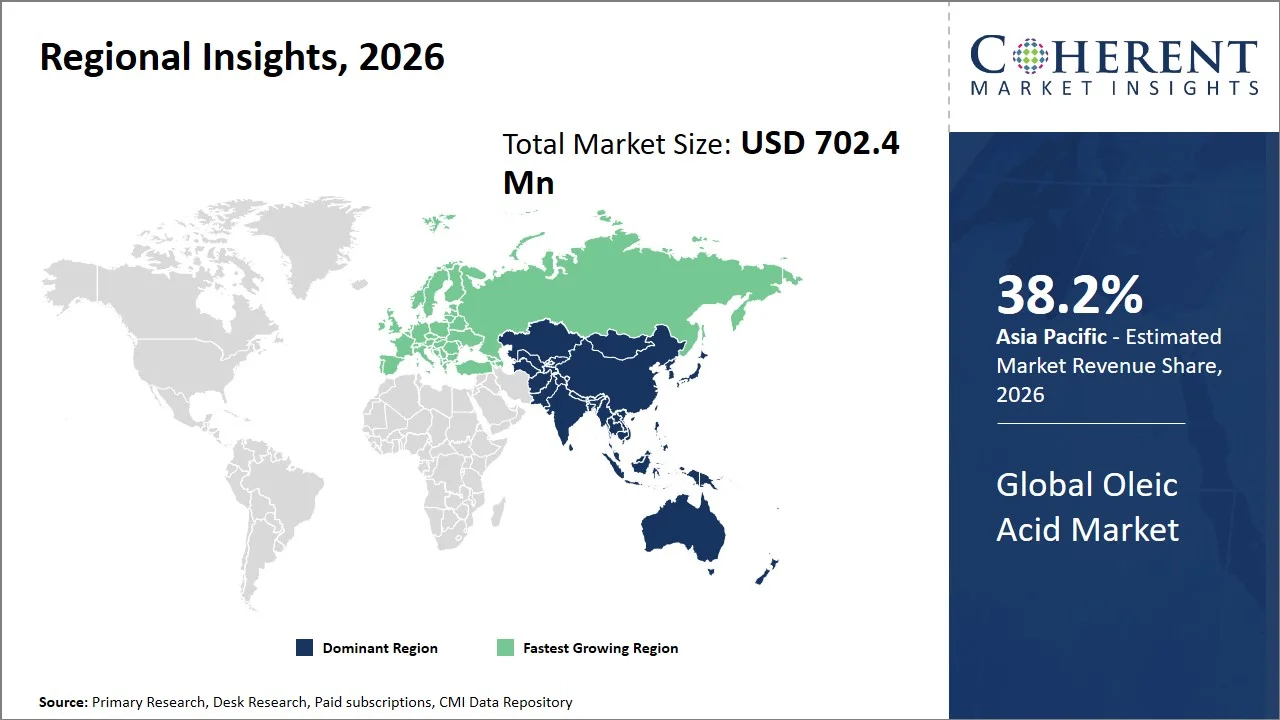
- Asia Pacific is expected to remain the dominant region with 38.2 % of the market share in 2026, supported by integrated palm-based oleochemical capacity, feedstock proximity, and export-oriented manufacturing clusters in Malaysia, Indonesia, China, and India. In 2025, KLK OLEO highlighted integrated complexes across Malaysia, Indonesia, China, and Europe, serving over 120 countries through a diversified oleochemical portfolio.
- Europe is projected to be the fastest-growing region, accounting for 27.40% of the market share in 2026, aided by strong regulatory backing for renewable ingredients, bio-based chemistry, and reduced-carbon industrial inputs. This development highlights Europe’s increasing focus on alternative bio-based feedstocks and sustainable oleochemical innovation, reinforcing the region’s growth trajectory in the oleic acid market.
- Bio-Based Formulation Shift: Oleic acid is moving from a commodity fatty acid to a strategic formulation input as manufacturers prioritize renewable carbon, traceable sourcing, and multifunctional performance. This tendency leads to supplier differentiation, promotes long-term procurement contracts and presents opportunities for producers that can provide consistent and certified products as well as application-specific customization.
- Value Migration Toward Specialty Applications: Looking ahead, suppliers will benefit from greater market share in personal care, pharmaceuticals, high performance lubricants and specialty surfactants, as well as bulk industrial use, will grow. Companies that can combine purity control, regulatory documentation, technical support, and sustainable feedstock assurance will be better positioned to capture premium margins and defend customer relationships.
Segmental Insights
Why Does Vegetable Oil Based Oleic Acid Dominate the Global Oleic Acid Market?
Vegetable oil based oleic acid will have the highest market share of 84.70% in 2026, as large buyers increasingly favor oleic acid derived from vegetable oils, which not only have a greater availability of supply but are easier to position as sustainable and much more widely accepted in the formulation of products in the eyes of consumers. It has proven leadership in the processing of palm, soybean, canola and sunflower oils and has created well-developed hydrolysis and fractionation processes for converting renewable triglycerides into streams of fatty acids. Demand is highest in soaps/detergents, cosmetics and food emulsifiers, and in industrial intermediates where vegetable-origin claims are used in positioning the brand and within regulatory frameworks. In May 2025, Louis Dreyfus Company inaugurated a new glycerin refining plant and edible oil packaging line in Lampung, Indonesia, strengthening downstream vegetable oil processing and ingredient supply capabilities.
- Current Industry Events of 2026
- Market Size Estimation
- Regional Breakdown
- Competitive Landscape
- Customer Intelligence
- Segmental Analysis
- Pricing Analysis
- Key Market Drivers, Challenges & Future Trends
- Customized Insights Section
Why Does Technical Grade Represent the Largest Grade Segment in the Global Oleic Acid Market?
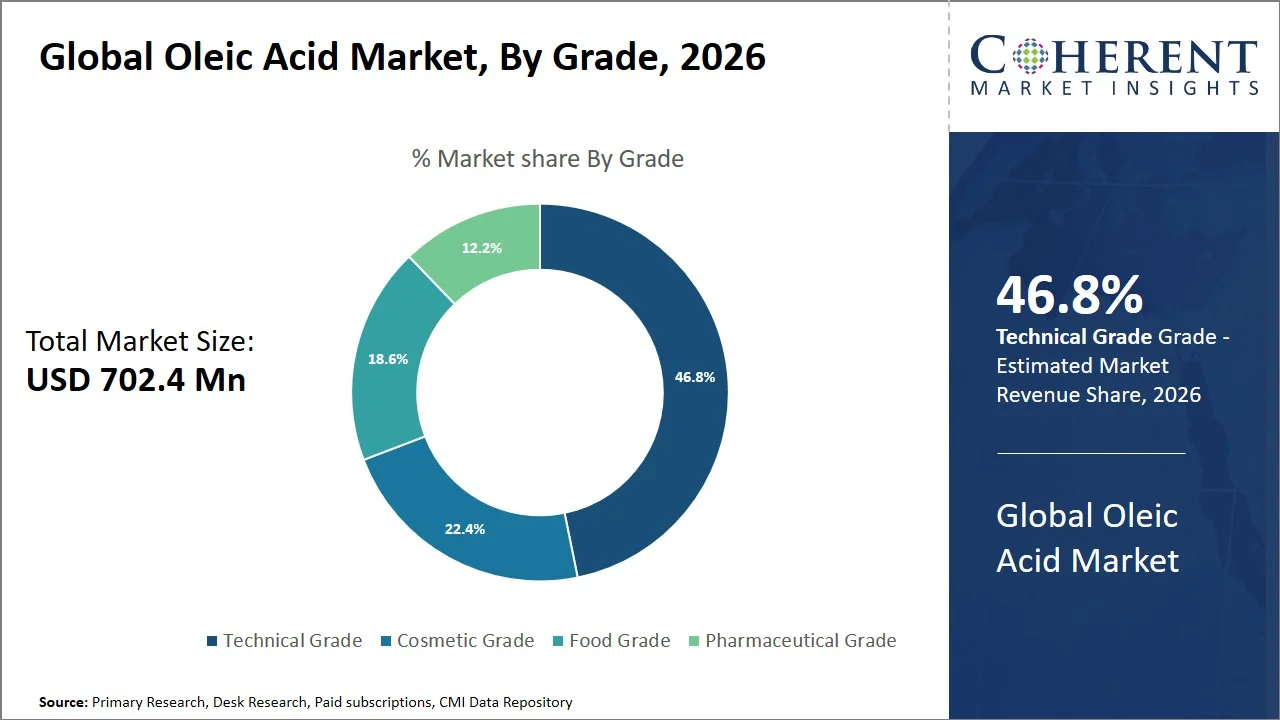
Technical grade oleic acid is expected to remain the largest grade segment, accounting for 46.80% of the market in 2026, as most industrial conversion and formulation applications do not require the higher purity standards associated with food-grade or pharmaceutical-grade oleic acid. Technical grade is more suitable for use in surfactants, amines, alkoxylates, liquid soaps, metalworking fluids and lubricant additives for bulk users, who are interested in the acid value, iodine value, color, handling stability and reliability of delivery. Technical grade is also favored on the supply side for its lower processing intensity and flexibility in terms of fatty acid cuts, as well as the fact that it is compatible with large volume storage and bulk shipment facilities. In June 2025, Emery Oleochemicals’ OleoBasics Product Portfolio listed EMERSOL oleic acids for industrial lubricants, liquid soaps, metalworking fluids, and downstream production of esters, surfactants, amines, and alkoxylates.
Why Does 70% to 85% Purity Dominate the Global Oleic Acid Market?
The 70% to 85% purity segment dominates with an estimated market share 48.60% in 2026 because it offers the most practical specification window for high-volume oleochemical conversion, balancing oleic content, fluidity, reactivity, and cost efficiency. This range provides sufficient C18:1 unsaturation for esterification, epoxidation, surfactant production, soap processing, and textile auxiliaries while avoiding the premium associated with highly purified grades. Manufacturers also benefit from easier scale-up because mid-purity oleic acid can be produced through conventional fractionation without excessive refining losses. In April 2025, a Kemijska industrija paper accepted a study using 75% purity palm-derived oleic acid for catalytic epoxidation into dihydroxystearic acid, highlighting its suitability as a functional raw material for bio-based specialty chemical and cosmetic precursor development.
Global Oleic Acid Market Dynamics
Key Market Drivers
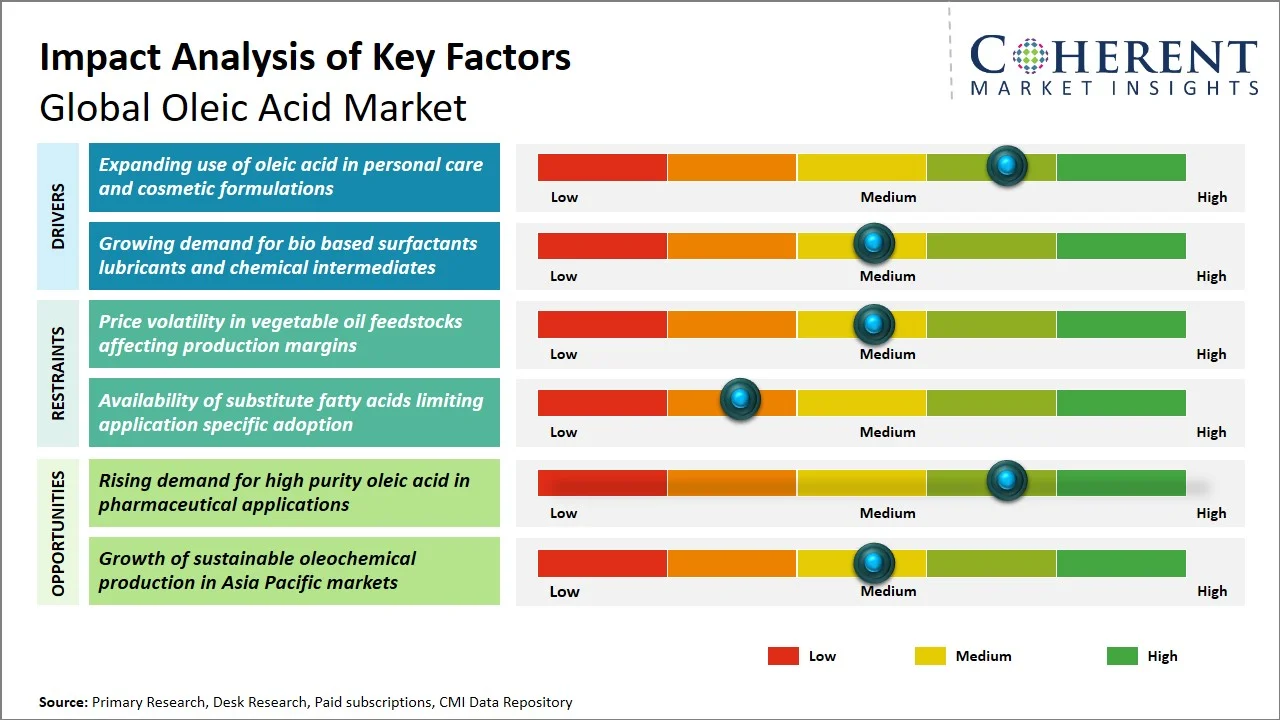
- Expanding Use of Oleic Acid in Personal Care and Cosmetic Formulations: Oleic acid in personal care formulations is being used as an emollient, penetration enhancer, emulsifying aid, lipid carrier and conditioning agent in creams, lotions, serums, hair care and dermal delivery systems, which are making it more relevant commercially in the personal care industry. Its vegetable source can enable it to be marketed as a clean label ingredient, and its ability to match lipids and ceramides enhances its use in high-end skin care products. In addition, the growing trend of using multifunctional ingredients for food texture, spreadability, skin feel and active delivery without the need for complex synthetic systems is contributing to the demand. Samyang KCI has given an update that it will be showcasing a Charge-Induced Liposome system at IFSCC 2025, which combines oleic acid, ceramide, and lecithin for enhanced skin penetration, barrier protection and formulation stability.
- Growing Demand for Bio-Based Surfactants, Lubricants, and Chemical Intermediates: Oleic acid is an excellent option for the industry's transition to renewable carbon-based materials for surfactants, esters, lubricant additives, amines, alkoxylates, and specialty intermediates. Oleic acid is valued by chemical manufacturers due to the fact that the C18 backbone of its molecule provides versatility for further processing into formulations which are flexible, biodegradable and performance-oriented. The driver is particularly crucial in detergents, industrial cleaning, agrochemical carriers, textile auxiliaries and bio-lubricants, where the purchasers increasingly consider and compare the functionality and sustainability of the product, as well as its regulatory readiness. Logistics risk management and customer responsiveness are also driving toward regionalization of supply chains.
Emerging Market Trends
- Shift Toward Traceable Vegetable-Origin Oleic Acid: Price and basic specification is being replaced by the procurement of oleic acid that is traceable, with transparency on the feedstock, and with documentation of sustainability. Consumers in personal care, food emulsifiers, pharmaceuticals, and specialty chemicals are increasingly asking vegetable origin, responsible sourcing, and/or consistent fatty acid profile and auditable supply chain controls from their suppliers. This trend brings advantage to the producers that have more effective certification systems and segregated or controlled feedstock supplies and are able to provide the required documentation for customer compliance. It also establishes price differentials between commodity oleic acid and premium grades for regulated or “brand sensitive” applications. Traceability will increasingly be a supplier-selection criteria throughout the forecast period, especially in export to premium cosmetic brands, Europe and North America. Companies able to offer cost efficiency and documentation of origin and quality will be in a better long-term position for supply agreements.
- Value Migration from Bulk Fatty Acid to Functional Oleic Derivatives: The oleic acid market is progressing towards an increasing preference for higher value derivative applications. The use of oleic acid-based esters, emulsifiers, surfactants and bio-lubricants, specialty intermediates, skin delivery systems and plastic additives is in growth where functionality, purity and performance consistency become more important than volume. This trend can benefit producers who can supply application specific grades instead of undifferentiated fatty acid supply. End users are looking for ingredients which provide lubricity, solubilization, mildness, moisture-holding, stability or biodegradability in one formulation system. This will increase the amount of technical service, formulation support, quality control, and derivative chemistry that oleic acid suppliers will need to invest. The trend also drives increased synergy between oleochemical producers, cosmetic formulators, lubricant manufacturers and specialty chemical manufacturers.
Current Events and their Impact
Current Events | Description and its Impact |
December 2025 / May 2026 – EU Deforestation Regulation Phase-In and Simplification Review |
|
June 2025 – India Reduced Basic Customs Duty on Crude Edible Oils |
|
December 2025 – FDA Published PFAS Assessment for Cosmetic Products under MoCRA |
|
Regional Insights
Why Does Asia Pacific Dominate the Global Oleic Acid Market?
Asia Pacific dominates the global oleic acid market with an estimated share of 38.2% in 2026, due to its integrated vegetable oil refining base, large oleochemical manufacturing clusters, and strong downstream consumption across soaps, detergents, personal care, lubricants, and industrial chemicals. The region benefits from proximity to palm and other vegetable oil feedstocks, allowing producers to secure cost-efficient raw material streams and scale fatty acid production for both domestic and export markets. China and India provide large-volume demand from chemical manufacturing, home care, cosmetics, and textile processing, while Southeast Asia supports upstream-to-downstream integration. In May 2025, Musim Mas entered into an agreement to acquire a manufacturing facility in Batangas, Philippines, to expand its surfactants product offerings, strengthening Asia Pacific’s role in downstream oleochemical value chains. (Source: Musim Mas)
Why is Europe Emerging as the Fastest-Growing Region in the Global Oleic Acid Market?
Europe is emerging as the fastest-growing region with an expected share of 27.40% in 2026 in the global oleic acid market as industrial buyers accelerate the transition from petrochemical inputs to renewable, biodegradable, and traceable oleochemical ingredients. Regional demand is supported by premium personal care, home care, bio-lubricants, coatings, pharmaceuticals, and specialty surfactants, where sustainability documentation and regulatory compliance influence procurement decisions. European manufacturers also favor oleic acid for its role in low-carbon formulation strategies and specialty chemical conversion. Growth is further supported by policy focus on chemical-sector modernization and circular bio-based production. In July 2025, the European Commission presented an Action Plan for the Chemicals Industry to strengthen competitiveness, modernization, and cleaner production pathways across the EU chemical sector. (Source: European Commission)
Global Oleic Acid Market Outlook for Key Countries
Why is the U.S. a Key Market for the Global Oleic Acid Market?
The U.S. is a key market for oleic acid due to its diversified end-use base across personal care, household cleaning, food processing, pharmaceuticals, lubricants, and industrial chemicals. Demand is supported by established formulators that use oleic acid as an emulsifier, emollient, surfactant intermediate, lubricant additive, and chemical building block. The country’s mature specialty chemical industry also supports higher-value applications where quality consistency, supply reliability, and regulatory documentation are important purchasing criteria. In consumer-facing sectors, clean-label, plant-derived, and biodegradable ingredient preferences create steady pull for vegetable oil-based oleic acid. The U.S. also remains important for technical-grade consumption in metalworking fluids, coatings, industrial soaps, and surfactant manufacturing, making it a balanced market across both commodity and specialty oleic acid applications.
Why is India Important in the Global Oleic Acid Market?
India is important in the global oleic acid market because of its large soaps, detergents, cosmetics, textiles, pharmaceuticals, and industrial chemical base. The country has a strong cost-sensitive manufacturing ecosystem where oleic acid is widely used in high-volume formulations and chemical intermediates. Demand is supported by expanding personal care consumption, rising hygiene product penetration, and growth in domestic surfactant and lubricant manufacturing. India’s vegetable oil refining and oleochemical ecosystem also provides a foundation for fatty acid processing, although feedstock availability and import dependence can influence pricing and procurement strategies. The market’s strength lies in scale, price competitiveness, and broad downstream usage rather than premium-only demand. As domestic manufacturing expands, India continues to support volume-led growth for technical and mid-purity oleic acid grades.
What is the Reason for China to Promote the Development of Global Oleic Acid Market?
China has a huge chemical industry production capacity, well-established industrial clusters and a high demand for oleic acid in personal care, detergents, plastics, textiles, coatings and lubricant applications, and will push the oleic acid market in the future. China accounted for around 45%–46% of global chemical sales in 2024, making it the world’s largest chemical market, while MPOC, citing CCIA and Chinese Customs, reported that China produced about 1.7 million MT of fatty acids and imported around 1.245 million MT of fatty acids, along with 1.763 million MT of glycerine. This shows China’s strong role in processing and consuming oleochemical intermediates used in surfactants, soaps, esters, amides, and specialty chemical formulations.
Why is Germany a Strategic Country in the Global Oleic Acid Market?
Germany is a strategic country in the global oleic acid market due to its advanced specialty chemical, personal care, pharmaceutical, lubricant, and industrial manufacturing base. German buyers typically prioritize high-quality inputs, consistent technical specifications, sustainability documentation, and compliance with EU chemical standards, creating demand for oleic acid grades suitable for premium and regulated applications. The country’s strong automotive and machinery industries also support use in lubricants, metalworking fluids, coatings, and industrial additives. In personal care and household formulations, Germany’s focus on biodegradable and renewable ingredients encourages the adoption of plant-derived oleochemical inputs. Its role is not only volume-based but also value-driven, as German manufacturers often influence formulation standards, supplier qualification practices, and technical performance expectations across the broader European oleic acid market.
Why is Brazil an Important Growth Market for the Global Oleic Acid Market?
Brazil is an important growth market for oleic acid due to its expanding personal care, household cleaning, food processing, agro-industrial, and industrial chemical sectors. The country has a strong consumer base for soaps, detergents, cosmetics, and hygiene products, supporting steady demand for oleic acid as a surfactant intermediate, emulsifier, emollient, and formulation aid. Brazil’s agricultural economy also supports the demand for industrial lubricants, agrochemical carriers, and bio-based processing inputs. Its regional distribution role in Latin America strengthens its relevance for suppliers targeting both domestic and neighboring markets. Brazil’s vegetable oil availability, especially from soybean and other agricultural feedstocks, provides a strategic foundation for oleochemical development, while growing preference for renewable and locally adaptable ingredients supports long-term market expansion.
Technology Adoption Landscape - Global Oleic Acid Market
Technology | Adoption Level | Key Application Area | Business Impact |
Fat splitting / hydrolysis technology | High | Conversion of vegetable oils and animal fats into fatty acid streams | Enables large-scale oleic acid production with stable output and cost-efficient processing. |
Fractional distillation and crystallization | High | Purity control and fatty acid separation | Improves grade consistency, supports 70%–85% and higher-purity oleic acid specifications, and reduces off-spec supply risk. |
Enzymatic esterification | Medium | Cosmetic esters, emollients, bio-lubricants, and specialty intermediates | Supports milder processing, improved selectivity, and higher-value derivative development. |
Catalytic epoxidation and hydroxylation | Medium | Bio-based plasticizers, coatings, surfactants, and specialty chemical precursors | Expands oleic acid use beyond commodity applications into performance chemicals. |
Process automation and inline quality monitoring | Medium | Fatty acid refining, blending, and packaging operations | Improves batch consistency, reduces processing losses, and supports customer-specific specifications. |
Feedstock traceability and certification systems | Medium | Vegetable oil sourcing, export compliance, and customer audits | Strengthens regulatory readiness and improves acceptance among premium personal care, food, and EU-facing buyers. |
How are Sustainable Personal Care and Bio-Based Industrial Formulations Creating New Growth Opportunities in the Global Oleic Acid Market?
Sustainable personal care and bio-based industrial formulations are creating strong growth opportunities for oleic acid suppliers because the ingredient sits at the intersection of renewable sourcing, functional performance, and large-scale chemical convertibility. In cosmetics, oleic acid can support emolliency, lipid delivery, emulsification, and sensorial improvement, allowing suppliers to target higher-margin skincare and haircare formulations. In industrial markets, oleic acid can be converted into esters, surfactants, lubricants, amides, and specialty intermediates, supporting the substitution of petrochemical-derived inputs. This opportunity is commercially important because it allows producers to move from bulk fatty acid sales into differentiated grades, customized blends, and application-specific derivatives. Companies can capture higher value by offering traceable vegetable-origin supply, technical documentation, formulation support, and consistent purity profiles. Export-oriented suppliers also have an opportunity to position oleic acid as a strategic renewable feedstock for customers facing sustainability, biodegradability, and compliance pressures.
Market Players, Key Development, and Competitive Intelligence
Key Developments
- In November 2025, BASF inaugurated expanded production capacity for alkyl polyglucosides (APGs) at its Bangpakong site in Thailand to strengthen regional supply for personal care, home care, industrial cleaning, and industrial formulations. This supports the oleic acid market as demand for bio-based surfactants and renewable oleochemical intermediates continues to grow across consumer and industrial applications.
- In May 2025, Louis Dreyfus Company inaugurated a new glycerin refining plant and edible oil packaging line in Lampung, Indonesia, strengthening downstream vegetable oil processing capabilities. This is relevant to the oleic acid market because Indonesia is a key vegetable oil and oleochemical supply hub, and stronger refining infrastructure improves feedstock integration for fatty acid-based value chains.
Competitive Landscape
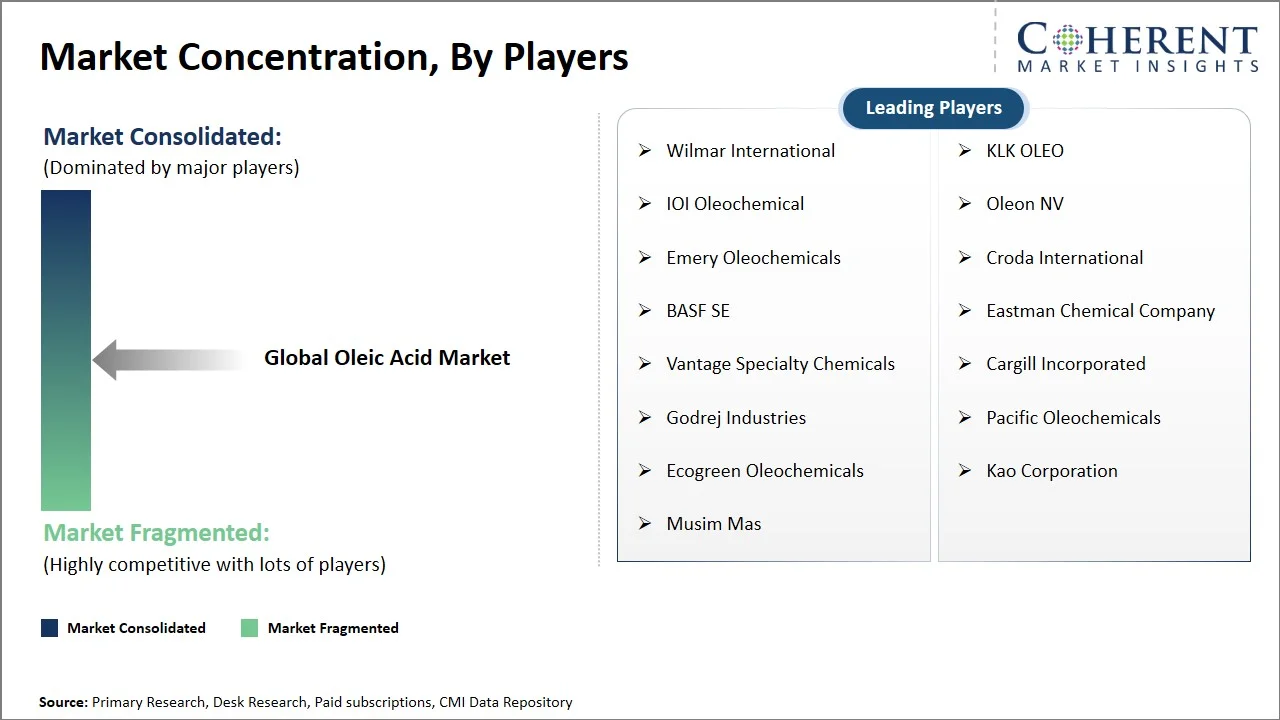
The global oleic acid market is moderately fragmented, as the competition is divided among integrated oleochemical producers, vegetable oil refiners, specialty ingredient suppliers and regional fatty acid manufacturers. Large players are involved in the security of feedstock, scale, consistency, and availability; specialty suppliers focus on purity, documentation, customization, and support.
Key focus areas include
- Product quality, acid value, color, odor, and fatty acid composition consistency remain key supplier-selection criteria.
- Cost competitiveness is strongly influenced by vegetable oil prices, refining efficiency, and regional feedstock access.
- Suppliers differentiate through technical, cosmetic, food, and pharmaceutical grade offerings.
- Purity-based positioning is becoming more important for premium personal care and regulated applications.
- Certifications, sustainability documentation, and traceability are gaining importance in export-oriented supply chains.
- Strong distribution networks help suppliers serve fragmented buyers across soaps, detergents, cosmetics, textiles, and industrial chemicals.
- Process efficiency and yield optimization are critical for protecting margins during raw material price volatility.
- Long-term supply agreements and customer-specific specifications are becoming more important for demand stability.
Market Report Scope
Oleic Acid Market Report Coverage
| Report Coverage | Details | ||
|---|---|---|---|
| Base Year: | 2025 | Market Size in 2026: | USD 702.4 Mn |
| Historical Data for: | 2020 To 2024 | Forecast Period: | 2026 To 2033 |
| Forecast Period 2026 to 2033 CAGR: | 6.8% | 2033 Value Projection: | USD 1,113.2 Mn |
| Geographies covered: |
| ||
| Segments covered: |
| ||
| Companies covered: | Wilmar International, KLK OLEO, IOI Oleochemical, Oleon NV, Emery Oleochemicals, Croda International, BASF SE, Eastman Chemical Company, Vantage Specialty Chemicals, Cargill Incorporated, Godrej Industries, Pacific Oleochemicals, Ecogreen Oleochemicals, Kao Corporation, and Musim Mas | ||
| Growth Drivers: |
| ||
| Restraints & Challenges: |
| ||
Analyst Opinion (Expert Opinion)
- The global oleic acid market is expected to maintain steady growth over the forecast period, supported by its broad use across chemical manufacturing, personal care, soaps and detergents, food emulsifiers, pharmaceuticals, textiles, and lubricants. Vegetable oil-based oleic acid will remain the core supply platform due to its scalability, renewable positioning, and compatibility with mainstream industrial and consumer formulations.
- The strongest growth pockets are expected in personal care and cosmetics, bio-based surfactants, technical-grade industrial formulations, and mid-purity oleic acid used in high-volume chemical conversion. Asia Pacific will continue to lead on production scale and feedstock integration, while Europe will offer stronger value growth through sustainability-led procurement and specialty chemical demand.
- Key risks include vegetable oil price volatility, feedstock traceability requirements, competition from alternative fatty acids, and pressure on low-margin bulk grades. Market participants should focus on differentiated purity ranges, certified vegetable-origin supply, application-specific derivatives, and technical support for formulators. Companies that combine cost-efficient production with regulatory-ready documentation and specialty-grade innovation will be better positioned to defend margins and win long-term customers.
Speak to the analyst
Want personalized insights?
Take the findings above to one of our principal consultants, or have the report rebuilt around the segments, geographies and competitors you actually track.
Market Segmentation
- Source Insights (Revenue, USD Mn, 2021 - 2033)
- Vegetable Oil Based Oleic Acid
- Animal Fat Based Oleic Acid
- Grade Insights (Revenue, USD Mn, 2021 - 2033)
- Technical Grade
- Cosmetic Grade
- Food Grade
- Pharmaceutical Grade
- Purity Insights (Revenue, USD Mn, 2021 - 2033)
- 70% to 85% Purity
- Above 85% Purity
- Below 70% Purity
- Application Insights (Revenue, USD Mn, 2021 - 2033)
- Soaps and Detergents
- Personal Care and Cosmetics
- Lubricants and Surfactants
- Food Emulsifiers
- Pharmaceuticals
- Textile and Leather Processing
- Others
- End-use Industry Insights (Revenue, USD Mn, 2021 - 2033)
- Chemical Manufacturing
- Personal Care and Cosmetics
- Food and Beverages
- Pharmaceuticals
- Textile and Leather
- Automotive and Industrial
- Others
- Regional Insights (Revenue, USD Mn, 2021 - 2033)
- North America
- U.S.
- Canada
- Latin America
- Brazil
- Argentina
- Mexico
- Rest of Latin America
- Europe
- Germany
- U.K.
- Spain
- France
- Italy
- Russia
- Rest of Europe
- Asia Pacific
- China
- India
- Japan
- Australia
- South Korea
- ASEAN
- Rest of Asia Pacific
- Middle East
- GCC Countries
- Israel
- Rest of Middle East
- Africa
- South Africa
- North Africa
- Central Africa
- North America
- Key Players Insights
- Wilmar International
- KLK OLEO
- IOI Oleochemical
- Oleon NV
- Emery Oleochemicals
- Croda International
- BASF SE
- Eastman Chemical Company
- Vantage Specialty Chemicals
- Cargill Incorporated
- Godrej Industries
- Pacific Oleochemicals
- Ecogreen Oleochemicals
- Kao Corporation
- Musim Mas
Sources
Primary Research Interviews
- Oleic acid manufacturers and global oleochemical producers
- Fatty acid processors and vegetable oil-based oleochemical refiners
- Palm oil, soybean oil, sunflower oil, and animal fat feedstock suppliers
- Personal care and cosmetic formulation experts using oleic acid as an emollient, emulsifier, and penetration enhancer
- Soap, detergent, surfactant, and industrial cleaning product manufacturers
- Bio-lubricant manufacturers and industrial chemical formulators using oleic acid derivatives
- Food emulsifier, pharmaceutical excipient, and nutraceutical ingredient specialists
- Regulatory, quality assurance, and sustainability certification professionals from oleochemical companies
Stakeholders
- Oleic acid manufacturers and oleochemical companies
- Vegetable oil refiners and fatty acid processors
- Animal fat processors and rendered fat suppliers
- Contract manufacturers and toll processors serving specialty chemicals and oleochemicals
- Distributors and traders of fatty acids, vegetable oils, and industrial chemicals
End-use Sectors
- Soaps and detergents manufacturers
- Personal care and cosmetics companies
- Lubricants, surfactants, and industrial chemical producers
- Food and beverage ingredient manufacturers
- Pharmaceutical formulation and excipient companies
- Textile and leather processing companies
- Automotive and industrial fluid manufacturers
- Specialty chemical manufacturers
Regulatory & Standards Bodies
- U.S. Food and Drug Administration (FDA) – food contact substances, cosmetics, food additives, and pharmaceutical-related use cases; FDA’s inventory includes oleic acid under food contact / additive references.
- European Chemicals Agency (ECHA) – REACH registration, classification, labeling, and substance information for oleic acid.
- European Commission – REACH, CLP, food contact materials, cosmetics regulation, and sustainability policies such as EUDR affecting palm/soy-linked oleochemical feedstocks
- Food Safety and Standards Authority of India (FSSAI) – food ingredient and additive compliance in India
- Central Drugs Standard Control Organization (CDSCO), India – pharmaceutical and excipient-related regulatory framework
- National Medical Products Administration (NMPA), China – cosmetics and pharmaceutical regulatory compliance
- Pharmaceuticals and Medical Devices Agency (PMDA), Japan – pharmaceutical and excipient-related regulatory oversight
- Brazilian Health Regulatory Agency (ANVISA) – food, cosmetics, and pharmaceutical ingredient compliance in Brazil
- ASTM International / ISO – quality, test methods, and industrial chemical specification standards
Databases
- FDA Food Contact Substances / 21 CFR Inventory – oleic acid authorization and regulatory reference tracking.
- ECHA Substance Information Database – oleic acid registration, C&L inventory, and REACH-related information.
- FAOSTAT – oil crops, vegetable oils, agricultural production, and feedstock supply analysis across global regions.
- USDA FAS Oilseeds: World Markets and Trade – global production, trade, consumption, and stock data for oilseeds and vegetable oils.
- Malaysian Palm Oil Board (MPOB) / BEPI – palm oil, oleochemical, export, production, stock, and price indicators relevant to Asia Pacific supply.
- OECD-FAO Agricultural Outlook – long-term projections for oilseeds, vegetable oils, and related agricultural commodities.
- UN Comtrade Database – global import/export statistics for fatty acids, oleochemicals, and vegetable oil-linked trade flows.
- ITC Trade Map – country-wise trade performance, import demand, export markets, and tariff-line trade flow analysis.
- World Bank World Development Indicators – macroeconomic, manufacturing, trade, and industrial development indicators.
Magazines / Trade Publications
- Oils & Fats International – global oils, fats, oleochemicals, edible oils, bio-based materials, and market updates.
- Cosmetics Business – personal care, cosmetic ingredient, formulation, and beauty industry developments
- Personal Care Magazine – cosmetic ingredients, emulsifiers, emollients, and formulation innovation
- Specialty Chemicals Magazine – oleochemicals, surfactants, additives, and specialty chemical trends
- Chemical & Engineering News (C&EN) – chemical industry, bio-based chemicals, and regulatory developments
- Chemical Week – global chemical manufacturing, supply chain, and specialty chemical industry coverage
- Lubes’n’Greases – lubricants, base oils, additives, and bio-lubricant market coverage
- ICIS Chemical Business – chemical pricing, trade, and supply-demand intelligence
Journals
- Journal of the American Oil Chemists’ Society
- Journal of Surfactants and Detergents – covers oleochemical and petrochemical surfactants, formulation,
- performance, testing, and environmental fate.
- Journal of Oleo Science
- European Journal of Lipid Science and Technology
- Industrial Crops and Products
- ACS Sustainable Chemistry & Engineering
- ACS Omega
- Molecules
- Cosmetics
- International Journal of Cosmetic Science
- Journal of Cleaner Production
News Sources
- Bloomberg – commodity markets, chemical industry, and feedstock pricing
- Financial Times – sustainability regulation, chemicals, and global trade developments
- Chemical & Engineering News – chemical industry and bio-based product innovation
- MedTech / pharma trade sources only where oleic acid is used in pharmaceutical excipient or formulation contexts
- Food Navigator – food ingredient, emulsifier, and regulatory updates
- Cosmetics Design – cosmetic ingredient and personal care formulation trends
Associations
- American Oil Chemists’ Society (AOCS) – fats, oils, surfactants, proteins, analytical methods, and lipid chemistry.
- APAG Oleochemicals Europe / Cefic – represents European producers of fatty acids, glycerine, alcohols, metallic soaps, and fatty esters.
- Roundtable on Sustainable Palm Oil (RSPO) – certification and supply-chain standards for palm oil and oleochemical derivatives.
- Malaysian Palm Oil Board (MPOB) – palm oil and oleochemical industry data, research, and regulatory support.
- Malaysian Palm Oil Council (MPOC)
- FOSFA International – oils, seeds, fats, and international trade contract standards
- International Association for Soaps, Detergents and Maintenance Products (AISE)
- Personal Care Products Council (PCPC)
- Cosmetics Europe
- American Cleaning Institute (ACI)
- European Lubricating Grease Institute (ELGI)
Public Domain Sources
- FAO – oil crop, vegetable oil, and agricultural feedstock statistics through FAOSTAT.
- USDA Foreign Agricultural Service – global oilseed and vegetable oil market outlook.
- European Commission – chemical, sustainability, food contact, and deforestation-related policy framework
- U.S. FDA – food contact, cosmetic, food additive, and pharmaceutical ingredient regulatory references
- ECHA – oleic acid REACH and classification information
- World Bank – macroeconomic, trade, manufacturing, and industrial indicators
- UN Comtrade – country-wise imports and exports of fatty acids, vegetable oils, and oleochemical-related trade flows
- OECD-FAO Agricultural Outlook – long-term vegetable oil and oilseed market projections
- MPOB – palm oil production, exports, stocks, and oleochemical industry statistics
Proprietary Elements
- CMI Data Analytics Tool, Proprietary CMI Existing Repository of information for last 10 years.
Get access to 250+ pages report
Every segment, forecast, competitor profile and data table behind the analysis above — available for instant download.
- ESOMAR Member
- ISO 9001:2015 Certified
- D-U-N-S Registered
- GDPR & CCPA Compliant
Missing comfort of reading report in your local language? Find your preferred language:
Transform your Strategy with Exclusive Trending Reports
Frequently Asked Questions
The CAGR of the global oleic acid market is projected to be 6.8% from 2026 to 2033.
The global oleic acid market is estimated to be valued at USD 702.4 million in 2026 and is expected to reach USD 1,113.2 million by 2033.
In terms of grade, technical grade is estimated to dominate the global oleic acid market with expected share 46.8% in 2026.
In terms of application, soaps and detergents is estimated lead the global oleic acid market with an expected 28.40% share in 2026.
In terms of source, vegetable oil based oleic acid is estimated to dominate the market revenue share in 2026.
Expanding use of oleic acid in personal care and cosmetic formulations and growing demand for bio based surfactants lubricants and chemical intermediates are the major factors driving the growth of the global oleic acid market.
Price volatility in vegetable oil feedstocks affecting production margins and availability of substitute fatty acids limiting application specific adoption are the major factors hampering the growth of the global oleic acid market.