

Global Package Boilers Market Size and Forecast – 2026 To 2033
The Global Package Boilers Market is estimated to be valued at USD 12,985.4 Mn in 2026 and is expected to reach USD 19,015.3 Mn by 2033, exhibiting a compound annual growth rate (CAGR) of 5.6% from 2026 to 2033. Steady growth is driven by rising demand across industrial sectors for compact boiler systems that enable efficient steam generation, simplify installation, and enhance operational reliability. Package boilers are widely used in food processing, chemicals, pharmaceuticals, textiles, pulp and paper, institutional heating, and other process industries where continuous steam supply is critical.
Market growth is also supported by stricter emission and safety compliance requirements, which are encouraging end users to replace older boiler systems with efficient, certified, and easier-to-maintain packaged units. In March 2026, the U.S. Environmental Protection Agency (EPA) updated its compliance page for Industrial, Commercial, and Institutional Area Source Boilers under the National Emission Standards for Hazardous Air Pollutants (NESHAP), highlighting emission standards for boilers burning coal, oil, or biomass, including controls for mercury, particulate matter, and carbon monoxide. This supports higher adoption of compliant and efficient boiler systems across regulated industrial facilities (Source: U.S. Environmental Protection Agency)
Key Takeaways of the Global Package Boilers Market
- The fire tube package boilers segment is anticipated to be the dominant boiler type with 46.8 % of the market share in 2026 owing to their compact design, ease of maintenance and their aptitude for low pressure steam applications across industrial/commercial buildings. In February 2025, Cleaver-Brooks added Prometha IoT technology to its CBEX-3W firetube boiler to increase digital performance monitoring capabilities in packaged boiler rooms.
- Natural gas will account for 42.4 % of the market share in 2026, driven by the preference of end users for cleaner burn applications, consistent heat output and lower operation complexity than oil and coal fired applications. The U.S. Department of Energy (DOE) announced in September 2025 that it will provide funding for natural gas co-firing systems designed to help boiler systems operate efficiently and reliably at 100% natural gas.
- The 10 to 50 TPH segment is expected to account for 46.7 of the market share in 2026, as it fits medium-scale steam loads in pharmaceuticals, food processing, chemicals, textiles, and paper units without excessive capital intensity. In January 2025, Thermax commissioned a 10 TPH biomass-fired hybrid boiler for a U.S.-based pharmaceutical company’s brownfield project in Western India.
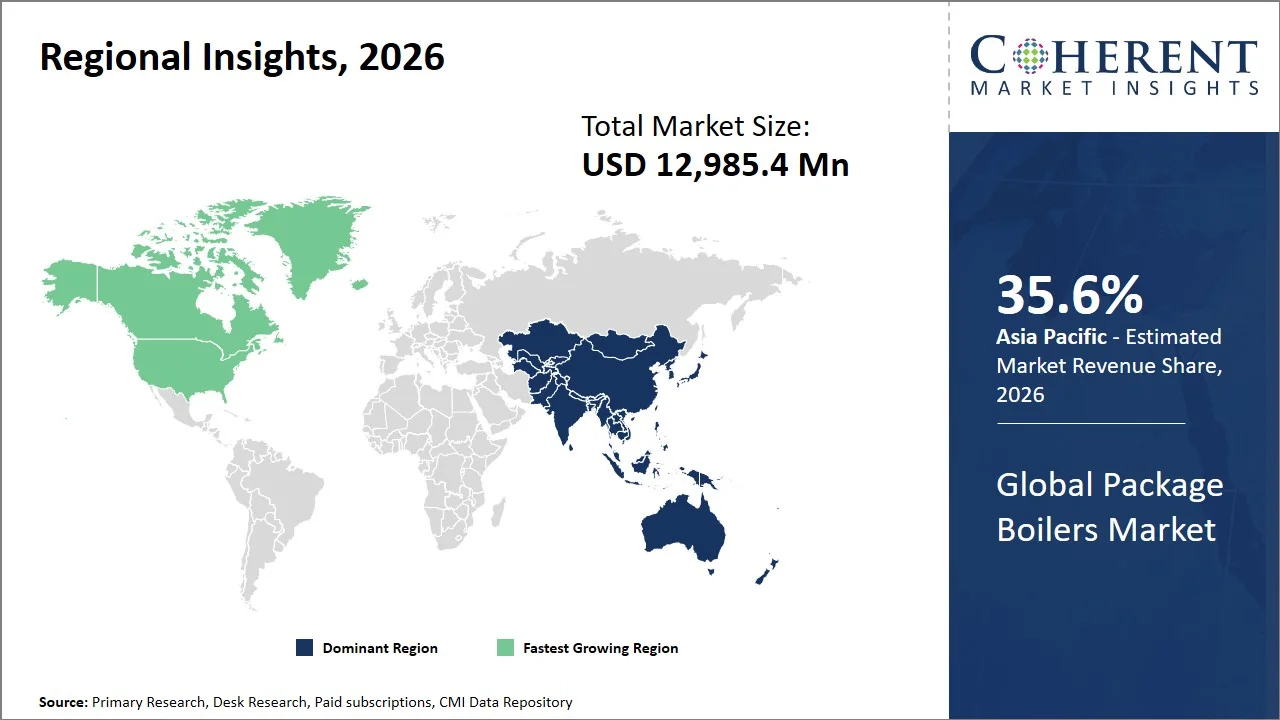
- Asia Pacific is projected to dominate the market with 35.6 % share in 2026 due to industrial growth, industrial localization and ongoing investments in process heat infrastructure in the region across India, China, and Southeast Asia. In March 2026, Thermax secured a contract to supply a boiler package for an ultra-supercritical thermal power project in Central India.
- North America is expected to hold 26.7 % of the market share in 2026 and register the fastest growth, backed by the replacement of aging steam assets, efficiency upgrades, and industrial decarbonization funding. In January 2025, the U.S. DOE awarded Skyven Technologies funding to begin a steam-generating heat pump project designed to replace natural gas boilers at U.S. manufacturing facilities.
- Shift Toward Modular and Digitally Managed Boiler Rooms: Customers are increasingly evaluating package boilers as integrated steam assets rather than standalone equipment. Modular layouts, IoT-enabled controls, predictive service models, and remote diagnostics are improving uptime, reducing unplanned maintenance, and supporting faster commissioning. This trend strengthens supplier differentiation through lifecycle services, aftermarket contracts, and performance-based boiler room optimization.
- Decarbonization Reshapes Fuel and Technology Choices: Package boiler procurement is moving toward cleaner fuel flexibility, hybrid heating, biomass compatibility, and electric-ready configurations. Industrial buyers are balancing carbon-reduction goals with steam reliability, making adaptable boiler platforms strategically important. Suppliers offering fuel-switching capability, efficiency upgrades, and compliance-ready designs are positioned to capture replacement and modernization demand.
Segmental Insights
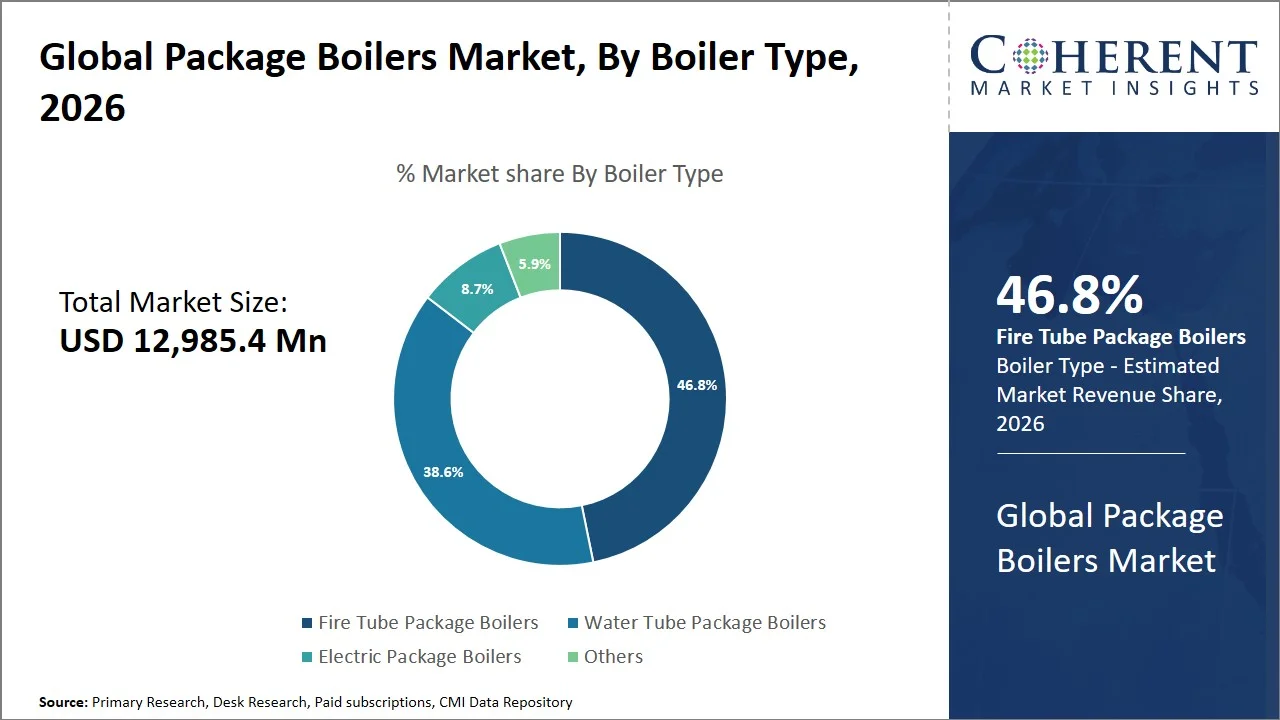
Why Do Fire Tube Package Boilers Dominate the Global Package Boilers Market?
Fire tube package boilers dominate the global package boilers market with an expected share of 46.8% in 2026 due to their strong fit for facilities needing reliable steam generation without the engineering complexity of large field-erected systems. Their leadership is supported by steady replacement demand from food processing, commercial heating, laundry, healthcare, and institutional boiler rooms where predictable load profiles, operator familiarity, and faster installation matter. On the supply side, manufacturers continue to improve packaged firetube systems with electronic combustion controls, stainless-steel heat exchangers, compact footprints, and retrofit-friendly designs. In April 2025, Fulton’s expanded ENDURA XE firetube boiler line was scheduled for first customer shipments, covering larger commercial capacities from 1,000 to 6,000 MBTU/HR and emphasizing rapid commissioning and serviceability. (Source: Hedrick Associates)
- Current Industry Events of 2026
- Market Size Estimation
- Regional Breakdown
- Competitive Landscape
- Customer Intelligence
- Segmental Analysis
- Pricing Analysis
- Key Market Drivers, Challenges & Future Trends
- Customized Insights Section
Why is Natural Gas the Largest Fuel Type in the Global Package Boilers Market?
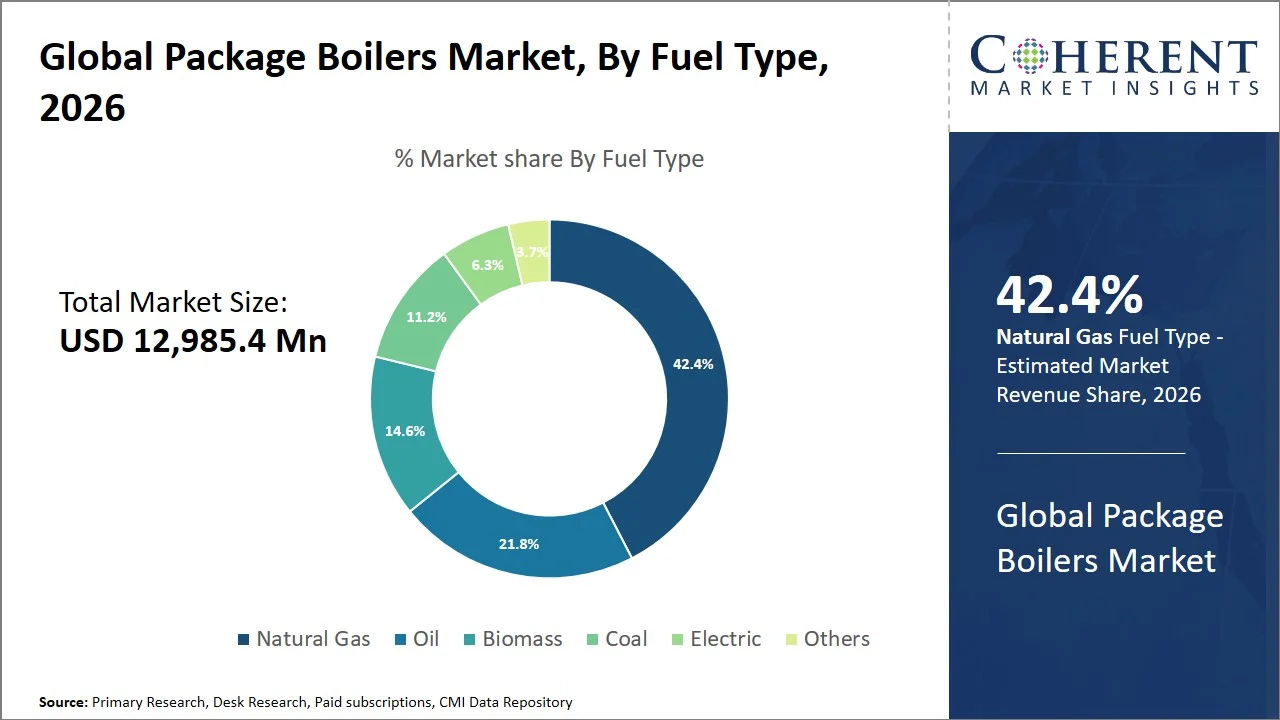
Natural gas leads the fuel type segment of the global package boilers market with an expected share of 42.4% in 2026 because industrial and commercial users prioritize clean combustion, stable burner performance, automated fuel-air control, and lower fuel-handling complexity compared with coal, biomass, or oil. It is especially relevant in packaged boiler rooms serving pharmaceuticals, hospitals, food plants, hotels, campuses, and light manufacturing, where space, emissions control, and operational consistency are critical procurement criteria. Supply-side support comes from mature low-NOx burners, integrated combustion management, and certification pathways for gas-fired package systems. In February 2025, UL Solutions highlighted the newly published UL 795 Commercial-Industrial Gas-Fired Package Boilers, 9th Edition, including certification and hydrogen/natural gas blend considerations at AHR Expo 2025. (Source: UL LLC)
Why Does 10 to 50 TPH Dominate the Global Package Boilers Market?
The 10 to 50 TPH capacity range dominates the global package boilers market with an expected market share of 46.7% in 2026 because it matches the steam requirement of medium-scale process industries without pushing buyers into high-capex utility-scale boiler systems. It is large enough for multi-shift production in chemicals, food and beverage, paper conversion, textiles, pharma, and agro-processing, while still allowing modular design, easier transport, and faster installation than very large units. Supply-side relevance is reinforced by availability of economizers, air pre-heaters, waste-heat recovery options, and multi-fuel configurations suited to plant-level efficiency programs. In March 2024, India’s Bureau of Energy Efficiency launched its voluntary Standards & Labeling program for packaged boilers, covering packaged boilers across IBR capacities and efficiency ratings valid through December 2026. (Source: Bureau of Energy Efficiency (BEE))
Global Package Boilers Market Dynamics
Key Market Drivers
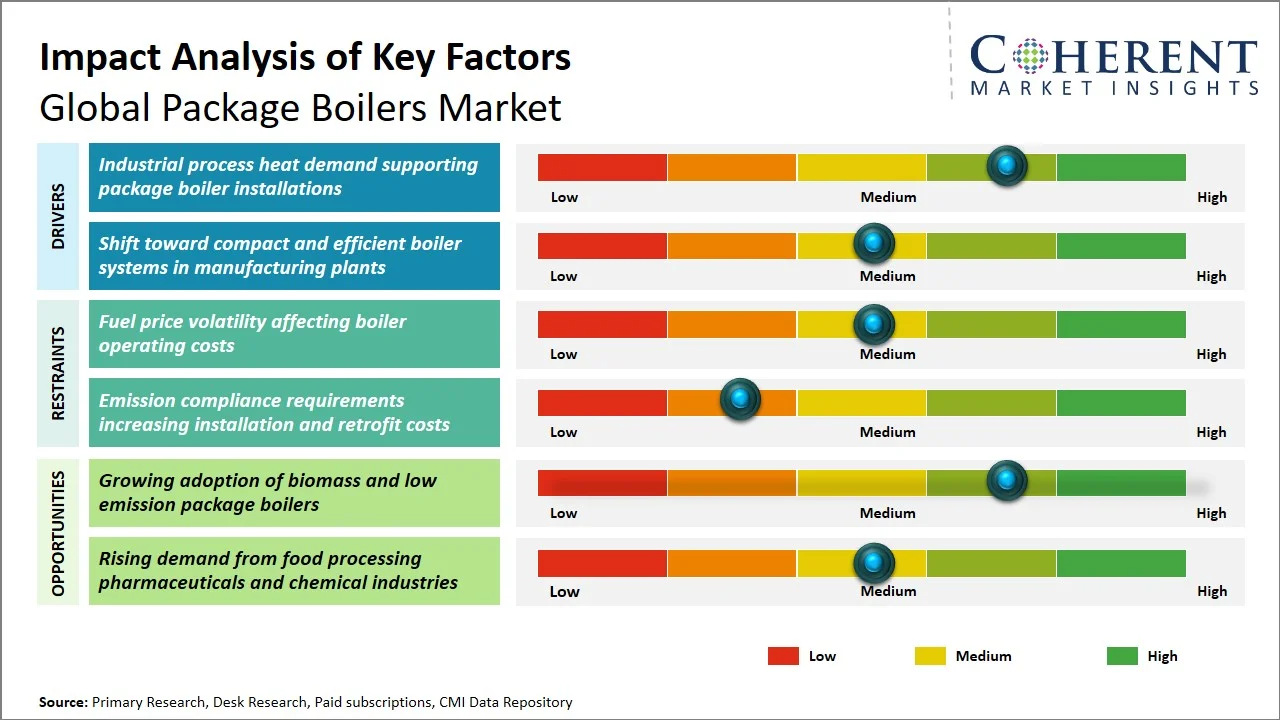
- Industrial Process Heat Demand Supporting Package Boiler Installations: Package boilers are gaining adoption as process industries require dependable steam for heating, sterilization, drying, cleaning, distillation, and continuous production. Food and beverage, chemicals, pharmaceuticals, pulp and paper, textiles, and oil and gas facilities prefer package boilers because they reduce installation time and provide plant-level steam reliability without the complexity of large field-erected systems. Demand is also supported by replacement of aging boiler rooms, higher uptime expectations, and growing need for flexible steam capacity across medium-scale production sites. In June 2025, Babcock Wanson expanded its industrial boiler service footprint through the acquisition of Chr. Møller, a Danish specialist in industrial boiler maintenance, refurbishment, rental, and thermal system optimization, strengthening support for process-heating users across Northern Europe.
- Shift Toward Compact and Efficient Boiler Systems in Manufacturing Plants: Manufacturing facilities are increasingly selecting compact package boilers to optimize floor space, reduce fuel consumption, and support flexible steam generation. This shift is especially important for plants operating with variable loads, space constraints, high utility costs, and strict maintenance schedules. Compact modular systems also allow easier capacity additions, faster startup, lower standby losses, and better integration with automated boiler-room controls. Manufacturers are not only evaluating boiler purchase cost but also lifecycle efficiency, service support, water treatment, and downtime risk. In May 2025, Miura America launched a tiered Miura Care program through its rep network, offering structured maintenance plans and performance guarantees, while highlighting efficiency, scale prevention, and reliability as key industrial steam priorities. (Source: Miura America Co., LTD)
Emerging Market Trends
- Fuel Flexibility and Low-Emission Boiler Configuration: Package boiler buyers are increasingly moving toward systems that can support natural gas, biomass, electric, and hybrid fuel configurations depending on local energy pricing, fuel access, and emissions requirements. This trend is changing procurement decisions from single-fuel equipment selection to long-term steam strategy planning. Industrial users want boiler systems that can meet current cost targets while preserving flexibility for future decarbonization pathways. Suppliers are therefore positioning multi-fuel compatibility, low-NOx burners, biomass-ready designs, and electric integration as value-added differentiators. The trend is commercially important because end users are under pressure to improve environmental performance without compromising steam availability, making adaptable boiler platforms more attractive for food processing, chemicals, pharmaceuticals, textiles, and institutional users.
- Digital Boiler-Room Management and Service-Led Differentiation: Digital controls, remote monitoring, automated blowdown, combustion optimization, water-quality tracking, and predictive maintenance are becoming central to package boiler value propositions. Customers increasingly prefer suppliers that can provide equipment, controls, maintenance, and lifecycle performance support as an integrated offering. This trend is shifting competition from product-only sales to recurring service relationships, where uptime, fuel efficiency, and compliance support influence supplier selection. Digital boiler-room management also supports multi-site industrial customers that need standardized performance visibility across plants. For manufacturers, this creates opportunities to improve aftermarket revenue, strengthen customer retention, and differentiate through operational intelligence rather than equipment specification alone. The trend is especially relevant for industries where steam interruption can directly affect product quality, production throughput, and safety compliance.
Current Events and their Impact
Current Events | Description and its Impact |
May 2026 – U.S. DOE Commercial Water Heater Enforcement Policy |
|
December 2025 – European Commission Consultation on Revised Ecodesign and Energy Labelling Rules |
|
August 2025 – Arkansas Boiler Safety Proposed Rulemaking |
|
Regional Insights
Why Does Asia Pacific Dominate the Global Package Boilers Market?
Asia Pacific dominates the global package boilers market with an expected share 35.6% in 2026 due to its broad manufacturing base, high process-steam consumption, and strong demand from food processing, chemicals, textiles, pharmaceuticals, pulp and paper, and refinery-linked industries. China and India remain key demand centers because medium-scale industrial plants require compact steam systems that can be installed faster than large custom boiler units. Regional buyers also prefer package boilers for capacity flexibility, lower installation complexity, and suitability for expanding industrial clusters. In April 2025, India enacted the Boilers Act, 2025, establishing uniform regulation for boiler design, manufacture, erection, inspection, and use, which strengthens safety compliance and supports organized adoption of certified boiler systems. (Source: Steamax Envirocare Pvt. Ltd)
Why is North America Emerging as the Fastest-Growing Region in the Package Boilers Market?
North America is emerging as the fastest-growing region with expected share 26.7% in 2026 as industrial users modernize aging steam assets, upgrade boiler-room safety systems, and invest in higher-efficiency packaged steam solutions. The region has strong demand from food processing, chemicals, pharmaceuticals, institutional campuses, healthcare facilities, and oil and gas operations, where reliability, emissions compliance, and quick service support are critical. Package boilers are also gaining relevance because they allow faster replacement during plant shutdowns and support modular capacity addition. In July 2025, the 2025 ASME Boiler and Pressure Vessel Code update advanced design, fabrication, inspection, and certification requirements for pressure equipment, reinforcing technical compliance expectations across boiler manufacturers and end users. (Source: LRQA Group Limited)
Package Boilers Market Outlook for Key Countries
Why is the U.S. a Key Market for Package Boilers?
The U.S. is a key market for package boilers because of its large base of industrial, commercial, and institutional steam users. Food processing plants, refineries, hospitals, universities, chemical facilities, and pharmaceutical manufacturers depend on reliable steam for heating, sterilization, cleaning, process control, and utility operations. Demand is supported by boiler replacement cycles, strict workplace safety expectations, and the need for low-emission burner systems. The country also has a strong network of boiler OEMs, service providers, rental suppliers, and inspection frameworks, which supports faster project execution and aftermarket revenue. In July 2025, OSHA cited Keystone Foods for alleged fire and explosion hazards linked to boiler-room maintenance, reinforcing the importance of safe boiler operation, preventive maintenance, and compliant equipment practices in U.S. industrial facilities.
Why is India Important in the Global Package Boilers Market?
India is important in the global package boilers market due to expanding demand from food processing, specialty chemicals, pharmaceuticals, textiles, paper, dairy, and industrial parks. Medium-capacity package boilers are widely relevant because many Indian facilities need dependable steam systems with manageable capital cost, compact layout, and easier installation. Domestic manufacturing capability also supports the availability of localized boiler designs, fabrication, spares, and maintenance services. Regulatory modernization is improving compliance discipline and creating stronger demand for certified systems. In June 2025, DPIIT issued draft rules under the Boilers Act, 2025, covering areas such as boiler operation engineers, boiler attendants, accident inquiry, appeal processes, and inspection qualifications, strengthening India’s boiler safety and operating framework.
Why Does China Support Growth in the Package Boilers Market?
China supports growth in the package boilers market because of its large industrial base, strong equipment manufacturing ecosystem, and high steam requirement across chemicals, textiles, metallurgy, food processing, paper, and industrial heating applications. The country’s boiler demand is shaped by both replacement of older systems and adoption of cleaner, more efficient boiler configurations. Package boilers are relevant for distributed industrial facilities that need standardized steam generation, faster commissioning, and compliance-ready operating performance. In March 2024, China’s State Administration for Market Regulation published opinions to promote green, low-carbon, and high-quality boiler development, with emphasis on stricter requirements for newly installed boilers and upgrading existing boiler operations. This policy direction encourages efficient boiler products and supports technology-led replacement demand.
Why is Germany a Strategic Country in the Package Boilers Market?
Germany is a strategic country in the package boilers market because it combines advanced industrial manufacturing, high-quality engineering standards, strong process industries, and strict energy-efficiency expectations. Demand is supported by chemicals, food processing, pharmaceuticals, paper, automotive suppliers, and institutional users that require efficient and reliable steam systems. German buyers typically prioritize lifecycle efficiency, automation readiness, emissions performance, and compliance with European pressure equipment and safety norms. The country is also important as a technology and export base for advanced boiler systems. In April 2025, the International Energy Agency (IEA) noted that Germany’s Heat Planning Act provides clearer direction for heating-sector decarbonization, creating pressure on industrial and commercial heat users to evaluate cleaner and more efficient steam and heating systems.
Why is Saudi Arabia an Important Growth Market for the Package Boilers Market?
Saudi Arabia is an important growth market for package boilers because industrial diversification is expanding demand beyond traditional oil and gas operations. Petrochemicals, refining, desalination, food processing, mining, manufacturing, and utility-linked industrial facilities require dependable steam and hot water systems for process heating and plant operations. Package boilers are relevant because they support faster installation, modular expansion, and reliable steam supply in large industrial zones and new manufacturing facilities. In May 2026, Saudi Arabia’s Ministry of Industry and Mineral Resources issued 188 new industrial licenses during March 2026, while 78 factories began production, signaling continued expansion of the country’s industrial base and supporting future demand for industrial utility equipment such as package boilers.
Technology Adoption Landscape in the Global Package Boilers Market
Technology | Adoption Level | Key Application Area | Business Impact |
Low-NOx burner systems | High | Natural gas and oil-fired package boilers | Supports emissions compliance and strengthens adoption in regulated industrial zones |
Economizers and heat recovery systems | High | Steam plants in food, chemicals, textiles, and paper | Reduces fuel consumption and improves lifecycle operating economics |
Automated combustion control | High | Multi-shift manufacturing boiler rooms | Improves fuel-air ratio control, steam stability, and operational safety |
Remote monitoring and IoT diagnostics | Medium | Multi-site industrial and institutional users | Reduces downtime risk and supports preventive maintenance contracts |
Electric package boilers | Medium | Low-emission facilities and space-constrained plants | Enables on-site emission reduction and supports decarbonization strategies |
Biomass-compatible boiler systems | Medium | Agro-processing, pulp and paper, and renewable heat users | Improves fuel diversification and supports sustainability-linked procurement |
How are Low-Emission Steam Technologies and Fuel-Flexible Designs Creating New Growth Opportunities in the Global Package Boilers Market?
Low-emission steam generation is a key growth opportunity, as industrial users aim to achieve a balance in productivity, cost control and environmental compliance. A more diverse customer base in both developed and emerging markets can be met by package boiler suppliers that provide natural gas optimization, biomass compatibility, electric heating systems, hybrid systems, and heat recovery integration. Given the fact that many facilities are not prepared to completely electrify steam operations, this opportunity is a business opportunity, as it provides a transition path to lower emissions and higher efficiency. With Fuel-flexible package boilers, end users can respond to the rising costs and availability of fuel, as well as changing regulatory requirements, without having to completely redesign their boiler room. Suppliers can also differentiate through modular designs, retrofit packages, digital monitoring, and service contracts that reduce total ownership cost.
Market Players, Key Development, and Competitive Intelligence
Key Developments
- In December 2025, Bosch Industriekessel entered into a strategic partnership with A.E.P. Thermal to develop electrode boiler solutions for industrial applications, district heating, and grid stabilization. This development reflects the market’s shift toward electrification of process heat and supports future demand for high-capacity electric boiler systems in decarbonizing industrial facilities.
- In February 2025, Cleaver-Brooks launched the LVR electric hydronic boiler, offering a compact zero-onsite-emission solution for commercial and institutional heating applications. The launch supports growing adoption of electric boiler systems where users need cleaner heat, easier installation, reduced fuel piping complexity, and better alignment with sustainability targets.
Competitive Landscape
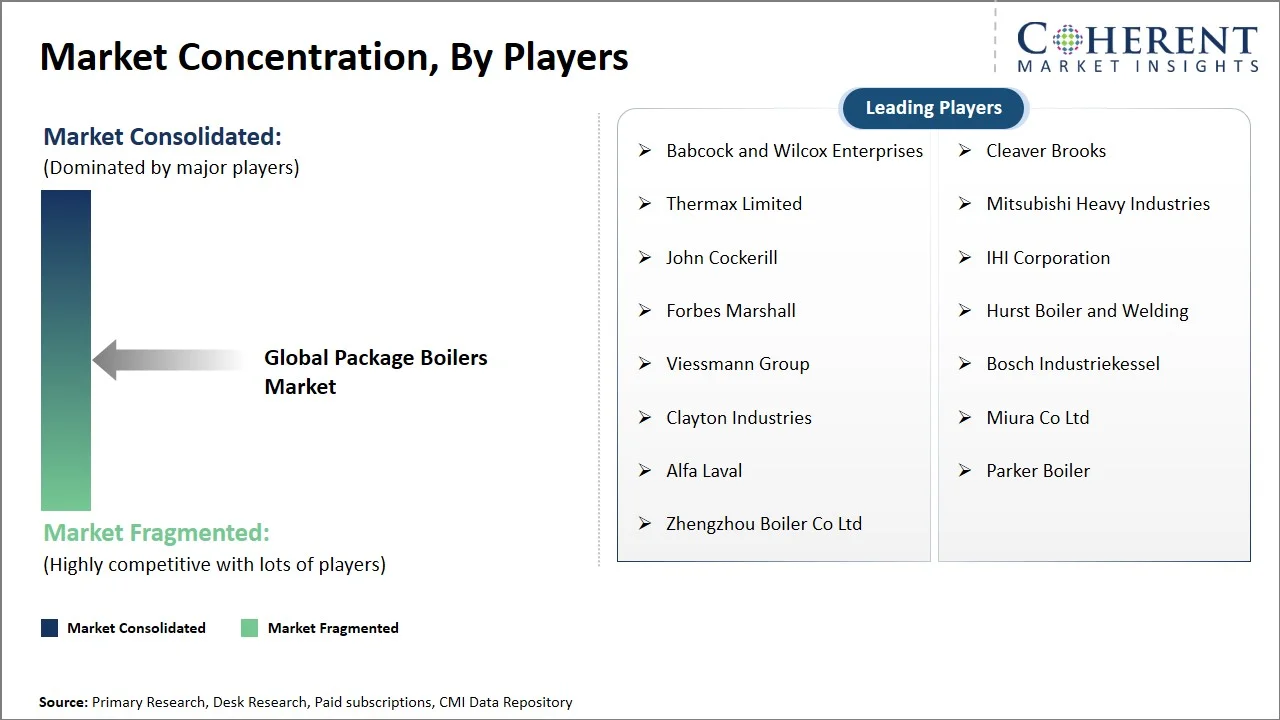
The global package boilers market is moderately fragmented, with competition spread across global industrial boiler manufacturers, regional engineering firms, burner and control system suppliers, boiler-room service companies, and EPC-linked solution providers. Companies compete on equipment reliability, energy efficiency, customization capability, installation support, fuel flexibility, and aftermarket service depth.
Key focus areas include
- Product quality and differentiation through pressure rating, steam output stability, and boiler design reliability
- Technology adoption and process efficiency through automation, economizers, and combustion optimization
- Pricing and cost competitiveness, especially in medium-capacity industrial boiler projects
- Capacity expansion and supply reliability for fast-track industrial and institutional installations
- Certifications, compliance, and quality control linked to boiler safety codes and emissions norms
- Distribution network and customer reach through regional dealers, service centers, and engineering partners
- Product specification differentiation by fuel type, capacity range, pressure level, and modular configuration
- Supplier agreements and lifecycle service contracts for maintenance, inspection, retrofit, and rental support
Market Report Scope
Package Boilers Market Report Coverage
| Report Coverage | Details | ||
|---|---|---|---|
| Base Year: | 2025 | Market Size in 2026: | USD 12,985.4 Mn |
| Historical Data for: | 2020 To 2024 | Forecast Period: | 2026 To 2033 |
| Forecast Period 2026 to 2033 CAGR: | 5.6% | 2033 Value Projection: | USD 19,015.3 Mn |
| Geographies covered: |
| ||
| Segments covered: |
| ||
| Companies covered: | Babcock and Wilcox Enterprises, Cleaver Brooks, Thermax Limited, Mitsubishi Heavy Industries, John Cockerill, IHI Corporation, Forbes Marshall, Hurst Boiler and Welding, Viessmann Group, Bosch Industriekessel, Clayton Industries, Miura Co Ltd, Alfa Laval, Parker Boiler, Zhengzhou Boiler Co Ltd | ||
| Growth Drivers: |
| ||
| Restraints & Challenges: |
| ||
Analyst Opinion (Expert Opinion)
- The global package boilers market is expected to grow steadily as industries continue to require reliable steam systems for process heating, production support, cleaning, sterilization, and plant operations. Demand is likely to remain strong among manufacturing facilities that need compact, efficient, and easy-to-install boiler solutions.
- Growth opportunities are expected to be stronger in industrial applications where companies are replacing old boiler systems with more efficient, fuel-flexible, and digitally managed package boilers. Fire tube boilers, natural gas-fired systems, and medium-capacity units are expected to remain preferred choices due to their practical use across food processing, chemicals, pharmaceuticals, textiles, and institutional facilities.
- Key challenges include fuel price changes, stricter emission rules, high initial equipment cost, and the need for skilled maintenance support. Companies should focus on energy-efficient designs, low-emission technologies, strong service networks, and flexible fuel options to strengthen their market position and improve customer retention.
Speak to the analyst
Want personalized insights?
Take the findings above to one of our principal consultants, or have the report rebuilt around the segments, geographies and competitors you actually track.
Market Segmentation
- Boiler Type Insights (Revenue, USD Mn, 2021 - 2033)
- Fire Tube Package Boilers
- Water Tube Package Boilers
- Electric Package Boilers
- Others
- Fuel Type Insights (Revenue, USD Mn, 2021 - 2033)
- Natural Gas
- Oil
- Biomass
- Coal
- Electric
- Others
- Capacity Insights (Revenue, USD Mn, 2021 - 2033)
- Below 10 TPH
- 10 to 50 TPH
- 50 to 100 TPH
- Above 100 TPH
- Application Insights (Revenue, USD Mn, 2021 - 2033)
- Food and Beverage Processing
- Chemical Processing
- Oil and Gas
- Pulp and Paper
- Healthcare and Pharmaceuticals
- Textile Processing
- Others
- End User Insights (Revenue, USD Mn, 2021 - 2033)
- Industrial
- Commercial
- Institutional
- Others
- Regional Insights (Revenue, USD Mn, 2021 - 2033)
- North America
- U.S.
- Canada
- Latin America
- Brazil
- Argentina
- Mexico
- Rest of Latin America
- Europe
- Germany
- U.K.
- Spain
- France
- Italy
- Russia
- Rest of Europe
- Asia Pacific
- China
- India
- Japan
- Australia
- South Korea
- ASEAN
- Rest of Asia Pacific
- Middle East
- GCC Countries
- Israel
- Rest of Middle East
- Africa
- South Africa
- North Africa
- Central Africa
- North America
- Key Players Insights
- Babcock and Wilcox Enterprises
- Cleaver Brooks
- Thermax Limited
- Mitsubishi Heavy Industries
- John Cockerill
- IHI Corporation
- Forbes Marshall
- Hurst Boiler and Welding
- Viessmann Group
- Bosch Industriekessel
- Clayton Industries
- Miura Co Ltd
- Alfa Laval
- Parker Boiler
- Zhengzhou Boiler Co Ltd
Source
Primary Research Interviews
- Package boiler manufacturers and OEM executives
- Sales/technical heads of fire-tube and water-tube boiler manufacturers
- Boiler room system integrators and EPC contractors
- Industrial plant maintenance managers and utility heads
- Procurement heads from food processing, chemicals, pharma, textile, pulp & paper, and refineries
- Boiler burner, control system, economizer, and heat recovery equipment suppliers
Stakeholders
- Manufacturers of package boilers: Cleaver-Brooks, Babcock Wanson, Thermax, Miura, Hurst Boiler, Fulton, Bosch Industriekessel, Johnston Boiler, Mitsubishi Heavy Industries, Cochran, IHI, Alfa Laval Aalborg
- End-use sectors: Food & beverage, chemicals, pharmaceuticals, textiles, pulp & paper, oil & gas, refineries, hospitals, hotels, laundries, district heating, manufacturing plants
- Component suppliers: Burner manufacturers, pressure vessel fabricators, boiler control system providers, feedwater system suppliers, economizer and heat recovery system suppliers
- EPC and installation players: Industrial utility contractors, boiler room engineering firms, plant automation providers
- Regulatory & certification bodies: ASME BPVC, National Board Inspection Code, EPA Boiler MACT, EU Pressure Equipment Directive, Indian Boiler Regulations, ISO boiler/pressure equipment standards
Databases
- UN Comtrade Database – HS Code 8402 for steam/vapor generating boilers
- USITC DataWeb – boiler import/export tracking under HS 8402
- ITC Trade Map – global boiler trade flows
- World Bank WITS – country-level boiler trade data
- Eurostat COMEXT – EU boiler trade data
- OECD industrial energy database
- IEA industrial heat and energy efficiency database
- U.S. EIA industrial natural gas and fuel price data
- U.S. Census / NAICS 333414 – heating equipment manufacturing
Magazines / Industry Publications
- Power Engineering
- POWER Magazine
- Process Heating
- Boiler & Burner Engineering
- Chemical Engineering Magazine
- Plant Engineering
- Heating, Ventilating & Plumbing Magazine
- Energy Manager Magazine
- Industrial Heating
Journals
- Applied Thermal Engineering
- Energy
- Energy Conversion and Management
- Journal of Cleaner Production
- Case Studies in Thermal Engineering
- International Journal of Heat and Mass Transfer
- Fuel
- Thermal Science and Engineering Progress
- Journal of Energy Resources Technology
Newspapers
- The Wall Street Journal – manufacturing energy cost trends
- Financial Times – industrial decarbonization and boiler replacement trends
Associations
- American Boiler Manufacturers Association
- ASME
- National Board of Boiler and Pressure Vessel Inspectors
- Combustion Engineering Association
- European Heating Industry
- Japan Boiler Association
- VDMA Power Systems
- Indian Boiler Manufacturers Association
- Council of Industrial Boiler Owners
Public Domain Sources
- U.S. EPA – industrial, commercial, and institutional boiler emission standards
- European Commission – Pressure Equipment Directive 2014/68/EU
- ASME – Boiler and Pressure Vessel Code
- IEA – industrial heat and fuel transition reports
- EIA – industrial fuel consumption and natural gas pricing
- OSHA – boiler safety and workplace safety guidelines
- India DPIIT / Central Boilers Board – Indian Boiler Regulations
- Environment Agency UK – industrial combustion and emissions guidance
Proprietary Elements
- CMI Data Analytics Tool, Proprietary CMI Existing Repository of information for last 10 years.
Get access to 250+ pages report
Every segment, forecast, competitor profile and data table behind the analysis above — available for instant download.
- ESOMAR Member
- ISO 9001:2015 Certified
- D-U-N-S Registered
- GDPR & CCPA Compliant
Missing comfort of reading report in your local language? Find your preferred language:
Transform your Strategy with Exclusive Trending Reports
Frequently Asked Questions
The CAGR of the global package boilers market is projected to be 5.6% from 2026 to 2033.
The global package boilers market is estimated to be valued at USD 12,985.4 million in 2026 and is expected to reach USD 19,015.3 million by 2033.
Emission regulations are pushing industries to adopt low-emission, fuel-efficient package boilers with better combustion control and heat recovery systems.
Food processing, chemicals, pharmaceuticals, textiles, pulp and paper, oil and gas, healthcare, and institutional facilities are key demand-generating industries.
Fuel price volatility affecting boiler operating costs and emission compliance requirements increasing installation and retrofit costs are the major factors hampering the growth of the global package boilers market.
In terms of boiler type, fire tube package boilers are estimated to dominate the market revenue share in 2026.
Industrial process heat demand supporting package boiler installations and shift toward compact and efficient boiler systems in manufacturing plants are the major factors driving the growth of the global package boilers market.