

Nuclear Waste Management Market Size and Trends - 2026 to 2033
The nuclear waste management market is estimated to be valued at USD 5.30 Bn in 2026 and is expected to reach USD 6.24 Bn by 2033, exhibiting a compound annual growth rate (CAGR) of 2.5% from 2026 to 2033.
Key Takeaways
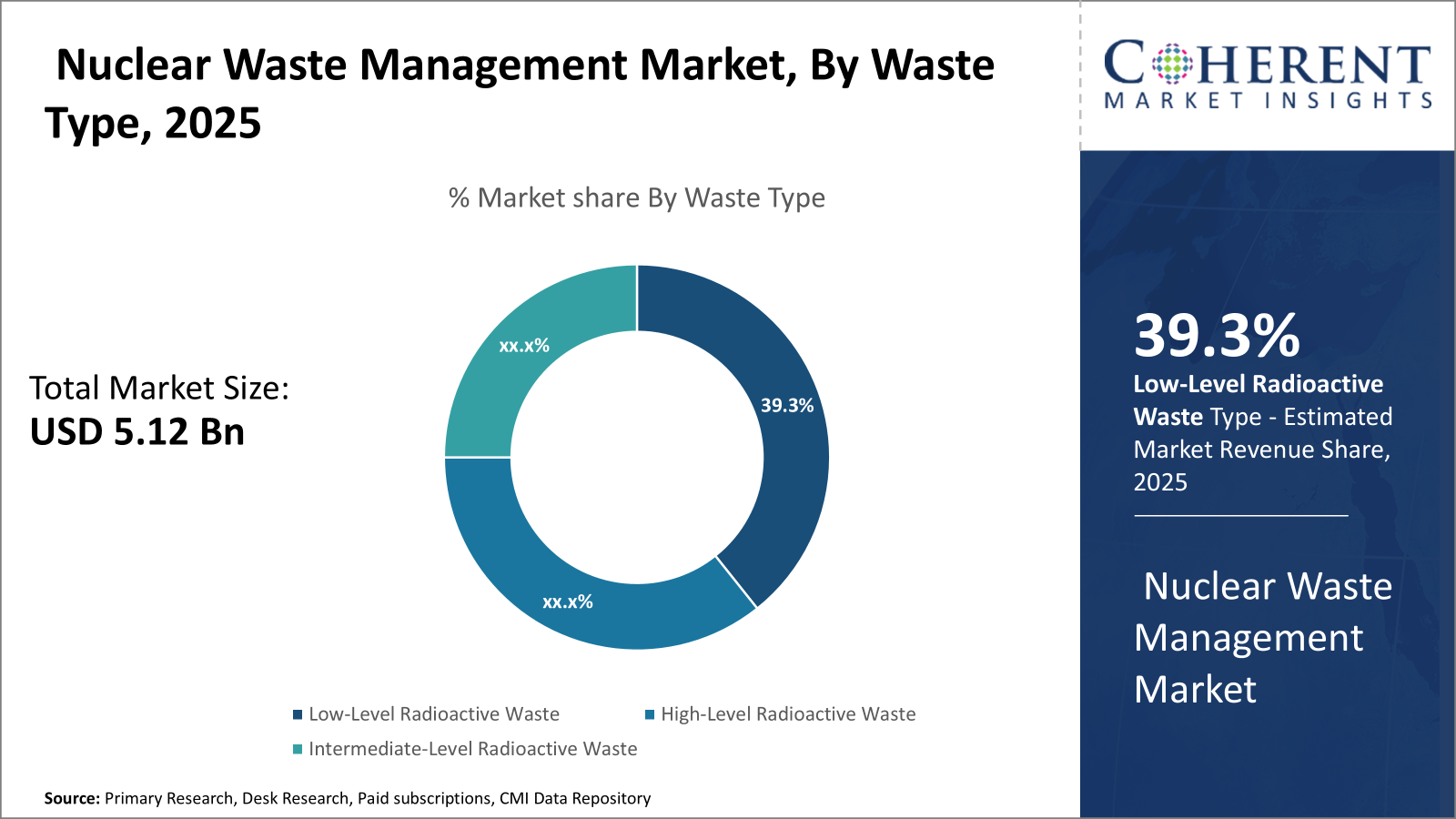
- In terms of Waste Type, Low-Level Radioactive Waste segment is poised to hold around 40.3% shares in 2026, owing to its relatively high volume.
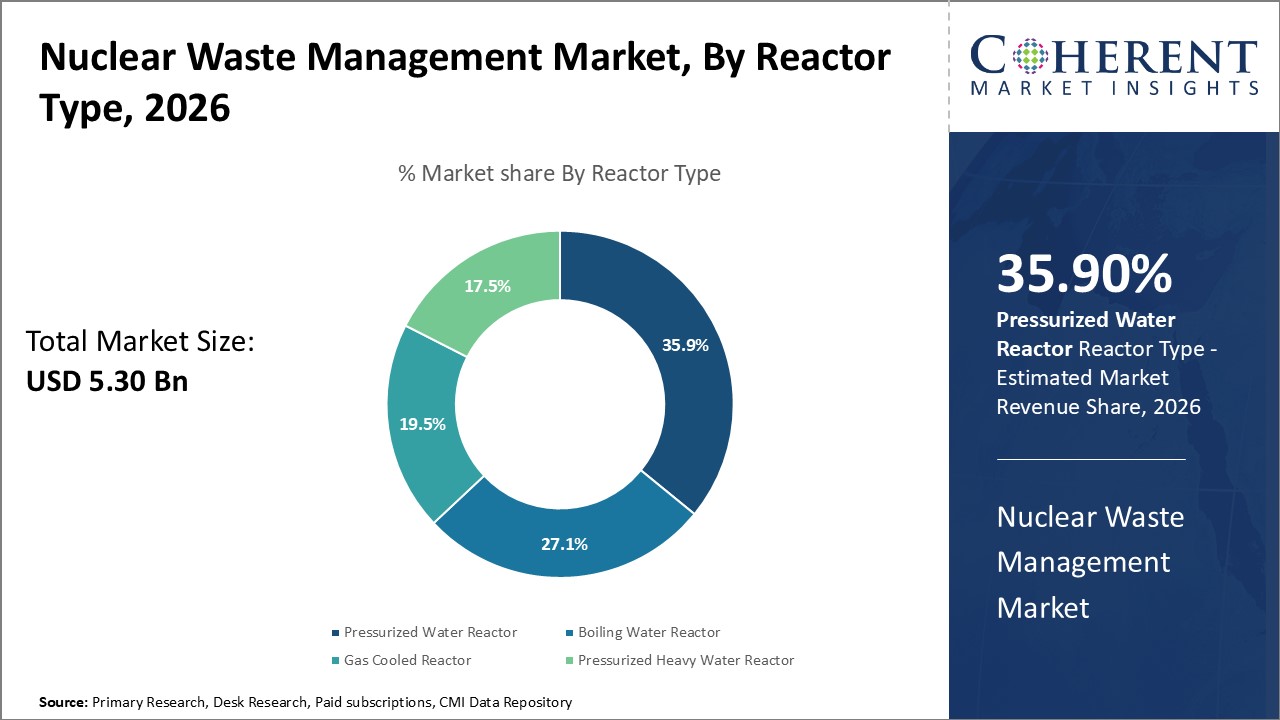
- Based on Reactor Type, Pressurized Water Reactor segment is projected to hold 35.9% shares, owing to its wide usage globally.
- By Disposal Method, Deep Geological Disposal division is expected to account 41.2% shares in 2026, due to its potential for permanent isolation of nuclear materials.
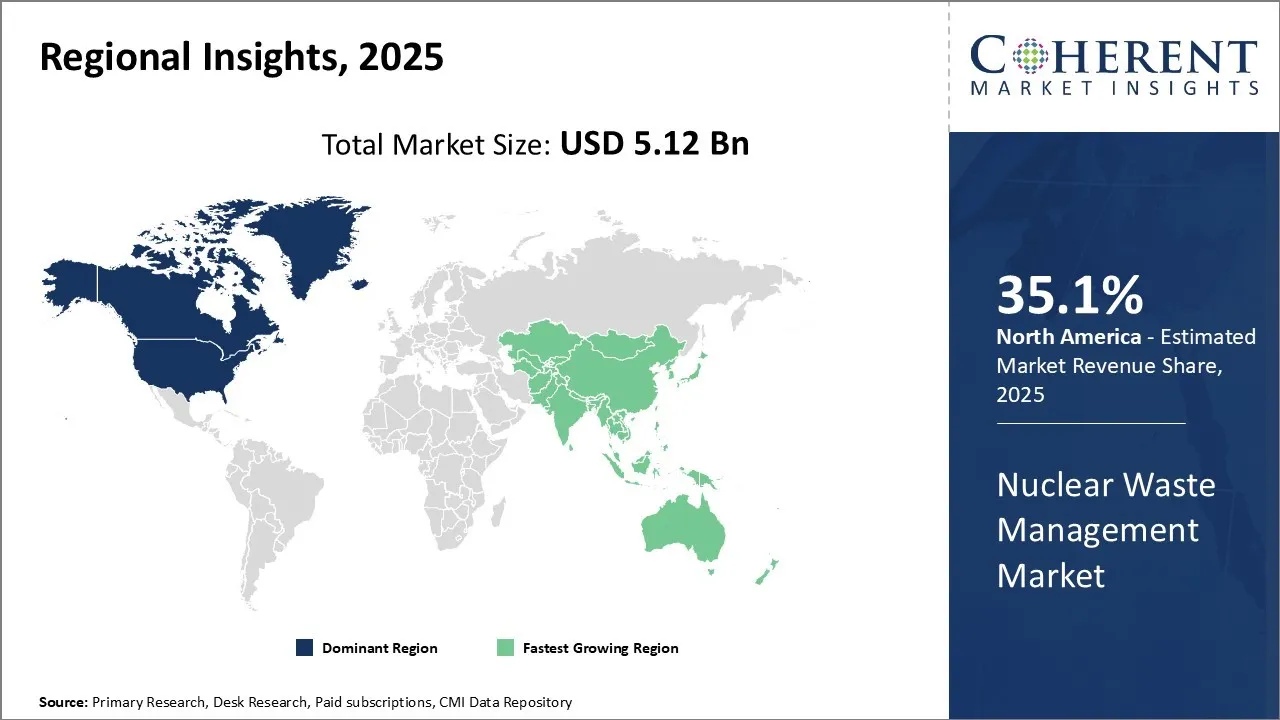
- Regionally, North America is poised to dominate the market with 35.1% shares during the forecast period.
Market Overview
Global nuclear waste management market is expected to witness steady growth over the forecast period. There has been increasing investments by various government and private organizations towards effective nuclear waste disposal technologies in recent years. Also, growth in nuclear energy production globally has resulted in the expansion of the sources generating nuclear waste. Various companies are investing in innovative solutions such as transmutation to reduce the half-life and radio-toxicity of nuclear waste, which is expected to lead to numerous opportunities in the market. However, the high costs associated with nuclear waste management and stringent regulatory guidelines for waste storage & transportation continue to remain key challenges for the growth of the nuclear waste management market.
Current Events and their Impact on the Nuclear Waste Management Market
Current Event | Description and its Impact |
Technological Breakthroughs in Waste Processing |
|
Geopolitical Nuclear Fuel Cycle Disruptions |
|
Microeconomic and Macroeconomic Factors Affecting Nuclear Waste Management Market Growth
Macroeconomic factors
- Energy transition & decarbonisation pressure: With many countries aiming to reduce greenhouse‑gas emissions, nuclear power is gaining renewed interest as a low‑carbon base‑load option. For example, the spent‑fuel and nuclear‑waste‑management market is being driven by increasing nuclear generation in countries such as China, India, and Russia.
- Regulatory & policy environment: International organisations (e.g., International Atomic Energy Agency (IAEA)) and national regulators are tightening waste‑treatment, storage, transport and disposal requirements.
- National infrastructure investment & funding availability: The scale of nuclear‑waste management is large and long‐term (decades to centuries in stewardship). For example, development of deep geological repositories or large‐scale facilities requires major capital and long time‑horizons
- Public sentiment & environmental consciousness: At the macro level, societal concerns over nuclear safety, environmental impact, and intergenerational liability drive political/regulatory responses. For instance, public scrutiny increases the pressure for more robust waste‑management practices.
Microeconomic factors
- Waste volumes and waste type mix: The more waste generated (whether low‑level, intermediate, or high‑level), the greater the requirement for storage, treatment, transport and disposal services. For example, low‑level waste (LLW) often constitutes a large volume share, though it may have lower unit cost.
- Technology & innovation: Advances in treatment technologies (e.g., vitrification, robotics, artificial intelligence monitoring, remote handling) improve efficiency, reduce cost over time, and open new service opportunities.
- Cost structure & capital intensity: Waste‑management projects are highly capital‑intensive (e.g., constructing repositories, storing HLW, decommissioning plants). The long payback periods and high initial CAPEX are a barrier.
- Liability & risk management: Because radioactive waste has long lifetimes, firms (and governments) face long‑term liability risk (environmental, regulatory, reputational). This risk drives demand for higher‐quality services, risk‑mitigation, and often insurance or surety.
- Current Industry Events of 2026
- Market Size Estimation
- Regional Breakdown
- Competitive Landscape
- Customer Intelligence
- Segmental Analysis
- Pricing Analysis
- Key Market Drivers, Challenges & Future Trends
- Customized Insights Section
Market Drivers
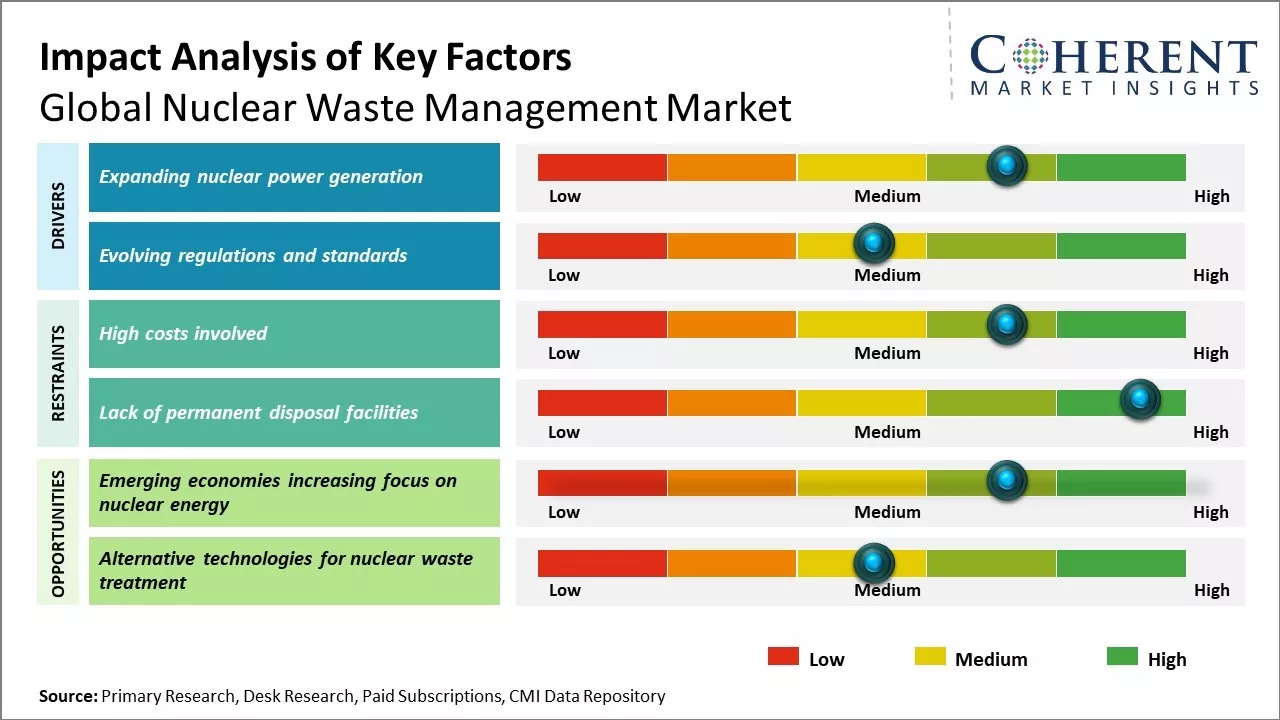
Expanding nuclear power generation
With growing global energy demands and increasing concerns around environmental sustainability, nuclear power generation is experiencing renewed interest as a low-carbon energy alternative. Many nations are expanding their existing nuclear fleets or embarking on new nuclear power programs to meet their rising electricity needs and decarbonization targets.
For instance, China currently has around 50 nuclear reactors in operation and is set to significantly increase this capacity over the next decade. India also has ambitious plans to escalate its nuclear power capacity from the current 7.1 GW to 63 GW by 2032. Other countries like Russia, South Korea, and Eastern European nations are similarly investing heavily in new nuclear builds.
This global surge in nuclear power infrastructure will translate to rising volumes of used nuclear fuel and radioactive wastes that require safe and regulated storage and management. As more reactors come online, greater tonnages of spent fuel from reactor operations will need to be removed from plant sites and housed in centralized waste management facilities.
Furthermore, as older Gen II reactors retire, the decommissioning process will produce large quantities of deregulated hazardous components and materials which must be disposed of or stored long-term according to safety protocols. The increasing waste volumes present significant logistical, technological, and financial challenges for nuclear utilities and regulatory bodies worldwide. This will drive substantial investments in developing effective waste management and permanent disposal solutions.
Evolving regulations and standards
Stringent regulations play a key role in shaping the nuclear waste management landscape. Over the past decade, safety standards and policy frameworks governing radioactive materials have continuously evolved in response to emerging industry practices and lessons from past incidents.
For instance, the Fukushima disaster prompted reviews of global regulatory structures resulting in more robust storage criteria. Similarly, changing public risk perceptions have also influenced the passage of updated laws around topics like transportation of wastes and siting of long-term repositories. Additionally, diverse international rules regarding issues such as accountability for full lifecycle costs are driving changes in waste owner responsibilities.
This dynamic legislative environment implies nuclear stakeholders must frequently upgrade their facilities, equipment, training, and handling processes to conform to the latest regulatory codes. Continuous evaluation and upgrading of aging waste management sites is necessitated to maintain compliance.
Global regulatory harmonization initiatives are likewise boosting quality standards and fostering international cooperation which impacts facility design requirements and operational models. The imperative of regulatory compliance alongside advancing national policy goals will sustain investments in modernizing nuclear waste infrastructures worldwide and foster technology innovations.
Segmental Insights
Global Nuclear Waste Management Market Insights, By Waste Type: Radiation Risk Dictates Share
In terms of Waste Type, low-Level Radioactive Waste is expected to contribute 40.3% share of the market in 2026, owing to its relatively high volume, widespread generation across medical, industrial, and research sectors, and the lower complexity and cost of its treatment and disposal compared to high-level waste.
For instance, according to a report from the United States Nuclear Regulatory Commission, approximately 2.32 million cubic feet and 154 thousand curies of low-level radioactive waste were disposed of in 2022.
Global Nuclear Waste Management Market Insights, By Reactor Type: Pressurized Design Prominence
In terms of Reactor Type, pressurized water reactor is estimated to contribute 35.9% share of the market in 2026, owing to its widespread use globally. Around 60% of commercial reactors globally use pressurized water technology. These reactors cool the core with high-pressure water which is then converted into steam to spin turbines for power generation.
The pressurized design proved highly influential during the 20th century expansion of nuclear energy. A standardized pressurized water system reduced construction costs while safety features isolate radioactive materials from the environment.
Established supply chains have emerged to support pressurized water reactors through their 40–50-year lifecycles. As the most prevalent reactor in operation, pressurized water waste remains a prominent aspect of nuclear waste generation with entrenched management infrastructure.
For instance, in January 2025, India’s state-owned enterprise, Nuclear Power Corporation of India Limited (NPCIL), announced that it had invited proposals to construct a fleet of 40–50 220 MW Pressurized Heavy Water Reactors (PHWRs) to replace coal-fired power plants serving heavy industries, including steel, aluminum, copper, and cement manufacturing facilities.
Global Nuclear Waste Management Market Insights, by Disposal Method: Geologic Isolation is Ideal
In terms of Disposal Method, deep geological disposal is expected to contribute 41.2% share of the market in 2026, due to its potential for permanent isolation of nuclear materials. Deep geological facilities involve burying high-level radioactive waste hundreds of meters underground in stable rock formations. Here the waste canisters are encapsulated and the tunnels backfilled to essentially entomb them.
Geological disposal relies on thick rock barriers to contain radiation over extremely long timeframes, achieving a passive safety through natural rather than engineered processes. While high initial costs are involved, perpetual monitoring and surface facilities are not required once sealed.
Many countries have extensive research programs working towards geological repositories as the preferred long-term solution. Though no such facilities are operational yet, geology-based storage remains at the forefront of strategies to immobilize nuclear waste for generations.
For instance, in January 2025, the UK government organization responsible for identifying a site for a deep geological repository for spent nuclear fuel announced three designated “areas of focus” for comprehensive studies and detailed investigations.
Regional Insights
North America Nuclear Waste Management Market Analysis and Trends
North America has established itself as the dominant region in the nuclear waste management market with 35.1% share in 2026. The U.S. accounts for the largest share of nuclear reactors and nuclear waste generation globally. With over 90 operating commercial reactors, the nuclear industry has a sizable presence in the country. Decades of nuclear power generation has resulted in a substantial amount of spent fuel and other radioactive waste requiring safe and environment-friendly storage and disposal.
The U.S. government has made significant investments in setting up necessary infrastructure for nuclear waste handling and long-term storage. A deep geological repository is being developed at Yucca Mountain in Nevada to permanently house high-level waste and spent biofuel. Temporary storage facilities have also come up near nuclear plant sites while final disposal solutions are developed. The extensive institutional structure, technical expertise, operational experience, and availability of capital make North America the established leader in this market.
For instance, in February 2024, according to a report from the United States Nuclear Regulatory Commission, approximately 2.32 million cubic feet and 154 thousand curies of low-level radioactive waste were disposed of in 2022.
Asia Pacific Nuclear Waste Management Market Analysis and Trends
The Asia Pacific region is emerging as the fastest growing market for nuclear waste management. Countries like China, India and South Korea are aggressively expanding their nuclear power capacity to meet growing electricity demands and reduce reliance on fossil fuels. Over 50 nuclear reactors are under construction globally, the majority being in Asia. This rapid capacity addition is boosting the volumes of nuclear waste. While these nations have gained expertise in nuclear technology over the years, the nuclear waste management sector is still developing.
Opportunities exist for private and public organizations to assist Asian countries in areas like interim storage, transportation, treatment and disposal facility design. The large projected waste volumes and increasing awareness around safe disposal makes Asia an attractive market.
Countries are investing in R&D, human resource development and setting up regulatory frameworks to ensure long-term sustainability of their nuclear programs. This marks the Asia Pacific region as one with high growth potential for nuclear waste management solutions.
For instance, in January 2026, the IAEA launched a new Regulatory Infrastructure Development Project for Asia and the Pacific as part of its efforts to strengthen radiation safety and nuclear security in the region.
Nuclear Waste Management Market – Dominating Countries
Canada Nuclear Waste Management Market Analysis and Trends
Canada is considered as dominating country with highest share in the global nuclear waste management market, due to its large number of operational nuclear reactors, well-established waste management infrastructure, significant government funding, and stringent regulatory frameworks that drive the safe handling, storage, and disposal of nuclear waste.
For instance, in June 2026, Canada's Nuclear Waste Management Organization sought public input to "confirm and refine" its proposed approach ahead of the planned 2028 launch of the site selection process for a second radioactive waste repository.
Japan Nuclear Waste Management Market Analysis and Trends
Japan is considered as dominating country with highest share in the global nuclear waste management market, owing to its rapid expansion of nuclear power capacity, substantial investments in nuclear infrastructure, government initiatives to improve waste management practices, and the development of advanced technologies for waste treatment and disposal.
For instance, in July 2023, an International Atomic Energy Agency (IAEA) safety review concluded that Japan’s plans to release treated water stored at the Fukushima Daiichi nuclear power station into the sea were consistent with IAEA Safety Standards. Such instances are propelling the nuclear waste management market share.
Market Concentration and Competitive Landscape
Key Takeaways from Analyst
The nuclear waste management market faces increased economic pressure to advance effective solutions. Stringent regulations on radioactive storage and transportation will drive investments in new reprocessing technologies. However, high capital costs to develop facilities may restrain short-term growth. Public opposition also poses challenges owing to fears around contamination.
North America currently dominate due to large nuclear power infrastructures. However, the Asia Pacific region is poised to grow rapidly as countries like China and India expand nuclear energy production. Emerging markets will seek safer, more sustainable solutions to match their rising energy demands.
Advanced reprocessing and long-term storage alternatives could capture gains. Innovations in robotic monitoring, leak detection and container materials may see increase in funding. International cooperation and knowledge sharing will prove vital to standardize safe practices.
Nuclear Waste Management Industry News
- In March 2025, Moltex Energy Canada Inc. (Moltex) shook up nuclear waste management with its revolutionary Waste to Stable Salt (WATSS) process.
- In September 2025, Deep Isolation Nuclear, Inc. announced it had signed a technology licensing agreement with Navarro Research and Engineering, Inc. (“Navarro”).
- In June 2025, the Nuclear Decommissioning Authority (NDA) announced a major partnership that saw innovative technology deployed for the first time to remotely and autonomously sort and segregate nuclear waste.
Market Report Scope
Nuclear Waste Management Market Report Coverage
| Report Coverage | Details | ||
|---|---|---|---|
| Base Year: | 2025 | Market Size in 2026: | USD 5.30 Bn |
| Historical Data for: | 2020 To 2024 | Forecast Period: | 2026 To 2033 |
| Forecast Period 2026 to 2033 CAGR: | 2.5% | 2033 Value Projection: | USD 6.24 Bn |
| Geographies covered: |
| ||
| Segments covered: |
| ||
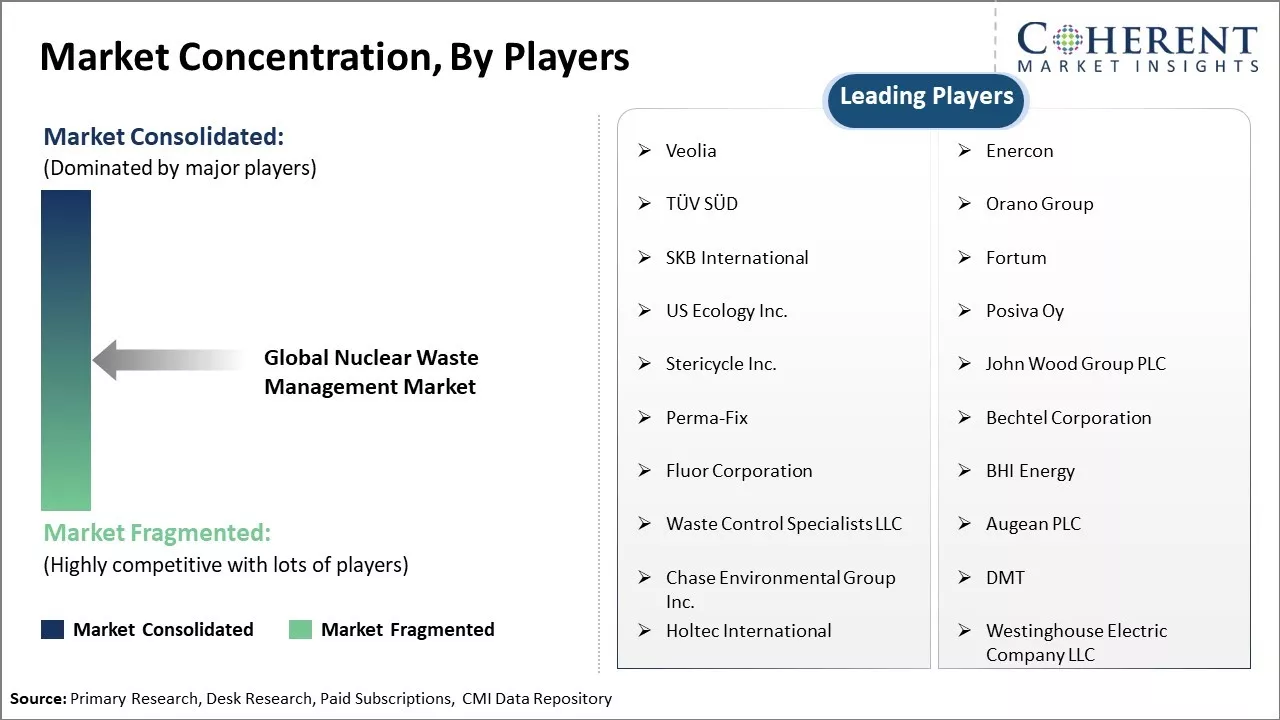
| Companies covered: | Veolia, Enercon, TÜV SÜD , Orano Group, SKB International, Fortum, US Ecology Inc., Posiva Oy, Stericycle Inc., John Wood Group PLC, Perma-Fix, Bechtel Corporation, Fluor Corporation, BHI Energy , Waste Control Specialists LLC, Augean PLC, Chase Environmental Group Inc. , DMT, Holtec International, Westinghouse Electric Company LLC | ||
| Growth Drivers: |
| ||
| Restraints & Challenges: |
| ||
Market Opportunities: Emerging economies increasing focus on nuclear energy
Emerging economies increasing focus on nuclear energy presents a huge opportunity for global nuclear waste management market. Many developing nations in Asia and Africa are aggressively pursuing nuclear power as a viable option to meet their growing energy needs in a sustainable manner. Countries like China, India, Pakistan, Bangladesh, Egypt, Nigeria, Ghana etc. are either constructing new nuclear power plants or expanding their existing capacities.
Market Segmentation
- Waste Type Insights (Revenue, USD Bn, 2021 - 2033)
- Low-Level Radioactive Waste
- Intermediate-Level Radioactive Waste
- High-Level Radioactive Waste
- Reactor Type Insights (Revenue, USD Bn, 2021 - 2033)
- Pressurized Water Reactor
- Boiling Water Reactor
- Gas Cooled Reactor
- Pressurized Heavy Water Reactor
- Disposal Method Insights (Revenue, USD Bn, 2021 - 2033)
- Incineration
- Storage
- Deep Geological Disposal
- Others
- Regional Insights (Revenue, USD Bn, 2021 - 2033)
- North America
- U.S.
- Canada
- Latin America
- Brazil
- Argentina
- Mexico
- Rest of Latin America
- Europe
- Germany
- U.K.
- Spain
- France
- Italy
- Russia
- Rest of Europe
- Asia Pacific
- China
- India
- Japan
- Australia
- South Korea
- ASEAN
- Rest of Asia Pacific
- Middle East & Africa
- GCC Countries
- Israel
- Rest of Middle East & Africa
- Key Players Insights
- Veolia
- Enercon
- TUV SUD
- Orano Group
- SKB International
- Fortum
- US Ecology Inc.
- Posiva Oy
- Stericycle Inc.
- John Wood Group PLC
- Perma-Fix
- Bechtel Corporation
- Fluor Corporation
- BHI Energy
- Waste Control Specialists LLC
- Augean PLC
- Chase Environmental Group Inc.
- DMT
- Holtec International
- Westinghouse Electric Company LLC
Sources
Primary Research interviews
- Nuclear Power Plant Operators
- Waste Management Technology Providers
- Regulatory Authority Officials
- Environmental Consultants
- Others
Databases
- International Atomic Energy Agency (IAEA) Database
- World Nuclear Association (WNA) Database
- Nuclear Energy Institute (NEI) Database
- OECD Nuclear Energy Agency Database
- Others
Magazines
- Nuclear Engineering International
- Nuclear News Magazine
- World Nuclear News
- Nuclear Plant Journal
- Others
Journals
- Journal of Nuclear Materials
- Nuclear Technology
- Annals of Nuclear Energy
- Others
Newspapers
- Nuclear Intelligence Weekly
- Nuclear Fuel
- NucNet News
- Nucleonics Week
- Others
Associations
- World Nuclear Association (WNA)
- Nuclear Energy Institute (NEI)
- International Atomic Energy Agency (IAEA)
- Nuclear Waste Management Organization (NWMO)
- Others
Public Domain sources
- U.S. Nuclear Regulatory Commission (NRC) Reports
- Department of Energy (DOE) Publications
- European Nuclear Safety Regulators Group (ENSREG)
- Nuclear Decommissioning Authority (NDA) Reports
- Others
Proprietary Elements
- CMI Data Analytics Tool
- Proprietary CMI Existing Repository of information for last 8 years
*Definition: Global nuclear waste management market involves a large number of services to safely store and dispose of radioactive waste produced by nuclear power plants and other nuclear applications. It consists of transportation solutions to move nuclear waste to centralized interim storage sites or permanent geological disposal repositories deep underground. It also includes advanced technologies for conditioning, compacting, and encapsulating nuclear waste into robust forms for secure long-term isolation from the human environment and the natural world. Overall aim is to protect both human health and the environment from any hazardous effects of radiation exposure.
Get access to 250+ pages report
Every segment, forecast, competitor profile and data table behind the analysis above — available for instant download.
- ESOMAR Member
- ISO 9001:2015 Certified
- D-U-N-S Registered
- GDPR & CCPA Compliant
Missing comfort of reading report in your local language? Find your preferred language:
Transform your Strategy with Exclusive Trending Reports
Frequently Asked Questions
The nuclear waste management market is estimated to be valued at USD 5.30 Bn in 2026, and is expected to reach USD 6.24 Bn by 2033.
The CAGR of the nuclear waste management market is projected to be 2.5% from 2026.24 to 2033.
Expanding nuclear power generation and evolving regulations and standards are the major factors driving the growth of global nuclear waste management market.
High costs involved and lack of permanent disposal facilities are the major factors hampering the growth of global nuclear waste management market.
In terms of Waste Type, Low-Level Radioactive Waste is expected to dominate the market revenue share in 2026.24.
Veolia, Enercon, TÜV SÜD, Orano Group, SKB International, Fortum, US Ecology Inc., Posiva Oy, Stericycle Inc., John Wood Group PLC, Perma-Fix, Bechtel Corporation, Fluor Corporation, BHI Energy, Waste Control Specialists LLC, Augean PLC, Chase Environmental Group Inc., DMT, Holtec International, and Westinghouse Electric Company LLC are the major players.
North America is expected to lead the global nuclear waste management market.