

Global Packaged Salad Market Size and Forecast – 2026 To 2033
The Global Packaged Salad Market is estimated to be valued at USD 14.79 Bn in 2026 and is expected to reach USD 23.13 Bn by 2033, growing at a compound annual growth rate (CAGR) of 6.6% from 2026 to 2033. Growth is supported by consumer preference for convenient, fresh, and nutritionally differentiated meal options, along with broader supermarket, convenience, and food-to-go availability.
Product innovation is also expanding salads beyond traditional side dishes toward protein-rich and complete meal solutions. In March 2026, Taylor Farms launched an 11-product protein-forward platform containing chopped salad kits and salad bowls, with several salad kits providing 20–21 grams of protein per bag, highlighting manufacturers’ efforts to combine fresh produce with functional nutrition and convenience.
Key Takeaways of the Global Packaged Salad Market
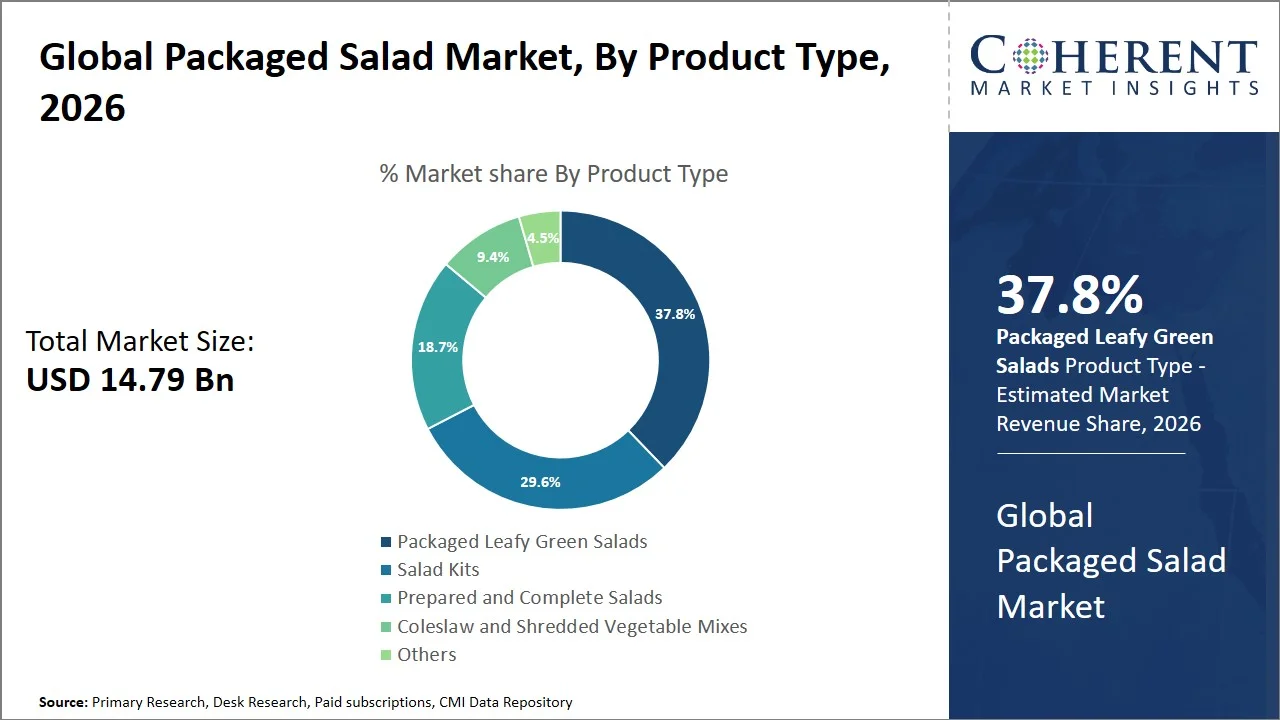
- Packaged Leafy Green Salads are expected to expand at an estimated CAGR of 6.2% during 2026–2033 and hold 37.8% of the global packaged salad market in 2026. Their lead reflects broad household familiarity, flexible meal use, and efficient merchandising as pre-washed greens. In June 2025, Little Leaf Farms highlighted its new no-wash Romaine Leaf, extending convenient packaged leafy-green choices for shoppers.
- Conventional packaged salads are expected to grow at an estimated CAGR of 5.9% during 2026–2033 and account for 72.6% of the market in 2026. Conventional products retain scale advantages through wider sourcing, lower shelf prices, and easier placement across mainstream grocery formats. In February 2025, Braga Fresh extended its conventional chopped salad kit line with four additional flavors for retail buyers.
- Bags and Pouches are expected to register an estimated CAGR of 6.3% during 2026–2033 and capture 48.7% of the market in 2026. Flexible packs support lightweight logistics, strong shelf visibility, portion versatility, and freshness management for high-turnover greens. In April 2025, Fresh Express unveiled redesigned packaging as part of its refreshed brand identity, reinforcing packaging as a critical retail communication tool.
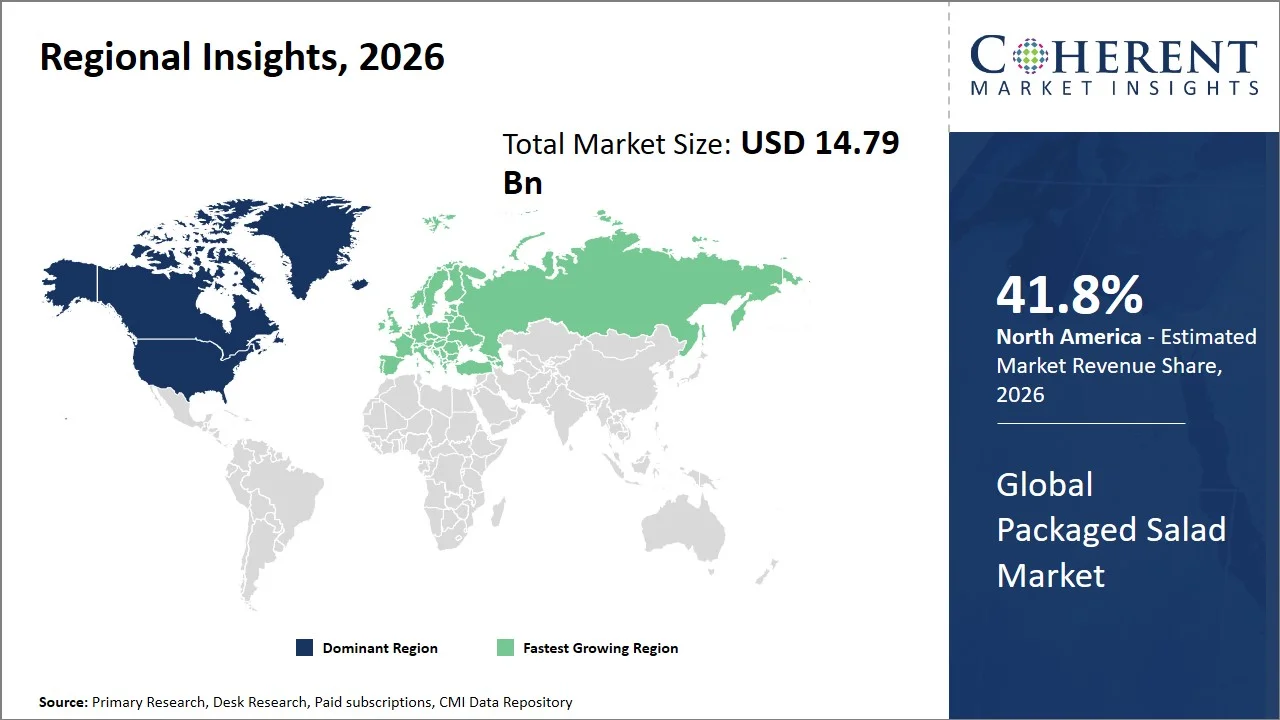
- North America is expected to advance at an estimated CAGR of 5.8% during 2026–2033 while accounting for 41.8% of the global packaged salad market in 2026. Its leadership rests on mature refrigerated retail, established value-added salad brands, and expanding controlled-environment supply. In July 2025, BrightFarms reported that three new greenhouse hubs had expanded access to its fresh greens across two-thirds of the U.S. population.
- Europe is expected to post an estimated CAGR of 8.1% during 2026–2033 and represent 31.7% of the global market in 2026, making it the fastest-growing region. Expansion is supported by convenience-led food purchasing, private-label strength, chilled prepared-food infrastructure, and investment in fresh meal solutions. In November 2025, Taylor Farms acquired UK-based Nature’s Way Foods, establishing a larger platform for fresh prepared foods in Europe.
Segmental Insights
Why Do Packaged Leafy Green Salads Dominate the Global Packaged Salad Market?
Packaged Leafy Green Salads are expected to hold 37.8% of the global packaged salad market in 2026 because they fit the broadest range of consumption occasions, from side dishes and sandwiches to meal bases and foodservice preparation. Their leadership is reinforced by the availability of romaine, spinach, spring mixes, and specialty leaves that can be washed, cut, blended, and packed at scale. For processors, standardized leafy-green inputs support high-throughput washing, drying, sorting, and cold-chain operations, while retailers benefit from familiar products with rapid inventory turnover. The segment also serves households seeking flexible ingredients rather than fully assembled kits. In October 2024, Del Monte announced the sale of Fresh Leaf Farms to First Leaf Farms, while preserving growing and logistics relationships intended to maintain leafy-green supply continuity and operational efficiency.
- Current Industry Events of 2026
- Market Size Estimation
- Regional Breakdown
- Competitive Landscape
- Customer Intelligence
- Segmental Analysis
- Pricing Analysis
- Key Market Drivers, Challenges & Future Trends
- Customized Insights Section
Why Does Conventional Represent the Largest Nature Segment in the Global Packaged Salad Market?
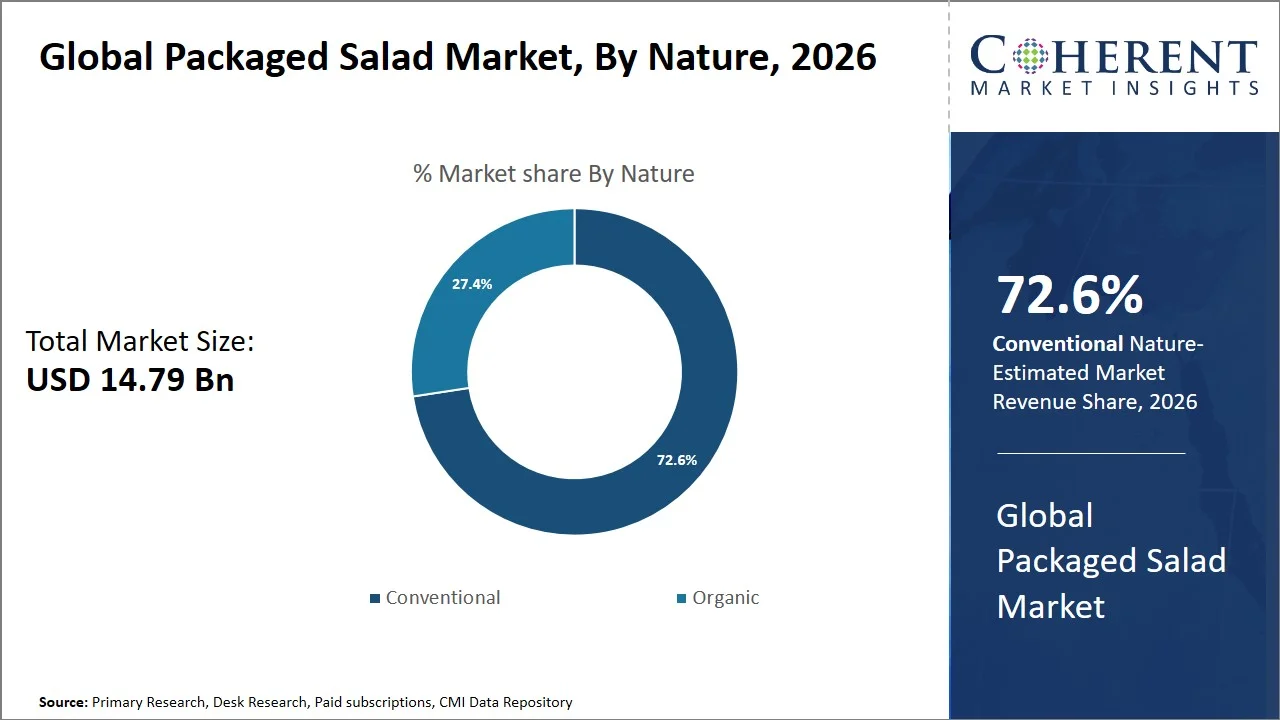
Conventional packaged salads are expected to account for 72.6% of the global packaged salad market in 2026 because they serve the widest price points and retail formats without the certification, segregation, and input constraints associated with organic production. Large field-growing networks give processors flexibility to source lettuce and other vegetables across seasonal production regions, supporting year-round replenishment for supermarkets, mass retailers, convenience outlets, and foodservice customers. This scale also allows manufacturers to offer broader pack sizes, private-label programs, and promotional pricing while maintaining frequent supply. Conventional products therefore remain commercially important for high-volume shoppers seeking freshness and convenience at accessible prices. In August 2025, Nature Fresh Farms entered an exclusive partnership with Revol Greens that explicitly positioned the companies to offer both conventional and organic packaged salads through greenhouse production capabilities.
Why Do Bags and Pouches Dominate the Packaging Type Segment of the Global Packaged Salad Market?
Bags and Pouches are expected to represent 48.7% of the global packaged salad market in 2026 because flexible packaging combines low material weight, efficient transport, strong shelf visibility, and compatibility with high-speed salad packing lines. For leafy greens, engineered films can incorporate oxygen-transmission control, laser or needle perforation, anti-fog properties, and resealable closures to manage respiration while preserving consumer convenience. These formats also use less storage space than rigid containers and can accommodate single-serve, family-size, and salad-kit configurations, giving processors and retailers greater assortment flexibility. Packaging suppliers benefit from demand for films that balance freshness performance with recyclability and reduced virgin-plastic use. In December 2023, Emerald Packaging and D’Arrigo California partnered on a romaine-hearts bag containing 30% post-consumer recycled plastic, demonstrating continued technical development in flexible produce packaging.
Current Events and their Impact
Current Event | Description and Its Impact |
EU Packaging and Packaging Waste Regulation entered into force – February 2025 |
|
FDA finalized revised pre-harvest agricultural water requirements – May 2024 |
|
U.S. DOJ antitrust intervention preserved packaged salad competition – March 2024 |
|
Global Packaged Salad Market Dynamics
Key Market Drivers
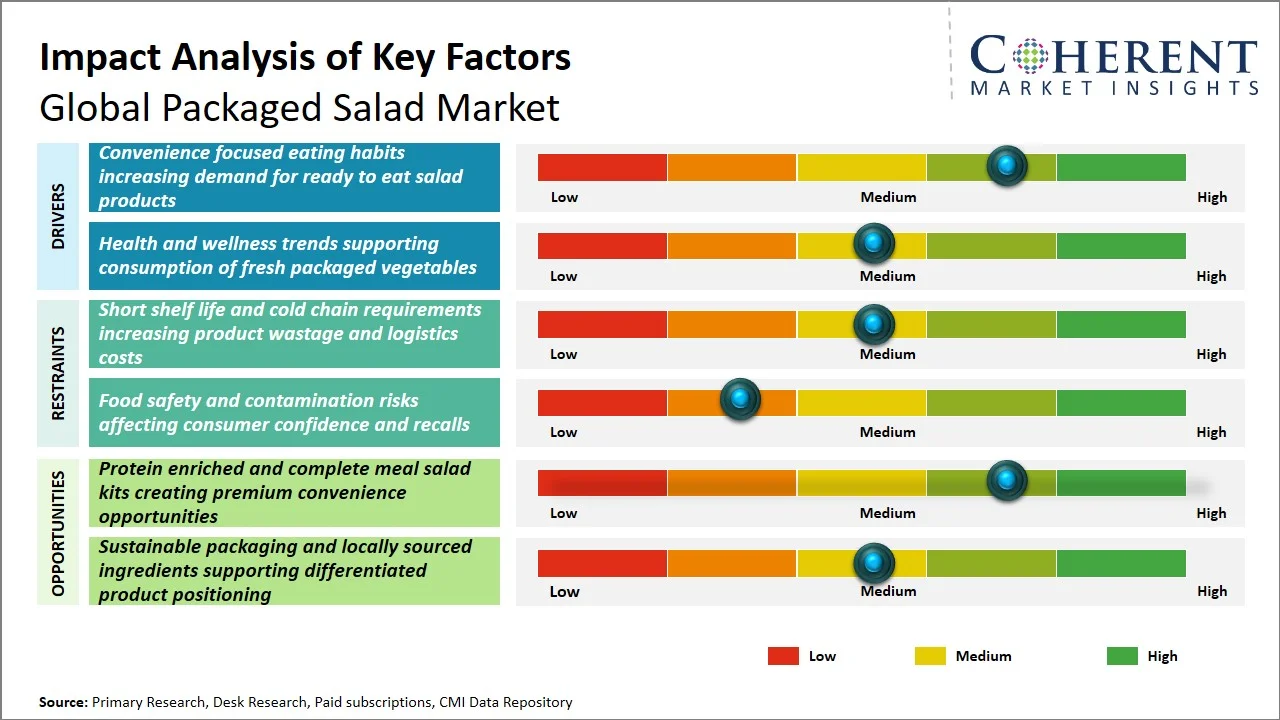
- Convenience focused eating habits increasing demand for ready to eat salad products: Packaged salads reduce meal preparation by eliminating washing, chopping, portioning, and dressing preparation, making them suitable for office workers, students, small households, and time-constrained families. Retailers benefit from higher-value fresh-food purchases, while manufacturers can differentiate through single-serve bowls, salad kits, and cuisine-inspired recipes. In December 2024, Fresh Del Monte’s Mann Packing announced Newman’s Own Salad Kits in four varieties for launch across North America.
- Health and wellness trends supporting consumption of fresh packaged vegetables: Health-focused consumers increasingly favor packaged salads that combine fresh vegetables, portion convenience, and recognizable ingredients. This supports leafy-green growers, fresh-cut processors, salad-kit manufacturers, and retailers positioning salads between fresh produce and ready meals. Ingredient transparency and balanced formulations are becoming more important for repeat purchases. In March 2024, 80 Acres Farms added Hail, Caesar! and vegan Zing N’ Zen salad kits, emphasizing pesticide-free greens and convenient fresh meal options.
Emerging Market Trends
- Flavor-led premiumization is reframing salad kits as culinary products: Packaged salad innovation is moving beyond standard Caesar and garden formats toward restaurant-inspired dressings, layered textures, specialty greens, seeds, cheeses, and globally influenced flavors. This allows manufacturers to build premium price points while helping retailers differentiate refrigerated assortments. Over the forecast period, faster recipe development and greater emphasis on distinctive flavor combinations are likely to become important competitive capabilities.
- Retailer private labels are becoming product-development platforms rather than value tiers: Private-label packaged salads are evolving into retailer-specific product ranges aligned with shopper preferences, freshness standards, dietary positioning, and meal occasions. Suppliers increasingly need flexible formulation, packaging, production scheduling, and quality systems to support exclusive programs. This trend may favor large contract manufacturers with agile production capabilities while increasing shelf-space pressure on smaller branded suppliers.
Regional Insights
Why Does North America Dominate the Global Packaged Salad Market?
North America is expected to account for 41.8% of the global packaged salad market in 2026, supported by a mature refrigerated produce system, widespread supermarket penetration, and strong consumer familiarity with bagged greens, chopped kits, and complete salad solutions. The region also benefits from established fresh-cut processing capacity and retail formats that support frequent replenishment of short-shelf-life products. Competition increasingly centers on flavor differentiation, convenient meal assembly, and dependable cold-chain execution rather than basic availability. In October 2025, Church Brothers Farms highlighted the debut of its Little Gems Salad Kits, extending its retail packaged-salad portfolio with four chef-inspired varieties built around whole Little Gem leaves and avocado-oil dressings. This supports the region’s continued shift toward higher-value salad formats and preimmunized convenience.
Why Is Europe Emerging as the Fastest-Growing Region in the Global Packaged Salad Market?
Europe is expected to hold 31.7% of the global packaged salad market in 2026 and emerge as the fastest-growing region as consumers increasingly combine fresh-food preferences with convenience, portion control, and reduced preparation time. Growth is also supported by dense modern grocery networks, established fresh-cut vegetable processing, and stronger retailer emphasis on packaging efficiency, waste reduction, and differentiated assortments. European suppliers are broadening salad occasions beyond side dishes toward meal salads, snacking, and ready-to-use vegetable solutions, while regional production can shorten replenishment cycles. In June 2026, Agrial reported that Florette strengthened its position during 2025, including higher sales in France and strong results from Florette Iberica. The development indicates continuing commercial traction for branded fresh ready-to-use vegetable products across important European markets.
Global Packaged Salad Market Outlook for Key Countries
Why Is the U.S. a Key Market for the Global Packaged Salad Market?
The U.S. is a key country in the global packaged salad market because packaged salads fit closely with high-frequency grocery shopping, workplace lunches, home meal shortcuts, and retailer-led fresh-food innovation. A large grocery network gives manufacturers broad distribution access, while fresh-cut processing infrastructure supports scalable supply. U.S. consumers are also accustomed to chopped kits combining vegetables, dressings, cheeses, seeds, and crunchy toppings, creating room for premium recipes and private-label differentiation. Retailers can therefore increase value per produce transaction without requiring shoppers to buy multiple ingredients separately. In March 2025, Kroger announced six new Private Selection salad kits, including Cheddar Truffle, Blueberry, Sweet Onion Gruyere, and Asian Sesame Ginger, illustrating how major U.S. retailers are expanding premium, flavor-led packaged salad assortments.
Why Is Germany a Strategic Country in the Global Packaged Salad Market?
Germany is strategically important in the global packaged salad market because its grocery sector supports frequent purchasing of chilled fresh foods while consumers increasingly value portion precision, convenience, and plant-forward meal components. The opportunity extends beyond standard mixed leaves into products designed for specific eating occasions such as bowls, pizza, pasta, burgers, wraps, and side dishes. This encourages processors to differentiate through pack size, composition, freshness, and preparation convenience rather than relying only on price. Germany also offers an established fresh-cut processing base and strong retail discipline around quality and waste management. In April 2024, Bonduelle Germany expanded its fresh-cut portfolio with portioned salads, including a dual-chamber side-salad pouch and meal-specific formats for baby spinach, arugula, and iceberg lettuce. The launch demonstrates demand for targeted portioning and occasion-based merchandising.
Why Does China Support Growth in the Global Packaged Salad Market?
China supports growth in the Global Packaged Salad Market through development of modern grocery retail, digital food purchasing, cold-chain infrastructure, and urban demand for convenient fresh-food formats. The commercial opportunity is strongest in major cities where consumers have greater access to refrigerated supermarkets, convenience-led retail, and health-oriented meal occasions. Packaged salad suppliers must nevertheless compete on freshness, food safety, local flavor adaptation, and price because chilled ready-to-eat vegetables require tighter handling than shelf-stable foods. Regulatory clarity can also influence how fresh-cut and ready-to-eat products are positioned. In March 2024, China’s State Administration for Market Regulation and five other authorities clarified that ready-to-eat vegetable and fruit salads are outside the defined category of prepared dishes requiring reheating or cooking. This provides clearer category boundaries for companies developing chilled fresh salad products.
Why Is Japan Important in the Global Packaged Salad Market?
Japan is important in the global packaged salad market because compact households, convenience-oriented food purchasing, disciplined chilled distribution, and frequent consumption of prepared meal components favor pre-cut vegetable formats. Packaged salads can serve as side dishes, meal ingredients, or vegetable-intake solutions, allowing suppliers to address both single-person households and families through multiple pack sizes. Japan’s retail environment also rewards precise portioning, freshness, attractive presentation, and low-preparation formats, making packaging and shelf-life management central to competitiveness. In March 2024, Salad Club announced a 350-gram “one day’s vegetables” colorful mixed salad for nationwide rollout from April, combining seven vegetable items in a large-format pack. The company linked the product with Japan’s daily vegetable-intake target and reported strong performance of its existing large-pack products, demonstrating demand for convenient vegetable volume and value.
Why Is Brazil an Important Growth Market for the Global Packaged Salad Market?
Brazil is an important growth market for the global packaged salad market because it combines a large domestic vegetable base with major urban consumer centers and expanding retail access to refrigerated, minimally processed foods. The category can gain relevance among households seeking fresh vegetables with less washing, trimming, and cutting, particularly where supermarkets maintain reliable chilled merchandising. Local sourcing of lettuce, cabbage, carrots, and other vegetables can also favor domestic processors with strong sanitation, packaging, and cold-chain capabilities. Public nutrition policy reinforces the positioning of minimally processed vegetables within healthier diets. In March 2024, Brazil issued Decree No. 11,936, which prioritizes in natura and minimally processed foods and explicitly recognizes operations including refrigeration, packaging, peeling, and slicing within minimally processed categories. This framework supports the broader fresh-food proposition surrounding packaged salads.
Technology Adoption Landscape in the Global Packaged Salad Market
Technology | Adoption Level | Key Application Area | Business Impact |
Modified-atmosphere packaging with microperforated films | High | Bagged leafy greens and salad kits | Controls package respiration conditions, supports freshness retention, and helps processors manage shelf-life performance and retail shrink. |
Automated multi-stage washing, sanitizer dosing, and drying systems | High | Fresh-cut leafy vegetable processing | Improves sanitation consistency, throughput, moisture control, and repeatability while reducing dependence on manual processing steps. |
Optical sorting and machine-vision inspection | Medium | Leaf quality and foreign-material inspection | Improves defect removal and product consistency while supporting faster inspection at commercial processing speeds. |
Controlled-environment hydroponic growing systems | Medium | Year-round leafy-green supply | Reduces seasonal variability, enables production nearer consumption centers, and supports more predictable raw-material quality and availability. |
Wireless temperature data loggers and real-time cold-chain monitoring | Medium | Processing-to-retail refrigerated distribution | Identifies temperature excursions, strengthens cold-chain accountability, and supports better shelf-life and inventory decisions. |
Digital lot-level traceability with standardized identifiers and ERP integration | Medium | Farm-to-processor-to-retailer tracking | Improves lot identification, recall precision, supplier accountability, and regulatory record management across complex fresh-produce networks. |
How Are Localized Fresh-Cut Microhubs and Controlled-Environment Supply Creating New Growth Opportunities in the Global Packaged Salad Market?
Localized fresh-cut microhubs paired with controlled-environment supply can create a new commercial pathway in import-dependent urban markets where long transport distances make freshness, shrink, and assortment consistency difficult to manage. The opportunity is not to replicate large North American processing plants immediately, but to build smaller regional systems that combine nearby greenhouse production, hygienic washing and cutting, flexible packing, and short refrigerated delivery routes. Such a model could serve premium supermarkets, convenience chains, corporate foodservice, hotels, and digital grocery platforms in major Middle Eastern and selected Asia Pacific countries. Companies can capture value by offering longer usable shelf life, locally adapted salad mixes, and faster replenishment while reducing dependence on fully finished imported salads. Participation requires food-safety capability, cold-chain discipline, reliable seed and substrate supply, retailer demand commitments, and packaging expertise. The opportunity is likely to favor vertically integrated growers and fresh-food specialists that can coordinate cultivation, processing, and route-to-market economics rather than entrants focused only on branding.
Market Players, Key Development, and Competitive Landscape
Key Developments
- In May 2025, Gotham Greens partnered with Sesame Workshop on a six-month limited-edition fresh-greens packaging and marketing program featuring Sesame Street characters. The initiative is important for the global packaged salad market because it demonstrates how leafy-green suppliers can use packaging, family-focused merchandising, and consumer education to broaden engagement with refrigerated salad products beyond traditional health-focused buyers.
- In September 2024, Plenty worked with 7-Eleven to bring lettuce from its indoor vertical farm into salads offered across approximately 1,300 convenience stores in California. This is important for the global packaged salad market because it connects controlled-environment production directly with high-frequency food-to-go distribution, illustrating how local growing technology can support packaged salad availability outside traditional supermarket channels.
- In February 2024, Revol Greens added its Green(house) Caesar Salad Kit to its packaged salad portfolio, combining greenhouse-grown green leaf, romaine, and arugula with cheese, croutons, and dressing in a ready-to-eat format. This is important for the global packaged salad market because it shows greenhouse suppliers extending downstream from packaged greens into higher-value assembled meal solutions, allowing greater capture of processing and formulation value.
Competitive Landscape
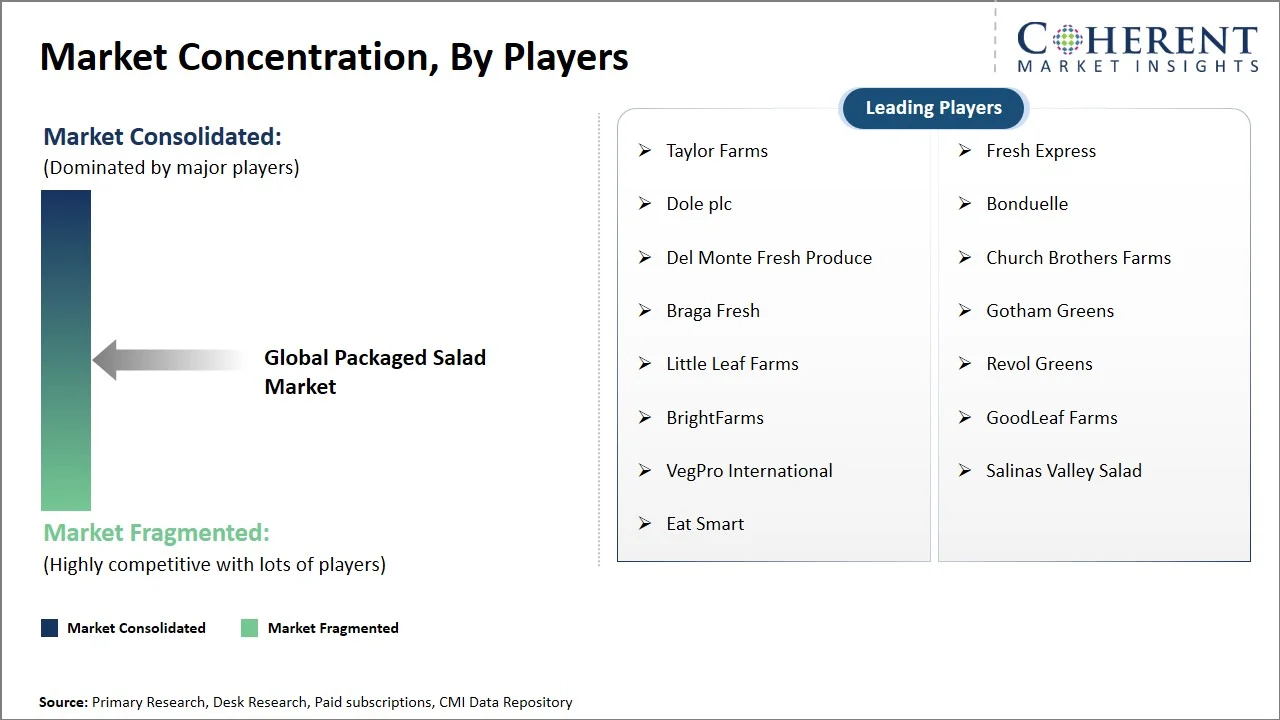
The global packaged salad market is moderately consolidated at the large-scale fresh-cut processing and branded retail level, but remains fragmented across regional suppliers, private-label manufacturers, specialty organic producers, greenhouse growers, and local prepared-food companies. Competition therefore operates on more than brand recognition. Processors must balance food safety, ingredient quality, flavor differentiation, procurement scale, refrigerated logistics, retailer service levels, packaging performance, and cost control. Regional companies can compete effectively where proximity provides fresher supply or stronger retailer relationships, while larger processors benefit from multi-site capacity, sourcing diversification, and the ability to execute national private-label programs.
Key focus areas include
- Food-safety performance: Preventive controls, sanitation discipline, supplier qualification, and recall readiness remain fundamental to retailer confidence.
- Manufacturing flexibility: Plants able to switch among leafy-green blends, kits, bowls, toppings, and pack sizes can serve more retailer programs efficiently.
- Freshness and supply reliability: Harvest scheduling, raw-material diversification, processing speed, and refrigerated distribution directly affect usable shelf life.
- Flavor and formulation differentiation: Dressings, toppings, specialty greens, texture combinations, and cleaner ingredient decks provide scope for premium positioning.
- Private-label capabilities: Retailer-specific recipes, packaging, quality standards, and confidentiality are increasingly important for contract manufacturers.
- Packaging economics: Suppliers must balance material cost, shelf visibility, sealing performance, portion convenience, recyclability, and product protection.
- Retail execution: Category management, replenishment consistency, promotional support, and strong buyer relationships can determine shelf access and assortment longevity.
Market Report Scope
Packaged Salad Market Report Coverage
| Report Coverage | Details | ||
|---|---|---|---|
| Base Year: | 2025 | Market Size in 2026: | USD 14.79 Bn |
| Historical Data for: | 2020 To 2024 | Forecast Period: | 2026 To 2033 |
| Forecast Period 2026 to 2033 CAGR: | 6.6% | 2033 Value Projection: | USD 23.13 Bn |
| Geographies covered: |
| ||
| Segments covered: |
| ||
| Companies covered: | Taylor Farms, Fresh Express, Dole plc, Bonduelle, Del Monte Fresh Produce, Church Brothers Farms, Braga Fresh, Gotham Greens, Little Leaf Farms, Revol Greens, BrightFarms, GoodLeaf Farms, VegPro International, Salinas Valley Salad, Eat Smart | ||
| Growth Drivers: |
| ||
| Restraints & Challenges: |
| ||
Analyst Opinion (Expert Opinion)
- Market leadership is likely to shift toward suppliers that manage the full freshness chain, including sourcing, processing, cold-chain logistics, replenishment, and product development. Companies that control these activities more closely can improve availability, reduce waste, and protect margins, favoring integrated fresh-food operating models over competition based mainly on individual salad brands.
- A major disruption could emerge as retailers place greater emphasis on usable shelf life and waste-adjusted economics rather than delivered case cost alone. This would increase the importance of forecasting, production sequencing, dispatch efficiency, and shelf-life management, while strengthening regional processors capable of achieving shorter farm-to-shelf cycles.
- Producers should prioritize flexible processing, diversified leafy-green sourcing, strong sanitation, retailer-specific formulation, and disciplined cold-chain execution. Key risks include high topping and packaging costs, produce shrink, and excessive SKU complexity. Retailer co-development and regional supply partnerships can help validate demand and reduce the risk of overinvesting in capacity.
Speak to the analyst
Want personalized insights?
Take the findings above to one of our principal consultants, or have the report rebuilt around the segments, geographies and competitors you actually track.
Market Segmentation
- Product Type Insights (Revenue, USD Bn, 2021 - 2033)
- Packaged Leafy Green Salads
- Salad Kits
- Prepared and Complete Salads
- Coleslaw and Shredded Vegetable Mixes
- Others
- Nature Insights (Revenue, USD Bn, 2021 - 2033)
- Conventional
- Organic
- Packaging Type Insights (Revenue, USD Bn, 2021 - 2033)
- Bags and Pouches
- Bowls and Trays
- Clamshell Containers
- Others
- Distribution Channel Insights (Revenue, USD Bn, 2021 - 2033)
- Supermarkets and Hypermarkets
- Convenience Stores
- Online Retail
- Specialty Food Stores
- Others
- Regional Insights (Revenue, USD Bn, 2021 - 2033)
- North America
- U.S.
- Canada
- Latin America
- Brazil
- Argentina
- Mexico
- Rest of Latin America
- Europe
- Germany
- U.K.
- Spain
- France
- Italy
- Russia
- Rest of Europe
- Asia Pacific
- China
- India
- Japan
- Australia
- South Korea
- ASEAN
- Rest of Asia Pacific
- Middle East
- GCC Countries
- Israel
- Rest of Middle East
- Africa
- South Africa
- North Africa
- Central Africa
- North America
- Key Players Insights
- Taylor Farms
- Fresh Express
- Dole plc
- Bonduelle
- Del Monte Fresh Produce
- Church Brothers Farms
- Braga Fresh
- Gotham Greens
- Little Leaf Farms
- Revol Greens
- BrightFarms
- GoodLeaf Farms
- VegPro International
- Salinas Valley Salad
- Eat Smart
Sources
Primary Research Interviews
- Packaged salad manufacturers, fresh-cut processors, salad-kit producers, private-label manufacturers
- Leafy-green growers, greenhouse operators, organic produce suppliers, ingredient and packaging suppliers
- Retailers, distributors, foodservice operators, cold-chain providers, and e-commerce grocery platforms
- R&D, food safety, quality, procurement, production, packaging, marketing, and sales executives
Stakeholders
- Packaged leafy-green, salad-kit, prepared salad, and shredded-vegetable manufacturers
- Lettuce, spinach, cabbage, kale, arugula, dressing, topping, and ingredient suppliers
- Washing, drying, sorting, cutting, filling, sealing, and packaging-equipment providers
- Retailers, distributors, refrigerated logistics providers, testing laboratories, and certification bodies
End-use Sectors
- Supermarkets, hypermarkets, convenience stores, specialty retailers, and online grocery
- Restaurants, cafés, hotels, QSRs, catering companies, and institutional foodservice
- Household consumption for lunches, side dishes, meal preparation, and healthy snacking
Regulatory and Government Bodies
- U.S. FDA and USDA
- European Commission and EFSA
- UK Food Standards Agency
- Canadian Food Inspection Agency and Health Canada
- China State Administration for Market Regulation
- Japan MHLW and MAFF
- India FSSAI
- Food Standards Australia New Zealand
- Brazil ANVISA and Ministry of Agriculture
Databases
- FAOSTAT
- UN Comtrade and ITC Trade Map
- Eurostat
- USDA AMS, NASS, and ERS
- FDA recall, traceability, and food-safety databases
- National agriculture, trade, retail, and consumption databases
- Company annual reports, product catalogues, retailer assortments, and pricing databases
Magazines and Journals
- The Packer
- Produce Business
- Fresh Produce Journal
- Food Safety Magazine
- Journal of Food Protection
- International Journal of Food Microbiology
- Food Control
- Postharvest Biology and Technology
- Food Packaging and Shelf Life
Associations
- International Fresh Produce Association
- California Leafy Greens Marketing Agreement
- Freshfel Europe
- Canadian Produce Marketing Association
- Global Cold Chain Alliance
- International Association for Food Protection
- Institute of Food Technologists
Public Domain Sources
- Product specifications, ingredients, pack sizes, salad varieties, and storage requirements
- Leafy-green production, pricing, sourcing, yield, and trade information
- Fresh-cut processing, sanitation, packaging, and cold-chain information
- Retail pricing, promotions, SKU availability, and private-label assortments
- Food-safety recalls, traceability, agricultural-water, and microbiological data
- Company launches, investments, partnerships, acquisitions, and capacity expansions
Key Standards and Regulations
- FDA FSMA Produce Safety Rule – 21 CFR Part 112
- FDA Pre-Harvest Agricultural Water Requirements
- FDA Food Traceability Rule – 21 CFR Part 1, Subpart S
- 21 CFR Part 117 – Preventive Controls for Human Food
- EU Regulation (EC) No 852/2004 – Food Hygiene
- EU Regulation (EC) No 2073/2005 – Microbiological Criteria
- EU Regulation (EU) No 1169/2011 – Food Information
- EU Packaging and Packaging Waste Regulation (EU) 2025/40
- Codex CXC 1-1969 – General Principles of Food Hygiene
- Codex CXC 53-2003 – Hygienic Practice for Fresh Fruits and Vegetables
Proprietary Elements
- CMI Data Analytics Tool, Proprietary CMI Existing Repository of information for last 10 years.
Get access to 250+ pages report
Every segment, forecast, competitor profile and data table behind the analysis above — available for instant download.
- ESOMAR Member
- ISO 9001:2015 Certified
- D-U-N-S Registered
- GDPR & CCPA Compliant
Missing comfort of reading report in your local language? Find your preferred language:
Transform your Strategy with Exclusive Trending Reports
Frequently Asked Questions
The CAGR of global packaged salad market is projected to be 6.6% from 2026 to 2033.
Major packaged salad types include packaged leafy green salads, salad kits, prepared and complete salads, and coleslaw and shredded vegetable mixes.
Key trends include premium and globally inspired salad kits, protein-forward meal salads, clean-label formulations, organic offerings, sustainable packaging, and retailer private-label innovation.
Packaged salads are primarily sold through supermarkets and hypermarkets, convenience stores, online retail platforms, specialty food stores, and other food retail channels.
The global packaged salad market is estimated to be valued at USD 14.79 billion in 2026 and is expected to reach USD 23.13 billion by 2033.
Convenience focused eating habits increasing demand for ready to eat salad products and Health and wellness trends supporting consumption of fresh packaged vegetables are the major factor driving the growth of global packaged salad market.
Short shelf life and cold chain requirements increasing product wastage and logistics costs and Food safety and contamination risks affecting consumer confidence and recalls are the major factor hampering the growth of global packaged salad market.