

Global Peppermint Oil Market Size and Forecast – 2026 To 2033
The Global Peppermint Oil Market is projected to grow from USD 385.3 Mn in 2026 to USD 606.7 Mn by 2033, reflecting a CAGR of 6.7% during 2026–2033. This indicates an absolute market expansion of USD 221.4 million, equal to nearly 57.5% growth over the forecast period. The increasing use of peppermint oil as a natural food, fragrance, wellness, pharmaceutical, and personal care ingredient is driving market growth.
Peppermint oil has been listed by the U.S. FDA as a Generally Recognized as Safe (GRAS) essential oil for its intended use in food since March, 1977, under 21 CFR 182.20, and is recognized for use as a flavoring agent or adjuvant in food products such as confectionery, beverages, chewing gums, and functional food products. India exported USD 59.4 million of peppermint essential oil, totaling 2.52 million kg during the year 2024 and the key export markets for the peppermint essential oil were the U.S., Germany, China, the U.K., and France. This indicates that the demand for the product is high in international markets for food, pharma, personal care and flavor & fragrance manufacturers. The export value rose by approximately 6.7% and the volume rose by almost 16.9% from 2023 when it was USD 55.7 million and 2.16 million kg respectively, reflecting the global procurement activities. (Source: World Integrated Trade Solution (WITS) )
Key Takeaways of the Global Peppermint Oil Market
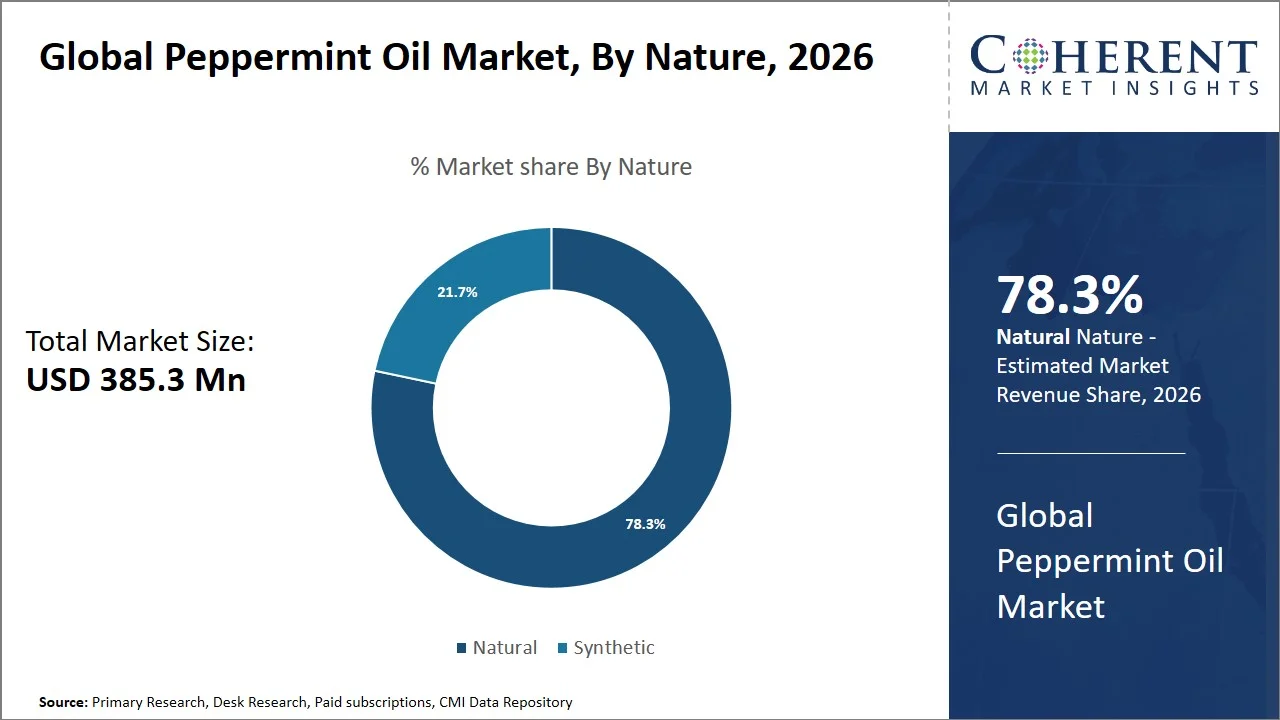
- The Natural segment is the leading nature segment, accounting for an estimated 78.3 % market share in 2026. Its dominance is supported by the strong preference for plant-derived peppermint oil across food, wellness, personal care, and pharmaceutical formulations. Peppermint oil is recognized by the U.S. Food and Drug Administration (FDA) as a substance used as a flavoring agent or adjuvant in food applications, highlighting its widespread use in naturally sourced formulations across the food industry. (Source: U.S. FDA, Substances Added to Food Database)
- The Food & Beverages segment is expected to remain a dominant application area for peppermint oil, with an expected share of 34.7% in 2026. Peppermint oil is widely used in confectionery, chewing gum, breath mints, bakery products, herbal teas, flavored drinks, desserts, and functional beverages due to its cooling taste, high-impact mint profile, and menthol-based freshness. Recent industry usage also supports this demand: ADM’s peppermint oil portfolio, including SustainMINT U.S. Willamette Peppermint Oil, Rose Mitcham Peppermint Oil, Crystal White Peppermint Oil, and Indian Peppermint Oil, is positioned for applications in chewing gum, breath mints, food, beverages, and related flavoring uses. This indicates that peppermint oil continues to be a preferred natural mint ingredient for food and beverage manufacturers focusing on refreshing taste, clean-label appeal, and product differentiation. (Source: ADM Mint Flavorings; 2024 IFIC Food & Health Survey)
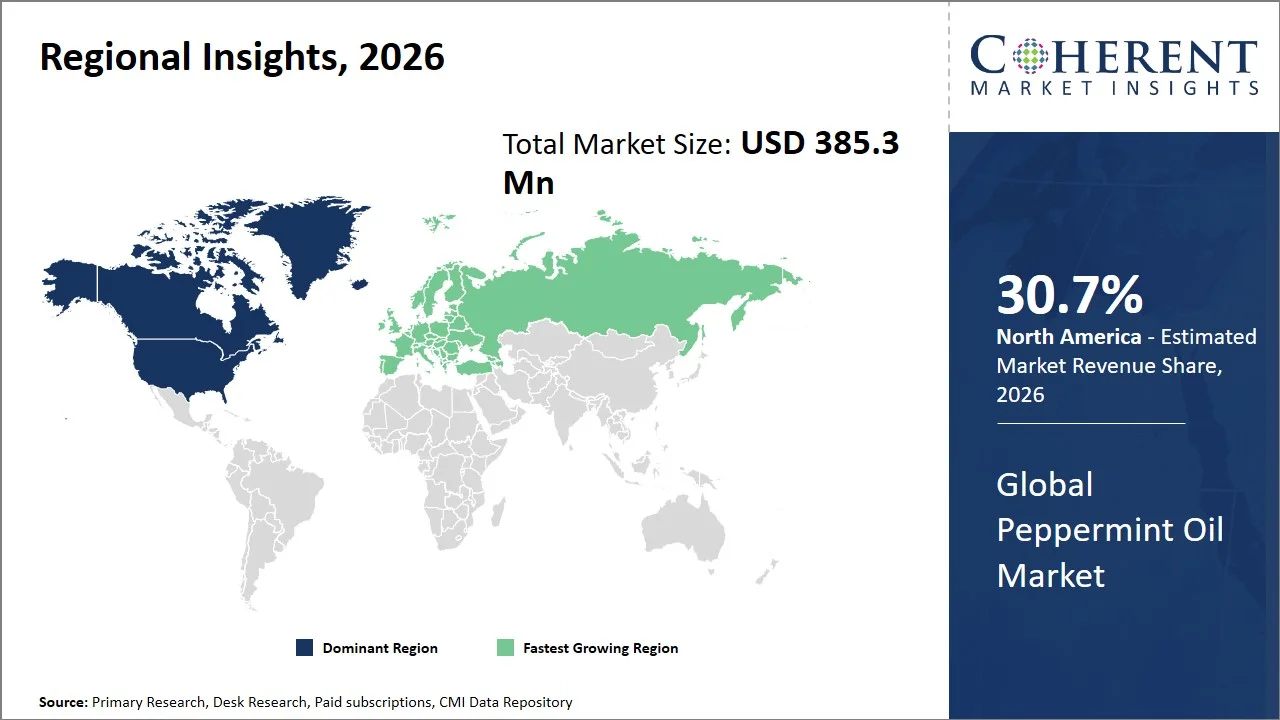
- North America is projected to be the leading regional market due to the present production base for peppermint oil and the significant demand from the food, oral care, nutraceutical and personal care industries in the downstream market. In 2025, the U.S. harvested 22,900 acres of peppermint oil, which is expected to rise 5% from 2024, and produce 2.47 million pounds. This is indicative of good regional supply capability and stable commercial cultivation. (Source: United States Department of Agriculture. National Agricultural Statistics Service.)
- Asia Pacific is expected to be the fastest-growing regional market, supported by rising demand for mint-based ingredients in oral care, pharmaceuticals, flavoring, and personal care applications. According to World Bank, in 2024, China imported USD 119.7 million of menthol in 2024 and India imported USD 108.7 million, indicating a high demand for menthol derivatives and ingredients used in peppermint production at the regional level. (Source: World Bank)
- Peppermint Oil Premium Product Lines: Brands are incorporating peppermint oil into premium, organic, and botanical lines; this opens up opportunities for the higher margins that clean label and wellness product lines offer manufacturers.
- Supply Chain Sensitivity: The price of peppermint oil is still very much dependent on the crop yield and weather, the area of mentha cultivation, the peppermint oil recovery rate, and the presence of high-menthol raw material.
Segmental Insights
Why does the Natural segment dominate the Global Peppermint Oil Market?
Global Peppermint Oil Market is dominated by the Natural segment, accounting for an estimated 78.3% of the market share in 2026, owing to the high demand for plant-based essential oil in flavor and fragrance, oral care, therapeutic formulations, and aromatherapy. Natural peppermint oil has a greater commercial edge as it provides functional positioning, cooling taste, fresh aroma, and menthol-rich composition, and is also sensory valued. It is also reinforced by the international trade's demand for standardized quality requirements. There is a dedicated standard for peppermint oil in ISO where ISO 856:2006 applies for peppermint oil from Mentha × piperita L. This means that natural peppermint oil is not only a botanical component but also a standardized industrial raw material for worldwide buyers in regulated and quality conscious applications. (Source: ISO: the International Organization for Standardization)
- Current Industry Events of 2026
- Market Size Estimation
- Regional Breakdown
- Competitive Landscape
- Customer Intelligence
- Segmental Analysis
- Pricing Analysis
- Key Market Drivers, Challenges & Future Trends
- Customized Insights Section
Why is the Food & Beverages segment the most crucial application in the Global Peppermint Oil Market?
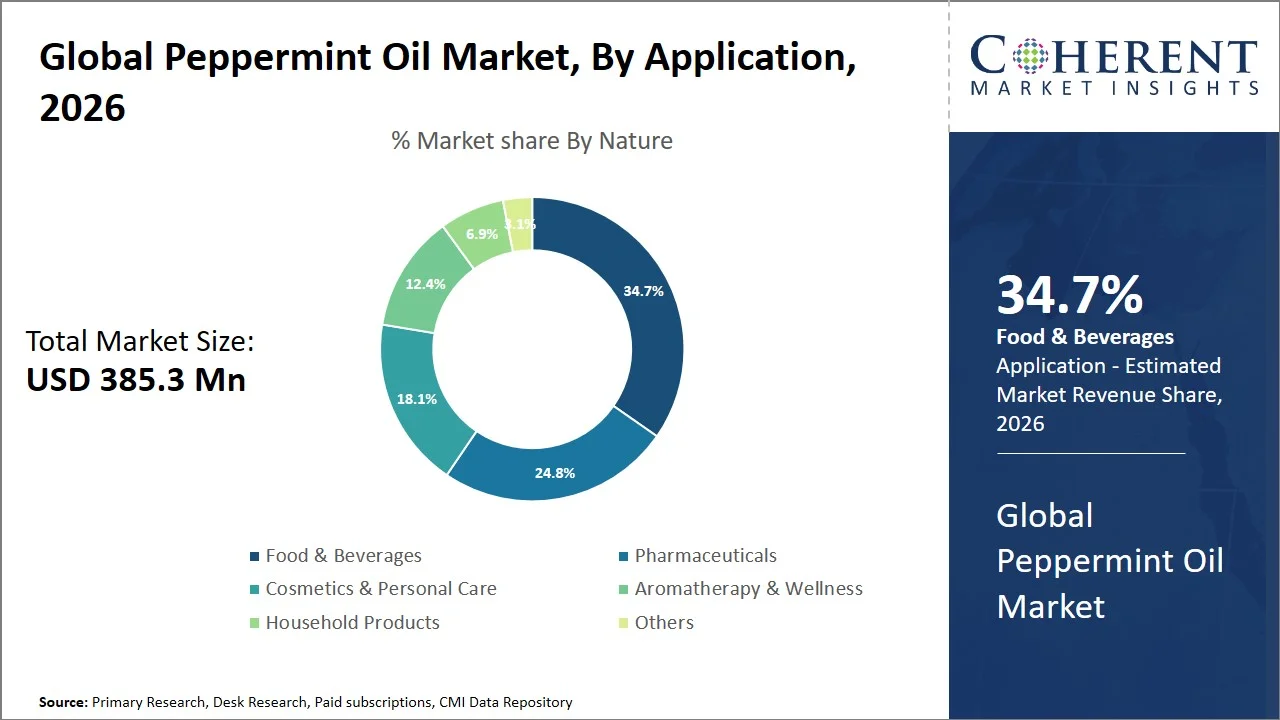
The Food & Beverages segment is projected to account for 34.7% of global peppermint oil market share in 2026 and remains a key demand center for peppermint oil due to its use in confectionery, chewing gum, beverages, chocolates, bakery products, syrups, and mint-flavored functional foods. The segment benefits from peppermint oil’s ability to provide a sharp cooling flavor even at low formulation levels, which makes it important for high-repeat consumer products. In Europe, the food industry can use only flavoring substances included in the EU list of flavorings under Regulation (EC) No. 1334/2008. This regulatory framework supports demand for standardized flavor ingredients and strengthens the use of peppermint-derived flavor components in food formulations. (Source: EU Health and Food Safety)
Why is the Pharmaceutical Grade segment gaining stronger value in the Global Peppermint Oil Market?
The Pharmaceutical Grade segment is expected to account for 24.4% of the global peppermint oil market share in 2026 and is gaining relevance due to peppermint oil’s use in digestive health, gastrointestinal comfort, and headache-relief formulations. This segment is more value-added than basic flavoring use because it requires higher purity, controlled composition, and compliance with medicinal product standards. The European Medicines Agency states that peppermint oil preparations taken by mouth can be used for symptomatic relief of minor gastrointestinal spasms, flatulence, and abdominal pain, especially in patients with irritable bowel syndrome. This formal medicinal recognition supports pharmaceutical-grade demand and creates a strong quality-driven segment beyond food and fragrance applications. (Source: European Medicines Agency)
Currents Events and their Impact
Current Events | Description and its Impact |
EU fragrance allergen labelling expansion for Mentha Piperita Oil |
|
U.S. MoCRA compliance strengthens cosmetic ingredient traceability |
|
CSIR-CIMAP commercializes high-yield peppermint variety CIM-Indushree |
|
(Source: U.S. Food and Drug Administration)
Peppermint Oil Market Dynamics
Market Drivers
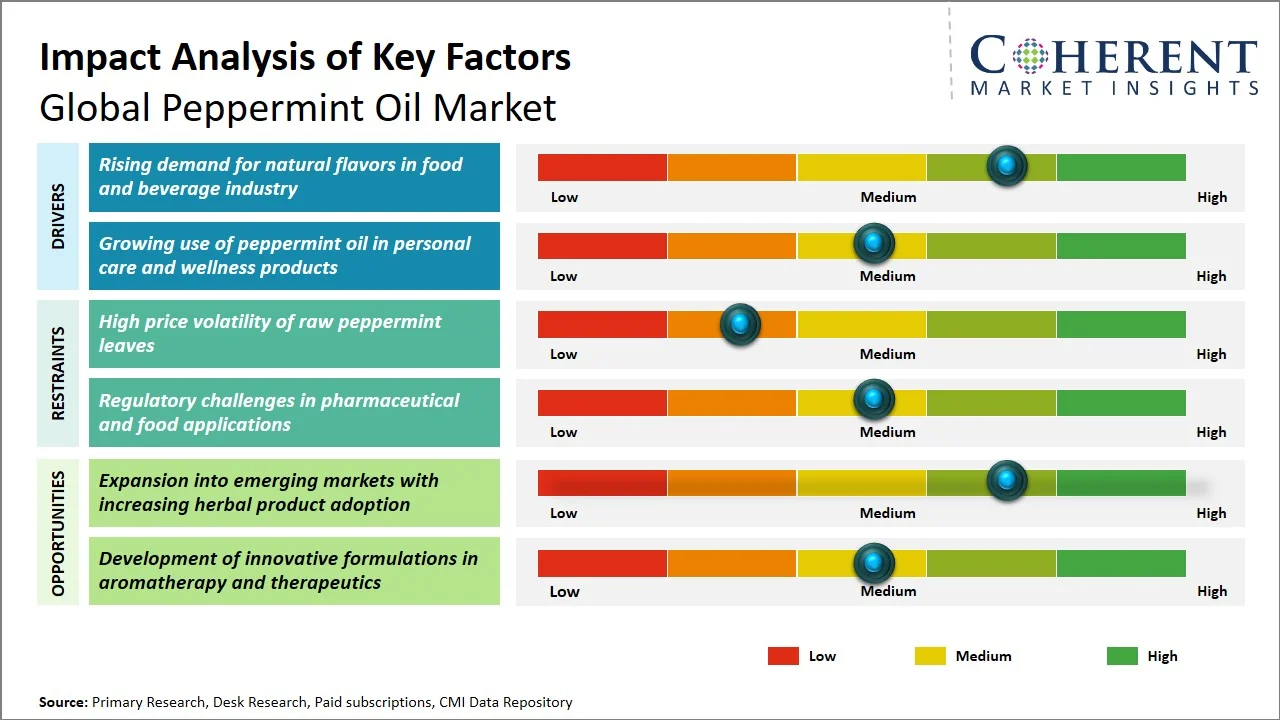
- Rising demand for natural flavors in food and beverage industry: The growing preference for natural, clean-label, and plant-derived ingredients is supporting the use of peppermint oil in food and beverage applications. Peppermint oil fits well into this trend because it is an essential oil derived from a botanical source and is widely used for its strong cooling taste and mint profile in confectionery, chewing gum, beverages, bakery products, chocolates, syrups, and functional foods. Consumer behavior also supports this demand shift. In the 2024 IFIC Food & Health Survey, 36% U.S. consumers indicated that labels like natural, organic or healthy make them more confident of the food's safety; 36% said that the lack of artificial ingredients or colors is a significant in-store safety signal. That means there is a push on food manufacturers to move away from artificial flavor positioning and increase use of food ingredient descriptors that use natural inputs, which is driving consumption of peppermint oil as a natural flavoring. (Source: The International Food Information Council’s)
- Growing use of peppermint oil in personal care and wellness products: Peppermint oil is increasingly used in personal care and wellness formulations due to its cooling sensation, refreshing mint aroma, and sensory benefits across hair care, skin care, bath care, foot care, lip care, body sprays, and aromatherapy products. Its role has expanded from a simple fragrance ingredient to a functional sensory ingredient used in “refresh,” “cooling relief,” “self-care,” and “at-home spa” positioning. In 2023, the Cosmetic Ingredient Review Expert Panel reaffirmed that Mentha piperita oil, extract, leaf, leaf extract, leaf juice, and leaf water are safe for use in cosmetics under present use practices when formulated to be non-sensitizing, supporting continued formulation use in cosmetic and personal care products. Recent product activity also reflects this trend: Lush’s 2024 Christmas Peppermint Delight body wash used fresh mint infusion and peppermint oil for a minty sensory bath-care experience, while The Body Shop continues to position its peppermint range for cooling foot-care relief and at-home pedicure routines. This aligns with the broader wellness shift, as the Global Wellness Institute reported that the global wellness economy reached US$6.8 trillion in 2024, growing 7.9% from 2023 to 2024, indicating stronger consumer spending on wellness-led personal care, self-care, and sensory beauty products. (Source: Sage Journal, The Global Wellness Institute (GWI))
Emerging Trends
- Microencapsulated Peppermint Oil for Controlled Release Applications: Peppermint oil is being focused on microencapsulated and Nano encapsulated form to overcome the problems of volatility, poor solubility in water, rapid evaporation, and instability during processing or storage. Encapsulation can help manufacturers of food, beverages, nutraceuticals, oral care/pharma, and personal products retain flavor, provide controlled release, disperse easily, and extend product shelf life. Manufacturers can use peppermint oil in its encapsulated form (powdered drinks, confectionery fillings, chewing gums, functional foods, capsules, long-lasting fragrance systems) instead of using it directly as a liquid in products. (Source: Food Innovation and Advances.)
- Peppermint Oil in Active and Biodegradable Food Packaging: Peppermint oil is a promising functional ingredient in active packaging particularly for making biodegradable films with antimicrobial activity. This makes peppermint oil a new material for preservation instead of its traditional use as a flavor and aromatic ingredient. Peppermint oil was added to PLA films at 1.25%, 1.875%, and 2.5% in a 2024 study. The use of a film containing 2.5% peppermint oil enabled the packaged chicken breast meat to be stored for 8 days compared with the 3 days obtained with the empty film. This opens up novel applications of peppermint oil in food packaging, fresh food preservation, and eco-friendly antimicrobial packaging materials. (Source: Polymer Engineering & Science)
Regional Insights
Why does North America dominate the Global Peppermint Oil Market?
North America is expected to account for 30.7% market share in 2026, supported by its strong peppermint cultivation base, established flavor and fragrance manufacturing ecosystem, and high demand from oral care, nutraceutical, food, and personal care brands. The U.S. has a specialized peppermint oil supply base across states such as Washington, Oregon, Idaho, and Indiana, which supports consistent sourcing for industrial buyers. USDA NASS state-level data shows that Washington alone recorded 6,100 harvested acres of peppermint for oil in 2025, with production of 659,000 lb. This regional crop base gives North America a structural advantage in supply security and quality consistency. (Source: USDA NASS Washington overview)
Why is Asia Pacific the fastest-growing region in the Global Peppermint Oil Market?
Asia Pacific is expected to be the fastest-growing region, supported by rising demand from oral care, pharmaceuticals, food flavors, cosmetics, aromatherapy, and household products. Growth is supported not only by consumer demand but also by ingredient sourcing and formulation activity in India and China. For example, dsm-firmenich highlights its Mint with Purpose program in India, where it works with local partners to support mint sourcing, farming practices, and oral care innovation. This indicates that global flavor and fragrance companies are strengthening Asia-based mint supply chains, which supports faster regional growth in peppermint oil and mint-derived ingredient demand. (Source: dsm-firmenich)
Peppermint Oil Market Outlook for Key Countries
Why is the U.S. a Premium Supply Hub in the Peppermint Oil Market?
The U.S. is a major country in the peppermint oil market due to its established cultivation base, high-quality oil production, and strong demand from flavor, oral care, food, nutraceutical, and personal care industries. The U.S.-origin peppermint oil is widely supplied to global buyers, especially in Asia and Europe. In 2024, the U.S. exported USD 59.6 million worth of peppermint essential oil, equal to 2.50 million kg. Japan, Mexico, Germany, China, and South Korea were key export destinations, showing the country’s role as both a premium supplier and formulation-linked export hub.
Is India the Strongest Mint Supply Base for the Peppermint Oil Market?
India is one of the strongest supply-side countries in the peppermint oil and mint ingredients value chain. Its advantage comes from large-scale mint cultivation, low-cost processing, distillation infrastructure, and a strong base of exporters supplying essential oils, menthol crystals, and mint derivatives. CSIR states that mint cultivation occupies around 300,000 hectares in India, and more than 95% of the cultivated area uses CSIR-CIMAP-developed mint varieties. These strong agronomic base supports India’s position as a cost-competitive supplier for food, pharmaceutical, oral care, and fragrance manufacturers. (Source: Council of Scientific & Industrial Research CSIR)
Why is China Emerging as a High-Potential Demand Hub in the Peppermint Oil Market?
China is emerging as a high-potential demand hub in the peppermint oil market due to its large downstream manufacturing base in oral care, pharmaceuticals, cosmetics, food flavors, personal care, and household products. The country depends on imported peppermint oil for specific formulation grades and quality requirements. In 2024, China imported USD 15.75 million worth of peppermint essential oil, equal to 319,420 kg. The U.S. and India were the two largest suppliers, indicating that China’s demand is closely linked to premium imported peppermint oil for industrial and consumer product formulations. (Source: World Integrated Trade Solution (WITS))
Germany Peppermint Oil Market Analysis and Trends
Germany is a key European market for peppermint oil, supported by its strong flavor, fragrance, pharmaceutical, cosmetics, and food processing industries. The country acts as both a major demand center and a European distribution hub for imported peppermint oil. In 2024, Germany imported USD 17.75 million worth of peppermint essential oil, equal to 561,859 kg. India and the U.S. were the leading suppliers, reflecting Germany’s demand for both cost-competitive and premium-quality peppermint oil. Growth is further supported by Europe’s strict flavoring rules, which increase the need for standardized, traceable, and compliant ingredients. (Source: World Integrated Trade Solution (WITS) & European Commission)
Market Players, Key Development, and Competitive Intelligence
Key Developments
- Symrise sustainable mint sourcing and traceability initiatives: In July 2025, Symrise AG expanded its sustainable mint sourcing and traceability initiatives across its flavor and fragrance business. This development improves supply security for mint-based ingredients and supports stronger sustainability credentials for global FMCG, oral care, food, beverage, and personal care customers.
- doTERRA peppermint grower sourcing partnerships: In March 2025, doTERRA International expanded peppermint sourcing partnerships with growers under its Co-Impact Sourcing program. This development helps secure long-term peppermint oil supply, improve raw material traceability, and strengthen farmer-linked sourcing models.
- Givaudan the Vibrant Collection: In September 2024, Givaudan Active Beauty launched the Vibrant Collection, a portfolio of five 100% natural-origin botanical extracts designed for performance makeup and beauty formulations.
Competitive Landscape
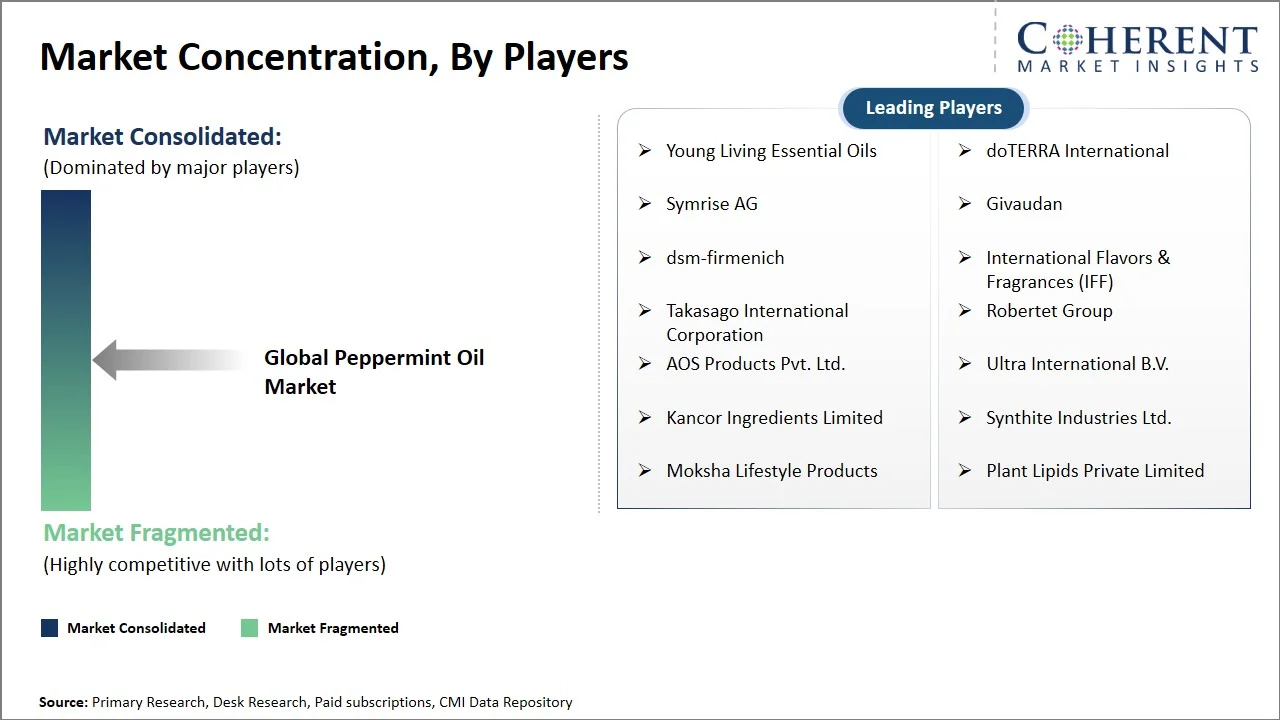
The global peppermint oil market is moderately competitive, with global flavor and fragrance companies, essential oil brands, and India-based natural ingredient suppliers competing across food, pharma, cosmetics, aromatherapy, and personal care applications. Key players differentiate through natural authenticity, menthol consistency, traceable sourcing, regulatory documentation, formulation expertise, and reliable B2B supply. Large companies such as Givaudan, Symrise, dsm-firmenich, IFF, Takasago, and Robertet focus on high-value formulations and global customer access, while doTERRA and Young Living compete through purity, wellness positioning, and grower-linked sourcing. Indian suppliers such as AOS Products, Ultra International, Kancor Ingredients, Synthite, Moksha Lifestyle, and Plant Lipids compete through cost-effective sourcing, distillation strength, and export readiness. Key focus areas include:
- Natural Purity and Quality Consistency: Suppliers are focusing on Mentha piperita authenticity, menthol profile, GC-MS testing, and batch-level quality control.
- Traceable Sourcing: Grower-linked procurement and responsible sourcing are becoming key differentiators for food, wellness, and personal care buyers.
- Grade-Specific Supply: Companies are offering food grade, pharmaceutical grade, cosmetic grade, aromatherapy grade, and industrial grade peppermint oil.
- Formulation Support: Flavor and fragrance companies are strengthening customized mint profiles for oral care, confectionery, beverages, cosmetics, and wellness products.
- B2B Supply Reliability: Export-ready suppliers are focusing on bulk availability, documentation, compliance, stable pricing, and long-term contracts.
Market Report Scope
Peppermint Oil Market Report Coverage
| Report Coverage | Details | ||
|---|---|---|---|
| Base Year: | 2025 | Market Size in 2026: | USD 385.3 Mn |
| Historical Data for: | 2020 To 2024 | Forecast Period: | 2026 To 2033 |
| Forecast Period 2026 to 2033 CAGR: | 6.7% | 2033 Value Projection: | USD 606.7 Mn |
| Geographies covered: |
| ||
| Segments covered: |
| ||
| Companies covered: | Young Living Essential Oils, doTERRA International, Symrise AG, Givaudan, dsm-firmenich, International Flavors & Fragrances (IFF), Takasago International Corporation, Robertet Group, AOS Products Pvt. Ltd., Ultra International B.V., Kancor Ingredients Limited, Synthite Industries Ltd., Moksha Lifestyle Products, Plant Lipids Private Limited | ||
| Growth Drivers: |
| ||
| Restraints & Challenges: |
| ||
Analyst Opinion (Expert Opinion)
- The maximum opportunity is expected in Natural Peppermint Oil, Pharmaceutical/Digestive Health Applications in the U.S. market. The U.S. has strong demand for natural digestive wellness products, OTC formulations, functional supplements, oral care products, and aromatherapy-based wellness solutions. Peppermint oil’s cooling effect, mint flavor, digestive support positioning, and natural ingredient appeal make this combination highly attractive for premium product development.
- Moving forward, the global peppermint market’s competitive advantage will depend on traceability, menthol consistency, purity documentation, and grade-specific supply capability. Peppermint oil suppliers that can offer food-grade, pharmaceutical-grade, cosmetic-grade, and aromatherapy-grade products with reliable quality testing and regulatory documentation will be better positioned with B2B buyers. The strongest growth opportunities are expected in value-added applications such as digestive health formulations, premium oral care, functional personal care, and wellness-led essential oil blends, where peppermint oil delivers both sensory and functional benefits.
Speak to the analyst
Want personalized insights?
Take the findings above to one of our principal consultants, or have the report rebuilt around the segments, geographies and competitors you actually track.
Market Segmentation
- Nature Insights (Revenue, USD Mn, 2021 - 2033)
- Natural
- Synthetic
- Grade Insights (Revenue, USD Mn, 2021 - 2033)
- Food Grade
- Pharmaceutical Grade
- Cosmetic Grade
- Aromatherapy Grade
- Industrial Grade
- Application Insights (Revenue, USD Mn, 2021 - 2033)
- Food & Beverages
- Pharmaceuticals
- Cosmetics & Personal Care
- Aromatherapy & Wellness
- Household Products
- Others
- Distribution Channel Insights (Revenue, USD Mn, 2021 - 2033)
- B2B
- B2C
- Regional Insights (Revenue, USD Mn, 2021 - 2033)
- North America
- U.S.
- Canada
- Latin America
- Brazil
- Argentina
- Mexico
- Rest of Latin America
- Europe
- Germany
- U.K.
- Spain
- France
- Italy
- Russia
- Rest of Europe
- Asia Pacific
- China
- India
- Japan
- Australia
- South Korea
- ASEAN
- Rest of Asia Pacific
- Middle East
- GCC Countries
- Israel
- Rest of Middle East
- Africa
- South Africa
- North Africa
- Central Africa
- North America
- Key Players Insights
- Young Living Essential Oils
- doTERRA International
- Symrise AG
- Givaudan
- dsm-firmenich
- International Flavors & Fragrances (IFF)
- Takasago International Corporation
- Robertet Group
- AOS Products Pvt. Ltd.
- Ultra International B.V.
- Kancor Ingredients Limited
- Synthite Industries Ltd.
- Moksha Lifestyle Products
- Plant Lipids Private Limited
Sources
Primary Research Interviews
- Peppermint oil manufacturers and distillers
- Mint growers and farmer cooperatives
- Procurement heads of flavor and fragrance companies
- Product development managers in food and beverage companies
- R&D heads of cosmetics and personal care manufacturers
- Pharmaceutical and nutraceutical formulation experts
- Essential oil exporters and bulk ingredient traders
- Aromatherapy and wellness brand owners
- Quality control managers handling GC-MS testing and purity validation
- Supply chain directors of natural ingredient companies
Stakeholders
- Peppermint oil manufacturers and suppliers: Young Living Essential Oils, doTERRA International, AOS Products Pvt. Ltd., Ultra International B.V., Kancor Ingredients Limited, Synthite Industries Ltd., Moksha Lifestyle Products, Plant Lipids Private Limited
- Flavor and fragrance companies: Symrise AG, Givaudan, dsm-firmenich, IFF, Takasago International Corporation, Robertet Group
- End-use sectors
- Food and beverage manufacturers using peppermint oil in confectionery, chewing gum, beverages, bakery, and flavor systems
- Pharmaceutical and nutraceutical companies using peppermint oil in digestive health and therapeutic formulations
- Cosmetics and personal care companies using peppermint oil in skincare, hair care, oral care, bath products, and wellness formulations
- Aromatherapy and essential oil brands using peppermint oil in diffusers, massage oils, blends, and wellness products
- Household product manufacturers using peppermint oil in air care, cleaners, and fragrance-based products
- Regulatory and certification bodies: U.S. FDA, European Medicines Agency, European Commission, ISO, IFRA, FEMA, RIFM
- E-commerce platforms and retailers: Amazon, Walmart, iHerb, Whole Foods Market, Nykaa, specialty essential oil retailers
- Testing and certification providers: SGS, Eurofins, Intertek, Bureau Veritas
Databases
- UN Comtrade Database – HS Code 330124 for peppermint oil and HS Code 290611 for menthol
- World Bank WITS Trade Database – peppermint oil and menthol import-export analysis
- ITC Trade Map – essential oil trade flows and country-level export/import mapping
- USDA NASS Quick Stats – U.S. peppermint acreage, yield, and oil production data
- FAOSTAT – agricultural crop and raw material reference data
- Eurostat International Trade Database – European essential oil imports and exports
- DGCI&S Export Import Data Bank, India – India’s mint oil, essential oil, and menthol trade data
- U.S. FDA Food Substance Inventory – food-use references for peppermint oil
Magazines
- Perfumer & Flavorist – flavor and fragrance ingredient trends
- Cosmetics & Toiletries – personal care and cosmetic formulation trends
- Happi Magazine – personal care, fragrance, and wellness product trends
- Personal Care Magazine – cosmetic ingredient and formulation updates
- Food Ingredients First – food flavor, botanical ingredient, and clean-label trends
- Nutraceuticals World – digestive health and wellness formulation trends
- Natural Products Insider – natural ingredient and supplement market updates
- Chemical Weekly – essential oil, aroma chemical, and ingredient industry updates
Journals
- Journal of Essential Oil Research
- Flavour and Fragrance Journal
- Industrial Crops and Products
- Journal of Agricultural and Food Chemistry
- Food Chemistry
- Molecules
- Phytochemistry
- Cosmetics
- International Journal of Pharmaceutics
- Journal of Ethnopharmacology
Newspapers
- The Wall Street Journal – consumer products, food, wellness, and supply chain trends
- Financial Times – global trade, consumer goods, and ingredient supply chain updates
- Reuters – essential oil trade, agriculture, FMCG, and regulatory updates
- Business Standard – India mint, essential oil, and export industry updates
- The Hindu BusinessLine – Indian agriculture, mentha crop, and export coverage
- The Economic Times – FMCG, personal care, flavor, and wellness industry developments
- Mint – consumer goods, wellness, and natural product business trends
Associations
- International Federation of Essential Oils and Aroma Trades (IFEAT)
- Essential Oil Association of India
- Flavor and Extract Manufacturers Association (FEMA)
- International Fragrance Association (IFRA)
- Research Institute for Fragrance Materials (RIFM)
- International Organization of the Flavor Industry (IOFI)
- Personal Care Products Council (PCPC)
- Cosmetics Europe
- Consumer Healthcare Products Association (CHPA)
- Agricultural and Processed Food Products Export Development Authority (APEDA), India
Public Domain Sources
- U.S. Food and Drug Administration – food substance and cosmetic regulatory references
- European Medicines Agency – peppermint oil herbal medicine references
- European Commission – food flavoring and cosmetic ingredient regulations
- USDA National Agricultural Statistics Service – peppermint production and acreage data
- CSIR-CIMAP – mint cultivation, varieties, and peppermint oil technology in India
- ISO – peppermint oil quality standards and specifications
- OECD – agricultural, trade, and sustainability references
- World Health Organization – oral care, digestive health, and wellness-related public health references
- National Center for Complementary and Integrative Health – peppermint oil health-use references
Proprietary Elements
- CMI Data Analytics Tool, Proprietary CMI Existing Repository of information for last 10 years.
Get access to 250+ pages report
Every segment, forecast, competitor profile and data table behind the analysis above — available for instant download.
- ESOMAR Member
- ISO 9001:2015 Certified
- D-U-N-S Registered
- GDPR & CCPA Compliant
Missing comfort of reading report in your local language? Find your preferred language:
Transform your Strategy with Exclusive Trending Reports
Frequently Asked Questions
The CAGR of Global Peppermint Oil Market is projected to be 6.70% from 2026 to 2033.
The Global Peppermint Oil Market is estimated to be valued at USD 385.3 million in 2026.
The Global Peppermint Oil Market is expected to reach USD 606.7 million by 2033.
In terms of Nature, Natural is estimated to dominate the market revenue share in 2026.
Rising demand for natural flavors in food and beverage industry and growing use of peppermint oil in personal care and wellness products are the major factors driving the growth of Global Peppermint Oil Market.
High price volatility of raw peppermint leaves and regulatory challenges in pharmaceutical and food applications are the major factors hampering the growth of Global Peppermint Oil Market.
North America is expected to lead the Global Peppermint Oil Market.