

Essential Oils Market Size and Share Analysis- Growth Trends and Forecasts (2026-2033)
The Essential Oils Market size is projected to register a CAGR of 11.8%, with a market valuation of USD 13.69 Bn in 2026 and valued at around USD 29.88 Bn by 2033. Key factors contributing to the growth include the growing need for natural or botanical-based ingredients, increasing usage of essential oils in personal care & cosmetics, adoption in food and beverage applications, and increasing use of aromatherapy and wellness products. Usage of essential oils includes aromatherapy and wellness applications, skin care applications, fragrances, household applications, and functional food applications. As per the U.S. Food and Drug Administration (FDA), essential oils are used in the aromatherapy and fragrances application, and the ingredients of fragrances are used in products such as shampoos, shower gel, shaving cream, and body lotions.
Key Takeaways
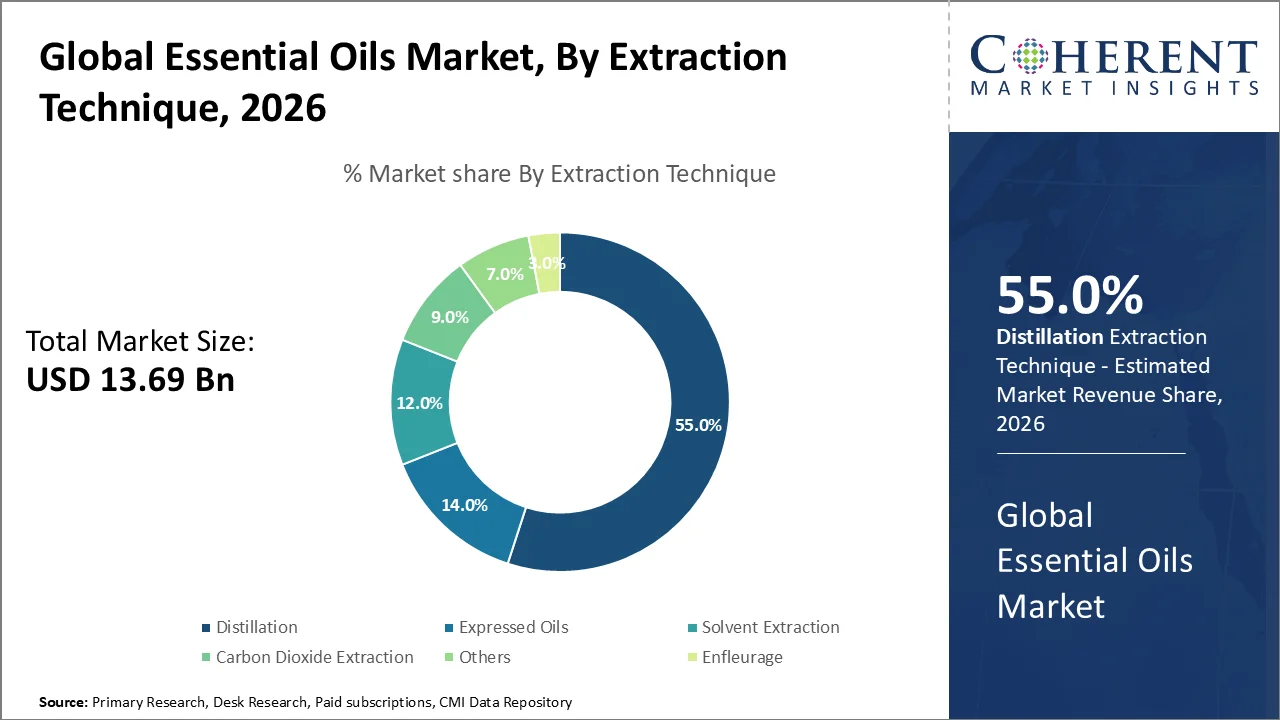
- The distillation segment is likely to dominate the market with approximately 55.0% in 2026. The segment’s growth is owing to its widespread commercial use for extracting volatile oils, relatively high extraction efficiency, suitability for a broad range of aromatic plant materials, and continued improvements in steam-distillation technology. A 2024 PLOS One study indexed by NIH/PubMed reported that technology-enabled improvements to essential-oil distillation increased extraction yield by 24%, improved quality by 10%, and reduced processing time by more than 50%, highlighting ongoing efficiency improvements in distillation-based extraction.
- The orange segment is expected to lead the product type category with approximately 30.0% in 2026. The segment’s growth is owing to the large availability of orange feedstock, extensive citrus-processing infrastructure, recovery of essential oil from orange peel and processing streams, and widespread utilization across flavors, fragrances, personal care, and household applications. According to the U.S. Department of Agriculture Foreign Agricultural Service (USDA FAS), total world production of fresh oranges is expected to attain about 45.9 million metric tons by 2025/26 seasons, whereas 17.1 million metric tons of oranges are expected to be processed into other forms of products.
- The food and beverages segment is projected to account for almost 38.0% of the market by applications in 2026. Growth in this segment is attributed to the wide utilization of essential oils in beverages, confectionary, bakery items, sauces, dairy products, and other processed foods as flavoring and aromatic agents. In a study published by the USDA ARS in the year 2025, it was found that cinnamon essential oil when added in concentrations of 0.5% and 1.0% v/v, inhibited the growth of Salmonella Typhimurium in liquid whole eggs kept for storage, with the latter concentration giving rise to total inhibition, thus showcasing the possible benefits of using essential oils in food products as antimicrobials.
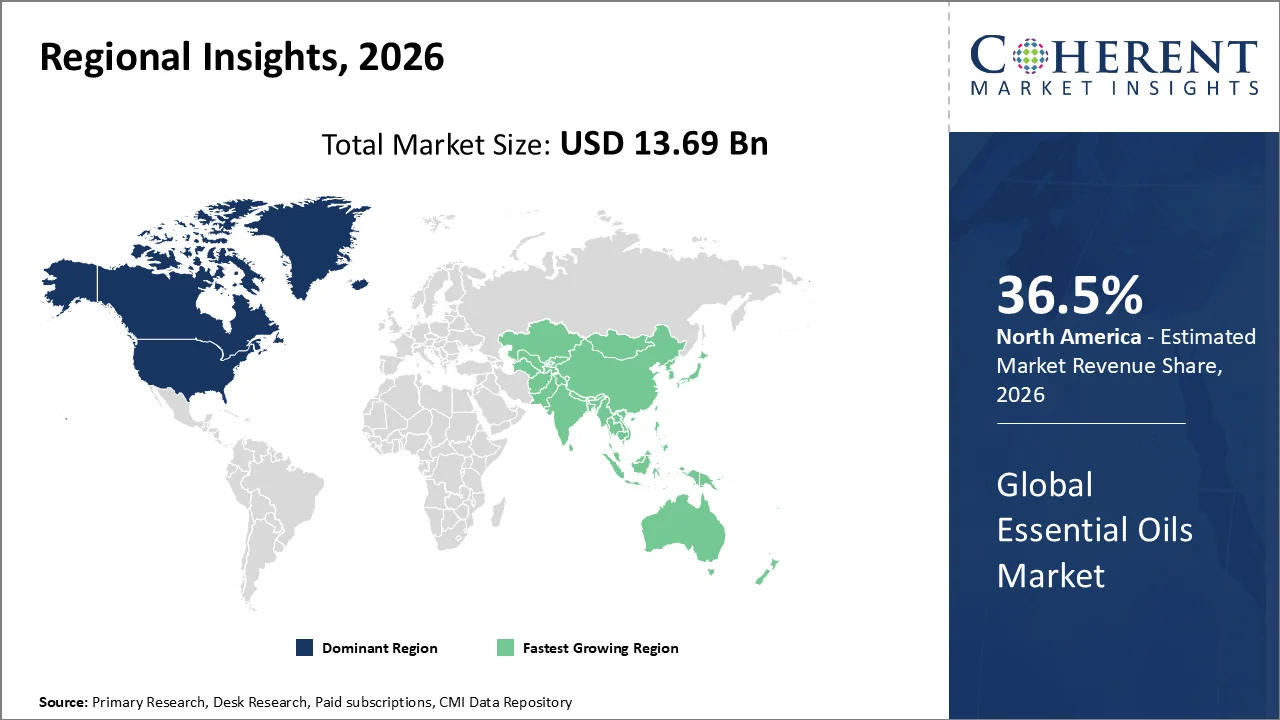
- North America is forecast to be the leading country in the Essential Oils Market, commanding about 36.5% market share in 2026. The dominance will be supported by a large consumption of essential oils in various applications like food and beverages flavorings, perfumes, cosmetics, aromatherapy, medicinal applications, and household applications due to having an infrastructure of essential oil importers, manufacturers, and distributors in the U.S. According to the U.S. Department of Agriculture Foreign Agricultural Service (USDA FAS), the U.S. was the world’s leading importer and exporter of essential oils in 2024, importing approximately USD 5.6 Bn and exporting a record USD 2.5 Bn.
Market Drivers
Expanding Food Processing and Natural Flavor Applications are Driving Essential Oil Demand
The Essential Oils Market is gaining momentum from the expanding use of plant-derived aromatic ingredients across processed foods, beverages, confectionery, bakery products, sauces, and functional food formulations. Essential oils such as orange, lemon, peppermint, rosemary, and other botanical oils are widely utilized to provide flavor and aroma, while certain oils are increasingly explored for preservative and antioxidant functions.
The rise in the food processing industry is widening the market base for these raw materials. As per the USDA Foreign Agricultural Service (USDA FAS), the Indian food processing industry is expected to grow from USD 355 billion in 2024 to USD 535 billion by the end of FY2026.
Current Events and Their Impact on the Essential Oils Market
Current Event | Description and its Impact |
EU Introduces New Restrictions on Citral and Acetylated Vetiver Oil in Cosmetics (April 2026) |
|
India Expands Aromatic Crop and Essential-Oil Capacity through CSIR Aroma Mission (2025–2026) |
|
- Current Industry Events of 2026
- Market Size Estimation
- Regional Breakdown
- Competitive Landscape
- Customer Intelligence
- Segmental Analysis
- Pricing Analysis
- Key Market Drivers, Challenges & Future Trends
- Customized Insights Section
Segmental Insights
Why is Distillation Acquiring the Largest Share?
On the basis of extraction technique, the distillation segment is expected to hold the maximum share of around 55.0% in the Essential Oils Market by 2026. The dominance of the category is due to the wide adoption of methods such as steam and hydrodistillation for extraction of volatile components from aromatic plants, its suitability for several types of plant sources, ease of scalability, and capability to manufacture essential oils without depending on organic solvents.
A recent comparative study indexed on NIH/PubMed comparing hydrodistillation, steam distillation, and solvent extraction yielded 0.750%, 0.440%, and 0.350% yields of the essential oil, respectively. This illustrates the very high extraction capability possible with distillation methods compared with solvent extraction for the plant being studied.
In July 2026, the Krishi Vigyan Kendra (KVK), Ernakulam, under ICAR-Central Marine Fisheries Research Institute, commissioned a 500 kg batch-capacity lemongrass distillation unit at Vavely, Kottappady, Kerala.
Why is Orange Acquiring the Largest Share?
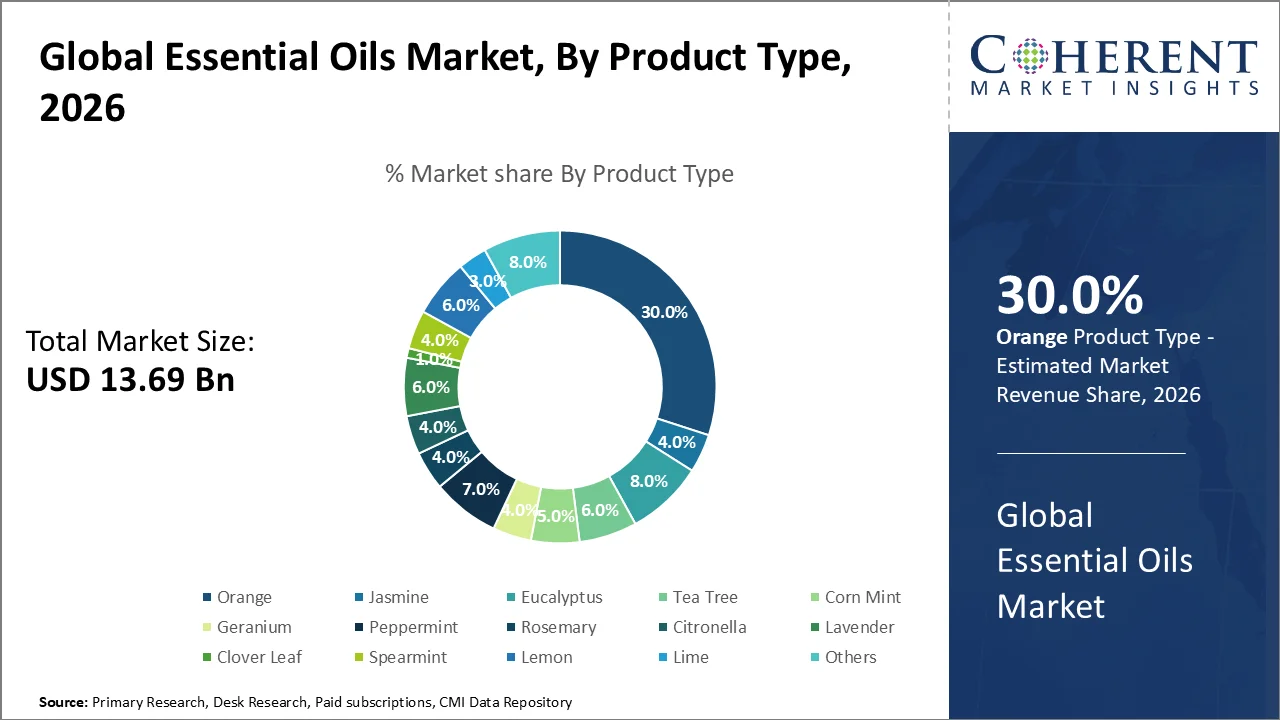
On the basis of product type, the orange segment is expected to account for the largest Essential Oils Market share of approximately 30.0% in 2026. The segment’s dominance is owing to the substantial availability of orange peel and other citrus-processing by-products, large-scale juice-processing infrastructure, comparatively economical oil recovery, and extensive utilization of orange essential oil across food flavoring, beverages, fragrances, cosmetics, cleaning products, and aromatherapy.
According to the U.S. Department of Agriculture Foreign Agricultural Service (USDA FAS), Brazil alone is forecast to produce 13.5 million metric tons of oranges in 2025/26, an increase of 500,000 metric tons from the previous year.
In June 2026, BASF Aroma Ingredients launched Micadelva™, a new citrus fragrance ingredient developed as a non-allergenic alternative to orange terpenes.
Why do Food & Beverages Hold the Largest Market Share?
On the basis of application, the food & beverages segment is projected to account for the largest Essential Oils Market share of approximately 38.0% in 2026. The segment’s growth is owing to the extensive utilization of essential oils in flavoring, natural preservation, antimicrobial formulations, edible coatings, beverages, bakery products, confectionery, sauces, and other processed-food applications.
A 2025 study indexed by NIH/PubMed found that several essential oils produced more than a 1-log CFU/mL reduction in Bacillus cereus spores at a 5% concentration, demonstrating their potential functionality as natural antimicrobial ingredients in food systems.
In February 2026, Givaudan launched its new House of Lime in Mexico City, a dedicated citrus innovation and co-creation center designed to accelerate the development of lime- and citrus-based solutions across food and beverage applications.
Essential Oils Market Trends
- The rise of natural and clean label cosmetics has seen the increased consumption of natural oils including lavender oil, rosemary oil, tea tree oil, patchouli oil, citrus oil, among others. According to Centre for the Promotion of Imports from Developing Countries (CBI), Ministry of Foreign Affairs, Government of the Netherlands, in 2024, EU’s imports of essential oils except for mint and citrus oils were valued at around €947 million or 20,520 tonnes.
- The rising need for ingredient transparency, standardization, and traceability has led to greater transparency from essential oil companies regarding the botanical source, production process, composition, and safety of their products. The International Fragrance Association (IFRA) announced its updated Transparency List on July 2025 containing 3,691 fragrance and functional ingredients among which 1,021 are Natural Complex Substances (NCS), including essential oils and botanical extracts.
- The rise in the use of circular economy in the extraction process has led to increased production of essential oils from citrus peel, among other agricultural wastes, instead of disposal. In March 2026, a research study in Biomass and Bioenergy indicated that 3.0% of essential oils were produced from pomelo peel through sustainable extraction process. The composition of the extracted oil included 41 compounds, where D-limonene made up 73.87%.
Regional Insights
North America Dominates Owing to Strong Essential-Oil Production and Established Consumer Applications
The North America region is projected to account for approximately 36.5% of the global Essential Oils Market in 2026. The region’s dominance is owing to its established essential-oil production base, mature food and beverage, cosmetics, fragrance, wellness, and household-product industries, and widespread commercial utilization of peppermint, spearmint, citrus, lavender, and other botanical oils.
According to the U.S. Department of Agriculture’s National Agricultural Statistics Service (USDA NASS), U.S. peppermint oil production reached 2.47 million pounds in 2025, increasing 5% year-on-year. Spearmint oil production increased even faster, reaching 1.61 million pounds, up 18% from 2024, while harvested spearmint acreage expanded 13% to 11,600 acres. These figures demonstrate North America’s established agricultural and processing infrastructure for commercial essential-oil production.
In April 2025, International Flavors & Fragrances (IFF) opened a new 30,000-square-foot Citrus Innovation Center in Lakeland, Florida, in partnership with Florida Polytechnic University.
Asia Pacific Essential Oils Market Trends
Asia Pacific is expected to be the fastest-growing region in the Essential Oils Market during 2026–2033. Regional growth is being supported by expanding aromatic-crop cultivation, increasing essential-oil processing and exports, growing adoption of natural ingredients in cosmetics and wellness products, and rising consumer interest in aromatherapy across markets such as India, China, Japan, and Southeast Asia.
As per the Government of India’s report published in June 2026, the nation had about 150 million agarwood trees, out of which almost 90% grow in the North-Eastern states of the country. The export quota for agarwood oil was increased from 1,050 kilograms to 7,050 kilograms, which signifies the increasing globalization of high-value essential oils extracted from the region.
In October 2025, International Flavors & Fragrances (IFF) announced plans to establish a new Scent Creative Center in Mumbai, India, with the facility expected to become fully operational during the first half of 2026.
Strong Personal-Care and Food Consumption Base is Supporting the Essential Oils Market in the United States
The U.S. Essential Oils Market is witnessing steady growth owing to the widespread use of essential oils across fragrances, cosmetics, personal care, food flavoring, beverages, home-care products, and wellness applications. Demand is particularly supported by the large downstream base of fragrance and personal-care manufacturers seeking botanical and naturally derived aromatic ingredients.
According to the Personal Care Products Council (PCPC), the U.S. personal-care products industry generated approximately USD 495.6 billion in total economic output in 2024 and contributed USD 242.4 billion to U.S. GDP. The industry’s exports also reached USD 15.8 billion in 2025, demonstrating the scale of downstream sectors that utilize fragrance, botanical, and essential-oil ingredients.
China Essential Oils Market Trends
China is expected to witness strong growth in the Essential Oils Market over the forecast period. Growth is owing to the expansion of cosmetics and personal care consumption, increasing demand for natural fragrance ingredients, rising use of botanical extracts in food and beverages, and the country’s well-established manufacturing and processing ecosystem.
According to the National Bureau of Statistics of China, retail sales of cosmetics by enterprises above the designated size reached approximately RMB 465.3 billion in 2025, increasing 5.1% year-on-year.
Who are the Major Companies in Essential Oils Industry
Some of the major key players in Essential Oils Market are Biolandes, doTERRA International, Essential Oils of New Zealand, Farotti SRL, H.Reynaude & Fils, Moksha Lifestyle Products, Sydney Essential Oils Rocky Mountain Oils LLC, Co. Pty Ltd, The Lebermuth Company, West India Species, Inc., and Young Living Essential Oils.
Key News
- In June 2026, H. Reynaud & Fils announced that a portion of its Elemi supply chain had been verified under the UEBT Responsible Sourcing programme. The initiative covers biodiversity management, non-destructive harvesting, community rights, and documented traceability from harvesting through processing, strengthening the company’s responsible natural-ingredient portfolio.
- In June 2026, dōTERRA launched its limited-edition Endless Summer collection, including the returning Endless Summer Sunshine Blend, an all-new Hair & Body Mist, and a Sunshine Blend + Pilot Diffuser bundle.
Market Report Scope
Essential Oils Market Report Coverage
| Report Coverage | Details | ||
|---|---|---|---|
| Base Year: | 2025 | Market Size in 2026: | USD 13.69 Bn |
| Historical Data for: | 2020 To 2024 | Forecast Period: | 2026 To 2033 |
| Forecast Period 2026 to 2033 CAGR: | 11.8% | 2033 Value Projection: | USD 29.88 Bn |
| Geographies covered: |
| ||
| Segments covered: |
| ||
| Companies covered: | Biolandes, doTERRA International, Essential Oils of New Zealand, Farotti SRL, H.Reynaude & Fils, Moksha Lifestyle Products, Sydney Essential Oils Rocky Mountain Oils LLC, Co. Pty Ltd, The Lebermuth Company, West India Species, Inc., and Young Living Essential Oils. | ||
| Growth Drivers: |
| ||
| Restraints & Challenges: |
| ||
Analyst Opinion
- The Essential Oils Market is expected to benefit from sustained demand for natural, organic, and plant-derived ingredients across food, beverages, personal care, fragrances, and wellness applications. USDA Economic Research Service, citing Organic Trade Association data, reported that U.S. organic food retail sales increased from an inflation-adjusted USD 38.6 billion in 2012 to approximately USD 65.4 billion in 2024, illustrating the broader consumer shift toward naturally positioned products.
- Cosmetics, fragrances, and personal care are expected to remain important end-use markets for essential oils as manufacturers increasingly incorporate differentiated natural aromas and botanical ingredients into formulations. Cosmetics Europe reported that the European cosmetics and personal-care market reached approximately EUR 110 billion in 2025, including EUR 17.1 billion from fragrances and perfumes, while European cosmetic exports reached EUR 29.8 billion.
- Competitive differentiation is increasingly shifting beyond volume supply toward consistent chemical composition, traceability, quality assurance, responsible sourcing, and regulatory documentation. In March 2026, IFRA reported that the 2025 edition of the IFRA–IOFI Labelling Manual had been released on January 15, 2026, providing updated GHS-aligned hazard classifications for fragrance and flavor ingredients. Although the manual is not legally binding, it highlights the growing importance of standardized ingredient documentation across the fragrance value chain.
Speak to the analyst
Want personalized insights?
Take the findings above to one of our principal consultants, or have the report rebuilt around the segments, geographies and competitors you actually track.
Market Segmentation
- By Extraction Technique (Revenue, USD Bn, 2021-2033)
- Solvent Extraction
- Expressed Oils
- Distillation
- Enfleurage
- Carbon Dioxide Extraction
- Others
- By Product Type (Revenue, USD Bn, 2021-2033)
- Orange
- Jasmine
- Eucalyptus
- Tea tree
- Corn Mint
- Geranium
- Peppermint
- Rosemary
- Citronella
- Lavender
- Clover Leaf
- Spearmint
- Lemon
- Lime
- Others
- By Application (Revenue, USD Bn, 2021-2033)
- Food & Beverages
- Cosmetics and Personal Care
- Home Care
- Healthcare
- Aromatherapy
- Others
- By Region (Revenue, USD Bn, 2021-2033)
- North America
- U.S.
- Canada
- Latin America
- Brazil
- Mexico
- Argentina
- Rest of Latin America
- Europe
- Germany
- U.K.
- France
- Italy
- Spain
- Russia
- Rest of Europe
- Asia Pacific
- China
- India
- Japan
- Australia
- South Korea
- ASEAN
- Rest of Asia Pacific
- Middle East
- GCC
- Israel
- Rest of Middle East
- Africa
- South Africa
- Central Africa
- North Africa
- North America
Sources
Primary Research Interviews
- Essential oil manufacturers and distillers
- Aromatic crop growers and plantation operators
- Flavor and fragrance ingredient suppliers
- Food & beverage formulation and procurement managers
- Cosmetics and personal care product manufacturers
- Aromatherapy and wellness product companies
- Essential oil distributors and exporters
- Procurement heads from fragrance, food, cosmetics, and home-care companies
- Key opinion leaders (KOLs) in phytochemistry, aromatherapy, and natural ingredients
Databases
- FAOSTAT – Food and Agriculture Organization of the United Nations
- UN Comtrade Database
- U.S. Department of Agriculture – FAS and NASS
- Eurostat
- International Trade Centre (ITC) Trade Map
- World Bank
- Organisation for Economic Co-operation and Development (OECD)
Magazines
- Perfumer & Flavorist
- Cosmetics & Toiletries
- FoodNavigator
- Happi
- CosmeticsDesign
- Beauty Packaging
Journals
- Journal of Essential Oil Research
- Industrial Crops and Products
- Flavour and Fragrance Journal
- Food Chemistry
- Molecules
- Journal of Applied Research on Medicinal and Aromatic Plants
- Journal of Ethnopharmacology
Newspapers
- Reuters
- Financial Times
- The Wall Street Journal
- The Economic Times
- Business Standard
- The Guardian
Associations
- International Federation of Essential Oils and Aroma Trades (IFEAT)
- International Fragrance Association (IFRA)
- International Organization of the Flavor Industry (IOFI)
- Personal Care Products Council (PCPC)
- Cosmetics Europe
- Aroma Environment Association of Japan (AEAJ)
- European Federation of Essential Oils (EFEO)
Public Domain Sources
- Company annual reports, sustainability reports, and investor presentations
- Government agricultural production and aromatic crop statistics
- Import-export and customs trade databases for essential oils
- U.S. FDA, European Commission, and ECHA regulatory publications
- USDA and FAO publications on citrus, mint, aromatic crops, and natural ingredients
- University and government research publications on essential oil extraction and applications
- Patent databases such as WIPO, USPTO, and Google Patents
- Publicly available product launches, capacity expansions, sourcing initiatives, and company press releases
Proprietary Elements
- CMI Data Analytics Tool
- Proprietary CMI Existing Repository of Information for the Last 10 Years
Get access to 250+ pages report
Every segment, forecast, competitor profile and data table behind the analysis above — available for instant download.
- ESOMAR Member
- ISO 9001:2015 Certified
- D-U-N-S Registered
- GDPR & CCPA Compliant
Missing comfort of reading report in your local language? Find your preferred language:
Transform your Strategy with Exclusive Trending Reports
Frequently Asked Questions
The Essential Oils Market is expected to reach approximately USD 29.88 Bn by 2033, compared with USD 13.69 Bn in 2026.
Major players operating in the global Essential Oils Market include Biolandes, doTERRA International, Essential Oils of New Zealand, Farotti SRL, H.Reynaude & Fils, Moksha Lifestyle Products, Sydney Essential Oils Rocky Mountain Oils LLC, Co. Pty Ltd, The Lebermuth Company, West India Species, Inc., and Young Living Essential Oils.
The high volatility in raw material prices and seasonal fluctuations in aromatic crop supply is among the major factors hampering growth of the Essential Oils Market.
The increasing demand for natural and plant-based ingredients in food & beverages and growing adoption of essential oils in cosmetics and personal care products are major factors driving market growth.
The Essential Oils Market is anticipated to grow at a CAGR of approximately 11.8% between 2026 and 2033.
Among regions, North America is expected to account for the largest share of the global Essential Oils Market, with approximately 36.5% in 2026.
Asia Pacific is expected to be the fastest-growing region during the forecast period, supported by expanding aromatic crop cultivation, essential-oil processing, natural ingredient consumption, and rising aromatherapy and personal-care demand.