

Ethoxyquin Market Size and Share Analysis – Growth Trends and Forecast (2026 – 2033)
The global ethoxyquin market size is estimated to grow from USD 258.4 Mn in 2026 to USD 344.9 Mn by 2033, registering a compound annual growth rate (CAGR) of 4.2% during the forecast period (2026–2033). This growth is driven by steady demand in animal feed preservation, increasing use of antioxidants in the food and feed industry, and continued adoption in aquaculture and pet food applications across emerging markets.
Key Takeaways from the Global Ethoxyquin Market Report (2026)
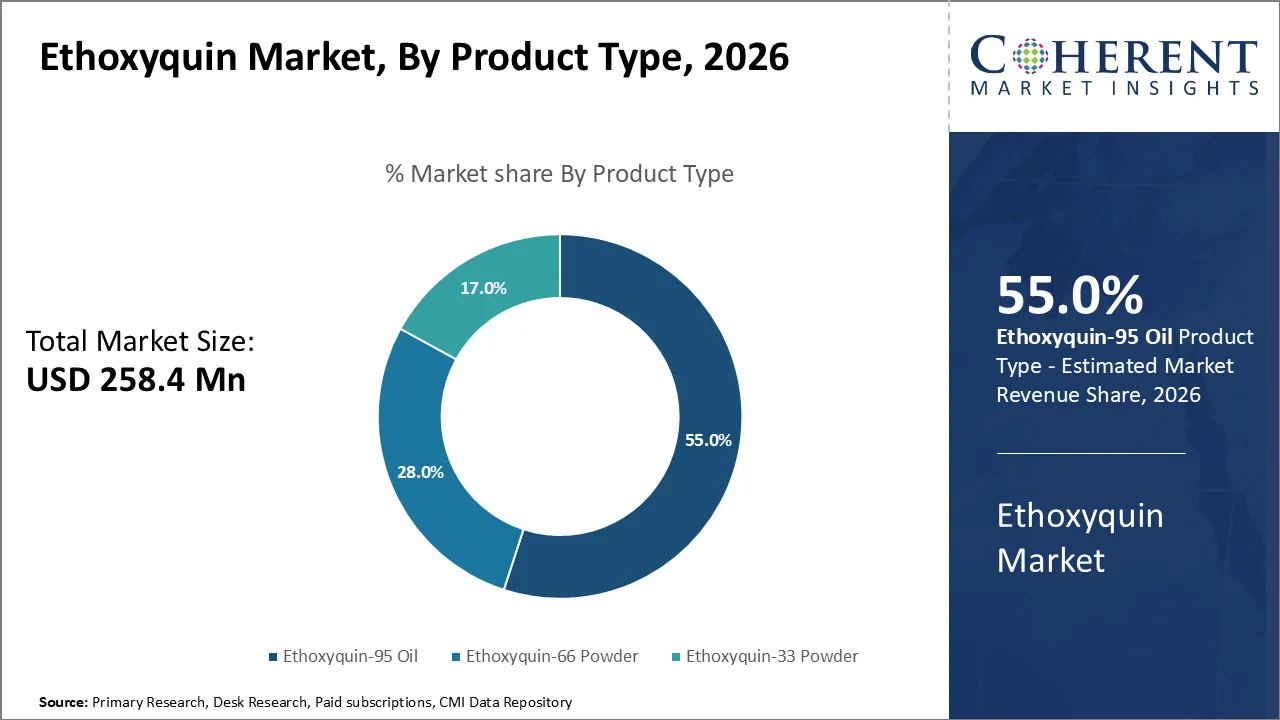
- Ethoxyquin 95 Oil is expected to hold the highest market share of 55% in 2026, due to its excellent antioxidant properties and the need for preservation of fish feed in aquaculture. According to the FDA of the United States (21 CFR 573.380), the role of ethoxyquin is to inhibit oxidation in order to preserve the quality of feed components, while according to the EFSA, ethoxyquin is used in fish meal in order to prevent oxidation and stabilize the feed during transport.
- The Aquaculture market is forecasted to dominate the market by accounting for 33% because of rising consumption of fish globally and rapid development of fisheries in Asia-Pacific. According to the International Fishmeal & Fish Oil Organisation (IFFO), this reflects aquaculture’s heavy reliance on fishmeal-based feed systems, feed made from fishmeal, and hence it requires ethoxyquin as antioxidants.
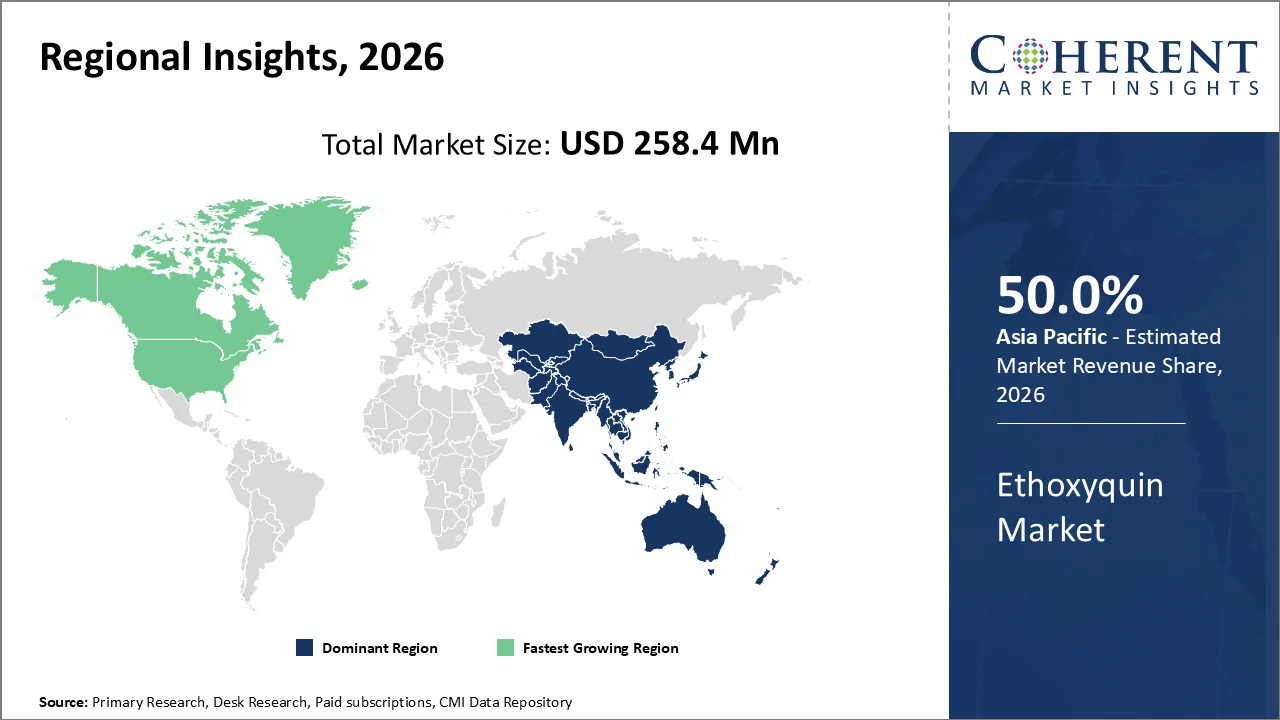
- The Asia-Pacific region is projected to dominate the global market for ethoxyquin with a share of approximately 50% by 2026, due to extensive aquaculture operations in the region, high consumption of livestock feed, and the availability of major feed production plants in countries such as China, India, Vietnam, and Indonesia. The Asia-Pacific region is said to account for almost 91% of the total aquaculture production globally, according to the Food and Agriculture Organization (FAO).
Growth of Pet Food and Protein-Rich Diets is Accelerating Market Expansion
The rising demand for pet food products across the globe is another factor responsible for boosting the adoption of ethoxyquin products. As per the findings revealed by the APPA, the spending made by the pet industry in the United States in the year 2023 amounted to USD 147 billion, indicating a substantial rise in premium shelf-stable pet foods.
Ethoxyquin is used in regulated amounts in pet food manufacturing to ensure the stability of fats and increase shelf life, especially in meat and fish-based formulas. Urbanization and humanization of pets are additional factors that are expected to fuel global demand for preserved nutrition products.
Expansion of Livestock Feed Industry is Supporting Steady Demand
The global livestock feeding industry is still growing because of increasing demand for meat products and large-scale animal farming operations. As per the Alltech Global Feed Survey Report, around 1.3 billion metric tons of feed was produced globally in 2023.
This growth directly increases demand on ethoxyquin demand since antioxidants are necessary in ensuring that feed is stable in the transport and storage chain. Feed manufacturers use antioxidants such as ethoxyquin to maintain the freshness of the feed.
- Current Industry Events of 2026
- Market Size Estimation
- Regional Breakdown
- Competitive Landscape
- Customer Intelligence
- Segmental Analysis
- Pricing Analysis
- Key Market Drivers, Challenges & Future Trends
- Customized Insights Section
Current Events and Their Impact on the Ethoxyquin Market
Current Event | Description and its Impact |
EU Regulatory Scrutiny on Ethoxyquin Usage in Animal Feed |
|
Expansion of Aquaculture Production in Asia-Pacific |
|
Segmental Insights
Why is Ethoxyquin 95 Oil Acquiring the Largest Market Share?
The Ethoxyquin 95 Oil segment is expected to dominate the global ethoxyquin market in 2026, accounting for about 55% of the overall product type market share. The primary reason behind the dominant market position of the Ethoxyquin 95 Oil variant is attributed to its higher antioxidant content and efficient operation in mass feed production, especially in the fields of aquaculture and livestock feed production. Based on information provided by the Food and Agriculture Organization (FAO), aquaculture production in the world has exceeded 94 million tonnes, out of which Asia-Pacific alone accounts for about 91%, thus ranking highest in the world. Liquid-based products like Ethoxyquin 95 Oil are extensively used in commercial feed blending operations because of their easy dispersion and efficient fat and oil stabilization in fish meal and animal feed.
Why is Aquaculture the Dominant End-Use Segment?
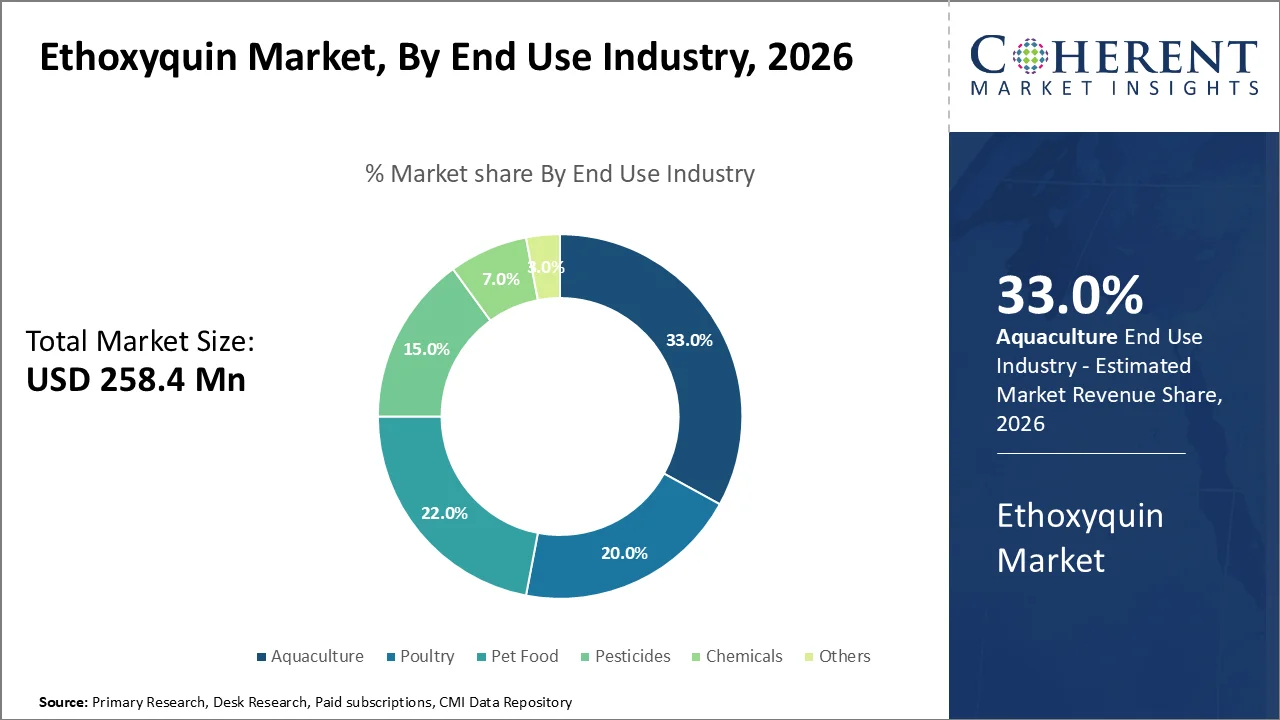
The aquaculture segment is anticipated to lead the market for ethoxyquin in 2026, capturing a share of about 33% from the end-user perspective. The dominance is mainly attributed to the fast growth of fish farming practices, rising consumption of seafood across the world, and increased dependence on fishmeal feeding systems.
Aquaculture feed has an extensive reliance on fish meal and fish oil because these are very easily oxidized during processing and handling. Ethoxyquin has been extensively used as a stabilizer to prevent the oxidation and loss of nutritional value in aquafeed.
Ethoxyquin Market Trends
- Higher global feed output ensures consistent market consumption: The global production of compound feed stood at 1.3 billion tonnes (2023), ensuring the consumption of antioxidants needed for the preservation of livestock and aquaculture feed.
- Trend towards natural antioxidants exerts substitution effect: Research indicates rising substitution of chemical antioxidants by natural antioxidants in developed countries because of the “clean label” approach in feed additives.
- Asia-Pacific remains dominant consumption region: Strong aquaculture activity and fishmeal-based feed systems make Asia-Pacific the largest ethoxyquin-consuming region globally.
Regional Insights
Asia-Pacific Dominates the Global Ethoxyquin Market
Asia-Pacific is projected to lead the global ethoxyquin market with a share of about 50% in 2026 owing to high aquaculture production, significant demands for livestock feed, and established feed manufacturing plants in countries such as China, India, Vietnam, and Indonesia.
The region benefits from rapidly expanding fish farming activities and rising protein consumption, which continue to increase demand for feed antioxidants used in fishmeal and livestock feed preservation.
In June 2024, the Food and Agriculture Organization (FAO) announced in its State of World Fisheries and Aquaculture (SOFIA) 2024 report that global aquaculture production reached a record 130.9 million, including 94.4 million tonnes of aquatic animals, with Asia contributing 91.4% of total global aquaculture production.
North America is the Fastest-Growing Region
The North American region is expected to register the fastest growth in the ethoxyquin market during the forecast period, driven by robust consumer demand for high-quality pet foods, effective feed preservatives, and an existing presence in livestock and aquaculture.
The rising trend in pet ownership, alongside the increasing demand for pet nutrition products with an extended shelf life, will drive regional market growth. There are also growing trends of using antioxidants in feed systems to ensure fat stability and prevent oxidation in animal nutrition products within the U.S. and Canada.
In September 2025, Elanco Animal Health announced major expansion momentum in companion animal health products, reflecting rising North American demand for advanced pet nutrition and preservation technologies linked to the feed antioxidant market.
U.S. Ethoxyquin Market Trends
The Ethoxyquin market in the U.S. is projected to grow at a steady pace during the forecast period. The factors responsible for the growth of the market include increasing demand for high-quality pet food, rising livestock feed production, growing aquaculture practices, and use of feed preservation techniques.
According to American Pet Products Association, in 2025, the total market expenditure in U.S. pet industry stood at USD 158 billion, with pet food and treats contributing around USD 68.3 billion, demonstrating high consumer preference for quality and functional pet foods containing feed preservatives and antioxidants like Ethoxyquin.
China Ethoxyquin Market Forecast
China is likely to remain among the key markets for Ethoxyquin over the forecast period, due to fast-growing aquaculture operations, higher consumption of animal protein, greater production of livestock for industrial purposes, and rising requirements for effective feed preservation products.
Everest Medicines announced that China’s National Medical Products Administration (NMPA) granted full approval for NEFECON in May 2025 for the treatment of primary IgA nephropathy (IgAN) in adults at risk of disease progression.
Who are the Major Companies in Ethoxyquin Industry
Some of the major key players in Ethoxyquin are Camlin Fine Sciences Ltd., Merck KGaA, Mitsui & Co. Ltd., Shanghai Fuda Fine Material Co. Ltd., Skystone Feed Co. Ltd., Industrial Técnica Pecuaria S.A., Kemin Industries Inc., Jiangsu Zhongdan Group Co. Ltd., Impextraco N.V., Rensin Chemicals Ltd. and among others.
Key News
- In March 2025, Kemin Industries launched a new feed safety solution called PROSIDIUM at VIV Asia 2025.
- In April 2025, Impextraco participated in VIV Asia 2025, showcasing its animal nutrition and feed additive solutions, including antioxidants and sustainability-focused feed technologies.
Market Report Scope
Ethoxyquin Market Report Coverage
| Report Coverage | Details | ||
|---|---|---|---|
| Base Year: | 2025 | Market Size in 2026: | USD 258.4 Mn |
| Historical Data for: | 2020 To 2024 | Forecast Period: | 2026 To 2033 |
| Forecast Period 2026 to 2033 CAGR: | 4.2% | 2033 Value Projection: | USD 344.9 Mn |
| Geographies covered: |
| ||
| Segments covered: |
| ||
| Companies covered: | Camlin Fine Sciences Ltd., Merck KGaA, Mitsui & Co. Ltd., Shanghai Fuda Fine Material Co. Ltd., Skystone Feed Co. Ltd., Industrial Técnica Pecuaria S.A., Kemin Industries Inc., Jiangsu Zhongdan Group Co. Ltd., Impextraco N.V., Rensin Chemicals Ltd. and among others. | ||
| Growth Drivers: |
| ||
| Restraints & Challenges: |
| ||
Analyst Opinion
- The Ethoxyquin market will grow on account of the structural demand from the aquaculture and livestock feeding sectors more than any other factors. The production of global fish meals and compound feeds is steadily increasing in the Asia-Pacific region.
- Ethoxyquin continues to be among the most effective synthetic antioxidants against fat oxidation in animal feeds, especially when it comes to preserving fish meal, since other options continue to be costly or unstable.
- However, the market has started being dictated by increasing regulation and the slow movement towards natural feed additives. This limits growth possibilities for the market even as the demand in emerging markets remains steady.
- Overall, the market is expected to remain steady but regionally fragmented, with growth concentrated in Asia-Pacific aquaculture hubs, while mature markets slowly transition toward alternative antioxidant systems.
Speak to the analyst
Want personalized insights?
Take the findings above to one of our principal consultants, or have the report rebuilt around the segments, geographies and competitors you actually track.
Market Segmentation
- By Product Type (Revenue, USD Mn, 2021-2033)
- Ethoxyquin 95 Oil
- Ethoxyquin 66 Powder
- Ethoxyquin 33 Powder
- By End Use Industry (Revenue, USD Mn, 2021-2033)
- Pesticides
- Aquaculture
- Pet Food
- Poultry
- Chemicals
- Others
- By Region (Revenue, USD Mn, 2021-2033)
- North America
- U.S.
- Canada
- Latin America
- Brazil
- Mexico
- Argentina
- Rest of Latin America
- Europe
- Germany
- U.K.
- France
- Italy
- Spain
- Russia
- Rest of Europe
- Asia Pacific
- China
- India
- Japan
- Australia
- South Korea
- ASEAN
- Rest of Asia Pacific
- Middle East
- GCC
- Israel
- Rest of Middle East
- Africa
- South Africa
- Central Africa
- North Africa
- North America
Sources
Primary Research Interviews
- Feed additive manufacturers
- Animal nutrition and livestock feed producers
- Aquaculture industry experts
- Pet food manufacturers
- Veterinary nutrition specialists
- Chemical and antioxidant formulation experts
- Regulatory and compliance consultants (feed safety standards)
Databases
- Food and Agriculture Organization (FAO)
- World Organisation for Animal Health (WOAH/OIE)
- U.S. Food and Drug Administration (FDA) – 21 CFR Feed Additive Regulations
- European Food Safety Authority (EFSA)
- Organisation for Economic Co-operation and Development (OECD)
- United Nations Comtrade Database (trade statistics for feed additives and chemicals)
Magazines
- Feed Strategy
- All About Feed
- Poultry World
- AquaFeed Magazine
- Chemical Week
- Feed & Additive Magazine
Journals
- Journal of Animal Science
- Animal Feed Science and Technology
- Aquaculture Nutrition
- Journal of Agricultural and Food Chemistry
- Food Additives & Contaminants
Newspapers
- The Financial Times
- The Wall Street Journal
- Reuters Business News
- Bloomberg News
- The Economic Times (India)
Associations
- International Feed Industry Federation (IFIF)
- American Feed Industry Association (AFIA)
- European Feed Manufacturers’ Federation (FEFAC)
- Food and Agriculture Organization (FAO)
- International Fishmeal and Fish Oil Organisation (IFFO)
- Association of American Feed Control Officials (AAFCO)
Public Domain Sources
- Company Annual Reports and Investor Presentations (e.g., Kemin Industries, Camlin Fine Sciences, Impextraco)
- Government Food Safety Authority Publications (FDA, EFSA, FSSAI)
- Trade Statistics Portals (UN Comtrade, ITC Trade Map)
- Clinical and regulatory databases for feed additive
- FAO Fisheries and Aquaculture Reports (SOFIA reports)
Proprietary Elements
- CMI Data Analytics Tool
- Proprietary CMI Existing Repository of information for last 10 years
Get access to 250+ pages report
Every segment, forecast, competitor profile and data table behind the analysis above — available for instant download.
- ESOMAR Member
- ISO 9001:2015 Certified
- D-U-N-S Registered
- GDPR & CCPA Compliant
Missing comfort of reading report in your local language? Find your preferred language:
Transform your Strategy with Exclusive Trending Reports
Frequently Asked Questions
The Ethoxyquin Market is expected to grow from USD 258.4 Mn in 2026 to USD 344.9 Mn in 2033, registering a CAGR of 4.2% during the forecast period (2026–2033).
Major players operating in the global Ethoxyquin market include Camlin Fine Sciences Ltd., Merck KGaA, Mitsui & Co. Ltd., Shanghai Fuda Fine Material Co. Ltd., Skystone Feed Co. Ltd., Industrial Tecnica Pecuaria S.A. (ITPSA), Kemin Industries Inc., Jiangsu Zhongdan Group Co. Ltd., Impextraco N.V., and Rensin Chemicals Ltd.
Strict regulatory restrictions, especially in Europe, along with increasing concerns regarding food safety, toxicity debates, and residue limits, are limiting market expansion.
Growth is driven by rising aquaculture feed demand, expansion of livestock production, increasing pet food consumption, and the need for oxidation control in animal feed fats and oils.
The Ethoxyquin Market is anticipated to grow at a CAGR of 4.2% between 2026 and 2033.
Asia-Pacific is expected to dominate the global Ethoxyquin market with an estimated 50% share in 2026, driven by strong aquaculture production and feed manufacturing activity.
The aquaculture segment leads the market, accounting for around 33% share in 2026, due to high use of fishmeal-based feed systems requiring oxidation control.