

Global Personal Safety App Market Size and Forecast – 2026-2033
The Global Personal Safety App Market is estimated to be valued at USD 2.03 Bn in 2026 and is expected to reach USD 5.61 Bn by 2033, exhibiting a compound annual growth rate (CAGR) of 15.6% from 2026 to 2033.
Key Takeaways of the Global Personal Safety App Market
- The emergency alerts segment leads the market holding an estimated share of 32.2 % in 2026.
- North America, holding a share of 36.46 % in 2026, is expected to dominate the market.
- Asia Pacific, holding a share of 31.4 % in 2026, is projected to show the fastest growth in the market.
Market Overview
The market is seeing a rise in the use of advanced features such as real-time location tracking, AI-powered threat detection, and emergency response automation within personal safety apps. Also, collaboration with local law enforcement agencies and expanding use in industries like healthcare, education, and travel further fuel market expansion. Growing smartphone penetration and emphasis on preventive safety measures continue to shape user preferences and boost demand in this dynamic market.
Current Events and Its Impact
Current Events | Description and its impact |
Geopolitical and Trade Developments |
|
Economic and Infrastructure Trends |
|
Segmental Insights
- Current Industry Events of 2026
- Market Size Estimation
- Regional Breakdown
- Competitive Landscape
- Customer Intelligence
- Segmental Analysis
- Pricing Analysis
- Key Market Drivers, Challenges & Future Trends
- Customized Insights Section
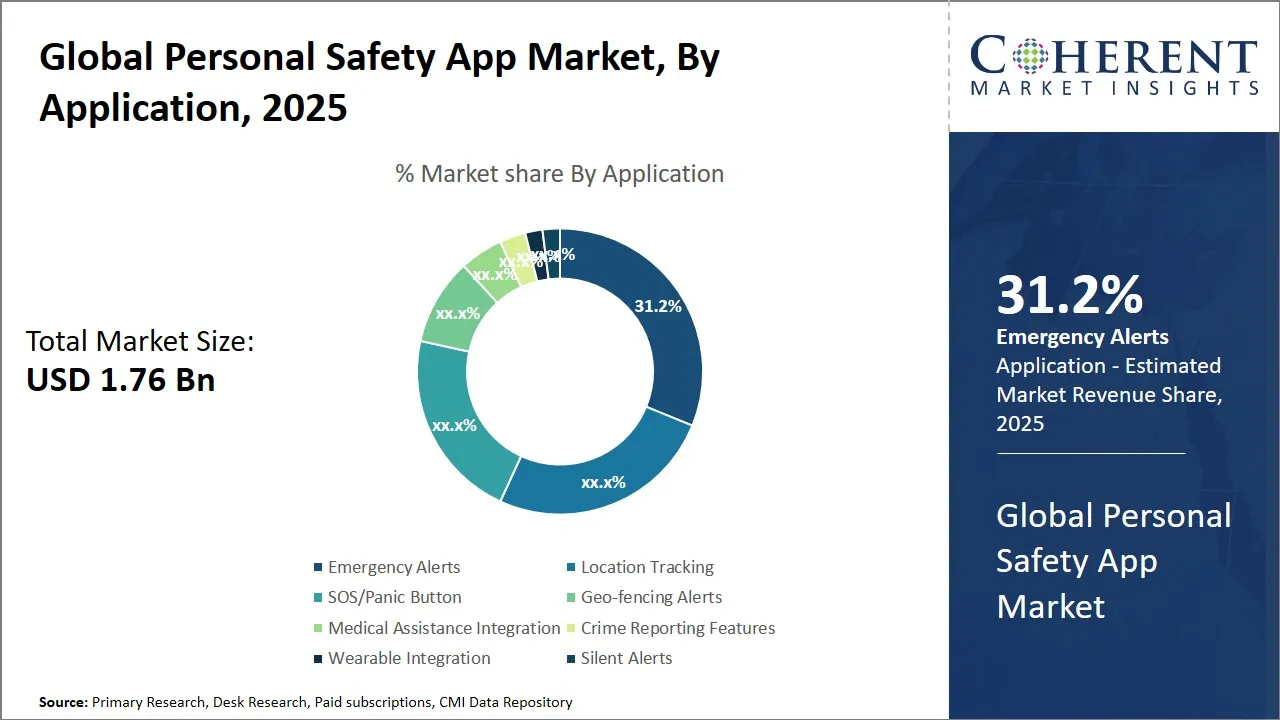
Global Personal Safety App Market Insights, By Application – Emergency Alerts Lead Because of Rising Demand for Immediate Safety Communication
Emergency alerts are expected to hold the largest market share of 32.2% in 2026, driven by the growing need for real-time communication during emergencies. These features allow users to instantly notify contacts or authorities with their live location—critical in cases of assault, accidents, or medical crises. Increasing safety awareness in women, elderly, and children, along with the use of GPS-enabled alerts, has added to adoption. The rise in smartphone and wearable usage further increases accessibility, allowing quick, discreet activations through one-tap or gesture-based triggers.
Authorities are also pushing these tools through public safety partnerships. For example, Life360 has collaborated with U.S. emergency services, allowing users to connect directly to dispatchers for faster assistance. Also, AI-based alert verification, like in Noonlight’s smart detection system, reduces false alarms and increases trust.
Pricing Analysis of the Personal Safety App Market
App/Service | Monthly (USD) | Annual (USD) |
Life360 – Gold | USD 14.99 | USD 179.88 |
Life360 – Platinum | USD 24.99 | USD 299.88 |
Noonlight | USD 0.25 | USD 3.00 |
bSafe (premium) | USD 4.99 | USD 49.99 |
Citizen – Protect (premium) | USD 19.99 | USD 239.88 |
Find My Kids | USD 2.99 | USD 16.99 |
Hollie Guard Extra | USD 10.68 | USD 106.95 |
Silent Beacon (device price) | — | USD 59.99 (one-time device) |
Silent Beacon (app subscriptions) | USD 1.99 – USD 12.99 (tiered) | USD 23.88 – USD 155.88 |
Regional Insights
North America Personal Safety App Market Analysis and Trends
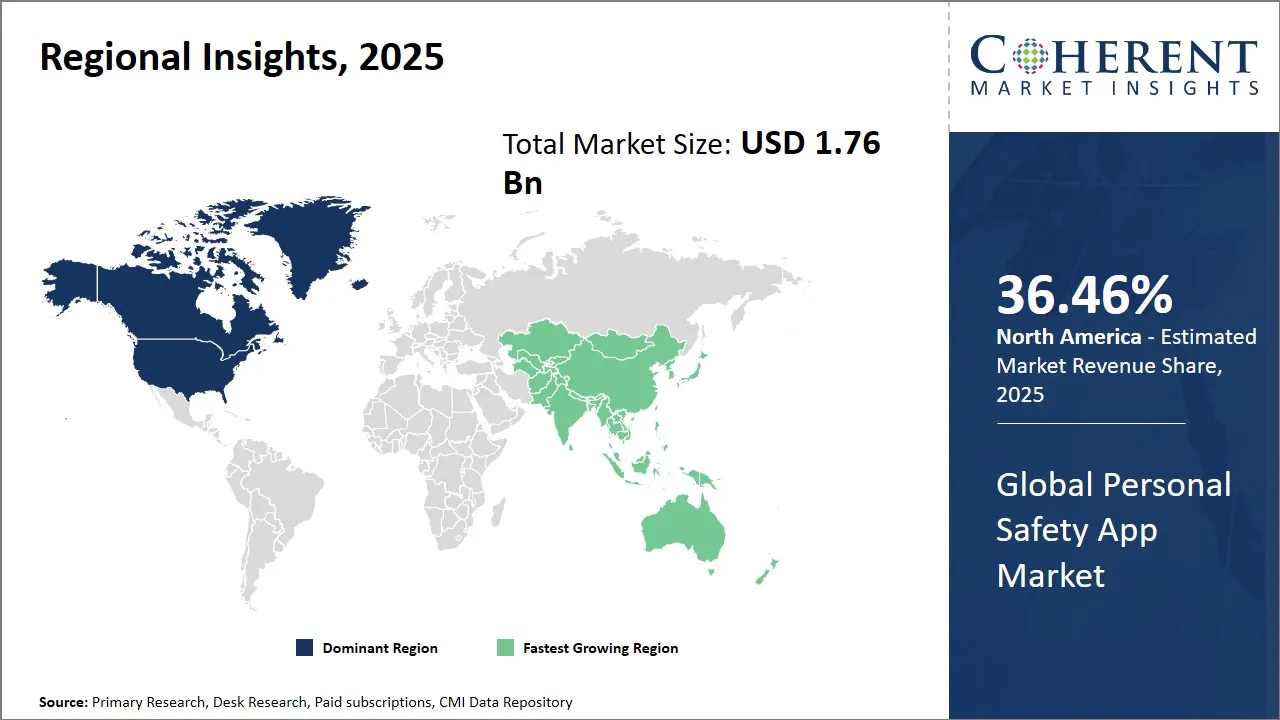
North America, holding a share of 36.46% in 2026, is expected to dominate the global personal safety app market, driven by a mature technological ecosystem, high smartphone penetration, and heightened public awareness regarding personal safety. The region sees strong government initiatives pushing public safety, emergency response systems integration, and data privacy regulations that add to consumer confidence. Moreover, North America hosts a lot of major technology companies and startups specializing in personal safety solutions, fostering innovation and competitive offerings.
Prominent players such as Life360, Noonlight, and SafeTrek have established significant market presence by continuously evolving their app functionalities to include real-time location tracking, emergency alerts, and seamless integration with law enforcement agencies. The existing app ecosystem is further made stronger by collaborations between tech firms, telecom providers, and security services, creating an interconnected safety infrastructure that outpaces other regions.
Asia Pacific Personal Safety App Market Analysis and Trends
The Asia Pacific region, holding a share of 31.4% in 2026, is projected to exhibit the fastest growth in the global personal safety app market due to rapid urbanization, increasing smartphone penetration, and a growing middle-class population that is becoming more conscious of personal security issues. Many APAC governments are pushing digital safety innovations, and policy frameworks are gradually adapting to support mobile app-based safety solutions, especially in countries experiencing higher crime rates or natural disaster risks.
The region’s diverse and growing internet infrastructure, combined with the presence of big technological hubs in India, China, Japan, and Southeast Asia, accelerates app adoption. Companies such as Safetipin (India), WeGuard (China), and Nimb (Singapore) have been instrumental in making apps for local cultural and safety concerns, integrating features like community alerts and multi-language support.
Personal Safety App Market Outlook for Key Countries
U.S. Personal Safety App Market Analysis and Trends
The U.S. plays a big role in North America, seeing a highly competitive landscape with companies like Life360, Noonlight, and bSafe actively pushing innovation. Government initiatives for digital safety and partnerships with public safety agencies improve app credibility and adoption. Consumer demand for comprehensive safety features—such as automatic crash detection and panic alerts—propels continuous product development. The presence of big technology incubators and venture capital pushes startup innovation contributing to the dynamic nature of the market.
India Personal Safety App Market Analysis and Trends
India personal safety app market sees fast growth because of increasing mobile internet usage and governmental emphasis on women's safety and urban security frameworks. Apps like Safetipin and Himmat, supported by collaboration with local law enforcement and NGOs, resolve issues like harassment and crime hotspots. The Indian government’s Digital India initiative has played a big role in making awareness and adding mobile solutions to broader public safety policies, making demand in urban and rural populations.
Japan Personal Safety App Market Analysis and Trends
Japan continues to lead because of advanced technological integration in personal safety apps, influenced by the country’s high exposure to natural disasters like earthquakes and tsunamis. Big players such as P-Navi and Safety tips app add disaster alert features alongside traditional personal safety tools. The Japanese government’s proactive stance on disaster preparedness and citizen safety standards creates a lot adoption, supported by robust telecom infrastructure and consumer willingness to invest in premium safety solutions.
Brazil Personal Safety App Market Analysis and Trends
Brazil personal safety app market emphasizes community-based safety solutions propelled by a high need for crime prevention in urban areas. Local companies like Colab and apps supported by social initiatives offer features suited for neighborhood watch and real-time police reporting. The Brazilian government’s focus on improving public security through digital means complements the efforts of tech firms. Also, trade dynamics in Latin America push cross-border app adoption and innovation exchange within the region.
South Africa Personal Safety App Market Analysis and Trends
South Africa personal safety app market sees a lot of concerns around personal security and high crime rates in certain regions. Apps like MySAPS and React Mobile are adapted to local conditions, incorporating features for rapid alert systems and direct liaison with emergency responders. Government initiatives aimed at digital transformation and public safety awareness campaigns encourage app utilization. Partnerships between the private sector and public safety departments makes the ecosystem stronger.
Market Players, Key Development, and Competitive Intelligence
Key Developments
- On October 22, 2025, Life360 announced Life360 Pet GPS, the first pet tracker made to fit the lives of today’s connected families. The device also unlocks new features in the Life360 app, advancing the platform to become the first whole-family super app protecting people, pets, and things.
- In August 2025, Finnish phone-maker, HMD, launched a new smartphone for kids. It is called the HMD Fuse. The company claims that the device can block all nude content from being shown or recorded by using AI. HMD is using an AI model called HarmBlock AI from SafeToNet, a British cybersecurity
- In February 2025, Protector, an innovative startup creating apps to serve the private security market, announced the launch of its mobile application, Protector, designed to bring the highest level of private protection to citizens' fingertips.
- In December 2022, Motorola Solutions acquired Rave Mobile Safety, a leader in mass notification and incident management that helps organizations and public safety agencies communicate and collaborate during emergencies.
Top Strategies Followed by Personal Safety App Market Players
- Established industry leaders invest a lot in research and development to innovate high-performance products that integrate advanced technologies such as artificial intelligence, real-time location tracking, and automated emergency response systems.
- Life360 continues to invest in AI and real-time analytics to improve location accuracy and predictive safety alerts. In 2024, it launched Crash Detection 2.0, using sensor fusion algorithms to detect vehicle accidents and automatically contact emergency services.
- Mid-level market participants use a contrasting yet complementary approach by concentrating on delivering cost-effective solutions that balance quality with affordability.
- bSafe provides a subscription plan starting around USD 4.99/month, offering live audio/video streaming and automatic alerts without the high costs of enterprise-level apps. Its affordable tiering model targets mass-market users in regions like Southeast Asia and Eastern Europe.
- Smaller-scale players stand out by focusing on niche market segments and specialized product attributes that fulfil unique user needs unmet by larger competitors.
- UrSafe focuses on women’s safety and dating app integration, using voice-activated SOS commands and geo-matching safety alerts. It uses AI voice recognition and partnerships with dating platforms to reach a specialized user base, setting it apart from broader personal safety apps.
Market Report Scope
Personal Safety App Market Report Coverage
| Report Coverage | Details | ||
|---|---|---|---|
| Base Year: | 2025 | Market Size in 2026: | USD 2.03 Bn |
| Historical Data for: | 2020 To 2024 | Forecast Period: | 2026 To 2033 |
| Forecast Period 2026 to 2033 CAGR: | 15.6% | 2033 Value Projection: | USD 5.61 Bn |
| Geographies covered: |
| ||
| Segments covered: |
| ||
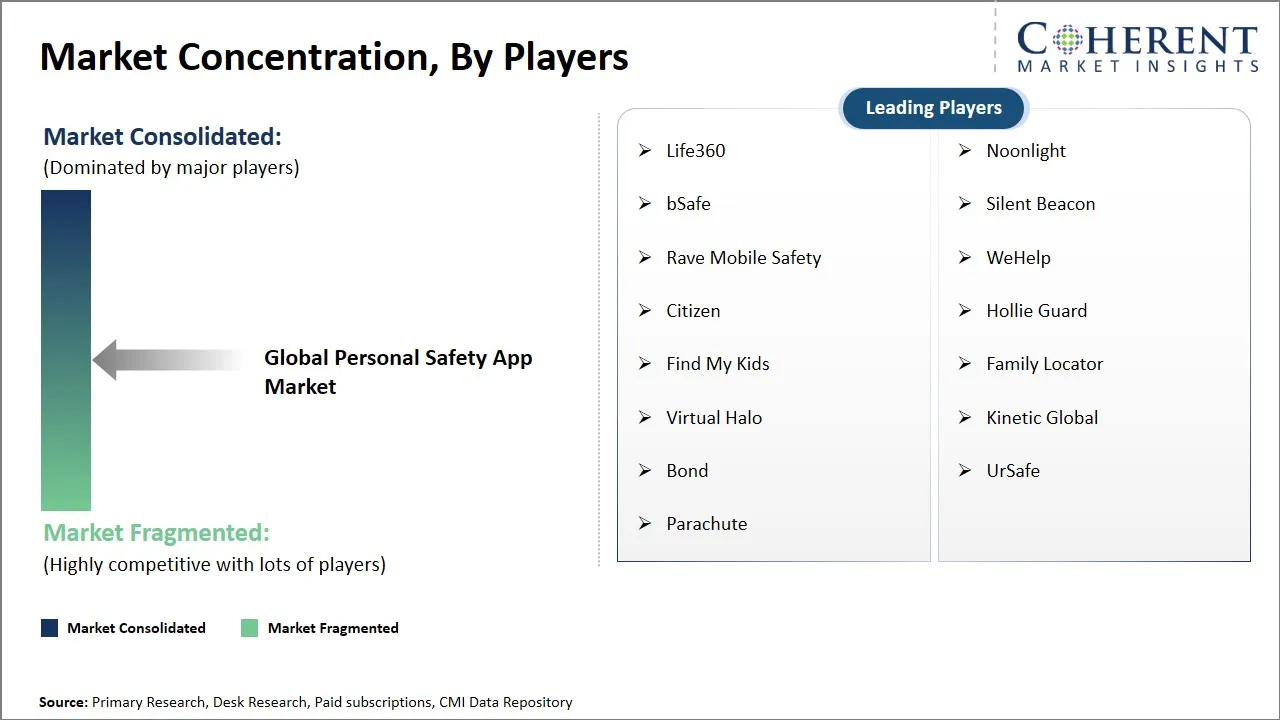
| Companies covered: | Life360, Noonlight, bSafe, Silent Beacon, Rave Mobile Safety, WeHelp, Citizen, Hollie Guard, Find My Kids, Family Locator, Virtual Halo, Kinetic Global, Bond, UrSafe, and Parachute | ||
| Growth Drivers: |
| ||
| Restraints & Challenges: |
| ||
Market Dynamics
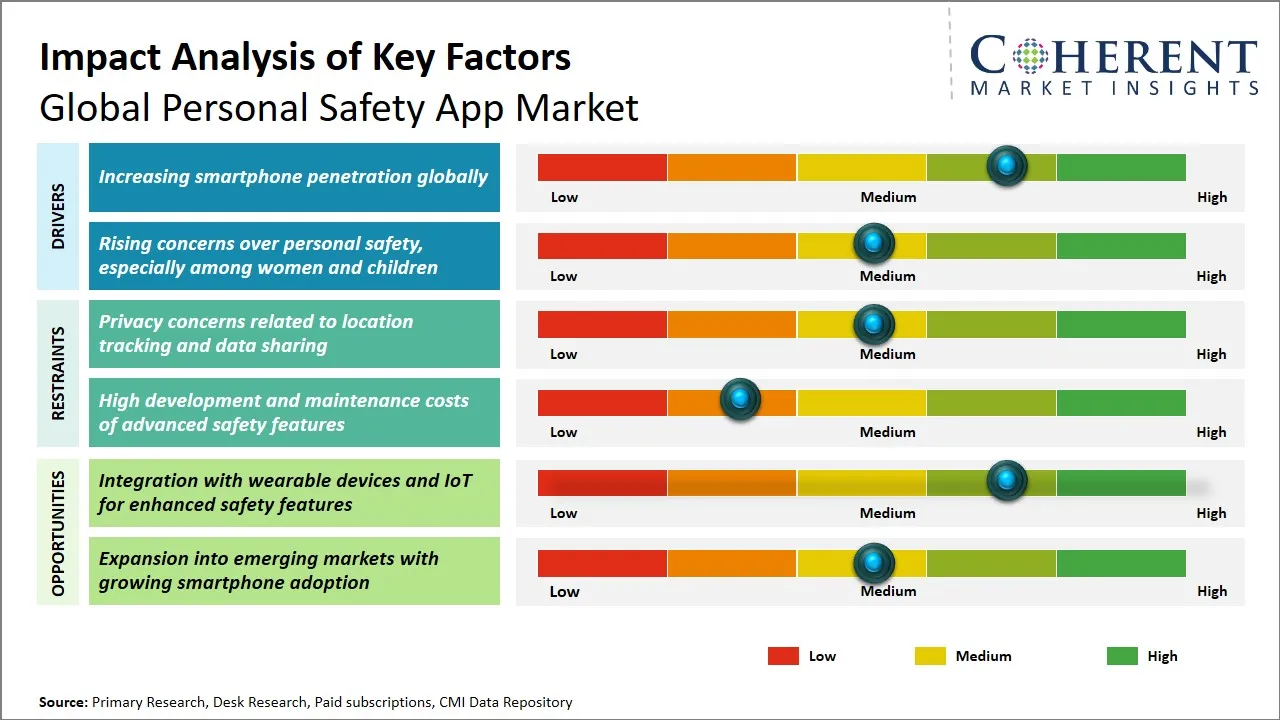
Global Personal Safety App Market Driver – Increasing Smartphone Penetration Globally
The high adoption of smartphones in diverse demographics and geographies has made a lot of demand for personal safety apps worldwide. The integrated features of modern smartphones—like GPS, real-time location tracking, high-speed internet connectivity, and advanced sensors—make a suited platform for sophisticated safety applications.
In 2024, Google expanded its “Personal Safety” app and Android SOS features to more than 60 countries, making possible automatic crash detection and location sharing with emergency services. This move shows how the growing smartphone ecosystem increases the practicality and reach of safety solutions worldwide.
This technological synergy allows users to instantly alert authorities or trusted contacts during emergencies, access safety resources, and monitor their environments remotely. Also, the rising awareness of personal safety, combined with the convenience offered by mobile apps, pushes users to download and regularly use these solutions. Ultimately, the increased smartphone penetration enhances app usability and accessibility, driving the continuous expansion of the global personal safety app market as it reaches broader and more varied user bases worldwide.
Global Personal Safety App Market Opportunity – Integration with Wearable Devices and IoT for Enhanced Safety Features
The global personal safety app market stands to gain a lot of momentum through the integration of safety applications with wearable devices and Internet of Things (IoT) technology, representing a transformative opportunity for market players. Wearable devices like smartwatches, fitness trackers, and smart jewelry are increasingly ubiquitous, providing continuous connectivity and biometric monitoring capabilities that can be used to improve personal safety solutions. By embedding personal safety apps into these devices, users can access real-time emergency alerts, location tracking, and fall detection features with minimal user interaction, which is very important during distress situations.
Apple’s Watch Series 9 comes with “Emergency SOS via Satellite” and “Fall Detection”, allowing users to contact emergency responders even in remote, offline areas. Similarly, Garmin’s smartwatch SOS integration connects directly with the Garmin IERCC global emergency response center, demonstrating how IoT-enabled wearables are revolutionizing proactive personal safety.
Also, the IoT ecosystem makes possible seamless communication between multiple connected devices, making a comprehensive safety network that can include smart home systems, vehicles, and public infrastructure. For instance, a personal safety app integrated with IoT-enabled home security systems can trigger instant alerts to authorities or trusted contacts if a potential threat is detected.
Analyst Opinion (Expert Opinion)
- Despite rapid growth, personal safety apps continue to struggle with consumer trust due to privacy concerns and misuse of sensitive location data. Users are increasingly wary of constant GPS tracking and data sharing with third parties. Unless developers demonstrate robust transparency and encryption standards, widespread adoption could plateau—especially in markets with strict data protection laws like the EU and Canada.
- The market faces a serious profitability challenge. Most users prefer free or low-cost apps, leaving companies reliant on advertising or limited freemium models. This compromises R&D investment and service quality. Without creative monetization—such as value-added subscriptions, partnerships with insurers, or enterprise integration—the sector risks fragmentation and price wars that erode long-term viability.
- The personal safety app ecosystem is saturated with hundreds of lookalike offerings offering SOS and tracking functions. Few players succeed in innovating beyond basic alert mechanisms. Unless brands shift focus toward AI-based predictive safety, contextual awareness, and integration with smart ecosystems, the market risks commoditization—where users see little reason to switch or upgrade apps.
Speak to the analyst
Want personalized insights?
Take the findings above to one of our principal consultants, or have the report rebuilt around the segments, geographies and competitors you actually track.
Market Segmentation
- Application Insights (Revenue, USD Bn, 2021 - 2033)
- Emergency Alerts
- Location Tracking
- SOS/Panic Button
- Geo-fencing Alerts
- Medical Assistance Integration
- Crime Reporting Features
- Wearable Integration
- Silent Alerts
- Regional Insights (Revenue, USD Bn, 2021 - 2033)
- North America
- U.S.
- Canada
- Latin America
- Brazil
- Argentina
- Mexico
- Rest of Latin America
- Europe
- Germany
- U.K.
- Spain
- France
- Italy
- Russia
- Rest of Europe
- Asia Pacific
- China
- India
- Japan
- Australia
- South Korea
- ASEAN
- Rest of Asia Pacific
- Middle East
- GCC Countries
- Israel
- Rest of Middle East
- Africa
- South Africa
- North Africa
- Central Africa
- North America
- Key Players Insights
- Life360
- Noonlight
- bSafe
- Silent Beacon
- Rave Mobile Safety
- WeHelp
- Citizen
- Hollie Guard
- Find My Kids
- Family Locator
- Virtual Halo
- Kinetic Global
- Bond
- UrSafe
- Parachute
Sources
Primary Research Interviews
Stakeholders
- Mobile App Developers and Software Engineers (e.g., Product Managers, UI/UX Designers)
- Cybersecurity Specialists and Data Protection Officers
- Emergency Response Service Providers (e.g., Public Safety Agencies, 911 System Integrators)
- Wearable Technology Manufacturers (e.g., smartwatch and IoT device firms)
- Telecommunications Providers and Network Infrastructure Experts
- NGOs and Safety Advocacy Organizations (focused on women’s and child safety)
- Travel Security Consultants and Risk Management Firms
Databases
- GSMA Intelligence
- World Telecommunication/ICT Indicators Database (ITU)
- Pew Research Center – Internet & Technology
- World Bank Digital Development Dataset
- UN Data Portal
- OECD Digital Economy Statistics
Magazines
- TechWorld Today
- Digital Security Review
- App Developer Magazine
- Smart Mobility Insider
- CyberTech Journal
Journals
- Journal of Mobile Information Systems
- Computers & Security Journal
- Journal of Safety Research
- Human–Computer Interaction Journal
- IEEE Internet of Things Journal
Newspapers
- The Guardian (UK)
- The Economic Times (India)
- TechCrunch
- Wired News
- The New York Times – Technology Section
- Asia Tech Daily
Associations
- Mobile Ecosystem Forum (MEF)
- Internet Society (ISOC)
- Global System for Mobile Communications Association (GSMA)
- Information Systems Security Association (ISSA)
- International Association for Safety and Security Technology (IASST)
- Women’s Safety Global Alliance (WSGA)
Public Domain Sources
- U.S. Federal Communications Commission (FCC)
- EU Digital Single Market Data Portal
- World Bank Open Data
- United Nations Economic and Social Council (ECOSOC)
- ResearchGate
- World Health Organization (WHO) – Safety and Violence Prevention Statistics
Proprietary Elements
- CMI Data Analytics Tool, Proprietary CMI Existing Repository of Information for the Last 8 Years
Get access to 250+ pages report
Every segment, forecast, competitor profile and data table behind the analysis above — available for instant download.
- ESOMAR Member
- ISO 9001:2015 Certified
- D-U-N-S Registered
- GDPR & CCPA Compliant
Missing comfort of reading report in your local language? Find your preferred language:
Transform your Strategy with Exclusive Trending Reports
Frequently Asked Questions
The global personal safety app market is estimated to be valued at USD 2.03 billion in 2026 and is expected to reach USD 5.61 billion by 2033.
The CAGR of global personal safety app market is projected to be 15.6% from 2026 to 2033.
Increasing smartphone penetration globally and rising concerns over personal safety, especially among women and children are the major factors driving the growth of the global personal safety app market.
Privacy concerns related to location tracking and data sharing and high development and maintenance costs of advanced safety features are the major factors hampering the growth of the global personal safety app market.
In terms of application, emergency alerts are estimated to dominate the market revenue share in 2026.
Life360, Noonlight, bSafe, Silent Beacon, Rave Mobile Safety, WeHelp, Citizen, Hollie Guard, Find My Kids, Family Locator, Virtual Halo, Kinetic Global, Bond, UrSafe, and Parachute are the major players.
Yes, safety apps are highly effective for solo travelers as they provide instant access to help, location sharing, and offline or satellite-based SOS options in areas with weak connectivity. Apps like Life360, Noonlight, and bSafe enable travelers to stay connected with trusted contacts and authorities, significantly enhancing personal security during solo trips.