

Global Pork Meat Market Size and Forecast – 2026 To 2033
The Global Pork Meat Market is estimated to be valued at USD 287.6 Bn in 2026 and is expected to reach USD 372.9 Bn by 2033, growing at a compound annual growth rate (CAGR) of 4.6% from 2026 to 2033. Growth is supported by population expansion, urbanization, improving household incomes, established pork consumption in major markets, and wider access to refrigerated retail and foodservice channels.
Emerging economies are expected to provide incremental volume opportunities, while mature markets increasingly emphasize value-added, convenient, traceable, and premium pork products. In July 2026, the OECD-FAO Agricultural Outlook 2026–2035 projected global pig meat consumption to increase by around 6 million tonnes, or 4%, over its outlook period, with additional demand concentrated largely in middle-income economies.
Key Takeaways of the Global Pork Meat Market
- Fresh and Chilled Pork is projected to grow at a CAGR of 6.9% during 2026–2033, while accounting for 43.8 % of the global pork meat market in 2026. Its leadership reflects frequent household purchases, strong supermarket meat-counter turnover, and consumer preference for fresh cuts offering better cooking versatility. In March 2026, Smithfield initiated approval for a new fresh pork processing facility in Sioux Falls, reinforcing refrigerated pork processing capacity.
- Loin, representing an expected 26.8 % market share in 2026, is forecast to expand at a CAGR of 7.0% through 2033. Its strong position stems from its lean profile, portioning flexibility, broad retail acceptance, and suitability for chops, roasting, grilling, and marinated preparations. In March 2024, Hormel Foods launched Sweet Garlic Ginger Pork Loin at select grocery retailers nationwide, extending value-added merchandising opportunities for loin-based products.
- Unprocessed Pork is expected to retain the largest position within processing types, accounting for 61.4 % of the market in 2026 and registering a CAGR of 6.4% during 2026–2033. Its scale reflects extensive use in household cooking, butcher shops, supermarkets, restaurants, and downstream meat processing. In July 2026, USDA ERS projected U.S. pork production to remain above 2025 levels, supporting continued availability of primary pork products.
- Asia Pacific is set to remain the leading regional market with a 42.6 % share in 2026 and an expected CAGR of 7.1% from 2026 to 2033. Large hog-production systems, deeply established pork consumption, extensive fresh-meat distribution, and expanding foodservice networks support its position. In January 2026, China’s National Bureau of Statistics reported 2025 pork output of 59.38 million tons, highlighting the substantial production base underpinning regional supply.
- Europe is forecast to post the fastest regional CAGR of 7.8% during 2026–2033, alongside an expected 24.8 % share of the global pork meat market in 2026. Its expansion is supported by sophisticated meat processing, strong cross-border trade, premium pork categories, established retail infrastructure, and resilient consumption. In July 2026, the European Commission indicated that EU pigmeat production and consumption were expected to remain stable, while exports remained resilient as prices moderated.
Segmental Insights
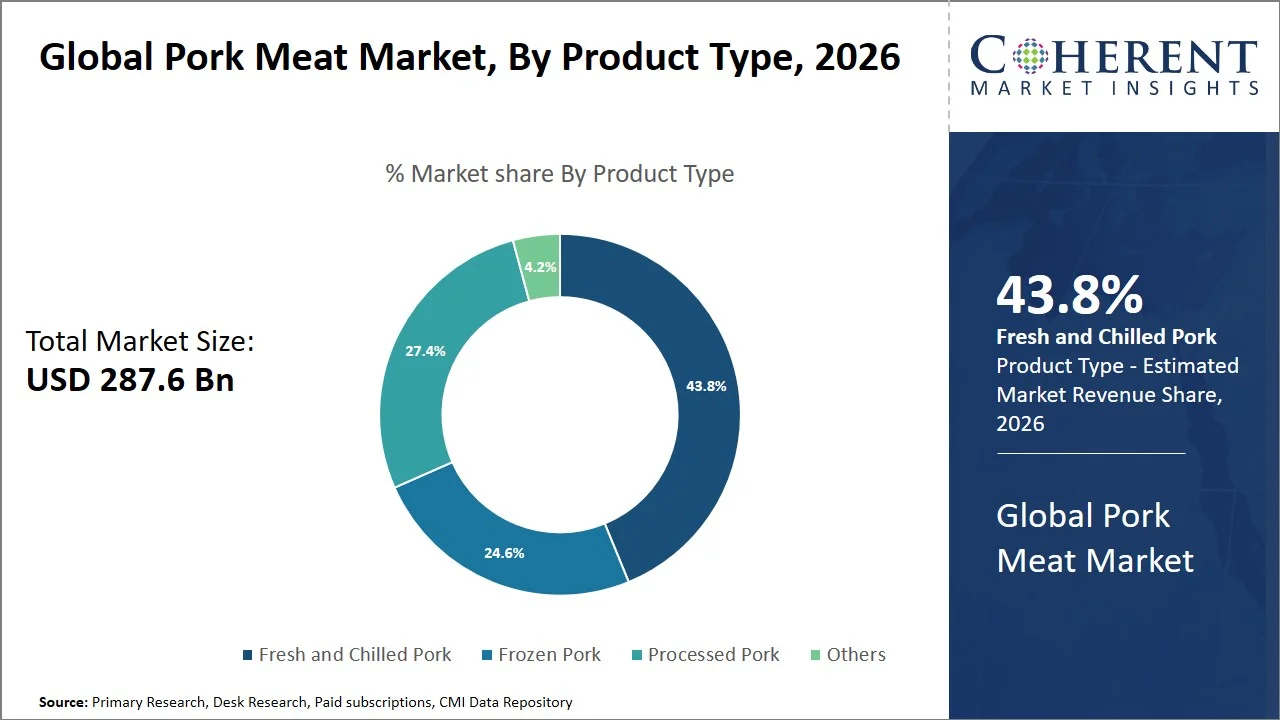
Why Does Fresh and Chilled Pork Dominate the Global Pork Meat Market?
Fresh and Chilled Pork is projected to account for 43.8% of the global pork meat market in 2026 as it closely reflects the typical cooking needs of the household in the wake of foodservice demand for cuts that can be put straight into the food preparation. Shorter inventory cycles also provide opportunities for the supermarkets and specialty stores to distinguish pork by cut, marbling, trim, origin, and ready-to-cook seasoning while retaining refrigerated quality. Case-ready packaging and reliable cold-chain replenishment are commercially appealing for processors because they enable fresh pork products to have greater visibility and flexibility in product development. In April 2026, True Story Foods announced the rollout of seven fresh pork products across 300 Target stores in California, including pork loin, tenderloin, ribs, shoulder, and ground formats, illustrating continued retail investment in refrigerated pork assortments.
- Current Industry Events of 2026
- Market Size Estimation
- Regional Breakdown
- Competitive Landscape
- Customer Intelligence
- Segmental Analysis
- Pricing Analysis
- Key Market Drivers, Challenges & Future Trends
- Customized Insights Section
Why Does Loin Represent the Largest Cut Type in the Global Pork Meat Market?
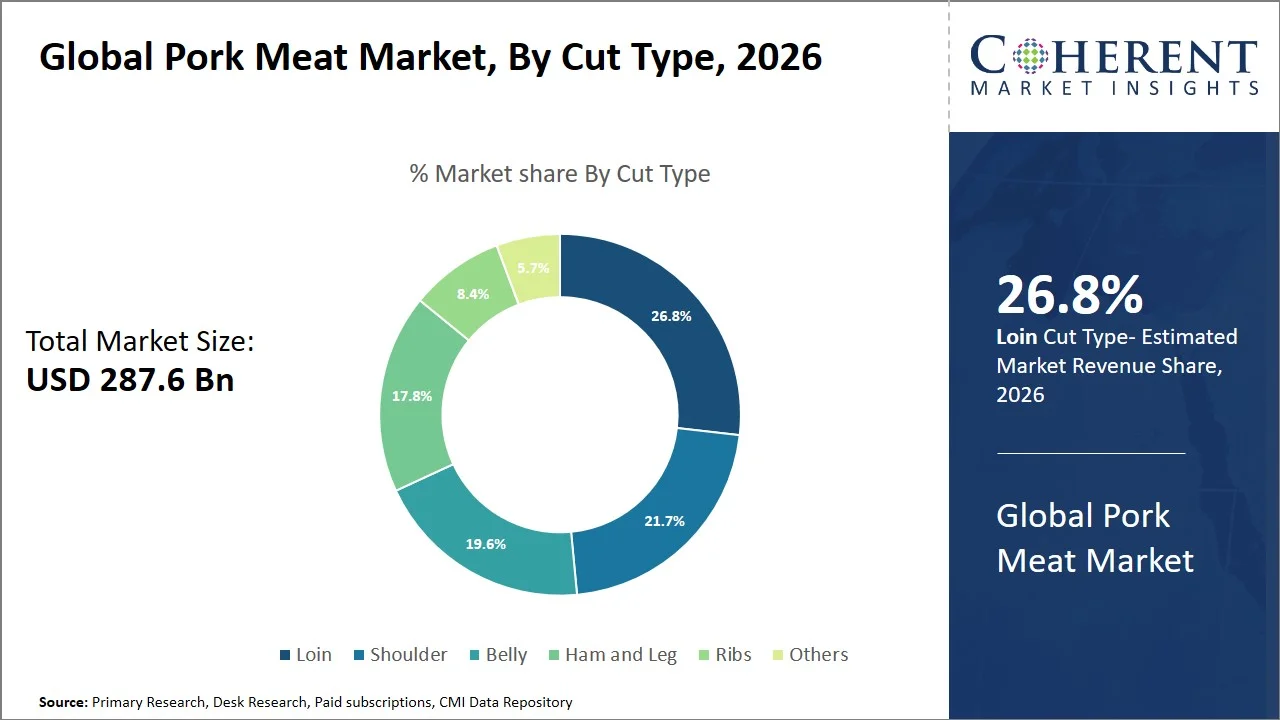
Loin is projected to account for 26.8% of the global pork meat market by cut type in 2026, as a single primal can be sold in a variety of high utility cuts, such as chops, roasts, center-cut, and value-added meat solutions. The relatively low fat content, consistent portioning, low profile, and mild flavor lend to wide menu flexibility for retailers and foodservice operators as it can be grilled, roasted, pan cooked, and marinated. The cut also is versatile for marketing as whole loins can be broken into various pack sizes and price points, catering to both family dinners and premium portion controlled demand. In January 2026, the National Pork Board reported that its late-2025 holiday activation with the Independent Grocers Alliance included a two-week feature centered on pork loin roast, supported through digital circulars and recipe marketing, demonstrating the cut’s suitability for coordinated retail merchandising.
Why Does Unprocessed Pork Dominate the Processing Type of the Global Pork Meat Market?
Unprocessed Pork is expected to command 61.4% of the global pork meat market by processing type in 2026 because primary pork cuts remain the starting point for household cooking, restaurant preparation, butcher sales, and downstream meat manufacturing. Buyers can convert primal and sub-primal pork into numerous recipes or further-processed products, giving unprocessed supply greater functional breadth than finished cured or ready-to-eat formats. For slaughterhouses and integrated processors, selling fresh primals also limits additional curing, smoking, cooking, and formulation stages, while allowing carcass value to be allocated across domestic, foodservice, industrial, and export customers. In September 2025, Seaboard Foods purchased three farms in Texas and Oklahoma containing 57,000 market-hog spaces to directly supply its Guymon pork processing facility, strengthening livestock availability for primary pork production and reinforcing the importance of secure upstream supply.
Current Events and their Impact
Current Event | Description and Its Impact |
December 2025 – China Imposes Final Anti-Dumping Duties on EU Pork |
|
May 2025 – UK Restores FMD-Related Market Access for German Pork |
|
June 2024 – Philippines Maintains Reduced Pork Import Tariffs Under Executive Order 62 |
|
Global Pork Meat Market Dynamics
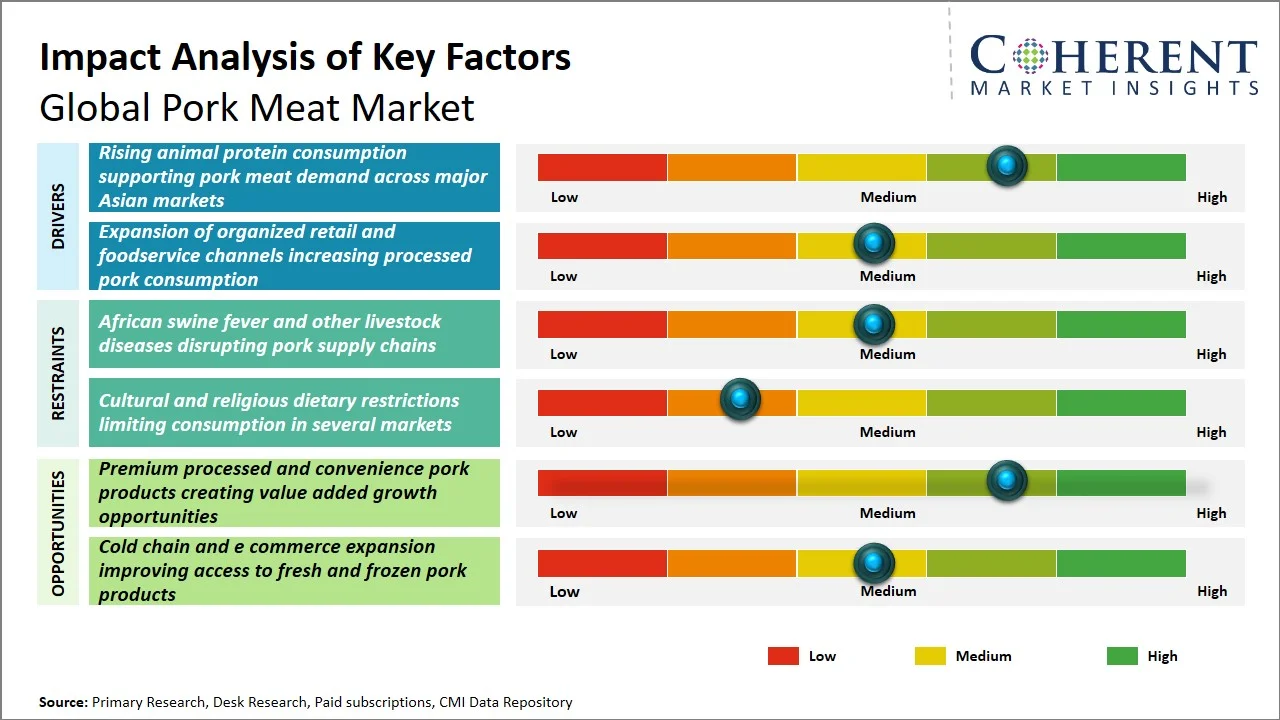
Key Market Drivers
- Rising animal protein consumption supporting pork meat demand across major Asian markets: Pork remains a central animal-protein choice across several Asian diets, especially where fresh meat purchasing, traditional cuisine, and expanding urban foodservice reinforce frequent consumption. Higher household incomes and wider refrigerated distribution are also making standardized chilled and frozen pork easier to supply beyond major cities. This supports throughput for hog producers, slaughterhouses, importers, meat processors, distributors, and retailers while encouraging suppliers to secure dependable volumes and diversify sourcing. Commercially, the driver matters because stronger consumption can translate into greater use of inspected, packaged, and processor-ready pork. In December 2025, Vietnam’s agriculture market-information portal reported that chilled and frozen pork imports exceeded 159,000 tonnes during the first ten months of 2025, with purchasing accelerating toward year-end as demand increased for the festive season.
- Expansion of organized retail and foodservice channels increasing processed pork consumption: Organized supermarkets, branded meat counters, restaurant chains, and institutional foodservice are changing how pork is specified and purchased. These channels favor consistent portion sizes, food-safety documentation, dependable delivery schedules, longer shelf life, and products requiring less kitchen preparation, increasing the commercial relevance of bacon, sausages, cured pork, marinated cuts, and other value-added formats. Processors with integrated distribution, automated packaging, and strong customer relationships benefit because they can serve retail planograms and foodservice menus at scale. Smaller suppliers without standardized processing or traceability face higher entry requirements. In January 2024, Tyson Foods opened a USD 355 million bacon facility in Bowling Green, Kentucky, designed to supply premium bacon products to both retail and foodservice customers, demonstrating how channel demand can justify dedicated processed-pork capacity.
Emerging Market Trends
- Nutrition-Focused Reformulation Is Reshaping Processed Pork Portfolios: Processed pork manufacturers are increasingly reformulating bacon, ham, sausages, and ready-to-eat products around cleaner labels, lower sodium, simpler ingredients, and improved nutritional positioning. This is shifting R&D toward formulations that maintain food safety, shelf life, texture, and taste while meeting changing buyer expectations. Ingredient suppliers, premium processors, and private-label retailers are positioned to benefit from this shift.
- Biosecurity Performance Is Becoming Part of Commercial Supplier Qualification: Biosecurity is becoming an important supplier-selection criterion as processors, retailers, and importers seek greater protection against animal-disease-related supply disruption. Producers with strong herd monitoring, farm-access controls, traceability, diagnostics, and animal-movement protocols can strengthen customer confidence and contracting positions. Over the forecast period, biosecurity capabilities are expected to influence procurement, export eligibility, insurance, and supply-chain resilience more directly.
Regional Insights
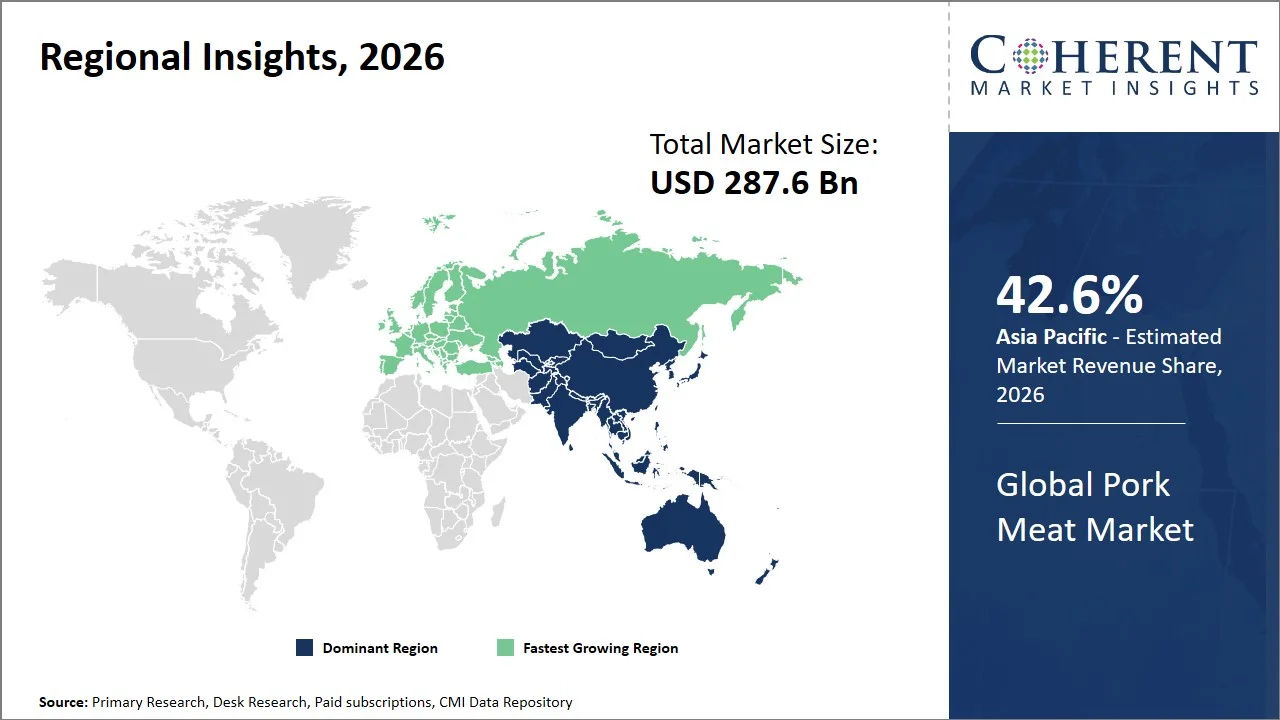
Why Does Asia Pacific Dominate the Global Pork Meat Market?
Asia Pacific is expected to dominate the global pork meat market with a 42.6% share in 2026, driven by strong cultural preference for pork, large-scale hog production, and deeply embedded fresh-meat consumption patterns. China remains the core demand and supply hub, while Japan, South Korea, Vietnam, and the Philippines contribute steady consumption across fresh, chilled, frozen, and processed formats. The region is supported by extensive wet markets, modern retail expansion, and a rapidly improving cold-chain network that ensures year-round availability. Intra-regional trade also helps balance supply gaps across countries. In July 2025, the Philippines Department of Agriculture planned imports of about 150,000 metric tons of pork under the minimum access volume mechanism, reflecting active supply management in the region.
Why Is Europe Emerging as the Fastest-Growing Region in the Global Pork Meat Market?
Europe is emerging as the fastest-growing region with expected market share of 24.8% in 2026 in the global pork meat market, supported by a mature but highly efficient pork industry. growth is driven by advanced processing capabilities, strong demand for premium cured and processed pork, and well-established retail and export networks. Producers are increasingly focusing on automation, energy efficiency, and higher-value product differentiation to maintain competitiveness. Strict food-safety and traceability standards further strengthen consumer trust and cross-border trade. In October 2025, Eurostat reported EU pigmeat production of 21.1 million tonnes in 2024, up 2.2% year-on-year, with Spain and Germany leading output, indicating stable production recovery.
Global Pork Meat Market Outlook for Key Countries
Why Is the U.S. a Key Market for the Global Pork Meat Market?
The U.S. is a key market due to its large-scale commercial hog production, highly efficient processing systems, and advanced cold-chain and retail infrastructure. Demand is diversified across fresh cuts, bacon, ham, ribs, sausages, and convenience pork products, enabling full carcass utilization. The country also plays a major role in global pork exports, strengthening overall industry value realization. In June 2026, the U.S. Meat Export Federation reported that January to April pork exports reached 1.04 million metric tons valued at USD 2.89 billion, reflecting continued strong international demand.
Why Is India Important in the Global Pork Meat Market?
India represents an emerging pork market with demand concentrated in the Northeast, selective eastern states, and urban hospitality channels. While smaller than other meat segments, pork consumption is locally significant and supported by regional dietary preferences. Supply constraints in high-demand areas are gradually encouraging investment in organized pig farming, improved breeding, and better cold-chain distribution. Government initiatives are also supporting productivity improvements and disease control. In August 2026, the Government of India sanctioned USD 0.019 Mn for a Pig Semen Collection and Processing Laboratory in Assam, along with broader support for piggery development and vaccination programs.
Why Does China Support Growth in the Global Pork Meat Market?
China plays a central role in global pork demand due to its massive production base and deeply rooted consumption culture. Pork is a staple protein across households, foodservice, and processed food industries, supported by large integrated producers and extensive distribution networks. Government oversight of supply, reserves, and food safety helps stabilize the market and improve quality standards. In July 2025, Shanghai introduced updated hog-product safety regulations covering sourcing, slaughtering, transport, retail, and traceability, strengthening formal supply chains and consumer confidence.
Why Is Germany a Strategic Country in the Global Pork Meat Market?
Germany is strategically important due to its strong production base, advanced meat processing industry, and central role in European pork trade. Demand is supported by widespread consumption of fresh pork and processed products such as sausages, ham, and cured meats. The country operates under strict EU regulatory standards, encouraging efficiency, quality control, and sustainable production practices. In February 2026, Germany’s Federal Statistical Office reported 4.3 million tonnes of pork production in 2025, reflecting a modest year-on-year increase and stable industry performance.
Why Is Brazil an Important Growth Market for the Global Pork Meat Market?
Brazil is a key growth market due to its cost-competitive feed base, integrated production systems, and expanding export footprint. Strong availability of corn and soy supports efficient pig farming, while southern regions provide well-developed processing and logistics infrastructure. Domestic demand is also supported by pork’s affordability compared to beef, while exports diversify revenue streams across multiple global markets. In June 2026, Paraná state reported 1.426 million tonnes of pork production in Q1 2026, up 6.9% year-on-year, highlighting continued production expansion.
Technology Adoption Landscape in the Global Pork Meat Market
Technology | Adoption Level | Key Application Area | Business Impact |
Vision-based carcass grading and yield mapping systems | Medium | Slaughter lines and carcass classification | Improves cut-yield estimation, carcass sorting, specification consistency, and raw-material allocation. |
Robotic primal cutting and automated deboning systems | Medium | High-volume pork fabrication plants | Reduces labor dependency, improves cutting repeatability, enhances worker safety, and supports higher processing throughput. |
Vacuum skin and modified-atmosphere packaging systems | High | Fresh and chilled retail pork | Extends commercial shelf life, improves product presentation, reduces handling exposure, and lowers retail shrink. |
High-pressure processing for ready-to-eat pork | Medium | Cooked ham, deli pork, sausages, and prepared meats | Strengthens microbial control while preserving sensory characteristics and extending refrigerated shelf life. |
Rapid PCR-based pathogen detection systems | High | Plant sanitation and finished-product quality control | Shortens testing cycles for key microbial hazards and enables faster quality-release and corrective-action decisions. |
Networked cold-chain temperature monitoring and data loggers | High | Refrigerated transport, storage, and distribution | Improves temperature compliance, reduces spoilage risk, supports shipment traceability, and strengthens retailer acceptance. |
How are breed-specific and origin-certified premium pork programs creating new growth opportunities in the Global Pork Meat Market?
Breed-specific and origin-certified premium pork represents an underdeveloped opportunity between commodity fresh meat and highly processed specialty products. Urban specialty retailers, chef-led restaurants, premium supermarkets, and affluent home cooks increasingly offer room for pork differentiated by genetics, feeding regime, intramuscular fat, provenance, aging suitability, and verified production practices. The opportunity is strategically attractive because these attributes can support premium pricing while reducing dependence on commodity pork benchmarks. Suppliers can capture value through dedicated breeding programs, segregated slaughter and fabrication, sensory-led cut specifications, origin certification, chef education, and packaging that clearly communicates provenance and cooking performance. Participation requires consistent pig genetics, controlled feed programs, traceable farm-to-pack systems, strict refrigerated handling, and enough production discipline to deliver repeatable eating quality. The model is likely to favor vertically integrated processors and specialist producer groups capable of preserving identity throughout the supply chain, although premium-focused new entrants can participate through contracted farming and outsourced processing. Successful programs should prioritize repeat purchase and culinary differentiation rather than relying only on luxury branding.
Market Players, Key Development, and Competitive Landscape
Key Developments
- In January 2026, Danish Crown announced plans to establish a specialized pork-deboning facility in Vejen, Denmark, with operations planned for October 2026. The site will expand fabrication capacity for pork foreends and improve flexibility in serving both European and export markets. The development supports greater efficiency and optimized cut allocation across destinations.
- In May 2025, JBS USA announced a USD 135 million investment to build a dedicated sausage production facility in Perry, Iowa. The proposed plant is designed to expand prepared-pork capacity and strengthen JBS USA’s ability to serve value-added protein demand rather than relying solely on commodity pork sales. This reflects the broader shift toward further-processed pork products that enhance differentiation and margin potential.
- In February 2025, Cranswick acquired JSR Genetics Limited, including its pig genetics and pig-farming operations. The transaction extends Cranswick’s upstream integration into breeding and genetic improvement, strengthening control over supply consistency, animal performance, and eating quality. This enhances resilience in periods of tight pig availability or disease-related disruption.
Competitive Landscape
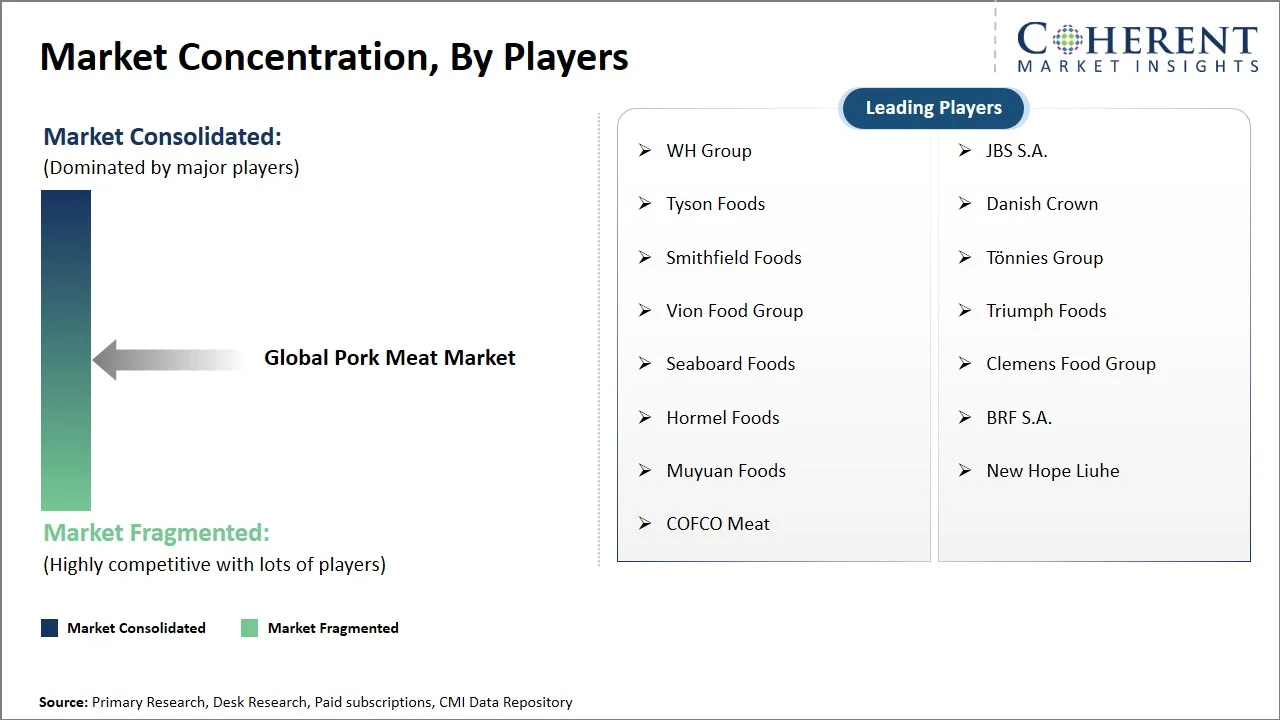
The global pork meat market is moderately fragmented, with competition spanning vertically integrated pork companies, cooperative slaughter groups, national meat processors, prepared-food manufacturers, specialist premium suppliers, and numerous regional fresh-meat producers. Scale alone does not ensure leadership because profitability depends on hog procurement economics, plant utilization, product mix, disease management, customer contracts, and access to multiple distribution channels. Large integrated processors benefit from supply control and manufacturing efficiency, while regional companies can compete through freshness, local sourcing, specialty cuts, and customer-specific service.
Key focus areas include
- Hog procurement and supply security: Ensuring predictable slaughter volumes to maintain plant utilization and control unit costs
- Processing efficiency: Automation, yield optimization, and plant throughput management
- Food safety and quality assurance: Strong pathogen control and compliance systems for retail and export access
- Product and format flexibility: Ability to shift between fresh, frozen, cured, and prepared pork formats
- Retail and foodservice relationships: Long-term contracts enabling stable demand and private-label development
- Geographic diversification: Multi-market sourcing and export capability to reduce trade and disease exposure
- Premium positioning: Differentiation through breed, provenance, welfare standards, and eating quality
Market Report Scope
Pork Meat Market Report Coverage
| Report Coverage | Details | ||
|---|---|---|---|
| Base Year: | 2025 | Market Size in 2026: | USD 287.6 Bn |
| Historical Data for: | 2020 To 2024 | Forecast Period: | 2026 To 2033 |
| Forecast Period 2026 to 2033 CAGR: | 4.6% | 2033 Value Projection: | USD 372.9 Bn |
| Geographies covered: |
| ||
| Segments covered: |
| ||
| Companies covered: | WH Group, JBS S.A., Tyson Foods, Danish Crown, Smithfield Foods, Tönnies Group, Vion Food Group, Triumph Foods, Seaboard Foods, Clemens Food Group, Hormel Foods, BRF S.A., Muyuan Foods, New Hope Liuhe, COFCO Meat | ||
| Growth Drivers: |
| ||
| Restraints & Challenges: |
| ||
Analyst Opinion (Expert Opinion)
- Competitive advantage is expected to shift toward companies capable of operating flexible, multi-origin supply networks. The ability to rebalance sourcing, production, and export allocation in response to trade shifts, disease events, or price volatility will become a core determinant of margin stability.
- Automation and flexible processing systems are likely to reshape cost structures across pork fabrication. As robotics, digital yield systems, and adaptive processing lines expand, traditional labor-cost advantages may weaken, increasing the competitiveness of modernized plants closer to supply or demand centers.
- Market participants should prioritize supply diversification, biosecure sourcing, export flexibility, and value-added product development. Overexposure to commodity pork without secured demand or livestock supply increases volatility risk. Stronger integration with producers, logistics partners, and foodservice customers will be essential to sustaining long-term competitiveness.
Speak to the analyst
Want personalized insights?
Take the findings above to one of our principal consultants, or have the report rebuilt around the segments, geographies and competitors you actually track.
Market Segmentation
- Product Type Insights (Revenue, USD Bn, 2021 - 2033)
- Fresh and Chilled Pork
- Frozen Pork
- Processed Pork
- Others
- Cut Type Insights (Revenue, USD Bn, 2021 - 2033)
- Loin
- Shoulder
- Belly
- Ham and Leg
- Ribs
- Others
- Processing Type Insights (Revenue, USD Bn, 2021 - 2033)
- Unprocessed
- Cured and Smoked
- Sausages and Minced Products
- Ready to eat Products
- Distribution Channel Insights (Revenue, USD Bn, 2021 - 2033)
- Supermarkets and Hypermarkets
- Meat and Specialty Stores
- Foodservice
- Online Retail
- Convenience Stores
- Others
- Regional Insights (Revenue, USD Bn, 2021 - 2033)
- North America
- U.S.
- Canada
- Latin America
- Brazil
- Argentina
- Mexico
- Rest of Latin America
- Europe
- Germany
- U.K.
- Spain
- France
- Italy
- Russia
- Rest of Europe
- Asia Pacific
- China
- India
- Japan
- Australia
- South Korea
- ASEAN
- Rest of Asia Pacific
- Middle East
- GCC Countries
- Israel
- Rest of Middle East
- Africa
- South Africa
- North Africa
- Central Africa
- North America
- Key Players Insights
- WH Group
- JBS S.A.
- Tyson Foods
- Danish Crown
- Smithfield Foods
- Tönnies Group
- Vion Food Group
- Triumph Foods
- Seaboard Foods
- Clemens Food Group
- Hormel Foods
- BRF S.A.
- Muyuan Foods
- New Hope Liuhe
- COFCO Meat
Sources
Primary Research Interviews
- Pork producers, hog farmers, slaughterhouses, meat processors, and integrated pork companies
- Fresh, chilled, frozen, processed pork, bacon, ham, sausage, and specialty pork suppliers
- Supermarkets, meat retailers, foodservice operators, importers, exporters, and distributors
- Procurement professionals, livestock experts, meat technologists, veterinarians, and industry consultants
Stakeholders
- Hog producers, breeders, feed suppliers, slaughterhouses, and pork processors
- Retailers, foodservice companies, meat wholesalers, cold-chain operators, and logistics providers
- Importers, exporters, distributors, packaging suppliers, and institutional buyers
End-use Sectors
- Household and retail consumption
- Hotels, restaurants, and catering
- Meat processing and prepared foods
- Institutional and commercial foodservice
Regulatory and Government Bodies
- U.S. USDA, FSIS, APHIS, FDA, and Census Bureau
- European Commission, EFSA, Eurostat, and national veterinary authorities
- China MARA, GACC, and National Bureau of Statistics
- India DAHD, FSSAI, APEDA, and Ministry of Agriculture
- Brazil MAPA, ANVISA, and IBGE
- FAO and World Organisation for Animal Health
Databases
- FAOSTAT, UN Comtrade, ITC Trade Map, WTO, World Bank, OECD, and Eurostat
- USDA livestock and meat databases
- National livestock production, slaughter, meat-consumption, and trade databases
- Company filings, product catalogues, pricing records, and customs statistics
Magazines and Journals
- Meat Science and Journal of Animal Science
- Livestock Science and Animal
- Food Control and Journal of Food Protection
- Meat & Poultry, National Hog Farmer, and Pig Progress
Associations
- International Meat Secretariat
- National Pork Producers Council
- U.S. Meat Export Federation
- European Livestock and Meat Trades Union
- National pork, livestock, meat-processing, and food-industry associations
Public Domain Sources
- Pork production, slaughter, carcass-weight, consumption, and livestock inventory statistics
- Fresh, chilled, frozen, and processed pork trade data
- Product specifications, packaging formats, food-safety information, and nutritional data
- Annual reports, processing-capacity additions, facility investments, export approvals, and disease-status updates
Key Standards and Regulations
- Codex meat hygiene and food-safety requirements
- HACCP and slaughterhouse sanitation requirements
- U.S. Federal Meat Inspection and USDA FSIS requirements
- EU Food Hygiene Package and Animal Health Law requirements
- African swine fever, animal-movement, biosecurity, import, and veterinary certification requirements
- Labeling, traceability, cold-chain, packaging, and residue-control requirements
Proprietary Elements
- CMI Data Analytics Tool, Proprietary CMI Existing Repository of information for the last 10 years
Get access to 250+ pages report
Every segment, forecast, competitor profile and data table behind the analysis above — available for instant download.
- ESOMAR Member
- ISO 9001:2015 Certified
- D-U-N-S Registered
- GDPR & CCPA Compliant
Missing comfort of reading report in your local language? Find your preferred language:
Transform your Strategy with Exclusive Trending Reports
Frequently Asked Questions
The CAGR of global pork meat market is projected to be 4.6% from 2026 to 2033.
The global pork meat market is estimated to be valued at USD 287.6 billion in 2026 and is expected to reach USD 372.9 billion by 2033.
The major pork meat types include fresh and chilled pork, frozen pork, processed pork, and other specialty pork products.
Pork meat is primarily distributed through supermarkets and hypermarkets, meat and specialty stores, foodservice channels, online retail platforms, and convenience stores.
Key trends include cleaner-label processed pork, improved biosecurity, premium and traceable pork products, automated meat processing, and expansion of refrigerated distribution networks.
African swine fever can reduce hog availability, disrupt slaughtering operations, restrict international trade, increase procurement risks, and create temporary supply and pricing imbalances across affected markets.
Rising animal protein consumption supporting pork meat demand across major Asian markets and Expansion of organized retail and foodservice channels increasing processed pork consumption are the major factor driving the growth of global pork meat market.